
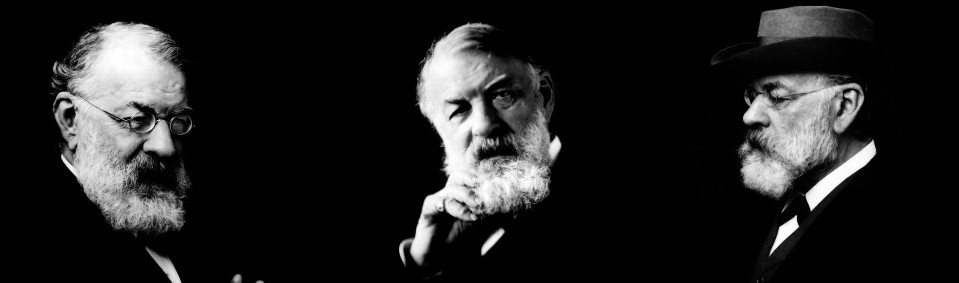
John Ella
Portrait by Charles Baugniet in 1851
Courtesy of Raymond E. O. Ella, author-historian

John Ella, “Mendelssohn and His Protégé,” in Musical Sketches Abroad and at Home, ed. John Belcher, 3rd ed. (London: William Reeves, 1878), 250–253.
13 Monday Jan 2025
Posted in Reminiscences & Encomia
John Ella
Portrait by Charles Baugniet in 1851
Courtesy of Raymond E. O. Ella, author-historian
John Ella, “Mendelssohn and His Protégé,” in Musical Sketches Abroad and at Home, ed. John Belcher, 3rd ed. (London: William Reeves, 1878), 250–253.
06 Monday Jan 2025
Posted in Literature Review

LITERATURE REVIEW
Joseph Joachim, Herman Grimm, and American Transcendentalism:
Encounter with Ralph Waldo Emerson
Styra Avins
In Joseph Joachim: Identities/Identitäten, edited by Katharina Uhde and Michael Uhde, 373–386. Hildesheim; Zürich; New York: Georg Olms Verlag, 2024.
Styra Avins’s chapter, “Joseph Joachim, Herman Grimm, and American Transcendentalism: Encounter with Ralph Waldo Emerson,” examines the profound impact of Ralph Waldo Emerson’s philosophical ideas on Joseph Joachim and his close friend, the German writer and art historian Herman Grimm, during a turbulent period in their early adulthood.
Joachim’s Early Struggles:
Grimm’s Introduction to Emerson:
Emerson’s Influence on Joachim and Grimm:
Specific Examples of Emersonian Influence:
The Significance of Shared Ideals:
Avins’s chapter provides valuable insight into the intellectual and emotional landscape that shaped Joachim’s early career, highlighting the profound impact of Emerson’s Transcendentalist philosophy on both Joachim and Grimm. By exploring their embrace of these ideas, the chapter offers a nuanced understanding of Joachim’s artistic and personal journey, revealing how his quest for self-discovery and creative fulfillment was nurtured by a vibrant transatlantic exchange of ideas.
“A Large, True Heart”
The Sounding of Joseph Joachim’s Friendship with Charles Villiers Stanford
Adéle Commins
In Joseph Joachim: Identities/Identitäten, edited by Katharina Uhde and Michael Uhde, 187–204. Hildesheim; Zürich; New York: Georg Olms Verlag, 2024.
Joseph Joachim is well-documented as having had close associations with many great musicians of the nineteenth century, including Mendelssohn, Liszt, Clara and Robert Schumann, and Brahms. Joachim also had a significant influence on the career and music of the Irish-born composer Charles Villiers Stanford (1852–1924). Adèle Commins’s chapter “‘A Large, True Heart’: The Sounding of Joseph Joachim’s Friendship with Charles Villiers Stanford” explores the friendship between Joachim and Stanford over four decades, from their first meeting when Stanford was a young boy to Joachim’s death in 1907, and is briefly summarized as follows:
Joachim served as a mentor to Stanford throughout his career. In 1876, Joachim advised Stanford to seek training in Germany. Joachim also helped Stanford change composition teachers from Carl Reinecke to Friedrich Kiel. Joachim seems to have viewed himself as a father figure to Stanford, signing an 1899 letter to him “always your affectionate Uncle Jo”. For his part, Stanford relied heavily on Joachim for advice about his career as a musical director and composer, seeking his feedback on musical scores and programming decisions.
Joachim’s frequent visits to England and their shared views on music were important for the development of their relationship. Joachim made his English debut in London in 1844, and from then on, considered England his “second home.” Stanford arranged for Joachim to perform regularly at Cambridge when Stanford was the musical director of the Cambridge University Musical Society. In turn, Joachim was a champion of Stanford’s music, praising it in correspondence with Brahms and requesting that Stanford send him scores so he could arrange performances in Germany. Joachim also helped Stanford in his role as Professor of Music at Cambridge University, sharing his expertise with him by suggesting questions for examinations and providing musical examples.
Stanford wrote an article about Joachim shortly after his death in which his respect for Joachim as a musician, composer, performer, conductor, and friend is evident. Stanford’s autobiography expresses similar sentiments about his friendship with Joachim. Stanford praised Joachim’s traditional tendencies, reverence for the masters, and his purist attitude toward composition – characteristics they both shared. Stanford also admired Joachim’s personality and approach to life, contrasting it with the “large personalities and divas” he often encountered in his work. Stanford appreciated Joachim’s sense of humor and viewed him as a “model of sanity”.
Stanford dedicated his String Quartet No. 5 to Joachim after his death. The dedication to Joachim was more than just an association with a famous musician—it was Stanford’s way of processing the death of his friend. The quartet, the subtitle of which is “In Memoriam Joseph Joachim,” includes musical allusions to Joachim’s Romance Op. 2 No. 1 for violin and piano. The motto theme of the quartet is based on the first phrase of Joachim’s Romance, which Stanford described to Herbert Thompson as “quite unconsciously evolved”. Stanford described the quartet as not meant to be sad because Joachim “was not the sort of man whose memory could be associated with sadness, at least not to me”.
Joachim remained an important influence on Stanford throughout his life. Their relationship evolved over time from family friend to inspiration to mentor to friend and colleague. Stanford and Joachim shared a respect for one another, supported one another, and benefited from a long and healthy relationship.
Joachim in Weimar 1850-1852
Robert Whitehouse Eshbach
In Joseph Joachim: Identities/Identitäten, edited by Katharina Uhde and Michael Uhde, 387–407. Hildesheim; Zürich; New York: Georg Olms Verlag, 2024.
Robert Whitehouse Eshbach’s chapter, “Joachim in Weimar 1850–1851,” delves into a crucial period in Joachim’s early adulthood, examining how his time in Weimar shaped his artistic development and career trajectory.
Eshbach challenges the prevailing narrative that Joachim left Weimar due to artistic disillusionment with Liszt, arguing instead that their relationship was one of mutual respect and admiration during this period. Joachim’s move to Hanover was driven more by career aspirations and the promise of a “large sphere of influence,” facilitated by Liszt himself.
Joachim’s Decision to Move to Weimar:
Early Experiences in Weimar:
Friendship and Artistic Collaboration:
Joachim’s Evolving Relationship with Liszt and the “New German School”:
Drawing on newly discovered concert programs and archival documents, Eshbach provides a detailed account of Joachim’s musical activities in Weimar.
These sources reveal:
Eshbach’s chapter offers a nuanced understanding of a transformative period in Joachim’s life, illuminating the complexities of his artistic journey and his shifting allegiances within the musical world. He sheds light on the crucial role Weimar played in shaping Joachim’s identity as a performer, collaborator, and, ultimately, as a leading figure in the musical landscape of the nineteenth century.
Joseph Joachim and Wilma Neruda
Constructing Musical Identity in Victorian London
Natasha Loges
In Joseph Joachim: Identities/Identitäten, edited by Katharina Uhde and Michael Uhde, 263–278. Hildesheim; Zürich; New York: Georg Olms Verlag, 2024.
Natasha Loges’s chapter, “Joseph Joachim and Wilma Neruda: Constructing Musical Identity in Victorian London,” explores how gender, nationality, class, and connections to famous composers shaped the identities of two successful violinists. The chapter begins by reflecting on the concept of identity and the challenges of interpreting historical sources, particularly for Neruda, who left fewer behind than Joachim.
Joachim and Neruda Shared Similarities in Their Backgrounds and Careers:
However, factors like gender and connections to composers led them down different paths:
Loges examines the broader context of women and the violin in the late nineteenth century. During this period, women’s roles and abilities were hotly debated, and female violinists often faced stereotypes and prejudice. Male violinists like Joachim were seen as strong and intellectual, while women were expected to be graceful and charming, potentially limiting their artistic expression.
To understand how these broader societal views impacted Joachim and Neruda, Loges analyzes their public image through statistical data and press coverage:
A comparison of their repertoire reveals both overlaps and key differences:
Joachim’s “Hungarian” and “German” Identities:
Loges analyzes how Joachim strategically presented different aspects of his identity for specific purposes:
Loges concludes by summarizing the key identity transformations both artists underwent throughout their lives:
By comparing the careers and reception of Joachim and Neruda, Loges’s chapter highlights how gender, nationality, and connections to powerful figures shaped the construction of musical identity in Victorian London.
The chapter also suggests that Neruda’s legacy deserves further exploration and recognition, challenging the traditional focus on Joachim in music history.