
Adolf von Hildebrand: Bust of Joseph Joachim

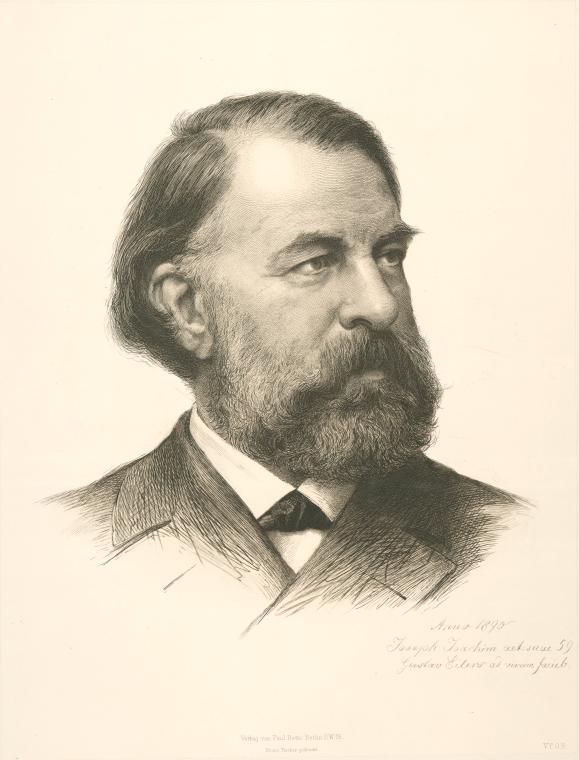
Adolf von Hildebrand’s bust of Joseph Joachim in the Alte Nationalgalerie is a marble portrait dating from 1908–1913, conceived for the foyer of the Königliche Akademische Hochschule für ausübende Tonkunst in Berlin and now held under the inventory number B II 87 c. The work is a design by the sculptor Adolf von Hildebrand (1847–1921), executed by the sculptor Adolf Rothenburger (1883–1972), and was created in Florence, where Hildebrand lived and worked.
The bust forms the central element of a larger commemorative ensemble commissioned by Joachim’s admirers and patrons for the Hochschule’s concert hall foyer, reflecting Joachim’s role as founding director of the institution from 1869 and his stature as a celebrated violin virtuoso, composer, and musician. Early designs from 1909 envisaged a more elaborate monument with an Orpheus relief and fountain arrangement, but Hildebrand progressively simplified the concept; the final 1913 version consisted of a round-arched niche framed by pilasters, the centrally placed bust and an inscription tablet (“JOSEPH JOACHIM / ZVM ANDENKEN / MDCCCCXIII”) flanked by two female figures playing lyre and lute.
For the bust itself, which was conceived to be viewed from below, Hildebrand drew on an earlier, unclothed portrait of Joachim he had modeled in 1899 (now in the Neue Pinakothek, Munich), and reworked it into an “antique” draped form for the Joachim memorial. The bust shows Joachim with a slightly opened mouth and an almost visionary, unfocused gaze, while a dynamically handled lock of hair, together with the folds of the drapery and the raised left eyebrow, subtly breaks the strict symmetry of the overall architectural setting.
The monument commemorates Joachim as a musician who converted to Christianity in 1855 but was born into a Jewish family, and it thus acquired a politically charged status under National Socialism. In 1937 the National Socialists had the monument dismantled and transferred it from the Hochschule in Berlin-Charlottenburg to the care of the Nationalgalerie, where the bust is now preserved as part of the collection.
Information: Yvette Deseyve, Staatliche Museen zu Berlin