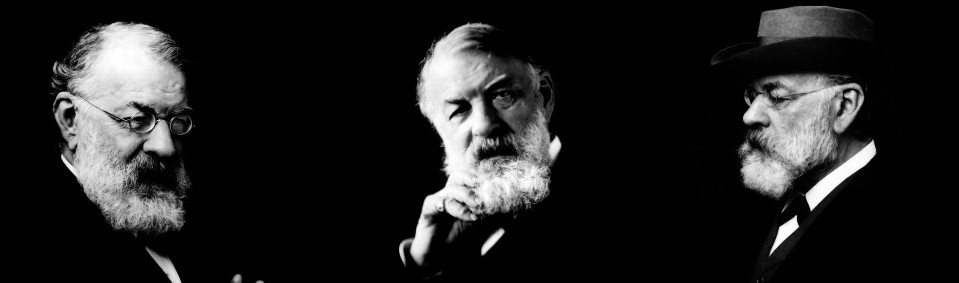

To Dr Joachim
Not for thine art, not for thy heaven-taught hand
Waking again into the breathing present
With tremulous bow the passion of the Past,
Stealing with mild and subtle melody
The speechless speech of soul-dissolving sound;
Not for thy gift, O great Enchanter, but
For that which makes thy gift a sacrament
To all dim hearts, and yearning hearts, and strong.
The Freeborn impulse and the child-like soul
Towards all Beauty and all form and thought:
For this we love thee — and would learn of thee
The inner worship of a listening heart
Seizing in darkest and most saddest themes
The eternal self endowing Harmonies.
— Found amongst Joachim’s uncatalogued papers in the Newberry Library, Chicago.
Poem by Alice Buckton.

“Das Sonnett von Miss Buckton muß ich liegen lassen haben; sei so gut es gelegentlich mitzuschicken. Vergiß es nicht, denn ich schätze es sehr.”
[“I must have left Miss Buckton’s sonnet lying about; be good enough to send it along when you can. Don’t forget it, for I value it very highly.”] (Joachim to his brother Heinrich, Berlin, den 19ten August 1889. Brahms-Institut Lübeck Signatur: Joa : B1 : 540 Inv.-Nr.: 1991.2.89.15)
Letter from Gertrude Joachim recounting a visit by Joseph Joachim to family at Haslemere
August, 1889
University of Edinburgh Library Heritage Collections ADO-2017-0024
***
Uncle Joe’s visit to Haslemere — Aug. 89
J. J. spent a few days with us in Haslemere (August — 89) which will not easily be forgotten.
He had just been to Glasgow where they had made him Dr of L. L. D. & was on his way back to Berlin. I had never known his true self so well before; it was delightful to have him with us as he was then, all unworried by the usual rush of affairs; (wh: come upon him always during his London visit) and simply rejoicing in Nature — It was then that we learnt his true greatness; he took, as always, a vivid intelligent interest in everything — from the wonders of science (which Mr. Buckton laid before him) to the simple games of bowles & crocquet with the children. He admired every flower — each rose — “But, I say! do just look at this one. what a beauty!” But with the thought that rain was threatening & would spoil it, “better pick it” says he, & takes it in to mother. He is also interested in the sweet-pea hedge, pulls off the pods – to help the flowering & goes to feed the donkey with them —
Walking through the fields he would stand still for a moment to feel the wind (blowing boisterously enough) & breathe it in. “Ah! that’s what I like!” and then he must go up to every gate to see the view on the other side. When we get home he teaches Nina (who is not well) a new game of patience — then takes out his “new English fiddle” (just presented on his jubilee)[1] and plays — “anything you like! So we have concertos & sonatas etc. etc. The double Bach concerto with Harold & Haydn trios with mother and me.
It was at this time that Alice Buckton sent him the charming little poem, which he found at breakfast one morning & which gave him real pleasure. In it she touches the secret of his greatness; it is, as she says “the listening soul” which has given him such power over the hearts of his fellow-men.
G. Joachim
Gertrude Joachim was the daughter of Joseph’s brother Henry [Heinrich] (*1825 Kittsee — †1897 London) and Ellen Margaret (Smart) Joachim (*ca. 1844 — †1925). Gertrude married Francis Albert Rollo Russell, the son of British Prime Minister John Russell, and uncle of the philosopher Bertrand Russell. Gertrude’s brother, Harold Henry Joachim (1868-1938), Wykeham Professor of Logic at Oxford University until his retirement in 1935, married Joseph’s youngest daughter Elizabeth (1881-1968). Harold was a talented amateur violinist and an eminent intellectual, educated at Harrow School and Balliol College, Oxford. In his distinguished academic career, he lectured on moral philosophy and logic at St. Andrews University and later at Oxford. Shortly after his death, his student, T. S. Eliot, wrote: ‘to his criticism of my papers I owe an appreciation of the fact that good writing is impossible without clear and distinct ideas’ [letter in The Times, August 4, 1938].
[1] London, 16 April 1889. In honor of the 50th anniversary of Joachim’s concert debut, his friends and admirers presented him with a 1715 Stradivari, “Il Cremonese.”


