Concert: Berlin, February, 1853

The Musical World, Vol. 31, No. 8 (February 19, 1853), p. 110
[Deutsche Übersetzung unten]

__________

jj-initials

BERLIN. — JOACHIM’S FIRST APPEARANCE. — The second concert of the Sternsche Verein was rendered remarkable by the first appearance of the young violinist, Joseph Joachim. His name was already well known, but himself, his artistry, had yet to be appreciated. His birth-place is Pesth; he went early to Leipzig, where, as a boy, he was the favourite of Mendelssohn; was afterwards greatly distinguished by Liszt in Weimar, and is now Concert-master in Hanover. But his genius stands not in need of patronage. He came forward as one of those rare artists who in the performance of a few bars manifest the entire greatness of their genius. This it would seem impossible to do in a simple theme, or in some unimportant passages: but yet it is so. Joachim had not played twelve bars when the most joyful astonishment was shewn on every face. His soft, full tone, the charm of his phrasing, the exquisite refinement of his crescendo and decrescendo, in fact, the enchantment that it was to feel the presence of every quality that is desired in an artist, placed him at once in the first rank in our esteem, and proved him to be, perhaps, the greatest living performer on his instrument. The grand cadence that he introduced in the Beethoven concerto seemed to shew that he could also perform all the modern “tours de force” as well as, and better, than the best bravura players of our time. But he had already shewn a gift in which he is unrivalled, and therefore this test of his powers was hardly needed. His external appearance, the awkward, embarrassed way of presenting himself; the half-shy, half-sulky, and yet so winning physiognomy, all shew that the outward world hardly touches him; that it is his art alone which engrosses him entirely. Even his success — and of course he excited a storm of approval, which from the audience of these concerts, the most intelligent in Berlin, is saying a great deal — he received with indifference.  — Suddeutsche Musik Zeitung.

Screen Shot 2013-12-16 at 11.49.10 AM


BERLIN. — JOACHIMS ERSTER AUFTRITT. — Das zweite Konzert des Sternschen Vereins wurde durch den ersten Auftritt des jungen Geigers Joseph Joachim bemerkenswert. Sein Name war bereits bekannt, aber er selbst, seine Künstlerfähigkeiten, sollten noch geschätzt werden. Sein Geburtsort ist Pesth; früh ging er nach Leipzig, wo er als Junge der Liebling von Mendelssohn war; später wurde er von Liszt in Weimar sehr ausgezeichnet und ist nun Konzertmeister in Hannover. Aber sein Genie braucht keine Patronage. Er trat als einer jener seltenen Künstler auf, die in der Ausführung einiger Takte die gesamte Größe ihres Genies erkennen lassen. Es scheint unmöglich zu sein, dies in einem einfachen Thema oder in einigen unwichtigen Passagen zu tun, aber dennoch ist es so. Joachim hatte noch keine zwölf Takte gespielt, als auf jedem Gesicht die freudige Verblüffung zu sehen war. Sein sanfter, voller Ton, der Zauber seines Phrasierens, die exquisite Raffinesse seines Crescendo und Decrescendo, kurz gesagt, der Zauber, den es bedeutete, die Anwesenheit jeder gewünschten Eigenschaft eines Künstlers zu spüren, stellte ihn sofort in unserer Achtung an die erste Stelle und bewies, dass er vielleicht der größte lebende Interpret seines Instruments ist. Die großartige Kadenz, die er im Beethoven-Konzert einführte, schien zu zeigen, dass er auch alle modernen “tours de force” genauso gut wie, wenn nicht besser als die besten Bravur-Spieler unserer Zeit beherrschen konnte. Aber er hatte bereits ein Talent gezeigt, in dem er unübertroffen ist, und daher war dieser Test seiner Fähigkeiten kaum nötig. Sein äußeres Erscheinungsbild, die unbeholfene, verlegene Art, sich zu präsentieren; die halb-scheue, halb-mürrische, aber dennoch so gewinnende Physiognomie zeigen allesamt, dass die äußere Welt ihn kaum berührt, dass allein seine Kunst ihn völlig in Anspruch nimmt. Selbst sein Erfolg – und natürlich erregte er einen Sturm der Zustimmung, was bei dem Publikum dieser Konzerte, dem intelligentesten in Berlin, viel sagt – empfing er mit Gleichgültigkeit. — Süddeutsche Musik Zeitung.

Joseph Joachim’s Memorial Speech at Robert and Clara Schumann’s Grave, Sunday, 20 May, 1906

Die Musik, Year 5, 4th Quarter, Vol. 20 (1905-1906), pp. 128-129

Translation © Robert W. Eshbach, 2013


jj-initials

Joseph Joachim’s Memorial Speech at Robert and Clara Schumann’s Grave

Sunday, 20 May, 1906

Screen Shot 2013-12-14 at 9.50.41 AM

With reverent homage, we approach the sacred place in which Robert and Clara Schumann rest. Fifty years have passed since the death of the master; just ten years ago Clara Schumann was taken from us. Both remain shining stars in the firmament of art, for creators as well as for performers. The muse of the composer will refresh generations — his songs, his instrumental creations, belong to every corner of the world — and we, too, wish, in these days, to be uplifted by that which he has created. His greatness is to us more eloquent than words can convey. But here we wish especially to remember the noble man, the “lofty” man, as his favorite poet, Jean Paul, called those rare mortals who steadfastly lead a spiritual life, fostering the divine spark in themselves; whose thoughts remain apart from the daily cares of the world, which lies far behind them in insubstantial illusion. And yet, how kindly, how lovingly, this lofty man walked among his fellows; how his supportive nature strove to kindle every spark of genuine, true striving into pure flame. How pure and without envy he was in his admiration of other masters — how he loved Mendelssohn, Brahms — how willingly he acknowledged others, even lesser talents! His writings bear a lasting testimony to this. But also to his love of fairness! He could occasionally be severe, in the consciousness of his pure intentions, and he did not conceal his displeasure. He had an innate, dignified presence that dared not approach anything mean; and yet, at the same time a touching modesty, about which I may be permitted to relate a personal experience from his last years.

Schumann and Clara visited Hanover, and I hoped to give them pleasure with a musical performance. We played quartets for the master, and it was natural that I should choose, among others, a favorite of mine: the F minor quartet by Beethoven. When I thereafter put one of his own magnificent quartets on the stand, seeing this, he gave me his hand in his true-hearted way, and with a typically beautiful expression in his marvelously mild eyes, he said: “No, not this, after what we have just heard!” I shall never forget his cordial tone, and the truth that it conveyed.

Especially here in the town of Beethoven’s birth, it is pleasant to think of this homage. Bonn has honored both great masters with monuments: the one who here entered into the world, and the one who was here delivered into rest. May this remain a symbol to the community to hold Frau Musika in honor, and to work tirelessly for her care. The coming days shall, as we all wish and hope, bear witness to the city’s efforts. But before we leave this sacred place, we wish also to remember, with intimate reverence, the woman who rests by her husband’s side, his Clara, who understood him so completely, and remained his pride and his comfort throughout his earthly pilgrimage. It is uplifting, too, to regard the life of this unique woman, who, in her struggle against a harsh fate, remained strong, never bitter, goodness itself. Robert and Clara will always remain a symbol of purest love; of genuine German spiritual life. All those who had the good fortune to edify themselves in their presence think back on them both with longing. The beauty of these people is purifying for us, even after their passing “much too sacred for their pain.” We wish to pay homage to them by bringing them Rhine flowers — children of spring.

Schumanns


Ehrfurchtsvoll nahen wir huldigend der geheiligten Stätte, in der Robert und Clara Schumann ruhen. Fünfzig Jahre sind hingegangen seit dem Tode des Meisters, vor gerade zehn Jahren war uns Clara Schumann entrissen. Beide bleiben leuchtende Sterne am Kunsthimmel für Schaffende und Ausübende. Generationen wird die Muse des Tondichters erquicken, seine Lieder, seine instrumentalen Tongebilde sind Eigentum aller Weltteile, und auch wir wollen uns in diesen Tagen erheben an dem, was er geschaffen. Es wird beredter von seiner Grösse zu uns sprechen, als alle Worte es vermöchten. Aber hier wollen wir besonders des edlen Menschen gedenken, des hohen Menschen, wie sein Lieblingsdichter Jean Paul diejenigen seltenen Sterblichen bezeichnet, die immer hinieden unentwegt ein Geistesleben führen, den göttlichen Funken in sich fördernd; deren Gedanken dem Weltgetriebe fern bleiben, das weitab in wesenlosem Scheine hinter ihnen liegt. Und doch wie gütig, wie liebevoll wandelte dieser hohe Mensch unter seinen Mitmenschen, wie suchte er fördernd jedes Fünkchen echten, wahren Strebens zu reiner Flamme zu entfachen. Wie rein und neidlos war er in seiner Bewunderung anderer Meister, wie liebte er Mendelssohn, Brahms, wie willig erkannte er andere, auch Geringere an! Seine Schriften geben dafür ein bleibendes Zeugnis. Aber auch für seine Gerechtigkeitsliebe! Er dürfte im Bewusstsein seines reinen Wollens bei Gelegenheit streng sein und verschwieg seinen Unmut nicht. Eine Äussere Würde war ihm eigen, der sich nichts Unlauteres zu nahen wagte; und doch dabei eine rührende Bescheidenheit, für die ein eigenes Erlebnis aus seinen letzten Lebensjahren mitzuteilen mir gestattet sei. Schumann und Clara besuchten Hannover, und ich hoffte, ihnen durch Vorführung von Musik eine Freude zu bereiten. Wir spielten dem Meister Quartette vor, wobei es natürlich war, dass ich u. a. ein Lieblingsstück von mir wählte, das f-moll Quartett von Beethoven. Als ich nun darauf eines seiner eigenen herrlichen Quartette auf das Pult legte und er dies sah, gab er mir in seiner treuherzigen Weise die Hand und mit einem eigentümlich schönen Ausdruck der wunderbar milden Augen sagte er: “Nein, dies nicht, nach dem, was wir soeben gehört!” Ich werde die Herzlichkeit im Ton, die Wahrheit, die daraus sprach, nie vergessen. Es ist wohltuend, gerade hier in der Geburtsstadt Beethovens an diese Huldigung zu denken. Beide grosse Meister hat Bonn durch Monumente geehrt, den hier in die Welt eintretenden, den hier zur Ruhe eingegangenen. Möge dies der Gemeinde ein Wahrzeichen bleiben, Frau Musika in Ehren zu halten, für ihre Pflege rastlos tätig zu bleiben. Die kommenden Tage werden, wie wir alle wünschen und hoffen, Zeugnis für das Streben der Stadt geben. Bevor wir aber diese geweihte Stätte verlassen, wollen wir in inniger Verehrung auch derjenigen gedenken, die an des Gatten Seite hier ruht, seiner Clara, die ihn so ganz verstanden, die sein Schmuck und sein Trost durchs ganze Erdenwallen blieb. Erhebend ist es auch, das Leben dieser einzigen Frau zu betrachten, die im Kämpfen gegen ein herbes Geschick stark, nie verbittert, die Güte selbst blieb. Immer werden Robert und Clara ein Symbol reinster Liebe, echten deutschen Seelenlebens bleiben. Mit Sehnsucht denken alle an die beiden zurück, welchen das Glück ward, in ihrer Nähe sich zu erbauen. Die Schönheit dieser Menschen bleibt läuternd für uns, auch nach ihrem Heimgang ‘viel zu heilig für ihren Schmerz.’ Wir wollen ihnen huldigen, indem wir rheinische Blüten, Kinder des Frühlings, darbringen.

Anne Thackeray Ritchie: Concerning Joseph Joachim (1901)

Concerning Joseph Joachim, From Blackstick Papers, by Mrs. Richmond Ritchie (Anne Isabella Thackeray Ritchie)

Anne_Isabella_Thackeray_Ritchie

Anne Isabella Thackeray Ritchie (1837-1919)

Daughter of William Makepeace Thackeray

Published: The Critic, Vol. 38 (January-June, 1901), pp. 344-349

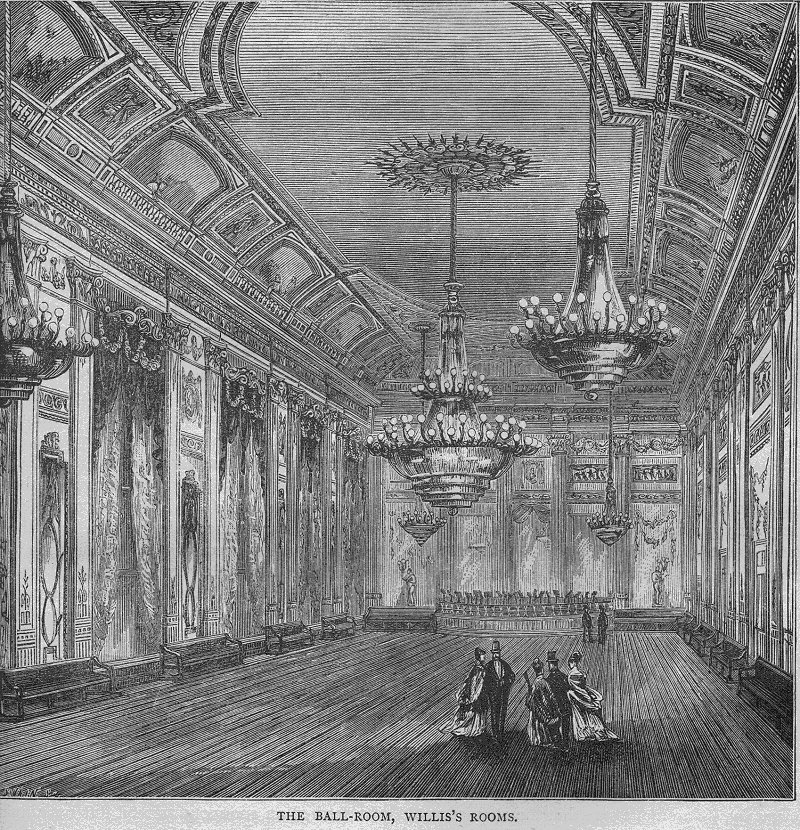
Before life was experience — when it was curiosity, hope, speculation, all those desires with which existence begins — the writer was sent by her father to some musical meetings, which are now so long over that the very rooms in which they first originated do not exist any more. They were Willis’s Rooms, out of St. James’s Street. The Musical Union was the name given to the concerts, which were an admirable invention of Mr. Ella’s to try to raise the standard of music from certain shallow depths to which it seemed gradually to be sinking. There used to be an encouraging picture of a lyre on the programme, and a pretty little sentence — “Il più gran omaggio alla musica sta nel silenzio” — printed in colored letters at the end of it. This, alas! is not yet the universal opinion; promiscuous clap-trap applause and boisterous encores, often before the last notes have died away, being still in fashion.

willis2

The Ballroom, Willis’s Rooms

I believe the Musical Union eventually migrated to St. James’s Hall, but it was in Willis’s cool and stately halls, with the faded velvet seats, that the writer  for the first time heard those familiar and delightful strains of Joachim’s violin, which have so happily sounded on through the latter half of a century of change and perplexity, ever bringing truth and strength and tranquillity [sic] among them.

[…]

$(KGrHqJHJD!E90vmFvMFBPe7,PN5+!~~60_57

Thackeray’s House, No. 2 Palace Green

Currently the Embassy of Israel

Illustration by James S. Ogilvy, 1902

When the writer first personally knew Dr. Joachim, it was in her father’s house at Palace Green. She can remember seeing him coming in one rainy afternoon in springtime, and entering the long light-blue drawing-room. He was a young man then. He was carrying a rolled-up scroll — it was an original score of Beethoven’s which some one had just given him; he showed us the cramped, fierce writing, the angry-looking notes of those calm harmonies. I have never again seen a Beethoven MS.; but the remembrance is distinct of that one, as well as of Joachim’s talk of Beethoven himself, of his mighty self and his protesting nerves, and his impossible difficulties with housekeepers and maids-of-all-work. I have sometimes heard Joachim speak of Schumann with the gentlest affection and reverence, and then of Brahms, — above all of Brahms, and of his meeting with him, one of the greatest emotions of his life.

We had once the happy opportunity of hearing the Joachim quartet at Dresden. It seemed to me then, as now, that I had never heard music before, so beautiful, so exquisite did it sound in that dark, bare Gewandthaus [sic] by the Elbe. It may be a foolish fancy, but to the writer’s mind music never sounds so well as when there is flowing water within reach, whether it is best for those who listen by the Rhine at Bonn or by the Elbe at Dresden matters little; or shall we write of a Romance of Schumann’s, a Concerto of Mozart’s, that were sounding but a few days ago in an old Chelsea house? Joachim was not there, but it was his teaching and inspiration that called forth the harmony. One of his most faithful followers was at the piano; his friend and pupil, Mrs. Liddell, had brought her violin. To the writer, hurrying home afterwards with happy pulses, the very mists of winter seemed to bear the beautiful impression along with them, and the tides of the stream to repeat it.

But perhaps of all places the Hochschule at Berlin is the place we like best to remember Dr. Joachim, and to think of him in the midst of his young pupils, as they sit in serried rows in the concert room. It is a sight to satisfy the touched spectator, for so much that is personal goes into music that to watch the master gravely facing the pupils, and that vast young assembly eagerly attentive and following his guiding hand and glance, seems a revelation to the music itself. Many of the scholars are scarcely more than children, but they play as if they were men and women grown, and they answer in a moment to his sign. Some especial bar or cadence does not go rightly; he makes them repeat it again and again; suddenly, with a flash along the line, they understand correctly, and then the music goes on once more. It was Beethoven’s great concerto for the violin that they were playing when we were there. A few parents and friends sit listening, a daughter of Mendelssohn’s among them. As the countless bows sweep up and down, an up-springing wave of swelling sound seems to spread from one end to the other of the great hall. They young, serious musicians bring the movement triumphantly to its close; the master looks approving; then comes a moment’s pause. “Miss Lenora Jackson will play the solo,” he says, and a girl of sixteen, in a straw hat, with a long plait of hair, steps quickly forward, lays her straw hat upon a chair, tosses back her fair hair, and begins to play.

It was a child playing to the others, a child with perfect taste and sure handling; the young orchestra listened and approved, and when she finished burst into gay, delightful applause. The master joined, too, clapping his two hands. It was a happy moment for everybody.

This Hochschule, as we know, is perhaps Joachim’s greatest interest in life, and to it we owe the spread of his wise and beautiful teaching.

Untitled-1Untitled-2Untitled-3Untitled-4Untitled-5Untitled-6

Obituary: Monthly Musical Record

Monthly Musical Record, Vol. 37, No. 441 (September 1, 1907) p. 193-194.

N. B.: Obituaries are posted for historical interest only, and should not be taken as sources of accurate biographical information.


jj-initials1-e1395761217629

Joseph Joachim, 1831-1907

The eminent violinist passed away on August 15. Paganini, Ernst, De Bériot, Wieniawski, and many other violinists achieved celebrity. Dr. Joseph Joachim, however, was not only a great violinist, but a great and serious artist. At his first appearance at the Gewandhaus, sixty-four years ago, he played Ernst’s Fantasia on themes from Rossini’s “Otello,” and this again was the show piece which he performed in the following year, when he made his début in London, viz., at a concert in Drury Lane Theatre on March 28, 1844. But before two months had elapsed, his rendering of the Beethoven violin concerto at a Philharmonic concert (May 27), under the direction of Mendelssohn, at once showed that the fame of a mere virtuoso would not satisfy him. He was then only a lad of fourteen [sic], but he had been under good guidance: Gottfried Preyer, under whom he studied theory and composition at Vienna; his cousin, Fanny Figdor, a gifted amateur pianist, who took great interest in him; the elder Hellmesberger and Boehm, with whom he studied the violin. Yet probably the strongest influence was that exercised by Mendelssohn, and it is only right to mention that it was owing to the cousin named above that Joachim made the acquaintance of the composer, when the latter was at the zenith of his fame. Fanny Figdor, who was living in Leipzig, heard that Boehm recommended Paris as a city in which the lad would be able to develop and display to advantage his gifts, but she expressed the strong opinion that the recently-founded Leipzig Conservatorium was the best place for him.

Mendelssohn’s influence was for good; Joachim had no doubt already studied the music of Bach and Beethoven, but he must have been strongly moved by Mendelssohn’s enthusiastic admiration for these masters. That influence, however, would only have been transitory had Joachim not understood, or rather felt, its value. We live in an age in which Mendelssohn’s art-work is often unfavourably criticised, but no one has doubted his sincere reverence for the two composers named. Joachim soon lost his great friend’s advice. After the death of Mendelssohn in 1847 his surroundings were of a very different kind, for he went to Weimar, where Liszt was trying to convince the world that Wagner was a genius. Liszt’s strong personality and the music of “Lohengrin,” with which Joachim, who was leader of the theatre orchestra, became familiar, made a convert of the young musician. The latter soon made the personal acquaintance of Wagner, and expressed the hope that when the “Ring” was produced he might take part in it. It is useless to speculate as to what would have been the future of Joachim had his zeal for the “new” music continued; but now, looking back at the long career just closed, it really seems as if what happened was, as regards the art itself, and also Joachim, for the best.

After a time the Weimar life became distasteful to the young artist — he was still in his teens when he first went there. Wagner’s music was not the cause of estrangement, for although, later on, he objected to the art principles of the new school, he recognized to the end of his life the genius of Wagner. Liszt’s music was the special stumbling-block. For a time the two remained friends, but in 1857 there came a rupture, and in a letter which Joachim wrote to Liszt he frankly declared that his Symphonic Poems “contradict everything  in the works of our great masters, on which my mind has been nurtured since the days of my early youth.” This was a bold letter for a rising artist to write, not only to a man about double his age, but to one who as a pianist had achieved extraordinary fame. It showed, however, strength of character.

Joachim left Weimar and became leader of the orchestra at Hanover. And now he came under two new and strong influences. He made the acquaintance of Schumann and of a young composer named Johannes Brahms. The friendship with Schumann was soon broken off, like that with Mendelssohn, by death, but that of Brahms lasted for well-nigh half a century — lasted, indeed, until in 1897 he saw the composer lowered into his grave.

Joachim will be remembered by the public generally for his magnificent performances of Bach’s “Chaconne,” and of the concertos of Beethoven and Mendelssohn; for these interpretations were certainly unique. But he became the chief, nay, at one time almost the sole, propagandist of a new school, which may be termed the Schumann-Brahms school. At the present day it is difficult to understand the long prejudice against Schumann; in the case of Brahms it is not so difficult, because, through an unfortunate event, the latter was placed at the head of a party in opposition to Wagner, and as the influence of the latter gradually increased; and as Wagner himself personally disliked Brahms’s music, the recognition of Brahms’s merits was long delayed. The steady determination of Joachim to perform the works of these two composers in spite of the indifference of the public and the hostile attitude of the press, offers the strongest evidence of his disinteredness and of his judgment. He might easily have achieved fame as a virtuoso; he might have won immense fortune; he preferred to honour the great classical masters, and to help to make known the works of gifted contemporaries.

Mention has been made of Joachim’s first visit to England in 1844. He came again in 1852, and soon after that he visited this country annually until last year. His first appearance at a Popular Concert was on May 16, 1859, and in 1904 a memorable concert was given at Queen’s Hall in commemoration of the artist’s diamond jubilee — the sixtieth anniversary of his first appearance at the Philharmonic Concert mentioned above. It was then that his portrait, painted by Mr. Sargent, was presented to him by Mr. Balfour, then Prime Minister.

There are two other noteworthy facts to record in the life of Joachim — his direction for over thirty years of the “Königliche Hochschule für Musik” in Berlin, and the formation in 1869 of the Joachim Quartet, the original members of which were Joachim, Schiever, De Ahna, and Wilhelm Wirth.

Joachim’s pupils, many of whom have distinguished themselves, and innumerable friends throughout the Continent and also here in England, will mourn the loss not only of a great artist, but of a man for whom they entertained both respect and love.

At the funeral on Monday, August 19th, in the cemetery of the Kaiser Wilhelm Memorial Church, Berlin, there were deputations from various art institutions. The bodies of Joachim and his wife now rest in the same grave.

Concert: Vienna, November 15, 1841

Allgemeine Wiener Musik-Zeitung, Vol. 1, No. 139 (November 20, 1841) p. 582.

__________

Large Musical-Declamatory Academy

Sunday, November 15, 1841 in the k. k. Hoftheater near the Kärntnertor, for the benefit of the Institute of the Merciful Sisters, sponsored by Mr. Jos. Wache, Agent of the Institute.

Joseph Joachim’s playing and performance of [Charles de] Beriot’s Adagio and Rondo truly surprised us, and fully justified anew our conviction and our often-made claim about the soundness of Herr Prof. Böhm’s teaching method; for here, everything was accomplished — even the most audacious expectations that one can ask of an 8-to-9-year-old [Joseph was 10] — and the word virtuoso, if we wish to assign it to the little violinist, would not be an arrow shot too high above the target. Without question, one cannot, and will not, expect and demand from a child performing a composition of Beriot the power of tone, the subjectively nuanced interpretation, the firm, bold playing of a man; but his tone is pure, strong, his bowing noble and correct, his staccato astonishing, especially with a short bow, his harmonics pure and secure; and there was not — and this is truly all that one can say here — a false tone to be heard in any passage; neither in the runs nor in the double stops. Herr Professor Böhm has already trained a number of outstanding pupils, and if Joachim follows in the path that has been set out for him, we may confidently predict the highest for him; he should beware of arrogance; otherwise false paths are unavoidable, and — the return to, and progress along, the path of genuine art is very difficult. Experientia docti — !

__________

Große musikalisch = declamatorische Akademie

Sonntag den 15. November 1841 im k. k. Hoftheater nächst dem Kärnthnerthore, zum Besten des Institutes der barmherzigen Schwestern, veranstaltet von Hrn. Jos. Wache, Agenten dieses Institutes.

[…] Joseph Joachim’s Spiel und Vortrag des Beriot‘schen Adagio und Rondo hat uns wahrhaft überrascht, und auf’s neue unsere Überzeugung und unseren oftmaligen Ausspruch über die Gediegenheit der Lehrmethode des Hrn. Prof. Böhm aufs vollkommenste gerechtfertigt; denn hier ward alles geleistet, was selbst die kühnste Erwartung von einem 8 bis 9 Jahre alten Kinde fordern kann, und das Wort Virtuose, wenn wir’s schon dem kleinen Violinisten beilegen möchten, wäre kein über’s Ziel hinausgeschossener Pfeil. Daß man die Kraft des Tones, den subjectiv=nuancirten Vortrag, das feste, kühne Spiel eines Mannes bei einer Beriot‘schen Composition von einem Kinde niemals erwarten und fordern kann, und wird, ist zweifelsohne; allein der Ton ist rein, stark, die Bogenführung edel und richtig, sein Staccato, besonders im kurzen Bogen, überraschend, sein Flageolett rein und sicher, und es ließ sich — und dieß ist doch wahrlich alles was man hier sagen kann, in gar keiner Passage ein falscher Ton, weder in den Läufen noch in den Doppelgriffen, vernehmen. Hr. Professor Böhm hat bereits mehrere treffliche Zöglinge gebildet, und folgt Joachim der ihm vorgezeichneten Bahn, ist von ihm das Höchste mit Zuversicht zu erhoffen; er hüte sich aber vor Dünkel, sonst sind Abwege unvermeidlich, und — der Rück= und Weiterschritt auf dem echten Kunstpfad sehr schwer. Experientia docti — !

___________

Screen Shot 2013-12-04 at 8.26.38 PM