A Prodigious Fellow

© Robert W. Eshbach, 2013

Previous Post in Series: London Philharmonic Debut


JJ Initials

A Prodigious Fellow

             Joseph found himself in constant demand for the remainder of his stay in London. On Monday June 3, “the marvelous little Joachim” played at Mr. Hausmann’s soirée at 55 Wimpole Street, where Louise Dulcken was among the other performers. Adult appearances required an adult wardrobe. Ignaz Moscheles’ son Felix, [1] who was two years younger than Joseph, recalled: “after singing at our house, Mendelssohn wanted to take [Joachim] to a musical party; a pair of gloves were deemed necessary to make him presentable, and we two boys were sent out to get them; we had a walk, and a talk besides, and I remember thinking what a nice sort of sensible boy he was; no nonsense about him and no affectation; not like the other clever ones I knew. The gloves we bought in a little shop in Albany Street, Regent’s Park, and as these were the first pair of English gloves that Joseph wore, I duly record the historical fact for the benefit of all those who have at one time or the other been under the spell of the fingers we fitted that evening.” [i]

“Evening concerts of Classical Instrumental Music at Radley’s Hotel, Bridge Street, Blackfriars, this evening,” ran an advert in the Times on June 5th. “Mr. Purdy has the pleasure to inform his friends and the public that Dr. Felix Mendelssohn Bartholdy has kindly consented to play his Trio in D minor for pianoforte, violin, and violoncello; and that Master Joachim will lead two quartetts, and play a solo on the above named night, supported by Messrs. Case, Hill, and Hancock.” This was a formidable program. The “quartetts” were Mozart’s Quartet in d minor, K. 421, and a reprise of Beethoven’s treacherous “Rasumovsky” Quartet in C Major, op. 59, no. 3. The solo was again Ernst’s Othello Fantasy. That evening’s trio performance left a deep impression on Joseph, not only of Mendelssohn’s memory and sang-froid, but also of his character. “It so happened,” he later recalled, “that only the violin and violoncello parts had been brought to the concert-room, and Mendelssohn was rather displeased at this; but he said, ‘Never mind, put any book on the piano and someone can turn from time to time, so that I need not look as though I played by heart.’ Nowadays, when people put such importance on playing or conducting without a book, I think this might be considered a good moral lesson of a great musician’s modesty. He evidently did not like to be in too great a prominence before his partners in the Trio. He was always truly generous!” [ii]

Amidst this whirlwind of performance, Joseph somehow found time for study. Mendelssohn, who was directing his education, placed a great emphasis on his compositional work, and insisted as well that he not neglect his general studies and physical culture. “So thoroughly grounded seems to be this young professor in musical science, as well as in executive skill —,” wrote Henry Chorley, “so liberally gifted in the essentials of head, heart, and health — that we see no limit to his future career; and if the creative faculty develop itself, shall look for a great artist in him, in the most comprehensive acceptation of the term.” [iii]

No doubt on Mendelssohn’s recommendation, Joseph took lessons in composition and orchestration from the thirty-one-year-old George Macfarren, at Macfarren’s flat on the corner of Oxford and Berners Streets. Lady Macfarren later recalled their first meeting at Joseph’s uncle Bernhard Figdor’s home at Tulse Hill: “It was a grey, warm afternoon, and I saw a tall, [2] genial youth, who I was told was a great violin player. I had a long game of ball with him, several times resumed, on the lawn, whilst Professor Macfarren and his uncle walked up and down on the paths at the sides of the garden.” [iv]

 Screen shot 2013-07-03 at 5.01.00 PM

Album leaf: “for Joseph Joachim in remembrance of his
friend G. A. Macfarren, London 20 May 1844” [v]

Though not an enthusiastic advocate of Macfarren’s theories, Mendelssohn was nevertheless generous in his support of Macfarren, whose overture Chevy Chase he had performed at the Leipzig Gewandhaus on October 26 of the previous year. [3] Macfarren was an engaging and original teacher, with a “quaint, chatty” tutorial style. While still in his mid-twenties, he had been appointed professor of harmony and composition at the Royal Academy of Music. He founded the Society of British Musicians in 1834 and the Handel Society in 1844. In 1845, he would assume conducting duties at the Royal Opera House, Covent Garden.

A proponent of Alfred Day’s novel and controversial harmonic theory, Macfarren was discovered one day in 1847 by an official of the RAM teaching from an unauthorized text. “Holloa!” cried the visitor. “What is this book? We cannot have any new-fangled notions here.” [vi] A conference was called with Macfarren’s former teacher Cipriani Potter (then director of the school), William Sterndale-Bennett and three others. After a spirited discussion, Macfarren resigned his position, “rather than continue to teach contrary to his convictions.” Potter eventually recalled Macfarren to his old position, telling him: “come back and teach anything you please.” In the words of a friend, “better counsels prevailed; not the acceptance of Day’s theory, but the wise persuasion that it was better to have a musician of unquestioned competence and power to teach that which he believed from his own out-thinking, than that any old traditions should be so stereotyped in an educational system or curriculum as to bar all free thought, and to alienate from the Institution one whose worth was so fully recognised.” [vii]

Macfarren gave Joseph his first instruction in composing for orchestra. [viii] Whether he taught Joseph using Day’s theories is not known, but it seems likely that he did. Day’s Treatise on Harmony was begun at Macfarren’s instigation in 1840 — though it was not published until 1845.

On Friday, June 7th, Joseph was among the performers at a concert in the Princess’ Concert Room, co-sponsored by Macfarren and the critic for the Musical World, James William “Jimmy” Davison. For Joseph, this program, too, amounted to a recital. As originally conceived, it was to have included a performance by W. H. Holmes of Macfarren’s Second Solo Sonata in A Major, Ma Cousine. When Holmes fell ill, Macfarren asked Mendelssohn to step in. Mendelssohn demurred:

Felix Mendelssohn to George Macfarren [ix]

4, Hobart Place, Eaton Square

June 6th, 1844.

My dear Sir,

I need not tell you with how great a pleasure I would have played your Sonata to-morrow, if I possibly could—for I hope you know this. And you also know that it is with true and sincere regret that I must say I am not able to undertake the task which you propose me. During the bustle of the last weeks I have not yet been able to become acquainted with your Sonata; the whole of this day and of to-morrow morning is taken up with different musical and unmusical engagements, and accordingly I would hardly have an hour till to-morrow night to play your Sonata over. This I cannot think sufficient, and I would not be able to do it justice in my own eyes. Do not misunderstand me and take this for false modesty; I know very well that I should be able to-morrow to play it through without stopping, and perhaps without wrong notes; but I attach too much importance to any public performance to believe that sufficient, and unless I am myself thoroughly acquainted with a composition of such importance and compass, I would never venture to play it in public. Once more I need not tell you how much I regret it, for you must know it very well.

Mr. Davison told me the Concert was now to begin with my Trio: I shall therefore be punctually with you to-morrow evening at half-past eight. I beg you will arrange about having a good piano of Erard’s at the room; they know there already which I like best.

Always very sincerely yours,

Felix Mendelssohn Bartholdy.


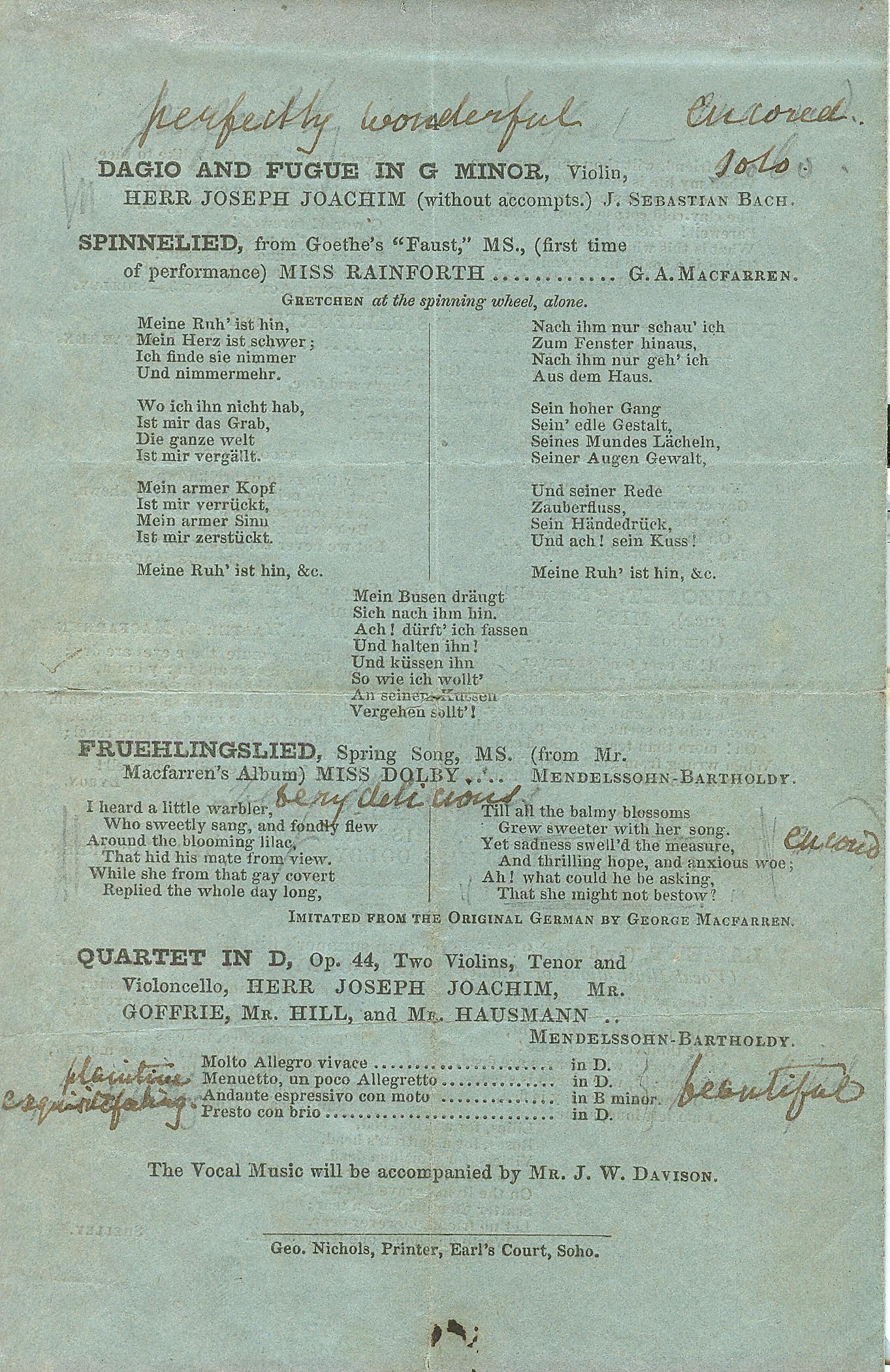
The room was filled — “the presence of the most eminent musicians and dilettanti giving a character and importance to the audience not often observable apart from the Philharmonic.” The concert opened with a performance of Mendelssohn’s D minor Trio, [4] performed by Mendelssohn, Joachim and Hausmann “with a spirit, freshness, and brilliancy perfectly inapproachable by any other set of artists. The andante and the scherzo were encored.” [x]  Later, Joachim, substituting for the ailing Holmes, played J. S. Bach’s Prelude and Fugue in G minor for violin solo (BWV 1001), after which he led a performance of Mendelssohn’s quartet in D, op. 44.

“The adagio and fugue in G minor, which Joachim volunteered, were delivered to perfection, and met with a unanimous encore,” reported the Morning Herald. “The more frequently this gifted lad plays the more extraordinary does he appear. Boy as he is, it does not seem that he has more to learn. He has all the energy, feeling, and judgement of the matured musician, and certainly he does not lack those acquirements of hand, which have hitherto been supposed attainable only by years of persevering practice. The vigorous fugue of old Bach he gave with the most complete readiness and precision; never faltering for an instant, or clouding the development of the subject in its interlacements by confused or insufficient workmanship. As a mere manual performance it was remarkable; but there was a fine intelligence pervading every bar in the highest degree gratifying, the more so as it was quite unlooked for.” [xi] The reviewer for The Polytechnic Review and Magazine, who took a decidedly negative view of the entire concert, demonstrated the risk of programming Bach’s solo works in the age of opera fantasias: “Young Joachim, in obedience to the Genius of Dulness, who seemed to have made these concerts the objects of her most particular care, played a dull tiresome fugue from one of Bach’s Violin Studies. The playing was marvellously good, and the music miraculously flat.” [xii]
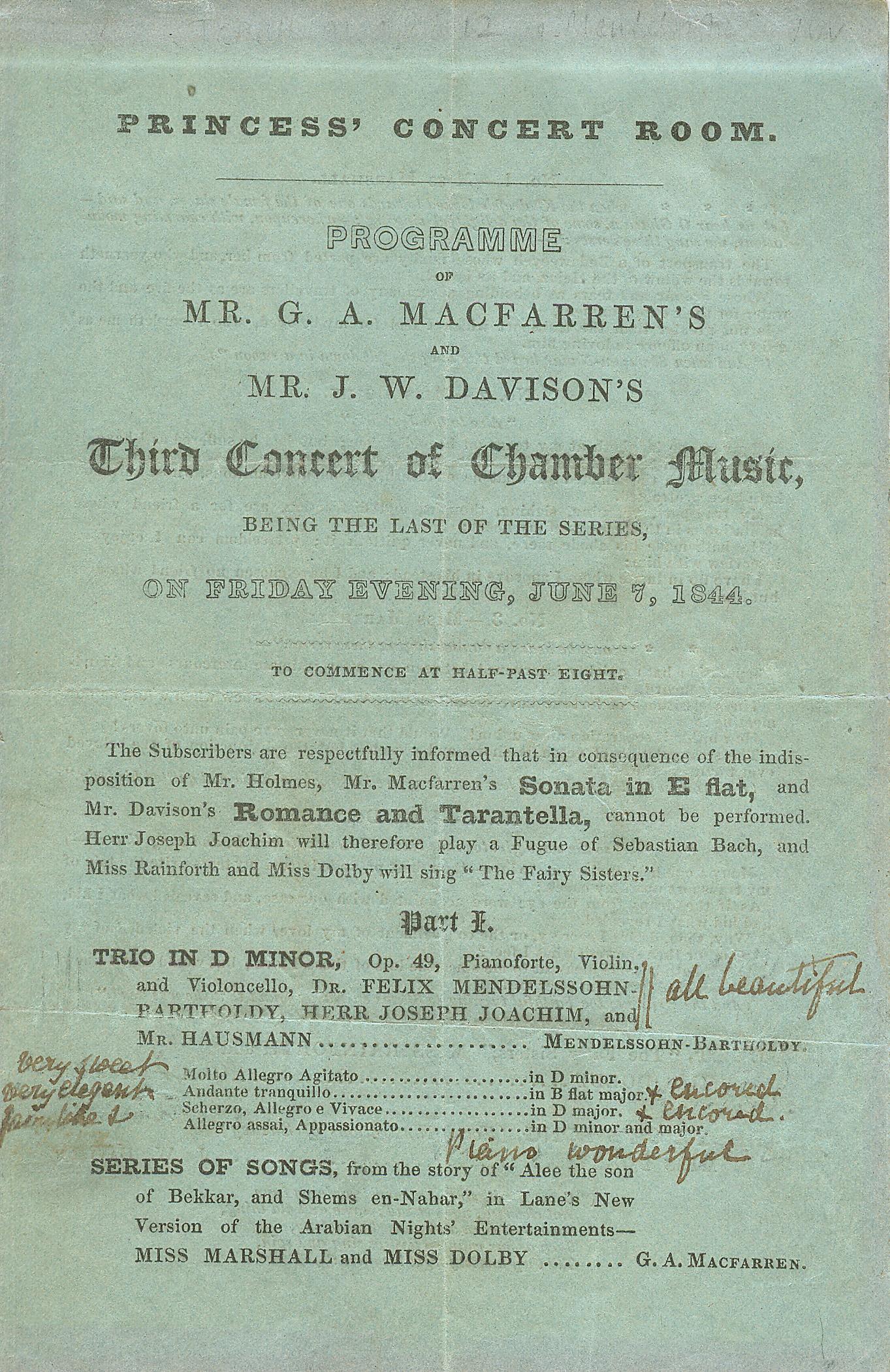
Scan1Scan2

[xiii]

             Better than any review was a letter from a Miss Robinson, daughter of the Venerable Archdeacon Robinson, addressed to a Mr. Wood, and later forwarded to Macfarren:

                                                                                    14, Euston Square

                                                                                    June 8 [1844]

My dear Mr. Wood,

How much have we to thank you for! The Concert last night was a rare treat, and the boy Joachim is beyond my poor powers of description. He is ‘a marvel and a mystery’ if ever one existed. How I wish you could have heard him! It is impossible otherwise to form a notion of his power. Papa and I were convinced that, however wonderful, it seemed impossible that such a child could equal or even approach a master of the art like Ernst; but we came away satisfied that the impossibility was accomplished. I should say Joachim is fully equal to Ernst both in power of expression and execution. The firmness and delicacy of his touch (is that a right epithet for the violin?) and the taste with which he applies both, is something quite mysterious when you remember what a mere child he is. There is no accounting for it by any method of ordinary reasoning. He has been endowed with the gift, ‘the faculty divine,’ and that has lifted him above all education.

In case you have not seen him I will just give you an idea of his appearance. He is rather short for his age, and has shaggy hair which completely covers his brow and shades his eyes, which are deep set with an earnest sort of gaze in them, the eyebrows being slightly contracted, which throws an expression of thought and intellectual grasp over his countenance. He has a most genius-like awkwardness about his figure and great simplicity and childishness of carriage. His bow of acknowledgment to the thunders of the room seemed rather to say ‘do be quiet and let me be at it again,’ than the usual ‘I am much obliged to you’ air of a bow. He just gave it as a necessary quietus, and no more. His enthusiasm in playing was intense; in the pieces, at which he played seated, he would every now and then get up and every nerve appeared to thrill as the music burst into form at his spell, while at some of the soft wailing tone which his little instrument sent forth, he bent his head close to it and shut his eyes till you might well fancy it was a spirit breathing out his plaint into his master’s ear. His face is very pale and perfectly free from vanity or consciousness of being anything extraordinary; altogether, he is a very interesting looking child. So much for his personal appearance, which I hope has not been a tedious detail. I always, myself, like to have a picture to look at, and so I tried to give you one.

What am I to say of that ‘Boy-God’s’ solo and the quartett? They were both perfectly wonderful. The Fugue, played without notes, was delicious, and the extreme grace with which he managed the reiterations surprising. I thought the house would have been down with the shouting ‘again, again, encore,’ and the clapping and thumping. In the quartett he seemed to be the master-spirit of the thing and, without the slightest effort, accomplished the most difficult passages. His shake is beautiful, clear and distinct; I thought Ernst was matchless there, but this boy is his equal. The Concert was crowded to excess, so much so that even the orchestra up to the top was thronged. [xiv]


Macfarren responded:

                                                                        73, Berners Street [xv]

                                                                        Friday.

 My Dear Sir,

I return you Miss Robinson’s sprightly and clever letter with thanks for its perusal.

Joachim is surely a prodigious fellow — I do not mean a ‘prodigy.” This is a term that has been so abused that we conventionally understand it as a mountebanking charlatan. I assure you that on his instrument, in his general capacity for music, and in his mental powers in matters unconnected with the art, he is at once one of the most minded and most interesting persons I have ever known. It has been my great pleasure to be very intimate with him during his stay in London, and I have had perhaps better opportunities than most people of estimating his transcendent talents, for he has played my music and I have given him lessons during his sojourn. I speak therefore most advisedly, and I am most delighted to find that I am not alone in my opinion, but that he is generally understood and appreciated.

Sincerely yours,

G. A. Macfarren
G. H. Wood, Esq.


Special dispensation was no longer necessary for Joseph to appear with the Philharmonic. At the beginning of his final week in England, he was invited, at Prince Albert’s request, to appear in the Sixth Philharmonic Concert, playing Ludwig Maurer’s Sinfonia Concertante, op. 55, for four violins, together with three veteran performers: his hero, Heinrich Wilhelm Ernst, Henry Blagrove, and Paganini’s protégé, Camilo Sivori. The concert, which also included Beethoven’s 5th Symphony, arias by Mozart and Bellini, William Sterndale Bennett’s Overture The Naiades, and a reprise of Mendelssohn’s incidental music to A Midsummer Night’s Dream, was to be attended by Queen Victoria, Prince Albert and their guest, the King of Saxony. [xvi]

Ernst, who had been in precarious health, was disinclined to play, and at first refused. At Mendelssohn’s request, he reconsidered, but only on the condition that he should play the first violin part. Sivori then objected, proposing that they draw lots to determine parts. Hearing this, Ernst again refused to participate. The French virtuoso Prosper Sainton was persuaded to fill in for Ernst, and it seemed as if the “show-lion quatour” was again en train. “At the rehearsal, however,” reported the Musical World, “when the four violinists were called upon, little Joseph Joachim, a good artist and true, seeing that Ernst was not present, was not to be persuaded by any argument to ascend the orchestra. He declared, and properly so, that he had only acceded to make one of the quartet on the understanding that Ernst was to lead it — and that though he would play any where, or any thing under the auspices of that great violinist, he would by no means place himself under the same control with any one else. Nothing could be more straight-forward than this, and the little violinist was as firm as a rock — not to be shaken. At last the directors were compelled to ask Mr. Willy to play; and Mr. Willy, with his usual good nature, consented. So that on Monday we had the advantage of hearing two first-rate English violinists (Blagrove and Willy), one first-rate Italian and one first-rate Frenchman (Sivori and Sainton), perform, before an English audience, one of the most supreme pieces of rubbish that ever was penned to flatter popular prejudice or tickle uncultivated ears.” [xvii]

On that Monday afternoon, Joseph played instead at Madame Dulcken’s soirée in the Great Concert Room of the Italian Opera House. According to the Musical World, “Mad. Dulcken’s soirée, in honor of Dr. Mendelssohn, was brilliantly attended, by amateurs and artists of the highest distinction. The Doctor delighted the company by several performances on the piano, and little Joachim, Goffrie, Hill, Hausman, Brizzi, Miss Rainforth, (who sang the Reislied, [sic] ‘Journey song,’ to the accompaniment of the great composer) and Madame Dulcken herself, helped to make up a musical treat of the most intellectual kind.” [xviii] That same week “the extraordinary little Joachim” also appeared in Mr. John Parry’s Concert and was present at the final dinner of the Melodists club, at which Ernst and Jacques Offenbach (on ‘cello) played solos.

Screen shot 2014-10-17 at 9.00.12 AM

London Standard, June 17, 1844, p. 3

On June 14, [5] “Master Joachim” made his final London appearance in a morning gala of gargantuan proportions, promoted by Julius Benedict, in the Great Concert Room of Her Majesty’s Theatre. Here again, the boy was in the most illustrious company. An advance notice boasted: “The giant concert of this most amiable man and distinguished musician takes place to-morrow morning… Not a name of any ability is absent from the programme — and we cannot doubt that the attendance will be as brilliant as the high merit of the beneficiaire and the unrivalled pretensions of his programme so richly deserve.” [xix] The distinguished roster of performers included, among others, Mendelssohn, Thalberg, Dulcken, Sivori, Lablache, [6] Staudigl, Costa, Parish-Alvars and Jacques Offenbach. Thirty-nine pieces were presented. Joseph played the Othello Fantasy “(by desire) […] (His last appearance in England.)” [xx]

That evening, two weeks prior to his 13th birthday, Joseph left for Leipzig with the English public at his feet. In his baggage was a gift from Thomas Alsager: a score of the Beethoven quartets. [xxi] The Musical World reported his departure:

JOSEPH JOACHIM left London on Friday night, by the Hamburgh steamer, for Leipsic where he goes to study under Hauptman, the contrapuntist. Query:— does he better himself by leaving Macfarren? But there are other educational reasons. Little Joseph’s departure will cause many a heart-pang. He is as much loved for his amiability, as for his most wonderful talent. He has no reason, we hope, to feel discontented with his reception in England. [xxii]

hp_scanDS_77251730335 copy

Joseph Joachim acknowledges the audience, London, 1844

This album-leaf is the joint effort of Julius Benedict and Felix Mendelssohn.

The drawing is probably Mendelssohn’s, and shows the young violinist from the conductor’s perspective. Note the proper accentuation of Joachim’s name, which is pronounced in the Hungarian manner: JOachim. [xxiii]


Joachim, little Joachim
Fare well, Fare well
and come back to us very soon
come soon, come soon back to us.
Mendelssohn says he can’t write any more
nothing, nothing. What a Malheur.
Joachim, little Joachim,
don’t take it badly of me.
Since he won’t help,
it’s all over with my song.
I search and search in vain. Ei. ei. ei.

Joseph was to return as he had come — alone. Mendelssohn’s old friend Karl Klingemann escorted the youth safely to the ship. There, Joseph was entrusted to the supervision of the Hanoverian courier. The journey quickly became a nighmare. The weather was violent. The storm-tossed ship lost its mainmast, and was badly damaged. With the courier nowhere to be seen, the ship’s captain intervened to care for the seasick child. At Cuxhaven, Joseph eventually took it upon himself to find his protector. When he opened the cabin door, he found the courier lying dead on the floor with his throat slit.


Joachim’s English Repertoire March 28 — June 14, 1844 included at least the following works:

Bach Adagio and Fugue in G Minor, BWV 1001
Beethoven Violin Concerto, Op. 61
Beethoven Quartet Op. 59, No. 3
Beethoven Quartet in Bb Op. 130
Beethoven Quintet in C
de Bériot Andantino and Rondo Russe (from the Concerto No. 2 in B Minor, op. 32)
Ernst Othello Fantasy
Haydn Quartet Hob. III: 70
Maurer Sinfonia Concertante, Op. 55 for four violins (prepared but ultimately not performed)
Mendelssohn Quartet in D Major, Op. 44 No. 1
Mendelssohn Trio in D Minor
Mozart Quartet K 421
Mozart Quartet K. 516
Spohr Concerto No. 8 in A Minor, Op. 47, Gesangsscene


Next Post in Series: After the London Debut: Tharandt


[1] Felix Moscheles was Mendelssohn’s godson.

[2] Perhaps Lady Macfarren was very short. Joachim, in any case, was not tall.

[3] “Macfarren’s theoretical system […] may have led him to write unusual chords and progressions,” wrote Macfarren’s friend Henry Banister; “certainly it led him to use unusual notation. Mendelssohn did not argue these matters with him, it may well be believed; but, when playing from Macfarren’s manuscript, would, on coming to such cases, cry out, in that quick way which is not to be forgotten by those who once heard it: ‘Mac, Mac, do you mean this?’ On an affirmative answer being given, he would simply say, ‘Very well, all right, go on,’ to the rest of the performers.” [Banister/MACFARREN, p. 81]

[4] The first English performance of the trio had occurred the previous year, also in one of the Davison-Macfarren concerts. The performers were Sterndale Bennett, Henry G. Blagrove and Charles Lucas. [Banister/MACFARREN, p. 98]

[5] Not May 19th, as stated in Moser/JOACHIM 1901, p. 55.

[6] Luigi Lablache (1794-1858) was the great bass singer of the age, and a great fan of Joseph’s violin playing. Moser relates how, whenever Joseph played something particularly well, “Lablache’s resonant voice” was sure to be heard from a corner of the room, with a loud and encouraging “serr gutt.” [Moser/JOACHIM 1898, p. 51] During Joseph’s English sojourn, Lablache on one occasion backed out of a previous performance commitment, so that he could appear on the same program with Joseph. “Joachim plays, then I sing,” he said. [Unpublished MS, British Library: Joachim Correspondence, bequest of Agnes Keep, Add. MS 42718, p. 199.]


[i] Moscheles/FRAGMENTS, p. 25.

[ii] The Musical Times, Vol. 45, No. 736 (June 1, 1904), p. 377. See also: Moser/JOACHIM 1901, p. 101.

[iii] The Musical Times and Singing Class Circular, Vol. 35, No. 616 (June 1, 1894), p. 383.

[iv] Lady Macfarren, Recollections of Dr. Joachim, The Musical Times, Vol. 48, No. 776 (Oct. 1, 1907), p. 662.

[v] Lübeck: Brahms Institut, Sig. ABH: 6.3.96

[vi] Banister/MACFARREN LIFE, p. 70.

[vii] Banister/MACFARREN LIFE, p. 70.

[viii] Banister/MACFARREN, p. 103.

[ix] Banister/MACFARREN, pp. 102-103.

[x] Review of Messrs. MacFarren and Davison’s Concerts of Chamber Music (From the Morning Herald.)  Friday, 7 June, 1844, Quoted in The Musical World, vol. XIX No. 24 (June 13, 1844), p. 196.

[xi] Review of Messrs. MacFarren and Davison’s Concerts of Chamber Music (From the Morning Herald.)  Friday, 7 June, 1844, Quoted in The Musical World, vol. XIX No. 24 (June 13, 1844), p. 196.

[xii] The Polytechnic Review and Magazine, George G. Sigmond, M. D., (ed.), London: John Mortimer, (July-December 1844), p. 77.

[xiii] Program scans courtesy the collection of John and John Anthony Maltese.

[xiv] F. G. E./JOACHIM, pp. 579-580.

[xv] F. G. E./JOACHIM, p. 580.

[xvi] See letter in British Library: Joachim Correspondence, bequest of Agnes Keep, Add. MS 42718, p. 199.

[xvii] The Musical World, vol. XIX No. 24 (June 13, 1844), p. 197 Review of concert Monday, 10 June, 1844 Sixth Philharmonic Concert.

[xviii] The Musical World, vol. XIX No. 24 (June 13, 1844), p. 199.

[xix] The Musical World, vol. XIX No. 24 (June 13, 1844), p. 200.

[xx] A full notice of the concert appeared in the Allgemeine Wiener Musik-Zeitung, Vol. 4, No. 82 (July 9, 1844), p. 328.

[xxi] Levy/ALSAGER, p. 124.

[xxii] The Musical World, vol. XIX No. 25 (June 20, 1844), p. 207.

[xxiii] Lübeck Brahms Institute, Sig. ABH: 6.3.97

Joseph Joachim to Bernhard Scholz, February 5, 1899

Joseph Joachim to Bernhard Scholz

                                                                        Sonntag früh [February 5, 1899]

Lieber Scholz

Ich weiß wie innig tief Du mit mir empfinden wirst bei dem Schmerz, den mir die letzten Tage brachten. Am 3ten Abends kurz nach ½ 10 ist unsere Ursi [1] ruhig entschlafen, in der Körte’schen Klinik, [2] wo sie operirt wurde, um Gallensteine zu entfernen, die sie seit lange quälten. Ihre Kräfte versagten nach der gegen drei Stunden währende Operation — Ich habe sie vor ihrer Übersiedlung in die Klinik noch zweimal gesehen, zuletzt am Dienstag Abend. Nie habe ich aufgehört, sie wie mich selbst zu betrachten, ein Teil meiner Seele, bei allem Kummer. Wir begraben sie am nächsten Dienstag, um ½ 4.

Ich mußte Dir’s selbst schreiben, teuerer Freund. Auch Deiner Frau und den Kindern wird die Teilnahme nicht fehlen.

Von Herzen ergeben,

Joseph J.

__________

[1] The nickname that Amalie Schneeweiss Joachim gave herself.
[2] Werner Körte (October 21, 1853 — December 3, 1937) was a German surgeon who specialized in liver, gall bladder and pancreatic operations. From 1889 to 1924, he was director of the Krankenhaus Urban in Berlin. http://bsbndb.bsb.lrz-muenchen.de/sfz44006.html
__________
Published in Robert W. Eshbach: ”Verehrter Freund! Liebes Kind! Liebster Jo! Mein einzig Licht. Intimate letters in Brahms’s Freundeskreis,“ Die Tonkunst, vol. 2, no. 2 (April, 2008), p. 190.  Holograph in the Newberry Library, Chicago.


Amalie Schneeweiss to Joseph Joachim, February, 1863

jj-initials1

Amalie Schneeweiss to Joseph Joachim

[Early February, 1863]

            Ich kann keine Ruhe finden, mein Freund — muß mich wieder setzen um Dir zu schreiben. Was hast Du mit mir angefangen? Ich bin, trotz des unbeschreiblichen Glückes — immer voll Unruhe und habe furcht vor etwas — u. weis nicht vor was! Wäre ich doch nicht von Dir weg. —  Ich will Dir etwas erzählen  — vielleicht beruhigt mich das, und erfahren mußt Dir’s doch. Als Du mich gestern um L. fragtest, konnte ich Dir nicht ruhig antworten — ich will es jetzt thun. — Vor 5 Jahren lernte ich Lewinger, durch Wolf Heurteur, in welcher, wie ich Dir schon sagte, der Verlobte einer recht lieben Freundin von mir war, kennen. Ich war 19 u er kaum 20 Jahre alt. Ich verliebte mich in ihn. Ich habe keinen anderen Ausdruck dafür. Das Gefühl war kein erhabend u. beglückendes —  er gefiel mir sehr gut — war heiter u wir machten zusammen die tollsten Streiche — welche ich Dir wol noch erzählen werde. Dies währte wol über ein Jahr — als ich zu bedenken anfing daß dies eigentlich nicht das ist, was für mich nöthig ist, was ich brauche, will ich  Er mußste wol seblst sehen, daß ich endlich zu der Einsicht kommen würde, hat aber das rechte mittel nicht anwenden können. — Ich hatte durch dieser “Verhältniss” ohne es zu bemerken allmählig meine Freunde verloren — u. stand endlich ganz allein — nur auf den Schutz dieser Menschen angewiesen u. Da Ich — obwol ich fühlte, er kann mir das Glück welches ich Heute nicht gewähren, so wollt ich, aus Stolz oder Trotz nicht zurück u. zwingte mich so, und kämpfte mit mir beinahe 3 Jahre. Er hat mir einst gesagt, wenn ich ihn nicht wahr liebte, würde er sich tödten, u. wirklich hatte ich einmal Mühe zu verhindern, daß er sich nicht umbrachte [sic] — Furcht davor — u. Gott weis was alles! ließen mich einen entscheidenden Schritt nicht thun, und täglich fühlte ich mehr, daß ich so zu Grunde  gehe. —  Vor einem Jahr endlich konnte ich es über mich gewinnen — denn die Zeit war da, wo ich ihn auf immer angehören sollte. Ich sagte ihn damals — ich weiß nicht mehr was — u. er ging. Am Tage meiner Abreise haben wir uns noch einmal gesehen — u. er mich Gebeten ihm zu schreiben. Ich habe es gethan, bis vor kurzer Zeit. Mir thut mein Herz weh, wenn ich denke, daß ich eigentlich mit dem Leben dieses Mannes gespielt habe. Daß ich ihm Schwöre gebrochen — u. wieder geschworen habe. Doch auch tausend Schmerzen habe ich gelitten — u. Jahre meines Lebens in Kummer verbracht. — Ich habe kein Wort — was mich entschuldigen würde — und wenn Du mich nicht mehr lieben kannst, weil ich so abscheulich gewesen, so muß ich es tragen. Ich war fast entschloßen, nie mehr einem Manne zu sagen, daß er mir werth — um mein ganzes Leben als Strafe dafür, einsam zubringen zu müßen — doch wie ich Dich gesehen, wusste ich, nur Du könntest mich wieder gesund machen — und hoffte doch gar nicht, daß Du mich lieben könntest u. wie Du zu mir kamst — u. wie  Du sagtest Du hättest mich lieb — konnte ich nicht widerstehen u. mußte Dir sagen, wie lieb ich Dich habe. Hätte ich es nicht sollen? Ich kann nicht mehr überlesen was ich Dir da geschrieben habe, ist Dir was unklar, so wirst Du mich fragen. —  ich bin nicht ruhig genug — u. vernunftig schreiben zu können. Ich habe heute nach Wien an L. u. seine Mama geschrieben.[1] Ich habe sie gebeten — falls es nötig ist ihn zu trösten. Hoffentlich braucht er keinen Trost. Bis hieher bin ich glücklich gekommen, als ich durch Frau Seyfferth zur Spazierfahrt abgeholt wurde— und erst jetzt — 9 Uhr Abends — konnte ich zu Hause kommen — Was ich geschrieben, weiß ich nicht mehr. Mir war so bange, a. ich war nicht traurig und nun will ich’s Dir doch schicken — ohne es nochmals anzusehen. — Ich bin jetzt wieder ruhig. Freitag bin ich ja bei Dir, und alles ist dann wieder gut. Ich habe mich so gefreut — dass auch hier Dein Name so mit Liebe u. Verehrung ausgesprochen wird obwol die Herren doch ein weinig böse sind dass Du nie kommen willst. Sie sagen die Hofcapellmeister sind stolz. — Seyfferths scheinen recht liebe Leute […] Ich habe von ihrem Wintergarten aus, die Sonne untergehen sehen. — Welche so prächtig u. feurig hinabsank wie auch nie. Tausend Grüße habe ich ihr für Dich gegeben — hat sie sie gebracht? Und gesungen habe ich auch, schöne, liebe Lieder — warum konntest Du sie nicht hören. — Joseph Joachim — ich sage Dir was neues. Ich habe Dich lieb, u. bin Deine Ursi Schneeweiss — weißt’s schon? Die Leute wollen, ich soll noch Freitag hier bleiben, weil ein Ball ist — ich aber bleibe nicht, ich habe ein so häßlich Zimmer bekommen, daß ich froh bin, wenn ich wieder fortkomme  u. dies ist der einzig Grund warum ich schon Freitag früh abreise — Gelt! Liebchen, hast mich Dein noch lieb? Was machst Du heute in Schläfrig Hannover? Du bist ein furchtbar dummes E—chen, daß Du nicht mit mir hieher bist. Herzlieb, mein Brief wird wol gar nicht durchgelesen worden, so lang wird er u. ich machte mich recht viel schreiben aber es ist schon ungezogen. Mein lieber Joseph (Dein Name gefällt mir schon immer beßer) Gut nacht! Ich gebe Dir auch einen lieben Kuß —

u. behalte Dich lieb — Du mich auch?

Gut nacht!

Deine Ursi

Mitwoch

Gelt, das Papier was ich da habe ist recht häßlich u. die Tinte blau u. roth u. der Streusand weiß — aber ich kann nichts dafür.


Published in Robert W. Eshbach: “Verehrter Freund! Liebes Kind! Liebster Jo! Mein einzig Licht. Intimate letters in Brahms’s Freundeskreis,” Die Tonkunst, vol. 2, no. 2 (April, 2008), pp. 186-187.  Holograph in the Newberry Library, Chicago.


[1] This is also undoubtedly the meaning of her words, quoted in Borchard/STIMME, p. 244: “Nun will ich noch einen traurigen Brief nach Wien schreiben — traurig nicht für mich!”

London Debut

© Robert W. Eshbach, 2013

Previous Post in Series: Alsager


JJ Initials

London Debut

Hanover-Square-Rooms-concert

[i]

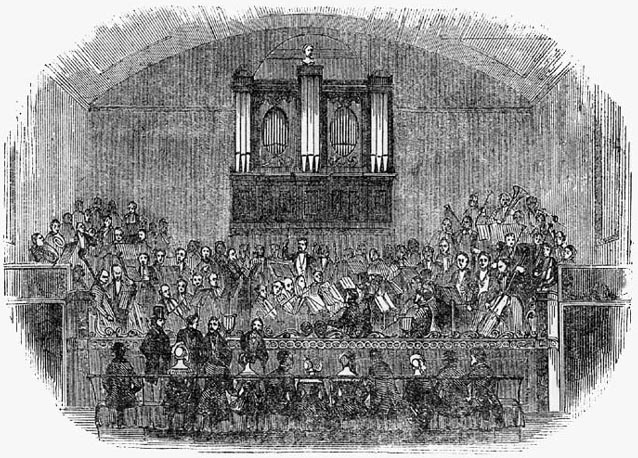
Hanover Square Rooms in 1843

HSRA 

[ii]

Hanover Square Rooms in 1843

            Mendelssohn had been an occasional guest conductor with London’s Philharmonic Society Orchestra since his first appearance there in 1829. In 1843, the Society had come into financial difficulties, and, by engaging Mendelssohn to conduct the following season, they hoped to help rebuild their audiences and recoup their losses. It may not have pleased them, therefore, when Mendelssohn suggested an unknown 12-year-old as a soloist. The Philharmonic had a long-standing ban on appearances by children. In arranging Joachim’s debut, Mendelssohn, who himself had a well-known aversion to the exploitation of prodigies, was required to give personal assurances to the committee that his young protégé was no mere Wunderkind, but already “an eminent artist and a fine person.”

Ella

John Ella

Portrait by Charles Baugniet in 1851
Courtesy of Raymond E. O. Ella, author-historian

Impresario John Ella claimed some of the credit for easing the committee’s skepticism, by including Joseph in what amounted to a series of high-profile auditions:

By special invitation, I accompanied a literary friend, in April 1844, to the residence of the late Madame Dulcken, Pianist to the Queen, to hear a youth play the violin. M. Dulcken was in doubt whether a boy of the age of Master Joachim, then fourteen [sic], would be allowed to play at the Philharmonic Concerts, and both Sir Henry Bishop and Sir George Smart were sceptical on the matter. On the Tuesday following, the youthful violinist came to my second weekly quartet union, and led Beethoven’s Quintet in C. At two other of my private musical gatherings Master Joachim played solos, or led quartets, and ultimately I mustered a notable assembly of musical lions to hear him play Beethoven’s Posthumous Quartet in Bb. Royalty and nobility crowded my room, but the most illustrious of the company comprised Mendelssohn, Moscheles, Dragonetti, Ernst, Lablache, Döhler, Offenbach, Benedict, Thalberg, Sainton, Sivori, Sir George Smart, Sir Henry Bishop, and Costa.[iii]

Ella

The Morning Post, May 15, 1844, p. 3

It seems that the original plan had been for Joseph to play Spohr’s Concerto No. 8, the Gesangsscene, but here again Ernst played a pivotal role in Joachim’s career; since Ernst had only weeks earlier played the same work, the choice fell by default to the Beethoven Violin Concerto, for which Joseph had provided cadenzas his own devising.[1]


JJCadenza

Joseph Joachim: Cadenza to the Rondo of Beethoven’s Violin Concerto
“London, 12 May 1844
To my dear friend Hill for remembrance”

“The MS. of the cadenza to the Rondo of the concerto is now in the possession of Messrs. W. E. Hill & Sons, the well-known violin makers of New Bond Street. The following ‘account’ is attached to it:— Joseph Joachim: born 1831. A cadenza written by the great violinist, in 1844, for the Beethoven Concerto, when he was but thirteen years of age, and presented by him to the late Henry Hill, who was present on the occasion of its being played for the first time at an evening musical party. Joachim played the cadenza from memory, and took the musicians by surprise when he told them that it was his own composition, and to convince them that this was so (some doubts being expressed) he wrote this and presented it to Henry Hill.'” [F. G. Edwards, Professor Joachim’s English Jubilee, The Musical Herald and Tonic Sol-fa Reporter 552 (1 March, 1894): 70.] Henry Hill was a prominent London violist, and a member of the famous English family of violin makers. This manuscript was passed to Hill’s son Arthur F. Hill, and eventually found its way into the collection of Serge Lifar. It was sold at Sotheby’s on December 6, 2002.


This, too, must have been a controversial decision. Beethoven’s concerto had had a checkered career since the evening, just before Christmas, 1806, when Franz Clement first conjured it to life in Vienna’s Theater and der Wien. Though it had been championed by such eminent violinists as Luigi Tomasini (Berlin, 1812), Pierre Baillot (Paris, 1828) and Henri Vieuxtemps (Vienna, 1834), [iv] it had never garnered more than a succès d’estime in public performance. Many great violinists, including Ludwig Spohr, had rejected the work outright (“…that was all very fine,” Spohr later said to Joachim by way of congratulations after a performance in Hanover, “but now I’d like to hear you play a real violin piece.”). [v] The concerto’s London premiere, given in April 1832 by a Frankfurt native named Edward Eliason, had not impressed the critics. “Beethoven has put forth no strength in his violin concerto,” wrote the reviewer for the Hamonicon. “It is a fiddling affair, and might have been written by any third or fourth rate composer. We cannot say that the performance of this concealed any of its weakness, or rendered it at all more palatable.” [vi]

This difficult, reputedly disagreeable work was a risky choice, then, as a debut vehicle for a boy one month shy of his 13th birthday. For Joseph, as for Mendelssohn, the stakes for this performance were unusually high. Joseph’s success in meeting this challenge would have historic consequences, both for the boy and for the concerto.

Screen shot 2013-07-03 at 7.00.56 PM

[vii]

A copy of the original program, signed in 1899 by Joseph Joachim, “the little fellow.”

            Joseph’s May 27 Philharmonic debut took place at the Hanover Square Rooms. [2] The long and diverse program began at eight. The highlight of the evening promised to be Mendelssohn’s incidental music to A Midsummer Night’s Dream, featuring the first English performance of the celebrated Wedding March. The concert opened with a performance of Beethoven’s fourth symphony, followed by a mawkish duet, excerpted from the young Liverpudlian John Liptrott Hatton’s opera Pascal Bruno:

Stung by horror, shame, and anguish,
Driven from her once loved home;
Mid yon mountains, wild, and lonely,
There she sought an early tomb.
Holy hand her grave ne’er hallowed;
Tears, none but his, her only child,
Who swore thereon an oath of vengeance —
Vengeance! as terrible as wild.

After that came Joseph and Beethoven’s “fiddling affair.” Mendelssohn’s account of the performance evokes the boisterous concert-going customs of the time, and vividly captures the atmosphere of exhilaration in the hall:

… The excitement into which [Joseph] had transported everyone, beginning with the rehearsal, was so great that a frenetic applause began as soon as he stepped in front of the orchestra, and lasted right up until the piece could begin. He then played the beginning so masterfully, so surely and well in tune, and, playing from memory notwithstanding, with such irreproachable security that the audience interrupted him three times before the first big Tutti, and then applauded throughout half of the Tutti. They likewise interrupted in the middle of his Cadenza, and after the first movement the noise only stopped because it needed to stop sometime, and because people’s hands and throats hurt from clapping and shouting. It was a great joy to be a fellow witness—and to see as well the boy’s quiet and secure modesty, immune from all temptation. After the first movement, he said softly to me: ‘I really am very frightened.’ The cheers of the audience accompanied every single part of the concerto throughout. When it was over and I took him down the stairs, I had to remind him that he should once more acknowledge the audience, and even then the thundering noise continued until long after he had again descended the steps, and was out of the hall. A better success the most celebrated and famous artist could neither hope for nor achieve. [viii]

“I well remember Mendelssohn’s bright look of pleasure and appreciative interest in his little friend,” witness Elizabeth Mounsey [3] recalled later. “As conductor, he turned towards the very young soloist, attired in short jacket and turned-down collar, so as to follow him dutifully, Mendelssohn’s own subordinate position appearing to give him a degree of amusement. But it was very beautiful to see the pleasure it gave him to regard the boy at his side, not only with admiration, but with honour. [4] Joachim, whose playing was so masterly, and whose whole manner was so thoughtful, was still boy enough to indulge in an unbecomingly full pocket at his side; one wondered what its contents might be!” [ix]

The ‘cellist Alfredo Piatti, making a London debut of his own that season, was also in the audience. Fifty years later, at a joint jubilee celebration, Piatti recalled the “little fat boy in tight trousers” who had made such a sensation that night. “He had blooming cheeks and a short jacket, and he stepped up on the platform at the Philharmonic Concert and played Beethoven’s violin concerto in such style that everybody was astonished. It was my good fortune to be very much associated with the little boy in after years; and his name was that of my friend, the great artist, Joseph Joachim.” [x]

Joseph emerged the lion of the hour, and even the most feared of reviewers were effusive in their praise. In the Athenaeum, the occasionally cantankerous Henry Chorley wrote: “Then came Beethoven’s Violin Concerto, played by Herr Joachim and, what is more, played with… Very few performers have come before us so satisfactory, and for the future so brightly promising as this boy; who seems, too, to possess a strong frame and a disposition so modest, as well as cheerful, that the perils of praise are less formidable than usual.” [xi]

The reviewer for The Musical World, probably J. W. Davison, was equally impressed:

Joachim’s rendering of Beethoven’s concerto was astonishing. Not only was it astonishing as coming from a comparative child, but astonishing as a violin performance, no matter from whom proceeding. The greatest violinists hold this concerto in awe. It is, we must own, not adapted to display advantageously the powers of the instrument — though a composition of great distinction, the first movement being in Beethoven’s highest manner. Young Joachim, however, attacked it with the vigour and determination of the most accomplished artist, and made every point tell. So well did he play, that we forgot how entirely unadapted for display was the violin part. No master could have read it better, no finished artist could have better rendered it. Tone, execution, and reading, were alike admirable — and the two cadences introduced by the young player were not only tremendous executive feats, but ingeniously composed — consisting wholly of excellent and musician-like workings of phrases and passages from the concerto. The reception of Joachim was enthusiastic, and his success the most complete and triumphant that his warmest friends could have desired. What Charles Filtsch [5] is upon the piano, Joseph Joachim is upon the violin, and he is, in common with that prodigious little genius, remarkable for the most attractive manners, the most amiable disposition, and the most intelligent and charming modesty. We wonder not that he should be such a favourite with Mendelssohn, who is ever the first to acknowledge and to nurture rising genius. [xii]

JJ London 1844
 [6]
Joseph Joachim at the time of his English debut
_____

The Illustrated London News concurred:

… now we come to the dictu mirabile monstrum, in the shape of a little boy of thirteen, who perhaps is the first violin player, not only of his age, but of his siècle. Of late years we have heard some prodigies, in the form of grown persons, as performers on that splendid instrument; but without severally enumerating them, or their merits, we can safely say that little Joachim is equal to any, or all of them, put together. His tone is of the purest cantabile character — his execution is most marvellous, and at the same time unembarrassed — his style is chaste, but deeply impassioned at moments; and his deportment is that of a conscious, but modest genius! He performed Beethoven’s solitary concerto, which we have heard all the great performers of the last twenty years attempt, and invariably fail in. On Monday last its performance was an eloquent vindication of the master-spirit who imagined it, and we might fearlessly add, that in the cadences, composed by the youth himself, there was as much genius exhibited as in the subject which gave birth to them. Joachim plays from memory, which is more agreeable to the eye of the auditor than to see anything read from a music-stand; it seems more like extemporaneous performance, and admits a greater degree of enthusiasm on the part of the instrumentalist. We never heard or witnessed such unequivocal delight as was expressed by both band and auditory. [xiii]

The reviewer concluded: “We did not think so much of the [Wedding] March as the rest of the audience, but “trahit sua quemque voluptas.” [7] Altogether it was a delightful concert; but we should like to see the programme of the next a little more varied.” [!]

Finally, the reviewer for the Morning Post enthused:

Joachim, the boy violinist, astounded every amateur. The concerto in D, op. 61… has been generally regarded by violin-players as not a proper and effective development of the powers of their instrument… But there arrives a boy of fourteen [sic] from Vienna, who, after astonishing everybody by his quartett-playing, is invited to perform at the Philharmonic, the standard law against the exhibition of precocities at these concerts being suspended on his account. […] As for his execution of this concerto, it is beyond all praise, and defies all description. This highly-gifted lad stands for half-an-hour without any music, and plays from memory without missing a note or making a single mistake in taking up the subject after the Tutti. He now and then bestows a furtive glance at the conductor, but the boy is steady, firm, and wonderfully true throughout.

In the slow movement in C — that elegant expanse of melody which glides so charmingly into the sportive rondo — the intensity of his expression and the breadth of his tone proved that it was not merely mechanical display, but that it was an emanation from the heart — that the mind and soul of the poet and musician were there, and it is just in these attributes that Joachim is distinguished from all former youthful prodigies… Joachim’s performance was altogether unprecedented, and elicited from amateurs and professors equal admiration.

Mendelssohn’s unequivocal expression of delight and Loder’s [8] look of amazement, combined with the hearty cheering of the band as well as auditory, all testified to the effect young Joachim had produced. [xiv]

Reports of Joseph’s success continued to appear. As late as August, Schumann’s Neue Zeitschrift für Musik reported: “The very youthful Jos. Joachim played in the 5th Philharmonic Concert, and aroused the liveliest sensation, and not simply through his virtuosity, but more through the maturity and capacity of comprehension, and the taste with which he performed the Beethoven Violin Concerto. He also retained these virtues elsewhere, through his outstanding quartet playing, and the partiality that he seems to hold for Bach’s works. Though, indeed, still a boy, Joachim is not one of those pitiable hothouse plants that our era is so rich in, and the tact with which he deflected all speculation that would stamp him as a Wunderkind is commendable.” [xv]

On the day after the concert, the thrill of the event still vivid in his mind, Mendelssohn sat down and penned the glowing letter to the Wittgensteins in Leipzig (from which the foregoing description of the concert was drawn):

Felix Mendelssohn to Herman Wittgenstein

 Dear sir,

I cannot neglect to tell you, at least with a few words, what an unheard-of, unprecedented success our dear Joseph has had with his performance of the Beethoven Concerto yesterday evening in the Philharmonic concert. The cheers of the entire audience, the unanimous love and esteem of all musicians, the warm affection of all who are genuinely interested in music and who base the fairest hopes upon such a talent — all that was expressed yesterday evening. You are to be thanked that you and your wife were responsible for bringing this exceptional boy into our midst; you have my thanks for all the joy he has given me in particular; and if heaven keep him in good and sound health, everything else that we wish for him will not then fail to be forthcoming — or rather, it cannot fail, for he no longer needs to become an eminent artist and a fine person: he is both already, as certainly as a boy of his age can be or ever has been. […]

With this [successful concert], the chief object of a first English visit has been, in my opinion, fully attained: every one here who is interested in music is his friend and will remember him. Now I wish, as you know, that he should soon return to a perfectly tranquil life, retiring entirely from public playing in order that he may use the next two or three years to develop his inner resources in every regard, practicing his art in all those areas in which there is still room for improvement without neglecting that which he has already achieved, composing industriously, and even more industriously going for walks and caring for his physical development, so that in three years’ time the youth may be as healthy in mind and body as the boy. I consider this impossible without perfect peace and quiet; may this be granted in addition to all the good things that Heaven has given him.

This letter is intended for your wife as well as for yourself; now just a short farewell from your most devoted,

Felix Mendelssohn-Bartholdy [xvi]

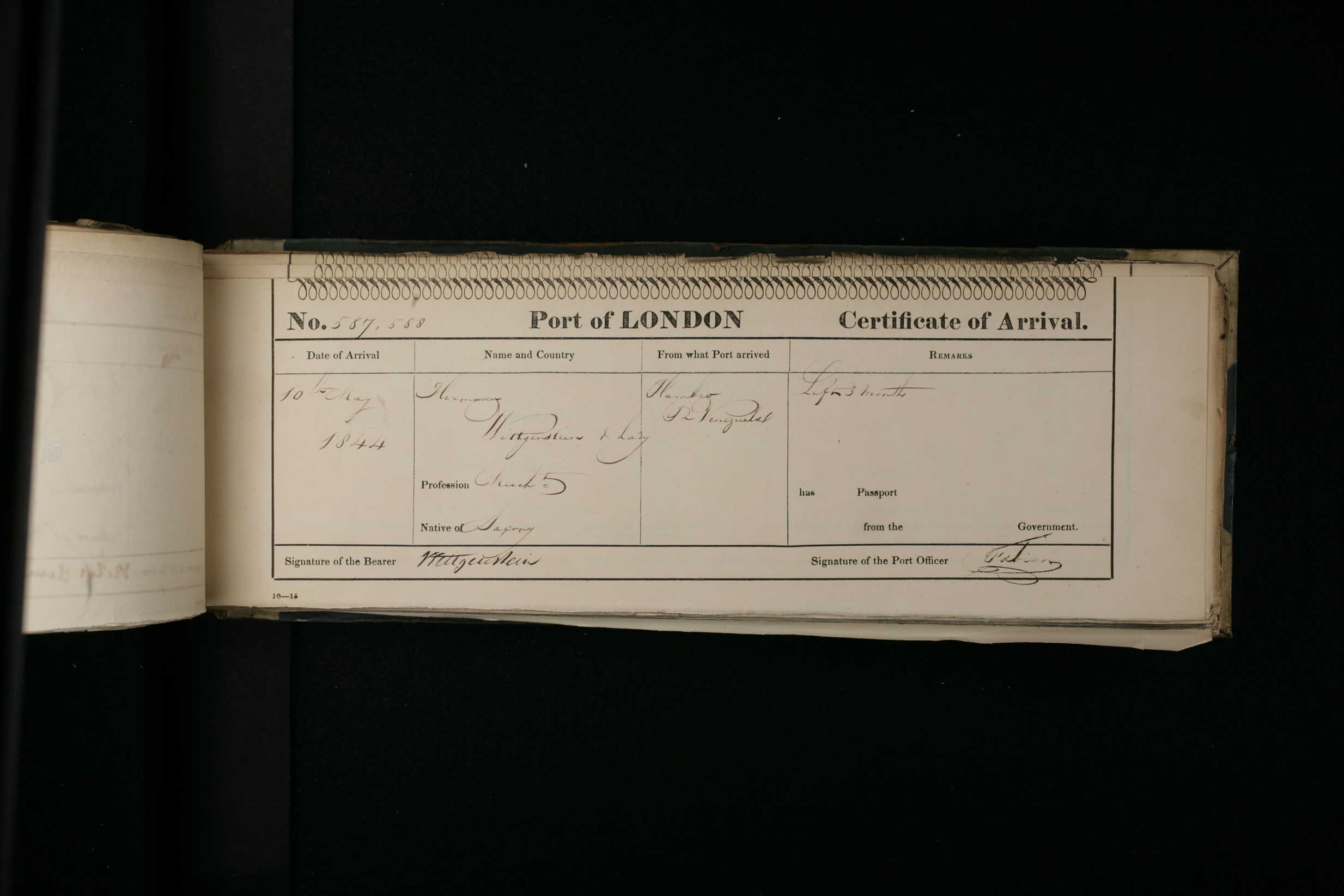
Wittgenstein arrival

Arrival of Hermann Wittgenstein at the Port of London

On the 5th of June, Fanny Wittgenstein sent a transcript of this letter to Joseph’s parents in Pest, along with the following lines:

Fanny Wittgenstein to Julius and Fanny Joachim [xvii]

Leipzig, 5 June [18]44

Dear Aunt and Dear Uncle,

It is a sweet task for me to add my joyous news to the many gratifying reports that you have received from London and Vienna about our Jos, for I have been a witness to a part of his success! Although it was a 14-day [journey], I could not resist the temptation of traveling to London with my dear Papa and my Hermann, and (perhaps foolishly) left my 4 children in the care of my servants and my brother-in-law. It was a great joy to see how Jos. is universally acknowledged and appreciated, how even ladies of the first rank approach him with interest, how he delights everyone with his talent and his modesty, and is therefore dearly loved by everyone. Fortunate parents, what joys still await you! How often have we regretted that you, especially, are not present to witness his triumphs! You know how Mendelsohn [sic], this marvelous, independent artist, dotes on Jos. — in order to demonstrate this properly, I send you a transcript of the letter that we received from him yesterday. As you shall see, he wishes for Jos. to devote several perfectly tranquil years to his studies, with particular attention paid to his health. Leipzig, which is home to so much genuine edification, because it does not possess the distracting temptations of larger cities, is a suitable place for him to live; we love him like our own child, and again accept him gladly, to watch over him with parental love (if I may say so), although it is a difficult challenge. Jos. is what he should be — a child — but a marvelous child; only precocious in the development of his art. This weekend, I will go to the countryside near Dresden with the children; there he should fully recuperate and then he will return diligently to work. The children are well, thank God. I congratulate you and dear Hany. Dear Uncle and dear Aunt, may you enjoy your grandchildren as much as you enjoy your children. Affectionate greetings to all of you dear ones from Fany Wst.

[xviii]

Joseph conquers the world, 1844.
Drawing attributed to John Callcott Horsley
Perhaps by Charles Edward Horsley
Private collection

Screen Shot 2014-10-16 at 6.23.21 PM

The Musical Post, May 17, 1844, p. 1

            The “perfectly tranquil life” would have to wait until Joseph’s return to Leipzig. Following his brilliant debut, invitations to perform flooded in from all quarters. Joseph’s reputation reached as far as Windsor, where, on June 4th, he was called to give a command performance at a state concert before Queen Victoria and the Prince Consort, together with their guests Emperor Nicholas of Russia, Frederick Augustus II, King of Saxony, the Duke of Wellington and Sir Robert Peel. [xix] He traveled to Windsor with his Uncle Bernhard, returning the next day. [xx] Joseph performed Ernst’s Othello Fantasy, and Bériot’s Andantino and Rondo Russe[xxi] accompanied by the Queen’s private band, and received a golden watch and chain from the Queen for his efforts. [xxii] For the young “Hungarian Boy,” not yet thirteen years of age, the story of these days, which hovers so close to the world of myth, had already become the founding narrative of his incomparable English career.


Next Post in Series: A Prodigious Fellow


[1] “There will be nothing left for me to do than to choose to play the Beethoven concerto (since Ernst played the Gesangsscene in the 2nd concert).” [Joachim to David, Joachim/BRIEFE I, p. 5.] Joseph was paid 5 guineas for his performance (a guinea being equal to one pound, one shilling — there are 20 shillings in a pound). Five guineas was the same fee that Louise Dulcken got that season for the first English performance of Chopin’s Second Piano Concerto. Sivori was paid £11 for two consecutive concerto appearances, and Spohr £30 for a command concert and a concerto. [Ehrlich/PHILHARMONIC, p. 56.]

[2] “These same Hanover-square Rooms are the arcana of a mysterious temple, and many and beautiful and powerful have been the worshippers within its walls,” wrote The Illustrated London News in 1843. “Here are held many of the gay subscription assemblies of the London season — and here the stately and aristocratic ball of the Royal Academy holds its fancy court… But Music is the true genius of these halls — the concert is their lawful revelry, and to an annual round of musical celebration — soirée and matinée — are they devoted as sacredly as was ever patriot to the altar of country. In these rooms enthusiastic assemblies have heard evoked the genius of some of the finest spirits of the age. From that orchestra Paganini, with almost unearthly presence, enthralled hearts and souls with the magician power of an instrument, oracular with strength and beauty, and poetry, and his touch alone! There Liszt flooded the raptured sense with wonder and delight as he opened up the stores of Genius — and in marvellous and gushing harmonies seemed, with an almost hallowed inspiration, to improvise the very music of the spheres. […] Now, turn from the orchestra to the company, and see what a graceful assembly you have. Peer curiously among them, and ten to one but you discover people of renown — great critics, or men of literary fame — artists, professionals, and musical amateurs. There is always something bright, cheerful, and exhilarating about the atmosphere of the Hanover-square Rooms, and often are they honoured with the presence of royalty.” [The Illustrated London News, Vol. 2, No. 60 (June 24, 1843), p. 439.]

[3] A musical acquaintance of Mendelssohn’s, Elizabeth Mounsey was from the age of fourteen the organist of St. Peter’s Church, Cornhill. A musical souvenir (Bach Passacaglia in C Minor) that Mendelssohn gave her when he played the church organ in 1840 is still preserved in the organ gallery of the church. “Miss Bessie” Mounsey became an associate of the Philharmonic Society in 1842. Her sister’s husband, William Bartholomew, was the translator of the libretto to Mendelssohn’s Elijah. The work received its first English reading by the sisters in Miss Mounsey’s home. Elizabeth Mounsey died October 3, 1905, just days before her 86th birthday. [“Elizabeth Mounsey,” The Musical Times, Vol. 46, No. 753 (Nov. 1, 1905), pp. 718-721.]

[4] Singer Elise Polko similarly described Mendelssohn’s supportiveness as a conductor: “No words can describe Mendelssohn’s exceeding kindness to me when I sang at the Gewandhaus. He moved his conductor’s desk forward, which was quite unusual, so that it was close beside me, and I could see him just before me in order to inspire me with courage, and how good-naturedly he nodded and glanced at me while conducting! … Mendelssohn had always a cheering word for the timid singer. ‘Mademoiselle, you always do your work so admirably; but I can see by your face this evening that you intend fairly to bewitch the public;’ or, ‘Now just for the next half-hour imagine that your are the first singer in Europe; and so will I;’ or, ‘Let us try to turn Ferdinand Böhme’s head altogether to-day with delight.’ Oh! who could ever forget all those kind words, and the kind face, too!” [Polko/MENDELSSOHN, pp. 103-104].

[5] Charles Filtsch (1830-1845) was Chopin’s most gifted pupil, about whom Franz Liszt is reported to have said “When that boy begins to travel, I will close shop.” He died, tragically young, in Venice.

[6] “When, at the end of the season, Joachim was leaving London, I accompanied him to Claudet’s Daguerreotype Studio, at the old Adelaide Gallery in the Strand, for the purpose of sitting for some portraits, a process which was very different from that we experience in these days of photography, for instead of seconds, the patient — or shall I say victim? — had to remain in one position for several minutes. Joseph Joachim gave me one of these pictures, which, notwithstanding the years that have elapsed, is still in perfect preservation, and my readers will rejoice at the opportunity of seeing what this great artist was like when he first visited London.” Walter Cecil Macfarren, F.R.A.M., Memories, London & New York: Walter Scott Publishing Co., 1905, pp. 37-39. In March, 1840, Antoine Claudet (1797-1867), a student of Louis Daguerre, purchased the first Daguerreotype license for England for £200. He operated his studio in the Adelaide Gallery, behind St. Martin in the Fields, from 1841-1851.

[7] Virgil: “Each is led by his own taste.”

 Concertmaster John David Loder (1788-1846), a member of a prominent English musical family.


[i] The Illustrated London News (June 24, 1843).

[ii] The Illustrated London News, (June 24, 1843).

[iii] Ella/SKETCHES, p. 250.

[iv] Stowell/BEETHOVEN, p. 34.

[v] Moser/JOACHIM 1908, pp. 291.

[vi] Stowell/BEETHOVEN, p. 35.

[vii] The Musical Times, Vol. 40, No. 677 (July, 1899), p. 457.

[viii] MT/JOACHIM, p. 227.

[ix] The Musical Times, Vol. 39, No. 662 (April 1, 1898), p. 227.

[x] Klein/LONDON, pp. 396-397.

[xi] The Musical Times and Singing Class Circular, Vol. 35, No. 616 (June 1, 1894), p. 383-384. Original in Athenaeum June 1, 1844.

[xii] The Musical World, vol. XIX No. 22 (May 30, 1844), pp. 180-181.

[xiii] The Illustrated London News, vol. 4, No. 109 (June 1, 1844), p. 354.

[xv] Neue Zeitschrift für Musik, Vol. 20, No. 16 (August 20, 1844), p. 63.

[xvi] Moser/JOACHIM 1907, pp. 63-65 [my translation; Fanny Wittgenstein’s transcription of this letter is in the British Library letters, p. 198]

[xvii] Unpublished MS, British Library: Joachim Correspondence, bequest of Agnes Keep, Add. MS 42718, p. 198.

[xviii]  Original 1844 pencil drawing on J. Whitman paper (watermarked 1842), depicting the young Joseph Joachim standing on England, atop the globe, with the four continents in the corners. Signed and dated in pencil at lower ground. Measures 8-3/4 x 6-3/4 inches. John Callcott Horsley (*1817 – †1903) was a well-known painter and illustrator, best known as the designer of the first Christmas card. His brother, Charles Edward Horsley (*1822 – 1876), was a composer and pupil of Mendelssohn. He lived in Leipzig from 1841 – 1843.

Ivan Mahaim, in his Beethoven: Naissance et renaissance des derniers quatuors (1964), ascribes the drawing to Charles Horsley and not his brother John Callcott Horsley, although the plate he reproduces from Briefe von und an Joseph Joachim (1911) attributes it to the latter, stating that the drawing is from Joseph Joachim‘s “stammbuch.” Neither of them provide any location for the work or said book. [Mahaim/BEETHOVEN, vol. 1, Fig. 41] Other publications, including Borchard’s Stimme und Geige: Amalie und Joseph Joachim: Biographie und Interpretationsgeschichte (2005, p. 60, p. 630 n.), variously suggest original placement in Joseph Joachim‘s “stammbuch” or in the John Callcott Horsley’s family album (“stammbuchzeichnung”). However, the British Library confirms that they have no record of the drawing ever appearing in their collections of Joachim and likewise the Bodleian Library, which houses the Horsley family archives, confirms the drawing has never been on deposit with them.  In any event, the work was at some point acquired by the noted collector of music education and appreciation, Diana R. Tillson (1918-2013), much of whose collection is now part of the Cotsen Children’s Library at Princeton University. The Callcott drawing, together with other items from the Tillson collection, was sold in a 2014 auction following her death.

[xix] Moser/JOACHIM 1908, p. 65.

[xx] Unpublished MS, British Library: Joachim Correspondence, bequest of Agnes Keep, Add. MS 42718, p. 199.

[xxi] The Times (London) (June 5, 1844), p. 4.

[xxii] Allgemeine Wiener Musik-Zeitung, Vol. 4, No. 86 (July 18, 1844), p. 344; Reich/BETH EL, p. 64; The Musical Times, Vol. 48, No. 775 (September 1, 1907), p. 578.

Alsager

© Robert W. Eshbach, 2013

Previous Post in Series: London, 1844


JJ Initials

Alsager

NPG D13535; Thomas Massa Alsager ('The mirror of the Times') by and published by Richard Dighton, reissued by  Thomas McLean

Thomas Massa Alsager. By and published by Richard Dighton, reissued by Thomas McLean, hand-coloured etching, published August 1823

Thomas Massa Alsager (‘The mirror of the Times’)Thomas Massa Alsager (‘The mirror of the Times’)

National Portrait Gallery, London


Music-making in early 19th Century London owed much of its character to the enthusiasm and enterprise of musical amateurs. Among them, none had a greater influence, or left a greater legacy, than the co-owner, financial writer and sometime music critic of the Times, Thomas Massa Alsager. At a time when Beethoven’s works were still struggling for recognition, Alsager was a devoted advocate for the most difficult of them: the later string quartets and sonatas that even today elude many sophisticated audiences. Many of Beethoven’s works received their first English performances  — often by distinguished artists — at Alsager’s home at 26 Queen Square, Bloomsbury. Larger works were not excepted: the English premiere of Beethoven’s Missa solemnis took place there on December 24, 1832 conducted by Ignaz Moscheles. Alsager’s pioneering work on behalf of the Beethoven quartets culminated in a remarkable series of five concerts, held at two-week intervals between April 21st and June 16th 1845, in which the entire cycle of sixteen quartets (excluding the Grosse Fuge) was performed for the first time. Every concert featured at least one selection each from Beethoven’s early, middle and late quartets. Beautifully engraved programs and special pocket scores were printed for each occasion, to help the audience of 250 in their understanding of the works at hand. Listeners were requested to arrive at 8:00 o’clock for the 8:30 performances, to give them time to prepare their minds, and to assure that, once commenced, the music making would not be interrupted. [i]

Beethoven Qt pass 18

“Honor to Beethoven”

Admission token for a concert of the Beethoven Quartett Society

            Alsager committed suicide in 1846, on the anniversary of his wife’s funeral. Nevertheless, with the exception of 1849, the performance of the complete Beethoven cycle by the “Beethoven Quartett Society” continued as an annual spring feature of the London season until 1851. It would be forty-three years before it would be performed again in its entirety. [1] A contemporary reviewer commented upon the significance that these concerts had for the reception of Beethoven’s late works in England and beyond:

The Society’s concerts put an end to the controversy about the merit of Beethoven’s last quartets. Everything that used to be called eccentric, confused, linked to the excesses of a disorderly, unbalanced imagination resulting from the composer’s deafness, was actually only the product of the works’ originality which remained inaccessible to the uninitiated listener. In these brilliant recitals, the late Beethoven quartets were played with such exactness, such finesse of expression and nuances, with so much fire and impetus that they finally emerged in the purity of their architecture. They are listened to with most profound rapture. Unanimous opinion places them at the summit of this genre of composition. [ii]

Alsager copy

[iii]

One of the beautifully produced programs from the 1845 Beethoven Quartett Society Concerts. Poetry, musical incipits and program notes helped to do “Honor to Beethoven” and to spread the gospel of the Beethoven string quartets. The concerts were held at 76 Harley Street, the home of Louis Julienne (1812-1860), the colorful  director of the Drury Lane Theater. Hector Berlioz stayed there on his 1847 visit to London.

            Over the years, Mendelssohn had been a familiar participant at Alsager’s gatherings, performing both as a pianist and violist. On Thursday May 16th, 1844, having recently arrived from Berlin, he responded to Alsager’s invitation for the following Sunday: “Of course I shall be most happy to be allowed to assist to your musical Séance. . . I need not assure you that I will be at your house as early as I can, & you know very well how happy I shall be to shake you again by the hand & to perform on the Tenor [viola] or if that cannot be on the Piano as much of Beethoven’s music, and as little of mine as you possibly can give me.” [iv] Joseph was also invited to participate in the event, at which he delighted Mendelssohn with his performance of one of his “musical father’s” piano quartets. In the course of his stay in London, Joseph was a frequent guest at Thomas Alsager’s home, and a frequent partaker in the music-making there. [v] As a parting gift, Alsager presented Joseph with the Beethoven quartets in score.

On his second visit to London, in 1847, Joseph took part in the Beethoven Quartett Society’s ground-breaking performances, together with veteran performers Sainton, Hill, Thomas and Rousselot. [2] During that same 1847 visit, Joachim and the great Italian ‘cellist Alfredo Piatti [3] began a legendary chamber music partnership that lasted until Piatti’s retirement in 1898.


Next Post in Series: London Philharmonic Debut


[1] By Eduard Rappoldi and colleagues in Dresden. The Joachim Quartet did not perform the entire cycle until 1903. See: Mahaim/CYCLES, pp. 541-547.

[2] Violinist Prosper Sainton, violist Henry Hill and ‘cellist Scipion Rousselot were original members of the Beethoven Quartett Society.

[3] Alfredo Piatti (1822-1901) had been discovered, destitute and ill and playing on a borrowed instrument, by Franz Liszt, who, with characteristic generosity, bought him an Amati cello and introduced him in Paris. Shortly thereafter, Piatti made his London debut — on May 31, 1844, four days after Joachim. Longtime friends, Joachim and Piatti celebrated the 50th anniversary of their debuts together.


[i] Mahaim/CYCLES, p. 509.

[ii] Mahaim/CYCLES, pp. 508-509.

[iii] Reproduced in Mahaim, vol. I. Original in British Museum.

[iv] Levy/ALSAGER, p. 124.
[v] Margaret Alsager Ayrton’s unpublished diary in Levy/ALSAGER, p. 124 n.

London, 1844

© Robert W. Eshbach, 2013

Previous Post in Series: Growing Pains/Travel Plans


JJ Initials

CHAPTER IV: LONDON, 1844

Port of London Bartlett

The Port of London

W. H. Bartlett, ca. 1844

Joseph first saw the “smoky nest,” as Mendelssohn called London, [i] under the most auspicious of circumstances. To be introduced as Mendelssohn’s protégé was to fling wide every door to London’s musical establishment. That Mendelssohn was the most highly regarded living musician in English musical life, there can be no doubt. England was Mendelssohn’s second home, and a place in which he received, if anything, greater and more affectionate recognition than he did in his native Germany.

image.x

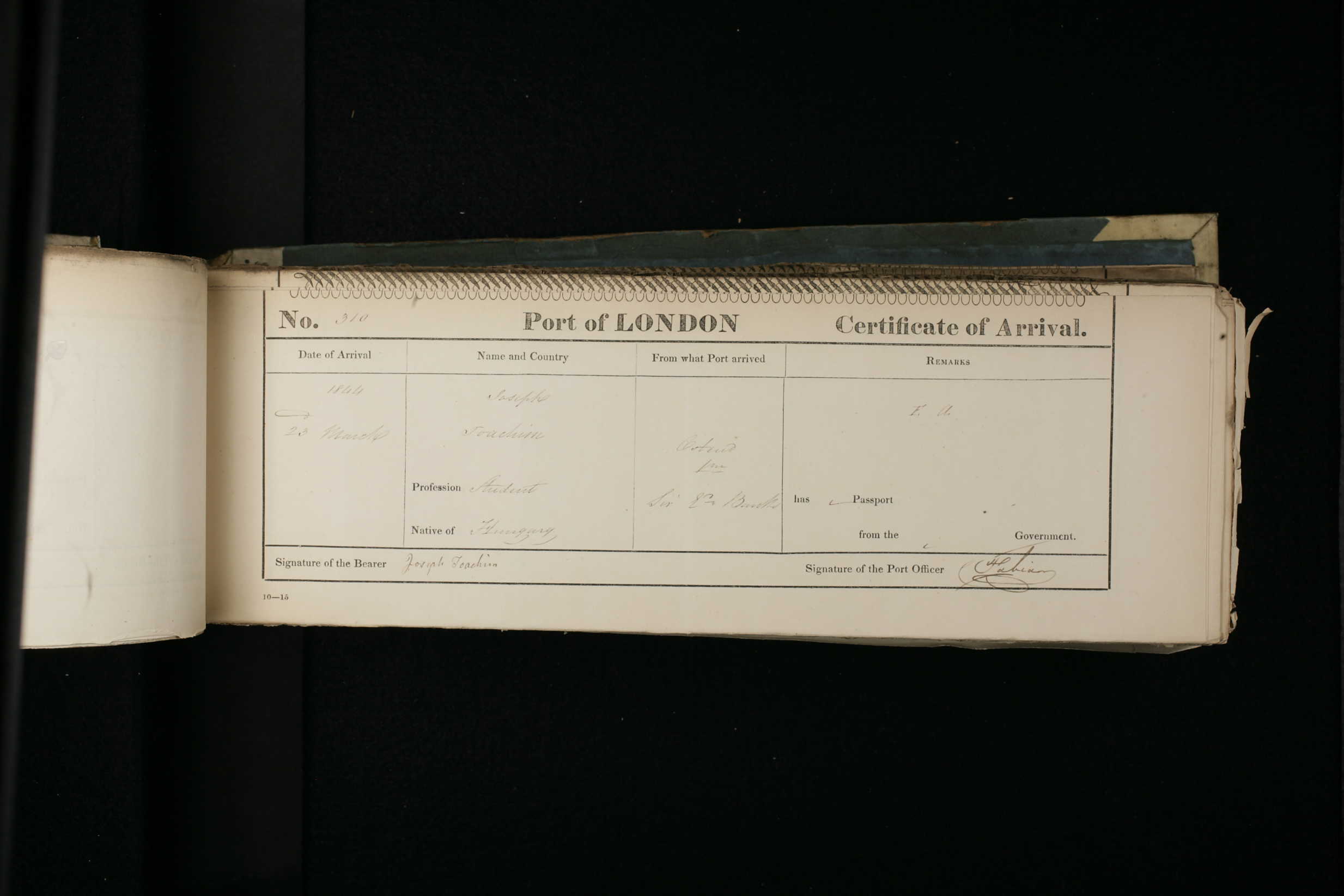
Record of Joseph Joachim’s Arrival in London, March 23, 1844 [ii]

Mendelssohn had fortified Joseph with extraordinary letters of introduction, with praise such as only the young could endure. To William Sterndale Bennett he wrote: “The bearer of these lines, although a boy of thirteen, is one of my best and dearest friends, and one of the most interesting people I have met for a long time.” [iii] Upon meeting Joseph, the eminent pianist Ignaz Moscheles wrote in his diary: “Joachim, a boy thirteen years of age, has come to London, bringing with him a letter of recommendation from Mendelssohn; his talent, however, is his best introduction. We organized a small party expressly for him. I listened with delight to him and Emily [1] playing in Mendelssohn’s lovely D minor trio; after that I was fairly taken by surprise by Joachim’s manly and brilliant rendering of David’s Variations and De Bériot’s Rondo. Mendelssohn is right, here we have a talent of the true stamp.” [iv]

Joachim Daguerreotype

[v]

Joseph Joachim at the time of his English Debut, From a Daguerreotype [4]

Joseph’s first London appearance came on March 28, when he performed between the first and second acts of Balfe’s operetta The Bohemian Girl at the Drury Lane Theatre. [2] This “Miscellaneous Concert,” produced by the impresario Alfred Bunn, [3] also included performances by three pianists: Ignaz Moscheles, Madame Louise Dulcken (Ferdinand David’s sister), and C. M. von Weber’s former pupil, Julius Benedict. The program declared “The celebrated Hungarian boy, MASTER IOACHIM [sic], will make his first appearance before an English public and perform Grand Variations for the violin on a theme from Rossini’s Othello, by Ernst.” [vi] Joseph was embarrassed by the merciless teasing that the “Hungarian Boy” received for being introduced at a performance of the “Bohemian Girl,” but Mendelssohn thought it was hilarious, and would later kid him as he arrived for his lessons: “Now, my ‘Hungarian Boy,’ what have you to show me?” [vii]

 St. Paul's

St. Paul’s Cathedral, London, 1844

While residing with his Uncle Bernhard Figdor [5] in Basinghall Street near St. Paul’s Cathedral, Joseph spent time attending concerts and taking in the musical landscape. After three weeks, he sent a newsy letter to Ferdinand David, thanking him for introductions to relatives: a certain Herr David, who lived along his travel route in Cologne, and to Mme. Dulcken in London. “There is a superabundance of foreign fiddlers here,” he wrote. “Ernst, Sivori, [6] Pott [7] (who will play in the 4th Philharmonic), Gulomy [8] (of whom one hears nothing at all), and Rossy, [9] 16 years old, who comes with good recommendations from Rossini and is supposed to play badly, as competent people say.” [viii]

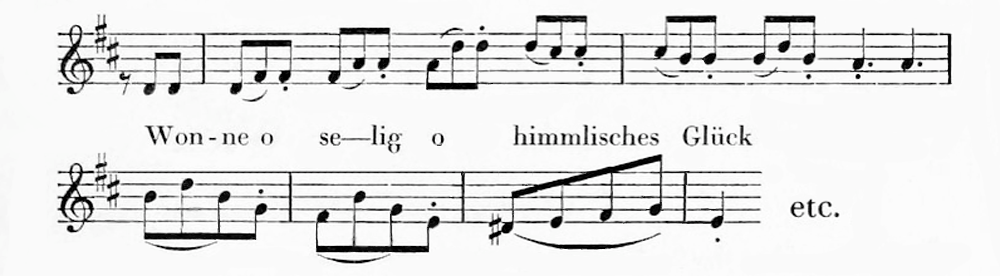
His sharp observations demonstrate a remarkable level of personal and musical maturity, and also paint a vivid picture of London’s musical scene. “I find that the Philharmonic Concerts do not deserve the reputation that they have,” he wrote, “for when one is used to hearing Beethoven’s symphonies in Leipzig, one cannot find edification in the performances here. Even the tempos were mistaken, in my possibly incorrect opinion.” The concert he attended was the second of the Philharmonic series, at which H. W. Ernst performed Spohr’s Gesangscene concerto. This was a piece that Joseph knew well: having performed it recently in the Gewandhaus, he had brought it with him to perform in London. “Ernst did not play the Gesangscene faithfully,” he told David; “he made the cadenza much more modern (although with the same harmony), introduced great difficulties, completely left out the beautiful modulations in the passage in the Allegro (in F), and made very modern endings to the terminations of every solo in the Allegro, played the staccato run in thirds, which required him to take the passage somewhat slower. I consider Ernst to be a very great violin player, and find him incomparably greater as a virtuoso, artist and human being than Sivori. [10] The latter creates truly surprising difficulties, but he often plays inaccurately, and is really a great Charlatan […]. Dr. Mendelssohn is very certainly expected here today:

 Wonne

[11]

I will go right away to H[err] Klingemann and see whether he is not yet here. Farewell, and do not completely forget your thankful Alderchen

J. Joachim.” [ix]


Screen Shot 2014-10-16 at 5.26.50 PM

The Morning Post, March 29, 1844, p. 1.

Joseph made a number of appearances before his official Philharmonic debut. On April 22 he gave his own performance of the Gesangscene Concerto in the Societa Armonica concert. [12]

Screen Shot 2014-10-16 at 5.42.33 PM

The Morning Post, April 25, 1844, p. 5

The following day, he played an important “audition” organized by John Ella, with many influential guests present:

Screen Shot 2015-04-08 at 10.22.39 PM

The Morning Post, April 24, 1844, p. 5

Two days later, he performed for the Melodists’ Club, and on May 1, he played at Miss Nunn’s Soirée:

Screen Shot 2014-10-16 at 5.53.54 PM

The Morning Post, April 27, 1844, page 5

Screen Shot 2014-10-16 at 5.58.59 PM

The Morning Post, May 2, 1844, p. 5


31160_A002129-00441

Record of Hermann Wittgenstein’s Arrival in London, May 10, 1844


Joseph took part in Madame Caradori-Allan’s extravaganza on May 17. [x] “At Caradori’s morning concert I accompanied some twenty-two vocal pieces in which the concert-giver and a host of vocalists took part” wrote Moscheles; “the legion of instrumentalists was headed by Joachim, who played Ernst’s ‘Otello’ Fantasia in the most masterly way.” [xi]

Joseph had a special affinity for this 15-minute showpiece — his war-horse — and an increasingly intimate personal relationship with its composer. Ever since he had first heard Ernst play in Vienna in 1839, Joseph had looked to him as a role model. Ernst’s kind and supportive intervention at that crucial moment had rescued Joseph’s violin-playing career, and his informed advice had steered young Pepi toward his all-important study with Joseph Böhm. [13]

Screen Shot 2014-10-16 at 5.33.31 PM

The Morning Post, April 19, 1844, p. 1

On this first English trip, Ernst and Joachim would solidify their friendship. The impresario John Ella records an occasion at which Joseph assisted as page-turner for Ernst during a performance of the second Razumovsky Quartet of Beethoven. He also assisted Mendelssohn during a performance of Mendelssohn’s Trio in D Minor:

Had the art of photography in 1844 been popular, as at the present time, we might have had a pictorial souvenir of this performance of Mendelssohn, and Joachim at his side, with Ernst and Hausmann at the violin and violincello [sic]. In the first Allegro, Ernst failing to turn his page in time for the rentrée of the violin, Mendelssohn improvised an elegant rhythm of four additional bars of music, which elicited bravos from all present. A bank director humorously accused Mendelssohn of “putting more notes into circulation than allowed by printed authority.” The composer, with joyous spirit, laughed heartily at the success of his improvisation, and Thalberg had his joke upon Ernst, voltando, non subito. [xii]

Ernst performed his famous Elegie at the same concert. On May 5, Ernst wrote to his brother: “Little Joachim is here […], creating a sensation. He is really extraordinary and to be placed far above the Milanollos with regard to execution and musicianship. I love him very much and see him often.” [xiii] Three weeks later, Joseph wrote to their teacher, giving news of his activities and conveying Ernst’s greetings:

Joseph Joachim to Joseph Böhm in Vienna [xiv]

[London, shortly before May 27, 1844]

Dear H[err] Professor,

I have owed you an answer for such a long time — can assure you, however, that it was neither ingratitude nor neglect that inhibited me from writing, but that I am truly very busy. Things are going very well for me here, thank God; on Monday the 27th I will play in the Philharmonic Concerts, the Beethoven Concerto, and if it is possible to work it out, also a solo. This evening, I will play quartets in public: No. 70 by Haydn in D Major, Quintet No. 2 in G minor by Mozart, Quartet with the fugue in C, No. 3 of the Razumovskys. [14] Ernst just left me; he wants me to send you and your wife many warm greetings. He is a magnificent person and artist. — If I get a little peace, I will write more to you, and better. With warm greetings, and a Handkuss to your wife, I am your eternally grateful, obedient pupil,

Peppi.

[…] Please convey many greetings and regards to Herr Preier, who I thought would come here, from his pupil.

Screen Shot 2014-10-16 at 6.10.16 PM

The Morning Post, May 15, 1844, p. 5


Next Post in Series: Alsager


[1] Moscheles’ daughter. Emily was 16 years old at the time.

[2] This concert was arranged for him by Moscheles. Balfe’s operetta, then very popular, is the source of the “hit” song “I dreamt that I dwelt in marble halls.” — “There is a dreadful vulgar ballad, composed by Mr. Balfe and sung with most unbounded applause by Miss Rainforth ‘I dreamt that I dwelt in marble halls’ which is sung and organed at every corner in London. I think you may imagine what kind of flowing 6/8 time of the last imbecility it is. The words are written by Mr. Bunn! ‘Arcades ambo.’” (Edward Fitzgerald to F. Tennyson, October 10, 1844) [Demuth/ANTHOLOGY, p. 206] The operetta is set in Pressburg, five miles from Joachim’s birthplace of Kittsee.

[3] “This was the gentleman of whom [soprano Maria] Malibran is said to have shown her indignation at an outburst of his managerial temper by saying: ‘I shall call you Good Friday, because you are a hot, cross Bunn!’” [The Musical Times, Vol. 39, No. 662 (April 1, 1898), p. 226.]

[4] This was one of the earliest portraits of this kind: the Daguerreotype process was patented in 1839.

[5] Bernhard Figdor (1806-1876) was the youngest of ten siblings, of whom Joseph’s mother was the oldest. He was born in Kittsee, and died in Baden, near Vienna. For many years, he represented Figdor family business concerns in London.

[6] Camillo Sivori (1815-1894) was Nicolò Paganini’s only pupil, and a renowned virtuoso. Among the numerous valuable instruments that he played, his favorite was a gift from Paganini — J. B. Vuillaume’s impeccable copy of Paganini’s Guarneri del Gesù, il cannone.

[7] August Friedrich Pott (1806-1883). Like Ferdinand David, Pott was a student of both Spohr and Hauptmann in Kassel. He made his debut with the London Philharmonic in 1838, playing Lipinski’s Concerto in B minor.

[8] Jérôme Louis Gulomy (1821-1887). A Livonian, Gulomy was one of the first violinists to perform the Beethoven Concerto (in Leipzig, 1841).

[9] Carlo Rossi. According to Moser, Rossi was a violin student of Menzel in Vienna. He was better known as a pianist, and lived, after 1851, in Venice.

[10] The reviewer for The Musical World concurred: “This dextrous violinist gave his first concert on Friday last at the Hanover-square rooms, and played several of the Paganini difficulties with wonderful address and neatness. Praise must pull up here; for feeling, expression, and everything like poetical enthusiasm, were swallowed in the flood of executive mechanisms. […] We give him great preferences as an astonisher. He is, however, very inferior to Ernst in the main essentials of his art. The latter has tone, pathos, and poetry, which Sivori never dreams of; and what is more, he selects, principally, such music for his displays as shall largely contain these desirable elements. [The Musical World, Vol. 19, No. 17, (April 25, 1844), p. 145.]

[11] Incorrectly quoted from memory from Schumann’s recently premiered Paradies und Peri.

[12] The Societa Armonica was one of four organizations that gave regular orchestral concerts in London at that time, the other three being the Antient Concerts, the Society of British Musicians, and the Philharmonic Society. The Society of British Musicians programmed exclusively works by British composers.

[13] Years earlier, Ernst’s encouragement had also helped to steer Robert Schumann toward a musical career.

[14] Hob. III: 70, K. 516 and op. 59, no. 3, respectively.


[i] F. G. E./JOACHIM, p. 577.

[ii] Ancestry.com, accessed 9/30/2011. England, Alien Arrivals, 1826-1869. Source Citation: Class: HO 2; Piece: 129; Certificate Number 310. The National Archives (England) Public Record Office.

[iii] G. Selden-Goth (ed.), Felix Mendelssohn Letters, London: Paul Elek, 1946.  p. 333

[iv] Coleridge/MOSCHELES II, pp. 116-117.
[v] Original from Brahms Nachlaß in Brahms-Institut, Lübeck. This is backwards—similar one in Ernst Burger, Robert Schumann.

[vi] Quoted in Fuller-Maitland/JOACHIM, p.6; also in The Musical Times, Vol. 45, No. 736 (June 1, 1904), p. 377.

[vii] The Musical Times, Vol. 39, No. 662 (April 1, 1898), p. 226; Moser/JOACHIM 1908 I, p. 62.

[viii] Joachim/BRIEFE I, p. 6.

[ix] Joachim/BRIEFE I, pp. 5-6. The date on this letter is incorrectly given as 1847. By internal evidence, it should be 1844. The letter, which was sold at Sotheby’s on June 9, 2010, is on four 8vo pages (20 x 12.5 cm), and bears the watermark “WHATMAN 1843.”

[x] The Musical Times, Vol. 45, No. 736 (June 1, 1904), p. 377.

[xi] Coleridge/MOSCHELES II, p. 117.

[xii] Ella/SKETCHES, p. 252.

[xiii] Rowe/ERNST, p. 128. [Quoted from Heller, Amely, H. W. Ernst in the Opinion of his Contemporaries, ed. Samuel Wolf, trans. Roberta Franke (Linthicum Heights: Swand Publications, 1886), p. 18. %]

[xiv] Biba/PEPPI, p. 203.

Verehrter Freund! Liebes Kind! Liebster Jo! Mein einzig Licht. — Intimate letters in Brahms’s Freundeskreis

Verehrter Freund! Liebes Kind! Liebster Jo! Mein einzig Licht. — Intimate letters in Brahms’s Freundeskreis

Published in Die Tonkunst, vol. 2, no. 2 (April, 2008), pp. 178-193. © Robert W. Eshbach