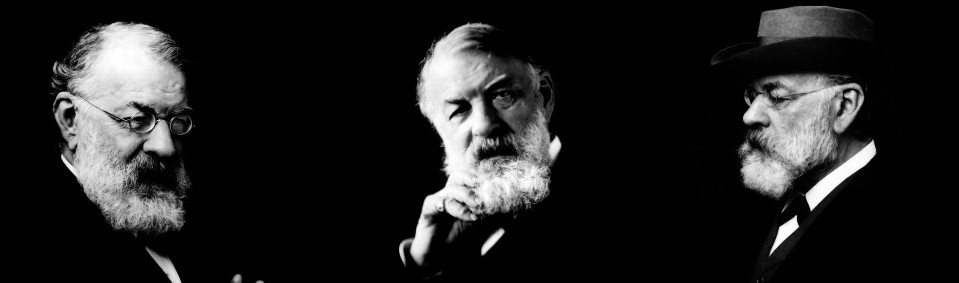
 The Joachim Quartet (1896)

Joseph Joachim, Robert Hausmann, Emmanuel Wirth, Johann Kruse
28 Tuesday Jan 2014
Posted in Iconography, Joachim Quartet
The Joachim Quartet (1896)
Joseph Joachim, Robert Hausmann, Emmanuel Wirth, Johann Kruse
28 Tuesday Jan 2014
Posted in Iconography
Portrait of Joseph Joachim.
Inscribed ‘Joseph Joachim, London, Mar 9th, 1904’
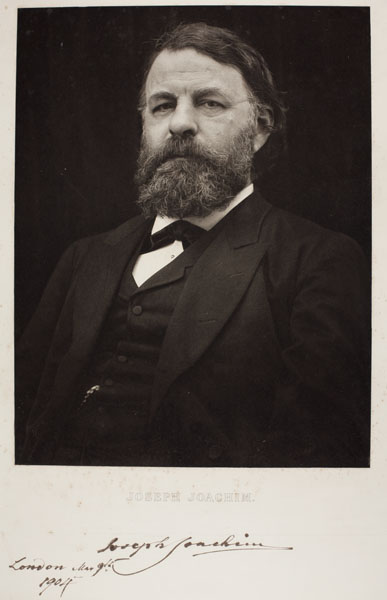
Royal Academy of Music, Museums & Collections, 2003.1567
http://apollo.ram.ac.uk/emuweb/pages/ram/display.php?irn=11149
28 Tuesday Jan 2014
Posted in Iconography, Joachim Quartet
Joachim Quartet. Beethoven Feier in Bonn, 11-15 May 1890.
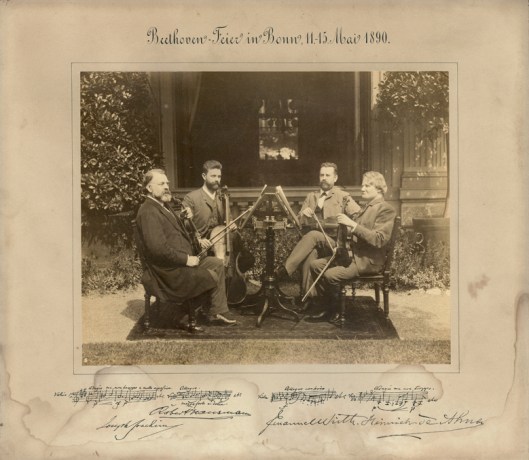
Joseph Joachim, Heinrich de Ahna, Emanuel Wirth, Robert Hausmann
Royal Academy of Music, Museum & Collections, 2004.1969, bequeathed by Norman McCann, 1999.
http://apollo.ram.ac.uk/emuweb/pages/ram/display.php?irn=4719
Related:
http://josephjoachim.com/2014/01/28/beethoven-feier-in-bonn-1890-joachim-reinecke-and-piatti/

28 Tuesday Jan 2014
Posted in Iconography
Portrait of Alfredo Piatti, Carl Reinecke and Joseph Joachim with musical quotations. Beethoven Feier in Bonn, 11-15 May 1890.
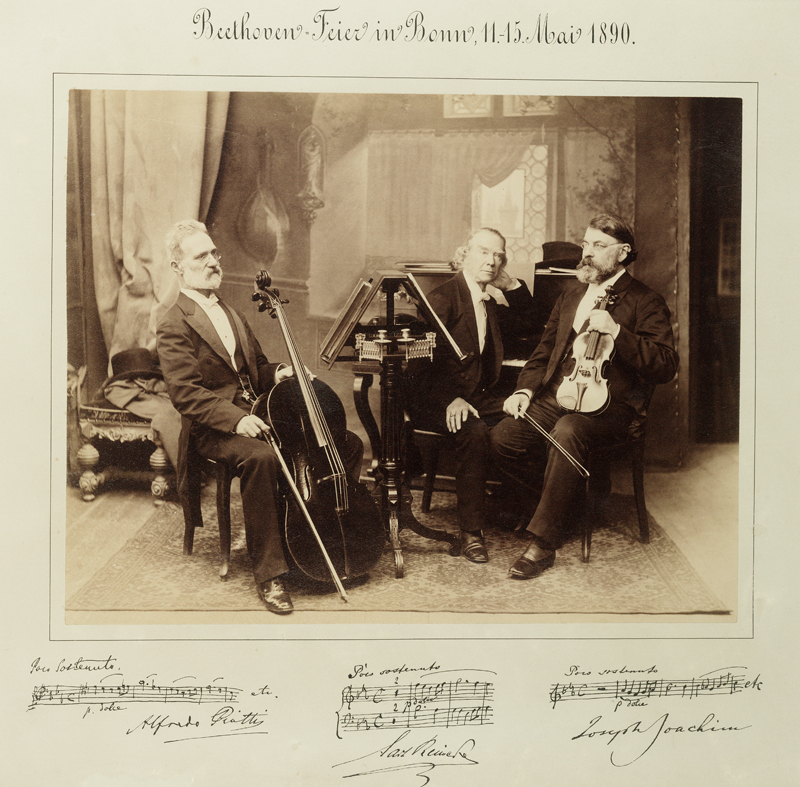
Royal Academy of Music, Museum & Collections, 2004.604, bequeathed by Norman McCann, 1999.
http://apollo.ram.ac.uk/emuweb/pages/ram/display.php?irn=3303
Related:
http://josephjoachim.com/2014/01/28/joachim-quartet-beethoven-feier-in-bonn-11-15-may-1890/
24 Friday Jan 2014
Posted in Iconography
Joseph Joachim, 1879

___________

Portrait: Carl Krause, Berlin

22 Wednesday Jan 2014
Posted in Iconography
The Illustrated Sporting and Dramatic News (February 14, 1885), p. 536.

© 2014 Please acknowledge the source: Joseph Joachim — Biography and Research: http://www.josephjoachim.com
21 Tuesday Jan 2014
Posted in Biographical Sketches, Miscellaneous Articles, Pages
The South Australian Advertiser, (Adelaide, SA, Monday, October 31, 1859), p. 3.
The following is one of the earliest published biographical sketches of Joseph Joachim — a translation from the German language Jewish Chronicle and Hebrew Observer, excerpted from Beth-El by Ignaz Reich. It is clearly based on information that could only have come from Joachim’s family, and is therefore likely reliable, if not exactly dispassionate. It is confusing, however, concerning the date of Joachim’s first trip to England, which was in 1844, not 1843, as reported here. This discrepancy is at present unexplainable.

HERR JOACHIM. — A BIOGRAPHICAL SKETCH.
[From the Jewish Chronicle and Hebrew Observer]
[The following biography has been forwarded by a respected correspondent, with request for publication]
Herr Joachim, the celebrated violinist and composer, has, in a shorter time than any other artist, achieved a European reputation. Young as he is, he deservedly ranks among the highest in the musical world. He is just now again exciting the admiration and receiving the applause of the English metropolis. A sketch of the life, therefore, of this Paganini resuscitated, belonging as he does to the Jewish community, may not be out of place. We condense it from a German publication “Beth-El,” by Ignaz Reich, published at Pest, in 1856, containing the lives of several Jewish Hungarian worthies.
Joseph Joachim is a native of Kitsee, in Hungary. When he was yet a child his parents settled at Pest. Here the musical talent of the child, scarcely five years old, soon showed itself, and had opportunities for development. His sisters receiving instruction in music, the sounds seemed to have had a magical effect upon the boy, and he listened to them with intense and unwearied attention. Soon he begged his father to be permitted to take lessons in music like his sisters. The violin was the instrument chosen for him. The progress which he made in the first month disclosed at once his extraordinary talent. More and more skilful masters had to be engaged for him, and a ray of intellectual satisfaction was often seen to light up his countenance, when, after conquering some extraordinary difficulty, a smile or an applauding nod of his teachers, to whom he clung with filial attachment, rewarded his perseverance, and encouraged him to further efforts. At the age of six, after a study of about one year, he executed in public, before the gentry and nobility of Pest, the variations of Pechatsek; the applause was immense. At the age of eight he was sent to Vienna, where he for three years continued his studies under the greatest musicians. During this period he but rarely played in public; but when he did he excelled all other competitors. The leading papers of the day, in speaking of his performance on January 31, 1842, said, “The palm of the evening is due to a boy of ten years old, Joachim, a pupil of Professor Böhm, who played the variations of Ernst with astonishing excellence. On hearing the playing of this boy, the marvellous skill, the depth of feeling, the plaintive notes, as it were the sorrow of the instrument, and the musically expressed grief, one is led to believe that the whole is a delusion — some charming dream. In this boy we see the ripest fruit of bloom; in him we perceive the accomplished deep-feeling artist.
Towards the end of 1842, at the age of eleven, he went to Leipsic, in order to enter the musical academy. There he played at a private concert, in the house of Mendelssohn Bartholdy. The greatest masters of the art listened in deep emotion to the boy; for a long time the enrapturing sounds of his instrument alone were heard. When he had finished, Mendelssohn solemnly walked up to the violinist, and impressing a kiss on his forehead, enthusiastically called out, “I, myself, was once such a child.” More was not requisite. Joachim’s artistic position was now marked out. Henceforth Mendelssohn proved his most faithful patron, his warmest friend. House and heart of the great master were now alike open to the child. It was Mendelssohn who opposed his entering the musical academy, declaring that he had outgrown this institution, and that he would find there no equal. Mendelssohn himself, as well as David and Hauptmann, gave him private instruction.
In 1843 Herr Joachim undertook his first journey to London. He was provided with influential letters of recommendation, especially on the part of his teacher and friend Mendelssohn. In consequence thereof the boy, of thirteen years old, had the honor of playing at Windsor before the Queen, the Emperor of Russia, the King of Saxony, the Duke of Wellington, and a number of the highest statesmen. The Queen, as a token of her approbation, presented him with a gold watch and chain.
The following is a translation of the letter of introduction which Joachim brought from Mendelssohn to Moscheles: — “Dear Friend — By these lines I present to you a boy who, during the nine months that I have known him, has become truly dear to me, has entwined himself round my heart, and of whom I have conceived such a high opinion (hochachtung), as I entertain but for few with whom I have latterly been in contact. It is Joachim, of Pest, in Hungary, a boy 13 years old, who intends to pay a visit to his uncle residing in London. I cannot sufficiently describe to you his extraordinary marvellous talent in handling the violin. You must hear him yourself to be able to judge of the manner in which he plays all existing solos, and of the ease with which he deciphers everything in notes, how he discerns and knows music — to be able to form an estimate of the results awaiting him in the art, and whereby I am justified to assign him the high rank in which I place him.
“At the same time you will find in him an excellent, sound, well-educated, honourable, and shrewd lad, most intelligent and upright.
“Be therefore attentive to him, and befriend him in this great metropolis of the world. Present him to such of our acquaintances as know how to appreciate such a bright phenomenon, and who on their part may afford him assistance and stimulate his development. In this I principally bear in mind our friend Horsley. Introduce him also, if convenient, to Chaliers. In general, whatever you do for the boy you do for myself. Expecting to see you soon, God willing, I am, &c.,
“MENDELSSOHN.”
Moscheles endeavoured with all his heart to comply with the wish of his friend. Through him Joachim soon became acquainted with all the musical celebrities of London. Here he made the acquaintance of Ernst, Sivori, Lablache, and also, if we are not mistaken, of Schuhmann [sic], with whom he soon became befriended. After a sojourn of three months in London, he returned to his quiet Liepsic [sic] as an artist of note. Here again he devoted himself with the greatest zeal to his studies, as though he had never quitted that town. How little he was spoiled by the extraordinary applause which his performances met in the great English metropolis is evident from the following extract from the letter which the feeling lad, soon after his return, addressed to his parents: — “I continue my lessons with Herr Hauptmann. My German master believes that he will in a fortnight be able to instruct me again. I hope in the course of this winter to make considerable progress in music and other branches of study. I rise every day at six o’clock in the morning, when I study Latin, classics, or some other useful work, until breakfast. The whole forenoon afterwards I devote exclusively to music, the violin in particular, composition, and the necessary practice in thorough bass. At half-past two in the afternoon I recommence working, writing till four o’clock: from then till eight I play pianoforte; then, having taken a walk and supped, I again study music until nine o’clock. Sometimes I commit to memory passages from our splendid Schiller, whilst also composing a concert and diligently practicing music.”
For a whole year he now devoted himself to study, before he appeared the second time before the public. In 1844 he went again to London, where he played at one of the Philharmonic concerts, although by the rules of the society no artist under 20 was admitted to any performance there. The leading papers were loud in their praise of the young violinist. In 1847 he went to Paris. The reception with which he was met by the French musical world was not less enthusiastic than that accorded to him in England. He then returned to England, and on the invitation of the principal provincial towns, visited them. He now returned to his quiet Leipsic, where he, for seven consecutive years, incessantly applied himself to the cultivation of art and science. He had the gratification of being appointed professor in that very academy which a few years before he was to enter as a pupil. But now an event happened which for a time seemed entirely to prostrate him. On the 5th November, 1847, the following letter was received from him in Pest: —
“Dearest and Good Parents — Prepare yourself to hear from me something unspeakingly sad and terrible. God Almighty yesterday visited me with a great calamity. All my joy, all my hopes, all, all was blighted — yesterday, at nine o’clock in the evening — Mendelssohn is dead! A world of grief lies in these three words. Alas, it is but too true — dead, dead, dead! It is impossible for me to think of anything else, or to listen to a sound of music. Mendelssohn had been unwell for some time; yesterday a week he got worse, and a fit of apoplexy supervened. There was, nevertheless, hope until the day before yesterday, when at two o’clock he had a renewed severe fit, and he became worse. Last evening a rattling in the throat commenced, gradually his strength failed him, and at a few minutes after nine o’clock he passed over into a better world, calm like an angel.
“the thoughts of you and other dear persons at Pest is the only thing that keeps me up; but I am very unhappy, and shall never be cheerful again. You may easily imagine, my dear parents, how pleased I should be with a few lines from you, and I fervently trust that I shall see your handwriting.— Yours, disconsolate,
“JOSEPH.
This melancholy occurrence had indeed produced a deep and lasting impression upon Joachim’s mind. The sounds which he henceforth elicited from his instrument became more solemn, more august; a profound melancholy pervaded them. It is as though we heard in them the whispers of blissful departed spirits. Henceforth his youthfulness quickly matured into manly earnest, and composing now became his favourite occupation.
In 1851, induced by Lisst [sic], he resigned his teachership at Leipsic, and accepted the office of court concert-master from the Grand Duke of Weimar. Lisst, in writing to a friend, alludes in the following terms to his meeting with Joachim: “I lately had a very agreeable visit, which contributed not a little to restore my health. The visitor was Joachim, whom you probably remember. You know that I succeeded in carrying him off from Leipsic, and to draw him to Weimar, where he officiates as concert-master. He is an artist through and through, his execution is vigorous and splendid, and I believe I am not mistaken when I add that in four or five years — he is not yet 20 year old — he will excel all violinists in Europe. To form an idea of his consummate mastery one must hear him play Bach, Beethoven, or Paganini. The full vigorous sound, the depth of his style, the tenderness in the details, the fire, life, and soul of music — everything is blended there on a large scale to perfection; yet more, he exhibits the character of a true, loyal, and exceedingly modest artist.”
However, he only remained one year at Weimar; in 1852 he accepted a similar appointment from the King of Hanover.
Among his principal works we notice his “Hebraeische Lieder,” to which Lord Byron’s “Hebrew Songs” had given him the impulse. Herr Joachim is at this moment in London; and we all known [sic] how the musical world has received his performance.
20 Monday Jan 2014
Posted in Concert Reviews & Criticism
Der Humorist, Vol. 3, No. 187 (September 19, 1839), p. 745.
__________
One of the earliest notices, from Joseph Joachim’s debut concert in Pesth, by M. G. Saphir.
Paprika-Notes from Hungary
by M. G. Saphir
Pesth
I was very sorry not to be able to attend a concert by the worthy and talented Mr. Serwaczynzky, in which a young Wunderkind, a boy of the tenderest age, Joachim, let himself be heard on the violin, and who, according to the judgment of all connoisseurs and professionals, achieved astounding things, and justified enormous expectations. […]

Paprika-Notizen aus Ungarn
Von M. G. Saphir.
Pesth.
Sehr leid war es mir, ein Concert des verdiest- und talentvollen Hrn. Serwaczynzky nicht beiwohnen zu können, in welchem ein junges Wunderkind, ein Knabe in dem zartesten Alter, Joachim, sich auf der Violine hören ließ, und welcher, nach dem Urteile aller Kenner und Männer vom Fache, Erstaunliches leistet, und zu den ungeheuersten Erwartungen berechtigt. Meine Zeit war mir so knapp zugemessen, daß ich kaum die wertesten und liebreichsten Freunde und Freundinnen besuchen konnte, sie mögen diese Zeilen als Besuch und Entschuldigung gefälligst hinnehmen, und die Zornschale nicht ganz auf mein unschuldig Haupt ausgießen.


14 Tuesday Jan 2014
Posted in Concert Reviews & Criticism
Der Wanderer in Gebiete der Kunst und Wissenschaft, Industrie und Gewerbe, Theater und Geselligkeit, Vol. 30, No. 45 (Wednesday, 22 February, 1843), p. 179.
__________
Private Entertainment of Franz Glöggl.
The Day Before Yesterday in the Hall of the Musikverein
[…] Hereupon, the little Joachim played Ernst’s “Othello Fantasy.” I have never so regretted that the term Wunderkind is so used up, and moreover has a bad reputation, as now, for, in my haste, I can find no other suitable term for this little hero of the violin. I heard Joachim today for the first time, and I must confess that I often could not believe my eyes. This powerful stroke, this lively combination of colors [Colorit], this astonishing bravoura, and from a small boy, twenty Paris Zoll in height, that works these wonders — — what should one demand from finished virtuosi?

Privat-Abendunterhaltung des Franz Glöggl.
Vorgestern im Musikvereinssaale.
[…] Hierauf spielte der kleine Joachim Ernst’s “Othello-Fantasie.” Nie habe ich es bedauert, daß der Name Wunderkind so abgenützt ist, und überdieß im schlechtem Geruche steht, als jetzt, den ich weiß in der Eile keine andere passende Bezeichnung für diesen kleinen Helden der Violine aufzufinden. Ich hörte Joachim heute zum ersten Male, und muß gestehen, daß ich oft meinen Augen nicht trauen zu dürfen glaubte. Dieser kräftige Streich, dieses lebensvolle Colorit, diese staunenswerthe Bravour, und ein Bürschlein, zwanzig Pariser Zoll lang, das diese Wunder übt — — was soll man von den fertigen Virtuosen fordern?

13 Monday Jan 2014
Posted in Concert Reviews & Criticism
Der Humorist. Von M. G. Saphir, Vol. 7, No. 143 (Thursday, 20 July, 1843), p. 379.
__________

While visiting his family, the amiable violinist, Joseph Joachim, also highly esteemed in the [Imperial] Residence, has given a private academy in the salon of his uncle, the wholesaler Herr Vigdor. All that our city has to show for artists and patrons of art graced this private concert with their presence. The winsome little singer (that is Joachim on his instrument) was smothered in caresses. He who has not seen this Wunderkind with his own eyes as he performs the compositions of Classical masters would believe himself to be hearing a Nestor, or one of the modern, celebrated heroes of the violin. Joseph Joachim lacks only world renown — the aura of widespread reputation, in order to shine, both spiritually and technically, amongst the violin-stars of the present. Whether his honorable family will see their wish fulfilled, to have the great public delight in their darling’s songs, is not yet determined.
Joseph Joachim: Early Daguerreotype
Der liebenswürdige Violinspieler, Joseph Joachim, auch in der Residenz rühmlichst bekannt, hat, auf Besuch bei seiner Familie anwesend, im Salon seines Onkels, des Großhändlers Hr. Vigdor, eine Privatakademie veranstaltet. Was unsere Stadt an notablen Künstlern und Kunstmäcenaten besitzt, verherrlichte dieses Privatconcert. Der herzgewinnende kleine Sänger (das ist Joachim auf seinem Instrumente) wurde von Liebkosungen erdrückt. Wer dieses Wunderkind, während es die Kompositionen klassischer Meister vorträgt, nicht mit eigenen Augen seht, glaubt in der That einen Nestor, oder einen der modernen, gefeierten Heroen der Violine zu hören. Joseph Joachim fehlt nur noch die ausgebreitete Weltbekanntschaft — der Nimbus des verbreiteten Rufes, um schon jetzt in geistiger wie in technischer Beziehung unter den Sternen der Violinisten der Gegenwart zu glänzen. Ob seine verehrliche Familie dem allgemeinen Wunsch: das große Publikum an den Gesängen ihres Lieblings delektiren zu lassen, nachkommen werde, ist bis jetzt unentschieden.

__________