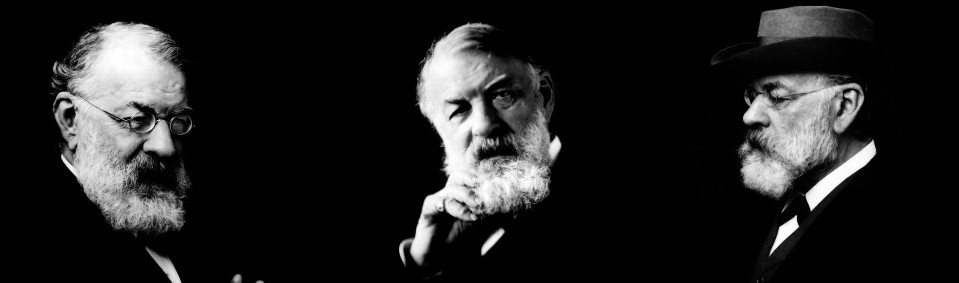
© Robert W. Eshbach, 2007
(Originally published in Die Tonkunst, Jg. 1, Nr. 3, Juli 2007, 205-217.)
Der Geigerkönig Article
To Eric Rosenblith
Gifted teacher, profound practitioner of our great art

I — The Composer’s Voice
To those who knew Joachim in his latter years, he was the Geigerkönig — the “King of Violinists” — the “Last of a Classic School.” Reflecting on Joachim’s career, Brahms biographer Florence May observed:
“…from early childhood Joachim never appeared on a platform without exciting, not only the admiration, but the personal love of his audience. His successes were their delight. They rejoiced to see him, to applaud him, recall him, shout at him. The scenes familiar to the memory of three generations of London concert-goers were samples of the everyday incidents of his life in all countries and towns where he appeared. Why? It is impossible altogether to explain such phenomena, even by the word “genius.” Joachim followed his destiny. His career was unparalleled in the history of musical executive art. It began when he was eight; it closed only a few weeks before his death at the age of seventy-six.” [1]
Five-score years after his death, Joachim remains a celebrated artist. There is hardly a biography of any 19th-century musician in which we do not read his name. Letters, memoirs, photographs, recordings and manuscripts survive, giving evidence of his remarkable life, rich in music and association. In that sense he is, as British poet-laureate Robert Bridges wished he would be,
Remember’d when thy loving hand is still,
And ev’ry ear that heard thee stopt with dust. [2]
And yet, Carl Flesch observed, “the remembrance of a great interpreter grows weaker in the degree that the living witnesses of his achievement go the way of all flesh.” Twenty years after he died, the vital Joseph Joachim was already fading from public consciousness, and Flesch noted with regret that he was beginning “to take on the semblance of a myth.” “It is not surprising that Joachim’s musical and technical advantages are no longer entirely comprehensible to the youth of our day on the basis of mere description,” he wrote. “For the very essence of Joachim’s playing eludes description, in as much as it was not purely technical, but lay in an indefinable charm, an immediacy of feeling which caused a work played by him to be haloed with immortality in the listener’s recollection. What our time fails to understand is not so much Joachim’s violin playing as Joachim’s spirit.” [3]
Today, the transformation from man to icon is complete: Joachim’s position in the musical pantheon is that of the distinguished, musically conservative violinist, the graybeard gatekeeper of 19th-century Germany’s musical establishment — and especially the eminent “Friend Of Brahms.” Few remember Jussuf Joachim, the youthful Joseph who stood at the center of the greatest artistic disputes of his age — an age renowned for its partisan spirit. For a brief period, around mid-century, Joachim was a Zukunftsmusiker, a member of the musical avant-garde. At the dawn of Weimar’s second Golden Age, Franz Liszt hired the 19-year-old violinist to be concertmaster of his orchestra. There, the young man who had grown up under the personal and artistic guidance of Felix Mendelssohn and Robert Schumann helped give birth to the tone poem and the Wagnerian music drama, and contributed some convincing works of his own in the new “psychological” style. For several years, he enthusiastically carried the banner of this new music — and then he dropped it and walked away. Joachim’s desertion from the progressive cause was Liszt’s first great blow at Weimar, and it stung. But, as May pointed out, “Joachim followed his destiny.” In his long life, he was destined to play many roles: child prodigy, composer of a short but distinguished catalog of works, virtuoso, conductor, pioneer of the quartet literature, Zukunftsmusiker, founding director of the Berlin Hochschule, surrogate and advocate for his early-departed mentors Mendelssohn and Schumann, and midwife to the careers and compositions of others, most notably his great “Friend Brahms.”
Along the way, by precept and example, Joachim helped bring about a fundamental change in the artistic attitude of virtuosi toward composers and their works. “The simple refinement and cohesive unity with which Joachim brought forth the concerti of Beethoven, Mendelssohn, Spohr and Viotti, movements from Bach’s works for violin alone, sonatas of Tartini, the Schumann Fantasy, etc., acted practically as revelations and conveyed to his contemporaries a hitherto completely unknown understanding of the mission of a performing musician,” wrote his biographer Andreas Moser. [4] In Joachim’s youth, virtuosi mostly played a repertoire, often of their own confection, tailored to show off their particular violinistic skills and specialties. Joachim stood as primus and exemplar among a new breed of interpretive artists. According to Leopold Auer: “it was about the middle of the nineteenth century that a nobler, more artistic trend made itself plainly evident in the recital programs of the really great virtuosi. The change was inspired, I am inclined to think, by Mendelssohn, and, after his death, by Schumann in Leipsic and Liszt in Weimar. Ferdinand David and Joachim were the first to make a breach in the approved and sanctioned violin program of their time.” [5] “What type of program did he present at about the middle of the past century?” asked Flesch. “Did he court the public’s favor and follow the example of those who were his colleagues by trying to drag down the auditor’s taste to the level of the fantasies on successful operas? No, what he undertook was to draw his listeners up to him, to extend their understanding, to broaden their intellectual horizon, by offering them a musical fare which in its very self, without any theatrical ‘make-up,’ was of lofty musical worth. What a need of moral earnestness, what courage is required, in the days of Prume’s ‘Mélancholie,’ of Ernst’s ‘Élegie’ and of Paganini’s ‘Carneval de Venise,’ relinquishing all claim to the applause of the multitude, to put on a program of Bach’s sonatas and partitas for solo violin, the concertos of Bach, Beethoven, Mozart and Spohr, and Beethoven’s last quartets! This consciousness of an educational mission entrusted to the artist, of his moral obligation with respect to the composer awaiting the performance of his work, have for the most part become quite foreign to the generations of the age of transcriptions.” [6]
The idea of elevation, of “drawing one’s listeners up,” remains an essential element of Joachim’s legacy — an element as vulnerable in this age of popular culture as it was in Flesch’s “age of transcriptions.” It belongs most properly to the era of Joachim’s youth — a time in which music was enlisted to serve the ideals of Bildung, or edification, as celebrated in the salons of Berlin, Leipzig and Weimar. It was there, in the elite company of the Mendelssohns, Schumanns, von Arnims and others, that Jussuf came of age. The notion of Bildung has deep connections with the Athenian notion of Paideia (παιδεία), the process of educating man to his own ideal form, the Kalos Kagathos — the “beautiful and good.” This process was understood to take place in a social context, in conversation and performance, through occupation with great questions and great works. Like Paideia, it represented a marriage of intellectual, emotional and moral virtues: a quest for mental illumination, a broadening of spiritual horizons and a disdain for that which is understood to be self-seeking or dishonorable. “Supreme is the morally beautiful character, who through reverence for the holy and a deeply felt love of the purely good and true, is educated to a noble revulsion against everything unclean, indelicate and coarse,” wrote the great educational reformer and architect of Bildung Wilhelm von Humboldt. [7]
Joachim was raised an idealist and an acolyte of high culture. He was the first great violinist to receive a university education, which he pursued at Göttingen on his own initiative. To Anton Rubinstein, the young Joachim gave “the impression of a novice at a convent, who knows he can choose between the convent and the world, and who has not yet made his choice.” [8] At 22, Jussuf wrote in Brahms’s commonplace book:
Künstler sollen nicht Diener, sondern Priester des Publikums sein.
Artists should not be servants, but priests of the public. [9]
As we aspire, so we become. “I always felt as though he were a priest, thrilling his congregation with a sermon revealing the noblest moral beauties of a theme, which could not help but interest all humanity,” Auer recalled. [10] “Of all violinists, Joachim… was the noblest of all in his aims, aspirations and ideals,” wrote W. W. Cobbett. “The litteræ scriptæ which remain testify to this, his published letters addressed to leading musicians telling in almost every line of his determination to live for his art as for a religion, to place artistic before commercial considerations and to familiarise his audiences with the music of the greater masters…. He was happily indicated for the task by the possession of an exceptional mentality allied in nature to that of the composers he selected for interpretation, and this it probably was that gave him an almost uncanny insight into their intentions.” [11]
Joachim’s performances were informed by the understanding of a first-rate creator — a composer whose work had been admired by the greatest of his age: Mendelssohn, Schumann, Liszt and Brahms. His contemporaries repeatedly observed that what set him apart as an interpreter was his ability to think like a composer. “His playing was (as Wagner said of Liszt’s) no mere reproduction, but creation,” wrote Donald Francis Tovey. “Only those who have known his playing can realize what a great composer he was. Posterity will learn from his compositions how vivid, and how free from all conventionality or imitative mannerism, was his presentation of classical music.” [12]
Joachim’s contemporaries frequently commented on his ability to disappear into the music that he was interpreting. “You forget the virtuoso, and hear nothing but a musician of the purest water,” observed Thomaskantor Moritz Hauptmann in 1865. [13] And elsewhere: “Joachim stands by himself. It is not his technique, it is not his tone, it is not anything that anybody could describe; it is the reserve of all these qualities, so that you hear, not Joachim, but the music. With all his depth of character, there is a rare modesty about him; he never makes a fuss about himself, but he does make an effect, which is recognised everywhere.” [14]
Joachim is most closely associated with the music of Beethoven, and his interpretation of Beethoven’s Violin Concerto was legendary. When he was just a 12-year-old boy, his electrifying performance of the work in London under Mendelssohn’s direction permanently altered the concerto’s critical reception and helped to rescue the work from an ill-deserved oblivion. According to Eugène Ysaÿe, Joachim played the concerto “… so well that he now seems part of it. It was he… who showed it to the world as a masterpiece. Without his ideal interpretation the work might have been lost among those compositions which are placed on one side and forgotten. He revived it, transfigured it, increased its measure. It was a consecration, a sort of Bayreuth on a reduced scale, in which tradition was perpetuated and made beautiful and strong… Joachim’s interpretation was as a mirror in which the power of Beethoven was reflected.” [15] For Viennese critic Eduard Hanslick, the mature Joachim’s interpretation of Beethoven’s concerto was the greatest of his age:
“At the close of the first movement it must have been clear to everyone that this was not merely an astonishing virtuoso, but an eminent and striking personality. Joachim, with all his bravura, is so completely lost in the musical ideal, that one might almost describe him as having passed through the most brilliant virtuosity to perfect musicianship. His playing is great, noble, and free. . . . The Beethoven Concerto, especially the free, deeply emotional performance of the adagio (which almost sounded like an improvisation), proved the most decided independence of interpretation. Under Vieuxtemps’ bow the concerto sounded more brilliant and lively; Joachim’s interpretation was deeper, and surpassed, with truly ethical power, the effect which Vieuxtemps obtained by reason of his temperament.” [16]
Oral tradition through Joachim’s student Karl Klingler has it that before Joachim, Beethoven’s concerto was played dryly, like an etude, and it produced little effect. [17] All attempts to recreate it as a virtuoso showpiece were similarly unsuccessful. Klingler reaffirmed Clara Schumann’s observation that the mature Joachim played it with “such soul in each little note” that, for the first time, listeners were allowed to partake of the poetry that only a mature musical mind can discover in Beethoven’s score. “It is an error to think that a work ‘can speak for itself,’” wrote Carl Flesch in The Art of Violin Playing. “Its soul is a dream, and it is mute until awakened to life by the magic rod of an artist in harmony with it.” [18]

In May 1843, following several years’ apprenticeship in Vienna with the violinist Joseph Böhm and the composer Gottfried von Preyer, 11-year-old Pepi Joachim arrived on Mendelssohn’s doorstep in Leipzig, determined to study at the newly founded Leipzig Conservatorium. Mendelssohn listened as he played a few solos. Together, they played Beethoven’s Kreutzer sonata. Mendelssohn then gave Joseph a few harmony exercises to complete. When it came time to render judgment, he first asked Joseph’s cousin Herman Wittgenstein what he should do for the boy. “Just let him breathe the air you breathe!” Wittgenstein is reputed to have replied. [19] And that is essentially what he did. In Mendelssohn’s opinion, Joachim did not need a school, but for the next four years he guided the young prodigy, regarding him almost as an adopted son. Six months after arriving in Leipzig, Joachim made his Gewandhaus debut with a virtuoso piece, Ernst’s Othello Fantasy, appearing in the same concert with another debutant: Carl Reinecke, then an aspiring pianist. Another six months later, in May 1844, Joseph gave his famous London performance of the Beethoven Concerto under Mendelssohn’s direction. Following Mendelssohn’s shocking death in 1847, Joachim remained for three despondent years in Leipzig, where his friends and mentors attempted to retain him by creating positions for him at the Conservatorium and in the Gewandhaus Orchestra. But the association there with David, Moscheles, Gade, Klengel and Hauptmann could not make up for Mendelssohn’s absence, and it failed to inspire him to greater artistic achievement. In June 1850, after a musical evening with Joachim, Clara Schumann wrote in her diary: “as enamored as everyone is of him, we can’t warm up to him. His playing is accomplished, everything beautiful, the finest pianissimo, the greatest bravura, complete mastery of the instrument, but that which grips one, that which makes one go hot and cold, is missing — there is neither spirit nor fire in him, and that is bad, for no fine artistic future awaits him. Technically, he is entirely proficient — the other, who knows if that will come?” [20]
It was the astute and generous Franz Liszt who saw Joachim’s potential and led him out of the doldrums. Joachim had made Liszt’s acquaintance four years earlier, while visiting relatives in Vienna. In Liszt’s pied-à-terre, the Hotel Stadt London, the great pianist astonished Mendelssohn’s protégé by sight-reading his mentor’s new violin concerto — with a lit cigar held between his fingers. [21] Now, in 1850, Liszt asked Joachim to join him as a colleague in his ambitious avant-garde enterprise in Weimar. Joachim’s first act in the Athens on the Ilm was to perform the Beethoven Concerto under Liszt’s direction. He continued to work closely with Liszt for several years, as concertmaster and chamber music partner, and, as he himself acknowledged, Liszt’s pupil. [22] Gradually, though, Joachim’s sympathy for Liszt and his disciples began to wane, and in January 1853 he struck out on his own as the Royal Concertmaster in Hanover. On May 17, 1853, four months into his new position, Joachim appeared once again with the Beethoven Concerto. No longer a child prodigy but a 22-year-old artist, he performed the work under Ferdinand Hiller’s baton before an elite — and initially skeptical — audience at the Lower-Rhine Music Festival in Düsseldorf. This performance marked the true beginning of Joachim’s adult career. Clara Schumann was enthralled: “Joachim won the victory over us all with the Beethoven concerto,” she noted in her diary, “but he also played with a perfection, and with such deep poetry, with such soul in each little note, really ideal, that I have never heard such violin playing, and I can truly say that I have never received such an unforgettable impression from a virtuoso. And how the great work was accompanied — with what perfection! It was as if a holy devotion possessed the whole orchestra.” [23] Carl Reinecke, present at the same performance, never forgot it. “What a different person, how much greater he had become in the meantime,” he recalled. “Once an acolyte of virtuosity, now a priest of art… It is an idle thing to describe such consummate playing. But even today, after fifty-six years, I remember clearly that I stole through the loneliest walks of the court gardens, to relive this artistic event inwardly.” [24]
Joachim’s bitter split with Liszt did not occur until 1857, [25] but the seeds of their estrangement were planted with this event, as Joachim grew closer to the Schumanns. The estrangement grew that summer when Jussuf met the astonishing, beautiful, enigmatic Brahms; and a coterie formed that autumn, when, together with Bettina and Gisela von Arnim and the artist Jean-Joseph Bonaventure Laurens, they all experienced a brief idyll of music, art and conversation before the darkness fell.
For years, Joachim and his partisans would seek to play down Liszt’s influence on his style, but Joachim’s debt to Liszt is clear. Knowledgeable contemporaries, such as Joachim’s student Waldemar Meyer, were struck by the similarity of their artistry, and regretted the personal rift between the two artists. Joachim himself acknowledged that his playing combined the “strictness of Mendelssohn and the freedom of Liszt,” [26] and, as Moser tells us, he often cited the article On Conducting, in which Richard Wagner had chided him: “…from what I have heard concerning his playing, this virtuoso truly knows and practices the style of execution I demand for our great music. Beside Liszt and his disciples he is the only musician I know to whom I can point as a proof and example of the foregoing assertions. It is irrelevant if it annoys Herr Joachim, as I understand, to be mentioned in such company; for, with regard to that which we can do, it matters little what we choose to profess, but what is true. If Herr Joachim thinks it necessary to allege that he has developed his fine style in the company of Herr Hiller, or of R. Schumann, this may rest upon its merits, provided he always plays in such a way that one may recognize the good results of several years’ intimate association with Liszt.” [27]

II — Das Freispielen
…There has hardly ever existed a more subjective artist, in the noblest sense of the word, a genius of interpretation who ever renewed without repeating himself. In spite of the fact, he has been labelled “objective,” whereas he was, perhaps, the most subjective of all violinists, save that he was dominated by his reverence for the art-work, whose spiritual content he was able to select as the guiding thread for the manner of his own expression. [28]
— Carl Flesch
At the beginning of the twentieth century, a young Scottish violinist, Marion Bruce, later Marion Bruce Ranken, attended the Berlin Hochschule, where, in the course of six years of lessons with Karl Klingler, she came regularly into contact with Joachim and his quartet colleagues. Her inexplicably neglected memoir is one of the most extensive and valuable sources of information extant about Joachim’s playing and teaching, as well as that of his Hochschule colleagues. [29] Like many such works, it has the character of a defense of a beloved but dying art, and thus continually draws useful contrasts with more modern practice. Among Ranken’s many perceptive comments on Joachim’s playing two stand out, especially when taken together. First, Ranken notes the characteristic “which of all its qualities was the most striking… i.e. its spontaneity — the impression made that nothing was prearranged, that all of it was feeling and thought experienced at the very moment of playing.” [30] At the same time, she notes that the “restfulness (Ruhe) of Joachim’s playing was continually being commented upon… and no one hearing him could help being struck by this quality in all his performances, whether of slow or fast music. Liveliness, spirit, subtlety, speed, nothing seemed to make any difference to this sense of rest and balance…” [31]
By all reports, Joachim was a supremely centered and balanced performer — personally, musically, and physically. “Joachim’s bearing was exemplary and truly regal,” wrote Karl Klingler. “His appearance alone sufficed to give an audience the confidence that something extraordinary could be expected to occur.” [32] His stance, adopted and taught by his disciples Adila Fachiri, Jelly D’Aranyi, Carl Courvoisier, Karl Klingler and others, was “normal, easy and dignified, without any angularities or any self-conscious pose liable to distract the attention of the listener from the music.” [33] “The stillness of Joachim’s style of playing was a thing which every one noticed,” wrote Ranken. “There never were any disturbing or unnecessary movements and yet there was the greatest sense of flexibility. I have since come to the conclusion that this complete absence of rigidity was due to the fact that his body was never really motionless although it seemed to be so; but that all the movement was in the contrary direction to that of the bowing.” [34]
If there was a natural freedom in Joachim’s physical approach to playing, there was a lack of rigidity, too, in his interpretation. “He has unjustly been called a ‘Classical violinist,’” claimed Carl Flesch, “with the somewhat suspect implication that this adjective has acquired in common parlance over the course of time, and that always puts one in mind of a certain respectable stuffiness. In reality he was romantic through and through, inwardly unrestrained, in fact, disposed to be somewhat gypsy-like, and he remained so over the course of time, just as his ‘Concerto in the Hungarian Manner,’ would lead us today to imagine him.” [35]
The charge, often made against Joachim in his latter years, that his playing was “dry and academic,” probably stems from his manner of tone-production, which, in the heyday of Ysaÿe, had long since gone out of fashion. Ranken describes an “intense and pure tone, which can be produced without any vibrato whatever” as being characteristic of the Joachim quartet. This tone, produced with a slow-moving bow (usually in the middle) was used in all dynamics from pp to ff. “Joachim very generally used this sort of tone in deep and intense passages, such as those which occur so often in Beethoven,” claimed Ranken, “and once having heard them played so, the sickly wobble of most modern playing, in such places, becomes very painful.” [36] Elsewhere she states: “no one who listened appreciatively to his playing will ever forget the stillness and grand simplicity of the way he so often played slow themes of Beethoven, allowing himself not one single slide when avoidable or one hint of vibrato, but remaining unabashed in the low positions, using fingerings such as would probably be chosen for a child in its first lessons.” [37]
All of the players in the Joachim tradition railed against the modern habit of continuous and wide vibrato. [38] It is well-known that Joachim used vibrato sparingly, as a means of emotional emphasis rather than as an artificial sweetener for the sound, and that his vibrato was of a quick, close variety: according to Flesch, more of a Bebung (“tremble”) than the plangent pulsation of a Kreisler or Ysaÿe. Nevertheless, according to Ranken: “Joachim’s flexibility of wrist, both right and left, was famous. Consequently his vibrato was very easy and free, and he used it a great deal and with the greatest effect when he wished to.” […] “The sudden free use of vibrato immediately after the still, intense tone already mentioned and in contrast to it, was an effect often produced with great expressiveness. Or still more striking was the sudden hairpin crescendo out of dead stillness culminating in a sforzando climax, where every ounce of force, both of bow and of vibrato, would be let loose.” [39] “Vibrato was made great use of in sforzandos and the fact that it was often switched off entirely in other places made the added weight that it imparted on such occasions all the more effective.” [40]
The lack of a consistently sweet, saturated sound renders all the more important the variety of articulation and degree of expressivity produced with the bow alone. “He had… all tone colors on his palette,” recalled Andreas Moser, “and knew how to mix them in such a manner that his slow movements were as reverently devotional as his fiery-rhythmic movements were electrifyingly Magyar-like. Of all other artist violinists together, I have not heard the words “tone color” and “supple tone production” used nearly as frequently as of Joachim alone.” [41]
That Joachim was a master of tempo rubato is one of the most universally noted aspects of his style. Modern scholarship identifies two main varieties of rubato playing: a Classical type — rhythmically emancipated melody over a strict rhythmic foundation— and a freer “agogic rubato” — alteration of the underlying tempo — increasingly favored as the 19th century progressed. The Classical, “contrametric” [42] type of rubato, identified by Pier Francesco Tosi in 1723 and well known from the writings of the Mozarts, father and son, [43] seems always to have been regarded as a rare art — the province of only the most sophisticated performers. In Joachim’s youth it was practiced by such musicians as Spohr and Viardot-García. Later, it continued to be employed by some in Joachim’s circle for a considerable time after it had fallen into general disuse. Its nature was well described by Joachim’s friend Bernhard Scholz, who, as late as 1859, learned it from the eminent baritone Julius Stockhausen:
“I often had the pleasure of accompanying [Stockhausen] with the orchestra or at the piano. At first, I endeavored to follow every small inflection of his performance; he asked me, however, to remain calmly and consistently in tempo, even as he allowed himself, here and there, small deviations, which he would then recoup; he could achieve full freedom of motion only on a firm rhythmic base. […] From him I first came to a full understanding of the character of the tempo rubato: freedom of phrasing on an imperturbably stable rhythmic foundation. This is, of course, also what Chopin demanded for the performance of his own music, according to his student Mikuli.” [44]
Joachim, too, favored a contrametric-style rubato, enhanced by copious and varied accentuation, both dynamic and agogic. Sam Franko spoke of “the freedom of his interpretation while preserving perfect rhythm.” [43] Richard Hohenemser observed: “Joachim’s playing was characterized by strict adherence to the underlying pulse (Zeitmass) with constant small deviations, i. e. by the employment of tempo rubato in the Mozartean sense (‘let not thy left hand know what thy right hand doeth’), and further by sharply bringing out all requisite accents. This comprehensive treatment of the rhythm lent his interpretations firmness and, at the same time elasticity and freedom, where the exaggerated use of actual tempo rubato, that is to say change in the underlying pulse, leads to distortion, and the lack of sharp accentuation leads to vagueness, a fact of which even celebrated artists provide ample proof.” [46]
Joachim’s use of rubato extended to quartet playing, with the first violinist taking the lead in the Classical manner of Spohr. According to Ranken: “In long florid passages such as occur so often in slow movements of Haydn or Mozart quartets… above an accompaniment of quavers in the under parts, there seemed in Joachim’s playing to be no attempt at exact ‘ensemble’ between the two, that is to say the quavers, which in this case took on themselves the role of the ‘beat,’ moved along unconcernedly in strict time while the demi-semiquavers moved as unconcernedly up above, without any attempt to syncronise regularly with the beat…, but with free and gracious lines, only making sure to arrive at certain given points at the right moment and together.” [47] This manner of playing was emphasized by Joachim and his colleagues at the Berlin Hochschule as an essential part of musical artistry. “Not only were you ‘allowed’ this freedom from the beat,” declared Ranken, “but if you did not take it, you were at first looked upon as a novice who required instruction and later on as an unmusical person whom it was not worth instructing.” [48]
Joachim did not in principle oppose the judicious use of agogic rubato. According to Andreas Moser, he “frequently expressed himself on the topic of ‘freedom of shaping’ (‘Freiheit des Gestaltens’) with regard to rhythm, and in so doing liked to refer to Richard Wagner’s penetrating essay ‘On Conducting,’ with which he was thoroughly familiar. But he believed that Richard Wagner, with his advice and suggestions concerning the ‘modification of tempo,’ had not sufficiently emphasized moderation and restraint in the use of this means of expression. ‘Spohr was much more careful in his suggestions on the performance of his own works, published in his School of Violin Playing, and he grew to be the excellent conductor that he was later to become, so to speak, under Beethoven’s eyes, during the time that he was active in Vienna.’” [49]
As Wagner noted and he himself acknowledged, the freedom of Joachim’s playing reflects the influence of Liszt. Nevertheless, Andreas Moser traces Joachim’s use of rubato to Mendelssohn’s instruction, and Joachim claimed that his musical father “perfectly understood the management of time as a subtle means of expression.” [50] The lengthening of particular notes for emphasis, agogic accent, was indeed characteristic of the Gewandhaus style under Mendelssohn, [51] and was among the devices that Joachim used liberally, as may be heard particularly in his recording of the Adagio of Bach’s G minor solo sonata. “If my memory is not very much at fault,” writes Ranken,” Joachim used this kind of accent quite freely. In his hands, however, it did not degenerate into a senseless habit.” [52]
Tovey, who often accompanied Joachim on the piano, speaks of his “largeness of rhythm” — the “the giving of full measure,” which is “a primary quality in all great art, both productive and reproductive, and in all great personality.” “But… it follows that to us, who are so much more accustomed to stiff rhythm and therefore take it as normal, true artistic rhythm always seems unexpectedly large for its pace. Taking players of real rhythmic power, it is astonishing to notice how, when they follow Dr Joachim’s reading of a work… they are forced to play actually slower than he does in order to produce an analogous impression of breadth and detail. If they tried to play at his pace their expression would become breathless and coarse.” [53] Klingler, who played in the Berlin Joachim Quartet, called attention to one way in which this was managed: Joachim’s predilection for entering early, to give a relaxed character to upbeat motives. [54] Ranken gives as an instance “the arpeggio triplet on which the solo violin floats up to the high A that begins the first theme of the Beethoven Concerto. One usually hears this played exactly on the last crotchet beat as written, but Klingler, who studied the concerto under Joachim, told me that Joachim always played the triplet broadly, deliberately borrowing what time he needed for this from the rest which precedes it and thus not in any way interfering with the tempo. Played so the triplet has the same serene character as the theme itself, and seems to belong to it, instead of appearing like a rather unhappy tag-end or a flimsy ladder put there only to enable the player to reach his high A in tune.” [55]
To Ranken, this “largeness of rhythm” — this “giving of full measure” — gave Joachim’s playing a retrospective quality, like “one looking backwards through a long vista of years, recalling things long ago felt deeply and subjectively and now made still more beautiful by the distance… Although in Joachim’s later years age may have fixed this deep retrospective attitude as a prevalent mood, one felt that the power to take this most impressive and mature of all long views must have been his much earlier, and that at all times his playing must have conveyed a sense of space and distance…” [56]
Joachim called his practice Freispielen — “free-playing” — a term that has wider implications than are generally understood by rubato. [57] His method of playing was true Freispielen — deliberately spontaneous in its conception. “One felt that it was the replica, the reproduction, which was being guarded against as perhaps the very lowest crime in art,” wrote Ranken. Joachim’s friend, Edward Speyer, remembered:
“It was astonishing, sometimes even amusing, to listen to his variations in interpretation. In a simple Haydn minuet, for instance, you would be particularly delighted by a characteristic rendering of a phrase; you looked forward to enjoying it again in the repeat and would then be pleasantly surprised to hear him play it differently but equally delightfully. I remember his playing with Leonard Borwick the great G major Violin Sonata of Beethoven, Op. 96. Borwick was on the watch for the shape of each phrase and turn which Joachim played, to echo it on the piano. But the next time the phrase recurred Joachim would make a subtle difference and Borwick had to change again. On the other hand, I often heard Joachim stop at rehearsals with his own colleagues and ask them almost naïvely whether they agreed with a turn he had given to a phrase.” [58]
It was the near universal judgment of Joachim’s contemporaries that his playing was characterized by the greatest of all artistic ideals: that which Pablo Casals called “freedom with order.” This is the true substance of classicism, and the sense of Joachim’s late-life reply to the “Proust questionnaire” poser:
“Your favorite composers?”
“The masters of form who have lost nothing in depth of feeling or free flight of fantasy: our great masters.” [59]

III — Performer and Audience
The power of playing a thing perfectly familiar to him “as if he were playing it for the first time,” was a feature of Joachim’s playing which excited much comment and which none could miss who had ears to hear… [Yet this] does not absolutely describe my own personal impression of his performance. To me it seemed more like some one renewing the acquaintance of an old friend — a thing which always calls up deeper human feelings than does the meeting of an entire stranger. Or it was as if her were throwing open a chest full of precious possessions which have been carefully laid aside and half-forgotten and was now experiencing keen pleasure both in discovering new qualities in them and in displaying them to his friends. [60]
— Marion Bruce Ranken
Nearly a decade before he sketched Brahms, the Schumanns and Joachim in Düsseldorf, the artist Jean-Joseph Bonaventure Laurens received a visit from Franz Liszt at his studio in Montpellier. Laurens’ brother Jules recalled their meeting:
Laurens, who had heard of Liszt’s “piano acrobatics,” greeted him in a less than civil way: “You are reputed to be just as great a charlatan as you are a great artist.” Laurens drew his guest, and asked him to play a certain organ piece with obbligato pedal by Bach, the first of the volume of six fugues — the one in a minor — whose difficulties Liszt would certainly be able to master.
Liszt: “Forthwith. How do you want it played?”
Laurens: “What? — Now then, just as one must play it.”
Liszt: “To begin, then, as I believe Bach would have understood it.”
Liszt played wonderfully, perfection itself, and in a strictly classical style. Then Liszt continued: “Now a second time, the way I feel the work, somewhat more colorful and more flowing, in the modern spirit and with the tonal effects of an instrument that has been significantly perfected since the 17th century.” With these nuances, the fugue sounded no less grand. “And finally, a third time, as I would do as a charlatan, to amaze and astonish the public.”
Liszt lit a cigar, held it now between his lips, now in one hand, performed the most unbelievable legerdemain and carried the pedal voice into the left hand. This way, too, the fugue sounded fabulous, and the good Laurens was won over.
In bidding farewell, Liszt signed the sketch that Laurens had done of him: “Tel quel pour copie conforme. 13 août 1844. Montpellier. F. Liszt” [61]
One wonders if Laurens fully appreciated the remarkable lesson he had been given. The artist and musical amateur collected musical scores as he would drawings. For him, performance apparently meant simply the precise aural reproduction of the text, like the iteration of an etching: one played “just as one must play it.” In his ingenious and charming way, Liszt gradually widened the circle for Laurens, revealing three different points of view that a performer must consider — that of composer, interpreter and audience — all the while showing an admirable awareness of historical context. And, just so the lesson wouldn’t be lost, he signed Laurens’s sketch with the arch comment that the portrait was a true copy of its original.
“You are reputed to be just as great a charlatan as you are a great artist,” Laurens had said, and Liszt as much as admitted the possibility, at least as far as the greater public was concerned (and revealed the reality when it came to impressing the young protégé of his friend and rival Mendelssohn). According to Joachim’s colleague Ernst Rudorff, it was this element of showmanship in Liszt’s manner — his readiness to treat music as a fungible commodity of personality — his ability to ask “how do you want it played?” as casually as if he were asking “how do you like your eggs?” — his willingness, as he himself once said, to “string the piano differently for the public than for connoisseurs, in order to make an impression” — that ultimately occasioned the breach between the two erstwhile friends. “As proximate as their talents were,” wrote Rudorff, “so radically different were their characters. It was a short beguilement that both believed that they fundamentally belonged to one another; the paths that their deepest natures compelled them to take led them in diametrically opposite directions. Joachim once commented to me: ‘Even in the time of my greatest enthusiasm for Liszt, I never heard him play in such a way that, in the innermost corner of my being, the voice of conscience did not object.’ Later, when I reminded Joachim of this, he claimed: ‘I can’t have said that, because I know, for example, that Liszt, Cossmann and I played the B flat Major trio of Beethoven as beautifully as I have ever heard it in my life. To be sure, the three of us were making music quite alone. As soon as some woman appeared, it was naturally all over with artistic seriousness, and the theater began.’” [62]
The young American Amy Fay was one such admiring object of Liszt’s attention. “Liszt is a complete actor who intends to carry away the public, who never forgets that he is before it, and who behaves accordingly,” she wrote. “Joachim is totally oblivious of it. Liszt subdues the people to him by the very way he walks on to the stage. He gives his proud head a toss, throws an electric look out of his eagle eye, and seats himself with an air as much as to say, ‘Now I am going to do just what I please with you, and you are nothing but puppets subject to my will…’ Joachim, on the contrary, is the quiet gentleman-artist. He advances in the most unpretentious way, but as he adjusts his violin he looks his audience over with the calm air of a musical monarch, as much as to say, “I repose wholly on my art, and I’ve no need of any ways or manners.” In reality I admire Joachim’s principle the most, but there is something indescribably fascinating and subduing about Liszt’s willfulness. You feel at once that he is a great genius, and that you are nothing but his puppet, and somehow you take a delight in the humiliation!” [63]
In his late thirties, Liszt retired from what he described as “my traveling-circus life,” to devote himself to composing, teaching and spiritual matters, and to lead, from his staging ground in Weimar, his futuristic charge against what he called the “posthumous party” located a scant 80 miles away in Leipzig. At a similar age, Joachim, by contrast, gave up composing, except as an occasional occupation, to devote himself to teaching and performance, both of which became, for him, the vehicle for sharing his deepest spiritual joys and concerns. Joachim’s solo repertoire had always been limited, even for his time. It was in quartet playing that he found his true vocation. [64] He founded two quartets, and gave two concert series: one in London and one in Berlin. Perhaps the most significant was the series of quartet concerts that he gave over the course of nearly forty years in Berlin’s temple to musical Bildung, Schinkel’s chastely classical Singakademie — a favored gathering place for Berlin’s edified classes, hallowed through its association with the Mendelssohns and the Bach revival. To borrow Ysaÿe’s phrase, the concerts were “a sort of Bayreuth on a reduced scale, in which tradition was perpetuated and made beautiful and strong.” Like the salons of Joachim’s youth, the Joachim concerts were a haven — a secure public-private space that provided a spiritual oasis for Berliners in an otherwise contentious and mundane world.
In Art and Revolution, Wagner had written: “When the prince leaves a heavy dinner, the banker a fatiguing financial operation, the working man a weary day of toil, and goes to the theater, they ask for rest, distraction and amusement, and are in no mood for renewed effort and fresh expenditure of force. This argument is so convincing that we can only reply by saying: it would be more decorous to employ for this purpose any other thing in the wide world, but not the body and soul of Art.” [64] Those who attended the Joachim Quartet concerts were witnesses for the opposite proposition. Hans Joachim Moser’s description of the atmosphere surrounding those concerts is revealing of the audience’s attitudes and expectations:
“Whenever people entered the Berlin Singakademie for a Joachim Quartet soirée, they greeted one another in a cheerful and familiar way; all were mutually acquainted — indeed, they knew that all had been brought here for the same purpose: to pay homage to beauty. Joachim stood, his violin under his arm, in a corner of the thickly-occupied stage and conversed with this one or that; he chatted as though at home, and when he then walked to his music stand, it was as if he simply wanted to continue the conversation with his dear guests. There was nothing studied or calculated in his movements, when he quietly tuned his violin, when he dog-eared the corner of a page of music or polished his glasses. But then — a slight nod of the head — and he began. An inner excitement came over all of us, a sweet, intangible delight. He who arrived jaded from indifferent occupations or wearying work, was here refreshed; he who had lived frivolously or thoughtlessly was here stirringly admonished. He who had experienced sadness, who had lost that which was dear to him, received solace and comfort; the mourner smiled, the angry were quieted, and the faithless confessed: “I believe again!” [66]
The entire absence of the spirit of display at once made itself felt so that the listeners’ attention, like that of the players themselves, became almost wholly absorbed in the music alone,” wrote Marion Ranken. “There was something venerable and priestlike in the appearance of the four elderly men earnestly applying themselves to their task and one felt a reverent and almost religious spirit in their whole performance. [67] Edith Stargardt-Wolff concurred: “Words can hardly describe the reverential atmosphere of those quartet evenings in the Singakademie,” she wrote. “The audience listened to the quartet’s playing devoutly, like the congregation of a church. Even if one did not know one’s neighbors and those who were sitting nearby by name, one nevertheless felt united with them through regular encounters at this place which was consecrated to the noblest art.” [68]
The artist Adolph Menzel attended the Joachim Quartet concerts from the very beginning until his death on February 9, 1905. Edith Stargardt-Wolff recalled: “A concert of the Joachim Quartet was planned for the same evening. Joachim’s three partners had already seated themselves at their stands when Joachim appeared, mounting the ramp, and, with deepest seriousness, spoke these simple words: ‘Before we begin our program, we wish to play, in memory of the man whose seat is empty today for the first time, the Cavatina from Beethoven’s Opus 130, which he particularly loved.’ — Those present arose, and stood while they listened to the magnificent movement, which may never have been played or listened to with greater warmth of feeling than in that hour.” [69]
Joachim was a man who, in his most impressionable youth, breathed Mendelssohnian air — who imbibed the spirit of Bildung from its greatest prodigy. It was Mendelssohn’s project to use music in the furtherance of universalist social aims, attempting to create, through music, an organic social order in which individual expression and collective identity would be mutually stimulating and supportive. In the Joachim Quartet soirées in Mendelssohn’s beloved Singakademie, as in London, Mendelssohn’s spirit reigned under the auspices of his greatest disciple.
There was, in Joachim’s professional credo, a deeply-felt sense of connection — of covenant rooted in humility and respect. Joachim believed that the performer has a profound responsibility vis-à-vis the composer to portray his works honestly, with dignity, skill and personal sympathy. In bringing a work to life, he has the self-respecting freedom of his own feelings and intuitions, as well as the responsibility to speak his own convictions, sincerely and forthrightly. His covenant with his auditors was to treat them with the respect of a true friend; to regard them as a community — an audience and not a crowd — to throw open for them a chest full of precious possessions, and give them the best that he had to offer.
____________________________
[1] Florence May, The Life of Johannes Brahms, (2 vols) London: William Reeves, n.d. (1905), vol. II, pp. 210-211.
[2] Robert Bridges sonnet: To Joseph Joachim
[3] Carl Flesch, The Art of Violin Playing, New York: Carl Fischer, 1930, pp. 74-75.
[4] Andreas Moser, Joseph Joachim: Ein Lebensbild, (2 vols.), Berlin: B. Behr’s Verlag, 1898, vol. II, pp. 343-344.
[5] Leopold Auer, Violin Playing as I Teach It, New York: Dover Publications, 1980, p. 208.
[6] Carl Flesch, op. cit., pp. 74-75.
[7] Wilhelm von Humboldt, Briefe an eine Freundin, Zweiter Theil, (5. Auflage), Leipzig: 1853, 61. Brief, pp. 291f.
[8] Andreas Moser, op. cit., vol. II, p. 225.
[9] Johannes Brahms, Des jungen Kreislers Schatzkästlein: Ausspruche von Dichtern, Philosophen und Künstlern, Carl Krebs (ed.), Berlin: Verlag des Deutschen Brahmsgesellschaft, 1909, p. 58.
[10] Auer op. cit., p. 6.
[11] Joachim Centenary Concert 1831-1907, Queen’s Hall, London, London: Ibbs & Tillett, July 14, 1931, p. 6.
[12] ibid., p. 8.
[13] Moritz Hauptmann, The Letters of a Leipzig Cantor, Being the Letters of Moritz Hauptmann to Franz Hauser, Ludwig Spohr, and Other Musicians, (2 vols.), Alfred Schöne and Ferdinand Hiller (eds.), A. D. Coleridge (trans.), London: Novello Ewer and Co., 1892, vol. II, p. 167.
[14] Ibid. II, p. 275.
[15] Quoted in Robin Stowell, Beethoven: Violin Concerto, Cambridge: Cambridge University Press, 1998, p. 36.
[16] Quoted ibid. pp. 37-38.
[17] Conversation with Eleonore Schoenfeld.
[18] Flesch, op. cit., p. 69.
[19] Ray Monk, Ludwig Wittgenstein: The Duty of Genius, New York: The Free Press, 1990, p. 6.
[20] Berthold Litzmann, Clara Schumann: Ein Künstlerleben, Leipzig: Breitkopf und Härtel, 1920, vol. II, p. 112.
[21] Andreas Moser, op. cit., vol. I, p. 76.
[22] Johannes Joachim and Andreas Moser (eds.), Briefe von und an Joseph Joachim, (3 vols.), Berlin: Julius Bard, 1911-1913, vol. I, p. 443.
[23] Berthold Litzmann, op. cit., vol. II, p. 278.
[24] Carl Reineke, Erlebnisse und Bekenntnisse: Autobiographie eines Gewandhauskapellmeisters, Doris Mundus (ed.), Leipzig: Lehmstedt Verlag, 2005, pp. 261-262.
[25] “I am completely cold [unzugänglich] to your music,” he wrote to Liszt. “It contradicts everything which from early youth I have taken as mental nourishment from the spirit of our great masters. Were it possible to imagine that I could ever be robbed of, that I should ever have to relinquish, that which I have learned to love and honor in their creations, that which I feel to be music, your sounds would not fill for me any of the vast and annihilating desolation.” [Johannes Joachim and Andreas Moser (eds.), Briefe von und an Joseph Joachim, op. cit., vol. I, p. 442.]
[26] Karl Klingler, “Über die Grundlagen des Violinspiels” und nachgelassene Schriften, Hildesheim: Georg Olms Verlag, 1990, p. 96.
[27] Richard Wagner, Über das Dirigieren, in: Richard Wagner: Dichtungen und Schriften (Dieter Borchmeyer, ed.), Frankfurt am Main: Insel Verlag, 1983, vol. VIII, p. 212.
[28] Carl Flesch, op. cit., p. 69.
[29] M[arion]. [Bruce] R[anken]., Some Points of Violin Playing and Musical Performance as learnt in the Hochschule für Musik (Joachim School) in Berlin during the time I was a Student there, 1902-1909, Edinburgh: Privately Printed, 1939. I am indebted to Dr. Dietmar Schenk for help in ascertaining the author’s identity. Other important sources on Joachim’s playing are the essays of Donald Francis Tovey and Karl Klingler.
[30] Ranken, op. cit., p. 50.
[31] ibid., p. 54.
[32] Karl Klingler, op. cit., p. 1.
[33] Ranken, op. cit., p. 23.
[34] ibid., p. 23.
[35] Carl Flesch, Erinnerungen eines Geigers, 2., Durchgesehene Auflage, Zürich: Atlantis Verlag, 1960, p. 33.
[36] Ranken, op. cit., pp. 12-13.
[37] Ranken, op. cit., p. 16.
[38] Jelly d’Aranyi, for example, recalled her “Onkel Jo’s” advice: “Never too much vibrato!” he said, “That’s circus music.” [Joseph Macleod, The Sisters d’Aranyi, Boston: Crescendo Publishing Company, 1972, p. 48.]
[39] Ranken, op. cit., p. 13.
[40] ibid., p. 41.
[41] Andreas Moser, Geschichte des Violinspiels: Zweite verbesserte und ergänzte Auflage von Hans-Joachim Nösselt, (2 vols.), Tutzing: Schneider, 1967, vol. II, p. 268.
[42] The term is Sandra P. Rosenblum’s, from her Performance Practices in Classic Piano Music, Bloomington and Indianapolis: Indiana University Press, 1988.
[43] “What these people cannot grasp is that in tempo rubato, in an Adagio, the left hand should go on playing in strict time. With them the left hand always follows suit.” — W. A. Mozart, 1777, quoted ibid., p. 379.
[44] Bernhard Scholz, Verklungene Weisen: Erinnerungen von Bernhard Scholz, Mainz: Jos. Scholz, 1911, p. 127.
[45] Sam Franko, Chords and Discords: Memoirs and Musings of an American Musician, New York: The Viking Press, 1938, p. 20.
[46] Richard Hohenemser, Joseph Joachim * 28. Juni 1831 zu Kittsee, + 15. August 1907 in Berlin, Die Musik, Vol. 23, No. 9 (June, 1931), pp. 641-644. In a 1905 essay, J. A. Fuller-Maitland observed: “The moulding of [Joachim’s] phrases, as it may be called, is inimitable, for it consists of slight modifications of the strict metronomic value of the notes, together with slight variations of power such as no marks of expression could convey. “Elasticity” is the word which best expresses the effect of his delivery of some characteristic themes; as in a perfect rubato there is a feeling of resilience, of rebound, in the sequence of the notes, a constant and perfect restoration of balance between pressure and resistance taking place, as an indiarubber ball resumes its original shape after being pressed. Compared with this kind of subtIe modification, the phrasing of many players who lack a keen sense of rhythm, but who wish to play in a free style, suggests the same pressure when applied to a lump of dough; the slackening of pace is here made up by no acceleration in another place as it is with the great artists. It is, perhaps, this subjection to the real laws of rhythm that makes Joachim an extraordinarily easy player to accompany; one seems to know what he is going to do before he does it, and the notes of his phrases seem to follow a natural curve which, once started, must pursue an inevitable course.” [J. A. Fuller Maitland, Joseph Joachim, London & New York: John Lane, 1905, pp. 26-29.] Pace Fuller-Maitland, it should be noted that Joachim’s playing was not always considered easy to accompany. “To play with the ‘old man’ is damned difficult,” one of his partners told Julius Levin. “Always a different tempo and different accents…” [Die Musik, Vol 18, No. 10 (July, 1926), p. 746.]
[47] Ranken, op. cit., p. 79.
[48] ibid., p. 76.
[49] Andreas Moser, Geschichte des Violinspiels, op. cit., p. 268.
[50] Joachim and Moser, Violinschule, Berlin: Simrock, 1905, vol. III, p. 228.
[51] Henry F. Chorley on the Gewandhaus Orchestra: “Then those small aggravations of emphasis, those slight retardations of time, neither finically careful nor fatiguingly numerous, — for which Imagination thirsts so eagerly, so rarely to be gratified, — were all given; and with such ease and nature, that I felt the gift was no holiday effort, got up for once, but the staple mode of interpretation and execution to the place.” [Henry F. Chorley, Music and Manners in France and Germany: a series of travelling sketches of Art and Society, London: Longman Brown, Green, and Longmans, 1844, vol. III, pp. 103-104.]
[52] Ranken, op. cit., p. 78.
[53] Donald Francis Tovey, The Classics of Music: Talks, Essays, and other Writings Previously Uncollected, Michael Tilmouth (ed.), Oxford: Oxford University Press, 2001, p. 644. Tovey’s essays provide many interesting and nuanced explanations of Joachim’s style, too numerous to be included here.
[54] See also: Klingler, op. cit., p. 96.
[55] Ranken, op. cit., p. 129.
[56] ibid., pp. 102-103.
[57] “The literal translation ‘free play,’ or ‘playing,’ does not convey all that was meant by this word… The word ‘Rubato’… is apt, on the other hand, to convey a meaning which was often not intended at all when ‘freispielen’ was spoken of, i.e. a special kind of ‘free playing,’ sudden and emotional, which is more often associated with a Chopin Mazurka or a Hungarian Dance, than with Beethoven or Mozart.” [Ranken, op. cit., p. 67.]
[58] Edward Speyer, My Life and Friends, London: Cobden-Sanderson, 1937, pp. 181-182.
[59] Julius Rodenberg: Zur Erinnerung an Joseph Joachim, Deutsche Rundschau CXXV, (May, 1908), p. 229.
[60] Ranken, op. cit., p. 47.
[61] J. Marcelle Herrmann, J. B. Laurens’ Beziehungen zu deutschen Musikern, Schweitzerische Musikzeitung CV (1965), pp. 257-266.
[62] MS transcript: Brahms-Institut Lübeck ABH 6.3.106.
[63] Amy Fay, Music-Study in Germany, from the Home Correspondence of Amy Fay, Mrs. Fay Pierce (ed.), New York: MacMillan, 1896, pp. 269-270.
[64] His quartet repertoire was comparatively large. In the course of its existence, the Berlin Joachim Quartet’s repertoire included compositions by: Bargiel, Beethoven, Berger, Brahms, Cherubini, d’Albert, Dittersdorf, Dohnányi, Dvorak, Gade, Gernsheim, Haydn, von Herzogenberg, Kahn, Kiel, Klughardt, Mendelssohn, Mozart, von Perger, Prince Reuss, Rubinstein, Scholz, Schrattenholz, Schubert, Schumann, Spohr, Stanford, Taubert, Vierling and Volkmann. [See: Ivan Mahaim, Beethoven: Naissance et Renaissance des Derniers Quatours, Paris: Desclee de Brouwer, 1964, vol. I, p. 276.]
[65] Richard Wagner, Art and Revolution, Ashton Ellis (tr), http://users.belgacom.net/wagnerlibrary/prose/wagartrev.htm accessed 1/7/2005.
[66] Andreas Moser, Joseph Joachim: Ein Lebensbild, op. cit., vol. II, pp. 205-206.
[67] Ranken, op. cit., p. 46.
[68] Edith Stargardt-Wolff, Wegbereiter großer Musiker, Berlin: Bote & Bock, 1954, p. 149.
[69] ibid., p. 149.
Like this:
Like Loading...