• Home
  • INDEX

Joseph Joachim

~ biography and research

Joseph Joachim

Monthly Archives: December 2013

Arthur Hartmann: Joachim’s Death

31 Tuesday Dec 2013

Posted by Joachim in Reminiscences & Encomia

≈ Leave a comment

Arthur Hartmann, Claude Debussy as I Knew Him and Other Writings by Arthur Hartmann, Samuel Hsu, Sidney Grolnic, and Mark Peters (eds.), Rochester: University of Rochester Press, 2003, pp. 210-211.

__________

jj-initials

Joachim’s Death

Deathbed

On the afternoon of 15 August 1907, I was in my home in Berlin giving an American girl a lesson. The sultriness was intense, and presently a terrific thunderstorm with rain broke over the earth. Terrified by it all, I commented to the young woman, “What a storm, eh? What a time for Joachim to die, just like Beethoven!” The lesson terminated and the storm died. I took my hat and went for a walk. Passing a small music store not far from my house, I glanced into the window and there saw the proprietor beckoning to me. Entering, I at once noticed his bloodshot eyes, his tear-stained face. “What is it? What’s the matter with you?” I asked with sudden concern. He choked, sobbingly, “But didn’t you hear? Joachim died this afternoon!” and leaning against the wall, he wept unrestrainedly.

I waited for several days, knowing that hundreds of people were streaming to his house to see the Grand Old Man before burial. And one day I, too, presented myself in Charlottenburg and asked the maid if I might enter. I found myself quite alone in the large rooms and heard the maid say, “There is a gentleman here who asks to see the Meister.” Presently a lady appeared and asked me, “Were you a pupil of my father?” “No, Madame,” I answered quietly, but also without adding any polite words of regretting not to have been. “Your name?” she asked curtly, and I gave it. She inclined her head and with her left hand invited me to advance. And finally I stood at the foot of the casket and gazed long at that calm face, those crooked and twisted fingers, those large tufts of hair protruding from the top of his nose and near his ears, and fervently I prayed: “O, great God Almighty, if only I could take up where he left off, and carry on!” The room was piled high with wreaths from Emperors, Kings, Academies, Artists, and Pupils. I approached closer, and leaning over him gazed at him long — long — all alone with the great, dead Joachim! Then I bowed to him and backed out of the room.

Share this:

  • Share on X (Opens in new window) X
  • Share on Facebook (Opens in new window) Facebook
  • Email a link to a friend (Opens in new window) Email

Like this:

Like Loading…

The Athenæum: Herr Joachim’s Degree (March 17, 1877)

31 Tuesday Dec 2013

Posted by Joachim in Concert Reviews & Criticism

≈ Leave a comment

The Athenæum, No. 2577 (March 17, 1877), pp. 361-362.

__________

jj-initials

HERR JOACHIM’S DEGREE

Cambridge, March 10, 1877

[…] The reasons which led to this degree being conferred on the German violinist are simple. Prof. Macfarren is an enthusiast in his art, and has always been anxious to raise the status of musicians. As it is not the custom for our Government to bestow crosses and orders on musical men, as is done in most continental countries, Prof. Macfarren suggested that honorary degrees should be awarded to Herr Brahms, Herr Joachim, Sir John Goss, and Mr. Arthur Sullivan, and the University authorities readily adopted the suggestion.

[…] There would be considerable difficulty in finding artistic reasons for making Herr Joachim honorary Mus. Doc., if we looked only at his compositions. They are few in number, although they are clever and scholarly; but signs of genius there are none. We know here his March and Trio in c, his Hungarian Concerto, and his Dances (associated with Brahms). He has also composed Overtures to ‘Hamlet’ and ‘Henry the Fourth,’ and to the ‘Demetrius’ of Schiller, [1] and he has written songs, but there is really nothing in them to distinguish him from other clever composers, masters of the grammar of their art, but who possess neither fancy nor imagination enough to impress us with their individuality. Why, then, Mus. Doc. of Cambridge? Because as an executant he occupies an exceptional position — it may be added an unparalleled one. There have been violinists who have surpassed him in the creation and in the execution of difficulties, but there has never been another artist who possessed, so to speak, such a creative faculty in the interpretation of great classical works. He has the essential elements of perfect intonation, of a magnificent tone, of acute sensibility, and of a

362

thorough command of the most intricate scales. His self-possession enables him to play without extravagance of action; he manages the gradations of sound, to the softest pianissimo, without any apparent effort. His intellectuality and poetic temperament, combined with his classical taste in the concertos of Bach, Beethoven, Mendelssohn, and Spohr, have developed points and effects from innermost passages which had escaped all previous executants. When it is added that his career has been consistent throughout, that he has always aimed at introducing music by the masterminds, never pandering to popular prejudices, always encouraging artists as well as amateurs to cultivate a sound school, and that for a series of years, during his visits to this country, he has not only gratified but instructed the general musical public, enough has been stated to justify the University officials in selecting an executant for the first time for a musical degree. And so thought, evidently, the large assemblage gathered in the Senate House, when the Vice-Chancellor, the Master of Clare, greeted the new doctor. Besides being supported by the presence of so many professors and conoisseurs from London, Herr Joachim had University feeling on his side; the undergraduates, ready as they were at whistling music-hall tunes, including the ‘Rogues’ March,’ after the passing of the Mus. Doc., M.A.s, and B.A.s — for there were several — cheered the German artist repeatedly; but their sense of the ridiculous was touched when the orator associated Herr and Madame Joachim with Orpheus and Eurydice, and they supplied at once an Offenbach air.

To turn to the evening concert. Herr Joachim’s MS. Elegaic Overture, in commemoration of Heinrich von Kleist, — the patriot, poet, and dramatist, who committed suicide with a Frau Vogel in 1811, — can boast of little that is suggestive in its subjects, which are dry and formal, ably and vigorously developed as they are. The composer conducted his own work, and did the same duty for the MS. Symphony of his friend, Herr Brahms. […] In addition to the two novelties, the Overture, ‘The Wood-Nymphs,’ Op. 20, by Sterndale Bennett, so genial and graceful, and full of charm; the ‘Song of Destiny’ (Schicksalslied), Op. 54, by Herr Brahms; and the Violin Concerto of Beethoven, Op. 61 (wondrously played by Herr Joachim), were ably conducted by Mr. C. Villiers Stanford, organist of Trinity.  […]


[1] The overture is actually to the ‘Demetrius’ of Herman Grimm.

Share this:

  • Share on X (Opens in new window) X
  • Share on Facebook (Opens in new window) Facebook
  • Email a link to a friend (Opens in new window) Email

Like this:

Like Loading…

Joseph and Amalie Joachim, 1873

23 Monday Dec 2013

Posted by Joachim in Iconography

≈ Leave a comment

Joseph and Amalie Joachim: Die Gartenlaube, vol. 38 (1873), p. 611


Die_Gartenlaube_(1873)_pic_611


© 2014 Please acknowledge the source: Joseph Joachim — Biography and Research: http://www.josephjoachim.com

Share this:

  • Share on X (Opens in new window) X
  • Share on Facebook (Opens in new window) Facebook
  • Email a link to a friend (Opens in new window) Email

Like this:

Like Loading…

Concert: Berlin, February, 1853

16 Monday Dec 2013

Posted by Joachim in Concert Reviews & Criticism

≈ Leave a comment

The Musical World, Vol. 31, No. 8 (February 19, 1853), p. 110
[Deutsche Übersetzung unten]

__________

jj-initials

BERLIN. — JOACHIM’S FIRST APPEARANCE. — The second concert of the Sternsche Verein was rendered remarkable by the first appearance of the young violinist, Joseph Joachim. His name was already well known, but himself, his artistry, had yet to be appreciated. His birth-place is Pesth; he went early to Leipzig, where, as a boy, he was the favourite of Mendelssohn; was afterwards greatly distinguished by Liszt in Weimar, and is now Concert-master in Hanover. But his genius stands not in need of patronage. He came forward as one of those rare artists who in the performance of a few bars manifest the entire greatness of their genius. This it would seem impossible to do in a simple theme, or in some unimportant passages: but yet it is so. Joachim had not played twelve bars when the most joyful astonishment was shewn on every face. His soft, full tone, the charm of his phrasing, the exquisite refinement of his crescendo and decrescendo, in fact, the enchantment that it was to feel the presence of every quality that is desired in an artist, placed him at once in the first rank in our esteem, and proved him to be, perhaps, the greatest living performer on his instrument. The grand cadence that he introduced in the Beethoven concerto seemed to shew that he could also perform all the modern “tours de force” as well as, and better, than the best bravura players of our time. But he had already shewn a gift in which he is unrivalled, and therefore this test of his powers was hardly needed. His external appearance, the awkward, embarrassed way of presenting himself; the half-shy, half-sulky, and yet so winning physiognomy, all shew that the outward world hardly touches him; that it is his art alone which engrosses him entirely. Even his success — and of course he excited a storm of approval, which from the audience of these concerts, the most intelligent in Berlin, is saying a great deal — he received with indifference.  — Suddeutsche Musik Zeitung.

Screen Shot 2013-12-16 at 11.49.10 AM


BERLIN. — JOACHIMS ERSTER AUFTRITT. — Das zweite Konzert des Sternschen Vereins wurde durch den ersten Auftritt des jungen Geigers Joseph Joachim bemerkenswert. Sein Name war bereits bekannt, aber er selbst, seine Künstlerfähigkeiten, sollten noch geschätzt werden. Sein Geburtsort ist Pesth; früh ging er nach Leipzig, wo er als Junge der Liebling von Mendelssohn war; später wurde er von Liszt in Weimar sehr ausgezeichnet und ist nun Konzertmeister in Hannover. Aber sein Genie braucht keine Patronage. Er trat als einer jener seltenen Künstler auf, die in der Ausführung einiger Takte die gesamte Größe ihres Genies erkennen lassen. Es scheint unmöglich zu sein, dies in einem einfachen Thema oder in einigen unwichtigen Passagen zu tun, aber dennoch ist es so. Joachim hatte noch keine zwölf Takte gespielt, als auf jedem Gesicht die freudige Verblüffung zu sehen war. Sein sanfter, voller Ton, der Zauber seines Phrasierens, die exquisite Raffinesse seines Crescendo und Decrescendo, kurz gesagt, der Zauber, den es bedeutete, die Anwesenheit jeder gewünschten Eigenschaft eines Künstlers zu spüren, stellte ihn sofort in unserer Achtung an die erste Stelle und bewies, dass er vielleicht der größte lebende Interpret seines Instruments ist. Die großartige Kadenz, die er im Beethoven-Konzert einführte, schien zu zeigen, dass er auch alle modernen “tours de force” genauso gut wie, wenn nicht besser als die besten Bravur-Spieler unserer Zeit beherrschen konnte. Aber er hatte bereits ein Talent gezeigt, in dem er unübertroffen ist, und daher war dieser Test seiner Fähigkeiten kaum nötig. Sein äußeres Erscheinungsbild, die unbeholfene, verlegene Art, sich zu präsentieren; die halb-scheue, halb-mürrische, aber dennoch so gewinnende Physiognomie zeigen allesamt, dass die äußere Welt ihn kaum berührt, dass allein seine Kunst ihn völlig in Anspruch nimmt. Selbst sein Erfolg – und natürlich erregte er einen Sturm der Zustimmung, was bei dem Publikum dieser Konzerte, dem intelligentesten in Berlin, viel sagt – empfing er mit Gleichgültigkeit. — Süddeutsche Musik Zeitung.

Share this:

  • Share on X (Opens in new window) X
  • Share on Facebook (Opens in new window) Facebook
  • Email a link to a friend (Opens in new window) Email

Like this:

Like Loading…

Joseph Joachim’s Memorial Speech at Robert and Clara Schumann’s Grave, Sunday, 20 May, 1906

14 Saturday Dec 2013

Posted by Joachim in Speeches and Utterances (Joachim)

≈ 2 Comments

Die Musik, Year 5, 4th Quarter, Vol. 20 (1905-1906), pp. 128-129

Translation © Robert W. Eshbach, 2013


jj-initials

Joseph Joachim’s Memorial Speech at Robert and Clara Schumann’s Grave

Sunday, 20 May, 1906

Screen Shot 2013-12-14 at 9.50.41 AM

With reverent homage, we approach the sacred place in which Robert and Clara Schumann rest. Fifty years have passed since the death of the master; just ten years ago Clara Schumann was taken from us. Both remain shining stars in the firmament of art, for creators as well as for performers. The muse of the composer will refresh generations — his songs, his instrumental creations, belong to every corner of the world — and we, too, wish, in these days, to be uplifted by that which he has created. His greatness is to us more eloquent than words can convey. But here we wish especially to remember the noble man, the “lofty” man, as his favorite poet, Jean Paul, called those rare mortals who steadfastly lead a spiritual life, fostering the divine spark in themselves; whose thoughts remain apart from the daily cares of the world, which lies far behind them in insubstantial illusion. And yet, how kindly, how lovingly, this lofty man walked among his fellows; how his supportive nature strove to kindle every spark of genuine, true striving into pure flame. How pure and without envy he was in his admiration of other masters — how he loved Mendelssohn, Brahms — how willingly he acknowledged others, even lesser talents! His writings bear a lasting testimony to this. But also to his love of fairness! He could occasionally be severe, in the consciousness of his pure intentions, and he did not conceal his displeasure. He had an innate, dignified presence that dared not approach anything mean; and yet, at the same time a touching modesty, about which I may be permitted to relate a personal experience from his last years.

Schumann and Clara visited Hanover, and I hoped to give them pleasure with a musical performance. We played quartets for the master, and it was natural that I should choose, among others, a favorite of mine: the F minor quartet by Beethoven. When I thereafter put one of his own magnificent quartets on the stand, seeing this, he gave me his hand in his true-hearted way, and with a typically beautiful expression in his marvelously mild eyes, he said: “No, not this, after what we have just heard!” I shall never forget his cordial tone, and the truth that it conveyed.

Especially here in the town of Beethoven’s birth, it is pleasant to think of this homage. Bonn has honored both great masters with monuments: the one who here entered into the world, and the one who was here delivered into rest. May this remain a symbol to the community to hold Frau Musika in honor, and to work tirelessly for her care. The coming days shall, as we all wish and hope, bear witness to the city’s efforts. But before we leave this sacred place, we wish also to remember, with intimate reverence, the woman who rests by her husband’s side, his Clara, who understood him so completely, and remained his pride and his comfort throughout his earthly pilgrimage. It is uplifting, too, to regard the life of this unique woman, who, in her struggle against a harsh fate, remained strong, never bitter, goodness itself. Robert and Clara will always remain a symbol of purest love; of genuine German spiritual life. All those who had the good fortune to edify themselves in their presence think back on them both with longing. The beauty of these people is purifying for us, even after their passing “much too sacred for their pain.” We wish to pay homage to them by bringing them Rhine flowers — children of spring.

Schumanns


Ehrfurchtsvoll nahen wir huldigend der geheiligten Stätte, in der Robert und Clara Schumann ruhen. Fünfzig Jahre sind hingegangen seit dem Tode des Meisters, vor gerade zehn Jahren war uns Clara Schumann entrissen. Beide bleiben leuchtende Sterne am Kunsthimmel für Schaffende und Ausübende. Generationen wird die Muse des Tondichters erquicken, seine Lieder, seine instrumentalen Tongebilde sind Eigentum aller Weltteile, und auch wir wollen uns in diesen Tagen erheben an dem, was er geschaffen. Es wird beredter von seiner Grösse zu uns sprechen, als alle Worte es vermöchten. Aber hier wollen wir besonders des edlen Menschen gedenken, des hohen Menschen, wie sein Lieblingsdichter Jean Paul diejenigen seltenen Sterblichen bezeichnet, die immer hinieden unentwegt ein Geistesleben führen, den göttlichen Funken in sich fördernd; deren Gedanken dem Weltgetriebe fern bleiben, das weitab in wesenlosem Scheine hinter ihnen liegt. Und doch wie gütig, wie liebevoll wandelte dieser hohe Mensch unter seinen Mitmenschen, wie suchte er fördernd jedes Fünkchen echten, wahren Strebens zu reiner Flamme zu entfachen. Wie rein und neidlos war er in seiner Bewunderung anderer Meister, wie liebte er Mendelssohn, Brahms, wie willig erkannte er andere, auch Geringere an! Seine Schriften geben dafür ein bleibendes Zeugnis. Aber auch für seine Gerechtigkeitsliebe! Er dürfte im Bewusstsein seines reinen Wollens bei Gelegenheit streng sein und verschwieg seinen Unmut nicht. Eine Äussere Würde war ihm eigen, der sich nichts Unlauteres zu nahen wagte; und doch dabei eine rührende Bescheidenheit, für die ein eigenes Erlebnis aus seinen letzten Lebensjahren mitzuteilen mir gestattet sei. Schumann und Clara besuchten Hannover, und ich hoffte, ihnen durch Vorführung von Musik eine Freude zu bereiten. Wir spielten dem Meister Quartette vor, wobei es natürlich war, dass ich u. a. ein Lieblingsstück von mir wählte, das f-moll Quartett von Beethoven. Als ich nun darauf eines seiner eigenen herrlichen Quartette auf das Pult legte und er dies sah, gab er mir in seiner treuherzigen Weise die Hand und mit einem eigentümlich schönen Ausdruck der wunderbar milden Augen sagte er: “Nein, dies nicht, nach dem, was wir soeben gehört!” Ich werde die Herzlichkeit im Ton, die Wahrheit, die daraus sprach, nie vergessen. Es ist wohltuend, gerade hier in der Geburtsstadt Beethovens an diese Huldigung zu denken. Beide grosse Meister hat Bonn durch Monumente geehrt, den hier in die Welt eintretenden, den hier zur Ruhe eingegangenen. Möge dies der Gemeinde ein Wahrzeichen bleiben, Frau Musika in Ehren zu halten, für ihre Pflege rastlos tätig zu bleiben. Die kommenden Tage werden, wie wir alle wünschen und hoffen, Zeugnis für das Streben der Stadt geben. Bevor wir aber diese geweihte Stätte verlassen, wollen wir in inniger Verehrung auch derjenigen gedenken, die an des Gatten Seite hier ruht, seiner Clara, die ihn so ganz verstanden, die sein Schmuck und sein Trost durchs ganze Erdenwallen blieb. Erhebend ist es auch, das Leben dieser einzigen Frau zu betrachten, die im Kämpfen gegen ein herbes Geschick stark, nie verbittert, die Güte selbst blieb. Immer werden Robert und Clara ein Symbol reinster Liebe, echten deutschen Seelenlebens bleiben. Mit Sehnsucht denken alle an die beiden zurück, welchen das Glück ward, in ihrer Nähe sich zu erbauen. Die Schönheit dieser Menschen bleibt läuternd für uns, auch nach ihrem Heimgang ‘viel zu heilig für ihren Schmerz.’ Wir wollen ihnen huldigen, indem wir rheinische Blüten, Kinder des Frühlings, darbringen.
Share this:

  • Share on X (Opens in new window) X
  • Share on Facebook (Opens in new window) Facebook
  • Email a link to a friend (Opens in new window) Email

Like this:

Like Loading…

Image

Joachim at 40 (1871)

14 Saturday Dec 2013

Musikalisches Wochenblatt, Vol. 2, No. 24 (June 9, 1871), p. 377


1871 Portrait Musikalisches Wochenblatt


$_57


$_57-1


 © 2014 Please acknowledge the source: Joseph Joachim — Biography and Research: http://www.josephjoachim.com

Share this:

  • Share on X (Opens in new window) X
  • Share on Facebook (Opens in new window) Facebook
  • Email a link to a friend (Opens in new window) Email

Like this:

Like Loading…

Posted by Joachim | Filed under Iconography, Uncategorized

≈ Leave a comment

Anne Thackeray Ritchie: Concerning Joseph Joachim (1901)

11 Wednesday Dec 2013

Posted by Joachim in Reminiscences & Encomia

≈ 1 Comment

Concerning Joseph Joachim, From Blackstick Papers, by Mrs. Richmond Ritchie (Anne Isabella Thackeray Ritchie)

Anne_Isabella_Thackeray_Ritchie

Anne Isabella Thackeray Ritchie (1837-1919)

Daughter of William Makepeace Thackeray

Published: The Critic, Vol. 38 (January-June, 1901), pp. 344-349

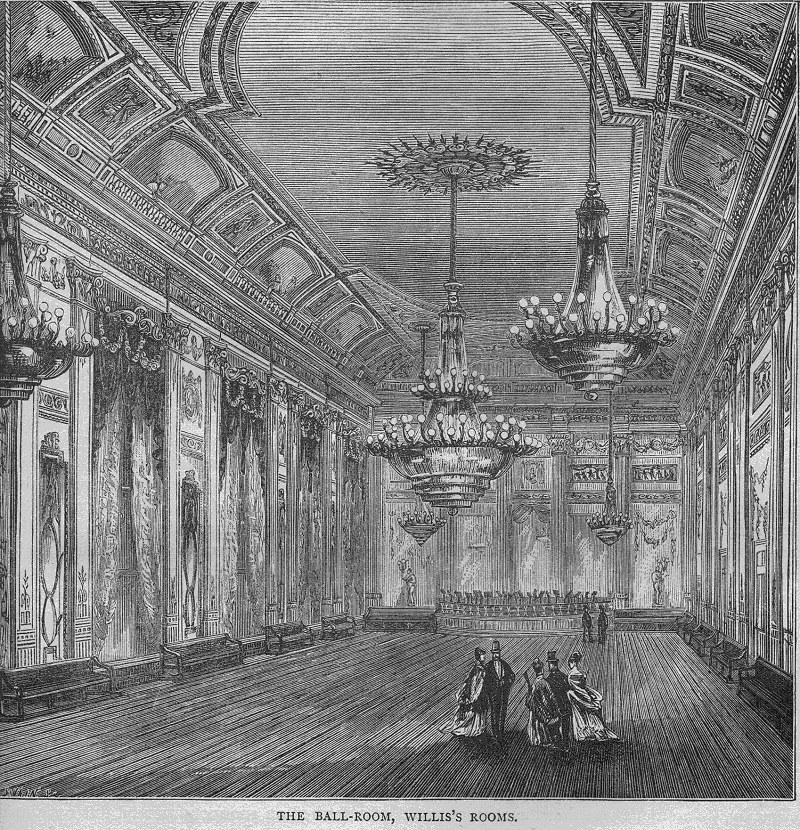
Before life was experience — when it was curiosity, hope, speculation, all those desires with which existence begins — the writer was sent by her father to some musical meetings, which are now so long over that the very rooms in which they first originated do not exist any more. They were Willis’s Rooms, out of St. James’s Street. The Musical Union was the name given to the concerts, which were an admirable invention of Mr. Ella’s to try to raise the standard of music from certain shallow depths to which it seemed gradually to be sinking. There used to be an encouraging picture of a lyre on the programme, and a pretty little sentence — “Il più gran omaggio alla musica sta nel silenzio” — printed in colored letters at the end of it. This, alas! is not yet the universal opinion; promiscuous clap-trap applause and boisterous encores, often before the last notes have died away, being still in fashion.

willis2

The Ballroom, Willis’s Rooms

I believe the Musical Union eventually migrated to St. James’s Hall, but it was in Willis’s cool and stately halls, with the faded velvet seats, that the writer  for the first time heard those familiar and delightful strains of Joachim’s violin, which have so happily sounded on through the latter half of a century of change and perplexity, ever bringing truth and strength and tranquillity [sic] among them.

[…]

$(KGrHqJHJD!E90vmFvMFBPe7,PN5+!~~60_57

Thackeray’s House, No. 2 Palace Green

Currently the Embassy of Israel

Illustration by James S. Ogilvy, 1902

When the writer first personally knew Dr. Joachim, it was in her father’s house at Palace Green. She can remember seeing him coming in one rainy afternoon in springtime, and entering the long light-blue drawing-room. He was a young man then. He was carrying a rolled-up scroll — it was an original score of Beethoven’s which some one had just given him; he showed us the cramped, fierce writing, the angry-looking notes of those calm harmonies. I have never again seen a Beethoven MS.; but the remembrance is distinct of that one, as well as of Joachim’s talk of Beethoven himself, of his mighty self and his protesting nerves, and his impossible difficulties with housekeepers and maids-of-all-work. I have sometimes heard Joachim speak of Schumann with the gentlest affection and reverence, and then of Brahms, — above all of Brahms, and of his meeting with him, one of the greatest emotions of his life.

We had once the happy opportunity of hearing the Joachim quartet at Dresden. It seemed to me then, as now, that I had never heard music before, so beautiful, so exquisite did it sound in that dark, bare Gewandthaus [sic] by the Elbe. It may be a foolish fancy, but to the writer’s mind music never sounds so well as when there is flowing water within reach, whether it is best for those who listen by the Rhine at Bonn or by the Elbe at Dresden matters little; or shall we write of a Romance of Schumann’s, a Concerto of Mozart’s, that were sounding but a few days ago in an old Chelsea house? Joachim was not there, but it was his teaching and inspiration that called forth the harmony. One of his most faithful followers was at the piano; his friend and pupil, Mrs. Liddell, had brought her violin. To the writer, hurrying home afterwards with happy pulses, the very mists of winter seemed to bear the beautiful impression along with them, and the tides of the stream to repeat it.

But perhaps of all places the Hochschule at Berlin is the place we like best to remember Dr. Joachim, and to think of him in the midst of his young pupils, as they sit in serried rows in the concert room. It is a sight to satisfy the touched spectator, for so much that is personal goes into music that to watch the master gravely facing the pupils, and that vast young assembly eagerly attentive and following his guiding hand and glance, seems a revelation to the music itself. Many of the scholars are scarcely more than children, but they play as if they were men and women grown, and they answer in a moment to his sign. Some especial bar or cadence does not go rightly; he makes them repeat it again and again; suddenly, with a flash along the line, they understand correctly, and then the music goes on once more. It was Beethoven’s great concerto for the violin that they were playing when we were there. A few parents and friends sit listening, a daughter of Mendelssohn’s among them. As the countless bows sweep up and down, an up-springing wave of swelling sound seems to spread from one end to the other of the great hall. They young, serious musicians bring the movement triumphantly to its close; the master looks approving; then comes a moment’s pause. “Miss Lenora Jackson will play the solo,” he says, and a girl of sixteen, in a straw hat, with a long plait of hair, steps quickly forward, lays her straw hat upon a chair, tosses back her fair hair, and begins to play.

It was a child playing to the others, a child with perfect taste and sure handling; the young orchestra listened and approved, and when she finished burst into gay, delightful applause. The master joined, too, clapping his two hands. It was a happy moment for everybody.

This Hochschule, as we know, is perhaps Joachim’s greatest interest in life, and to it we owe the spread of his wise and beautiful teaching.

Untitled-1Untitled-2Untitled-3Untitled-4Untitled-5Untitled-6

Share this:

  • Share on X (Opens in new window) X
  • Share on Facebook (Opens in new window) Facebook
  • Email a link to a friend (Opens in new window) Email

Like this:

Like Loading…

Joachim: Brahms Hungarian Dance No. 2 in D Minor (1903)

11 Wednesday Dec 2013

Posted by Joachim in Recordings

≈ Leave a comment

Joachim: Brahms Hungarian Dance No. 2 in D Minor (1903) Victor D 803 – B

Share this:

  • Share on X (Opens in new window) X
  • Share on Facebook (Opens in new window) Facebook
  • Email a link to a friend (Opens in new window) Email

Like this:

Like Loading…

Joachim: Brahms Hungarian Dance No. 1 in G Minor (1903)

11 Wednesday Dec 2013

Posted by Joachim in Recordings

≈ Leave a comment

Share this:

  • Share on X (Opens in new window) X
  • Share on Facebook (Opens in new window) Facebook
  • Email a link to a friend (Opens in new window) Email

Like this:

Like Loading…

Joachim: Bach Adagio in G Minor (1904)

11 Wednesday Dec 2013

Posted by Joachim in Recordings

≈ Leave a comment

Share this:

  • Share on X (Opens in new window) X
  • Share on Facebook (Opens in new window) Facebook
  • Email a link to a friend (Opens in new window) Email

Like this:

Like Loading…
← Older posts

Photo collage © Mathias Brösicke — Dematon, Weimar

Archives

Categories

  • 1 Biographical Posts — RWE
  • 2 Articles and Essays — RWE
  • 3 Talks — RWE
  • Articles by Contributing Authors
  • Bibliography
  • Biographical Sketches
  • Books About Joseph Joachim
  • Brief Biography
  • Chronology
  • Concert Reviews & Criticism
  • Concerts
  • Contracts
  • Documents
  • Ephemera
  • Estate/Nachlass
  • Family
  • Iconography
  • Instruments
  • Joachim in Great Britain
  • Joachim Quartet
  • Letters
  • Links
  • Literature
  • Literature Review
  • Miscellaneous Articles
  • Obituaries
  • Pages
  • Queries
  • Recordings
  • Reminiscences & Encomia
  • Scores
  • Speeches and Utterances (Joachim)
  • Students
  • Uncategorized
  • Works
  • Writings (Joachim)

Pages

  • INDEX

Recent Comments

Johann Heinrich Bona… on Concerts: Vienna, January, 188…
Johann Heinrich Bona… on Joachim at the Società del Qua…
Johann Heinrich Bona… on Joachim in Italy (1880)
Concert: Düsseldorf,… on The 31st Lower Rhine Music Fes…
INDEX | Joseph Joach… on Mendelssohn’s Death

Meta

  • Log in
  • Entries feed
  • Comments feed
  • WordPress.org

Email: Reshbach(at)unh.edu

Powered by WordPress.com.

Loading Comments...

    %d