Joachim: Romanze in C Major, Op. 20 (1903)
11 Wednesday Dec 2013
Posted in Recordings, Uncategorized
11 Wednesday Dec 2013
Posted in Recordings, Uncategorized
05 Thursday Dec 2013
Posted in Obituaries
Monthly Musical Record, Vol. 37, No. 441 (September 1, 1907) p. 193-194.
N. B.: Obituaries are posted for historical interest only, and should not be taken as sources of accurate biographical information.

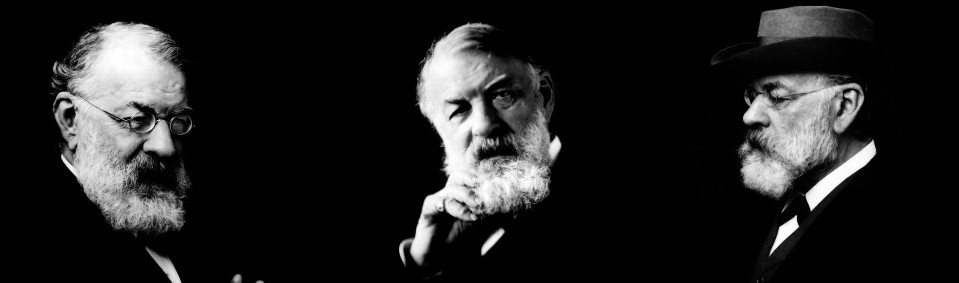
Joseph Joachim, 1831-1907
The eminent violinist passed away on August 15. Paganini, Ernst, De Bériot, Wieniawski, and many other violinists achieved celebrity. Dr. Joseph Joachim, however, was not only a great violinist, but a great and serious artist. At his first appearance at the Gewandhaus, sixty-four years ago, he played Ernst’s Fantasia on themes from Rossini’s “Otello,” and this again was the show piece which he performed in the following year, when he made his début in London, viz., at a concert in Drury Lane Theatre on March 28, 1844. But before two months had elapsed, his rendering of the Beethoven violin concerto at a Philharmonic concert (May 27), under the direction of Mendelssohn, at once showed that the fame of a mere virtuoso would not satisfy him. He was then only a lad of fourteen [sic], but he had been under good guidance: Gottfried Preyer, under whom he studied theory and composition at Vienna; his cousin, Fanny Figdor, a gifted amateur pianist, who took great interest in him; the elder Hellmesberger and Boehm, with whom he studied the violin. Yet probably the strongest influence was that exercised by Mendelssohn, and it is only right to mention that it was owing to the cousin named above that Joachim made the acquaintance of the composer, when the latter was at the zenith of his fame. Fanny Figdor, who was living in Leipzig, heard that Boehm recommended Paris as a city in which the lad would be able to develop and display to advantage his gifts, but she expressed the strong opinion that the recently-founded Leipzig Conservatorium was the best place for him.
Mendelssohn’s influence was for good; Joachim had no doubt already studied the music of Bach and Beethoven, but he must have been strongly moved by Mendelssohn’s enthusiastic admiration for these masters. That influence, however, would only have been transitory had Joachim not understood, or rather felt, its value. We live in an age in which Mendelssohn’s art-work is often unfavourably criticised, but no one has doubted his sincere reverence for the two composers named. Joachim soon lost his great friend’s advice. After the death of Mendelssohn in 1847 his surroundings were of a very different kind, for he went to Weimar, where Liszt was trying to convince the world that Wagner was a genius. Liszt’s strong personality and the music of “Lohengrin,” with which Joachim, who was leader of the theatre orchestra, became familiar, made a convert of the young musician. The latter soon made the personal acquaintance of Wagner, and expressed the hope that when the “Ring” was produced he might take part in it. It is useless to speculate as to what would have been the future of Joachim had his zeal for the “new” music continued; but now, looking back at the long career just closed, it really seems as if what happened was, as regards the art itself, and also Joachim, for the best.
After a time the Weimar life became distasteful to the young artist — he was still in his teens when he first went there. Wagner’s music was not the cause of estrangement, for although, later on, he objected to the art principles of the new school, he recognized to the end of his life the genius of Wagner. Liszt’s music was the special stumbling-block. For a time the two remained friends, but in 1857 there came a rupture, and in a letter which Joachim wrote to Liszt he frankly declared that his Symphonic Poems “contradict everything in the works of our great masters, on which my mind has been nurtured since the days of my early youth.” This was a bold letter for a rising artist to write, not only to a man about double his age, but to one who as a pianist had achieved extraordinary fame. It showed, however, strength of character.
Joachim left Weimar and became leader of the orchestra at Hanover. And now he came under two new and strong influences. He made the acquaintance of Schumann and of a young composer named Johannes Brahms. The friendship with Schumann was soon broken off, like that with Mendelssohn, by death, but that of Brahms lasted for well-nigh half a century — lasted, indeed, until in 1897 he saw the composer lowered into his grave.
Joachim will be remembered by the public generally for his magnificent performances of Bach’s “Chaconne,” and of the concertos of Beethoven and Mendelssohn; for these interpretations were certainly unique. But he became the chief, nay, at one time almost the sole, propagandist of a new school, which may be termed the Schumann-Brahms school. At the present day it is difficult to understand the long prejudice against Schumann; in the case of Brahms it is not so difficult, because, through an unfortunate event, the latter was placed at the head of a party in opposition to Wagner, and as the influence of the latter gradually increased; and as Wagner himself personally disliked Brahms’s music, the recognition of Brahms’s merits was long delayed. The steady determination of Joachim to perform the works of these two composers in spite of the indifference of the public and the hostile attitude of the press, offers the strongest evidence of his disinteredness and of his judgment. He might easily have achieved fame as a virtuoso; he might have won immense fortune; he preferred to honour the great classical masters, and to help to make known the works of gifted contemporaries.
Mention has been made of Joachim’s first visit to England in 1844. He came again in 1852, and soon after that he visited this country annually until last year. His first appearance at a Popular Concert was on May 16, 1859, and in 1904 a memorable concert was given at Queen’s Hall in commemoration of the artist’s diamond jubilee — the sixtieth anniversary of his first appearance at the Philharmonic Concert mentioned above. It was then that his portrait, painted by Mr. Sargent, was presented to him by Mr. Balfour, then Prime Minister.
There are two other noteworthy facts to record in the life of Joachim — his direction for over thirty years of the “Königliche Hochschule für Musik” in Berlin, and the formation in 1869 of the Joachim Quartet, the original members of which were Joachim, Schiever, De Ahna, and Wilhelm Wirth.
Joachim’s pupils, many of whom have distinguished themselves, and innumerable friends throughout the Continent and also here in England, will mourn the loss not only of a great artist, but of a man for whom they entertained both respect and love.
At the funeral on Monday, August 19th, in the cemetery of the Kaiser Wilhelm Memorial Church, Berlin, there were deputations from various art institutions. The bodies of Joachim and his wife now rest in the same grave.
05 Thursday Dec 2013
Posted in Concert Reviews & Criticism
Allgemeine Wiener Musik-Zeitung, Vol. 1, No. 139 (November 20, 1841) p. 582.
__________

Large Musical-Declamatory Academy
Sunday, November 15, 1841 in the k. k. Hoftheater near the Kärntnertor, for the benefit of the Institute of the Merciful Sisters, sponsored by Mr. Jos. Wache, Agent of the Institute.
Joseph Joachim’s playing and performance of [Charles de] Beriot’s Adagio and Rondo truly surprised us, and fully justified anew our conviction and our often-made claim about the soundness of Herr Prof. Böhm’s teaching method; for here, everything was accomplished — even the most audacious expectations that one can ask of an 8-to-9-year-old [Joseph was 10] — and the word virtuoso, if we wish to assign it to the little violinist, would not be an arrow shot too high above the target. Without question, one cannot, and will not, expect and demand from a child performing a composition of Beriot the power of tone, the subjectively nuanced interpretation, the firm, bold playing of a man; but his tone is pure, strong, his bowing noble and correct, his staccato astonishing, especially with a short bow, his harmonics pure and secure; and there was not — and this is truly all that one can say here — a false tone to be heard in any passage; neither in the runs nor in the double stops. Herr Professor Böhm has already trained a number of outstanding pupils, and if Joachim follows in the path that has been set out for him, we may confidently predict the highest for him; he should beware of arrogance; otherwise false paths are unavoidable, and — the return to, and progress along, the path of genuine art is very difficult. Experientia docti — !
__________
Große musikalisch = declamatorische Akademie
Sonntag den 15. November 1841 im k. k. Hoftheater nächst dem Kärnthnerthore, zum Besten des Institutes der barmherzigen Schwestern, veranstaltet von Hrn. Jos. Wache, Agenten dieses Institutes.
[…] Joseph Joachim’s Spiel und Vortrag des Beriot‘schen Adagio und Rondo hat uns wahrhaft überrascht, und auf’s neue unsere Überzeugung und unseren oftmaligen Ausspruch über die Gediegenheit der Lehrmethode des Hrn. Prof. Böhm aufs vollkommenste gerechtfertigt; denn hier ward alles geleistet, was selbst die kühnste Erwartung von einem 8 bis 9 Jahre alten Kinde fordern kann, und das Wort Virtuose, wenn wir’s schon dem kleinen Violinisten beilegen möchten, wäre kein über’s Ziel hinausgeschossener Pfeil. Daß man die Kraft des Tones, den subjectiv=nuancirten Vortrag, das feste, kühne Spiel eines Mannes bei einer Beriot‘schen Composition von einem Kinde niemals erwarten und fordern kann, und wird, ist zweifelsohne; allein der Ton ist rein, stark, die Bogenführung edel und richtig, sein Staccato, besonders im kurzen Bogen, überraschend, sein Flageolett rein und sicher, und es ließ sich — und dieß ist doch wahrlich alles was man hier sagen kann, in gar keiner Passage ein falscher Ton, weder in den Läufen noch in den Doppelgriffen, vernehmen. Hr. Professor Böhm hat bereits mehrere treffliche Zöglinge gebildet, und folgt Joachim der ihm vorgezeichneten Bahn, ist von ihm das Höchste mit Zuversicht zu erhoffen; er hüte sich aber vor Dünkel, sonst sind Abwege unvermeidlich, und — der Rück= und Weiterschritt auf dem echten Kunstpfad sehr schwer. Experientia docti — !
___________
