• Home
  • INDEX

Joseph Joachim

~ biography and research

Joseph Joachim

Monthly Archives: January 2014

Ludwig Wittgenstein: Josef Joachim (1907)

06 Monday Jan 2014

Posted by Joachim in Reminiscences & Encomia

≈ Leave a comment

Neue Freie Presse. Morgenblatt, no. 15441 (Sunday, 18 August, 1907), p. 11.

Translation © Robert W. Eshbach 2014

__________

jj-initials1

[At the time of writing, Ludwig Wittgenstein was 18 years old. This remembrance is somewhat idiosyncratic regarding tense, and has been translated as written. It is also somewhat unclear as to voice: the “father” referred to is Ludwig Wittgenstein’s paternal grandfather, Hermann Wittgenstein. Ludwig’s paternal grandmother, Fanny Figdor Wittgenstein, was Joseph Joachim’s cousin, and, for a number of years, Joachim’s guardian. She is apparently the “mother” referred to. It seems, therefore, that this remembrance is actually that of Ludwig Wittgenstein’s father Karl, “communicated” by Ludwig Wittgenstein.]

Josef Joachim.

Communicated by Ludwig Wittgenstein.

“The little boy played at a large evening party; we listeners were filled with joyful amazement; while we speak of it, he leaves us unnoticed, and when I look for him I find him asleep, lying on a divan, an adorable child. That was the first time that I saw Joachim.” This is the way my mother told it.

Later, the child spent several years at her home in Leipzig. At first, Felix Mendelssohn had misgivings about his coming: how would he be able to help the boy? “Just let him breathe your air,” replied my father. To which Mendelssohn gave the friendly reply: “That he will have!” A happy stroke of fate. Before me lies a letter from Mendelssohn to my father, a testimony to the love and care that the noble man devoted to Joachim: “You are to be thanked,” Mendelssohn wrote then from London, “that you and your wife were responsible for bringing this exceptional boy into our midst; you have my thanks for all the joy he has given me in particular; and if heaven keep him in good and sound health, everything else that we wish for him will not then fail to be forthcoming — or rather, it cannot fail, for he no longer needs to become an eminent artist and a fine person: he is both already, as certainly as a boy of his age can be or ever has been.

With this [successful concert], the chief object of a first English visit has, in my opinion, been fully attained: every one here who is interested in music is his friend and will remember him. Now I wish, as you know, that he should soon return to a perfectly tranquil life, retiring entirely from public playing in order that he may use the next two or three years to develop his inner resources in every regard, practicing his art in all those areas in which there is still room for improvement without neglecting that which he has already achieved, composing industriously, and even more industriously going for walks and caring for his physical development, so that in three years’ time the youth may be as healthy in mind and body as the boy. I consider this impossible without perfect peace and quiet; may this be granted in addition to all the good things that Heaven has given him.”

The sixteen year-old Joachim wrote home about Mendelssohn’s death in a letter, which, it is said, no one could read with dry eyes.

Since our childhood, Joachim’s character was held up to my siblings and me as an example; even then, we heard from our mother: ‘Josef has never told a lie.”

So he has, even apart from his work as an artist, kept himself to be a noble, good, touchingly modest man, loved and honored by all who had the good fortune to know him.

JJ Initials

Josef Joachim.

Mitgeteilt von Ludwig Wittgenstein.

“In einer großen Abendgesellschaft spielte der kleine Knabe vor; wir Zuhörenden staunten voll freudiger Bewunderung; indem wir darüber sprechen, verlässt er uns unbemerkt, und da ich ihn suche, finde ich ihn im Schlaf auf einem Divan liegend, ein entzückendes Kind. Das war das erstemal, daß ich Joachim sah.” So erzählte meine Mutter.

Später war der Knabe einige Jahre bei ihr in Leipzig. Felix Mendelssohn hatte erst Bedenken gegen sein Kommen: wie vermöchte er den Knaben zu fördern? “Ihre Luft soll er atmen,” erwiderte mein Vater. Worauf Mendelssohn gar freundlich: “Die soll er haben!” Eine glückliche Fügung! Vor mir liegt ein Brief Mendelssohns an meinen Vater, ein Zeugnis der Liebe und Sorge, die der edle Mann Joachim gewidmet hat: “Haben Sie Dank,” schreibt Mendelssohn damals aus London, “daß Sie und Ihre Gemahlin die Ursache waren, diesen vortrefflichen Knaben in unsere Gegend zu bringen; haben Sie Dank für alle Freude, die er mir namentlich schon gemacht hat; und erhalte ihn der Himmel uns in fester guter Gesundheit, alles andere, was wir für ihn wünschen, wird dann nicht ausbleiben — oder vielmehr es kann nicht ausbleiben, denn er braucht nicht mehr ein vortrefflicher Künstler und ein braver Mensch zu w e r d e n, er ist es schon so sicher, wie es je ein Knabe seines Alters sein kann oder gewesen ist.” … “Der Hauptzweck der bei einem ersten englischen Aufenthalt nach meiner Meinung zu erreichen war, ist hierdurch aufs vollständigste erreicht: alles, was sich hier für Musik interessiert, ist ihm Freund und wird seiner eingedenk bleiben. Nun wünsche ich, was Sie wissen: daß er bald zu vollkommener Ruhe und gänzlicher Abgeschiedenheit vom äußerlichen Treiben zurückkehre, daß er die nächsten zwei bis drei Jahre nur dazu anwende, sein Inneres in jeder Beziehung zu bilden, sich dabei in allen Fächern seiner Kunst zu üben, in denen es ihm noch fehlt, ohne das zu vernachlässigen, was er schon erreicht hat, fleißig zu komponieren, noch fleißiger spazieren zu gehen und für seine körperliche Entwicklung zu sorgen, um dann in drei Jahren ein so gesunder Jüngling an Körper und Geist zu sein, wie er jetzt ein Knabe ist. Ohne vollkommene Ruhe halte ich das für unmöglich; möge sie ihm vergönnt sein zu allem Guten, was der Himmel ihm schon gab.”

Von Mendelssohns Tode hat dann der sechzehnjährige Joachim nach Hause in einem Briefe berichtet, den nach der Ueberlieferung niemand trockenen Auges lesen konnte.

Meinen Geschwistern und mir wurde seit unserer Kindheit Joachims Charakter gerühmt; schon damals hörten wir von unserer Mutter: “Josef hat nie eine Lüge gesagt.”

So hat er, auch abgesehen von seinem Wirken als Künstler, sich zeitlebens bewährt als der Edle, Gute, rührend Bescheidene, geliebt und verehrt von allen, die ihn zu kennen das Glück hatten.

23

Share this:

  • Share on X (Opens in new window) X
  • Share on Facebook (Opens in new window) Facebook
  • Email a link to a friend (Opens in new window) Email

Like this:

Like Loading...

Concert: Vienna Philharmonic Debut, April 30, 1843

05 Sunday Jan 2014

Posted by Joachim in Concert Reviews & Criticism

≈ Leave a comment

Der Humorist, vol. 7, no. 87 (Wednesday, 3 May, 1843), p. 354.

Translation © Robert W. Eshbach 2014

_________

jj-initials1

Fourth Society Concert, Sunday 30 April in the

Imperial and Royal Large Ball Room

“The young violin virtuoso Joachim provoked a true sensation with an Adagio and Rondo from Vieuxtemps’s newest concerto. Rarely has the voice of the public been so fully in accord with that of the critics as concerning the talent of this still virtually child-like boy; rarely have the most daring prospects become manifest as they have with him. Little Joachim has many very worthy fellow mignon-virtuosi here, both smaller and larger, but none possesses a power of interpretation so steeped in mind and spirit, with such irreproachable clarity and subtlety and nuance, with such boldness and resoluteness of bowing — in short, with so much technical correctness; none advances toward such a bright future, as he. His well-grounded and solid playing was interrupted by the liveliest applause, and at the end he was recalled three times with stormy acclaim.”

JJ Initials

Viertes Gesellschafts-Concert, Sonntag den 30 April im K. K. großen Redouten=Saale

Dasselbe wurde mit Preyer‘s oft und warmgewürdigte “Symphonie” einem tüchtig instrumentierten Werke, eröffnet, diesem folgte ein “Vokal-Chor” von Fred. Schubert, eine interessante Komposition, welche gleich der erstern beifällig aufgenommen wurde. Dlle. Reiter sang hierauf eine Bravour-Arie von Mercadante mit ziemlicher Fertigkeit und freundlichem Beifall. Wahrhafte Sensation erregte wieder der junge Violine-Virtuose Joachim durch ein “Adagio” und “Rondo” des neuesten Concertes von Vieuxtemps. Selten noch war die Stimme des Publikums so einstimmig mit der Kritik, als über das außerordentliche Talent dieses fast noch kindlichen Knaben, selten noch haben sich die kühnsten Erwartungen auf solch’ erfreuliche Weise manifestiert, als es bei ihm der Fall ist. Der kleine Joachim hat hier noch viele kleinere und größere, sehr schätzenswerte mitstreitende Mignon-Virtuosen, aber Keiner besitzt bei so viel tadelloser Deutlichkeit und Feinheit und Nuancierung, bei so viel Kühnheit und Entschiedenheit der Bogenführung, kurz, bei so viel technischer Korrektheit einen solch’ geist- und gemüthsdurchdrungenen Vortrag, Keiner geht einer solch’ glänzenden Zukunft entgegen, wie er. Der lebhafteste Beifall unterbrach auch heute sein sinniges und gediegenes Spiel, und am Schlüsse wurde er drei Mal stürmisch gerufen. Der hierauf folgende Vokal-Chor, von dem rühmlichste bekannten Neukomm, schien nicht sonderlich goutiert zu werden. Die Ouvertüre aus Abbé Vogler‘s “Samori,” welche wohl etwas aus der Zeit und dem Geschmack des Publikums, schloß das Concert.

–g–

Screen Shot 2014-01-05 at 6.22.12 PM

Share this:

  • Share on X (Opens in new window) X
  • Share on Facebook (Opens in new window) Facebook
  • Email a link to a friend (Opens in new window) Email

Like this:

Like Loading...

Moritz Hauptmann: “J! – O! – Ach! – im Canon”

05 Sunday Jan 2014

Posted by Joachim in Ephemera

≈ Leave a comment

Joachim Canon LEFTJoachim Canon RIGHT

Moritz Hauptmann: Autograph Musical Manuscript: “J! – O! – Ach! – im Canon.” 
Autograph manuscript, signed and with autograph title at head. A 4-voice canon in F Major, notated in brown ink on twelve staves, with a number of alterations in the texts visible. 1 page, 25.5 X 33 cm, 12-stave paper. Verso features an additional four measures on the bass notes G-A-D-E, a reference to the Danish composer Niels W. Gade.

Joachim Canon Verso510

Verso: “GADE”

Credit: Gabriel Boyers, Schubertiade Music & Arts LLC.

Currently (January 5, 2014) for sale from Schubertiade.

Moritz-Hauptmann

Moritz Hauptmann

The undated manuscript (presumably October 1845) is by Moritz Hauptmann, and relates to a similar copy (“Von Ihrem Sie herzlich liebendem M Hauptmann;” transposed, dated 12 October, 1845) in Moser’s biography: Andreas Moser, Joseph Joachim: Ein Lebensbild, (2 vols.), Berlin: Verlag der Deutschen Brahms-Gesellschaft, vol. 1: 1908, opp. p. 69.

Joachim Canon

Boyers lists the manuscript as “O! – O! – Och – im Canon,” with an erroneous attribution re: the Joachim-Brahms counterpoint exchange:

“The present canon is a previously unrecorded manuscript and it is possible that it relates to the famous Joachim-Brahms counterpoint exchange. “As unique in the annals of music history as their friendship is the exchange of studies in counterpoint carried on by Brahms and Joachim during their late twenties. First suggested by Brahms in a letter of February 26, 1856, the musical correspondence was active until the end of July, to judge by references made to it in their published correspondence. It was resumed during June and July, 1857, and again during the spring of 1860 and summer of 1861. Thereafter there is no further mention of counterpoint studies, although they continued to advise each other in connection with their compositions.” (Leonard Ellinwood, “The Brahms-Joachim Exercises in Counterpoint,” AMS Bulletin Sep. 1948, p. 50-51) $4000.00″

Share this:

  • Share on X (Opens in new window) X
  • Share on Facebook (Opens in new window) Facebook
  • Email a link to a friend (Opens in new window) Email

Like this:

Like Loading...

Edith Sichel: Joseph Joachim. — A Remembrance (1907)

05 Sunday Jan 2014

Posted by Joachim in Reminiscences & Encomia

≈ Leave a comment

The Living Age, Seventh Series, Vol. 36 (July, August, September 1907), pp. 693-695

__________

JOSEPH JOACHIM. — A REMEMBRANCE

Edith Sichel

 Screen shot 2014-01-04 at 7.33.12 PM

            “Coleridge is dead!” Charles Lamb would suddenly exclaim in the midst of other conversation, during the weeks that followed the poet’s death. And those who have loved Joseph Joachim feel the need of repeating such words to make them realize that he has gone. When men have lived the life of art or goodness belonging more or less to the eternal order of things, it is more difficult to grasp their mortality. For those who care for beauty, for the best in music and in life, a link has snapped never to be replaced. Music is not dead, cannot die; but the interpreter-genius who revealed it in its purest depths has passed away.

Those who, but a few years ago, heard him still at his strongest (at his best he always was) know the utmost limit of human achievement in art. “Whether in the body, or out of the body, I know not,” was the feeling with which one always came away from hearing him. What was it that made his playing what it was? Was it his tone, his phrasing, the might and grace of his rhythm? Was it the wonderful union of passion and restraint? It was all these, it was something more than these. He had not drunk at the spring of inspiration, he was that spring himself. It was this fount within him which compelled him, in spite of his vital personality, to become the music that he played; to be, in turn, Bach, Haydn, Mozart, Beethoven, Schubert, Schumann, Brahms. Perhaps it is the heritage of his race to be the selfless testifier that he was. “If people would only trust the music,” he once said, “they too often put themselves into it.” Once when Brahms heard Joachim play again after an interval, “I felt,” he wrote, “that there had been something lacking in life. Oh, how he plays!”

This particular effect of his music was due not only to the musician; it came from the man. If he stands for art he also stands for goodness: for duty, for loyalty, for obedience. Not for virtue, which affects a man’s relation to himself, but for the kinder, sweeter power which means his bond with others; the “human charity,” which Beethoven said “was the only superiority that counted.” Sometimes one was even tempted to wish that Joachim’s charity did not suffer so long and be kind. The most social of men, he would not reject anybody.

Of course, like all interesting people,

694

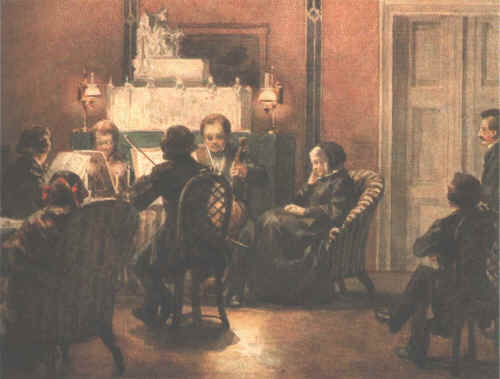
he liked interesting people best, and men who had made their mark in the world inspired him with respect and curiosity. He was courtly without being a courtier. His feeling for the Emperor, for Royalty, was a sentiment — the sentiment that Goethe had at Weimar. Bismarck was one of the persons for intercourse with whom he had cared most, and for the last sixty years he had known most people worth knowing both in Germany and England. In the ‘fifties he had played to Goethe’s Bettina, and in his drawing-room at Berlin there hung a water-color sketch of him and a quartette of that day, high-collared in swallow-tailed coats, playing to a little old lady, Bettina von Arnim.

Quartettabend

Carl Johann Arnold: Quartettabend bei Bettina

But the great friendships of his life were those for Mendelssohn, the Schumanns, and Brahms. His relations with Schumann began when he was very young. He had been playing Beethoven’s Concerto, and he and Schumann came out together from the hot, crowded concert-room into the star-lit open. “Little Master Joachim,” said Schumann, looking skywards, “do you think that star knows that you have just played the Beethoven Concerto and that I am sitting by you here?” As he spoke, he laid a hand tenderly upon the boy’s knee. The incident was always alive to Joachim as if it had been yesterday. Fifty years afterwards he loved to tell the story, in his vivid way, acting the gesture, recalling the tones which the years had not dulled for him. Joachim’s friendship for Brahms was one of those rare comings together which influence the history of art, like the friendship of Goethe and Schiller, of Coleridge and Wordsworth. In some ways the meeting of these two meant more than the conjunctions of creators, for without Joachim it is difficult to conceive how Brahms would have been adequately revealed to the world. Joachim immediately recognized in him a sovereign of the legitimate dynasty. He himself had no mean place in the company of great composers, but, humbly putting his creative work aside, he devoted himself to the reverent interpretation of the greater masters, more especially of this last one, whom the world as yet did not understand. It was England that he found the most responsive, and he reaped his reward. After forty-five years, his last pleasure in this country was to lead a performance of all Brahms’ chamber-music and to witness its established success.

The difference between Joachim and other artists was that intellectual equals such as these did not spoil him for the less effectual myrmidons. But with all his kindness it would be misleading to write of him as if he were a saintly bishop, instead of the most human of human beings. He did not affect tame company; he loved good looks, he loved quick wits and brilliance. He was himself witty. His humor had a sly malice, an innocent finesse, and he did not object on occasions to point it at particular persons. Some one had been criticising Mr. Z., a fussy man of his acquaintance. “But he is such a kind friend,” he rejoined — then, as if by an after-thought — “and he always lets me know it.”

Another time, at a concert of Bach’s music, he was sitting next a lady of high rank; they were looking over the score together. “She pointed out the beauties that were there — and some beauties that were not there,” he remarked afterwards. But his vision of their weaknesses did not at all interfere with his liking either for Mr. Z. or the lady. His satire was never discourteous. He was asked if a woman of note — a reputed liar — were untruthful, as was supposed. “Let us call it romantic,” he answered; “she was a very attractive person.” The difficulty in defining Joachim, the most unpara-

695

doxical of persons, is to bring home to those who did not know him the union in him of simplicity and subtlety, of dignity and spontaneity, of a warmth that thrilled its recipient with a dislike of extravagance and excess; to make men realize the fulness of his artist’s temperament, together with the qualities least supposed to belong to an artist. Joachim’s punctiliousness, his self-control, his good manners, his good sense, his distaste for what was not obvious, his still greater distaste for what was lawless, are not the attributes usually pertaining to the popular idea of a genius.

We have said that he gave up composition. It was not only to interpret the work of others that he did so. It was to fulfil his mission as a teacher. Those who have had the memorable good fortune to watch him among his pupils at his Hochschule, to see him conduct his orchestra, a king whose kingdom was youth; those who have witnessed his patience with all who did their best, his wrath with what was lazy or slovenly, understand how he spent himself for them. Of his sovereign kindness to young musicians, there are many stories to tell. He loved young life; he exacted nothing from it. “Am I boring you, children?” he asked some girls a little time ago, while he was playing Mozart.

Not only among his scholars was Joachim a King. There is a picture of him fresh before my eyes, when once, after a festival at Bonn, he was returning from a Festfahrt on the Rhine. As he stepped off the boat, a crowd received him, and he passed up to the town between two files of cheering people; undergraduates, tradesmen, Herr Doktors, English pilgrims, friends of all sorts. He had not expected an ovation; he was moved almost to tears as he walked between the ranks with royal simplicity; and

Blessings and prayers, a nobler retinue
Than sceptered king or laurelled conqueror knows,
Followed this wondrous potentate

            Yet the most enduring image of him, the one which lives for ever in our hearts, is the image of Joachim the player, standing by himself, or sitting with his Quartet, his Jovian head straight to the audience. The massive hair, the watchful eyes, the wonderful square, supple hands, from which virtue went forth, complete the man. He is surrounded by an atmosphere of concentration. His face wears a look of tension, a patient, almost troubled expression. Then the mighty bow is upraised, the Olympian fiddle poised against the shoulder, and the first attack holds us breathless. The tension disappears from his countenance; it becomes calm with a victorious serenity, with a rare intellectual force. There is no exaltation, no throwing back of the head, no common sigh of emotion, or excitement. But the eyes are transfigured with a spiritual light; the face is pervaded by an intense reverence.

The impression belongs to many places: to the Ducal Schloss at Meiningen amidst the green Thuringian hills; to the hall in the humble Yorkshire village at whose festival, amongst the moors, he liked to play; to the grim smoking towns of the Black Country; most familiarly to St. James’s Hall, where he reigned so long.

Once at the rehearsal of a concert in that little Yorkshire village, he was sitting deep in talk with a friend. The last singer had finished her performance, but he did not perceive it. He looked up, and discovered that he was waited for. “It is my turn now; I must go,” he said, concerned, almost as if he were a child hastening to obey his master’s call. His turn has come now — the call found him ready.

Edith Sichel.

__________

Excerpted from the Oxford Dictionary of National Biography:

Sichel, Edith Helen (1862–1914), historian and philanthropist, was born on 13 December 1862 at 25 Princes Gardens, London, the daughter of Michael Sichel (1819–1884), a cotton merchant, and his wife, Helena Reiss (1833–1888); her parents were Christians, but of German Jewish descent. She was well educated, becoming proficient in French, German, and Latin. In 1876 she met and formed a close friendship with Mary Elizabeth Coleridge (1861–1907), with whom she went to read Greek classics with William Johnson Cory (1823–1892), the poet and former master at Eton. She also attended Professor John Wesley Hales’s lectures on Elizabethan and Jacobean drama in 1880.

At the age of twenty-three Edith Sichel joined the Whitechapel branch of the Metropolitan Association for Befriending Young Servants. Through her work here she met Canon Samuel Barnett and his wife Henrietta, and also Emily Ritchie, who became her closest friend. Her philanthropy, informed by her deep Christian faith, was essentially conservative and individualistic: accepting as God-given the class system of Victorian society, she held that the core of her mission was the creation and development of personal friendships, and had little interest in administrative and committee work which resulted from the growth of institutional social work.

Sichel’s faith in personal initiative in philanthropic work was evidenced by her private projects, pursued after bad health had forced her to abandon her work in the East End in 1891. In 1889 she and Emily Ritchie established a nursery for East End workhouse children in Chiddingfold near Witley, where they were renting a cottage. When they moved to The Hurst, Hambledon, in 1891 they started a home for Whitechapel girls, where they intended to train them for domestic service.

However, Edith Sichel’s leading interest from the 1890s was her literary career. Her first published work, the tale of a Wapping girl entitled ‘Jenny’, which appeared in the Cornhill Magazine in 1887, was inspired by her East End work. She became a steady contributor to journals and magazines, including The Pilot, the Monthly Review, the Times Literary Supplement, and the Quarterly Review, revealing herself to be an enthusiastic, perceptive, and generous reviewer of histories, biographies, and memoirs. In 1893 she published Worthington Junior, an undistinguished novel, before turning to the more congenial pursuit of French history. The Story of Two Salons (1895) described the salons of the Suards and Pauline de Beaumont, while The Household of the Lafayettes (1897) dealt with the pre- and post-Revolution history of a prominent French family. In 1903, with G. W. E. Russell, she published Mr Woodhouse’s Correspondence, a collection of comic correspondence (which had originally appeared in The Pilot) between the family and associates of the imaginary Algernon Wentworth-Woodhouse, a rich, miserly, and valetudinarian egotist. This was followed in 1906 by The Life and Letters of Alfred Ainger, a tribute to a close friend. Another such tribute appeared in 1910, when she contributed a memoir to Gathered Leaves, a posthumous collection of pieces by Mary Coleridge, whose death in 1907 was a considerable blow. Women and Men of the French Renaissance (1901) foreshadowed more directly her magnum opus, a two-volume account of the life and career of Catherine de’ Medici, published as Catherine de’Medici and the French Reformation (1905) and The Later Years of Catherine de’Medici (1908). The Renaissance, written for H. A. L. Fisher’s Home University Library of Modern Knowledge series, and Michel de Montaigne, both published in 1911, were the last of her works to appear in her lifetime. In humorous self-deprecation, Sichel described herself as ‘only a gossiping lady’s maid who curls the hair of History’. In fact her histories were well researched in primary as well as secondary sources, and she believed that a woman historian could have a distinctive and serious role in exploring the more personal and domestic aspects of history. Vivid, impressionistic portraits of many leading figures in French courts and salons bear witness to her appropriately Renaissance belief that history was ‘human life remembered’ (Ritchie, 147, 45).

In 1911 Edith Sichel began to hold classes for female prisoners at Holloway Prison, where her sister was already a visitor. She became deeply interested in the 1914 Prison Reform Bill, drawing up a report for the commissioners of prisons and attending police courts to examine sentencing. This additional work may have contributed to her unexpected death, on the night of 13 August 1914, while visiting friends at Borwick Hall, near Carnforth, Lancashire.

Edith Sichel was remembered by her contemporaries as a woman of great charm, witty, cultivated, and cheerful, with a genius for friendship. Both her books and her letters reveal an attractive and vivacious personality. While her poetry is generally third rate and laboured, her prose is elegant, absorbing, and seasoned with epigrams. Her appearance was striking rather than handsome—photographs show a large-featured, dark-haired woman, a sort of beautified George Eliot—but observers commented on her expressive face, ‘full of mobility, vigour and refinement’ (Cornish, 217).

Rosemary Mitchell

Share this:

  • Share on X (Opens in new window) X
  • Share on Facebook (Opens in new window) Facebook
  • Email a link to a friend (Opens in new window) Email

Like this:

Like Loading...

Joseph Joachim by Schaarwächter Berlin, 1884

04 Saturday Jan 2014

Posted by Joachim in Iconography

≈ Leave a comment


jj-initials1

Joseph Joachim by Schaarwächter Berlin, 1884


JJcdv copy


Joachim Schaarwächter Cabinet copy


This photograph, dated 1890, was clearly taken at the same time, raising questions about its dating:

JJ Schaarwächter 1890

© 2014 Please acknowledge the source: Joseph Joachim — Biography and Research: http://www.josephjoachim.com


Share this:

  • Share on X (Opens in new window) X
  • Share on Facebook (Opens in new window) Facebook
  • Email a link to a friend (Opens in new window) Email

Like this:

Like Loading...
Joseph Joachim by Hansen, Copenhagen

03 Friday Jan 2014

Posted by Joachim in Iconography

≈ Leave a comment

jj-initials1

Joseph Joachim by Hansen, Copenhagen


JJ CDV 2$_3-1

Photo after 1856.

Georg Emil Hansen: http://en.wikipedia.org/wiki/Georg_Emil_Hansen


© 2014 Please acknowledge the source: Joseph Joachim — Biography and Research: http://www.josephjoachim.com

Share this:

  • Share on X (Opens in new window) X
  • Share on Facebook (Opens in new window) Facebook
  • Email a link to a friend (Opens in new window) Email

Like this:

Like Loading...

Joachim Jubilee: New York Times (May 7, 1899)

02 Thursday Jan 2014

Posted by Joachim in Concert Reviews & Criticism

≈ Leave a comment

New York Times, 7 May, 1899, p. 18.

__________
jj-initials1

Joachim Jubilee

Screen Shot 2014-01-02 at 6.31.05 PMScreen Shot 2014-01-02 at 6.31.45 PMScreen Shot 2014-01-02 at 6.32.10 PM

Share this:

  • Share on X (Opens in new window) X
  • Share on Facebook (Opens in new window) Facebook
  • Email a link to a friend (Opens in new window) Email

Like this:

Like Loading...

1902

02 Thursday Jan 2014

Posted by Joachim in Iconography

≈ Leave a comment

jj-initials1


(Thursday), 11 December 1902

JJ Schönknecht 11 Dec 1902

Charcoal illustration courtesy, Stefan Schönknecht, Leipzig


© 2014 Please acknowledge the source: Joseph Joachim — Biography and Research: http://www.josephjoachim.com

Share this:

  • Share on X (Opens in new window) X
  • Share on Facebook (Opens in new window) Facebook
  • Email a link to a friend (Opens in new window) Email

Like this:

Like Loading...

Joachim Committee Concerts, 1906

02 Thursday Jan 2014

Posted by Joachim in Concerts

≈ 2 Comments

© Robert W. Eshbach 2014


jj-initials1-e1395761217629

Spring Season

Autumn Season

Screen Shot 2014-01-02 at 5.31.32 PM

A series of concerts devoted entirely to the compositions of Johannes Brahms, and performed by the Joachim Quartet, assisted by Richard Mühlfeld and others. “The scheme, undertaken for the first time in this or any other country, will allow of the performance of the whole of Brahms’s Chamber Music Works written for more than two instruments, and, in addition, of two of the Violin Sonatas, the two Violoncello Sonatas, and the Two Sets of ‘Liebeslieder Waltzes.’” […] “The Bust of Johannes Brahms exhibited in the vestibule is a replica of that of the Brahms Monument at Meiningen, by Adolf Hildebrand.”

Venue Info: 1901: built as the Bechstein Hall; capacity: 550. 1916: everything auctioned off; 1917: reopened as the Wigmore Hall. Source: London Encyclopaedia

JJ Initials

Wednesday Afternoon, 21 November

Joachim Committee Concerts (autumn season): Concert no. 1

Queen’s Hall, London

Friday Evening, 23 November

Joachim Committee Concerts (autumn season): Concert no. 2

Bechstein Hall, Wigmore Street, W1, London

Monday Evening, 26 November

Joachim Committee Concerts (autumn season): Concert no. 3

Bechstein Hall, Wigmore Street, W1, London

Wednesday Afternoon, 28 November, 3 pm precisely

Joachim Committee Concerts (autumn season): Concert no. 4

Bechstein Hall, Wigmore Street, W1, London

• Johannes Brahms, Piano Trio no. 2 in C Major, op. 87

            Donald Francis Tovey, piano; Joseph Joachim, violin; Robert Hausmann, cello

            • Johannes Brahms, String Quartet no. 1 in C minor, op. 51, no. 1

            Joseph Joachim, violin 1; Carl Halir, violin 2; Karl Klingler, viola, Robert Hausmann, cello

            • Johannes Brahms, Piano Quartet no. 1 in G minor, op. 25

            Donald Francis Tovey, piano, Joseph Joachim, violin; Karl Klingler, viola; Robert Hausmann, cello

Monday Evening, 3 December

Joachim Committee Concerts (autumn season): Concert no. 5

Bechstein Hall, Wigmore Street, W1, London

Wednesday Afternoon, 5 December

Joachim Committee Concerts (autumn season): Concert no. 6

Queen’s Hall

Share this:

  • Share on X (Opens in new window) X
  • Share on Facebook (Opens in new window) Facebook
  • Email a link to a friend (Opens in new window) Email

Like this:

Like Loading...

Obituary: The Spectator

02 Thursday Jan 2014

Posted by Joachim in Obituaries

≈ Leave a comment

The Spectator, 24 August 1907, p. 255.

N. B.: Obituaries are posted for historical interest only, and should not be taken as sources of accurate biographical information.


jj-initials

JOSEPH JOACHIM

 WHATEVER her claim to consideration on the score of her native musical products, England has on the whole been singularly fortunate in her relations with the great foreign musicians. Sometimes, as in the case of Handel in the eighteenth and Manuel Garcia in the nineteenth century, this attachment led to a permanent residence. Sometimes, as in the case of Beethoven and Brahms, Schumann and Schubert, there has been cordial and intimate appreciation without personal contact; while Mendelssohn and the great artist whom we all deplore, without abating a jot of their patriotism, found a second home amongst us. The association of the two names is inevitable, for Mendelssohn was one of the first to recognise the genius of the young Hungarian and to commend him to his friends in England. The relationship thus auspiciously begun more than sixty years ago remained unbroken to the close of Dr. Joachim’s life. For half-a-century his name has been a household word among us wherever music is cared for. He was the pillar and glory of the Popular Concerts from their earliest days. His periodical appearances lent a special lustre to the Crystal Palace and Philharmonic Concerts and the great provincial Festivals, and of late years the visits of his quartet party have been an outstanding feature in our musical annals. Many musicians have been admired and idolised, but none have been so reverenced as Joseph Joachim. Honours were heaped upon him, but they never exceeded his deserts, and there was that in the man himself which happily kept vulgar flattery aloof. He was never called upon to wade through roses to the platform, or mobbed by fashionable maenads in St. James’s Hall. His native dignity and simplicity rendered such adulation impossible. It has been said of certain performers that to do themselves justice they needed artificial lights and a gaily bedizened and bediamonded audience. Joachim was entirely independent of the adventitious stimulants of an artificial environment. Or, to put it in another way, the only music that he cared to play did not require a spectacular setting to reinforce its appeal.

One has only to compare Joachim with most of the famous violinists of the past to realise how small a part of his greatness was that which was their chief title to eminence,— technical dexterity. It was not that he despised or neglected it, for no one was more thorough in his methods, but that at a very early stage of his career he abandoned the desire, if, indeed, he ever harboured it, to astonish rather than enlighten his hearers. His early successes—for he was famous at thirteen—did not beguile him into following the lucrative, but unsettling and feverish, career of the travelling virtuoso. From that danger he was saved by his own exalted ambition, by the advice of his master, the admirable Böhm, and by the parental interest taken in his progress by Mendelssohn, and subsequently Schumann, who not only hailed him as a great interpreter, but predicted for him a distinguished future as a composer. His early, intimate, and lifelong association with Brahms, again, was another potent determining influence on the exercise of his gifts. Indeed, in the whole history of instrumental music it would be impossible to find a more felicitous or better matched partnership. In the great majority of cases the executant falls below the requirements of the composer when they are contemporaries. But Brahms found in Joachim an interpreter endowed not merely with a splendid technical equipment, but with the highest intellectual and spiritual qualities as well; and this confidence in a kindred spirit assuredly lent wings to his inspiration. Indeed, where Brahms’s music for the solo violin or the string quartet was concerned, he always wrote with Joachim in his mind, while occasionally, as in the case of the Hungarian dances, there was actual collaboration between the two friends. This relationship only emphasises the contrast which has so often been noticed between great players and great singers. The latter, in nine cases out of ten, act as a drag on composers, and where they associate themselves with contemporary music, generally exhibit a fatal preference for the work of inferior musicians. There have been brilliant exceptions in the past — Schröder-Devrient and Pauline Viardot-Garcia and Stockhausen— and in the last twenty years the standard of excellence in the choice of songs by leading professionals has immensely improved. Still, the fact remains that singers as a rule are loth to undertake pioneer work, even when their reputations are securely established. On the other hand, the great players have, in the main, kept much more nearly abreast of the creative achievements of their time. Joachim’s services in this regard were perhaps most conspicuously shown in his connexion with Brahms, but can be happily illustrated by his relations with many other modern composers. The number of compositions dedicated to him is legion, but it may suffice to mention Schumann’s Fantasia for violin and orchestra, Liszt’s Hungarian Rhapsody in C sharp minor, Max Bruch’s First and Third Concertos, Dvorák’s Violin Concerto, Sir Charles Stanford’s Suite for violin and orchestra, and Sarasate’s First Book of Spanish Dances. The mention of Sarasate prompts one to add that the admiration was mutual, Joachim having always recognised the peculiar charm of the “fascinating Spanish violinist,” as he called him, and he repaid the compliment by dedicating to Sarasate his Variations for violin and orchestra. The proverb about two of a trade has often been painfully exemplified in the history of music, but it has found no support in the life of Joachim, who numbered amongst his intimate friends Ernst, Wieniawski, and Ferdinand David, as well as Liszt, von Bülow, and Rubinstein.

But Joachim’s loyal services to his contemporaries never interfered with his devotion to the great masters. His interest in the music of the past was not archaeological; it was governed by an unerring judgment which led him to consecrate his energies to the interpretation of the classic literature of the violin. He was the great hierophant of Bach and Beethoven, but his repertory was not confined to the music of Germany. No one had a livelier appreciation for the old Italian masters, from whom, handed down through Rode and Böhm, he derived the traditions on which his violin-teaching was based. The debt that the British public alone owe to Joachim as an educator of musical taste, as an elevating influence in art, is incalculable. The fame of the mere executant is, as a rule, short-lived; but the greatest music of the king of instruments will always remain inseparably associated in the minds of those who heard him with the tones of Joachim’s violin and the sight of his noble presence, — the very incarnation of strength, dignity, and simplicity. As a teacher no less than a player his influence was world-wide. He did not found a school, but he carried on and developed the best traditions of the great Franco-Italian school which originated with Corelli. The long list of his famous pupils is in itself a singular testimony to his greatness, while his modesty, his disinclination to thrust himself forward or claim a predominant position, could not be better illustrated than by the fact that, alone amongst violinists of the first rank, he devoted himself in the plenitude of his powers to quartet-playing, and as years passed on spent more and more time in this less remunerative and more self-effacing branch of his high calling. Few men of his eminence in art have inspired deeper affection than Joachim. He had known almost every one worth knowing in Germany and England during the last fifty years, and men of action as of thought yielded to the spell of his grave personal charm. Yet for all his sanity and seriousness he had a keen sense of humour, could enjoy a joke at his own expense, and used to tell with keen appreciation the story of the working man who accosted him at a railway station in the North of England where he was waiting late at night for his train, and, after some conversation, left him with the parting shot, “Paganini was the man.” It is good to think that the ties which bound him to this country were never relaxed, but rather grew closer with every succeeding visit, and it is a curious proof of his popularity that throughout the whole English musical world whenever the name “Joe” was mentioned, it stood for Joseph Joachim.

Share this:

  • Share on X (Opens in new window) X
  • Share on Facebook (Opens in new window) Facebook
  • Email a link to a friend (Opens in new window) Email

Like this:

Like Loading...
← Older posts
Newer posts →

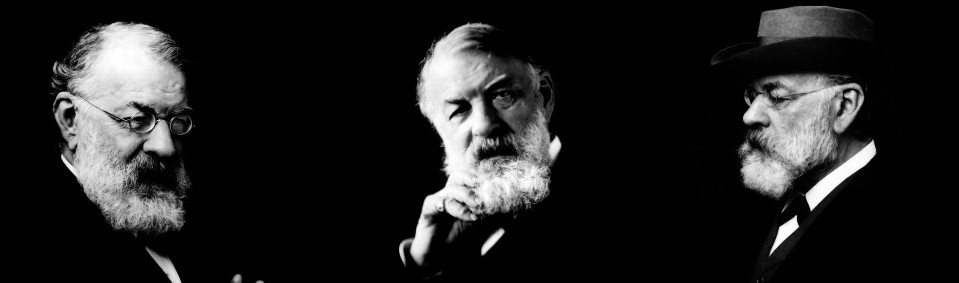
Photo collage © Mathias Brösicke — Dematon, Weimar

Archives

Categories

  • 1 Biographical Posts — RWE
  • 2 Articles and Essays — RWE
  • 3 Talks — RWE
  • Articles by Contributing Authors
  • Bibliography
  • Biographical Sketches
  • Books About Joseph Joachim
  • Brief Biography
  • Chronology
  • Concert Reviews & Criticism
  • Concerts
  • Contracts
  • Documents
  • Ephemera
  • Estate/Nachlass
  • Family
  • Iconography
  • Instruments
  • Joachim in Great Britain
  • Joachim Quartet
  • Letters
  • Links
  • Literature
  • Literature Review
  • Miscellaneous Articles
  • Obituaries
  • Pages
  • Queries
  • Recordings
  • Reminiscences & Encomia
  • Scores
  • Speeches and Utterances (Joachim)
  • Students
  • Uncategorized
  • Works
  • Writings (Joachim)

Pages

  • INDEX

Recent Comments

Joachim on Jakab Marastoni (Jacopo Antoni…
Joachim on Max Bruch: Gedenkworte für Jos…
Elena Breschkow on Max Bruch: Gedenkworte für Jos…
Bicskei Éva on Jakab Marastoni (Jacopo Antoni…
Bibliography | Josep… on Joachim’s Youth—Joachim…

Meta

  • Log in
  • Entries feed
  • Comments feed
  • WordPress.org

Email: Reshbach(at)unh.edu

Powered by WordPress.com.


Loading Comments...
 

    %d