ABS Handout
29 Monday Sep 2014
Posted in 3 Talks — RWE
29 Monday Sep 2014
Posted in 3 Talks — RWE
29 Monday Sep 2014
Posted in 2 Articles and Essays — RWE, 3 Talks — RWE
© Robert W. Eshbach 2014


REMÉNYI BEFORE BRAHMS
Based on a paper given to the American Brahms Society Conference, Brahms in the New Century, Brook Center for Music Research, City University of New York, March 21, 2012.
The story of Johannes Brahms’s first encounter with Joseph Joachim in May, 1853 has been told many times — not always accurately, and seldom without a condescending bias toward Ede Reményi, the man who made that meeting possible. It seems that this bias originated with Joachim himself: Joachim was famously possessive in friendship and in love, and, at the beginning of his relationship with Brahms, he can fairly be described as having been “smitten.” From the first, he was fully aware of his new-found friend’s musical and personal worth, and coveted for himself not only an exclusive relationship with the beautiful, enigmatic young tone-poet, but also the role of being Brahms’s “discoverer.” [1]

Joachim was barely 22 years old, and only 6 months into his new job as Royal Concertmaster to the King of Hanover when his boyhood acquaintance Eduard (Ede) Reményi paid him a surprise visit, bringing with him his young accompanist, Johannes Brahms. Like Schumann, who, in those early days of acquaintance spoke of Brahms in awestruck, messianic terms, Joachim saw his new acquaintance as born to greatness: the preternaturally unspoiled embodiment of the high ideals toward which he, himself, inclined. It is striking that, despite the loneliness that consumed Joachim in his first months in Hannover — what he called his “Hamlet mood” — his first response upon meeting Brahms was to see him, not as a potential new friend, but as a protégé. As he wrote to his brother Heinrich later that November in a still-unpublished letter: “My only companion here is now a young Hamburger named Brahms, a 20-year-old powerful talent in composition and piano playing, the good fortune of wresting which from the darkness is mine.” [2] He expressed himself to Hanover court pianist Heinrich Ehrlich with uncharacteristic poetry, emphasizing Brahms’s obscurity and undefiled nature: “Brahms has a quite exceptional talent for composition and a nature that could have been developed in its integrity only in the strictest retirement — pure as diamond, soft as snow.” [3]
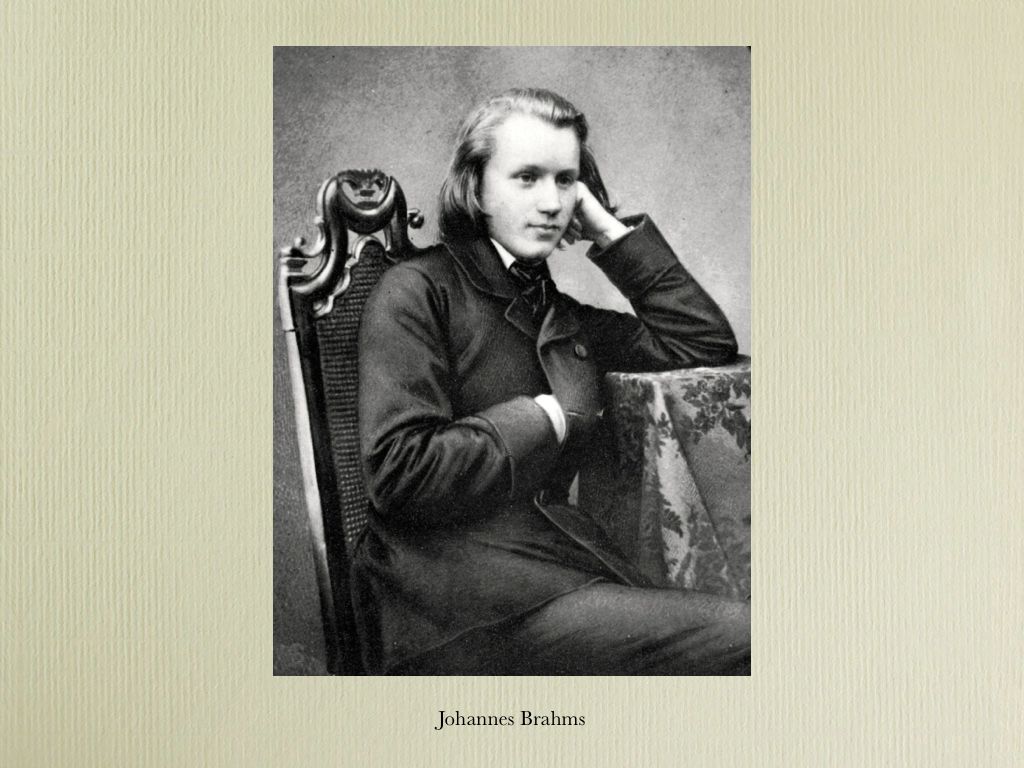
For his part, Brahms looked the role. To the Leipzig matron Hedwig von Holstein, the young genius exuded “purity, innocence, nature, power and depth. […] And, with all this free power, a thin little boy-voice, that had not yet changed! And a child-face that any girl could kiss without blushing! And the purity and security of his entire being, that guaranteed that this person can have nothing to do with this corrupt world! —”
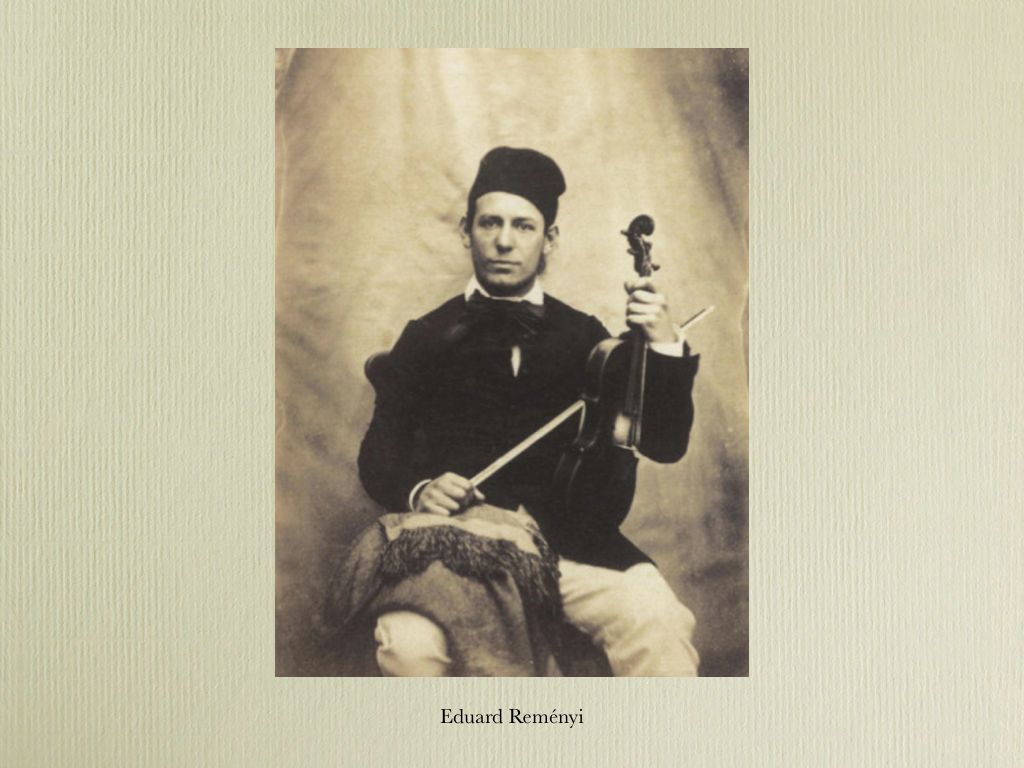
The flamboyant, garrulous, shrewd and Gypsy-like virtuoso Ede Reményi seemed to Joachim, as to others, then and later, an impossible figure to play the role of mentor to a boy with such deep blue, “forget-me-not” eyes. In his festival address at Meiningen on October 7, 1899, the 66 year-old Joachim coined the oft-repeated phrase die ungleichen Kunstgenossen (“the unequal comrades-in-art”) to describe not merely a difference in talent or temperament between Brahms and Reményi, but a difference in moral/artistic outlook between — note the adjectives — “the tender, ideal Johannes and the worldly, fanciful virtuoso” Reményi. Thus, he placed the young Brahms at the parting of two paths: the noble path of Joachim/Schumann artistry and the corrupting path of Reményi/Liszt showmanship. As Joachim told the story, his “discovery” of Brahms was a tale of rescue — of the “young fellow at whose cradle graces and heroes stood watch” — from the sinking weight of temporal concerns and the corrupting snares of musical charlatanism.
Joachim’s pronouncements held something of the vox dei for his contemporaries, and the spirit of his Meiningen speech has since entered all the Brahms biographies. Among biographers, it was Kalbeck who initiated the universally-accepted negative image of Reményi. Kalbeck introduces Reményi in the context of the violinist’s notorious accusation that Brahms plagiarized the Hungarian Dances. That is not an issue to be settled here, but it’s obvious that, whether or not Brahms stole anything, he owed a great musical debt to his early partnership with Reményi. He must have enjoyed the repertoire they played together, — he continued to slip quite happily into the Style Hongrois for the remainder of his life. However, even he refused to acknowledge his debt to Reményi. After the initial hurt of being rejected by Reményi in Weimar, he seemingly shut the door on that episode of his life. Three years later, he wrote to Clara Schumann: “I was delighted […] to learn that you heard the gypsies playing. I have often wanted to hear them. […] They are a very strange race but I was never able to learn very much about them from Reményi. He is such a dreadful liar.” [4]
For a century now, beginning with Kalbeck, Reményi has been portrayed in the Brahms literature as Brahms’s diametrical opposite: The flamboyant, dark-eyed, rootless, cosmopolitan, opportunistic, fawning and deceitful full-blooded Magyar, German-Hungarian Gypsy/Jew who didn’t even use his real name, Eduard Hoffmann. But how real is the commonly-credited and widely disseminated image of Reményi? The recorded facts are these: Eduard Hoffmann/Ede Reményi was born in 1828, 1829, 1830 and 1831. He was a conservatory classmate of Joseph Joachim, studying violin in Vienna with Joseph Böhm between the years 1840-1842, or again from 1842–1845. He and Brahms first met in 1848, 1849, 1850, 1851, 1852 and 1853. That is, assuming Reményi stayed in Germany, shamelessly milking the sympathy of the hapless Hamburgers for his own personal gain, and didn’t go to America in 1849, 1850, 1851 and 1852. As the character of Franz Schubert in the play “Three Pianos” says when asked about his life: “it depends on which biography you read.” One thing all the biographies seem to agree on: Eduard Hoffmann, known to his contemporaries by the “pseudonym” Reményi, was an unreliable, “musically and ethically dubious” person who, in his later life, harbored a personal jealousy of Brahms. That characterization is itself unreliable, however, and dubious in the extreme.
There are many things to be learned about Reményi. I will limit myself to exploring the following vexed questions, which are almost universally misrepresented in the literature:
In general, I hope to shed some light on Reményi’s well-known predilection for the folk-, café and national music of his native Hungary, which made him so mistrusted among the high-minded German classicists.
When Was Reményi Born?
Ede Reményi was born Eduard Hoffmann in the remote town of Miskolc [5] in northeastern Hungary.

He was the son of goldsmith János Henrik (Johann Heinrich) Hoffmann and Josepha Rosina Lustig Hoffmann. Reményi’s birth date is unknown.

The Miskolc Kehilla of Reményi’s birth was the third-largest Hungarian Jewish community. Preserved records for Jewish births in Miskolc begin in 1836 — too late to include Reményi. Grove’s and MGG both give the date of his birth as January 17, 1828. The preponderance of early references to Reményi’s age make this seem too early, however, and point to 1830 as the year of his birth.
A century ago, George Upton, who had access to the Reményi family, gave Reményi’s birthday as July 17, 1830 — the 17th of some month or other seems to be a common feature of all accounts. On May 14, 1836, Eduard’s parents and four of their five children were baptized in the Roman Catholic faith. The baptismal register gives Eduardus Franciscus Hoffman’s age as 6. Based in part on this evidence, the German scholar Adam Gellen, who has researched this issue exhaustively, argues convincingly for the 17th of June 1829 as the probable date of Reményi’s birth. This date would make Reményi two years older than Joachim, and four years older than Brahms.
What is the significance of Reményi’s name change?
Reményi is commonly reported to be a “German Jew” or a “German-Hungarian Jew,” but he was not. Again according to Gellen, the Reményis were of eastern-European origin, probably from Galicia. Eduard’s father was born in present-day Slovakia, and the family may originally have been Yiddish speakers. As Gellen points out, the name Hoffmann — upon which the notion of Reményi’s German heritage apparently rests — is meaningless as an indicator of heritage: after January 1, 1788, all Jews in the Austro-Hungarian territories were required to take German surnames. Before that, Jews didn’t commonly use family names. Joachim’s great-grandfather, for example, was Victor Schul, because he lived near the synagogue. After 1788, his family took the name Figdor, a variant of Victor.

The Patent issued by Emperor Joseph II, requiring the use of German surnames.
Language was of course an important marker of cultural and national identity in the early 19th century. At that time, the Lingua Franca of Hungary was Latin, and all official business was conducted in that tongue. The Hungarian magnates, many of whom lived abroad, spoke Hungarian poorly, if at all, and then only to their serfs. From the late 1820s on, Miskolc was at the forefront of Magyar cultural and linguistic politics, and the Jews of Miskolc were the cutting edge of the change. Jews were amongst the most ardent Magyar nationalists, since they stood to gain the most by the overthrow of the feudal Austrian regime. Beginning in the late 1830s, the Miskolc Kehilla began a gradual shift in their official documents away from Yiddish and toward the Magyar language.
Edward Hoffmann and his older brother Antál, both passionately committed to the Magyar cause, began using the name Reményi — the Hungarian equivalent of the German “Hoffnung,” or hope — in the years leading up to the revolution of 1848. The entire Hoffmann family later adopted the name in 1862.
 Reményi’s name-change is almost always cited in tandem with a mention of his Jewish background, and often together with qualifiers that imply that he was somehow disreputable for using a pseudonym. But, as we see, the name Hoffmann was of relatively recent origin, and probably fairly unsentimental to the family — and the use of the Magyar language was a part of all that was progressive in the culture. The Hoffmanns’ identity was doubtless better expressed, then, by the Hungarian “Reményi,” which goes farther than “Hoffnung” to connote expectancy, confidence and trust in the future.
What was the nature of Reményi’s early relationship with Joachim?
Both Hungarian Jews, Reményi and Joachim were nevertheless of significantly dissimilar backgrounds and of opposite temperaments. Joachim was a blue-eyed blonde, of German-Jewish descent. He was born in the prosperous Kittsee Kehilla on the Austrian border, and his wealthy family oriented toward nearby Vienna.
Psychiatrist Henri Ellenberger tells us “the attitude and mentality of the Austrian Jews largely depended upon the group to which their parents or grandparents belonged before the emancipation.” It made a significant difference, he claims, whether one’s parents “carried with them the resentment accumulated by the Jews of Galicia and south Russia,” or whether they “came from the comparatively privileged community of Kittsee.” [6] This would seem to be true where Reményi and Joachim are concerned — in any case, they were certainly of widely disparate temperaments: Reményi flamboyant and outgoing; Joachim self-effacing and reserved. Joachim a classicist; Reményi “an ardent Hungarian,” whose “national sentiment was reflected alike in his life and in his music.” [7] “It is useless to compare Reményi with Joachim,” wrote George Bernard Shaw. “They are both fiddlers, it is true; but then John the Baptist and the late Archbishop Tait were both preachers.” [8]

Joseph Böhm
Reményi and Joachim both studied in Vienna with Beethoven’s colleague, Joseph Böhm. How well they knew one another as children is open to question, however. Joachim lived with Böhm, and studied privately with him for more than two years before enrolling at the Conservatory. His name appears as a registered student there for a short time only — during the school year 1841-1842 — and then, only as a member of Böhm’s advanced violin class.

A pampered prodigy, he seems to have been regarded in other ways as a special student. According to Otto Gumprecht, “during the three years that this relationship [with Böhm] lasted, he diligently attended the Vienna Conservatory, without, however, being an official pupil of the institution. He took part, with particular eagerness, as a section leader in all the orchestra rehearsals.” [9]
Reményi’s experience was likely quite different. With his conservatory students, Böhm used his own adaptation of the Lancasterian Monitorial System, a method developed by the British pioneer of mass education, Joseph Lancaster (1778-1838) and widely adopted in Austria by the Catholic church. Following Seneca’s motto, Qui docet, discit (“He who teaches, learns”), Lancaster’s system employed advanced students as peer tutors to help the less experienced members of the class. [10] Karl Goldmark, who briefly studied with Böhm in 1847, gives an insight into this tiered system of instruction as Böhm practiced it. He writes: “In the five months that I attended school in [Böhm’s] upper class, I only got to see how one holds the violin. And yet, from this class the greatest violinists emerged […]. Admittedly, only his private students got to hear him. And we learned from them.” [11]


It seems likely, then, that if Joseph and Edward interacted at all, it would have been either in the orchestra, where the young prodigy Joseph would have stood apart as a section leader or concerto soloist,
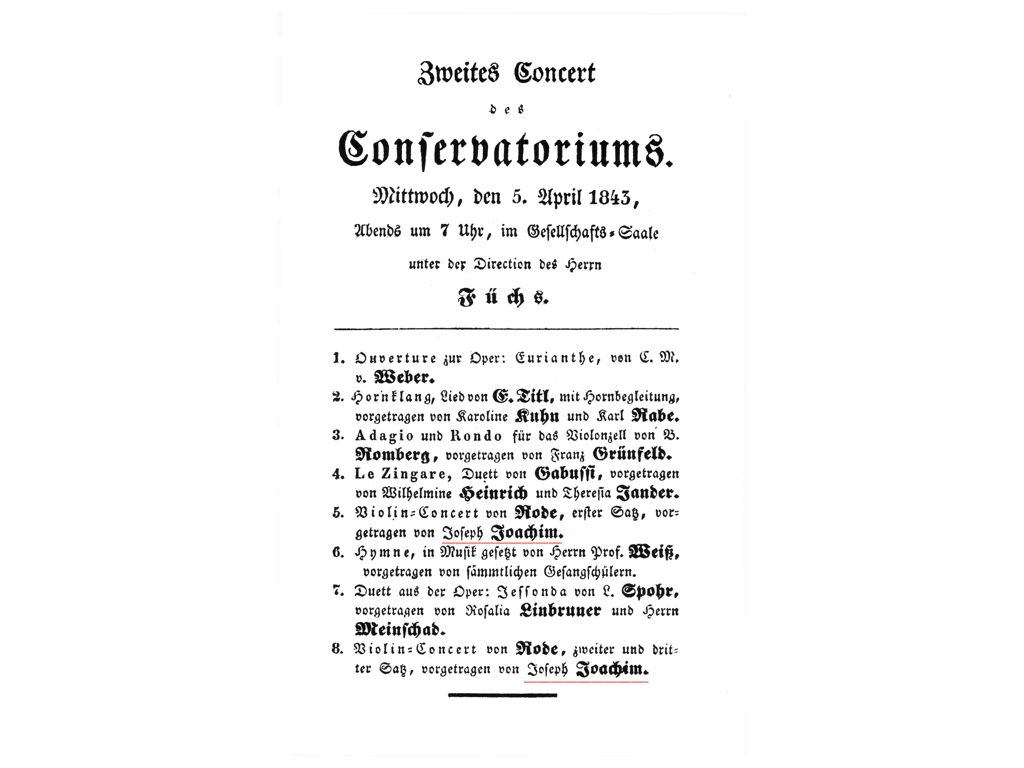
or in a situation where Joseph, around 11 years of age, might have been placed in a superior role to Edward, then about 13.

In any case, Eduard and Joseph did not formally overlap. Joseph withdrew as a student in the Spring of 1842. Eduard began as a mid-level student in the Fall of 1842, advancing to Böhm’s upper class in 1844. He left school at the end of the academic year 1844-45.
When did Reményi go to America, and what did he do there?
After his conservatory studies, Eduard spent some time Paris, and subsequently spent about a year in London, as a first violinist with “Her Majesty’s Theatre.” Reményi was in England in 1848 when the Hungarian revolution broke out. Inspired by patriotic feelings, he quit his job, and hurried home to join the army, serving as a kind of musical aide-de-camp to the commander-in-chief of the Hungarian troops, General Artúr Görgey.

Adam Gellen gives a lot of detail about Reményi’s involvement in the revolution, and evaluates, I believe correctly, the veracity of the various legends and stories that surround this time. It seems that Reményi was close to Görgey, and well known amongst the Hungarian forces, not for wielding a sword, but for wielding a bow. As a violinist, and a leader of military bands, the 18 year-old played a prominent, public role in building morale and patriotic spirit amongst the troops. His celebrated life-long passion for Hungarian music was thus set aglow on the coals revolution and forged on the anvil of war.
The rebellion succeeded for some months, but was eventually crushed when the Austrian Kaiser joined forces with the Russian Tsar. Görgey’s surrender to the Russian troops at Világos was a humiliation, and widely perceived as a traitorous act. A poignant story of the surrender, and of Reményi’s encounter with Görgey there, is told in the 1852 book, Kossuth and His Generals, and is included in your handout.

Reményi’s brother Antál was an aide to another of the principal generals, General György Klapka. Klapka’s forces were the last Hungarian holdouts against the Austrians, defending the fortress at Komárom.

After surrender, many of Görgey’s officers were executed by the Austrians. Klapka’s men were forced into exile, and given passage out of the country. About 60 of them, led by the civil governor of Komárom, Count Lajos Ujhazy, traveled to Hamburg, Germany, where they were received as heroes by the freedom-loving Hamburgers. Accompanying Ujhazy to Hamburg were the brothers Antál and Eduard Reményi. A number of Brahms biographers claim that it was at this time, in 1849, that Reményi met Brahms, then a young Hamburg piano teacher. I believe this to be incorrect, for reasons that I will give later. The exiles, many of whom had been prominent men of means, found themselves cast upon the charity of strangers. They appear to have relied on Reményi, at least to some extent, to raise money for them by playing benefit concerts. Apparently Reményi was not penniless: on November 7, he registered at Streit’s Hotel, one of Hamburg’s nicest establishments. [12]


Three days later, he took part in a benefit concert at the Thalia theater

playing Heinrich Wilhelm Ernst’s Elégie, his own arrangement of Hungarian National Melodies, and Wilhelm Bernhard Molique’s Souvenir de la Hongrie with orchestral accompaniment. [13] The following week, he had a brilliant success, playing for an audience of a thousand at the Tonhalle with a slightly altered program. For the performance, he wore the scarlet uniform of Görgey’s Hussars. A review of the concert mentions his “secure intonation, brilliant, bold bowing, impressive proficiency and deep emotion.” He was also singled out for his outstanding staccato, which was a characteristic of all Böhm students. [14]
On the 22nd of November, Reményi was cheered by an audience of 1,500 in a concert given by the pianist Otto Goldschmidt. Also participating was the phenomenally popular soprano, Jenny Lind, who would later become Goldschmidt’s wife.

On November 27th, he performed for a fourth and final time in Hamburg.
Trip to America
Kalbeck tells us that the exiles soon departed for America, but that Reményi stayed on in Hamburg playing concerts, and didn’t go to America until 1851. Biographers who apparently rely on Kalbeck, like Walter Niemann, Ludwik Erhardt or Jan Swafford, repeat this fallacy. [15] Siegfried Kross doubts that Reményi went to America at all. Florence May implies that he stayed in Hamburg for many months (he stayed 6 weeks), and she then writes: “It would be difficult, and is fortunately unnecessary, to trace the exact steps of Reményi’s career after his flight from Germany.” [16] Not only are these surmises casual or incorrect, but they obscure one of the most interesting parts of Reményi’s resumé: a part that even Brahms may have taken for a lie. The now easily demonstrable fact is that Reményi’s first journey to America took place in December, 1849, and not in 1851, and lasted for at least eight months.

Expelled from Hamburg, the exiles departed as a group in December, 1849, arriving penniless at Leith, Scotland, where the local citizens took up donations to send them on their way to America. They arrived in New York just before Christmas, armed with letters of introduction to President Zachary Taylor, and intending to found a Hungarian colony in the United States.

Leith Harbor
Arrival in Boston and stay in New York
Eduard and his brother Antál travelled separately from the group, arriving in Boston aboard the ship Cambria on December 31st.

Ship’s List for the Cambria on arrival in Boston. Note that Reményi gives his age as 19, and profession as “artist.”
Reményi’s arrival was noted in the press.
Tremont House, Boston
Once in America, Eduard resumed his fund-raising concerts on behalf of the exiles. Reményi’s American debut took place three weeks later, on January 19, 1850 at Niblo’s Saloon in New York City. The program for this concert, shown here, has been widely distributed in print since 1906, yet it has been all but ignored in the Brahms literature.

On this evidence, the only contemporary writer to discuss this program, Joseph Gold, writes in The Strad magazine: “The young violinist first travelled to America, where his concert on 19 January 1850 was a huge success. Remenyi’s performance was at New York City’s Niblo’s Gardens, probably a glorified saloon. He was accompanied by an ‘efficient’ orchestra and performed unnamed concertos by Vieuxtemps and Molique, La Sonnambula Fantasy by de Beriot and his own Hungarian Melodies.” [17] Lest you have visions of Doc Holliday, however, when you think of this “glorified saloon,” let’s take a look at the interior of the opera house at Niblo’s Garden.

Located on Broadway between Spring and Prince Streets, Niblo’s establishment was less than a year old when Reményi gave his American debut there, and was the most fashionable performance venue in New York. Niblo’s Theater, the best-equipped theater in the city, held more than 3,000 people. Reményi’s concert probably took place, not in the theater, but in the ballroom, or saloon, of Niblo’s establishment.

The perspective in this picture is probably not right — the accompanying article states that the room accommodated an audience of twelve hundred people. During the 1850’s, this room (not the opera theater) was home to the Philharmonic Society of New York, and the venue for appearances by such prominent musicians as Louis Moreau Gottschalk, Adelina Patti, Ole Bull, Henriette Sontag, Sigismund Thalberg and Henri Vieuxtemps.

Reményi’s collaborators on this program were Mr. William Scharfenberg, Mr. H. C. Timm and Mr. Theodore Eisfeld. Timm, Scharfenberg and Eisfeld were President, Vice-President and Assistant, respectively, of the Philharmonic Society of New York.

It seems highly likely, then, that the ‘efficient’ orchestra mentioned in the program was the New York Philharmonic, hired especially for the occasion. The concert is reported to have been well attended by a “highly respectable” audience.

How could an unknown 19- or 20 year-old violinist, arriving as a refugee in Boston a mere three weeks earlier, arrange and finance such an event? Clearly, the celebrity of the Hungarian refugees helped to fill the hall, but Reményi must also have been the beneficiary of considerable financial and logistical aid from an organized group of local supporters. It seems likely, also, that the lion’s share of the receipts from the concert went to support his compatriots in their exile.
Forty-five years later, Reményi gave an interview to the New York Times, in which he described the heros’ welcome that the Hungarian patriots received at the hands of the New Yorkers. “When I first came to New-York […],” he said, “I was an exile. At that time the people of this country knew such enthusiasm for Kossuth and the Hungarian cause as you of to-day can never know for anything — not even for yourselves. […] Citizens of the town came down to the ships to welcome the exiles and to provide for them. They were taken into the New-York families when they landed. It so happened that I became the guest of John Keeze Bailey, a Knickerbocker. In that family Washington was spoken of as familiarly by the mother and older members as we at this table would speak of each other. […] The name of Washington by us at home was worshipped. What then did it mean to me to be a member of a household where his past visits were spoken of, his words quoted trivially, as would be the expressions of any intimate friend! Ah! it seems that I could almost touch the hem of the garment of the hero worshipped in Hungary! […] The Baileys lived at 9 Sixteenth Street, Union Square. […] John Keeze Bailey’s father had given Union Square to the city in order to enhance the value of his property in Sixteenth Street, which was hopelessly far from town.” [18]
Reményi gave a second New York performance on February 25th in the Broadway Tabernacle, located at 340 Broadway, near the present-day city hall.

The Tabernacle, which held 2,400 people, was known for its embrace of liberal causes: within its walls, William Lloyd Garrison and Frederick Douglass advocated the abolition of slavery and Sojourner Truth spoke in favor of women’s suffrage. A decade earlier, church members had helped to raise a defense fund in the famous case of African slaves captured aboard the ship Amistad. Now, the speeches were mixed with advocacy of the Hungarian cause. In March, Horace Greely told an enthusiastic Tabernacle crowd: “Tyranny, by the help of Treachery, has Hungary at its mercy. […] It is ours to show to the world that our appreciation of the champions of Human Rights is not affected by the accidents of Fortune, but that they are as dear to us in this hour of their adversity and sorrow as they were in their proudest day of hope and victory.” [19]

The exiles continued their triumphant and celebrated tour from New York to Philadelphia, Baltimore, and then to Washington D. C., where Count Ujhazy met with President Taylor. In Philadelphia they were greeted by cheering crowds. In this picture, Count Ujhazy addresses a torchlit gathering in front of the Hotel Washington. According to the article in the Illustrated London News, Reményi also spoke on that occasion.


In each of these places, Reményi gave high profile concerts to benefit the Hungarian ex-patriots, playing in major venues, and with the best orchestras, including, in Baltimore, the Germania Musical Society — 25 Berliners who left Prussia for political reasons, but who were known in America for their exceptional musical skill and precision of execution.

The Germania performed all over the east coast, and formed the orchestra for Boston’s Handel and Haydn Society.
Reményi eventually left the company of his brother and the refugees, and proceeded on his own to New Orleans, another locus of the Hungarian diaspora. In July, we find him again in New York, living together with several other Hungarians, and playing again at Niblo’s Saloon.

Was Reményi a spy?
Perhaps. By all appearances, Reményi was an active member of the radical diaspora — the undead of the Hungarian revolutionary movement — and a visible contributor to the cause. It is not known whether his activities went beyond the musical. Reményi lived an itinerant life, and his movements were always difficult to trace. In later life, he turns up in South Africa, on the pyramids of Giza — in the most remote and remarkable places. Reports of his death were always greatly exaggerated, and he once amused himself by making a collection of his own obituaries. In the years following his sojourn in America, we lose track of him for months at a time. One thing is striking, however: he always resurfaces in places like Paris, Brussels and Hamburg, where there was a significant presence of the Hungarian “Umsturzpartei” — the revolutionaries in exile. We know that, at least in Germany, the police closely followed his activities and reported on his associations. According to these reports, his companions were known radicals, several traveling under assumed names.

In November and December of 1851 Reményi was in England, performing with leading British musicians in the celebrations surrounding the visit of the Hungarian leader in exile, Lajos Kossuth, newly released from detention in Turkey and on his way to America to plead the Hungarian cause to the American people and to President Millard Fillmore. Reményi was later associated in police reports with Kossuth’s sisters.

In April of 1853, Reményi and Brahms set out on the famous concert tour that would take them to Joachim in Hannover, and eventually to Liszt in Weimar. Within a half hour of their departure, the police were knocking on the Brahms family door, inquiring after Reményi. It is possible, though I can’t prove it, that Reményi’s interest in meeting Joachim during this tour, and especially in meeting Liszt, who had harbored the famous radical Richard Wagner, was as much political as musical. He may have tried to enlist them in the Hungarian national cause. As is well known, Reményi was detained and questioned in Hannover (June 10, 1853), and was immediately sent packing by police chief Wermuth, no doubt to Joachim’s extreme embarrassment. Joachim was, after all, new in his job there, and answerable, not only directly to King George, but to a very touchy, uncongenial Court Intendant, Count von Platen, with whom he was never able to establish a good working relationship. Inspector Wermuth’s report exists, and published excerpts of it are included in your handout.
When did Brahms and Reményi meet?
As I indicated earlier, published speculaton as to the first meeting between Reményi and Brahms ranges from 1848 to 1853. It seems that only Adam Gellen, Robert Pascall and Kurt Hofmann plead for 1853 — and I’d like to add my voice to theirs. As far as I have been able to determine, there is no direct evidence linking Brahms and Reményi before January of 1853.

Reményi himself left a rather detailed account of their first meeting, reported in the New York Herald on January 18, 1879 — 26 years after the fact. Probably because of the rather breathless nature of the reporting, and perhaps because of Reményi’s bad reputation, this account seems not to be widely credited. Nevertheless, I have found many of Reményi’s statements to the press to be highly credible, even after the passage of some time, and it’s worth taking a close look at this one. In Reményi’s words:
“In January, 1853, a fashionable musical entertainment was announced at the house of one of the great merchant princes of Hamburg, a Mr. Helmrich. On the very day that the soirée was to take place I received a letter from my regular accompanist stating that he would be unable to be present that evening, owing to illness. I went across the street from my hotel — Le Soleil — to the music establishment of Mr. Auguste Böhm, to ascertain where I could find a substitute. In answer to my inquiries, that gentleman remarked, in a nonchalant manner, that little Johannes would perhaps be satisfactory. I asked what sort of Johannes he was. He replied, ‘He is a poor piano-teacher, whose name is Johannes Brahms. He is a worthy young man, a good musician, and very devoted to his family.’”

As it happens, there are a number of verifiable facts in this account. If we look at the Hamburg Adreßbuch of 1853, we find that there was, indeed, a merchant named H. A. Hellmrich, who lived in the Gröningerstraße, one of the most fashionable streets in the city. There was also Johann August Böhme’s music store, at Neuerwall 53. (The founder of the business, Johann August Böhme, died on February 8, 1847. His son, Julius Eduard, took over the business in 1839 or 1840, and is perhaps the person that Reményi is referring to).

Reményi gives his hotel as Le Soleil — The Sun. We can confirm that he once stayed there around that time, insofar as the Hamburger Nachrichten of 18 November, 1852, lists “Remengi, Artiste v. Brüssel” among the foreign arrivals registered at the “Hôtel zur Sonne.” This is so far the only verifiable date that Reményi stayed in that hotel.

The address of the Hôtel zur Sonne, as it turns out, was Neuer Wall 49: as Reményi said, directly across the street from Böhme’s music shop.

Remenyi’s date of January 1853 is further confirmed by another source. Florence May gives details of Reményi and Brahms’s first acquaintance, and without giving specific dates, implies that it took place in 1849, before the Hungarian refugees departed for America. In this passage, she describes frequent visits in Dehensen at the villa of a Hungarian magnate named Begas, who was anxious to elude the police authorities.

“The violinist had connections of his own in the neighbourhood. Begas, a Hungarian magnate, had settled down into a large villa at Dehensen, on the Lüneburg Heath, that had been placed at his disposal for as long a time as he should find it possible to elude or cajole the police authorities, and kept open house for his compatriots and their friends. To his circle Brahms was introduced, and much visiting ensued between Dehensen and Winsen, for one or two musicians staying with Begas were pleased to come and make music with Reményi and Johannes, and to partake of the Giesemanns’ hospitality.”
This story, which May probably got from Brahms’s friend Elise Giesemann Denninghoff, is doubtless accurate, but the published report of police commissioner Wermut in Hannover from 1853, obviously referring to the same events, suggests that her implied date is too early.

Wermuth’s report mentions a certain 28-year-old former law student named Justinus Michael Begyats, one of the “Ungarische Emissäre der Umsturzpartei”

who had been living since 1851 in Dehnsen under the pseudonym Justinus Becker. The report states that Reményi and his traveling companion, the known subversive Alexander Asztalos, had secretly been staying with Begyats off-and-on during the end of 1852 and the beginning of 1853 — the very time Reményi claims he first met Brahms.
Justin von Begyats made several journeys to Australia aboard the ship La Rochelle, in January, 1855, and in November, 1856:


[Ancestry.com]
Conclusion

In conclusion: the information on Reményi in the Brahms literature is mostly self-contradictory, and, indeed, most of it is untrue. Trying to unearth just a few basic facts leads one to a fascinating story about this truly remarkable artist and man, who was intimately connected with the political and cultural ferment of his time. The numerous facts and anecdotes that I have been forced to leave out of this paper, particularly concerning his sojourn in America, are, if anything, even more interesting than the things that I have presented, but I hope I have at least been able to shed a little light on this history, and to pique your interest in this extraordinary man. Reményi has often been dismissed as a showman. That he was, but he was also a serious artist. This little-appreciated side of his character becomes clear when reading his description of Brahms, written shortly before his death, with which I would like to close. Who but a man of integrity could have written these words:
“Taking a broad view of him, Brahms was a man; a manly nature in contrast to the degenerate effemination of present-day art; a sturdy North German, sound to the roots, detesting pretences and mannerisms, an enemy of empty phrases; distinguished, forcible in character, strong in will and sentiment; a man possessing under a hard and rough exterior a warm and throbbing heart. Thus in Brahms the requirements for a true artist are an inseparable unit. Equipped with the highest artistic endowments, genius, and originality, having the power which can create and need not borrow, endowed with artistic culture in all its ramifications, he has created masterpieces, long secure in the sacred shrine of German music; treasures wrought of precious metal, remaining untarnished forever. Brahms’s systematic development reminds one forcibly of the evolution of Beethoven; a healthy instinct conjoined with imperturbable self-criticism always guarded him against mistake; and, although a born lyrist, he withstood the alluring voice of the stage, and never was faithless to his mission.” [20]


From: The Magazine of Poetry. A Monthly Review, Vol. 6, Buffalo, N. Y.: Charles Wells Moulton, 1894, p. 365.
[1] This desire extended into later life: see Marie von Bülow’s criticism of Joachim’s Meiningen Festrede:
[2] “Mein einziger Umgang ist jetzt hier ein junger Hamburger, Namens Brahms, ein 20 jähriges gewaltiges Talent in Komposition und Klavierspiel, das der Dunkelheit zu entreißen, mir das Glück wird.” Holograph,Brahms Institut Lübeck, 1991.2.53.9.
[3] Ehrlich/KÜNSTLERLEBEN, p. 184. This was, of course, pure romanticism and wishful thinking on Joachim’s part, and the reality was not long in sinking in. On October 20, 1854, Joachim wrote differently about the effects of an obscure upbringing on Brahms’s character: “Brahms is the most inveterate egotist one can imagine, without being at all conscious of it, as indeed everything with him pours altogether unconcernedly, in the most spontaneous geniality, from his sanguine nature — albeit at times with a recklessness (not a lack of reserve, for I would welcome that!) that is offensive because it betrays a lack of education. He has never in his life taken the trouble to think about what others are bound, by their nature and their upbringing, to value; whatever does not fit his own passions, his experience, even his mood of the moment, is rejected with loveless coldness, nay, assailed at will with the most malicious of sarcasms. So that for the listener who was just now warming to the blissful, radiant young man, his entire being marked with the traces of spirit, a barrier suddenly rises up. I often had to call upon my concern for justice, lest I plunge from my high spirits into coldness. He knows the weaknesses of those whom he deals with, uses them, and has no qualms about then showing them the fun he is having at their expense.” [“Brahms its der eingefleischste Egoist, den man sich denken kann, ohne daß er es selbst wüßte, wie denn überhaupt Alles bei ihm in unmittelbarster Genialität ächt unbesorgt aus seiner sanguinischen Natur hervorquillt — bisweilen aber mit einer Rücksichtslosigkeit (nicht Rückhaltlosigkeit, denn das wäre mir recht!), die verletzt, weil sie Unbildung verräth. Er hat sich nie in seinem Leben Mühe gegeben auch nur nachzudenken, was Andere ihrer Natur und dem Gang ihrer Entwickelung gemäß hochhalten müssen; was nicht in seine Begeisterung, in seine Erfahrung, ja in seine Stimmung paßt, wird mit liebloser Kälte zurückgewiesen, ja nach Laune mit den hämischsten Sarkasmen angefallen, daß [für] den Zuhörer, der sich noch eben an dem in sich selbst glückseligen, strahleneden jungen Menschen, auf dessen ganzem Wesen der Geist seine Spuren geprägt hat, recht erwärmte, eine unwillkührliche Scheidewand sich aufrichtet. Ich mußte oft meinen Wunsch der Gerechtigkeit aufrufen, um nicht aus meiner Stimmung in Kälte zu verfallen. Er kennt die Schwächen der Menschen, mit denen er verkehrt, benützt sie, und scheut es nicht dann zu zeigen (freilich ihnen selbst gegenüber) daß er sich über sie gaudiere.”] [Joachim/BRIEFE I, p. 218]
[4] Quoted in Handrigan, p. 26.
[5] Miskolc was the third-largest Hungarian Jewish community. See Howard Lupovitch on JSTOR:
[6] Ellenberger/DISCOVERY, p. 572.
[7] George P. Upton, quoted from Kelley/REMENYI, p. 9.
[8] Rattray/SHAW, p. 315.
[9] Gumprecht/CHARAKTERBILDER, p. 263. m.t.
[10] Lancaster made use of an intricate scheme of rewards and punishments, including silver-plated badges, toys or money for the diligent—and humiliation for the lazy. Some of Lancaster’s maxims, “a place for everything and everything in its place,” and “let every child at every moment have something to do and a motive for doing it,” are still known. Though Lancaster’s personal life “was mainly one of failed prospects, broken engagements, sordid quarrels, and endless debts,” his method achieved worldwide popularity by the beginning of the 19th century, especially in Christian education. Böhm may have learned of the method through the Catholic Church, which formally adopted the system in many of its schools.
[11] Goldmark/ERINNERUNGEN, p. 26.
[12] Gellen.
[13] Gellen.
[14] Gellen.
[15] The following account, from Swafford, is surely fanciful. Reményi was in America at the time that Swafford has him establishing a friendship with Brahms: “Brahms may or may not have attended Reményi’s Hamburg farewell, but he certainly heard about this virtuoso who had made a sensation in the city with his perfervid playing of both the standard and nationalistic repertoires. Meanwhile, Reményi stayed on and concertized for some time after this ‘farewell.’ In August 1850, Brahms got to know him when the violinist asked him to accompany a private concert at the house of a local merchant. That was an honor for Brahms; if this virtuoso was not world-renowned yet, he seemed likely to be — he had the thirst for it.
Brahms and Reményi began playing and socializing with the violinist’s circle of Hungarian exiles. There were trips to Winsen for pleasant evenings of playing at the Giesemanns’. Already a devotee of folk music in general, Brahms responded enthusiastically to the czardas and other styles that made up the alla Zingarese (in the gypsy style) repertoire. Still, there was little more to their relations than playing chamber music, a few shared interests, some sociable times in city and country. At that point, Reményi was likely just another contact for Johannes, who had no discernible plans for his career and little time for friends. The fun ended in early 1851, when rumors of an arrest warrant put Reményi on a boat to America.” Swafford/BRAHMS, p. 56.
[16] May/BRAHMS, vol. I, p. 94.
[17] Gold, Joseph. “King of the Salon.” Strad 109, no. 1302 (October 1998): 1102.
[18] “Remenyi, The Violinist,” The New York Times, New York: June 30, 1895, p. 28.
[19] “Reform Movements,” The Spirit of the Age, vol. II, no. 12, Saturday, March 23, 1850, p. 188.
[20] Upton/REMENYI, p. 15.
 From Gleason’s Pictorial, vol. 2, no. 10 (Boston, March 6, 1852).
27 Saturday Sep 2014
Posted in Concert Reviews & Criticism
Wiener Zeitung, No. 125 (May 26, 1853), p. 478.
Bei dem diesjährigen niederrheinischen Musikfeste in Düsseldorf am 15., 16. und 17. hat, wie es scheint, der Virtuose Herr Joachim den Preis davon getragen. Die “Kölnische Ztg.” sagt über denselben: “Es dürfte keinen lebenden Violinisten geben, der mit Herrn Joachim in die Schranken treten könnte. Sein Ton ist voll, rein bis in die höchsten Noten und zum Herzen sprechend. Daß seine Fertigkeit eine ungeheure ist, vergißt man über dem Vortrag; er ist nicht Virtuos, er ist Künstler, er spielt nicht Violine, er singt auf ihr. Es ist schwer, einen Vortrag von Tönen in Worten beschreiben zu wollen — genug, Herr Joachim hat geleistet, was man kaum für möglich gehalten. Man mußte die Musiker sehen, denen die Augen voll Wasser standen, um die Wirkung seines Spiels recht zu würdigen. Das Urteil der wackersten Künstler, die mit ihm spielten, die ihn jetzt begleiteten, erkannte ihm einstimmig den höchsten Lorbeerkranz zu. Von den einzelnen künstlerischen Leistungen war die des Herrn Joachim unbedingt die bedeutendste.”
At this year’s Lower Rhine Music Festival in Düsseldorf on the 15th, 16th, and 17th, it appears that the virtuoso Herr Joachim took home the prize. The “Kölnische Zeitug.” says about him: “There may be no living violinist who could compete with Mr. Joachim. His tone is full, pure even in the highest notes, and speaks to the heart. While listening to his performance, one forgets that his skill is immense; he is not a virtuoso, he is an artist, he does not play the violin, he sings on it. It is difficult to describe a performance of sounds in words – enough to say that Mr. Joachim has achieved what one could hardly imagine. One had to see the musicians with tears in their eyes to truly appreciate the effect of his playing. The unanimous verdict of the most reputable artists who played with him, who accompanied him now, awarded him the highest laurel wreath. Among the individual artistic achievements, Mr. Joachim’s was unquestionably the most significant.”


27 Saturday Sep 2014
Posted in Concert Reviews & Criticism
Der Ungar. Zeitschriftliches Organ für magyarische Interessen (Pesth), vol. 1, no. 28 (February 4, 1842), p. 172.
Hermann Klein (*Miscolc, 1805 — †Budapest, 1889), later known as Kilényi János, was a Hungarian Jewish journalist and translator. His journal Der Ungar, which appeared from 1842-1849 in Pest, is one of the early sources of articles about Joachim, the information for which was likely provided by Joachim’s parents.
Feuilleton
[Viertes Zöglings-Konzert des Conservatoriums.] Ueber unsern Landsmann den kleinen Geigenheros Joachim berichtet die Theaterzeitung: Die Palme des heutigen Abends ward und gebührte dem zehnjährigen Schüler des Herrn Professors Böhm, Joachim, welcher Variationen von Ernst mit einer staunenswerthen Virtuosität spielte. Der Stand für Konzertisten im Mannesalter wird in seiner Unerquicklichkeit bald den Kulminationspunkt erreicht haben, wenn schon Knaben, so aufzufassen und wiederzugeben vermögen. Joachim ist wahrhaftig ein musikalisches Phänomen. Es ist schwierig zu unterscheiden, ob bei ihm der eminente Vortrag, die trefflich ausgebildete Technik, oder diese jenen überragt. Hört man in dem Spiele des Knaben das wundervolle Cantabile, mit dieser Intensität des Gefühls, das Tonleiden, die Klage der Violine diesen klingenden Schmerz, den nur, wie man wähnt düstere Lebenserfahrungen aus dem Instrumente hervorzuloken im Stande sind, so wird man an der Erscheinung vor sich irre, und hält sich für das Spielwerk eines optischen Truges. In diesem Knaben sehen wir die reiffste Frucht in der beginnenden Blüthenzeit; wir erbliken in ihm den fertigen, tieffühlenden Künstler. In technischen Beziehung behandelt Joachim die Violine auf eine ganz vorzügliche Weise. Er besizt eine schöne Bogenführung, welche selbst durch die heterogensten Stricharten auf der E- und G-Saite nicht gestört wird, verbunden mit einer überaus leichten Lenkung der rechten Hand. Dieselbe musterhafte Methode zeigt auch die linke Hand durch den richtigen und zwekmäßigen Fingersaz, sowol zur Bildung des schönen Tones, als zur Klarheit und Deutlichkeit der Passagen in allen Violinlagen. Sein Spiel zeigt wahres Applicatur-Studium. Joachim entwikelte bei dem Vortrage der genannten Variationen nicht nur die größte Sicherheit in Überwindung immenser Schwierigkeiten, welche darin sich überbieten zu wollen scheinen, sondern auch alle Reize der Violine. Accorde drängen sich auf Accorde in den schwierigsten Formen, und in allen Lagen: Terzen, Oktaven und Dezimen, chromatische und diatonische Läufe im rapidesten Tempo, Arpeggien mit festen und springenden Bogen, Staccato mit der Spitze, und mit dem Mittelbogen, piccikirte Noten inzwischen angestrichen, kurz Alles, was nur schwierig genannt wird, spielt dieser Knabe mit einer, an’s Wunderbare streifenden Sicherheit, Reinheit und Klarheit, und mit einem von der trefflichsten Schule, und der meisterhaftesten Methode zeugenden Vortrag. Der Erfolg stellt sich mit der Außerordentlichkeit der Leistung auf gleiche Stufe; er war beispiellos eclatant. Nach vielmaligen Vorrufungen welche dem Knaben galten, ruhte das Publikum nicht früher mit seinem citierenden Beifalls, bis auch der große Meister Böhm erschien, welcher nur deshalb sein Spiel der Öffentlichkeit zu entziehen scheint, um desto mehr mit eminenten Schülern überraschen zu können.


26 Friday Sep 2014
Posted in 1 Biographical Posts — RWE
© Robert W. Eshbach, 2014

“A Very Agitated Evening” [1]
On June 9, 1848, Liszt arrived unexpectedly at the Schumanns’ home in Dresden. As they had not seen one another in nearly seven years, [2] Liszt was received with delight, though with no little consternation when he expressed his wish to hear some of Schumann’s chamber music later that evening. While Robert took Liszt to visit Wagner, Clara had but a few hours to gather the musicians and guests [3] for the evening’s festivities. “It was difficult to get four other artists to come at such short notice,” she later told Edward Speyer, “but I took a cab and drove about until I was fortunate enough to succeed in my mission.” [4] Liszt, for his part, made other plans for the early part of the evening, writing to Georg von Seydlitz: “Unfortunately I will only be able to spend a few moments with you, since I have asked Schumann to show me his new trio. [5] The Schumanns seem to me to be people who go to bed early, and so I will be obliged to arrive at your place at 8:00 o’clock.” [6]
The party started badly, with the guest of honor nowhere to be seen. After more than an hour of waiting, the disappointed guests began to make music without him. As they reached the last page of Beethoven’s D Major trio (“Ghost”), Liszt “stormed in the door,” two hours late. He seemed to enjoy the ensuing performance of Schumann’s trio, but his host’s quintet he belittled as too “Leipzigerisch.” “No, no, my dear Schumann, this is not the real thing,” he is reported to have said. “It is only Kapellmeister music.” [7] After dinner, Liszt sat down to play, in Clara’s words, “so disgracefully badly […] that I was really ashamed to have to stand there and listen, and not to be able to leave the room immediately, as Bendemann did.” [8] When he finished playing, Liszt gave an after-dinner speech, declaring that new trails were being blazed for music everywhere, and even that which a few years before had evoked the admiration of the world was already Rococo. [9] He tactlessly praised the music of Meyerbeer at the recently-deceased Mendelssohn’s expense, heedless of Schumann’s well-known aversion to Meyerbeer’s music and his esteem for his departed friend. Schumann flew into a rage, seizing Liszt by the shoulder and shouting: “And Mendelssohn? Is he also Rococo? Meyerbeer is a runt compared to Mendelssohn, who was an artist who made an effect, not only in Leipzig, but throughout the entire world, and Liszt should hold his tongue.” [10] After more similar abuse, Schumann retreated to his bedroom. Liszt made an attempt to downplay the event, but eventually gave up and left the party, saying to Clara as he departed “Tell your husband that there is only one man from whom I would so calmly accept words such has he has just said to me.” [11] Liszt drove home with Wagner in a state of “amused embarrassment.” Wagner wrote: “I have seldom seen Liszt so boisterously cheerful as on this night, in which, clothed only in a thin tailcoat against the severe cold, he alternately accompanied me and concertmaster Schubert home.” [12] Later, Liszt admitted to Lina Ramann that they had “suffered through a very agitated evening together — which was my fault.” [13] “It wounded Robert too deeply for him ever to be able to forget it,” Clara wrote afterward, saying of Liszt: “I have broken with him for all eternity.” [14]
Schumann eventually re-established relations with Liszt, though the former cordiality never returned. A year later, in May of 1849, Schumann was still smarting from Liszt’s assessment of his music. Liszt, trying the door that had been slammed in his face, inquired through Carl Reineke whether he might perform Schumann’s Faust at Weimar’s upcoming Goethe celebration. Schumann replied: “But, dear friend, wouldn’t the composition perhaps be too Leipzigerisch for you? Or do you indeed hold Leipzig to be a miniature Paris, [15] in which one can also accomplish something?” He then went on to defend himself and Leipzig against Liszt’s criticisms that Leipzigers were concerned only with perpetuating dead forms, and that their music consequently sounded too much alike. “Seriously — I might have expected something different from you, who knows so many of my compositions, than to lump them all together, [16] expressing such a judgment of a whole life in art. […] And, truly, those who were together in Leipzig weren’t so bad after all, — Mendelssohn, Hiller, Bennet, et al. — we could hold our own with the Parisians, Viennese, and Berliners. […] So much for your comment, which was unjust and insulting. For the rest, let us forget the evening — a word is not an arrow — and the main thing is to strive forward.” [17] Liszt replied: “Highly honored friend, above all, allow me to repeat to you what, after a long time, you should actually know best beside me: that no one admires and respects you more sincerely than my humble self. Certainly, we can find a time to have a friendly discussion about the meaning of a work, a man, or indeed a city […]” [18]
Despite Schumann’s stated wish, the memory of their “agitated evening” was still green in his mind in early February, 1851, when he found himself seated next to the pianist Marfa Sabinina following a concert in Düsseldorf. “He also told me about Liszt,” Sabinina later wrote, “and in particular about a quarrel with him concerning Mendelssohn and Meyerbeer. During the course of the conversation, Schumann reiterated that he could not stand the music of Meyerbeer. […] Then, Frau Schumann joined our conversation; she spoke intensely against Liszt, particularly as a composer. It is clear that two such dissimilar natures as Clara Schumann and Liszt could not agree. […] Robert Schumann did not share his wife’s opinion, though; he felt that Liszt ‘was a intelligent pianist and person.’ This fair-minded opinion notwithstanding, Schumann, influenced by his wife, distanced himself from Liszt, or — more precisely — he kept to the Leipzig music world in which he had grown up, and had not a few friends.” [19]
[1] This account is pieced together from numerous narratives, diary entries, reports of conversations, etc. While precise words vary, the gist and tenor of the story is consistent from source to source.
[2] In Leipzig, December, 1841.
[3] Liszt later told Lina Ramann that Wagner had been among the evening’s guests. [Franz Liszt and his World, ed. by Christopher Gibbs and Dana Gooley, Princeton 2006, p. 406 n. 17.] See also: Wagner, My Life.
[4] Speyer/LIFE, p. 82. Speyer, who heard this story directly from Clara Schumann, nevertheless mistakenly places it in Leipzig instead of Dresden.
[5] Opus 63.
[6] Quoted in Seibold/BEZIEHUNGEN, p. 193.
[7] ibid.
[8] “[…] so schändlich schlecht […] daß ich mich ordentlich schämte, dabeistehen zu müssen und nicht sogleich das Zimmer verlassen zu können, was Bendemann tat.” Litzmann/SCHUMANN, vol. 2, p. 121.
[9] Richter/GLANZZEIT, p. 74.
[10] “Und Mendelssohn? Der also ist auch Rokoko? Meyerbeer sei ein Wicht gegen Mendelssohn, letzterer ein Künstler, der nicht nur in Leipzig sondern für die ganze Welt gewirkt hätte, und Liszt solle doch lieber schweigen.” Richter/GLANZZEIT, p. 74.
[11] “Sagen Sie Ihrem Manne, nur von einem in der Welt nähme ich solche Worte so ruhig hin, wie er sie mir eben geboten.” Litzmann/SCHUMANN, vol. 2, p. 122. Speyer quotes Clara Schumann that Liszt said: “I am deeply sorry to have been the cause of such an unleasant incident. I feel I am in the wrong place here; pray accept my humble excuses and allow me to depart.” Speyer/LIFE, p. 82]
[12] “Ich habe selten Liszt so ausgelassen aufgeräumt gesehen als in dieser Nacht, wo er mich und den Konzertmeister Schubert bei empfindlicher Kälte nur im dünnen Frack gekleidet, abwechselnd von einem zum andern nach Hause begleitete.” (Wagner 1963: 435f.) (quoted in Seibold/BEZIEHUNGEN, 194-195). Dresden concertmaster Franz Schubert (1808-1878).
[13] Gibbs and Gooley/LISZT, p. 406, n. 17.
[14] “Robert hatte das zu tief verletzt, als daß er es jemals vergessen könnte. Ich habe für ewige Zeit mit ihm abgeschlossen.” Litzmann/SCHUMANN, vol. 2, p. 122.
[15] A reference to the Auerbachs Keller scene of Goethe’s Faust, in which the character Frosch says: “Mein Leipzig lob’ ich mir! Es ist ein klein Paris und bildet seine Leute.” (“I praise my Leipzig! It is a little Paris and educates its people.”)
[16] His expresion was “Im Bausch und Bogen.” Goethe: “Nehmt nur mein Leben hin / in Bausch und Bogen, wie ich´s führe; / Andre verschlafen ihren Rausch, / meiner steht auf dem Papiere.”
[17] “Aber lieber Freund, würde Ihnen die Komposition nicht vielleicht zu Leipzigerisch sein? Oder halten Sie Leipzig doch für ein Miniaturparis, in dem man auch etwas zustande bringen könne? Und wahrlich, sie waren doch nicht so übel, die in Leipzig beisammen waren — Mendelssohn, Hiller, Bennett u. a. — mit den Parisern, Wienern und Berlinern konnten wir es ebenfalls auch aufnehmen. […] So viel über Ihre Äußerung, die eine ungerechte und beleidigende war. Im übrigen vergessen wir des Abends — ein Wort ist kein Pfeil — und das Vorwärtsstreben die Hauptsache.” Litzmann/SCHUMANN, vol. 2, pp. 122-123.
[18] “Hochverehrter Freund, Vor allem erlauben Sie mir Ihnen zu wiederholen, was Sie eigentlich nach mir am Besten seit langer Zeit wissen sollten, nämlich, dass Sie niemand aufrichtiger verehrt und bewundert als meine Wenigkeit. Gelegentlich können wir allerdings über die Bedeutung eines Werkes, eines Mannes, ja sogar einer Stadt, freundschaftlich discutiren […].” Franz Liszt’s Briefe, ed. by La Mara (Marie Lipsius), vol. 1, Leipzig 1893, p. 78.
[19] “Er erzählte mir auch von Liszt, und zwar von einem Streit mit ihm über Mendelssohn und Meyerbeer. Dabei äußerte Schumann erneut, er könne die Musik von Meyerbeer nicht ertragen. […] Nun schloß sich Frau Schumann unserem Gespräch an; heftig redete sie gegen Liszt, insbesondere als Komponisten. Es ist klar, daß zwei so verschiedene Wesen wie Clara Schumann und Liszt sich nicht finden konnten. […] Robert Schumann teilte aber die Meinung seiner Frau nicht, er fand, Liszt ‘sei ein geistreicher Klavierspieler und Mensch.’ Dieser gerechten Meinung ungeachtet, hielt sich Schumann, von seiner Frau beeinflußt, Liszt fern oder — besser gesagt — er hielt sich an die Leipziger Musikwelt, in der er aufgewachsen war und nicht wenige Freunde hat.” Schumann Studien, ed. by Gerd Nauhaus, Sinzig: Studio Verlag, 1997, vol. 6, p. 212.
26 Friday Sep 2014
Posted in Iconography

Richard Lucae (1829-1877), Architect
 oseph Joachim commissioned the Villa Joachim from Richard Lucae, director of the Berlin Bauakademie, when he was 40 years old. It was built in Berlin near the von Arnim residence, In den Zelten 10 — Beethovenstrasse 3. It later became the residence of Fürst von Hatzfeldt. On July 6, 1919, the house was dedicated as the home of Magnus Hirschfeld’s Institut für Sexualwissenschaft. The building was taken over by the government in 1933, and went through a variety of uses until it was destroyed by bombs on November 22, 1943. It was eventually cleared away in 1950.

Lucae Richard (1829-1877), Villa Joachim, Berlin (1871): Perspektivische Ansicht. Tusche aquarelliert auf Papier, 17,50 x 30,80 cm (inkl. Scanrand). Architekturmuseum der Technischen Universität Berlin Inv. Nr. 46201.


“Joseph Joachim’s villa, built in 1871-72 to designs by Richard Lucæ, was in Tiergarten, with a main façade standing back from the street and fronting the corner of Beethovenstrasse and In den Zelten; the floor plan was inscribed in a square having the diagonal as its main axis. The villa was geometrically distinct, composed around a large music room. The exactness of the detailing and the thinness of the façade conveyed the impression of a cardboard model. And yet in the actual composition and the compression of the large temple front motif of the central section, despite all points of contact with classical revival, there is a tension that places the building in a period full of change and ambivalence.” — Fredric Bedoire, The Jewish Contribution to Modern Architecture 1830-1930,KTAV Publishing House, 2004, p. 232.

Richard Lucae (1829-1877), Wohnhaus Joachim, Berlin. (Aus: Architektonisches Skizzenbuch, H. 132/3, 1875) Perspektivische Ansicht von der Hauptseite
Druck
Stich auf Papier 26,6 x 35,1 cm Inv.-Nr. B 2557,14


Magnus Hirschfeld Institut für Sexualwissenschaft
Dedicated July 6, 1919 in the Villa Joachim

The bombed-out building, 1943
© 2014 Robert W. Eshbach
26 Friday Sep 2014
25 Thursday Sep 2014
Posted in Letters

Franz Liszt to Joseph Joachim [i]
[Weimar, mid-April 1853]
Very dear friend,
“To be or not to be; that is the question” as regards art, which is the beginning and, as it were, the birth-cry of our immortality, just as it is with regard to dogmatic belief and our hopes of a future life. You resolve this great question with an empathetic affirmative, by a serious and beautiful work, greatly conceived and broadly developed, which categorically proves its right to exist.
After a careful reading of your score of the Overture to Hamlet I do not hesitate to offer you my sincere compliments, as much on the distinction and integral worth of the ideas as on their noble and vigorous presentation. Various circumstances, which I need not explain to you in detail, have decided me to take no more part in the activities of our theater since the last performances of Wagner’s works (as I have already informed the few people whom it could concern), I have, unfortunately, not yet had an opportunity of having your overture performed; but, unless any quite improbable events should cause me to leave here, I count on not letting next month go by without giving myself the pleasure of hearing in its entirety this remarkable work, which, among other merits, has that of bearing a strong resemblance to you as I know you and love you. When I have had it rehearsed you will perhaps allow me to make detailed observations on it; meanwhile, I must thank you very cordially for the dedication, which will please our orchestra very much, and for which I am grateful to you. [ii]
You do not answer me with regard to your coming here in May for the concert which must take place then on the marriage of princess Amélie. [iii] Mr. de Ziegesar [iv] will write to you shortly on the matter, and I hope that, if you’re not prevented from doing so by a journey to London, you will give me the pleasure of seeing you again in Weimar.
As to news which would interest you, no doubt you know already that Mlle. Max d’Arnim [v] (Armgarte’s sister) is marrying Comte Oriola, Colonel of a regiment at Bonn, where she will live.
Cornelius [vi] has just spent a fortnight at Altenburg, — always the same, excellent and charming. His last Masses for four voices with organ accompaniment are very good and worthy of high esteem.
Benvenuto Cellini [vii] will be performed in May, in Italian, at Covent Garden Theatre in London.
Hans [viii] surpasses even you in epistolatory laziness, for he has not written me a single line from Vienna. From the news I have of him through Löwy, my cousin, and Haslinger, I know that he has given two concerts, and I have no doubt of the good results to his reputation and of the valuable lessons he will draw from this trip. Some rather bitter newspaper articles about him need not make him uneasy, and I hope he will succeed in maintaining a worthy and dignified bearing as becomes one hailing from Weimar. I have particularly advised him to do nothing to influence the press and to pay court to no one. There is nothing to be gained by making the way smooth for MM. Drey., Wilm., Litt., Schul., Leop. Meyer, only to be attacked by the first cad that comes along. “To be or not to be; that is the question,” and false pretences help not at all.
But I hope he will earn the right to exist, and not simply to appear and disappear again with the advertisements and notices of his concerts. You know that I am attached to Hans as if he were my son, and up to the present my affection has not brought ill-luck to anyone.
Raff [ix] leaves Weimar on the first of June next. His Alfred will be performed again on April 16. He also has a good chance of being appointed second director of the orchestra at Munich in the place of V. Lachner, [x] who goes to Hamburg in the autumn. I am trying to get him this post, which I think ought to suit him, and I have written to Dingelstedt [xi] and to Comte Pocci, [xii] “Musikgraf” at Munich, to recommend him as he deserves.
Klindworth [xiii] is making remarkable progress, and I think you will be pleased with him when he goes back to Hanover.
Have you read the great work of which Wagner has just had a hundred copies printed for his friends — The Nibelungen Ring — a dramatic work for three days and a preliminary evening?
If you like I can send you a copy. [xiv]
For light reading I recommend to you the Soirées de l’orchestre by Berlioz, and a charming article on Indra [xv] by Kossak.
Until we meet again soon, very dear friend, most sincerely and affectionately yours,
F. Liszt
Très cher ami,
“To be or not to be; that is the question” en fait d’art, qui est le commencement et come le vagissement de notre immortalité, aussi bien qu’en fait de croyance dogmatique et de nos espérances transmondaines. Vous résolvez cette grande question d’une manière très affirmative, par une œuvre sérieuse et belle, grandement conçue et largement développée, et qui prouve catégoriquement son droit d’être.
Après une lecture attentive de votre Partition de l’ouverture de Hamlet, je n’hésite point à vous faire mes très sincères compliments, tant pour la distinction et la valeur intégrale des idées que pour leur noble et vigoureuse ordonnance. Plusieurs circonstances, qu’il serait inutile de vous détailler, m’ayant déterminé à ne point participer à l’activité de notre théâtre depuis les dernières représentations des ouvrages de Wagner, (ainsi que j’en avais prévenu à l’avance les quelques personnes que cela pouvait intéresser) je n’ai malheureusement pas encore en occasion de faire exécuter votre ouverture; mais à moins d’événements fort improbables qui m’éloigneraient d’ici, je compte ne pas laisser passer le mois prochain sans me donner le plaisir d’entendre au long et au large cette œuvre remarquable, laquelle, entre autres mérites, a celui de vous ressembler très fort, tel que je vous connais et je vous aime. Quand je l’aurai fait répéter, vous me permettez de vous faire peut-être quelques observations de menu détail; en attendant, j’ai à vous remercier très cordialement de la Dédicace, qui flattera beaucoup notre chapelle et dont je vous suis reconnaissant.
Vous ne me répondez pas au sujet de votre venue ici au mois de mai pour le Concert qui doit avoir lieu lors des fêtes dii mariage de la Princesse Amélie. Mr. de Ziegesar vous écrira prochainement à sujet; et j’espère que, si vous n’en êtes pas empêché par un voyage à Londres, vous me ferez la fête de votre retour à Weymar.
En fait de nouvelles qui peuvent vous intéresser, vous savez sans doute déjà que Mlle Max d’Arnim (la soeur d’Armgarte) épouse le Comte Oriola, Colonel d’un régiment à Bonn, où elle s’établira.
Cornelius vient de passer une quinzaine de jours à l’Altenburg, — toujours le même, excellent et charmant. Ses dernières Messes à 4 voix avec accompagnement d’orgue sont un très bon travail et dignes d’une sérieuse estime.
Benvenuto Cellini sera représenté en italien au mois de mai au théâtre de Covent-Garden à Londres.
Hans vous surpasse encore en paresse épistolaire, car il ne m’a pas écrit une seule ligne de Vienne. D’après les nouvelles que j’en reçois par Löwy, mon cousin, et Haslinger, je sais qu’il y a donné deux Concerts, et ne suis pas en peine des bons résultats de réputation et d’utile apprentissage qu’il retirera de ce voyage. Quelques articles de journaux assez aigres sur son compte n’ont pas de quoi l’inquiéter, et j’espère qu’il saura faire bonne et digne contenance, comme il convient à quelqu’un arrivant de Weymar. Je lui ai particulièrement recommandé de ne point subventionner les louanges de la Presse et de ne point faire de basse Cour. H n’a rien à gagner en payant les voies battues par MMrs Drey:, Willm:, Litt:, Schul:, Leop: Meyer, si ce n’est à se faire battre par le premier malotru survenant. “To be or not to be, that is the question”, — et les faux semblans n’y peuvent rien.
Or, j’espère qu’il acquerra le droit d’être et non seulement d’apparaître pour disparaître avec les affiches et les réclames de ses Concerts. Vous savez que je me suis attaché à Hans comme à un fils, et jusqu’ici mon affection n’a porté malheur à personne.
Raff quittera Weymar le 1r juin prochain. Son Alfred sera représenté de nouveau le 16 avril. Il a aussi de bonnes chances pour être nommé second maître de Chapelle à Munich en remplacement de V. Lachner, qui vient à Hambourg en automne. Je m’intéresse à ce qu’il obtienne cette place, qui me semble devoir lui convenir, et j’ai écrit à Dingelstedt et au Comte Pocci “Musikgraf” à Munich, pour le recommander comme il le mérite.
Klindworth fait de notables progrès, et je pense que vous serez content de lui, quand il reviendra à Hanovre.
Avez-vous lu le grand œuvre que Wagner vient de faire imprimer à une centaine d’exemplaires pour ses amis “Der Ring des Nibelungen — ein Bühnenfestspiel für drei Tage une einen Vorabend?”
Si vous le désirez, je puis vous en envoyer un exemplaire.
Comme lecture amusante je vous recommande les “Soirées de l’orchestre” de Berlioz et un charmant article de Kossak sur Indra.
A revoir bientôt, très cher ami —
et bien sincèrement à vous
d’affection
F. Liszt.
[i] Joachim/BRIEFE I, pp. 49-51; translation from Bickley/LETTERS, pp. 20-23.
[ii] The score of the Hamlet Overture bears the dedication: “Dedicated to the members of the Weimar Orchestra”; it was not printed until after Joachim’s death in 1908 [sic]. [Footnote original to Bickley/LETTERS]
[iii] Princess Amalia of Saxe-Weimar-Eisenach (1830-1872) married Prince Henry (Willem Frederik Hendrik) of the Netherlands (1820-1879) in Weimar on May 19, 1853).
[iv] Baron Ferdinand von Ziegesar (1812-1854) was intendant of the Weimar Court Theater from 1847 until his death.
[v] Maximiliane (von Arnim) von Oriola (1818-1894), daughter of Achim and Bettina von Arnim.
[vi] Composer [Carl August] Peter Cornelius (1824-1874).
[vii] Berlioz’ opera, which he had composed that year. [Footnote original to Bickley/LETTERS]
[viii] Hans Guido von Bülow (1830-1894).
[ix] Joseph Joachim Raff (1822-1882).
[x] Composer and conductor Vinzenz Lachner (1811-1893), was the youngest brother of composer and conductor Franz Lachner (1803-1890).
[xi] Poet and Munich Court Theater intendant Franz von Dingelstedt (1814-1881).
[xii] Count Franz von Pocci (1807-1876).
[xiii] Karl Klindworth (1830-1916).
[xiv] This rare edition was in Joachim’s possession at the time of his death. [Footnote original to Bickley/LETTERS]
On April 8, 1853, Liszt wrote to Wagner: “Do not be offended, dearest friend, because I have not yet written to you about the Ring of the Nibelung at greater length. It is not my business to criticise and expound so extraordinary a work, for which later on I am resolved to do everything in my power in order to gain a proper place. I have always entreated you not to abandon the work, and am delighted by the perfection of your poetic workmanship. Almost every day the Princess greets me with the words — ‘Nicht Gut, nicht Geld, — noch göttliche Pracht; / Nicht Haus, nicht Hof, — noch herrischer Prunk; / Nicht trüber Verträge trügender Bund, / Noch heuchelnder Sitte hartes Gesetz: / Selig in Lust und Leid, lässt — die Liebe nur sein!’” [Correspondence of Wagner and Liszt, vol. I, 1841-1853, Francis Hueffer (trans.), New York: Scribner and Welford, 1889, pp. 275-276.]
[xv] Opera by Flotow, which was being performed everywhere at that time. [Footnote original to Bickley/LETTERS]
24 Wednesday Sep 2014
Posted in Uncategorized
24 Wednesday Sep 2014
Posted in Uncategorized


