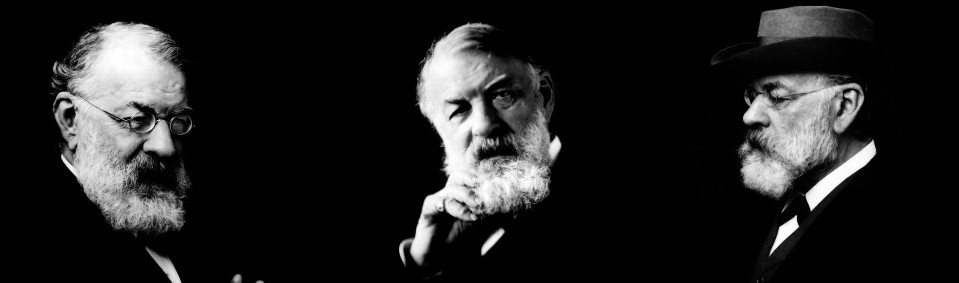
From: M. Charles, Zeitgenössische Tondichter. Studien und Skizzen, Leipzig: Serig’schen Buchhandlung, 1888, pp. 261-273.


26 Thursday Jan 2017
Posted in Miscellaneous Articles
From: M. Charles, Zeitgenössische Tondichter. Studien und Skizzen, Leipzig: Serig’schen Buchhandlung, 1888, pp. 261-273.
19 Thursday Jan 2017
Posted in Concert Reviews & Criticism
Der Ungar, Vol. 3, No. 99 (Pesth, April 29, 1844), p. 392.
Translation © Robert W. Eshbach 2017.
Concerning Joachim’s English successes.
Hermann Klein (*Miscolc, 1805 — †Budapest, 1889), later known as Kilényi János, was a Hungarian Jewish journalist and translator. His journal Der Ungar, which appeared from 1842-1849 in Pest, is one of the early sources of articles about Joachim, the information for which was likely provided by Joachim’s parents.
Pesth-Ofner Notizen.
Wir freuen uns nach vorliegenden englischen Journalen von dem außerordentlichen Erfolge unseres kleinen Landsmanns, eines gebornen Pesthers, des Violinspielers Joseph Joachim in London, berichten zu können. Die Londoner Musikzeitung vom 13. April setzt ihn ohne weiteres den berühmtesten Violinisten an die Seite, indem er mit erstaunenswerther Fertigkeit die Kompositionen aller Schulen spiele. Diese Zeitschrift spricht dann von dem berühmten Sivori, und sagt: “wir wissen nicht, ob sein Talent so allumfassend wie das des Ernst, oder so beispiellos, wie das des Joachim ist.” In gleicher Weise äußern sich das Hof-Journal, Concert-Journal, ferner das wichtigste englische Blatt die Times, die musical world und die andern Blätter. Er spielte im Drury-Lane zu Burns Benefize mit dem glänzendsten Erfolge. — Es ist dieser Succeß in der schwer zu befriedigenden und übersättigten Weltstadt um so ehrenvoller für unsern 13jährigen Landsmann, und um so erfreulicher für uns, als er seine erste Bildung hier in Pesth von St. Serwaczynski erhielt. Es hat allen Anschein, als ob Liszt nicht die einzige musikalische Celebrität bleiben sollte, welche Ungarn in neuer Zeit hervorgebracht.


We are happy to report on the extraordinary London successes of our little countryman, the violin player Joseph Joachim, a native of Pest, from English journals in our possession. The London music journal of 13 April sets him, as a matter of course, beside the most celebrated violinists, since he plays the compositions of all schools with astonishing proficiency. This journal speaks then of the celebrated Sivori, and says: “we do not know whether his talent is as all-encompassing as that of Ernst, or as exemplary as that of Joachim.” The court journal, concert journal, and further the most important English paper The Times, The Musical World, and other papers express themselves in like manner. He played in the Drury Lane Burns benefit with the most brilliant success. — This success by our 13-year-old countryman in the difficult-to-please and jaded world capital is all the more honorable and pleasing to us, since he received his earliest education here in Pest under St[anislaus]. Serwaczynski. By all appearances, Liszt will not remain the only musical celebrity to have emerged from Hungary in modern times.
17 Tuesday Jan 2017
Posted in Letters
Holograph: Universitätsbibliothek Leipzig, Kurt-Taut-Slg./5/Hee-J/H/294.
Joseph Joachim to Unknown
[Probably Dr. Julius Klengel (1818—1878), son of Moritz Klengel (1794-1870) and Joachim’s tutor after Hering. The Klengels lived at Lehmanns Garten, as did Joseph (Joseph lived at Door 4)]
[English translation below (c) Robert w. Eshbach, 2025]
Pesth am 12ten Mai 1848
Verehrter Herr Doctor!
Es ist mir lieb, daß ich so bald Gelegenheit finde, Ihnen
ein paar Worte schreiben zu dürfen, denn Sie haben es mir
ja selbst aufgetragen, Ihnen so bald ich etwas Gewißes über
[mein] nach Leipzig kommen wüßten, zu schreiben. Ich habe meinen
Eltern die Sache vorgestellt, [1] und obwohl sie im Anfange
Nicht recht davon wollten, mich wieder wegzulaßen, so
Gelang es mir doch zuletzt, sie zu überreden, und so denke
ich dann, wenn anders die Herrn Directoren noch die selben
Gesinnungen für mich hegen, Mitte oder Ende Juli in
Lehmanns=Garten, [5te] Thüre anzufragen, ob mich der Va=
ter und Frl. Nanni wieder aufnehmen möchten. —
Vorgestern um 10 Uhr Abends kam ich hier an, nachdem
ich 9 Tage in Wien zugebracht hatte. Sie können es sich
vorstellen, was das für Freude für mich war, meine
Lieben Eltern und alle Geschwister noch mehr als 2
2
Jahre wieder zu sehen! Und die vielen Neffen und Nichten,
die (ohne Oncle=Stolz) so wunderhübsch sind! Ich werde hier
gewiß sehr schöne Tage zubringen; und denke auch recht fleißig
zu sein, damit ich mein neues Amt mit Ehren antreten
kann. Freilich habe ich bis jetzt hier noch wenig Zeit
zu Arbeit gefunden. —
Ungarn ist in großer Aufregung; überall wünscht
man es womöglich ganz frei von Oesterreich zu sehen,
und dem Kaiser in der that nichts vom Lande zu laßen
als den Namen “König”. Natürlich überall, aus jedem
Fenster und aus jedem Knopfloch: weiß, roth, und grün,
die ungarischen National=Farben. Vorgestern Abends frag=
te man dem General Lederer, Kommandanten der Ofner Festung,
eine so genannte “Katzenmusik” die in Pfeifen und Miauen
besteht, weil er der Jugend, wie man die Studenden hier
nennt, sein Versprechen, Waffen zu geben, nicht gehalten
hatte, und weil man seinen Posten von einem Ungar besetzt
zu sehen, wünschte. General Lederer liest schändlicher
weise, ohne erst zum Zurückziehen aufzufordern, einhau=
en, und es gab 4 Todte und mehr als 20 Verwundete,
worüber denn hier Alles entrüstet ist. Lederer ist bereits
3
in derselben Nachte entwischt, aber die Ungarn verlangen,
daß er und die Officiere, die zum Stechen Befehl gegeben
exemplarisch bestraft werden. Man ist begierig, wie
es hier ablaufen wird, doch hofft man allgemein, ohne
ferneres Blutvergießen. — Die Orientaler haben
hier Ruhe, und was man von den Pesther Unruhen
dieser Art in der Leipziger Zeitung las, war
übertrieben, in Pressburg aber sind leider die schlimmsten
Dinge vorgefallen, und die grellsten Farben nicht hinrei=
chend die Judenverfolgunen dort, zu schildern. Die Ungarn
sind, oder stellen sich wenigstens entrüstet darüber,
und wollen alle Schuld auf die Slaven und Deutschen
schieben, von denen in Pressburg eine große Menge
wohnt. Das Standrecht ist in Pressburg für die Ver=
volger erklärt. — Doch, genug von diese häßlichen, bösen
Geschichten? Sie haben Beßeres zu thun, als sich dieselben
Vorlesen zu laßen, lieber [Hr] Doctor. Meinen herzlichen
Gruß an die liebenswürdige Vorleserin, sowie an Frl.
Nani und den Kinder von Ihrem
Ewig dankbaren
Joseph Joachim
P. S. Lesen Sie zuweilen noch Titan? Nach Shakspeare frage ich gar nicht?
Pest, May 12, 1848
Dear Herr Doctor,
I am glad to have the opportunity to write to you so soon, as you yourself requested that I inform you once I had definite news about my return to Leipzig. I presented the matter to my parents, and though they were initially reluctant to let me leave again, I eventually persuaded them. Thus, I plan to inquire at Lehmann’s Garden, 5th door, by mid- or late July—provided the directors still hold the same regard for me—whether Father and Miss Nanni might take me back.
I arrived here the night before last at 10 p.m., after spending nine days in Vienna. You can imagine my joy at seeing my dear parents and all my siblings again after over two years! And the many nephews and nieces (without an uncle’s pride) who are so wonderfully lovely! I will surely spend beautiful days here and intend to work diligently to honorably assume my new position. Admittedly, I’ve found little time for work so far.
Hungary is in great turmoil. Everywhere, people wish to see it entirely free from Austria, leaving the Emperor nothing but the title “King.” Naturally, the Hungarian national colors—white, red, and green—adorn every window and buttonhole. The night before last, a so-called “Katzenmusik” (a cacophony of whistles and catcalls) was directed at General Lederer, commander of the Ofen fortress, for failing to keep his promise to arm the youth (as students are called here) and because they wished his post occupied by a Hungarian. Disgracefully, Lederer ordered an attack without first calling for retreat, resulting in four dead and over twenty wounded, sparking widespread outrage. Lederer fled that same night, but Hungarians demand exemplary punishment for him and the officers who ordered the charge. All await the outcome, though hopes remain that further bloodshed will be avoided.
The Orientals here are calm, and reports of Pest’s unrest in the Leipzig Gazette were exaggerated. However, Pressburg has suffered the worst atrocities—no vivid description could adequately portray the persecution of Jews there. Hungarians, or at least their leaders, express outrage and blame Slavs and Germans, who are numerous in Pressburg. Martial law has been declared against the persecutors.
But enough of these ugly, grim tales. You have better things to do than read such accounts, dear Doctor! My warm regards to the gracious [female] reader [of this letter], Miss Nani, and the children.
Your eternally grateful,
Joseph Joachim
P.S. Do you still read Titan occasionally? I need not ask about Shakespeare.


[1] See letter of 2 May from JJ to Ferdinand David, Joachim/BRIEFE I, pp. 12-13.
08 Sunday Jan 2017
Posted in 1 Biographical Posts — RWE
© Robert W. Eshbach 2017

The Kaffeter
In 1843, the three Arnim sisters, Maximiliane, Armgart, and Gisela, together with Caroline and Wilhelmine Bardua, [1] Ottilie von Graefe [2] and Marie Lichtenstein formed a literary-artistic club — a Jungfrauenorden — which they called the Kaffeter. It was an unusual company of women: at the time, Caroline Bardua was sixty-one years old, and her sister “Mine” forty-five. At fifteen, Gisela was the youngest. In her memoirs, Maxe von Arnim tells how the idea arose:
One day in March, when the Bardua sisters were visiting Mother, I read them . . . a few things out of [Johanna] Mathieux’s interesting letters from Bonn — among other things about the “Maikäferbund,” composed of intellectually spirited young men who (in June 1840) gathered around Mathieux as “Directrix.” Each member was required to bring to the weekly meetings an anonymous literary contribution of his own, which was criticized, and eventually collected in Maikäfer: A Journal for Non-Philistines. The members were young scholars and students, whose names later acquired a good reputation, among them University Lecturer for Protestant Theology Gottfried Kinkel, who was at that time composing his delightful epic “Otto der Schütz,” Jakob Burckhardt, later culture- and art historian in Basel, the Hallenser theologian Willibald Beyschlag, the poet Wolfgang Müller von Königswinter, the chemist Karl Fresenius and others. Their high intellectual niveau did not prevent this fraternity from taking pleasure in singing and also much merry “Firlefanz,” as die Mathieux called it; so, for example, on meeting days each member had to wear the Order of the Maikäfer from early morning on, even to class.
I had hardly finished my reading when Giesel cried out: “We could also do that here, actually!” and the always-enterprising Mine Bardua concurred enthusiastically. So it was agreed that we would gather suitable girls for members, the Barduas from their circle of close friends, and we from ours. [i]
The first official meeting of the Kaffeter took place on March 30 at Ottilie von Graefe’s Berlin home, Behrenstraße 48. Officers were elected, and each Kaffeologe took a ceremonial name. Maxe von Arnim was elected “President Maiblümchen” (“lily-of-the-valley,” literally: “May-blossom”). With the exception of Maiblümchen, all the members took on male aliases. Mine Bardua, the true presiding spirit of the Kaffeter, became “Minus,” and was named to the post of recording secretary and editor of the group’s journal, the Kaffeterzeitung. As “Altmeister Bardolio,” Caroline would provide a folio frontispiece for each issue of the Kaffeterzeitung. On account of her bossiness, Armgart von Arnim became “Lord Armgart.” Ottilie was “Sir Odillon,” and Marie “Marius.” Gisel originally took the name of “Herr Giseloff,” but changed it later to “Marilla Fittchersvogel,” and finally “Spatz von Spatzenheim,” after the title of her fairy tale Aus den Papieren eines Spatzen (From the Papers of a Sparrow).

[ii]
President Maiblümchen
(Maxe von Arnim)
Drawing by Ottilie von Graefe for the Kaffeterzeitung
Before long, others were eager to join the circle, which had only two ironclad rules for membership: Kaffeologen must be unmarried and female. Over the course of six years, members included:
Valeska von Grabow [3] (“Valescus”)
Pauline (“Paulus”) and Anna (Annollo”) von Wolzogen [4]
Nina (“Ninus”), Marie [5] (“Mario”) and Hedwig (“Hektor”) von Olfers
Louise Bardua [6] (“Lucio della strada di Lenné”)
Amalie von Herder (“St. Malo”) [7]
Fernanda von Pappenheim (“Schwälble”)
Countess Elisabeth von Königsmarck (“Meister von Kannix,” “Elias Drosselmaier”) [8]
The group also included some non-resident members:
Marie von Guaita, a cousin of the Arnims who lived in Frankfurt am Main (“Sepperle vom Berge”)
Johanna Mathieux, who lived in Bonn
Mathilde Krummacher, who lived in Elberfeld
Various married women were invited as visitors. The name Kaffee-Tanten was given up as hideous, and the title Patroness settled upon. Among the Patronessen were:
Bettina (“Princess Dodona”)
Frau Savigny
Frau von Bardeleben
Frau von Olfers
Not to be overlooked was the Bardua’s dog, Beauty, an honorary member and occasional contributor to the Kaffeterzeitung via Gisela.

[iii]
St. Malo
(Amalie von Herder)
Drawing by Ottilie von Graefe for the Kaffeterzeitung
The members took turns hosting the Kaffeter. At first, only coffee and breakfast rolls were served — simple fare, such as would not distract the Kaffeologen from their artistic concerns. But little by little the rules were bent, and flights of fancy did not appear to suffer as hot chocolate replaced the coffee, and cakes and tortes supplanted the rolls. After refreshments, Maxe, arrayed as Maiblümchen in a high, pointed cap of white fabric, would take up her scepter, a white staff to which blossoms were entwined with a pink ribbon, and call the meeting to order. The other sisters wore similar hats of brown glazed paper. Affixed to the peak of each cone was a pink veil, to help a bashful maiden conceal her embarrassment or steady her nerves. Minus would then read the minutes of the last meeting, done up in humorous mock-ceremonial style, after which the girls would gather round to admire Altmeister Bardolio’s latest frontispiece for the journal. Each Kaffeologe would present an example of her work. Poems and tales were read, artwork viewed, musical compositions sung. Critical judgement, so important to the gesellige ethos of the time, was passed on each effort. Each sister was issued a ratchet-noisemaker with which to express disapproval — and a toy trumpet to administer praise. Contributions of a particularly distinguished nature were rewarded with a charm strung on a pink ribbon: the order of the golden coffee pot was reserved for founding members, and the order of the silver coffee pot for the others. All members were given a miniature silver coffee spoon as a token of their belonging.
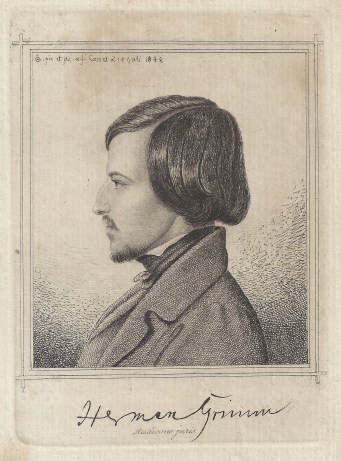
Herman Grimm
Etching by Ludwig Emil Grimm, 1848
It was Gisela who first broached the question of relaxing the all-female rule. Early on, Hans Christian Andersen (“Anderlein”) had been admitted as an honorary member, but Gisel agitated to have her best friend, Herman Grimm, admitted as a regular. After considerable debate, it was decided that “male individuals” might be acceptable, but only those who “were not dangerous.” Soon after, the Kaffeterkreis acquired its first male Kaffeologe, and one of its most talented and enthusiastic members: the fourteen year-old “Laban Habelmann” (Hermann Grimm). Apparently, only two others were benign enough to be admitted: the poet Emanuel Geibel [9] (“Götz mit der eisernen Hand”) and Gebhard von Alvensleben (“Apollo Plüsch”).
Maxe:
“After the principle of female exclusivity in the Kaffeter had been breached, the onrush of male applicants was no longer to be withstood. Especially after the king had publicly praised the Kaffeter, we could hardly ward off the many lieutenants, each of whom reckoned it an honor when a contribution that he had sent in was included in the Kaffeterzeitung. The Kaffeter was now no longer a violet that bloomed in secret; rather, it had become a kind of celebrity in Berlin.” [iv]

[v]
Sir Odillon leaves the Kaffeter
(Ottilie von Graefe, upon marrying Hermann von Thile)
Frontispiece for the Kaffeterzeitung by Caroline Bardua
The Kaffeter would occasionally host parties for the court, at the home of Bettina’s brother-in-law, minister Karl von Savigny. Princes and princesses, counts and countesses, ministers, and even a Catholic prince-bishop were among the attendees. In 1845, the King and Queen themselves were fêted by the Kaffeter. On this occasion, Caroline Bardua created tableaux, and, at the King’s request, Das Band, a pastoral play by Gellert, was performed. Bettina (“Princess Dodona”) painted sets, and created a fairy garden out of colored paper. Marie von Olfers appeared as a shepherdess, singing arias in her bright soprano and leading her three year-old brother Enne, “das Kaffeterkind,” on a pink silk ribbon as her sheep.
The Kaffeter was a casualty of the March revolutions of 1848. During those turbulent times, regular meetings ceased. On April 28, 1848, Maxe and Mine published a “manifesto” in which they state: “Our beloved Kaffeter was carried off by the merciless teeth of the Present in the scarcely unfolded bloom of its sixth year. It was too good for this world. Peace to its ashes.” [vi]
[1] Caroline (11 November 1781 — 2 July 1864) and Wilhelmine (26 May 1798 — 17 June 1865) Bardua lived together as unmarried sisters. Caroline, a professional painter, trained with Heinrich Meyer in Weimar and Gerhard von Kügelen in Dresden. She belonged to Goethe’s circle of friends. Wilhelmine had a beautiful voice, and in her youth had wanted to become a professional singer. As members of the Berlin Singakademie, the Bardua sisters were close friends of the Mendelssohn-Bartholdys. Their Berlin salon lasted from 1819 to 1852, with occasional long interruptions. Included among their circle of guests were Hans Christian Andersen, the Arnims, Adalbert Chamisso, Emanuel Geibel, Franz Grillparzer, Herman Grimm, the Mendelssohn-Bartholdys, Leopold von Ranke, Pierre Rode, Karl August and Rahel Varnhagen, and Carl Maria and Caroline von Weber.
[2] Ottilie von Graefe (1816-1898), daughter of Carl and Auguste von Graefe, later married Hermann von Thile (1812-1889)
[3] Lady-in-waiting to the widow of King Friedrich Wilhelm III.
[4] Daughters of General Ludwig Freiherr von Wolzogen. Anna was soon to become “Exkaffeologe Annollo” on account of her engagement to Marcus Niebuhr.
[5] Poet and painter, Marie von Olfers died in 1924 at age 97. (27 Oct. 1826 Berlin-8 Jan. 1924 Berlin). The von Olfers sisters were the granddaughters of noted salonnière Elisabeth von Staegemann, in whose salon such notables as E. T. A. Hoffmann, Heinrich von Kleist, Achim von Arnim and Clemens Brentano were guests. Elizabeth’s daughter Hedwig (1799-1891) became the playmate of King Friedrich Wilhelm IV, as well as Luise (Lulu) von Kleist (daughter of the playwright), and Princess Elisa Radziwill. It was not uncommon for the daughters of salonnières to host salons of their own under their mothers’ tutelage. In 1816, Hedwig gathered a group of younger artists, poets and musicians in her mother’s home, including future historian Friedrich Förster (1791-1868), poet Wilhelm Müller (1794-1827), artist Wilhelm Hensel (future husband of Fanny Mendelssohn, 1794-1861), poet Luise Hensel (younger sister of the artist, 1798-1876), and writer and musician Ludwig Rellstab (1799-1860). Also included were two older men, writer Clemens Brentano (1778-1842) and composer Ludwig Berger (tutor to the Mendelssohn children, 1777-1839). It was at a gathering of Hedwig’s salon that an improvised Singspiel was performed, later formalized by Müller into the poems that Schubert immortalized in his song cycle Die Schöne Müllerin.
[6] Niece of the Bardua sisters.
[7] Granddaughter of the theologian and philosopher Johann Gottfried von Herder (1744-1803).
[8] (1825-1901), Married Gustav Gans Edler zu Putlitz, Hoftheaterintendant in Karlsruhe.
[9] Margaret von Olfers refers to him as an “honorary member” only.
[i] Werner/MAXE, p. 103.
[ii] Werner/BARDUA, opp. p. 176.
[iii] Werner/BARDUA, opp. p. 176.
[iv] Werner/MAXE, p. 106.
[v] Werner/BARDUA, opp. p. 193.
[vi] This account of the Kaffeter relies mostly on information gleaned from Werner/BARDUA, pp. 175-184.
[vii] Werner/BARDUA, p. 182.
[viii] Werner/BARDUA, p. 183.
08 Sunday Jan 2017
Posted in Uncategorized
© Robert W. Eshbach 2017
Joseph Joachim to his Uncles (Wilhelm and Nathan Figdor), July 17, 1850
Facsimile of letter in the Brahmshaus, Baden-Baden.
In the Summer of 1850, Joachim acquired a fine Stradivarius violin with the help of his mother’s brothers Wilhelm and Nathan Figdor. In this letter, he thanks them for their assistance. On August 4th, Joachim wrote to his brother Heinrich: “The matter at hand is the, for me, supremely momentous acquisition of a violin of the first rank […] The violin that I have chosen for myself (perhaps the best Stradivari that I know in Germany) belongs to a wealthy private individual who has actually, although he prizes it above everything, decided to part with it as a favor to me, and to let me have it at the price that he paid for it (300 Louis d’or).
“Die Sache von der es sich handelt, ist die für mich höchst folgenreiche Anschaffung einer Violine ersten Ranges. […] Die Violine, die ich mir aber erkoren habe (vielleicht die beste Stradivari die ich in Deutschland kenne) gehört einem reichen Privatmann, der sich auch wirklich, obwohl die Geige ihm über alles gieng mir zu Liebe entschlossen hat, sich dann zu trennen, und zu dem Preise, den er dafür gegeben hatte (300 Louis d’or) sie mir zu lassen.”
[Unpublished letter in the collection of the Brahms Institut an der Musikhochschule Lübeck Signatur.: Joa : B1 : 20 / Inv-Nr.: 1991.2.50.3 / Kasten I]

The Joachim-Ma Stradivari, acquired by Joseph Joachim around the time of his 19th birthday, in the summer of 1850.

Joseph Joachim to his Uncles (Wilhelm and Nathan Figdor)
[English translation below (c) Robert Whitehouse Eshbach]
Leipzig am 17ten Juli 1850
Theure Oncles!
Als die liebe Fanny mir die schöne Botschaft
hinterbrachte, daß Sie mir zu einer Violine ersten
Ranges verhelfen wollten, war meine freudige Aufre-
gung und die Ungeduld meinen Lieblingswunsch bald
erfüllt zu sehen so groß, daß ich sofort nach Bremen
reiste, wo ich eine herrliche Stradivari wußte, und diesem
Umstand bitte ich es zuzuschreiben, wenn ich nicht gleich
wie ich wohl gesollt hätte, Ihnen ausdrückte, wie hoch ich
Euer so großmütiges Opfer dankbar zu schätzen weiß.
Ich bin nun wirklich so glücklich ein Instrument mein zu
nennen, welches zu den vorzüglichsten in Europa gehört,
und das mir stets als Ideal eines schönen tones vor-
geschwebt hat. Meine Freude darüber ist unbe-
2
schreiblich; vor allen dingen ist es mir aber wahres
und inniges Herzensbedürfniß, Ihnen, meine theueren
Oncles, von denen ich schon so vieles Liebe und Gute erfah-
ren habe, auch für diese Bereitwilligkeit, mir
die Künstlerbahn zu verschönern und erleichtern, meinen
tiefgefühlten Dank zu sagen. Die herrlichen Klänge
meiner Violine werden mir täglich von Ihrer Her-
zensgüte singen, und so lange meine Ohren hören
und mein Herz empfinden kann werde ich nicht auf-
hören mit Verehrung und Liebe zu sein
Ihr dankbarer
Joseph Joachim
Joseph Joachim to his Uncles (Wilhelm and Nathan Figdor)
Leipzig, July 17, 1850
Dear Uncles!
When dear Fanny (1) brought me the wonderful news that you wished to help me acquire a first-class violin, my joyful excitement and my impatience to see my dearest wish quickly fulfilled was so great that I went immediately to Bremen, where I knew there was a magnificent Stradivari, and I hope you will attribute to this the fact that I did not immediately express to you, as I should have, how gratefully and highly I know how to prize your magnanimous offer. I am now so truly lucky to call an instrument mine that is one of the most exquisite in Europe, and that has always represented for me the ideal of a beautiful tone. My joy over it is indescribable; it is above all my true and heartfelt desire to express my deeply-felt thanks to you, my dear Uncles, from whom I have already received so much that is dear and good, for your willingness once again to make my artistic career easier and more beautiful. The magnificent sounds of my violin will sing to me daily of the goodness of your hearts, and, as long as my ears hear and my heart can feel, I shall not cease from being, with respect and love
your thankful
Joseph Joachim
(1) Joachim’s cousin and guardian, Fanny Wittgenstein.


05 Thursday Jan 2017
Posted in Miscellaneous Articles, Uncategorized
W. Langhans, Die Königliche Hochschule für Musik zu Berlin, Leipzig: E. W. Fritzsch, 1873.

W. Langhans, Die Königliche Hochschule für Musik zu Berlin, Leipzig: E. W. Fritzsch, 1873.