
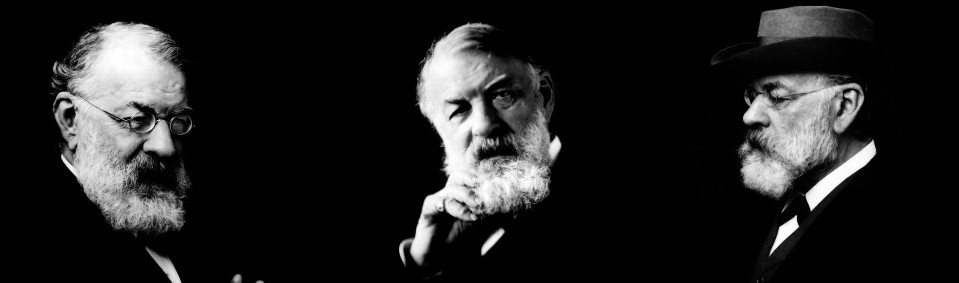
Joseph Joachim Delivers the Festrede at the Unveiling of Hildebrandt’s Brahms-Denkmal in Meiningen, October 7, 1899

24 Monday Jun 2019
Posted in Iconography
Joseph Joachim Delivers the Festrede at the Unveiling of Hildebrandt’s Brahms-Denkmal in Meiningen, October 7, 1899
01 Saturday Jun 2019
Posted in 1 Biographical Posts — RWE
© Robert W. Eshbach, 2019
The 31st Lower Rhine Music Festival
Is it not strange that sheep’s guts should hale souls out of men’s bodies?
—William Shakespeare, Much Ado About Nothing II, iii (1598)

The Tonhalle, Düsseldorf, 1852
On May 17, 1853 Joachim played the Beethoven concerto in what would prove to be a defining event in his career. The occasion was the 31st Lower Rhine Music Festival, held in Düsseldorf from May 15-17, under the direction of Robert Schumann. Schumann’s invitation was issued on April 17 (or perhaps the 12th — the letter seems to be misdated), a mere month before the event. “I think they will be happy days,” he wrote, “and there will be no shortage of good music. You will certainly also encounter many of your acquaintances here. So come, and don’t forget to bring your fiddle and the Beethoven concerto, which we all would love to hear.”
Joachim replied: “I am naturally always prepared to accept an invitation from you… You will believe the heartfelt delight that I felt, to be remembered by you, revered master. I had thought that it would be left to chance, to recall my name to you. How much nicer that it is otherwise…” [i] Schumann wrote again on the 18th with details of the contract: Joachim was requested to play on the third festival day for a fee of 12 Friedrichsdor — the same as David had received on a previous occasion. “My wife also requests that you come,” Schumann added. To afford Joachim sufficient privacy, Schumann arranged for him to stay nearby with a banker named Scheuer, who was a widower and agreed to put his house at Joachim’s disposal. [ii] Schumann promised to meet him at the train.
On May 9, Joachim wrote again, offering his services as a tutti player for the other performances. “The orchestra parts for the Beethoven concerto are ready,” he promised. “My violin is also in order, and looks forward with me to the rich days of music with you and your wife…” Though the Schumanns had known Joseph in Leipzig as Mendelssohn’s protégé, in Düsseldorf they would come to know and esteem him in his young maturity. In those “happy days” in May, their acquaintance would develop into a warm friendship, and, for Clara, a partnership that would sustain her through hard times to come.
Since their founding in 1818, the Lower Rhine Music Festivals had been a vital feature of German cultural life, an outgrowth of the prodigious passion for music amongst the Rhine Province’s socially vibrant and increasingly affluent middle class. The large choral and orchestral festival took place annually at Whitsuntide (the seventh Sunday after Easter), its venue alternating each year amongst the Rhenish cities of Düsseldorf, Cologne and Aachen. What had begun as an amateur festival under municipal sponsorship had gradually taken on a more professional aspect under the direction of such conductors as Felix Mendelssohn (who conducted seven times between 1833 and 1846), Louis Spohr, and Gaspare Spontini. The 1853 Musikfest was, in a way, a rebirth of the festival; due to the mid-century political troubles, it had occurred only once (1851) since 1847. Though the trend toward professionalism continued, both the chorus of 490 voices and the orchestra of 160 players were still largely made up of amateur musicians. As municipal music director in Düsseldorf, Robert Schumann was chosen to lead the event.
Like the other festivals in recent years it was a three-day affair, and programming followed a well-established pattern: the first day’s concert typically featured an oratorio (Mendelssohn’s Paulus had been composed for, and premiered at, the 1836 festival); a Beethoven symphony anchored the second day’s program, and the third day was given over to a display of “artists” (i.e. professional soloists), with attendant flower-throwing and laurel-crowning. The 1853 festival opened with the premiere performance of Schumann’s revised Fourth Symphony, paired with Handel’s Messiah. The second day’s offerings included works by Weber, Mendelssohn, Hiller and Gluck, and concluded with a performance of Beethoven’s ninth symphony. The lengthy artists’ concert opened with Handel’s Hallelujah chorus, and concluded with Schumann’s Rheinweinlied, specially composed for the occasion. Clara Novello was among the singers, Clara Schumann performed Robert’s piano concerto, and Joachim played Beethoven and Bach. Schumann led the first day’s performances, and Ferdinand Hiller conducted on days two and three.
The concert venue was prettily situated among hedges and walks in a park facing the court gardens, just outside the city limits about a dozen blocks from the Schumann’s Bilkerstrasse home. This garden spot had long been a popular recreational destination, and a privately maintained concert hall had existed there at least since 1816 (originally Jansen’s Lokal; then, after 1830, Anton Becker’s Gartensaal, and after about 1850 Geisler’s Gartensaal). [iii] Since 1818, it had been home to the Lower Rhine Music Festival in Düsseldorf. The hall was rebuilt and expanded several times. In 1852, a large new Tonhalle was erected in anticipation of an immense men’s choral contest, the “Sängerfest des Männergesangvereins” that drew vocal groups from as far away as Vienna, and overwhelmed the city with festivities from August 1-4 of that year. The Tonhalle was a rustic affair, described in 1863 as “only a provisional wooden structure, of the roughest workmanship, isolated without the necessary adjoining rooms; in bad weather not even to be reached with dry feet, not weatherproof, and, in the course of time, of very dubious safety.” [iv] Nevertheless, it had the advantage that the performances could be heard in the gardens outside its plank walls, and, for some, the added delight that the nightingales that gathered in the surrounding trees at Whitsuntide felt emboldened to join in the music making, loudly audible through the cracks and windows to the audience within.[v]
An English visitor (“ONE OF THE IDLE”) gave a charming description to the Musical Times of the festival’s cheerful, unbuttoned ambiance: “…for those who were partakers in this delightful meeting, there remains an unfading recollection of excellent music enjoyed at leisure, associated with the beaming and friendly faces of appreciating listeners. The executants and audience have an equally large appetite for music, if we judge by the length of each programme, but the way of getting through the appointed quantity conveys nothing of the business-hurry which attends your English Festivals. Here, in Germany, are long intervals for Mai-trank drinking, for smoking, and for friendly greetings in the garden-walks surrounding the Concert-Hall. At Birmingham last year there were but two rehearsals for seven concerts, — but here seven grand orchestral rehearsals, besides numerous previous small practice-meetings, are appointed for the two first concerts. Most of the chorus-singers and orchestra-players are amateurs in every sense of the word, and seem to live in the gardens while the Festival lasts, lunching and dining, and never in a hurry — the early morning hour of eight, finds them punctually present, and at the end of a long evening rehearsal, they seem as eager and as much awake as their deliberate natures will permit.” [vi]
Despite the overall cheerfulness of the event, Schumann’s direction on the first day was an embarrassment. Taciturn and bewildered, he proved to be so incapable of making his musical intentions known to the performers that they privately agreed to ignore him and follow concertmaster Hartmann instead. When the evening’s performance concluded without the anticipated disaster, Schumann responded dryly to a friend’s congratulations: “Oh, one only congratulates women after childbirth.” [vii] The critics were devastating. “Regarding the peformance of the Messiah, we have to confess, we have seldom heard one that is more inadequate,” wrote “H. W.” in the Süddeutsche Musik-Zeitung. “And why, exactly? Because Schumann is no conductor. Schumann possesses absolutely none of the characteristics that qualify a practical conductor; least of all does he understand how to lead large forces securely. As the saying goes, he “lets God be a good man” — if it goes well, all is well, if it does not go well, all is well too, at least for him. […] We are not alone in this opinion; it is already well-known in Düsseldorf — indeed, very well known — and we have only spoken clearly what others have until now dared only to insinuate. Furthermore, even aside from issues of conducting technique, Schumann’s conception of the oratorio was no less inadequate — indeed, [it was] faulty — the execution, with few exceptions, practically disgraceful.” [viii]
By comparison, the second day’s performance of Beethoven’s ninth symphony was a triumph for Ferdinand Hiller. “What a different ensemble from yesterday!” wrote “H. W.” “What completely different leadership, too!” [ix] Ludwig Bischoff, writing in the Rheinische Musik-Zeitung, noted with particular pride the reaction of the visitors from France. “With great satisfaction we heard from all directions the judgments of the foreign musicians and conductors, who were all in agreement that such a “virtuoso orchestra” was a rarity. The Parisian musicians in particular, who attended all the rehearsals and performances with greatest attention, were rapturous.” He quoted them saying: “we must freely admit, we do not have anything like it in France. We cannot therefore do better than to visit our neighbors on the Rhine in order to learn, for in music they are, for once, our masters.” With Hiller at the helm, he wrote, and Hartmann, Pixis and Joachim on the first desk, “a more consummate performance of this work, which demands the highest level of artistic training from all the musical forces, is in fact hardly to be approached; it is, as with everything superhuman, only imaginable.” [x]
Bischoff also noted the importance of the third-day “Artists’ Concert” (a feature of the festivals since Mendelssohn introduced it in 1833) for the education of the public and the general elevation of musical standards: “for without virtuosi there can be no virtuoso orchestra, and the heroes of the performing art belong, with their exemplary performances most particularly in a music festival where hundreds of art lovers converge, who, in their modest spheres of influence have no opportunity to hear anything so excellent.”[xi]

At 22, Joseph was no longer a child prodigy, and the expectations that he had to satisfy were daunting. Writing in 1897, Wilhelm von Wasielewski recalled: “He already enjoyed a widespread reputation in the musical world commensurate with his high artistic standing. It is therefore understandable that the musicians of the Rheinland, who had not yet had an opportunity to hear him, were extraordinarily curious about his accomplishments, but not in a wholly impartial way. Namely, it was supposed that his reputation was in part artificially created through partisanship, and to some extent exaggerated. His first appearance in the Rheinland was therefore awaited with a certain prejudice, seemingly as an opportunity for sizing him up in the most hypercritical way. Even the decent concertmaster Hartmann from Cologne, who led the festival orchestra, was to some extent disfavorably influenced by this attitude.” [xii]
At the rehearsal, the young concertmaster from Hanover created a buzz of excitement. Yet, with all the pressure of the day’s events, Joseph’s pre-concert thoughts were with Liszt. “Dear, honored friend,” he wrote. “There would not be time for me to tell you how it is that I am writing to you from here, for the concert that I am obliged to play in will begin in a few minutes. This is my first time at a Rhenish music festival, and the whole thing has interested me greatly; I shall tell you more in person, for I shall depart very early tomorrow morning, and after staying a few necessary hours in Hanover will immediately leave for Weimar and the Altenburg. I accept with thanks your kind offer to live there; it is the best means of enjoying a great deal of your company, and therefore the most welcome. In haste From my whole heart, your devoted Joseph Joachim.” [xiii]
“A truly tropical swelter prevailed in the concert hall, which was filled with more than 2,000 people,” wrote Wasielewski. “This heat, growing with every quarter-hour, became even more palpable on the raised stage than in the audience. Many soloists would have been ill at ease under such circumstances, but Joachim strode like a youthful hero before the audience, with his own innate, aristocratic bearing, as his turn came in the second half of the concert. Then, as the audience listened with reverential silence to the sublime, almost transfigured melodies of Beethoven, carried by Joachim’s silver tones, suddenly, as in his debut in Leipzig, the E-string broke. That the most beautifully progressing pleasure could be interrupted and disturbed by such an absurd accident led to a scene of awkward tension. Involuntarily, one wondered what would happen next. Pixis, Cologne’s second concertmaster, who was standing at the first stand of violins, helped him out of the bad situation. Fortunately, he had a good, true string on his violin, which he gave to Joachim, who after a few minutes again stood before the audience and began the concerto once again from the beginning. His unique playing was magnificent beyond description and, even with regard to intonation, left not the least thing to be desired, even though the newly-stretched string did not keep its pitch in consequence of the tropical heat in the room, and had to be tuned up in convenient moments. During the Larghetto, poetically animated by the soloist, many became misty-eyed with emotion, and even the worthy concertmaster Hartmann was so overcome that bright tears ran down his cheeks. A more beautiful compliment for the celebrated master of the violin could not be imagined. A storm of applause lasting many minutes with elemental force broke out after the finale. The audience could not be quieted, and let it be known, through sustained applause, that Joachim should give them something more… and so, despite his overheated and wearied state, Joachim had in the end to comfort them with an encore, which was nothing less than Bach’s Ciaccona for violin solo. It was, under the circumstances, an astonishing achievement.” [xiv]
In the ensuing days, the international music press was full of praise for Joachim’s performance. “As for the Beethoven Violin Concerto in D Major, we confess that we have never yet heard anything more perfect,” wrote “H. W.” in the Süddeutsche Musik-Zeitung. “Such a work, performed with such mastery, with such profound penetration into the spirit of the composition, is a pleasure that, in our time, is like an oasis in the desert. We wish to acknowledge the individual merits of all our German masters of the violin; but we have never heard any of them play ‘Beethoven’ in such a way as Joachim does. Here is Classicism from the first to the last stroke; not a Classicism that coquettes with form — no, such as it is ‘in spirit and in truth.’” [xv] Again, the German press seemed to take particular pride in foreign opinion. The Zeitung für Norddeutschland quoted the Indépendance Belge: “The ‘lion’ of the festival is Joachim. We have known his name for a decade. Mendelssohn took him under his wing in London, where the young Joachim accomplished wonders. Since then, the Wunderkind has become an artist, a very important artist. A pupil of David and Spohr, matured through the advice and friendship of Mendelssohn and Liszt, Joachim already realizes the highest ideal that one can dream of. Under his magical bowstroke, the colossal concerto of Beethoven becomes even more powerful. The master’s nobility of style, grandeur of expression, profundity of thought — all this, Joachim has understood, and he renders it all with the simplicity of genius and the warm and intimate passion of the great poet.” [xvi]
Clara Schumann, who, in the practice of the time accompanied Joachim for the Chaconne, afterward recalled: “Joachim was the glory of the evening. Though the rest of us also got applause to be sure, and though after Robert’s concerto I got a laurel wreath from the orchestra and much applause from the audience, nonetheless Joachim won the victory over us all with the Beethoven concerto — but he also played with a perfection, and with such deep poetry, with such soul in each little note, really ideal, that I have never heard such violin playing, and I can truly say that I have never received such an unforgettable impression from a virtuoso. And how the great work was accompanied — with what perfection! It was as if a holy devotion possessed the whole orchestra.” [xvii]
Carl Reineke, who was also present on the occasion, recalled the event many years later: “What a different person, how much greater he had become in the meantime. Once an acolyte of virtuosity, now a priest of art. He played the Beethoven violin concerto, hitherto unapproached by any interpretation, and recognized in its full greatness only from that moment on, since Joachim made it his own. Like a youthful hero, nobly, but modestly, he appeared on the podium… It is an idle thing to describe such consummate playing. But even today, after fifty six years, I remember clearly that I stole through the loneliest walks of the court gardens, to relive this artistic event inwardly.” [xviii]
“I don’t care to think of any other violin,” Clara wrote in her diary the day after the festival. That day, she and Joseph had performed Schumann’s a minor sonata for a small circle of friends. Joseph had played “so wonderfully that for the first time the work had created the impression that I had always imagined it could.” “It is not just as an artist that we have come to know Joachim, but also as a sweet, genuinely modest person. He has a nature that requires a longer and closer acquaintance to be properly appreciated, which is, in fact, the case with all excellent people!” [xix] Robert noted a simple mnemonic in their Haushaltsbuch: “18. May 1853 Joachim’s performance of my sonata.” Several years later, in the asylum at Endenich, the memory of the performance had not left him. Visiting him there, Brahms wrote to Clara: ”Of Joachim he spoke with an enthusiasm he normally reserves only for speaking of you. He spoke a lot about the Music Festival, how wonderfully J. played even in the rehearsal. That no one had ever had any idea the violin could produce such a tone.” [xx]

An Joachim.
 könnt’ ich Dir’s mit Deiner Sprache sagen,
Was ich gefühlt bei Deinen Zauberspiel:
Das wär’ ein Lied, das über Erdenklagen
Wie ein geheimnissvoller Schleier fiel!
Hielt mich ein fabelhafter Traum umschlungen,
Der mir Elysiums Gefilde wies? —
Du hast den Traum mir in die Brust gesungen,
Den Traum der Seligkeit, so mild, so süss!
Wie oft sich mischt in uns’rer Kindheit Thränen
Der liebevollen Mutter Schmeichelwort,
So lösest Du des ersten Mannes Sehnen
In einen sanften, weichen Moll-Akkord. —
Des lichten Traumes Bilder sind zerronnen,
Vorbei die süssen, holden Melodie’n,
Doch lange werden der Erinnrung Wonnen
Mir wunderkräftig durch die Seele ziehn!
Cöln G. H.
[Rheinische Musik-Zeitung für Kunstfreunde und Künstler, Vol. 4, No. 209, (December 31, 1853), p. 1464]
See posts:
Concert: Düsseldorf, May 17, 1853 Dwight’s Journal of Music, vol. 2, no. 11 (Boston, 18 June, 1853), pp. 86-87.
Concert: Düsseldorf, May 17, 1853 Rheinische Musik-Zeitung, Vol. 3, No. 154 (June 11, 1853), pp. 2128-2129.
Concert: Düsseldorf, May 17, 1853 Zeitung für Norddeutschland; Hannoversche Morgenzeitung, No. 1137, (Sunday, May 22, 1853).
Concert: Düsseldorf, May 17, 1853 Süddeutsche Musik-Zeitung, Vol. 2, No. 24 (June 13, 1853), p. 95.
[i] “Daß ich recht von Herzen erfreut war, daß Sie, verehrter Meister, meiner sich erinnern, werden Sie mir wohl glauben; schon hatte ich gemeint, es würde dem Zufall überlassen bleiben, meinen Namen Ihrem Gedächtnis einmal zurückzurufen. So schöner, daß es anders kömmt!” Moser/JOACHIM 1908, I, p. 150. Joachim/BRIEFE I, p. 53.
[ii] There were two bankers named Scheuer residing in Düsseldorf at the time: one who lived in the Kasernenstraße, and one who lived in the Carlsplatz. They were both within blocks of the Schumann’s Bilkerstraße home, and both were convenient to the concert venue.
[iii] See: Bernhard R. Appel, Geislers Saal und die Tonhalle. Zur Geschichte zweier Konzertsäle in Düsseldorf (1818-1864), in: Neue Chorszene, Vol. 16, No. 1 (January 2012), 34-42.
[iv] … “nur ein provisorisches Bauwerk von Holz, in der rohesten Bearbeitung, isoliert ohne die notwendigen Nebenräume; bei schlechtem Wetter nicht einmal trockenen Fußes zu erreichen, undicht und im Laufe der Zeit von sehr bedenklicher Sicherheit.” Apel/GEISSLER’S p. 41. “Zit. nach Hugo Weidenhaupt, Mit Jansens Garten fing es an, in: Tonhalle Düsseldorf Vom Planetarium zur Konzerthalle, Düsseldorf 1978, S. 56.
[v] Clara Novello: “In summer we went to Düsseldorf, for the Festival, Schumann conducting; he was beginning already to give signs of the sad mental illness which overcame him later, and was shy and strange in many ways. One evening a pretty incident happened: a number of nightingales came and perched on the high windows above the orchestra, and seemed excited to outsing Alceste’s divine song — till the audience and I turned our attention in delight to them.” Clara Novello, Clara Novello’s Reminiscences, London: Edward Arnold, 1910, pp. 152-153.
“Düsseldorf is encompassed by extensive park-like shrubberies, occupying the site of the old fortifications, where singing birds become tamest of the tame. At Whitsuntide nightingales abound, and day and night maintain their tuneful contests. Their reputed love of solitude seems not to hold good here, for they continue their song in loudest combination with the laughter and gossip of the festival-keepers. In the more piano passages of the concerts, the bird-songs made themselves audible; and the audience were enthusiastic when two nightingales poured forth their insisting notes close to the windows, joining in the passionate recitatives of Gluck’s Alceste: ‘Three nightingales at once’ burst forth in a shout, as the opportunity offered to vent their delight at the clear high notes of Clara Novello. At a moment of intense enjoyment how electrical is the effect of any additional accident which brings in new joy! Weak, indeed, are words to record the excitement of such a moment … ” The Musical Times and Singing Class Circular, Vol. 5, No. 109 (June 1, 1853), p. 197
[vi] “The Niederrheinisches Musik-Fest,” The Musical Times and Singing Class Circular, Vol. 5, No. 109 (June 1, 1853), 197.
[vii] Wasielewski/SCHUMANIANA, pp. 39-40.
[viii] “Das 31. Niederrheinische Musikfest zu Düsseldorf,” Süddeutsche Musik-Zeitung, Vol. 2, No. 23 (June 6, 1853), p. 90.
[ix] “Das 31. Niederrheinische Musikfest zu Düsseldorf (Schluss),” Süddeutsche Musik-Zeitung, Vol. 2, No. 24 (June 13, 1853), p. 94.
[x] “Das 31. niederrheinische Musikfest,” Rheinische Musik-Zeitung für Kunstfreunde und Künstler, Vol. 3, No. 50 (June 11, 1853), p. 1225-1127, passim.
[xi] ibid. p. 2127, recte: 1127.
[xii] Wasielewski/SIEBZIG p. 80.
[xiii] Weimar GSA 59/19, 15
[xiv] Wasielewski/SIEBZIG pp. 81-82.
[xv] “Das 31. Niederrheinische Musikfest zu Düsseldorf (Schluss),” Süddeutsche Musik-Zeitung, Vol. 2, No. 24 (June 13, 1853), p. 95.
[xvi] Zeitung für Norddeutschland, No. 1137 (May 22, 1853).
[xvii] Litzmann/SCHUMANN II, p. 278. [m. t.] To Hermann Härtel, she wrote [19 May]: “Joachim played the Beethoven concerto with a perfection such as I have hardly heard from a violinist, with such genius, so nobly, so simply and yet moving to the core! He also received an ovation such as I have never yet experienced; was deluged with flowers, and then played the Chaconne of Bach as an encore.” Schumann/TALENT, p. 105.
[xviii] Reineke/ERLEBNISSE, pp. 261-262. m.t.
[xix] Litzmann/SCHUMANN II, p. 278. [m. t.]
[xx] Avins/BRAHMS, p. 95.
20 Monday May 2019
Posted in Uncategorized
Jakab Marastoni (Jacopo Antonio Marastoni)
The Young Joseph Joachim
[Lost]


Marastoni’s portrait as it appears in Andreas Moser’s
Joseph Joachim. Ein Lebensbild.
This portrait of the 7-year-old Joseph Joachim was made at the time of his début in Pesth on March 17, 1839. Later in life, Joachim recalled how immensely proud he had been of his blue suit with the mother-of-pearl buttons. The artist was the Venetian-born painter and lithographer Jacopo Antonio Marastoni (*24 March 1804 — †11 July 1860), who, in Hungary, was known as Jakab Marastoni. The portrait appears as an illustration (above) in the numerous editions of Andreas Moser’s Joseph Joachim. Ein Lebensbild.
The painting was sold at auction by Stair Galleries on September 13, 2008 in Hudson, NY — erroneously identified as “Joseph Joachim Guernier — The Young Violinist,” “Oil on panel, 8 3/4 x 6 3/4 in. Provenance: Property from the New York Public Library, Astor, Lenox and Tilden Foundations.” Its whereabouts are currently unknown.

The confusion in naming (and, perhaps, in sale) may have come from the fact that Joseph was holding his Guarneri violin, and that there is, indeed, an artist named Joseph Joachim Guernier. My fear is that the current owner may not appreciate the painting’s true identity or historical significance.
I do not, as yet, know how or when the painting came into the possession of the New York Public Library, or the conditions under which it was sold. The NYPL documents it being in storage as early as January, 1949, and there is a conservation report from 1965 quoting a price to conserve it. The last mention of the painting in the NYPL records occurs in an internal letter dated September 27, 1988.
The NYPL files document it as:
“Portrait of Joseph Joachim ,” or as “Joseph Joachim, the violinist as a boy”
Artist: Marastoni
Oil on canvas
8 5/8 x 6 3/4
The existence of this portrait reinforces the notion that Joachim’s family was not, as has sometimes been maintained, of “modest means,” but, even the year after the devastating Budapest flood of 1838 could afford to hire Pest’s leading portrait painter to memorialize their son’s début recital. It also gives some indication of the seriousness with which this recital was treated. Marastoni created paintings and lithograph portraits of many of Hungary’s leading aristocrats.

Jacopo Antonio Marastoni (*1804 — †1860)
Note the same drape behind Marastoni as behind young Joachim
According to Wikipedia, Marastoni began his studies in Rome. “He settled in Pest in 1836, having come by way of Vienna and Pressburg. He soon became a much sought-after portrait painter. In 1846, he created the Első Magyar Festészeti Akadémiát (First Hungarian Academy of Painting) which, as the name suggests, was the first school in Hungary devoted exclusively to painting. It was a private school, but numbered András Fáy, Gábor Döbrentei and Archduke Stephen, Palatine of Hungary among its patrons and supporters. The school also sold shares to the general public. Károly Lotz, Mihály Zichy, Soma Orlai Petrich and Mihály Kovács were some of the school’s best-known students. Shortly after the founding of the school, Marastoni was named an honorary citizen of Pest. In later years, he became Hungary’s first professional Daguerrotypist. In 1859, his health began to deteriorate rapidly and he had to give up teaching. He soon went blind, and died in a mental institution. The school was closed shortly thereafter.” [See also this article in Hungarian]

Jakab Marastoni: Portrait of Ignáz Mayer

Jakab Marastoni: Portrait of Ferencz Szaniszló

Jakab Marastoni: Portrait of Karl Ludwig Leopold

Jakab Marastoni: Portrait of Baron Simon Révay
Österreichisches Biographisches Lexikon:
Marastoni Jakab (Jacopo), Maler. * Venedig, 24. 3. 1804; † Pest, 2. 7. 1860. Vater des Folgenden; nach Kunststud. in Venedig arbeitete er in Görz, Triest, Klagenfurt und Wien. Ab 1834 lebte er in Preßburg, dann in Pest, wo er eine private Malschule gründete. Neben Barabás (s. d.) war er der produktivste Porträtmaler seiner Zeit in Ungarn. M. beschäftigte sich auch mit der Herstellung von Porträts mittels der Daguerreotypie. 1846 gründete er die Erste Ungarische Malerakademie. Im selben Jahr wurde er Ehrenbürger der Stadt Pest. 1859 erblindet, starb er im Irrenhaus.
19 Sunday May 2019
Posted in Letters
https://i0.wp.com/josephjoachim.com/wp-content/uploads/2013/06/jj-initials.jpgTranslation © Robert W. Eshbach, 2019

Richard Wagner, 1861
Photo: Pierre Petit
Richard Wagner to Joseph Joachim [i]
Zürich, March 17, 1858
Dear Friend,
News of you has reached me through Clara Schumann and through Kirchner that has reassured me somewhat concerning your dismaying remoteness from me. More than this reassurance, my belief in the noble earnestness of your character enables me to entrust to you a matter that requires the delicate and discreet consideration of a friend, in the full sense of the word, if I am to approach you for counsel and help. I ask you then not to take my confidence in an unkindly way if I convey my request to you with the following.
From time to time, such an oppressive and consuming concern for my existence arises, through the unmitigated insecurity of my external circumstances, that years ago I consulted with Liszt, whether it would be possible to expect of the Grand Duke [Carl Alexander] of Weimar, who once appeared as my protector, that he would grant me an annuity for the assurance of an undisturbed domestic tranquility, for which I could commit myself, if I should someday receive amnesty, to personally perform my operas in Weimar at his command, etc. Liszt was dubious about this possibility, and seemed therefore not to wish to have anything conferred on him or on me by pressing the matter at the Weimar court. — In the meantime, I am again, as I have been for a considerable time, in the position of being most uncomfortable for want of an adequate and secure subsidy, since my alternative income from theaters is of such haphazard and unpredictable nature that I cannot rely on it in the slightest, and its often unexpected failure to appear causes me the most disagreeable embarrassment. Only the patronage of a prince can protect me against this, which, if it does not spare me from all need of earning money from my labors, would at least allow me the reassuring support of a secure livelihood. So it may well be forgiven me that I have had my eye on the King of Hanover for some time. His great and earnest love of art, his eagerness to secure excellent artists for himself by means of unrestrained liberality, and further, his outspoken affinity for my music, as I have been led to believe, are surely good excuses for me.
So it occurred to me then, that it would perhaps be necessary only to make him aware of me, my situation and my wish, in order to prompt him, completely on his own, to take vigorous action to help me.
I have chosen you, dear Joachim, as it made such good sense, to accord me this great act of friendship; anyhow, had I not known of your presence in Hanover and your influence on the King, I probably would not have been able to stoop to it. Therefore, I ask you first for your advice in this matter, and if you believe that you can give me a hopeful and auspicious word from him, then I would ask you to take up my cause and to bring my wish before the King in any manner that seems appropriate to you, and thus to be my gracious advocate.
My thought would be that the King, informed of my plight by friends, would of his own free will offer me a yearly stipend, adequate to secure my subsistence as well as primarily to ensure undisturbed tranquility for my work; in return for which I would commit myself to deliver my subsequent dramatic compositions to him in a special edition, allow them to be performed at the court theater without further remuneration, and finally, after — hopefully before long — attaining amnesty, to appear every year at the command of the King for a determined amount of time, personally to conduct whichever of my works he wishes to hear. I would add, with respect to the current splendid artistic resources of the court theater, that I would commit myself, in the event that I could personally participate, to producing my new works first in Hanover.
Now, valued friend, see what you may think of this; whether you can give me hope, and whether, as my friend, you wish to take this on with your influence. I am dependent more than I can say to you on a favorable decision in this matter; for it is one last thing that I can decide to try for the security of my — this between us — abject existence! —
Let me therefore hear good news from you soon, and remain as constantly my friend as it was easy for you to become!
With warm greetings
Your
Richard Wagner
What Joachim thought of this proposal is not known. In any case, there is no evidence that he ever replied. To Joseph, it must have seemed astoundingly craven. Here was the author of Das Judenthum in der Musik, who had libelously accused the “cultured Jew” of making a commodity of Art, admitting that without the prospect of Joachim’s help he would not have been able to stoop to making a commodity of his own. Here was the author of Art and Revolution seeking amnesty; the man who wrote of the Artwork of the Future: “Yet truly of its own immortal force will it maintain itself and blossom forth: not merely cry for maintenance on pretext of some outward-lying aim. For mark ye well, this Art seeks not for gain!” “‘Utopia! Utopia!’ I hear the mealy-mouthed wise-acres of our modern State-and-Art barbarianism cry,” he wrote, “the so-called practical men…” This is the man who wrote to Liszt: “Can you come in May? On May 22nd I shall be forty. Then I shall have myself re-baptised; would you not like to be my godfather? I wish we two could start straight from here to go into the wide world. I wish you, too, would leave these German Philistines and Jews. Have you anything else around you? Add the Jesuits, and then you have all. ‘Philistines, Jews and Jesuits,’ that is it; no human beings. They write, write, and write; and when they have ‘written’ a great deal, they think they have done something wonderful. Stupid fools! do you think our heart can beat for you? What do these wretched people know about it? Leave them alone, give them a kick with your foot, and come with me into the wide world, were it only to perish bravely, to die with a light heart in some abyss.” [ii]
For Joachim, who, unable to play the hypocrite, had so recently broken off artistic and personal relations with Liszt, and who chafed constantly under the humiliating conditions of his employment, the idea that he should now put himself forward at court as Wagner’s sponsor was surely as preposterous as it was insulting. The deleterious consequence of the commercialization of daily life was one of the central dilemmas of the nineteenth-century, as it is of our own. The trivialization of art through commerce was, and is, a central preoccupation of all serious artists; with Mendelssohn and Schumann it had been a defining concern. However, whereas Mendelssohn and Schumann addressed themselves to a newly-affluent public, hoping to knit them into an organic community through a deeper appreciation of art, Wagner and Liszt dreamed of creating communities of artists — independent geniuses, leaders and preachers whose main means of support would be the disinterested funding of the state. In Weimar, Liszt found his Carl Alexander; in Bavaria, Wagner would find his Ludwig — young, idealistic princes, both, who could be held in thrall by the charismatic personalities of the artists in their employ. But Joachim’s experience in Hanover with even so art-loving a king as George V had taught him that dependence upon the “protection” of a king was a highly problematic model for artists to follow. Unquestionably, as a Jew he knew that the favor of a monarch, freely given, could be freely revoked. Had not the recent history of the Jews been a struggle against just such “protection?” Enlightenment and capitalism had provided them a path to freedom and independence. Joseph may well have had Hermann Wittgenstein’s words in his ears as he read Wagner’s letter: “I began my career in other and troublesome circumstances. Thrown back upon my own powers, I was never despondent, never solicited or received any man’s favor, and endeavoring to emulate my betters, I never became an object of their contempt.” [i] Wagner’s brand of servile, reactionary, racist, anti-capitalist Romanticism could hold no charms for him. Subsequent relations between Joachim and Wagner went from chilly to cold, never again to thaw.
[i] McGuinness/WITTGENSTEIN, p. 3.

Hanover Opera House
Zürich, 17 III 1858
Lieber Freund!
Durch Clara Schumann, sowie durch Kirchner, sind mir Nachrichten von Dir zugekommen, die mich über Dein bedenkliches Entfernthalten von mir einigermassen beruhigt haben. Mehr als diese Beruhigung giebt mir aber mein Glaube an den noblen Ernst Deines Charakters den Muth, mich Dir in einer Angelegenheit anzuvertrauen, für welche ich, wenn ich Dich darin um Rath und Hülfe angehe, der zarten und verschwiegenen Rücksicht eines Freundes, im vollen Sinne des Wortes, bedarf. Ich bitte Dich daher, mein Zutrauen nicht unfreundlich aufzunehmen, wenn ich Dir mit folgendem mein Anliegen mittheile.
Von Zeit zu Zeit stellt sich bei mir, durch die gänzliche Unsicherheit meiner äusseren Verhältnisse hervorgerufen, eine so niederdrückende und verzehrende Sorge um mein Bestehen ein, dass ich schon vor Jahren Liszt zu Rathe zog, ob es möglich sein würde, dem Grossherzoge [Carl Alexander] von Weimar, da er einmal die Miene meines Protectors zeigte, zuzumuthen, dass er mir zur Sicherung einer ungestörten häuslichen Ruhe, eine Pension bewillige, für die ich mich verpflichten könnte, wenn ich dereinst amnestirt wäre, auf seinen Ruf und Wunsch meine Opern in Weimar persönlich aufzuführen, u.s.w. Liszt zweifelte an diesere Möglichkeit, und schien deshalb sich und mir durch Anregung der Sache beim Weimarischen Hofe nichts vergeben zu wollen. —
Seitdem bin ich gerade jetzt wieder seit längrer Zeit in der Lage, das Entbehren einer ausreichenden und sichren Subvention auf das Peinlichste empfinden zu müssen, da meine sonstigen Einnahmen von den Theatern so zufälliger und unberechenbarer Natur sind, dass ich nicht den mindesten Verlass auf sie haben kann, und ihr oft unvermuthetes Ausbleiben mich in die widerwärtigsten Verlegenheiten bringt. Hiergegen kann mich nur die Protection eines Fürsten schützen, die, wenn sie mich auch nicht gänzlich von aller Nothwendigkeit, auf Gewinn von meinen Arbeiten zu sehen, befreite, mir doch wenigstens den beruhigenden Rückhalt eines gesicherten Auskommens für alle Fälle gewähre. So ist es mir denn wohl verzeihlich, dass mein Auge seit einiger Zeit auf den König [Georg V.] von Hannover gefallen ist. Seine grosse und ernste Liebe zur Kunst, sein Eifer, durch rückhaltlose Liberalität sich ausgezeichneter Künstler zu versichern, und hierzu sein ausgesprochenes Gefallen an meiner Musik, wie es mir bekannt geworden, sind gewiss gute Entschuldigungsgründe für mich. So fiel mir denn ein, dass es vielleicht nur nöthig sei, ihn auf mich, meine Lage und meinen Wunsch aufmerksam zu machen, um ihn ganz von selbst zu einer durchgreifenden Hülfe für mich zu veranlassen.
Mir diesen grossen Freundschaftsdienst zu erweisen, habe ich nun, wie es so ganz nahe lag, Dich, lieber Joachim, auserlesen; ja, ohne eben Dich in Hannover und von Einfluss auf den König zu wissen, hätte ich wahrscheinlich dennoch gar nicht auf ihn verfallen können. Somit frage ich Dich zunächst um Deinen Rath in dieser Sache, und glaubst Du durch ihn Dich mich günstig und hoffnungsvoll zeigen zu können, so schliesse ich dann die Bitte daran, Dich meiner anzunehmen, meinen Wunsch, in welcher Weise es Dir geeignet dünkt, an den König zu bringen, und hierbei mein freundlicher Fürsprecher zu sein.
Mein Gedanke wäre, dass der König, von meiner Lage durch Freunde unterrichtet, wie aus freien Stücken zur Sicherung meines Lebensunterhaltes, so wie hauptsächlich zur Wahrung ungestörter Ruhe zum Arbeiten, mir einen genügenden Jahresgehalt aussetzte; wogegen ich mich verpflichtete, meine ferneren dramatischen Compositionen in einem besonderen Exemplare ihm zuzustellen, auch ohne weiteres Honorar sie dem Hoftheater zur Aufführung zu überlassen, so wie endlich, nach — hoffentlich bald — erlangter Amnestirung, auf den Befehl des Königs mich jedes Jahr auf eine bestimmte Zeit in Hannover einzufinden, um je nach Wunsch meine Opern selbst zu leiten. Dem füge ich, mit Hinsicht auf den glänzenden Bestand der gegenwärtigen Kunstmittel des Hoftheaters, bei, dass ich, falls ich eben persönlich mich dabei betheiligen kann, mich auch verbinden würde, meine neuen Werke zuerst in Hannover zur Aufführung zu bringen.
Nun, werther Freund, sieh einmal zu, was Du hiervon denken darfst; ob Du mir Hoffnungen machen kannst, und ob Du für diesen Fall Dich mit Deinem Einflusse als Freund meiner annehmen willst. Es hängt für mich mehr, als ich Dir sagen kann, von einem günstigen Entscheid dieser Sache ab; denn sie ist ein Letztes, was ich für die Sicherung meines — unter uns gesagt — elenden Daseins zu versuchen mich entschliessen kann! —
Lass mich also bald Gutes hören, und bleibe so dauernd mein Freund, als es Dir leicht wurde es zu werden!
Mit herzlichem Grusse
Dein
Richard Wagner
[i] Wagner/BRIEFE, IX, pp. 219-221.
[ii] Wagner/CORRESPONDENCE, pp. 272-273.
19 Sunday May 2019
Posted in 1 Biographical Posts — RWE

The pontoon bridge at Düsseldorf
Steel engraving by Emil Höfer (1845)

Cliffs of Fall
O the mind, mind has mountains; cliffs of fall
Frightful, sheer, no-man-fathomed. Hold them cheap
May who ne’er hung there.
—Gerard Manley Hopkins
Albert Dietrich to Joseph Joachim [i]
Düsseldorf, 28 February [1854]
Beloved friend,
I have infinitely sad news to communicate to you and our Johannes. Pardon me for withholding the specific details at the moment—I am still too upset to write them down. In a recent letter to Brahms I hinted at Schumann’s dire nervous condition. This has deteriorated, day by day. He heard music incessantly, often of the most beautiful kind, often also excruciatingly hideous. Later, spirit-voices joined in, which, as he believed, told him the most dreadful and the most beautiful things. A week ago Saturday, came the first violent attack of despair. Since then, Schumann was clearly mentally disturbed; the spirits allowed him not a moment of peace. I was with him 3 times daily; usually he appeared to be in a calm state; only occasionally did he indicate that something horrible might happen, which the spirits urged him to carry out—and he has attempted it;—on Monday—yesterday—at about noon he found a way to sneak out of the house—Hasenclever, I and a number of others searched until nearly 1:30 without success. Around this time he returned, brought by 4 boatmen;—they had rescued him from the Rhine; he had plunged in from the middle of the pontoon bridge. Now he is apparently sane as before, and yet so mentally disturbed that he is not expected to recover in the near future—although the doctors have not yet given up hope.—His wife is, as you might well imagine, hysterical with pain and despair; still, we were able to conceal the worst of it from her. Nevertheless, she seems to have an inkling—she shall not find out—since then, she is not allowed to go to him, but lives with Frl. Leser and consumes herself with longing. Only I, and no one except the doctors and caretakers are allowed to go to him—he will likely be taken to a well-run sanatorium.
What I have suffered, you may well imagine. I was very sick and am still ailing, so that I am often seized, as with fever shivers. I hope that I will soon be able to send you better news—I will send news again soon.
Schumann was not able to look at your Overture. I studied it thoroughly until Monday. I admire the sublime work most profoundly—will gladly write you quite a lot about it—but today it is impossible.
Your
Faithfully devoted
Albert Dietrich.
Schumann’s doctor, Richard Hasenclever, was an acquaintance of Dr. Franz Richarz, the proprietor of a private mental hospital at Endenich near Bonn, an eight-hours’ journey along the Rhine from Düsseldorf. The Endenich facility, situated on a seven-acre garden estate, had been a stately summer home before Richarz purchased it and converted it into an asylum. Schumann was taken there at his own request on Saturday, the 4th of March, never again to return. His daughter Marie recalled how the children looked down from an upper window as the Droschke arrived in the courtyard and her father, Dr. Hasenclever and two attendants got in. They had been told that their father would soon return, cured — but the maids stood by and wept. On the journey, he held a bouquet of flowers that Clara had gathered for him.
The entry for that date in the asylum’s register offers a provisional diagnosis: “Schumann Dr Robert/Music Director in Düsseldorf/melancholy with delusions.” Melancholy — the poet’s disease. [1] It is a poignant indication of the esteem that both Clara and Robert Schumann had for their young friends that from that day until Schumann’s death nearly two and a half years later, Brahms and Joachim were virtually the only visitors that Schumann saw. [2] Clara, with her personal love for Brahms and deep affection for Joachim, relied on them heavily; they were Schumann’s only lifeline to the outside world, and her help in time of need. For much of the time, they possessed knowledge that even Clara was unaware of. This immense, unimaginable responsibility, coupled with the heartbreak and horror that they, too, were experiencing, was a profound psychological burden for two young men in their early twenties to carry.
Johannes Brahms to Joseph Joachim
Düsseldorf, 3 March 1854
Herzliebster Joseph,
Do come Saturday; it comforts Frau Schumann endlessly to see familiar faces. With Schumann, things are going somewhat better. The doctors are hopeful; nevertheless, one may not go to him.
I was already with Frau Schumann.
Though she wept a lot, she was nevertheless very pleased to see me and to be able to expect you.
We await you on Sunday morning, and Grimm on Wednesday.
your
Johannes.
Shaken, Joseph made plans to depart. He wrote to Arnold Wehner: “Poor Schumann, poor wife and children, poor music, that had to take refuge in a bizarre spirit-world, instead of spreading vibrant beauty and nature among us.” [iii] He also sent a quick letter to Gisela, who had been plaguing him to send her his overture. Her letter to him does not survive, but a later one exists, in which she blames his tardiness and inability to bring things to completion on his “Jewish nature,” as she clearly did in this instance: “Have a little patience with my poor self!” he wrote. “I thought you to be so preoccupied with the Demetrius that I imagined everything else would be of no matter to you. Forgive me if I am wrong. In recent days I have experienced so much of the most emotionally wrenching nature. I have learned to censure myself in some things and still to respect myself. Oh, good Gisela, I could write the whole night long and I still wouldn’t tell you enough about what I have gone through inwardly in Berlin and afterward. I dare say I’m 20 years older. I was a true child in life! … What I said in Weimar has come to pass. I am so agitated; for, other than the direst events that call me to Düsseldorf… I am still plagued by small miseries: in spite of my agitation, I still have to play publicly, still have to pack, etc. So then, very briefly: the copyist is still not finished with the overture, even though he has already had it for 3 weeks. I must hear it first; if I like it, I will send it to you and Herman, and if you then want to Jew-bait me, go ahead. Neither I, nor the work, will be the worse for it. I long indescribably to hear my sounds — I think they would drown out my inner agitation.” [iv]
After the evening concert, Joseph took the night train to Düsseldorf, arriving at around 7 a.m. “The good soul!” wrote Clara. “How this touched me! In the morning, he was with me for several hours, during which we naturally spoke only of him, the dearest one. In the afternoon and evening, I decided to make music with Joachim; we played music by him…” [v]
The next day, Joseph wrote to Clara’s half-brother Woldemar Bargiel: “Schumann was no longer in Düsseldorf when I arrived; he had been taken to a pleasantly situated place near Bonn, where, one hopes, he will gradually become calmer, since everything that could remind him of his misadventure is carefully being kept from him. Your sister, who has not yet been told the worst, is more collected than I imagined, due to your mother’s presence and the care of loving friends. Music brings her consolation and firm confidence in the future. Before his harrowing episode, Schumann had such sublime moments of peace that he completed for his wife some variations on a theme he had heard during his first illness from ‘angels as a greeting from Mendelssohn and Schubert.’ Schumann had put his domestic affairs in order, down to the minutest details, as though he had had some sort of premonition; in the end, he had even added the most detailed instructions to all of his manuscripts. In one of his earlier notebooks, which he had filled with remarks of all sorts, there is the sentence: ‘As an artist, one should beware of losing touch with society, otherwise one founders, like me.’ It gave me the shivers, and I can think of nothing but my deepest grief over the Ideal that has, in such a heart-rending way been driven from beauty to the hideous.” [vi]
“Monday, the 6th of March, I began once again to give lessons!” Clara wrote in her diary. “And oh, it was a hard battle! But on the one hand I felt that only strenuous activity could sustain me now, and on the other, I had a double responsibility to earn…. Joachim came around 11 o’clock, and, together with Brahms and Dietrich, we went through Robert’s ‘Das Glück von Edenhall’ and ‘Des Sängers Fluch.’ We were all deeply moved! … In the evening, Hasenclever returned from Endenich… and told me how much he approves of the asylum! The whole Siebengebirge range can be seen, lying before one. Robert has the morning sun in his window, and the view of the Kreutzberg. The doctor received Robert very affectionately, and gave him an attendant for himself alone, whom he promptly came to like. In the evening, we made music — Joachim and I — again at Fräulein Leser’s (I couldn’t bring myself to do it at my house) until 9 o’clock, when Joachim departed. The good, true soul had to play a concert on Saturday, immediately afterward traveled through the night to get here, and now again travels through this night. We played Robert’s Third Sonata in a minor, and today for the first time we both played it with just the right spirit. I had already absorbed it before, but the last time, in Hanover, Joachim had not been able to find his way into it at all. Today, he was inspired, and I with him. — It is the one thing that can bring me relief — His music! I am absorbed in it, it moves me in the deepest way, alleviates my pain, but still only for minutes, after which, when I am finished, the pain of course returns the louder, and then I feel the doubled impact of the hard fortune, no longer to be able to press his hand with admiration — no longer to be able to tell him myself how much his works inspire me.” [vii]
Back in Hanover, Joseph wrote to Julius Grimm (who was in Düsseldorf with Brahms and Dietrich, and in close contact with Schumann’s doctor) that he was looking for an “anchor of hope,” however flimsy. Bettina had spoken with Count Ferencz Szápáry [3] concerning his “magnetic cures,” and was promoting the practice to Schumann’s friends, among them Woldemar Bargiel, who doubtless passed her suggestion on to Joseph. [viii] Joseph wrote: “… I do not believe strongly in Magnetism, but listen: I got a letter from Berlin saying that in Paris a Count Sagadie (the name is not very clearly written, he could be called Saparin), finds that, with his magnetic power, he has saved the lives of people on whom the doctors had given up hope. He is supposed to have discovered this power through his own child, whom he saved from death, and since he is very religious and previously wanted to go to a monastery, he now devotes his life, gratis, to the healing of the sick. The friend who told me of this matter named with names many people that he knows personally who have been helped by the magnetic cure, but he tells me primarily of a professor who was depressed for 8 years (as the doctors said, in consequence of a stroke and a softening of the brain which they declared to be incurable) and is now completely restored to health, after Count Sagarin treated him. — This is the news from Berlin — Now, what do you think, dear friend? In any case, the matter appears important enough to me that we should at least communicate it to Dr. Hasenclever. Discuss it with Dietrich, to whom I send warm greetings, and, if possible, let me know what Hasenclever says about it — though one may bow ever so obediently to destiny, one’s own worries cannot be assuaged — one mourns and hopes continually in ebbs and floods.” [ix]
[1] From time immemorial, melancholy has been associated with creative genius. The concept of melancholy derives from the theory of four humors; the word comes from μελας, melas, “black”, and χολη, kholé, “bile.” Aristotle noted the correlation between an excess of black bile and distinction in poetry, philosophy and politics. Renaissance thinkers and artists from Ficino to Dürer advanced a like theory of a connection between melancholic illness and artistic eminence. Schumann seems to have exemplified this ancient observation, and, in a time when mental illness was widely viewed as a shameful condition, melancholy was perhaps the most positive face that those who loved him could put on his terrifyingly unknowable condition. In Eduard Bendemann’s portrait, based upon Johann Anton Völlner’s 1850 Daguerreotype, Schumann is shown with head on hand, in the classic pose of the melancholic. The picture is strongly reminiscent, for example, of Dürer’s etching Melencolia I. Clara Schumann praised it as the best likeness of her husband. [see: Appel/SCHUMANN, pp. 18-21, 495-497.]


[2] Schumann had just three other personal visitors: Bettina and Gisela von Arnim visited once, in April, 1855, and Clara was allowed to see her husband only in the three days prior to his death.
[3] Ferencz Szápáry (1804-1875), author of the Katechismus des Vital-Magnetismus zur leichteren Direction der Laien-Magnetiseurs (Leipzig, Wigand, 1845), and Magnetisme et Magnetotherapie (Paris, 1853) directed a clinique magnetique in Dresden in the 1840’s, and later practiced his magnetic cures in Paris.
[i] Joachim/BRIEFE I, pp. 165-166.
[ii] C.f. Brahms/LETTERS, p. 747.
[iii] Joachim/BRIEFE I, p. 168.
[iv] Joachim/BRIEFE I, p. 170.
[v] Litzmann/SCHUMANN II, p. 304.
[vi] Joachim/BRIEFE I, p. 171.
[vii] Litzmann/SCHUMANN II, pp. 304-305.
[viii] See Bargiel’s letter to Mariane Bargiel in: Appel/SCHUMANN, p. 75 f.
[ix] Joachim/BRIEFE I, pp. 176-177.
14 Tuesday May 2019
Joseph Joachim, Lied: “O, mich entzückts der Vögel Ruf zu lauschen (…)” (Herman Grimm), Staatsarchiv Marburg, Collection Gisela Grimm, geb. von Arnim (1827-1889), Shelf mark 340 Grimm Nr. Ms 106.
13 Monday May 2019
Joseph Joachim, Lied: “Herr, schicke, was du willst (…)” (Mörike), Staatsarchiv Marburg, Collection Gisela Grimm, geb. von Arnim (1827-1889), Shelf mark 340 Grimm Nr. Ms 106.


Herr! schicke, was du willst,
Ob Leides oder Freudes;
Ich bin vergnügt, daß Beides
Aus Deinen Händen quillt.
Und wollest mit Freuden
Mich nicht überschütten!
Doch in der Mitten
Liegt holdes Bescheiden.
Mörike’s original:
Gebet
Herr! schicke, was du willt,
Ein Liebes oder Leides;
Ich bin vergnügt, daß Beides
Aus Deinen Händen quillt.
Wollest mit Freuden
Und wollest mit Leiden
Mich nicht überschütten!
Doch in der Mitten
Liegt holdes Bescheiden.
Das Gedicht besteht aus zwei Strophen die nicht gleichzeitig erschienen sind. Der Erstdruck der zweiten Strophe erschien 1832 im Maler Nolten. 1848 veröffentlichte Mörike eine Gedichtsammlung, in der sich das Gedicht in der Form eines Zyklus bestehend aus zwei Teilen vorfindet. (See Wikisource)
13 Monday May 2019
Posted in Scores
Joseph Joachim, Lied: “Du hast die Ros’ ans Herz gelegt (…)”, Staatsarchiv Marburg, Collection Gisela Grimm, geb. von Arnim (1827-1889), Shelf mark 340 Grimm Nr. Ms 106.


12 Sunday May 2019
Posted in Concert Reviews & Criticism
Croydon Advertiser and East Surrey Reporter (Saturday, 10 March 10, 1888), p. 7.


10 Sunday Mar 2019
Posted in Iconography
Photos by E. Encke, Berlin

E. Encke: Joseph Joachim, 1884


