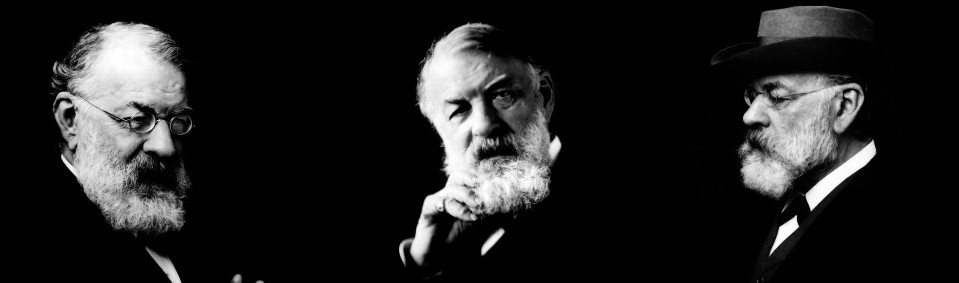
Study with Joseph Böhm


Previous Post in Series: Hauser and Hellmesberger

__________

JJ Initials

Study With Joseph Böhm

Böhm

[i]

Photo: Emil Rabending, k. k. Hof-Photograph, Vienna

What an intimate friendship customarily exists between the earnest teacher and the attentive student! It is the communion of minds, and they tread in a relationship like that of father and son. [ii]

— Simon Sechter, 1841

An important teacher, [Leopold] Joseph Böhm is known today as the father of the Viennese school of violin playing. His pupils included some of the leading artists of the age: Ernst, Joachim, Georg Hellmesberger senior, Adolf Pollitzer [1], Eduard Rappoldi, Ede Reményi (Eduard Hoffmann), Ludwig Straus, [2] Edmund Singer, Jakob Dont and Jakob Grün. In 1819, Böhm was named the first professor of violin at the recently-founded Vienna Conservatory, a position he held until 1848. His pupils Grün and Hellmesberger later joined him on the Conservatory faculty. In the days of Richter and Mahler nearly all the violinists in the Vienna Philharmonic Orchestra were scions of this distinguished musical family, as they continue to be today. Grün’s pupil Franz Mairecker taught, among others, the Philharmonic’s 20th-century concertmasters Walter Barylli, Willi Boskovsky and Franz Samohyl. Samohyl’s pupils include more than twenty of the Philharmonic’s current members. Numerous others, past and present, are descendants of the Hellmesberger branch, including Arnold Rosé, Wolfgang Schneiderhan and Gerhart Hetzel. [3] Böhm’s violin playing was said to be “exquisitely pure and delicate,” and full of “soulful intimacy.” The unique beauty of the Philharmonic strings is often traced to the dark, voluptuous Hungarian sound introduced to Vienna by Böhm in the days of Beethoven and Schubert.

“Böhm’s personality was utterly endearing,” recalled Edmund Singer in his memoirs. “He was distinguished; seemingly cool, but never stiff. And he was never impatient, not even when he required this or that passage to be repeated a dozen times, until it turned out the way he thought it should […]. Occasionally moved to anger, he nevertheless was never provoked into an offending remark. A pupil of Rode, his method was a combination of the German and French schools. He frowned upon nothing so much as mawkish, mannered playing. ‘You’re feeling awfully sentimental again today,’ he would say. ‘An artist must have healthy playing, healthy feelings, healthy technique; only then is he an artist.’”

“Böhm’s instruction was very inspiring,” Singer continued, “although the master seldom took violin in hand to demonstrate. One knew, however, that he, himself, assiduously practiced all of the pieces that he taught, and I, like many others of his students, often stood before the doors of his room and evesdropped on his magnificent playing. He never played in concert, because appearing in public made him nervous; it was even said that his agitation immediately before a concert once reached such a degree that he fell into a faint, and that, as a consequence, he once and for all gave up appearing before a larger audience.”

Joachim’s training under Böhm was a true apprenticeship. In accepting Joseph as a student, Böhm and his wife agreed to take the “Pester Buam,” [4] as they called him, into their home on the Glacis, two blocks from the Schwarzspanierhaus where Beethoven had lived and died. [5] For the next three years, for all but the summer months, they would raise him in loco parentis, and train him in the practical skills of a professional violinist.

Pepi

[6]

Joseph Joachim
From a daguerreotype

Once a “Pester Buam” himself, Böhm might have had a particular sympathy for young Joachim. Böhm had been born in Pest on March 4, 1795, and had studied violin with his father, a violinist in the local theater. As a boy, he practiced guitar as well as violin, and by the age of 12 he was able to earn money giving guitar lessons. He later took violin lessons with Pierre Rode, practicing so faithfully that he was banished to the attic by the other residents of his house. Rode, a principal representative of the bold new French style of playing, was then on the cutting-edge of violin pedagogy. Rode’s caprices and concerti are still studied today by every aspiring violinist. Together with selected works of Mayseder, they formed an important part of Joseph’s technical and musical training. In later life, Joachim was capable of playing from memory pieces by Viotti, Rode or Mayseder that he had studied with Böhm, though he had not practiced them since. “I have gone through a good school,” he said. “The rest has been given by a benevolent God.” [iii]

As a teacher, Böhm was able to help Joseph remedy the defects in his bowing that Hellmesberger had found so ruinous. “Based on an unfailing left hand and ideally smooth bowing, Böhm possessed an art of phrasing that enabled him to realize anything that he envisioned or felt,” Joachim later recalled. [iv] “In Böhm’s school Joachim’s bowing had become broad and free,” wrote Moser, “and he had acquired a degree of skill which in a few years was to lead to complete mastery. His pre-eminent power—later so conspicuous—of giving to each bowing its distinctive individuality; the absolute repose in his manner of drawing a long note; the incisiveness and pith of his half-bow; his spiccato, in all its shades, from “snow and rain to hail”; his equality of tone in all parts of the finger-board; in short, all the characteristics which adorn Joachim’s violin-playing, owe their origin to Böhm’s splendid method of teaching.” [v] “For the rest of his life,” Moser tells us, “Joachim could not say enough commendable things about the manner of [Böhm’s] instruction. Rigorous, serious and objective, it was at the same time loving and encouraging in every respect.”

As Catholics, the Böhms endured some criticism over their parental solicitude for Joseph; it was surely unusual in those years for a Jewish boy to live with a Catholic family. Moser claims: “Joachim was the butt of much harmless teasing at home on account of his Jewish descent.” Joachim also recalled to Moser how Frau Böhm would occasionally frighten him by saying: “Well, Pepperl, today the Chaplain gave me another good dressing-down because we have a heathen like you in our house. But don’t worry — practice like a good boy. We’ll answer to the dear Lord God for the rest.” [vi]

Though not a violinist, Frau Böhm played a critical role in the Joseph’s musical upbringing, attending his lessons, and taking personal charge of his practicing. Moser affords us a telling glimpse of their domestic life: “While Böhm was teaching in the Conservatoire, or discharging his duties in the orchestra of the Imperial Chapel, Pepi had to practice his assignment at home, and Frau Böhm would sit down, needle-work in hand, and supervise the boy’s practice. She would correct him with a ‘Pepperl, weißt, das war aber gar nit gut, und schöner klingen muß es auch noch… ’ (Viennese dialect: ‘Pepperl, look, that wasn’t at all good, and it must sound more beautiful still. You must practice such a passage repeatedly until you can manage it smoothly and without effort, etc.’).”  If he did not respond to Frau Böhm’s cajoling, “it might happen that the curtain was drawn back from the glass door of the adjoining room, and Böhm’s Mentor-head, with its strict but loving demeanor, would appear; or the door would open and the stern Herr Professor would call into the studio: ‘confounded boy, will you play that properly?’ This usually helped.” [vii]

Supervised practice was a critical element in Joseph’s success.  “For a long time, I […] was not allowed to practice alone,” Joachim wrote to Clara Schumann in 1861. [viii] Böhm employed a different approach to supervision with his conservatory pupils: an adaptation of the Lancasterian Monitorial System, a method developed by the British pioneer of mass education, Joseph Lancaster (1778-1838). Following Seneca’s motto, Qui docet, discit (“He who teaches, learns”), Lancaster’s system employed advanced students as peer tutors to help the less experienced members of the class. [7] According to one of Joachim’s fellow students, Adolf Grünwald, Böhm had his students play duets “for months together, so that the pupils became perfectly familiar with this form of music, indeed thoroughly tired of it.” [ix]

Not all Conservatory pupils thrived under this system. Karl Goldmark, who briefly studied with Böhm in 1847, gives an insight into this tiered system of instruction as Böhm practiced it: “Joseph Böhm was an extraordinary teacher. Great virtuosity, combined with thorough musical culture, were the results of his instruction. He spoke but little—his censure was a scornful smirk; it was devastating. In the five months that I attended school in his upper class, I only got to see how one holds the violin. And yet, from this class the greatest violinists emerged: for example, Ernst, Joachim, Auer, Ludwig Strauss, Singer, etc. Admittedly, only his private students got to hear him. And we learned from them.” [x]

Boehm crop

[xi]

Joseph Böhm

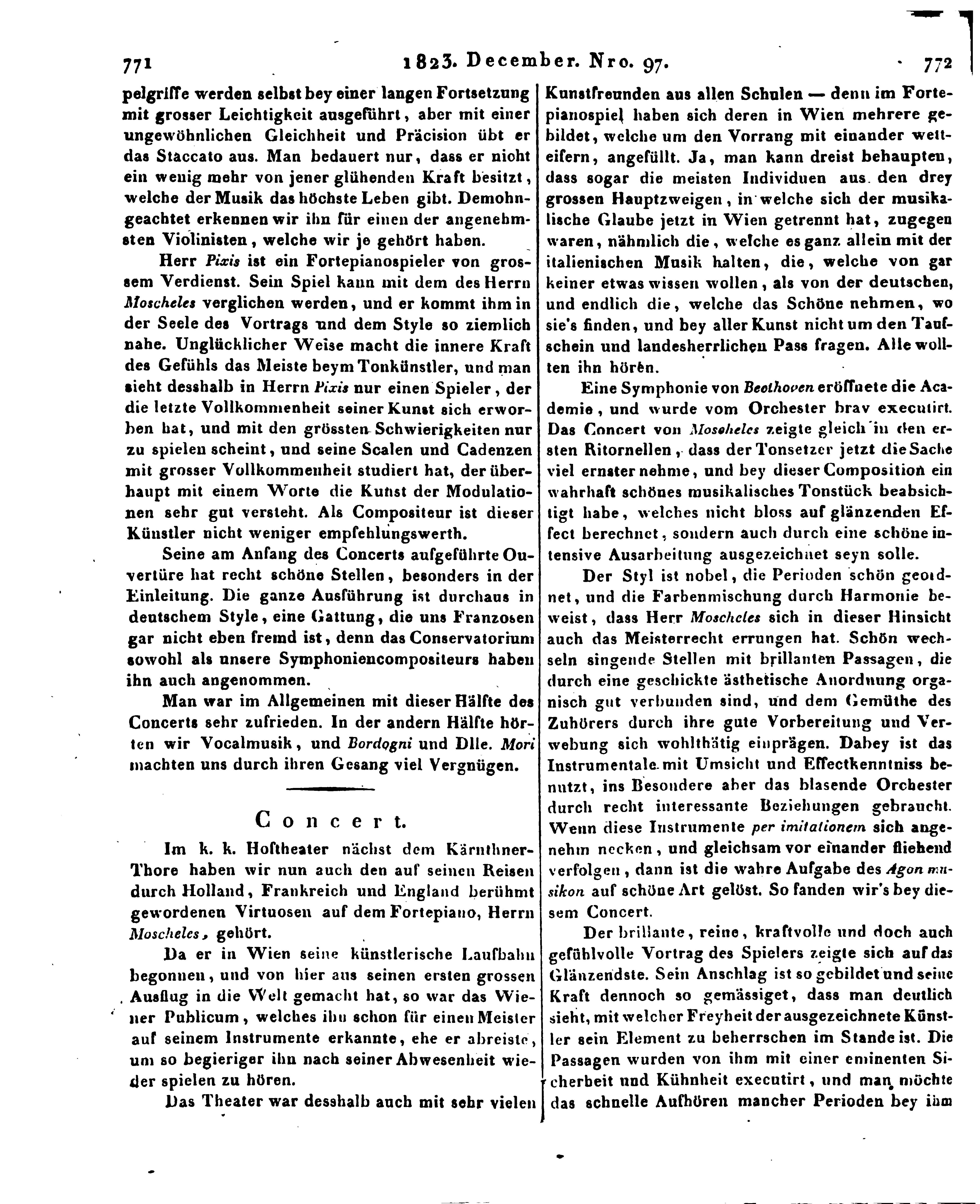
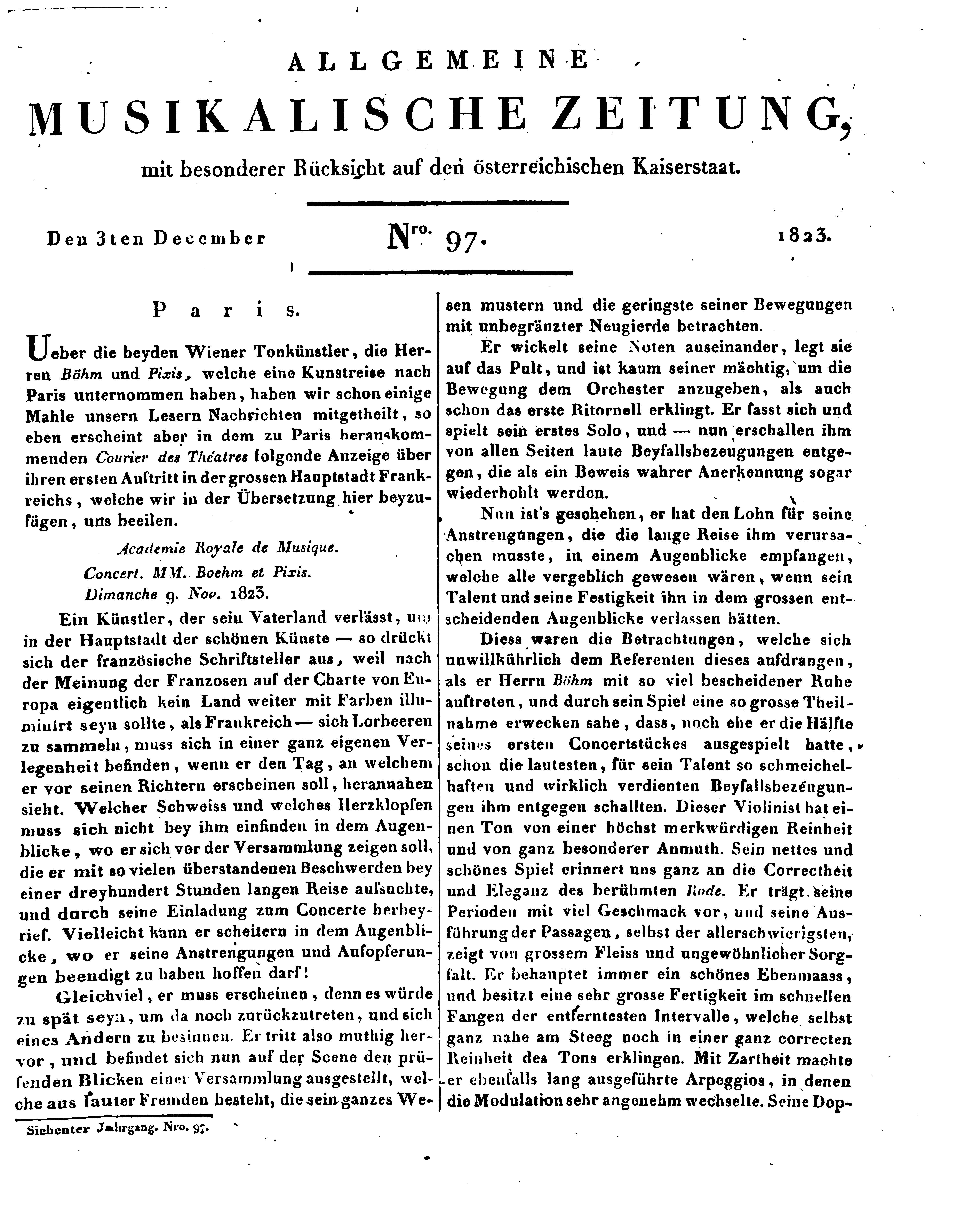
Though Böhm no longer gave solo performances, he could nevertheless look back upon a distinguished performing career. He made his début in Vienna at the age of twenty-one, and two years later toured Italy with the piano virtuoso Johann Peter Pixis (1788-1874). Böhm and Pixis were still playing together in September, 1823, when a reviewer in Frankfurt am Main described Böhm’s playing of his own violin concerto in D Major and a Rondo brillant of Mayseder: “clarity, security, beautiful tone, [8] excellent facility and variety of interpretation; Herr Böhm possesses all of these characteristics. Particularly surprising was his articulate staccato in the quickest tempo.” [xii]

As a member of the Imperial Hofopernorchester from 1821 to 1868, Böhm played in many historically significant concerts, including a performance of Beethoven’s 9th symphony under the composer’s direction. He became an early advocate for Schubert’s chamber music, and on March 26, 1828 he gave the premiere of Schubert’s opus 100 trio.  Together with Holz, Weiss and Linke of the original Schuppanzigh Quartet, he performed Beethoven’s string quartets under the composer’s supervision, [9] in venues that included a popular series of morning concerts in a coffee house in Vienna’s beautiful Prater. The 8:00 a.m. concerts commenced on the first of May, when there was still a chill in the air. “This is the way to hear Beethoven’s and Mozart’s quartets!” exclaimed the Vienna Musikzeitung in 1821. [xiii]

For Joachim, this direct personal and musical connection to Beethoven held a great and abiding significance. “I cannot think back upon it without emotion,” he told Moser:

how Böhm recounted the course of a rehearsal with Beethoven of one of his last quartets [10], around the year 1820. How the stone-deaf man sat and stared with wide-open mouth, and could only deduce which passages they were playing from the gestures of the players’ bowing. How, from time to time, he grabbed the arm of one or the other of them and sang for him, with horrible expression in impossible intervals, reading in the faces of the quartet players whether they had understood him or not. In the one case he rubbed his knee and smiled to himself with satisfaction; in the other, however, he strode across the room with agitated steps, fists clenched across his back, muttering unintelligible words to himself. How he ranted and cursed when, despite his careful correction of the parts, the players nevertheless found errors, or when one of them gathered up the courage to declare that this or that passage could not be performed in the prescribed way, even with the best of intentions. On the other hand, he could smile unbelievably indulgently and thankfully when one described a passage as particularly well-written, or offered the opinion: only ‘he’ could have composed something like that.

But Böhm was always honest enough to admit sincerely that neither he nor his colleagues — Schuppanzigh not excepted — had comprehended Beethoven’s genius during his lifetime to the extent that it was known after his death, when the composer could no longer torment them with his often completely unfulfillable demands, but instead, having entered into immortality, holds watch over the performance of his works as an invisible spirit. He assured me repeatedly that upon hearing the last quartet played by the elder Hellmesberger’s quartet a generation after Beethoven’s passing, he saw the form of the Titan so vividly before him as though it had been yesterday, and that he would not have wondered at all to see him enter the hall and to hear him argue about many things which were not to his liking in the otherwise truly outstanding performance. [xiv]

In this story we have a palpable representation of what Carl Dahlhaus claims as one of Beethoven’s signal contributions to the art of music:

Beethoven, virtually in one fell swoop, claimed for music the strong concept of art, without which music would be unable to stand on a par with literature and the visual arts; […] Beethoven’s symphonies represent inviolable musical “texts” whose meaning is to be deciphered with “exegetical” interpretations; a Rossini score, on the other hand, is a mere recipe for a performance, and it is the performance which forms the crucial aesthetic arbiter as the realization of a draft rather than an exegesis of a text. […] That a composer who did not care a whit about Ignaz Schuppanzigh’s “wretched fiddle,” as Beethoven called it, could successfully demand that performances be a function of the text, rather than vice versa, can only have astonished early-nineteenth-century contemporaries; and even though this view is now taken for granted among the artistically well educated, historians ought to receive it in its original spirit. The new insight that Beethoven thrust upon the aesthetic consciousness of his age was that a musical text, like a literary or philosophical text, harbors a meaning which is made manifest but not entirely subsumed in its acoustic presentation — that a musical creation can exist as an “art work of ideas” transcending its various interpretations. [xv]

From the earliest age, then, Joseph’s involvement in Beethoven’s circle taught him important artistic lessons: from Beethoven, through Böhm, he was imbued with the notion that the greater meaning of a work resides in the score itself, not as a “recipe for a performance” but as a text to be construed (here, after all, was the stone-deaf composer, nevertheless insisting on the finical interpretation of what he had written); that great music is not always easily understood or realized, even by distinguished musicians; and that a musical artwork possesses a quality of timeless “truth” that can be viewed sub specie aeternitatis — under the aspect of eternity. It is in that sense that the composer remains personally invested in his work, holding watch over it in spirit, even after death.

Böhm continued to be an enthusiastic quartet player at home. His informal performances with colleagues formed an important part of Joseph’s musical education:

Even today, I still have the liveliest recollection of the manner in which he played Beethoven quartets with his colleague friends on Sundays at his apartment. Indeed, they were the first truly great artistic impressions of my life. For what I heard my teacher Serwaczynski do in the house of Count Franz von Brunswick when I was a child in Pest has naturally nearly fully escaped my memory. I still remember only darkly that several times I had to jump in for the missing or sick second violinist in quartets by Beethoven and quintets by Onslow.

I remember all the more thankfully the affectionate care with which Böhm went through the second violin part of the F minor quartet, op. 95, with me one day […] Since the experiment was carried off to the satisfaction of my teacher and his companions, I was invited to participate more and more frequently, and in this way — already in my childhood — I learned a not insubstantial part of the quartet literature.

Indeed, it had the consequence that, spoiled by Böhm’s superior ability to give shape to the music, I could not be particularly satisfied by either the quartet-playing of the elder Müller brothers [11] or, later, that of Ferdinand David. The former only used to play single movements of the “late Beethoven” now and then, and even these were done in what seemed to me an insufficiently incisive way, while David very often played them in questionable taste, especially when Mendelssohn was away from Leipzig, sojourning on the Spree,[12] since he felt it was necessary to spruce them up with all manner of coquettish gimmicks. In general, he felt things absolutely correctly and, for the most part, he knew what was what, but sometimes he could not help overdoing it.

It was only in the fifties, when, together with Wieniawski and Piatti, I joined the quartet of the London Beethoven Society under H. W. Ernst’s leadership that I came to love and honor in the latter an artist that not only accorded with my ideals, but in certain points even exceeded them.

Admittedly, Ernst was also a pupil of Böhm’s and as truly devoted to him as I; indeed it was he who led me to become his student. [xvi]

“For Joachim,” writes Moser, “these gatherings in the Böhm household were an inexhaustible source of recollection about an epoch in the performing arts that has found its conclusion with his passing; and for me an object of inestimable edification when we later worked together on our shared edition of the Beethoven string quartets.” [xvii

Joseph Böhm

[xviii]

Joseph Böhm

© Robert W. Eshbach, 2013.


Next Post in Series: Conservatory Student  


Addendum: Joseph Böhm in Concert

Allgemeine Musikalische Zeitung, No. 66 (16 August 1823), p. 528.

Screen shot 2014-01-07 at 2.37.50 PM

Allgemeine Musikalische Zeitung, No. 80 (4 October, 1823), p. 640.

Screen Shot 2014-01-07 at 2.01.23 PM

Allgemeine Musikalische Zeitung, No. 84 (18 October, 1823), p. 680

Screen shot 2014-01-07 at 2.49.07 PM

Allgemeine Musikalische Zeitung, No. 97 (3 December, 1823), pp. 769-771.
12


[1] Adolf Pollitzer was born in Budapest on July 23, 1832 and died in London Nov. 14, 1900. In 1842 he moved to Vienna, where he studied violin with Böhm. He was awarded first prize in violin at the Vienna Conservatory at age 14. After a concert tour in Germany, he went to Paris, where he studied with Alard. In 1851 he settled in London where he was concertmaster of Her Majesty’s Theatre under Sir Michael Costa, as well as of the new Philharmonic Orchestra and the Royal Choral Society. A noted chamber musician, Pollitzer was appointed professor of violin at the newly-established London Academy of Music in 1861, and principal of the Academy in 1890. Pollitzer was the teacher of Sir Edward Elgar. His editions of standard violin works are occasionally still in use.

[2] Ludwig Straus was born in Pressburg on March 28, 1835 and died in Cambridge on October 23, 1899. From 1860-1864 he was concertmaster of the Frankfurt opera. He settled in England in 1864 as concertmaster of the Hallé Orchestra, also appearing frequently as a soloist. From 1888 he lived in London, retiring to Cambridge in 1893.

[3] Fritz Kreisler was also a Hellmesberger pupil.

[4] In dialect: “the boy from Pest.”

[5] The Böhms lived in Building 301 in Alservorstadt, currently Berggasse 7. [Handbuch 1843, p. 118.] Siegmund Freud’s famous residence at Berggasse 19 had not yet been built. The building faced directly onto the Glacis. The Böhm’s residence was also just 300 yards from the elegant summer palace and park of Prince Franz-Josef von Dietrichstein, the current Palais Clam-Gallas in the Währingerstrasse. The view from the Böhm’s house would have been essentially the same as that from the Schwarzspanierhaus, which, according to Gerhard von Breuning, “had a wide view over the Glacis and the inner city lying just opposite, with its bastions and church towers, left to Leopoldvorstadt and beyond that over the towering trees of the Prater and the Brigittenau…” [Breuning/MEMORIES, p. 60.]

[6] This is one of the earliest Daguerreotypes in existence, since the process was only patented in 1839.

[7] Lancaster made use of an intricate scheme of rewards and punishments, including silver-plated badges, toys or money for the diligent—and humiliation for the lazy. Some of Lancaster’s maxims, “a place for everything and everything in its place,” and “let every child at every moment have something to do and a motive for doing it,” are still known. Though Lancaster’s personal life “was mainly one of failed prospects, broken engagements, sordid quarrels, and endless debts,”[7] his method achieved worldwide popularity by the beginning of the 19th century, especially in Christian education. Böhm may have learned of the method through the Catholic Church, which formally adopted the system in many of its schools.

[8] Böhm played the Khevenhüller Stradivari, later owned by Yehudi Menuhin.

[9] Including a famous second performance, at Beethoven’s insistence, of Op. 127, after Schuppanzig’s performance had achieved only a succès d’estime.

[10] Op. 127. In 1863, Böhm wrote his own account of these rehearsals: “It was studied industriously and rehearsed frequently under Beethoven’s own eyes: I said Beethoven’s eyes intentionally, for the unhappy man was so deaf that he could no longer hear the heavenly sound of his compositions. And yet rehearsing in his presence was not easy. With close attention his eyes followed the bows and therefore he was able to judge the smallest fluctuations in tempo or rhythm and correct them immediately. At the close of the last movement of this quartet there occurred a meno vivace, which seemed to me to weaken the general effect. At the rehearsal, therefore, I advised that the original tempo be maintained, which was done, to the betterment of the effect.

Beethoven, crouched in a corner, heard nothing, but watched with strained attention. After the last stroke of the bows he said, laconically, ‘Let it remain so,’ went to the desks and crossed out the meno vivace in the four parts.” [Thayer/BEETHOVEN, pp. 940-941.]

Sir George Smart described a rehearsal of the op. 132 string quartet by Schuppanzigh, Holz, Weiss, and Lincke at which Böhm was present: Beethoven “directed the performers, and took off his coat the room being warm and crowded. A staccato passage not being expressed to the satisfaction of his eye, for alas, he could not hear, he seized Holz’s violin and played the passage a quarter of a tone too flat. I looked over the score during the performance. All paid him the greatest attention. About fourteen were present, those I knew were Boehm (violin), Marx (‘cello), Carl Czerny, also Beethoven’s nephew…” [Smart/JOURNALS, p. 109.]

[12] Berlin’s river.


[i] Photo: Emil Rabending K. K. Hof-Photograph Wien; Wieden, Favoritenstrasse No. 3.

An original of this picture is in the Vienna Gesellschaft der Musikfreunde, Ph 32. Another nice photo: Ph 4170 Standing portrait of Böhm in “Frack” with violin. Ph 3156 rather poor repro of Kriehuber portrait of Böhm. [1839]

[ii] Allgemeine Wiener Musik-Zeitung, No. 51 (April 29, 1841), p. 216.

[iii] Moser/JOACHIM 1908 II, p. 387.

[iv] Boris Schwarz: “Böhm, Joseph,” Grove Music Online ed. L. Macy (Accessed 5 May, 2004), http://www.grovemusic.com.

[v] Moser/JOACHIM 1901 p. 33.

[vi] Moser/JOACHIM 1908, I, pp. 28-29.

[vii] Moser/JOACHIM 1908, I, p. 28.

[viii] Joachim to Clara Schumann, June 28, 1861. [Joachim/BRIEFE II, p. 149.]

[ix] Moser/JOACHIM 1901, p. 22., quoting a “Professor Grünwald,” who can be identified through Conservatory records as Adolf Grünwald.

[x] Goldmark/ERINNERUNGEN, p. 26.

[xiii] Moser/VIOLINSPIEL II, p. 243.

[xiv] Moser/JOACHIM 1908, II, pp. 288-290. [Author’s translation]

[xv] Dahlhaus/19th CENTURY, pp. 9-10.

[xvi] Moser/VIOLINSPIEL II, pp. 244-245.

[xvii] Moser/JOACHIM 1908 I, p30.

[xviii] Gesellschaft der Musikfreunde, Vienna

Ludwig Wittgenstein: Josef Joachim (1907)

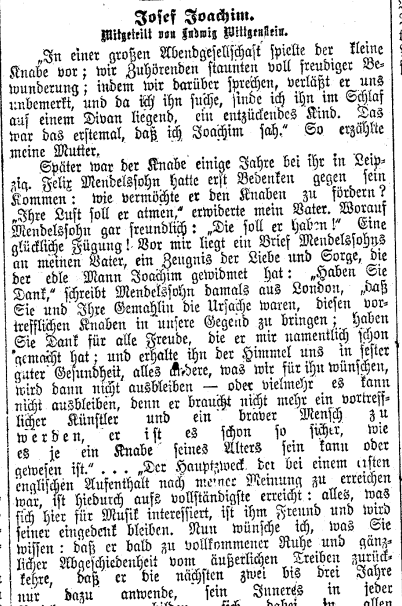
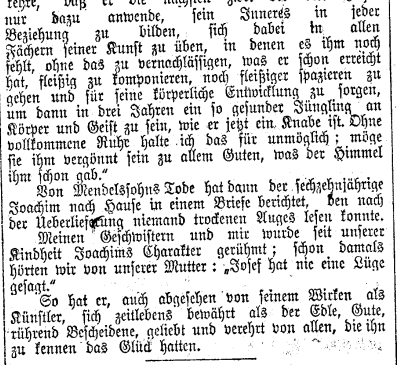
Neue Freie Presse. Morgenblatt, no. 15441 (Sunday, 18 August, 1907), p. 11.

Translation © Robert W. Eshbach 2014

__________

jj-initials1

[At the time of writing, Ludwig Wittgenstein was 18 years old. This remembrance is somewhat idiosyncratic regarding tense, and has been translated as written. It is also somewhat unclear as to voice: the “father” referred to is Ludwig Wittgenstein’s paternal grandfather, Hermann Wittgenstein. Ludwig’s paternal grandmother, Fanny Figdor Wittgenstein, was Joseph Joachim’s cousin, and, for a number of years, Joachim’s guardian. She is apparently the “mother” referred to. It seems, therefore, that this remembrance is actually that of Ludwig Wittgenstein’s father Karl, “communicated” by Ludwig Wittgenstein.]

Josef Joachim.

Communicated by Ludwig Wittgenstein.

“The little boy played at a large evening party; we listeners were filled with joyful amazement; while we speak of it, he leaves us unnoticed, and when I look for him I find him asleep, lying on a divan, an adorable child. That was the first time that I saw Joachim.” This is the way my mother told it.

Later, the child spent several years at her home in Leipzig. At first, Felix Mendelssohn had misgivings about his coming: how would he be able to help the boy? “Just let him breathe your air,” replied my father. To which Mendelssohn gave the friendly reply: “That he will have!” A happy stroke of fate. Before me lies a letter from Mendelssohn to my father, a testimony to the love and care that the noble man devoted to Joachim: “You are to be thanked,” Mendelssohn wrote then from London, “that you and your wife were responsible for bringing this exceptional boy into our midst; you have my thanks for all the joy he has given me in particular; and if heaven keep him in good and sound health, everything else that we wish for him will not then fail to be forthcoming — or rather, it cannot fail, for he no longer needs to become an eminent artist and a fine person: he is both already, as certainly as a boy of his age can be or ever has been.

With this [successful concert], the chief object of a first English visit has, in my opinion, been fully attained: every one here who is interested in music is his friend and will remember him. Now I wish, as you know, that he should soon return to a perfectly tranquil life, retiring entirely from public playing in order that he may use the next two or three years to develop his inner resources in every regard, practicing his art in all those areas in which there is still room for improvement without neglecting that which he has already achieved, composing industriously, and even more industriously going for walks and caring for his physical development, so that in three years’ time the youth may be as healthy in mind and body as the boy. I consider this impossible without perfect peace and quiet; may this be granted in addition to all the good things that Heaven has given him.”

The sixteen year-old Joachim wrote home about Mendelssohn’s death in a letter, which, it is said, no one could read with dry eyes.

Since our childhood, Joachim’s character was held up to my siblings and me as an example; even then, we heard from our mother: ‘Josef has never told a lie.”

So he has, even apart from his work as an artist, kept himself to be a noble, good, touchingly modest man, loved and honored by all who had the good fortune to know him.

JJ Initials

Josef Joachim.

Mitgeteilt von Ludwig Wittgenstein.

“In einer großen Abendgesellschaft spielte der kleine Knabe vor; wir Zuhörenden staunten voll freudiger Bewunderung; indem wir darüber sprechen, verlässt er uns unbemerkt, und da ich ihn suche, finde ich ihn im Schlaf auf einem Divan liegend, ein entzückendes Kind. Das war das erstemal, daß ich Joachim sah.” So erzählte meine Mutter.

Später war der Knabe einige Jahre bei ihr in Leipzig. Felix Mendelssohn hatte erst Bedenken gegen sein Kommen: wie vermöchte er den Knaben zu fördern? “Ihre Luft soll er atmen,” erwiderte mein Vater. Worauf Mendelssohn gar freundlich: “Die soll er haben!” Eine glückliche Fügung! Vor mir liegt ein Brief Mendelssohns an meinen Vater, ein Zeugnis der Liebe und Sorge, die der edle Mann Joachim gewidmet hat: “Haben Sie Dank,” schreibt Mendelssohn damals aus London, “daß Sie und Ihre Gemahlin die Ursache waren, diesen vortrefflichen Knaben in unsere Gegend zu bringen; haben Sie Dank für alle Freude, die er mir namentlich schon gemacht hat; und erhalte ihn der Himmel uns in fester guter Gesundheit, alles andere, was wir für ihn wünschen, wird dann nicht ausbleiben — oder vielmehr es kann nicht ausbleiben, denn er braucht nicht mehr ein vortrefflicher Künstler und ein braver Mensch zu w e r d e n, er ist es schon so sicher, wie es je ein Knabe seines Alters sein kann oder gewesen ist.” … “Der Hauptzweck der bei einem ersten englischen Aufenthalt nach meiner Meinung zu erreichen war, ist hierdurch aufs vollständigste erreicht: alles, was sich hier für Musik interessiert, ist ihm Freund und wird seiner eingedenk bleiben. Nun wünsche ich, was Sie wissen: daß er bald zu vollkommener Ruhe und gänzlicher Abgeschiedenheit vom äußerlichen Treiben zurückkehre, daß er die nächsten zwei bis drei Jahre nur dazu anwende, sein Inneres in jeder Beziehung zu bilden, sich dabei in allen Fächern seiner Kunst zu üben, in denen es ihm noch fehlt, ohne das zu vernachlässigen, was er schon erreicht hat, fleißig zu komponieren, noch fleißiger spazieren zu gehen und für seine körperliche Entwicklung zu sorgen, um dann in drei Jahren ein so gesunder Jüngling an Körper und Geist zu sein, wie er jetzt ein Knabe ist. Ohne vollkommene Ruhe halte ich das für unmöglich; möge sie ihm vergönnt sein zu allem Guten, was der Himmel ihm schon gab.”

Von Mendelssohns Tode hat dann der sechzehnjährige Joachim nach Hause in einem Briefe berichtet, den nach der Ueberlieferung niemand trockenen Auges lesen konnte.

Meinen Geschwistern und mir wurde seit unserer Kindheit Joachims Charakter gerühmt; schon damals hörten wir von unserer Mutter: “Josef hat nie eine Lüge gesagt.”

So hat er, auch abgesehen von seinem Wirken als Künstler, sich zeitlebens bewährt als der Edle, Gute, rührend Bescheidene, geliebt und verehrt von allen, die ihn zu kennen das Glück hatten.

23

Concert: Vienna Philharmonic Debut, April 30, 1843

Der Humorist, vol. 7, no. 87 (Wednesday, 3 May, 1843), p. 354.

Translation © Robert W. Eshbach 2014

_________

jj-initials1

Fourth Society Concert, Sunday 30 April in the

Imperial and Royal Large Ball Room

“The young violin virtuoso Joachim provoked a true sensation with an Adagio and Rondo from Vieuxtemps’s newest concerto. Rarely has the voice of the public been so fully in accord with that of the critics as concerning the talent of this still virtually child-like boy; rarely have the most daring prospects become manifest as they have with him. Little Joachim has many very worthy fellow mignon-virtuosi here, both smaller and larger, but none possesses a power of interpretation so steeped in mind and spirit, with such irreproachable clarity and subtlety and nuance, with such boldness and resoluteness of bowing — in short, with so much technical correctness; none advances toward such a bright future, as he. His well-grounded and solid playing was interrupted by the liveliest applause, and at the end he was recalled three times with stormy acclaim.”

JJ Initials

Viertes Gesellschafts-Concert, Sonntag den 30 April im K. K. großen Redouten=Saale

Dasselbe wurde mit Preyer‘s oft und warmgewürdigte “Symphonie” einem tüchtig instrumentierten Werke, eröffnet, diesem folgte ein “Vokal-Chor” von Fred. Schubert, eine interessante Komposition, welche gleich der erstern beifällig aufgenommen wurde. Dlle. Reiter sang hierauf eine Bravour-Arie von Mercadante mit ziemlicher Fertigkeit und freundlichem Beifall. Wahrhafte Sensation erregte wieder der junge Violine-Virtuose Joachim durch ein “Adagio” und “Rondo” des neuesten Concertes von Vieuxtemps. Selten noch war die Stimme des Publikums so einstimmig mit der Kritik, als über das außerordentliche Talent dieses fast noch kindlichen Knaben, selten noch haben sich die kühnsten Erwartungen auf solch’ erfreuliche Weise manifestiert, als es bei ihm der Fall ist. Der kleine Joachim hat hier noch viele kleinere und größere, sehr schätzenswerte mitstreitende Mignon-Virtuosen, aber Keiner besitzt bei so viel tadelloser Deutlichkeit und Feinheit und Nuancierung, bei so viel Kühnheit und Entschiedenheit der Bogenführung, kurz, bei so viel technischer Korrektheit einen solch’ geist- und gemüthsdurchdrungenen Vortrag, Keiner geht einer solch’ glänzenden Zukunft entgegen, wie er. Der lebhafteste Beifall unterbrach auch heute sein sinniges und gediegenes Spiel, und am Schlüsse wurde er drei Mal stürmisch gerufen. Der hierauf folgende Vokal-Chor, von dem rühmlichste bekannten Neukomm, schien nicht sonderlich goutiert zu werden. Die Ouvertüre aus Abbé Vogler‘s “Samori,” welche wohl etwas aus der Zeit und dem Geschmack des Publikums, schloß das Concert.

–g–

Screen Shot 2014-01-05 at 6.22.12 PM

Moritz Hauptmann: “J! – O! – Ach! – im Canon”

Joachim Canon LEFTJoachim Canon RIGHT

Moritz Hauptmann: Autograph Musical Manuscript: “J! – O! – Ach! – im Canon.” 
Autograph manuscript, signed and with autograph title at head. A 4-voice canon in F Major, notated in brown ink on twelve staves, with a number of alterations in the texts visible. 1 page, 25.5 X 33 cm, 12-stave paper. Verso features an additional four measures on the bass notes G-A-D-E, a reference to the Danish composer Niels W. Gade.

Joachim Canon Verso510

Verso: “GADE”

Credit: Gabriel Boyers, Schubertiade Music & Arts LLC.

Currently (January 5, 2014) for sale from Schubertiade.

Moritz-Hauptmann

Moritz Hauptmann

The undated manuscript (presumably October 1845) is by Moritz Hauptmann, and relates to a similar copy (“Von Ihrem Sie herzlich liebendem M Hauptmann;” transposed, dated 12 October, 1845) in Moser’s biography: Andreas Moser, Joseph Joachim: Ein Lebensbild, (2 vols.), Berlin: Verlag der Deutschen Brahms-Gesellschaft, vol. 1: 1908, opp. p. 69.

Joachim Canon

Boyers lists the manuscript as “O! – O! – Och – im Canon,” with an erroneous attribution re: the Joachim-Brahms counterpoint exchange:

“The present canon is a previously unrecorded manuscript and it is possible that it relates to the famous Joachim-Brahms counterpoint exchange. “As unique in the annals of music history as their friendship is the exchange of studies in counterpoint carried on by Brahms and Joachim during their late twenties. First suggested by Brahms in a letter of February 26, 1856, the musical correspondence was active until the end of July, to judge by references made to it in their published correspondence. It was resumed during June and July, 1857, and again during the spring of 1860 and summer of 1861. Thereafter there is no further mention of counterpoint studies, although they continued to advise each other in connection with their compositions.” (Leonard Ellinwood, “The Brahms-Joachim Exercises in Counterpoint,” AMS Bulletin Sep. 1948, p. 50-51) $4000.00″

Edith Sichel: Joseph Joachim. — A Remembrance (1907)

The Living Age, Seventh Series, Vol. 36 (July, August, September 1907), pp. 693-695

__________

JOSEPH JOACHIM. — A REMEMBRANCE

Edith Sichel

 Screen shot 2014-01-04 at 7.33.12 PM

            “Coleridge is dead!” Charles Lamb would suddenly exclaim in the midst of other conversation, during the weeks that followed the poet’s death. And those who have loved Joseph Joachim feel the need of repeating such words to make them realize that he has gone. When men have lived the life of art or goodness belonging more or less to the eternal order of things, it is more difficult to grasp their mortality. For those who care for beauty, for the best in music and in life, a link has snapped never to be replaced. Music is not dead, cannot die; but the interpreter-genius who revealed it in its purest depths has passed away.

Those who, but a few years ago, heard him still at his strongest (at his best he always was) know the utmost limit of human achievement in art. “Whether in the body, or out of the body, I know not,” was the feeling with which one always came away from hearing him. What was it that made his playing what it was? Was it his tone, his phrasing, the might and grace of his rhythm? Was it the wonderful union of passion and restraint? It was all these, it was something more than these. He had not drunk at the spring of inspiration, he was that spring himself. It was this fount within him which compelled him, in spite of his vital personality, to become the music that he played; to be, in turn, Bach, Haydn, Mozart, Beethoven, Schubert, Schumann, Brahms. Perhaps it is the heritage of his race to be the selfless testifier that he was. “If people would only trust the music,” he once said, “they too often put themselves into it.” Once when Brahms heard Joachim play again after an interval, “I felt,” he wrote, “that there had been something lacking in life. Oh, how he plays!”

This particular effect of his music was due not only to the musician; it came from the man. If he stands for art he also stands for goodness: for duty, for loyalty, for obedience. Not for virtue, which affects a man’s relation to himself, but for the kinder, sweeter power which means his bond with others; the “human charity,” which Beethoven said “was the only superiority that counted.” Sometimes one was even tempted to wish that Joachim’s charity did not suffer so long and be kind. The most social of men, he would not reject anybody.

Of course, like all interesting people,

694

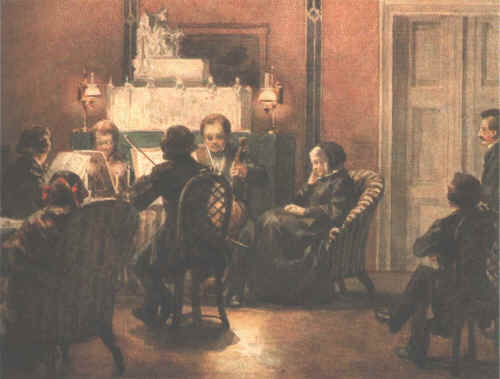
he liked interesting people best, and men who had made their mark in the world inspired him with respect and curiosity. He was courtly without being a courtier. His feeling for the Emperor, for Royalty, was a sentiment — the sentiment that Goethe had at Weimar. Bismarck was one of the persons for intercourse with whom he had cared most, and for the last sixty years he had known most people worth knowing both in Germany and England. In the ‘fifties he had played to Goethe’s Bettina, and in his drawing-room at Berlin there hung a water-color sketch of him and a quartette of that day, high-collared in swallow-tailed coats, playing to a little old lady, Bettina von Arnim.

Quartettabend

Carl Johann Arnold: Quartettabend bei Bettina

But the great friendships of his life were those for Mendelssohn, the Schumanns, and Brahms. His relations with Schumann began when he was very young. He had been playing Beethoven’s Concerto, and he and Schumann came out together from the hot, crowded concert-room into the star-lit open. “Little Master Joachim,” said Schumann, looking skywards, “do you think that star knows that you have just played the Beethoven Concerto and that I am sitting by you here?” As he spoke, he laid a hand tenderly upon the boy’s knee. The incident was always alive to Joachim as if it had been yesterday. Fifty years afterwards he loved to tell the story, in his vivid way, acting the gesture, recalling the tones which the years had not dulled for him. Joachim’s friendship for Brahms was one of those rare comings together which influence the history of art, like the friendship of Goethe and Schiller, of Coleridge and Wordsworth. In some ways the meeting of these two meant more than the conjunctions of creators, for without Joachim it is difficult to conceive how Brahms would have been adequately revealed to the world. Joachim immediately recognized in him a sovereign of the legitimate dynasty. He himself had no mean place in the company of great composers, but, humbly putting his creative work aside, he devoted himself to the reverent interpretation of the greater masters, more especially of this last one, whom the world as yet did not understand. It was England that he found the most responsive, and he reaped his reward. After forty-five years, his last pleasure in this country was to lead a performance of all Brahms’ chamber-music and to witness its established success.

The difference between Joachim and other artists was that intellectual equals such as these did not spoil him for the less effectual myrmidons. But with all his kindness it would be misleading to write of him as if he were a saintly bishop, instead of the most human of human beings. He did not affect tame company; he loved good looks, he loved quick wits and brilliance. He was himself witty. His humor had a sly malice, an innocent finesse, and he did not object on occasions to point it at particular persons. Some one had been criticising Mr. Z., a fussy man of his acquaintance. “But he is such a kind friend,” he rejoined — then, as if by an after-thought — “and he always lets me know it.”

Another time, at a concert of Bach’s music, he was sitting next a lady of high rank; they were looking over the score together. “She pointed out the beauties that were there — and some beauties that were not there,” he remarked afterwards. But his vision of their weaknesses did not at all interfere with his liking either for Mr. Z. or the lady. His satire was never discourteous. He was asked if a woman of note — a reputed liar — were untruthful, as was supposed. “Let us call it romantic,” he answered; “she was a very attractive person.” The difficulty in defining Joachim, the most unpara-

695

doxical of persons, is to bring home to those who did not know him the union in him of simplicity and subtlety, of dignity and spontaneity, of a warmth that thrilled its recipient with a dislike of extravagance and excess; to make men realize the fulness of his artist’s temperament, together with the qualities least supposed to belong to an artist. Joachim’s punctiliousness, his self-control, his good manners, his good sense, his distaste for what was not obvious, his still greater distaste for what was lawless, are not the attributes usually pertaining to the popular idea of a genius.

We have said that he gave up composition. It was not only to interpret the work of others that he did so. It was to fulfil his mission as a teacher. Those who have had the memorable good fortune to watch him among his pupils at his Hochschule, to see him conduct his orchestra, a king whose kingdom was youth; those who have witnessed his patience with all who did their best, his wrath with what was lazy or slovenly, understand how he spent himself for them. Of his sovereign kindness to young musicians, there are many stories to tell. He loved young life; he exacted nothing from it. “Am I boring you, children?” he asked some girls a little time ago, while he was playing Mozart.

Not only among his scholars was Joachim a King. There is a picture of him fresh before my eyes, when once, after a festival at Bonn, he was returning from a Festfahrt on the Rhine. As he stepped off the boat, a crowd received him, and he passed up to the town between two files of cheering people; undergraduates, tradesmen, Herr Doktors, English pilgrims, friends of all sorts. He had not expected an ovation; he was moved almost to tears as he walked between the ranks with royal simplicity; and

Blessings and prayers, a nobler retinue
Than sceptered king or laurelled conqueror knows,
Followed this wondrous potentate

            Yet the most enduring image of him, the one which lives for ever in our hearts, is the image of Joachim the player, standing by himself, or sitting with his Quartet, his Jovian head straight to the audience. The massive hair, the watchful eyes, the wonderful square, supple hands, from which virtue went forth, complete the man. He is surrounded by an atmosphere of concentration. His face wears a look of tension, a patient, almost troubled expression. Then the mighty bow is upraised, the Olympian fiddle poised against the shoulder, and the first attack holds us breathless. The tension disappears from his countenance; it becomes calm with a victorious serenity, with a rare intellectual force. There is no exaltation, no throwing back of the head, no common sigh of emotion, or excitement. But the eyes are transfigured with a spiritual light; the face is pervaded by an intense reverence.

The impression belongs to many places: to the Ducal Schloss at Meiningen amidst the green Thuringian hills; to the hall in the humble Yorkshire village at whose festival, amongst the moors, he liked to play; to the grim smoking towns of the Black Country; most familiarly to St. James’s Hall, where he reigned so long.

Once at the rehearsal of a concert in that little Yorkshire village, he was sitting deep in talk with a friend. The last singer had finished her performance, but he did not perceive it. He looked up, and discovered that he was waited for. “It is my turn now; I must go,” he said, concerned, almost as if he were a child hastening to obey his master’s call. His turn has come now — the call found him ready.

Edith Sichel.

__________

Excerpted from the Oxford Dictionary of National Biography:

Sichel, Edith Helen (1862–1914), historian and philanthropist, was born on 13 December 1862 at 25 Princes Gardens, London, the daughter of Michael Sichel (1819–1884), a cotton merchant, and his wife, Helena Reiss (1833–1888); her parents were Christians, but of German Jewish descent. She was well educated, becoming proficient in French, German, and Latin. In 1876 she met and formed a close friendship with Mary Elizabeth Coleridge (1861–1907), with whom she went to read Greek classics with William Johnson Cory (1823–1892), the poet and former master at Eton. She also attended Professor John Wesley Hales’s lectures on Elizabethan and Jacobean drama in 1880.

At the age of twenty-three Edith Sichel joined the Whitechapel branch of the Metropolitan Association for Befriending Young Servants. Through her work here she met Canon Samuel Barnett and his wife Henrietta, and also Emily Ritchie, who became her closest friend. Her philanthropy, informed by her deep Christian faith, was essentially conservative and individualistic: accepting as God-given the class system of Victorian society, she held that the core of her mission was the creation and development of personal friendships, and had little interest in administrative and committee work which resulted from the growth of institutional social work.

Sichel’s faith in personal initiative in philanthropic work was evidenced by her private projects, pursued after bad health had forced her to abandon her work in the East End in 1891. In 1889 she and Emily Ritchie established a nursery for East End workhouse children in Chiddingfold near Witley, where they were renting a cottage. When they moved to The Hurst, Hambledon, in 1891 they started a home for Whitechapel girls, where they intended to train them for domestic service.

However, Edith Sichel’s leading interest from the 1890s was her literary career. Her first published work, the tale of a Wapping girl entitled ‘Jenny’, which appeared in the Cornhill Magazine in 1887, was inspired by her East End work. She became a steady contributor to journals and magazines, including The Pilot, the Monthly Review, the Times Literary Supplement, and the Quarterly Review, revealing herself to be an enthusiastic, perceptive, and generous reviewer of histories, biographies, and memoirs. In 1893 she published Worthington Junior, an undistinguished novel, before turning to the more congenial pursuit of French history. The Story of Two Salons (1895) described the salons of the Suards and Pauline de Beaumont, while The Household of the Lafayettes (1897) dealt with the pre- and post-Revolution history of a prominent French family. In 1903, with G. W. E. Russell, she published Mr Woodhouse’s Correspondence, a collection of comic correspondence (which had originally appeared in The Pilot) between the family and associates of the imaginary Algernon Wentworth-Woodhouse, a rich, miserly, and valetudinarian egotist. This was followed in 1906 by The Life and Letters of Alfred Ainger, a tribute to a close friend. Another such tribute appeared in 1910, when she contributed a memoir to Gathered Leaves, a posthumous collection of pieces by Mary Coleridge, whose death in 1907 was a considerable blow. Women and Men of the French Renaissance (1901) foreshadowed more directly her magnum opus, a two-volume account of the life and career of Catherine de’ Medici, published as Catherine de’Medici and the French Reformation (1905) and The Later Years of Catherine de’Medici (1908). The Renaissance, written for H. A. L. Fisher’s Home University Library of Modern Knowledge series, and Michel de Montaigne, both published in 1911, were the last of her works to appear in her lifetime. In humorous self-deprecation, Sichel described herself as ‘only a gossiping lady’s maid who curls the hair of History’. In fact her histories were well researched in primary as well as secondary sources, and she believed that a woman historian could have a distinctive and serious role in exploring the more personal and domestic aspects of history. Vivid, impressionistic portraits of many leading figures in French courts and salons bear witness to her appropriately Renaissance belief that history was ‘human life remembered’ (Ritchie, 147, 45).

In 1911 Edith Sichel began to hold classes for female prisoners at Holloway Prison, where her sister was already a visitor. She became deeply interested in the 1914 Prison Reform Bill, drawing up a report for the commissioners of prisons and attending police courts to examine sentencing. This additional work may have contributed to her unexpected death, on the night of 13 August 1914, while visiting friends at Borwick Hall, near Carnforth, Lancashire.

Edith Sichel was remembered by her contemporaries as a woman of great charm, witty, cultivated, and cheerful, with a genius for friendship. Both her books and her letters reveal an attractive and vivacious personality. While her poetry is generally third rate and laboured, her prose is elegant, absorbing, and seasoned with epigrams. Her appearance was striking rather than handsome—photographs show a large-featured, dark-haired woman, a sort of beautified George Eliot—but observers commented on her expressive face, ‘full of mobility, vigour and refinement’ (Cornish, 217).

Rosemary Mitchell

Joseph Joachim by Schaarwächter Berlin, 1884


jj-initials1

Joseph Joachim by Schaarwächter Berlin, 1884


JJcdv copy


Joachim Schaarwächter Cabinet copy


This photograph, dated 1890, was clearly taken at the same time, raising questions about its dating:

JJ Schaarwächter 1890

© 2014 Please acknowledge the source: Joseph Joachim — Biography and Research: http://www.josephjoachim.com


Joseph Joachim by Hansen, Copenhagen

jj-initials1

Joseph Joachim by Hansen, Copenhagen


JJ CDV 2$_3-1

Photo after 1856.

Georg Emil Hansen: http://en.wikipedia.org/wiki/Georg_Emil_Hansen


© 2014 Please acknowledge the source: Joseph Joachim — Biography and Research: http://www.josephjoachim.com