• Home
  • INDEX

Joseph Joachim

~ biography and research

Joseph Joachim

Monthly Archives: June 2013

Milanollos, and a Farewell to Vienna

18 Tuesday Jun 2013

Posted by Joachim in 1 Biographical Posts — RWE

≈ Leave a comment


Previous Post in Series: Vienna Philharmonic Debut

__________

JJ Initials

Milanollos, and a Farewell to Vienna

index.php

[i]

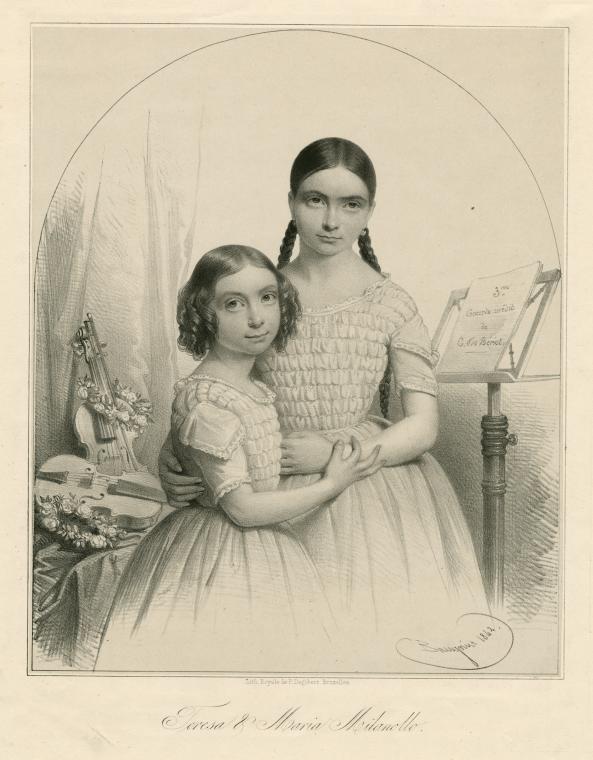
Teresa and Maria Milanollo, 1842

Exceptional as these notices were, Joseph’s Philharmonic debut was nearly overshadowed by the simultaneous appearance of two other child prodigies, Teresa and Maria Milanollo, whose arrival in Vienna had been a matter of breathless anticipation for weeks. The 15-year-old Teresa and her 10-year-old sister were adorable, gifted and irresistible, and they received copious, effusive notices in the press:

Truly, one can hear nothing more astonishing, nothing more surprising, nothing more enchanting than the violin playing of this thirteen-year-old child; [1] her talent is an insoluble puzzle, before which criticism stands powerless and perplexed — it is a marvel of nature, and not just for musicians but also for physiologists. In the hands of this magnificent girl, the violin is no longer an unsuitable instrument, for what is more graceful than this, so prettily formed arm, that controls the bow with the greatest noblesse and ease; this delicate child’s hand that masters the strings with giddy security! The talent of this child is equal to all genres; her execution is brilliant, gracious, sparkling, consummate, and above all full of deeply felt, touching expression — and at the same time full of purity and power, and inimitably tasteful, even in the most difficult passages, in double-stops and staccato. Her style is as grand as it is simple, and always her own. Her adagio is melting, her cantilena unsurpassable. Truly, one does not know what one should admire more, her immense talent, or her deep intelligence…. [ii]

Teresa had studied with various teachers in her native Savigliano, Italy, and in nearby Turin. When she and her sister were seven and three, they crossed the Alps on foot with their family, eventually arriving in Paris in 1837. There, Teresa took lessons from Lafont, Habaneck and de Beriot. Lessons were short-lived, however, as she was nearly constantly on the road, giving concerts in Holland and Belgium, England and Wales. At about this time, she began giving violin lessons to Maria, who was thereafter listed in programs as “Mlle. Maria Milanollo (Pupil of her Sister).” This much commented upon, maternal and nurturing, feature of their relationship added immensely to their popular and critical appeal. These “violin-playing angels” offered an appealing contrast in styles as well: Teresa’s playing was warm and emotional; Maria’s brilliant. To the public, they came to be known as Mademoiselle Adagio and Mademoiselle Staccato.[2]

Ex-Milanollo Francesco_Ruggeri

Francesco Ruggeri “Ex-Milanollo”

The concert instrument of Maria Milanollo [iii]

Like many young virtuosi, the Milanollo sisters lived hard lives, and encountered difficulties making the transition from prodigy to mature artist. They continued to travel widely on the virtuoso circuit, giving an immense number of concerts, but by 1845, they were beginning to encounter sharp, not to say sexist, criticism, especially in England:

As the efforts of young females, we are bound to own that the performances of the sisters Milanollo fully bear out their continental reputation. As a matter of art we would rather not number ourselves among the crowd of votaries who worship at their shrine. That the sisters are prodigies is undoubted — but prodigies are not invariably artists. Precocity is one thing, art another. The sisters Milanollo most betray the want of a steady and experienced master. They attempt things which are beyond their powers of execution, and thus, though they throw dust in the eyes of the multitude, they cannot deceive the connoisseur. The eldest, Teresa, who is eighteen, has certainly a great command of mechanism—but her mechanism is by no means faultless, and her style is not healthful. In the air of Bellini, on which Ernst has founded his Pirata fantasia, we remarked an excess of sentimentality which amounted to the maudlin. The continued miauling—to use an expressive word—absolutely put us beside ourselves. On the other hand, though a variation was omitted, and several of the difficulties (instance the pizzicato in the passage of tenths near the end) passed over, the variation in chords was admirably performed and proved that, with a careful instructor, Mdlle. Teresa Milanollo might become a first-rate executant. […] To sum up our opinion — the sisters Milanollo are clever, spiritual, and interesting girls — but unless they, for a while, abandon public playing — throw money-getting overboard — and take to serious and assiduous study — they are not likely ever to become great artists. [iv]

Teresa_and_Maria_Milanollo_by_Marie-Alexandre_Alophe

[v]

The Milanollo Sisters

The case of the Milanollo sisters demonstrates the dangers of the path that Joseph did not take: that of travelling Wunderkind. After a childhood of constant travel, Maria died of consumption at the age of 16, and was buried in Paris’s Père Lachaise cemetery. Grief-stricken Teresa withdrew from public life for some time, after which she devoted herself to giving concerts for the poor. Her Concerts des Pauvres were given in pairs: the first before a paying public, and the second before an indigent audience that, at the conclusion of the program, received gifts of money, food and clothing, bought with the proceeds of the paid event. Following her marriage in 1857, she retired from the concert stage. Joseph had been impressed with Teresa’s playing when she arrived in Vienna in 1843. It is not known how many of the sisters’ twenty-five concerts he attended. In later years, when she was the wife of French General Parmentier, he would never fail to visit her when he found himself in Paris. [vi]

 Teresa_and_Maria_Milanollo_by_Josef_Kriehuber

The Milanollo Sisters by Josef Kriehuber

During the summer of 1843, Joseph travelled to Leipzig, to audition for Mendelssohn. There, he also became acquainted with his prospective teachers: Gewandhaus concertmaster Ferdinand David, and the eminent theorist and cantor of St. Thomas’s Church, Moritz Hauptmann.

Returning to Vienna for a final visit, he gave a farewell recital. Saphir reported (20 July) in Der Humorist: “While visiting his family, the amiable violinist, Joseph Joachim, also highly esteemed in the [Imperial] Residence, has given a private academy in the salon of his uncle, the wholesaler Herr Vigdor. All that our city has to show for artists and patrons of art graced this private concert with their presence. The winsome little singer (that is Joachim on his instrument) was smothered in caresses. He who has not seen this Wunderkind with his own eyes as he performs the compositions of Classical masters would believe himself to be hearing a Nestor, or one of the modern, celebrated heroes of the violin. Joseph Joachim lacks only world renown — the aura of widespread reputation, in order to shine amongst the violin-stars of the present, both spiritually and technically. Whether his honorable family will see their wish fulfilled, to have the great public delight in their darling’s songs, is not yet determined.” [vii]

Screen Shot 2014-12-11 at 9.49.07 AM

On August 1, Joseph took a final leave of Vienna. With the Wittgensteins, he took the post-coach via Prague to Dresden, and the train from there to Leipzig. [viii] He did not get a chance to say farewell to the Böhms, who were staying in their summer residence at Schloss Plankenburg.

Joseph Joachim to Joseph Böhm [ix]

Vienna, [Monday] July 31, 1843

Revered Herr Professor,

You cannot imagine how sorry I am to miss the pleasure of seeing you before my departure, since I will not see you now for so long. The reason that I have not taken the liberty of visiting you in Plankenberg is that I only arrived here on Wednesday (delayed by illness), and I return tomorrow to Leipzig, which Mr. Wittgenstein only decided upon the day before yesterday; if I had known that we would leave my beloved Vienna so soon, I would have come to you in the first days of my presence here—so I am forced to take leave of you merely in writing. So with this I bid you my affectionate farewell, and further ask you to remember me; I will never forget the good things that you and your honored wife have done for me, and I will also strive to see that your efforts will not be in vain, to gratify you through my diligence. — Now farewell, dear Herr Professor, stay healthy, content and happy as you are now, and think sometimes, too, of your respectful and grateful pupil

Jos Joachim.

I kiss your dear, gracious wife’s hand. […]

Althen_Stationsrestaurant

Train on the Leipzig—Dresden Line, ca. 1837

[x]

© Robert W. Eshbach, 2013


Next Post in Series: Interlude: Leipzig 


[1] Following a well-worn custom, someone shaved several years off Teresa’s age.

[2] Teresa played a violin by Pietro Rogeri, later owned by David Oistrach. Maria played a 1703 Stradivarius. In 1846, the girls were bequeathed a pair of precious instruments by the great bass virtuoso Domenico Dragonetti. Maria received a violin built by Antonius and Hieronymus Amati ca. 1620, currently in the Smithsonian Institution; Teresa a 1728 Stradivarius that had once been the possession of Giovanni Battista Viotti, and had been played by Paganini. The Dragonetti-Milanollo Strad, an instrument of peerless beauty, has subsequently been owned by Christian Ferras and Pierre Amoyal. It is currently on loan to Corey Cerovsek.


[i] New York Public Library

[ii] Allgemeine Wiener Musik-Zeitung, No 35 & 36: 23, 25 March 1843, p. 147.

[iii] Tarisio Auctions

[iv] The Musical World, Vol, 20, No. 21 (May 22, 1845), p. 242.

[v] Musical Times, November 1, 1906, p. 737.

[vi] Moser/JOACHIM 1901, p. 24.

[vii] “Der liebenswürdige Violinspieler, Joseph Joachim, auch in der Residenz rühmlichst bekannt, hat, auf Besuch bei seiner Familie anwesend, im Salon seines Onkels, des Großhändlers Hr. Vigdor, eine Privatakademie veranstaltet. Was unsere Stadt an Notabeln Künstlern und Kunstmäcenaten besitzt, verherrlichte dieses Privatconcert. Der herzgewinnende kleine Sänger (das ist Joachim auf seinem Instrumente) wurde von Liebkosungen erdrükt. Wer dieses Wunderkind, während es die Kompositionen klassischer Meister vorträgt, nicht mit eigenen Augen sieht, glaubt in der That einen Nestor, oder einen der modernen, gefeierten Heroen der Violine zu hören. Joseph Joachim fehlt nur noch die ausgebreitete Weltbekanntschaft — der Nimbus des verbreiteten Rufes, um schon jetzt in geistiger wie in technischer Beziehung unter den Sternen der Violinisten der Gegenwart zu glänzen. Ob seine verehrliche Familie dem allgemeinen Wunsch: das große Publikum an den Gesängen ihres Lieblings delektiren zu lassen, nachkommen werde, ist bis jetzt unentschieden.” Der Humorist. Von M. G. Saphir, Vol. 7, No. 143 (Thursday, 20 July, 1843), p. 379.

[viii] Ehrlich/KÜNSTLERLEBEN, p. 154.

[ix] Biba/PEPPI, p. 201.

[x] Wikipedia http://en.wikipedia.org/wiki/File:Althen_Stationsrestaurant.jpg

Share this:

  • Share on X (Opens in new window) X
  • Share on Facebook (Opens in new window) Facebook
  • Email a link to a friend (Opens in new window) Email

Like this:

Like Loading...

Vienna Philharmonic Debut

18 Tuesday Jun 2013

Posted by Joachim in 1 Biographical Posts — RWE

≈ Leave a comment


Previous Post in Series: Summer Work in a Summer Playground 

__________

JJ Initials

Vienna Philharmonic Debut

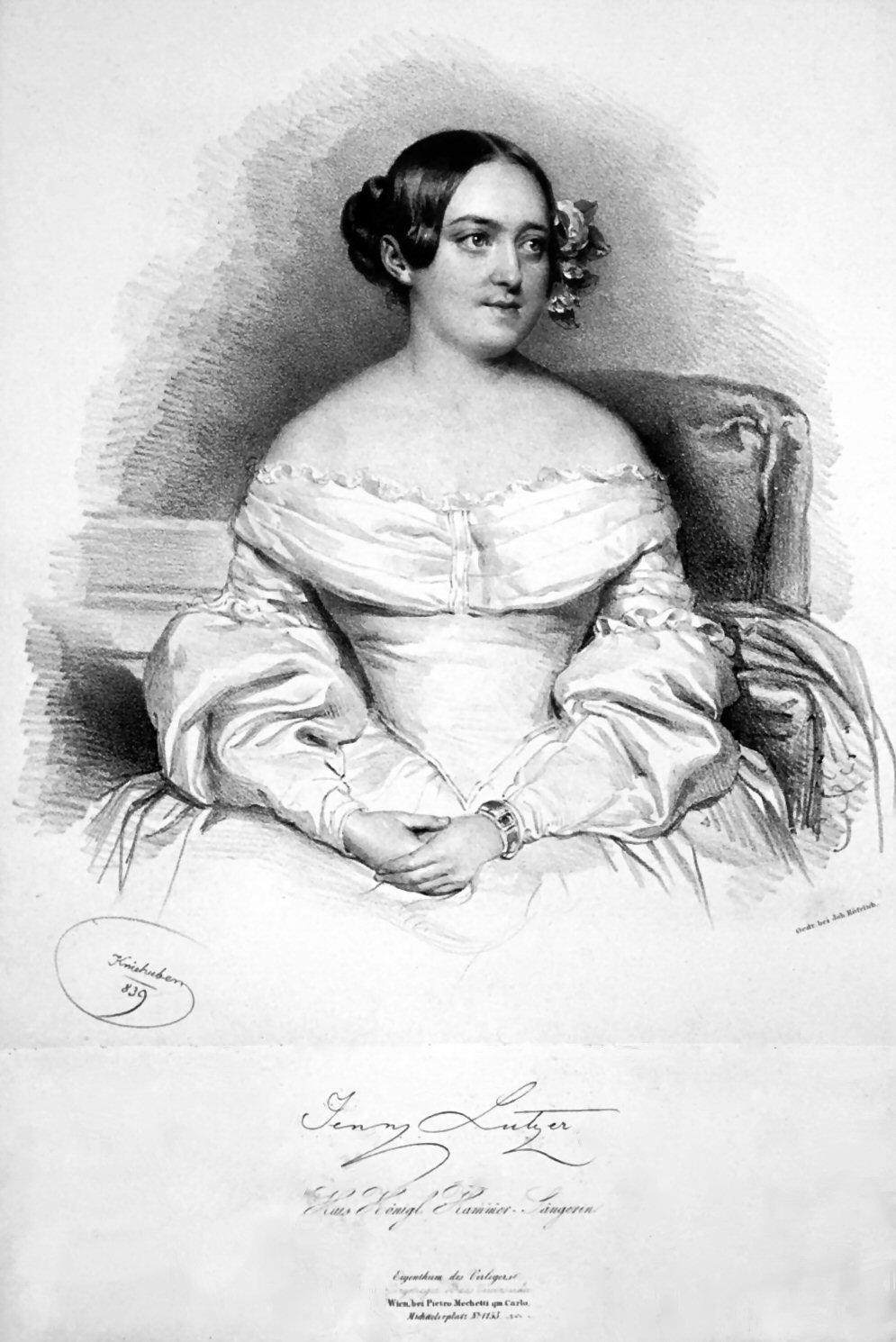
A notice appeared in the August 13 edition of the Allgemeine Wiener Musik-Zeitung that on the following day, the 14th, Herr Saphir would give a musikalisch-declamatorische entertainment for the benefit of Baden’s Infant-preservation Institute. The performers were to include Dlle. Lutzer and Herr Staudigl, and, once again, “the ingenious little violinist Joachim.” [i] Whether this concert actually took place on the date indicated is unclear. In any case, a review later appeared in the same journal of Saphir’s benefit for the same charity in the Baden Theater at noon on August 28th. The roster of performers had grown, but Joseph, being “indisposed,” was not among them. [ii] As we learn from the following letter to Böhm, the first that we have from Joachim himself, Joseph was afflicted with a rash. The letter, undoubtedly written with his Aunt looking over his shoulder, nevertheless shows a degree of independence and sophistication rare in an 11-year-old.

Joseph Joachim to Joseph Böhm [iii]

Baden [bei Wien] September 12, 1842

Highly honored Herr Professor,

It gives me the greatest pleasure to let you know that on Friday I will be back in your dear company. If we have good weather, my dear Aunt will probably accompany me; otherwise, someone from the Comptoir will take me to Plankenberg. [1] — I am now once again completely well, and there is no longer any trace of the rash. I am very much looking forward to your loving instruction, which I have had to do without for so long, and, though I have been diligent here, I am unfortunately doubtful whether you will be satisfied with me. — You will certainly already have news from dear Louis, [2] which I would very much like to know. I hope to find you and your honored wife healthy and cheerful, and remain, with respect and love,

your pupil,

Jos. Joachim

Pepi

Joseph Joachim: An Early Daguerreotype

On February 20, 1843, Joseph played at the annual “private entertainment” of Franz Glöggl (1796-1872), publisher, music shop owner, professor of trombone and bass at the conservatory, and archivist of the Gesellschaft der Musikfreunde. The long and diverse program featured an elite cadre of performers, including Mad. Hasselt-Barth, who sang Schubert’s Gretchen am Spinnrade and several of her husband’s songs, receiving praise for her brilliant coloratura, and criticism for the overheated expression of her performance. There were other singers and other songs as well, and a wide variety of instrumental pieces. Among the performers, Joseph was singled out for special notice. “This is a hearty, genuine talent,” claimed Der Humorist, “not an inflated, labored virtuosity that has been pummeled into him. Here is fullness of tone, so much proficiency in all fingerings, passages, positions; such elegance of interpetation, as if the boy had labored for twenty years with the fiddle, though he has lived barely more than half that time. […] Once again, a pupil comes from master Böhm’s hand, in whose talent the teacher has found a rich soil, from which beautiful art-blossoms spring; but if we take pleasure in the flower, we must acknowledge the gardener who has tended it so well.” [iv] Critic A. J. Becher of the Sonntags-Blätter concurred: “J. Joachim played Ernst’s exceedingly difficult Othello Fantasy with a security of mechanism, a finished conception of expression and a roundness of tone that one seldom hears in a pupil (and then, only in a pupil of a master like Prof. Böhm). One is indeed familiar with the mastery of this promising boy, astonishing for his age; nevertheless, one is each time surprised anew.” [v] The reviewer for Der Wanderer wrote: “I have never so regretted that the term Wunderkind is so used up, and moreover has a bad reputation, as now, for, in my haste, I can find no other suitable term for this little hero of the violin. I heard Joachim today for the first time, and I must confess that I often could not believe my eyes. This powerful stroke, this lively combination of colors [Colorit], this astonishing bravoura, and from a small boy, twenty Paris Zoll in height, that works these wonders — — what should one demand from finished virtuosi?”  [vi]

April 43 Cons. Program

[vii]

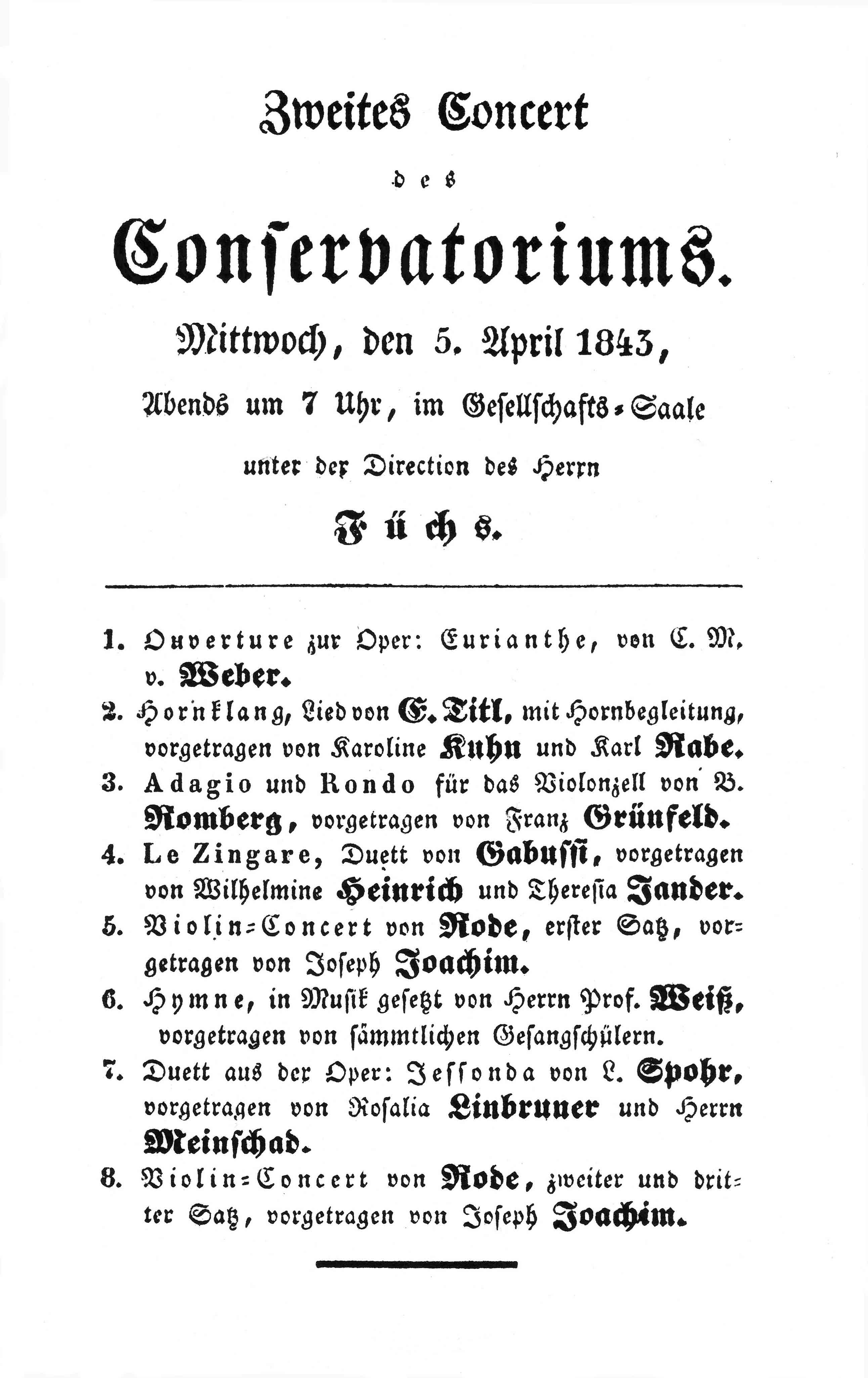
On Wednesday, April 5, 1843, Joseph played a Rode concerto (the program does not reveal which) in a Conservatory pupil’s concert, under the direction of Ferdinand Füchs, who had temporarily taken over leadership of the orchestra from Preyer. Joseph appeared 5th and 8th on the program: between the first and second movements of the concerto the choir sang a hymn, and two voice students sang a duet from Spohr’s Jessonda.

That year, Joseph’s cousin Fanny, who had been so influential in helping the Joachims to send their son to Vienna, would once again play a decisive role in directing his career. In 1839, Fanny had married Hermann Christian Wittgenstein, [3] a wool merchant some eleven years her elder, and a business acquaintance of her brother Gustav. Operating out of offices in Vienna and Leipzig — where nearly all the wool-export companies were headquartered — Hermann acquired wool from Poland and Hungary and sold it in England and Holland. After their wedding, Hermann and Fanny left Vienna and settled in Leipzig, where, as it happened, Felix Mendelssohn was just then working to create a Conservatory of Music — a German alternative to the Paris Conservatoire — that would reflect his own artistic credo. “From her new home,” writes Otto Gumprecht, Fanny “could not report enough of the lively artistic life that surrounded her on all sides. These alluring descriptions made the deepest impression on her cousin’s mind. He resolved to complete his studies at the newly-founded Leipzig Conservatory, and despite the objections of his Viennese relatives, who, jealous of the family pride, did not want to allow him to move so far away, he persisted in his decision.” [viii]

Here, as elsewhere, Joseph is depicted as having had a strong and even stubborn sense of his own best interest and future direction. Andreas Moser nevertheless credits Fanny Wittgenstein, who “exerted her whole influence to have the boy sent to Leipzig for further development in his art.” [ix] In any case, Julius Joachim was persuaded, and resolved to follow both Fanny’s advice and Joseph’s desire. In the view of Joachim’s friend and colleague Heinrich Ehrlich, this decision was a blessing that led ultimately to the “harmonious development of the man.” “Other than the happy Felix Mendelssohn, there has been no musician in modern times who has been governed by such an auspicious star [as Joachim]; to whom it was granted to develop his capabilities in such an untroubled, straight-forward manner. Above all, he was granted the good fortune not to be sent as a Wunderkind on “artist-tours,” but rather to be brought to the Conservatory that Mendelssohn had just founded. Our time has no idea of the consequence of this decision. In the forties […] the currently-prevailing attitude toward art had achieved an enduring currency and success only in north Germany; in the south, where virtuosity, Italian opera and Meyerbeer reigned, it was little regarded. In Vienna, in particular, Mendelssohn was regarded by the majority of professionals and critics as an egghead musician; Schumann interested the public only as the storied huband of Clara Wieck, whose father had for so long refused to give in [to their desire to marry]. His compositions, which Vienna now adores, were known by very few. I remember very well how he came to Vienna in the forties with his wife, and how she performed his wonderful concerto for a half-empty house, with little success. At the time that I am speaking of, the Viennese regarded only Paris as the city in which a young artist could achieve the highest training and reputation; that one could learn much from a Leipzig violin player ‘David,’ or become a great musician under the supervision of Mendelssohn and the ‘old’ Moscheles, seemed so doubtful that even Joachim’s Viennese teacher Böhm, an admirable, classicly trained virtuoso, found this move by his pupil strange.” [x]

In convincing Julius Joachim to send his son to Leipzig, Fanny prevailed over the united objections of her own father and uncle Nathan, who often vied with one another as Joseph’s principal caregiver. More importantly, she prevailed over the opposition of Joseph Böhm, who, according to Moser, showed not a little displeasure at the idea. Böhm had wanted Joseph to follow the virtuoso route to Paris. In his opinion, there was no one in Leipzig who could fill the role of a destination teacher; and despite the prestige of its founder, the Leipzig Conservatory was, as yet, a school in name only.

Otto Nicolai

[xi]

Otto Nicolai, 1842

Lithograph by Kriehuber, Vienna

Before departing for Leipzig, Joseph made an important début, in the fourth-ever subscription concert of the nascent Vienna Philharmonic Orchestra. [4] Playing on Sunday, April 30 before a capacity audience at the Imperial and Royal Redoutensaal, he performed the Adagio religioso and Finale marziale movements of Vieuxtemps’s fourth concerto in D minor. The otherwise lack-lustre program included Preyer’s Symphony in D minor, [5] Abbé Vogler’s Ouverture to Samori and an aria from Mercadante’s Ipermnestra. “It is astonishing what this little virtuoso achieves,” observed the Allgemeine Wiener Musik-Zeitung; “with what security and ease he conquers even the most difficult passages, and with what boldness he performs overall.” [xii] “The young violin virtuoso Joachim provoked a true sensation with an Adagio and Rondo from Vieuxtemps’s newest concerto” wrote Saphir. “Rarely has the voice of the public been so fully in accord with that of the critics as concerning the talent of this still virtually child-like boy; rarely have the most daring prospects become manifest as they have with him. Little Joachim has many very worthy fellow mignon-virtuosi here, both smaller and larger, but none possesses a power of interpretation so steeped in mind and spirit, with such irreproachable clarity and subtlety and nuance, with such boldness and resoluteness of bowing [6] — in short, with so much technical correctness; none advances toward such a bright future, as he. His well-grounded and solid playing was interrupted by the liveliest applause, and at the end he was recalled three times with stormy acclaim.”[xiii]

Joseph had had an opportunity to hear the concerto from Vieuxtemps himself that Spring, when the young Belgian master had played in the same hall. As with Ernst’s Othello Fantasy, Joseph was not detered from attempting the work, though the memory of the composer’s own performance was still fresh in his audience’s ears. The critic for Frankl’s Sonntags-Blätter made the inevitable comparison in his review:

In these pages, I have frequently had the opportunity to speak of the magnificent equipment, and — for his age — unusually advanced attainments of this twelve-year-old boy, for whom, with his diligence and his freshness, one can predict a distinguished future; it was also extremely pleasant this time to observe the persistent progress that he has made in technique and interpretation since last year. Our Joachim succeeded in such a surprising degree with the exceedingly difficult compositon — which we just recently heard performed with consummate mastery and artistry from the composer’s own irreproachable hands — that it made a generally satisfactory impression, not merely from the relative standpoint of a youthful virtuoso, but viewed in and of itself. Parts of it were, indeed, quite excellent. [xiv]

© Robert W. Eshbach, 2013.


Next Post in Series: Milanollos, and a Farewell to Vienna


[1] The Böhms lived from summer until early autumn in Sieghartskirchen, 17 miles west of Vienna, at Schloss Plankenburg, the former estate of Count Moritz von Fries. At the time that the Böhms stayed there, the Fries estate was a boarding school for the nobility.  [Biba/PEPPI, p. 200.] The manor house was eventually sold to the Liechtenstein family, who rented it in the 1880’s to the well-known landscape painter Emil Jakob Schindler. Schindler’s daughter, Alma, the wife of Mahler, Gropius and Werfel, and lover of Oskar Kokoschka, grew up there, fearing the ghost that was said to walk the grounds.

A patron of Beethoven and Schubert, and the dedicatee of Beethoven’s Seventh Symphony, Imperial Treasurer Count Moritz von Fries (1776-1826) was co-proprietor of the Viennese banking house Fries & Co. Fries was a man of great culture, well traveled and well-read, and a great lover of music. His extensive art collection included works by van Dyck, Dürer, Rembrandt and Rafael. The family fortune had been assured when Fries’s father received a privilege for the minting of the “Maria Theresa Thaler,” in 1752. The Maria Theresa Thaler has been legal tender in many countries worldwide since 1741. Fries was allowed to keep 1/3 of the Seignorage—the difference between the face value of the coins and their cost of production.

[2] Böhm’s nephew, Ludwig Böhm, Joseph’s fellow pupil and housemate.

[3] Hermann Christian Wittgenstein (b. September 12, 1802 in Korbach — d. May 19, 1878 in Vienna).

[4] The first concert of the Vienna Philharmonic —Vienna’s first professional concert orchestra — was given under Otto Nicolai’s direction on March 28, 1842, the same year as the founding of the New York Philharmonic. In the beginning, the Vienna Philharmonic had no regular season. It gave only 14 concerts between 1842 and 1848.

[5] Schumann’s 1839 consideration of a Preyer symphony, perhaps this one, is interesting as much for what he says about Viennese tastes as for what he says about Preyer’s work: “A few pages suffice to disclose a progressive young composer, initially somewhat ill at ease in the large, unfamiliar form, but gaining in security and courage as he gets under way. His aspirations must be doubly acknowledged in view of the fact that he lives in a city where little encouragement is vouchsafed the solid, serious or even profound average, where judgments for and against are largely determined by first impressions, and where the verdict is usually couched in terms of ‘it appealed’ or ‘it did not appeal.’ Thus it was after the première of Christus am Ölberge and Fidelio. They did not appeal, and that was the end of it. This symphony, which has been played frequently in Vienna, ‘appealed.’ It even ‘impressed,’ thanks to the veneer of scholarly working out which it often displays.” [Henry Pleasants (ed.), Schumann on Music: a Selection from the Writings, New York: Dover Publications, 1988, p. 149.]

[6] Ignaz Lewinsky also noted Joseph’s boldness of approach in his brief review for the Allgemeine Wiener Musik-Zeitung, Vol. 3, No. 53 (May 4, 1843), p. 222.


[i] Allgemeine Wiener Musik-Zeitung Vol. 2, No. 97 (August 13, 1842), p. 396.

http://books.google.com/books?id=hOMqAAAAYAAJ&printsec=frontcover&dq=editions:LCCN10024356#PRA1-PA396,M1

[ii] Allgemeine Wiener Musik-Zeitung Vol. 2, No. 105 (September 1, 1842), p. 427.

http://books.google.com/books?id=hOMqAAAAYAAJ&printsec=frontcover&dq=editions:LCCN10024356#PRA1-PA427,M1

[iii] Joachim/BRIEFE I, p. 1.

[iv] Der Humorist von M. G. Saphir, Vol. 7, No. 37 (February 22, 1843), p. 154.

http://anno.onb.ac.at/cgi-content/anno?apm=0&aid=hum&datum=18430222&seite=2&zoom=2

[v] Sonntagsblätter, Vol. 2, No. 9 (February 26, 1843), p. 205. M. T. http://anno.onb.ac.at/cgi-content/anno?apm=0&aid=stb&datum=18430226&seite=13&zoom=2

[vi] Der Wanderer in Gebiete der Kunst und Wissenschaft, Industrie und Gewerbe, Theater und Geselligkeit, Vol. 30, No. 45 (Wednesday, 22 February, 1843), p. 179.

[vii] Private collection.

[viii] Gumprecht/CHARAKTERBILDER, p. 263-4. Gumprecht knew Joachim, and doubtless learned this at first hand.

[ix] Moser /JOACHIM 1901 p. 34

[x] Ehrlich/KÜNSTLERLEBEN, pp. 154-155.

[xi] Wikimedia commons.

[xii] Allgemeine Wiener Musik-Zeitung Vol. 3, No. 53, p. 222.

[xiii] Der Humorist von M. G. Saphir, Vol. 7, No. 87 (May 3, 1843), p. 354.

http://anno.onb.ac.at/cgi-content/anno?apm=0&aid=hum&datum=18430503&zoom=2

[xiv] Sonntags-Blätter, Vol. 2, No. 19 (May 7, 1843), p. 452.

Share this:

  • Share on X (Opens in new window) X
  • Share on Facebook (Opens in new window) Facebook
  • Email a link to a friend (Opens in new window) Email

Like this:

Like Loading...

Image

Protected: Iconography

17 Monday Jun 2013

This content is password-protected. To view it, please enter the password below.

Posted by Joachim | Filed under Iconography, Pages

≈ Enter your password to view comments.

Bibliography

17 Monday Jun 2013

Posted by Joachim in Bibliography

≈ 2 Comments

© Robert W. Eshbach, 2025.

__________

SELECT BIBLIOGRAPHY

The bibliography lists as categories:

  • Articles and Chapters
  • Books
  • Dissertations
  • Editions 

Articles and Chapters

Altenburg/LISZT

Altenburg, Detlef. “Franz Liszt and the Legacy of the Classical Era.” 19th Century Music 18, no. 1 (Summer 1994): 46-63.

Altmann/JOACHIM

Altmann, Wilhelm. “Joseph Joachim.” Die Musik 6, no. 24 (1906/1907): 319-329.

Altmann/KRITIKER

Altmann, Wilhelm. “Joseph Joachim als Kritiker.” Die Musik 23, no. 9 (June 1931): 644-646.

Appel/DAVIDSBUND

Appel, Bernhard R. “Schumanns Davidsbund: Geistes- und sozialgeschichtliche Voraussetzungen einer romantischen Idee.” Archiv für Musikwissenschaft 38 (1981): 1-25.

Asatryan/NALBANDYAN

Asatryan, Anna Grigorievna. “Ein armenischer Schüler Joachims. Der Geiger Ioannis Nalbandian (1871–1942) — zu seinem 150. Geburtstag.” In Joseph Joachim: Identities/Identitäten, edited by Katharina Uhde and Michael Uhde, 149–148. Hildesheim; Zürich; New York: Georg Olms Verlag, 2024.

Avins/EMERSON

Avins, Styra. “Joseph Joachim, Hermann Grimm, and American Transcendentalism. Encounter with Ralph Waldo Emerson.” In Joseph Joachim: Identities/Identitäten, edited by Katharina Uhde and Michael Uhde, 373–386. Hildesheim; Zürich; New York: Georg Olms Verlag, 2024.

Babyak/CIPHER

Babyak, Tekla. “Between the Cipher and the Idée Fixe: Joachim, Berlioz, and the Lovestruck Psyche.” In Joseph Joachim: Identities/Identitäten, edited by Katharina Uhde and Michael Uhde, 77–93. Hildesheim; Zürich; New York: Georg Olms Verlag, 2024.

Banister/MACFARREN

Banister, H. C. “The Life and Work of Sir G. A. Macfarren.” Proceedings of the Musical Association 14th Sess. (1887-1888): 67-88.

Bär/KONZERTTÄTIGKEIT 

Bär, Ute. “Zur gemeinsamen Konzerttätigkeit Clara Schumanns und Joseph Joachims.” In Clara Schumann: Komponistin, Interpretin, Unternehmerin, Ikone, edited by Peter Ackerman and Herbert Schneider, 35-57. Hildesheim: Georg Olms Verlag, 1999.

Bekker/LISZT

Bekker, Paul. “Liszt and his Critics.” The Musical Quarterly 22, no. 3 (July 1936): 277-283.

Bellman/PERFORMANCE

Bellman, Jonathan. “Performing Brahms in the Style Hongrois.” In Performing Brahms: Early Evidence of Performance Style, edited by Michael Musgrave and Bernard Sherman, 327–348. Cambridge, UK, and New York: Cambridge University Press, 2003.

Biba/PEPPI

Biba, Otto. “Ihr Sie hochachtender, dankbarer Schüler Peppi: Joseph Joachims Jugend im Spiegel bislang unveröffentlicher Briefe.” Die Tonkunst 1, no. 3 (July 2007): 200-204.

Bonds/IDEALISM

Bonds, Mark Evan. “Idealism and the Aesthetics of Instrumental Music at the Turn of the Nineteenth Century.” Journal of the American Musicological Society 50, no. 2/3 (Summer-Autumn 1997): 387-420.

Borchard/AMALIE

Borchard, Beatrix. “Amalie Joachim und die gesungene Geschichte des Deutschen Liedes.” Archiv für Musikwissenschaft58 (2001): 265-299.

Borchard/BRIEFE

Borchard, Beatrix. “‘Bitte bedenken Sie, daß ich eigentlich seit meinem 9ten Jahr immer in der Fremde’: Briefe als Medium der Selbstvergiwisserung und der Selbstdarstellung.” In Joseph Joachim: Identities/Identitäten, edited by Katharina Uhde and Michael Uhde, 17-34. Hildesheim; Zürich; New York: Georg Olms Verlag, 2024.

Borchard/DIENST

Borchard, Beatrix. “‘Im Dienst der echten, wahren Kunst.’ Joseph Joachim und die Hochschule für Musik.” In “Die Kunst hat nie ein Mensch allein besessen”: 1696–1996, 300 Jahre Akademie der Künste, Hochschule der Künste, edited by Akademie der Künste, Berlin, 353–360. Berlin: Akademie der Künste, 1996.

Borchard/GEIGER

Borchard, Beatrix. “‘Als Geiger bin ich Deutscher, als Komponist Ungar.’ Joseph Joachim: Identitätsfindung über Abspaltung.” In Anklaenge 2008. Joseph Joachim (1831–1907): Europäischer Bürger, Komponist, Virtuose, edited by Michele Calella and Christian Glanz, 15–46. Vienna: Mille Tre, 2008.

Borchard/JOACHIM

Borchard, Beatrix. “Joachim, Joseph.” In Grove Music Online. Oxford Music Online. Oxford University Press, 2001.

Borchard/JOACHIM 2

Borchard, Beatrix. “Joseph Joachim.” In Die Musik in Geschichte und Gegenwart, 2nd ed., edited by Ludwig Finscher, 1060–1067. Personenteil, Vol. 9. Kassel: Bärenreiter, 2003.

Borchard/QUARTET

Borchard, Beatrix. “Joachim Quartet.” In New Grove Dictionary of Music and Musicians, 2nd ed., Vol. 13, edited by Stanley Sadie, 127–128. London: Macmillan, 2001.

Borchard/QUARTETTABEND

Borchard, Beatrix. “Quartettabend bei Bettine.” In Töne, Farben, Formen. Über Musik und die Bildenden Künste, edited by Elisabeth Schmierer, Susanne Fontaine, Werner Grünzweig, and Matthias Brzoska, 243-256. Regensburg: Bosse, 1995.

Borchard/VIRTUOSO

Borchard, Beatrix. “Ernst und Joachim: Virtuose Selbstdarstellung vs. sachbezogene Interpretationshaltung.” Presented at the conference Der lange Schatten Paganinis: Heinrich Wilhelm Ernst und das Phänomen Virtuosität im Spannungsfeld von Produktion – Reproduktion – Rezeption, Georg-August-Universität Göttingen, November 19–20, 2015. [Unpublished Paper].

Borchard/WUNDERKIND

Borchard, Beatrix. “Joseph Joachim: Vom Wunderkind zum Hohepriester der deutschen Musik – Ein kulturhistorischer Weg.” Neue Berlinische Musikzeitung (1995): 26-39.

Borchard/ZUKUNFTSRELIGION

Borchard, Beatrix. “Von Joseph Joachim zurück zu Moses Mendelssohn. Instrumentalmusik als Zukunftsreligion?” In Musikwelten—Lebenswelten. Jüdische Identitätssuche in der deutschen Musikkultur, edited by Beatrix Borchard and Heidy Zimmermann, 31-58. Vienna: Böhlau, 2009.

Borris/JOACHIM

Borris, Siegfried. “Joseph Joachim zum 65. Todestag.” Oesterreichische Musikzeitschrift 27 (June 1972): 352-355.

Botstein/AESTHETICS

Botstein, Leon. “The Aesthetics of Assimilation and Affirmation: Reconstructing the Career of Felix Mendelssohn.” In Mendelssohn and His World, edited by R. Larry Todd, 5-42. Princeton: Princeton University Press, 1991.

Bouws/REMENYI

Bouws, J. “Ein ungarischer Violinmeister in Sudafrika: Ein Beitrag zur Biographie von Ede Remenyi.” Studia Musicologica Academiae Scientiarum Hungaricae 10, no. 3/4 (1968): 353-360.

Brodbeck/EXCHANGE

Brodbeck, David. “The Brahms-Joachim Counterpoint Exchange: or, Robert, Clara, and ‘the Best Harmony between Jos. and Joh.'” In Brahms Studies 1, edited by David Brodbeck, 30-88. Lincoln, Nebraska, 1994.

Brody/BRIDGE

Brody, Judit. “The Széchenyi Chain Bridge at Budapest.” Technology and Culture 29, no. 1 (January 1988): 104-117.

Brown/BOWING

Brown, Clive. “Bowing Styles, Vibrato and Portamento in Nineteenth-Century Violin Playing.” Journal of the Royal Musical Association 113, no. 1 (1998): 97-128.

Brown/PERFORMANCE

Brown, Clive. “Joachim’s Violin Playing and the Performance of Brahms’s String Music.” In Performing Brahms: Early Evidence of Performance Style, edited by Michael Musgrave and Bernard Sherman, 48–98. Cambridge, UK, and New York: Cambridge University Press, 2003.

Bunzel/PRAGUE

Bunzel, Anja. “Joseph Joachim in Prague: ‘It was very original and entertaining there, and they had excellent food and drink’.” In Joseph Joachim: Identities/Identitäten, edited by Katharina Uhde and Michael Uhde, 353–372. Hildesheim; Zürich; New York: Georg Olms Verlag, 2024.

Burwick/TEAS

Burwick, Roswitha. “From Aesthetic Teas to the World of Noble Reformers: The Berlin Salonière (1780-1848).” Pacific Coast Philology 29, no. 2 (October 1994): 129-142.

Celenza/COMMUNITIES

Celenza, Anna Harwell. “Imagined Communities Made Real: The Impact of Robert Schumann’s Neue Zeitschrift für Musik on the Formation of Music Communities in the Mid-Nineteenth Century.” Journal of Musicological Research 24 (2005): 1-26.

Celenza/POET

Celenza, Anna Harwell. “The Poet, the Pianist and the Patron: Hans Christian Andersen and Franz Liszt in Carl Alexander’s Weimar.” 19th-Century Music 26, no. 2 (Autumn 2002): 130-154.

Commins/HEART

Commins, Adéle. “‘A Large, True Heart.’ The Sounding of Joseph Joachim’s Friendship with Charles Villiers Stanford.” In Joseph Joachim: Identities/Identitäten, edited by Katharina Uhde and Michael Uhde, 187–204. Hildesheim; Zürich; New York: Georg Olms Verlag, 2024.

Davies/CADENZA

Davies, Joe. “Clara Schumann, Joseph Joachim and the Nineteenth-Century Cadenza.” In Joseph Joachim: Identities/Identitäten, edited by Katharina Uhde and Michael Uhde, 239–262. Hildesheim; Zürich; New York: Georg Olms Verlag, 2024.

DeConcini/CRISIS

DeConcini, Barbara. “The Crisis of Meaning in Religion and Art.” The Christian Century, March 20-27, 1991, 223-326. Accessed May 28, 2006. http://www.religion-online.org/showarticle.asp?title=174.

Deme/MAGYAR

Deme, Laszlo. “Writers and Essayists and the Rise of Magyar Nationalism in the 1820’s and 1830’s.” Slavic Review 43, no. 4 (Winter 1984): 624-640.

Downes/SENTIMENTALISM

Downes, Stephen. “Sentimentalism, Joseph Joachim, and the English.” 19th Century Music 42, no. 2 (2018): 123-154. Electronic ISSN: 1533-8606.

Eshbach/BETTINA

Eshbach, Robert W. “‘For All are Born to the Ideal’: Joseph Joachim and Bettina von Arnim.” Music and Letters 101, no. 4 (November 2020): 713-742.

Eshbach/CHACONNE

Eshbach, Robert Whitehouse. “Joseph Joachim and Bach’s Chaconne.” Nineteenth Century Music Review. Published online December 11, 2024. 

Eshbach/GEIGERKÖNIG

Eshbach, Robert W. “Der Geigerkönig: Joseph Joachim as Performer.” Die Tonkunst 1, no. 3 (July 2007): 205-217.

Eshbach/HUNGARIAN

Eshbach, Robert. “Preface to Joseph Joachim.” In Concert (in ungarischer Weise) für die Violine mit Orchesterbegleitung, Op. 11, i–ii. Munich: Musikproduktion MPH Hoeflich, 2016.

Eshbach/JUGEND

Eshbach, Robert W. “Joachims Jugend.” Die Tonkunst 5, no. 2 (April 2011): 176-191.

Eshbach/MEININGEN

Eshbach, Robert W. “Brahms in ‘das Land ohne Musik’: The Visit of the Meiningen Orchestra to England in 1902.” In Spätphase(n)? Johannes Brahms’ Werke der 1890er Jahre. Internationales musikwissenschaftliches Symposium Meiningen 2008. Eine Veröffentlichung des Brahms-Instituts an der Musikhochschule Lübeck und der Meininger Museen, edited by Maren Goltz, Wolfgang Sandberger, and Christiane Wiesenfeldt, 233–246. Munich: G. Henle Verlag, 2010.

Eshbach/MENTOR

Eshbach, Robert W. “Schumann as Mentor: Joseph Joachim’s ‘Blick auf Schumann.’” Die Tonkunst 4, no. 3 (July 2010): 352-366.

Eshbach/QUARTET

Eshbach, Robert W. “The Joachim Quartet Concerts at the Sing-Akademie zu Berlin: Mendelssohnian Geselligkeit in Wilhelmine Germany.” In Brahms in the Home and the Concert Hall, edited by Katy Hamilton and Natasha Loges, 201-220. Cambridge: Cambridge University Press, 2014.

Eshbach/UHDE

Eshbach, Robert W. Review of The Music of Joseph Joachim, by Katharina Uhde. Notes 77, no. 2 (December 2020): 268-71.

Eshbach/VEREHRTER

Eshbach, Robert W. “Verehrter Freund! Liebes Kind! Liebster Jo! Mein einzig Licht. Intimate letters in Brahms’s Freundeskreis.” Die Tonkunst 2, no. 3 (April 2008): 178-193.

Eshbach/WEIMAR

Eshbach, Robert Whitehouse. “Joachim in Weimar 1850-1852.” In Joseph Joachim: Identities/Identitäten, edited by Katharina Uhde and Michael Uhde, 387-407. Hildesheim; Zürich; New York: Georg Olms Verlag, 2024.

Eshbach/YOUTH

Eshbach, Robert W. ” Joachim’s Youth — Joachim’s Jewishness.” The Musical Quarterly 94, no. 4 (Winter 2011): 548-592.

F. G. E./JOACHIM

F. G. E. [F. G. Edwards]. “Joseph Joachim.” The Musical Times 48, no. 775 (September 1, 1907): 577-583.

Fabian/RECORDINGS

Fabian, Dorottya. “The Recordings of Joachim, Ysaÿe and Sarasate in Light of Their Reception by Nineteenth-Century British Critics.” International Review of the Aesthetics and Sociology of Music 37, no. 2 (2006): 189–211

Flindell/WITTGENSTEIN

Flindell, E. Fred. “Ursprung und Geschichte der Sammlung Wittgenstein im 19. Jahrhundert.” Die Musikforschung 22 (1969): 298-314.

Gebauer/NALBANDYAN

Gebauer, Johannes. “Ioannis Nalbandyans Bericht über seinen Aufenthalt in Berlin 1894. Eine bisher unbekannte Quelle zu Joseph Joachims Violin-, Interpretations- und Unterrichtspraxis.” In Joseph Joachim: Identities/Identitäten, edited by Katharina Uhde and Michael Uhde, 157–186. Hildesheim; Zürich; New York: Georg Olms Verlag, 2024.

Gellen/REMÉNYI

Gellen, Adam. “Eduard Reményis Jugendjahre Und Seine Beziehungen Zu Johannes Brahms – eine Biographische Skizze.” Studia Musicologica 49, no. 3/4 (2008): 295-319.

Goertzen/SWITZERLAND

Goertzen, Valerie Woodring. “To Switzerland ‘in Good Spirits’.” In Joseph Joachim: Identities/Identitäten, edited by Katharina Uhde and Michael Uhde, 325–352. Hildesheim; Zürich; New York: Georg Olms Verlag, 2024.

Grimm/BETTINA

Grimm, Herman. “Bettina’s Goethe-Statue in Weimar.” Deutsche Rundschau 60 (1889): 469 ff.

Gumprecht/JOACHIM

Gumprecht, Otto. “Joseph Joachim, der König der Geiger.” Unsere Zeit. Deutsche Revue der Gegenwart Neue Folge 8, no. 2 (1872): 312-323.

Herrmann/LAURENS

Herrmann, J. Marcelle. “J. B. Laurens’ Beziehungen zu deutschen Musikern.” Schweitzerische Musikzeitung 105 (1965): 257-266.

Hertz/SALONIERES

Hertz, Deborah. “Salonières and Literary Women in Late Eighteenth-Century Berlin.” New German Critique 14 (Spring 1978): 97-108.

Herzfeld/ALLTAG

Herzfeld, Friedrich. “Sing-Akademischer Alltag.” In Sing-Akademie zu Berlin: Festschrift zum 175 jährigen Bestehen, edited by Werner Bollert, 11-20. Berlin: Rembrandt Verlag, 1966.

Hinrichsen/JEWISH

Hinrichsen, Hans-Joachim. “Musikalische Interpretation und antisemitisches Rezeptionsparadox: Joseph Joachim – Richard Wagner – Hans von Bülow.” In Musikwelten – Lebenswelten: Jüdische Identitätssuche in der deutschen Musikkultur, edited by Beatrix Borchard and Heidy Zimmermann, 181–191. Vienna: Böhlau, 2009.

Hohenemser/JOACHIM

Hohenemser, Richard. “Joseph Joachim * 28. Juni 1831 zu Kittsee, + 15. August 1907 in Berlin.” Die Musik 23, no. 9 (June 1931): 641-644.

Holde/SUPPRESSED

Holde, Artur. “Suppressed Passages in the Brahms-Joachim Correspondence Published for the First Time.” The Musical Quarterly 45, no. 3 (July 1959): 312-324.

Holland/LIND I

Holland, Henry Scott, and William Smyth Rockstro. Jenny Lind, — The Artist. Vol. I of Memoir of Madame Jenny Lind-Goldschmidt. New York: Charles Scribner’s Sons, 1891.

Holland/LIND II

Holland, H[enry] S[cott], and W[illiam] S[myth] Rockstro. Jenny Lind. Ihre Laufbahn als Künstlerin. Vol. I. Leipzig: Brockhaus, 1891.

Hoppe/TRADITION

Hoppe, Christine. “Zwischen Tradition, Ehrerbietung und Abgrenzung: Joseph Joachim als Virtuose, Interpret und Komponist im Spiegel früher Widmungskompositionen.” In Joseph Joachim: Identities/Identitäten, edited by Katharina Uhde and Michael Uhde, 35–55. Hildesheim; Zürich; New York: Georg Olms Verlag, 2024.

Horne/BRAHMS

Horne, William. “Brahms’s Op. 10 Ballades and his Blätter aus dem Tagebuch eines Musikers.” The Journal of Musicology 15, no. 1 (Winter 1997): 98-115.

Hornyák/BRUNSZVIK

Hornyák, Mária. “Ferenc Brunszvik, ein Freund von Beethoven.” Studia Musicologica Academiae Scientiarum Hungaricae 32, no. 1/4 (1990): 225-233.

Jensen/BURIED

Jensen, Eric Frederick. “Schumann at Endenich: Buried Alive.” The Musical Times 139, no. 1861 (March 1998): 10-18; 139, no. 1862 (April 1998): 14-23.

Joachim/AESTHETICS

Joachim, Henry. “Violin Aesthetics of To-Day: The Evil of Pedagogics.” The Musical Times 74, no. 1090 (December 1933): 1079-1081.

Joachim/FESTREDE

Joachim, Joseph. “Festrede Prof. Dr. Joachims zur Enthüllung des Brahms-Denkmals in Meiningen.” Allgemeine Musikzeitung 42 (October 20, 1899): 622-623.

Joachim/JOACHIM

Joachim, Henry. “Joseph Joachim: First Violinist of a Modern Art.” The Musical Times 74, no. 1087 (September 1933): 797-799.

Jütte/SINGER

Jütte, Daniel, and Anat Feinberg. “‘Un des meilleurs violons d’Allemagne:’ Der Violinvirtuose Edmund Singer — ein Beitrag zur deutsch-jüdischen Musikgeschichte des 19. Jahrhunderts.” In Jüdische Welten: Juden in Deutschland vom 18. Jahrhundert bis in die Gegenwart, edited by Marion Kaplan and Beate Meyer, 177-206. Göttingen: Wallstein Verlag, 2005.

Jütte/VIRTUOSEN

Jütte, Daniel. “Juden Als Virtuosen: Eine Studie zur Sozialgeschichte der Musik Sowie zur Wirkmächtigkeit einer Denkfigur des 19. Jahrhunderts.” Archiv Für Musikwissenschaft 66, no. 2 (2009): 127-154.

Kalisch/JOACHIM

Kalisch, Alfred. “Joseph Joachim, 1831-1931.” The Musical Times 72, no. 1061 (July 1, 1931): 599-600.

Kalcher/INVENTAR

Kalcher, Antje, ed. Inventar. Teilnachlass Joseph Joachim. Schriften aus dem Archiv der Universität der Künste Berlin. Berlin: Universität der Künste, 2004.

Kamlah/GEIGEN

Kamlah, Ruprecht. “Joseph Joachims Guarneri-Geigen: Eine Untersuchung im Hinblick auf die Familie Wittgenstein.” Wiener Geschichtsblätter 68, no. 1 (2013): 33-58.

Keiler/LISZT

Keiler, Alan. “Liszt and the Weimar Hoftheater.” Studia Musicologica Academiae Scientiarum Hungaricae 28, no. 1/4 (1986): 431-450.

Kelling/BETTINA

Kelling, Hans-Wilhelm. “Bettina von Arnim: A Study in Goethe Idolatry.” The Bulletin of the Rocky Mountain Modern Language Association 23, no. 2 (June 1969): 73-82.

Kiraly/NEO-SERFDOM

Kiraly, Bela K. “Neo-Serfdom in Hungary.” Slavic Review 34, no. 2 (June 1975): 269-278.

Kraft/SCHAFFEN

Kraft, G. “Das Schaffen von Liszt in Weimar.” Studia Musicologica Academiae Scientiarum Hungaricae 5, no. 1/4 (1961): 193-210.

Kreyszig/CIACCONA

Kreyszig, Walter Kurt. “‘…of this miraculous music by its best interpreter.’ Johann Sebastian Bach’s Ciaccona. Joseph Joachim and His Contribution to the 1908 Edition of Bach’s Sei solo a Violin senza Baßo accompagnato, BWV 1001–1006.” In Joseph Joachim: Identities/Identitäten, edited by Katharina Uhde and Michael Uhde, 205–238. Hildesheim; Zürich; New York: Georg Olms Verlag, 2024.

Kühn/DIRICHLET

Kühn, Helga-Maria. “‘In diesem ruhigen Kleinleben geht so schrecklich viel vor:’ Rebecka Lejeune Dirichlet, geb. Mendelssohn Bartholdy in Göttingen 1855-1858.” Mendelssohn Studien 11. Berlin: Duncker & Humblot, 1999.

Kühn/DENKMAL

Kühn, Jörg. “Joseph-Joachim-Denkmal von Adolf von Hildebrand.” In “Die Kunst hat nie ein Mensch allein besessen”: 1696-1996, 300 Jahre Akademie der Künste, Hochschule der Künste, edited by Akademie der Künste, Berlin. Berlin, 1996.

Larson/ORIGINS

Larson, Kenneth E. “The Origins of the ‘Schlegel-Tieck’ Shakespeare in the 1820s.” The German Quarterly 60, no. 1 (Winter 1987): 19-37.

Lea/TOLERANCE

Lea, Charlene A. “Tolerance Unlimited: ‘The Noble Jew’ on the German and Austrian Stage (1750-1805).” The German Quarterly 64, no. 2 (Spring 1991): 166-177.

Leistra-Jones/AUTHENTICITY

Leistra-Jones, Karen. “Staging Authenticity: Joachim, Brahms, and the Politics of Werktreue Performance.” Journal of the American Musicological Society 66, no. 2 (Summer 2013): 397-436.

Leistra-Jones/IDYLL

Leistra-Jones, Karen. “Improvisational Idyll: Joachim’s ‘Presence’ and Brahms’s Violin Concerto, op. 77.” 19th Century Music 38, no. 3 (Spring 2015): 243-271.

Levy/ALSAGER

Levy, David B. “Thomas Massa Alsager, Esq.: A Beethoven Advocate in London.” 19th-Century Music 9, no. 2 (Autumn 1985): 119-127.

Loges/NERUDA

Loges, Natasha. “Joseph Joachim and Wilma Neruda: Constructing Musical Identity in Victorian London.” In Joseph Joachim: Identities/Identitäten, edited by Katharina Uhde and Michael Uhde, 263–278. Hildesheim; Zürich; New York: Georg Olms Verlag, 2024.

Luedtke/LETTERS

Luedtke, Luther S., and Winfried Schleiner. “New Letters from the Grimm-Emerson Correspondence.” Harvard Library Bulletin 25, no. 4 (October 1977): 399-465.

Lupovitch/WALLS

Lupovitch, Howard. “Beyond the Walls: The Beginnings of Pest Jewry.” Austrian History Yearbook 36 (2005): 41-66.

Mahaim/CYCLES

Mahaim, Ivan, and Evi Levin. “The First Complete Beethoven Quartet Cycles, 1845-1851: Historical Notes on the London Quartett Society.” The Musical Quarterly 80, no. 3 (Autumn 1996): 500-524.

MT/JOACHIM

  1. “Joseph Joachim.” The Musical Times and Singing Class Circular 39, no. 662 (April 1, 1898): 225-230.

Musgrave/FAF

Musgrave, Michael. “Frei aber Froh: A Reconsideration.” 19th Century Music 3, no. 3 (March 1980): 251-258.

Nettl/JEWISH

Nettl, Paul. “Jewish Connections of Some Classical Composers.” Music and Letters 45, no. 4 (October 1964): 337-344.

Niecks/EXCURSIONS

Niecks, Friedrich. “Critical Excursions. Schumann.” The Musical Times and Singing Class Circular 22, no. 464 (October 1, 1881): 498-501.

NMZ/ANEKDOTEN

“Anekdoten über Josef Joachim.” Neue Musik-Zeitung, Stuttgart-Leipzig, Verlag Carl Grüninger 12, no. 15 (1891): 178.

Pfohl/FREUNDSCHAFT

Pfohl, Ferdinand. “Joseph Joachim und Richard Wagner: Zur Geschichte einer Freundschaft.” Die Musik 20, no. 9 (June 1928): 645-652.

Porter/DILETTANTI

Porter, Cecelia Hopkins. “The Reign of the ‘Dilettanti’: Düsseldorf from Mendelssohn to Schumann.” The Musical Quarterly 73, no. 4 (1989): 476-512.

Porter/MUSIKFEST

Porter, Cecelia Hopkins. “The New Public and the Reordering of the Musical Establishment: The Lower Rhine Music Festivals, 1818-67.” 19th Century Music 3, no. 3 (March 1980): 211-224.

Ravell/ELLA

Ravell, John. “John Ella 1802-1888.” Music & Letters 34, no. 2 (April 1953): 93-105.

Rehberg/BRAHMS

Rehberg, Willi. “Brahms-Erinnerungen.” Der Weihergarten: Beilage zu Melos (July/October 1933): 26.

Reynolds/ELGAR

Reynolds, Arthur S. “Elgar and Joachim.” The Elgar Society Journal 15, no. 2 (July 2007): 27-52.

Riggs/CORRESPONDENCE

Riggs, Robert. “‘Lieber, guter Bruder!’ ‘My dear Elly!’ Joseph Joachim in Correspondence with Heinrich and Ellen Joachim.” In Joseph Joachim: Identities/Identitäten, edited by Katharina Uhde and Michael Uhde, 279–294. Hildesheim; Zürich; New York: Georg Olms Verlag, 2024.

Rodenberg/JOACHIM

Rodenberg, Julius. “Zur Erinnerung an Joseph Joachim.” Deutsche Rundschau 125 (May 1908): 223-231.

Rost/STAMMBUCHPRAXIS

Rost, Henrike. “Einblicke in Joseph Joachims Stammbuchpraxis: Künstlerisches Selbstverständnis und individuelle Kommunikation.” In Joseph Joachim: Identities/Identitäten, edited by Katharina Uhde and Michael Uhde, 57–76. Hildesheim; Zürich; New York: Georg Olms Verlag, 2024.

Rozenblit/REFORM

Rozenblit, Marsha L. “The Struggle over Religious Reform in Nineteenth-Century Vienna.” AJS Review 14, no. 2 (Autumn 1989): 179-221.

Russell/JOACHIM

Russell, Anne. “Joachim.” The Etude (December 1932): 884-885.

Saloman/BEETHOVEN

Saloman, Ora Frishberg. “Origins, Performances, and Reception History of Beethoven’s Late Quartets.” The Musical Quarterly 80, no. 3 (Autumn 1996): 525-540.

Schäfer/GÖTTINGEN

Schäfer, Michael. “Joseph Joachim und Johannes Brahms in Göttingen.” Göttinger Jahrbuch 51 (2003): 155-160.

Schenk/GRÜNDERZEIT

Schenk, Dietmar. “Aus einer Gründerzeit: Joseph Joachim, die Berliner Hochschule für Musik und der deutsch-französische Krieg.” Die Tonkunst 1, no. 3 (July 2007): 231-245.

Schütz/TAUFE

Schütz, Siegfried. “Joseph Joachims Taufe in der Aegidienkirche zu Hannover am 3. Mai 1855.” In Stupor saxoniae inferioris: Ernst Schubert zum 60. Geburtstag, edited by Wiard Hinrichs, Siegfried Schütz, and Jürgen Wilke, 245-255. Göttingen: Edition Ruprecht, 2001.

Seidel/RES SEVERA

Seidel, Wilhelm. “„Res severa verum gaudium”: Über den Wahlspruch des Gewandhauses in Leipzig.” Die Musikforschung 50, no. 1 (January–March 1997): 1-9.

Sommer/ERINNERUNGEN

Sommer, Hans. “Erinnerungen an Joseph Joachim und seine Beziehungen zu Braunschweig.” Braunschweigerisches Magazin (1913): 20-22.

Sorkin/HUMBOLDT,

Sorkin, David. “Wilhelm Von Humboldt: The Theory and Practice of Self-Formation (Bildung), 1791-1810.” Journal of the History of Ideas 44, no. 1 (January-March 1983): 55-73.

Stanford/FOLK

Stanford, Charles Villiers. “Some Thoughts Concerning Folk-Song and Nationality.” The Musical Quarterly 1, no. 2 (April 1915): 232-245.

Steblin/DEATH

Steblin, Rita. “Death as a Fiddler: The Study of a Convention in European Art, Literature and Music.” Basler Jahrbuch für Historische Musikpraxis 14 (1990): 271-322.

Tillard/MENDELSSOHN

Tillard, Françoise. “Felix Mendelssohn and Fanny Hensel: The Search for Perfection in Opposing Private and Public Worlds.” In The Mendelssohns: Their Music in History, edited by John Michael Cooper and Julie D. Prandi, 279-288. Oxford: Oxford University Press, 2002.

Tóth/SOCIETIES

Tóth, Árpád. “Voluntary Societies as Social Networks in Mid-19th Century Hungarian Towns.” Accessed December 28, 2006. 

Tovey/JOACHIM

Tovey, Donald Francis. “Joseph Joachim: Maker of Music.” The Monthly Review (May 1902): 7–20.

Tozer/UPPINGHAM

Tozer, Malcolm. “‘Die Musik, lieber Freund, die Du mit Deinen Jungen machtest, wird mir noch lange im Innern fortleben.’ Joseph Joachim’s Friendship with Paul David and Uppingham School.” In Joseph Joachim: Identities/Identitäten, edited by Katharina Uhde and Michael Uhde, 295–324. Hildesheim; Zürich; New York: Georg Olms Verlag, 2024.

Uhde/FANTASIES

Uhde, Katharina. “Rediscovering Joseph Joachim’s ‘Hungarian’ and ‘Irish’ [Scottish] Fantasies.” The Musical Times 158 (December 2017): 2-25.

Uhde/PINELLI

Michael Uhde, “Ettore Pinelli. Ein Geiger aus Rom und sein Maestro Joseph Joachim” In Joseph Joachim: Identities/Identitäten, edited by Katharina Uhde and Michael Uhde, 115–148. Hildesheim; Zürich; New York: Georg Olms Verlag, 2024.

Uhde—Todd/DREI STÜCKE

Uhde, Katharina, and R. Larry Todd. “‘Clogged, Tormented and Over-Wrought’? Reconsidering Joseph Joachim’s Drei Stücke Op. 2 and the École de Weymar.” In Joseph Joachim: Identities/Identitäten, edited by Katharina Uhde and Michael Uhde, 95–111. Hildesheim; Zürich; New York: Georg Olms Verlag, 2024.

Vande Moortele/HAMLET

Vande Moortele, Steven. “Form, Program, and Deformation in Liszt’s Hamlet.” Dutch Journal of Music Theory 11, no. 2 (May 2006): 71-82.

Vörös/BUDAPEST

Vörös, Kati. “How Jewish is Jewish Budapest?” Jewish Social Studies 8, no. 1 (Fall 2001, New Series): 88-125.

Weiss-Aigner/KOMPONIST

Weiss-Aigner, Günter. “Komponist und Geiger: Joseph Joachims Mitarbeit am Violinkonzert von Johannes Brahms.” Neue Zeitschrift für Musik 135 (1974): 232-236.

Wolff/SPITTA

Wolff, Christoph. “From Berlin to Łódź: The Spitta Collection Resurfaces.” Notes, Second Series, 46, no. 2 (December 1989): 311-327.

Wollny/LEVY

Wollny, Peter. “Sara Levy and the Making of Musical Taste in Berlin.” The Musical Quarterly 77, no. 4 (Winter 1993): 651-688.

Wurzbach/JOACHIM

Wurzbach, Constant von. “Joseph Joachim.” In Biographisches Lexikon des Kaiserthums Oesterreich (Jablonowski-Karolina). Vol. 10, 217–221. Vienna: Zamarski, 1863.

Zalmon/WEG

Zalmon, Milka. “Der Weg der vertriebenen Juden.” Accessed December 11, 2006. 

Zedlitz/CHAT

Zedlitz, Baroness von. “A Chat with Dr. Joachim.” The Woman at Home (1894): 227–334.


Books

Ackermann/SCHUMANN

Ackermann, Peter, and Herbert Schneider, eds. Clara Schumann: Komponistin, Interpretin, Unternehmerin, Ikone. Hildesheim: Georg Olms Verlag, 1999.

Allin/ZARAFA

Allin, Michael. Zarafa: A Giraffe’s True Story, from Deep in Africa to the Heart of Paris. New York: Walker and Company, 1998.

Altenburg/LISZT

Altenburg, Detlef, ed. Liszt und die Weimarer Klassik. Laaber: Laaber-Verlag, 1997.

Altenburg/NEUDEUTSCHE

Altenburg, Detlef, ed. Liszt und die Neudeutsche Schule. Laaber: Laaber-Verlag, 2006.

Ambros/CULTUR

Ambros, August Wilhelm. Culturhistorische Bilder aus dem Musikleben der Gegenwart. Leipzig: Heinrich Matthes Verlag, 1865.

Andersen/TALES

Andersen, Hans Christian. Stories and Tales. Translated by H. W. Dulcken. London: Routledge, 2002.

Andersen/THEURER

Andersen, Hans Christian, and Grand Duke Carl Alexander von Sachsen-Weimar–Eisenach. Edited by Ivy York Möller-Christensen and Ernst Möller-Christensen. Mein edler, theurer Großherzog! Briefwechsel zwischen Hans Christian Andersen und Großherzog Carl Alexander von Sachsen-Weimar-Eisenach. Göttingen: Wallstein, 1998.

Anonymous/SCENEN

Anonymous. Scenen aus Pest. Schilderung der verheerenden Ueberschwemmung am 13., 14., 15., und 16. März 1838 … von einem Augenzeugen. Wien: J. S. Heubner, 1838.

Ansted/HUNGARY

Ansted, D. T. A Short Trip in Hungary and Transylvania in the Spring of 1862. London: Wm. H. Allen & Co., 1862.

Appel/SCHUMANN

Appel, Bernhard R., ed, Robert Schumann in Endenich (1854-1856): Krankenakten, Briefzeugnisse und zeitgenössische Berichte/hg. von der Akademie der Künste, Berlin, und der Robert-Schumann-Forschungsstelle, Düsseldorf, durch Bernhard R. Appel. Mainz: Schott, 2006.

Applegate/BACH

Applegate, Celia. Bach in Berlin: Nation and Culture in Mendelssohn’s Revival of the St. Matthew Passion. Ithaca and London: Cornell University Press, 2005.

Applegate/IDENTITY

Applegate, Celia, and Pamela Potter, eds. Music and German National Identity.Chicago and London: The University of Chicago Press, 2002.

Arnim/MÄRCHENBRIEFE

Arnim, Gisela von. Märchenbriefe an Achim. Edited by Shawn C. Jarvis. Frankfurt am Main: Insel Verlag, 1991.

Arnim/SCHOTTLAND

Arnim, Gisela von. Alt Schottland: Drama in fünf Akten mit einem Vorspiel.Privately printed, n.d.

ArnimB/WERKE

Müller, Joachim, ed. Bettina von Arnim: Werke und Briefe. 5 vols. Frechen/Köln: Bartmann-Verlag, 1961.

Asper/PANORAMA

Spiritus asper and Spiritus lenis (pseud. Friedrich Korn). Panorama von Ofen und Pesth, oder Charakter- und Sittengemälde der beiden Hauptstädte Ungarns. Aufgenommen und nach eigener Anschauung von Spiritus asper und Spiritus lenis. Leipzig: Hartmann, 1833.

Assing/TAGEBÜCHER

Assing, Ludmilla, ed. Tagebücher von K. A. Varnhagen von Ense. 14 vols. Bern, Switzerland, 1972.

Auer/VIOLIN

Auer, Leopold. Violin Playing as I Teach It. New York: Dover Publications, 1980.

Bach/JEW

Bach, H. I. The German Jew: A Synthesis of Judaism and Western Civilization, 1730–1930. Oxford: Oxford University Press, 1984.

Bachmann/VIOLIN

Bachmann, Alberto. An Encyclopedia of the Violin. New York: Da Capo Press, 1967.

Banister/MACFARREN

Banister, Henry Charles. George Alexander Macfarren, His Life, Works, and Influence. London: George Bell and Sons, 1891.

Barany/SZÉCHENYI

Barany, George. Stephen Széchenyi and the Awakening of Hungarian Nationalism, 1791–1841. Princeton: Princeton University Press, 1968.

Barnett/REMINISCENCES

Barnett, John Francis. Musical Reminiscences and Impressions. London: Hodder and Stoughton, 1906.

Bashford/PURSUIT

Bashford, Christina. The Pursuit of High Culture. Woodbridge, Suffolk: Boydell, 2007.

Batley/HALLE

Batley, Thomas, ed. Sir Charles Hallé’s Concerts in Manchester. A List of Vocal and Instrumental Soloists […] [and] Members of the Orchestra […] also, the Whole of the Programmes of the Concerts from January 30th 1858 to March 7th 1895. Manchester: Charles Sever, 1895.

Bauer/OPERNHAUS

Bauer, Karl, ed. 75 Jahre Opernhaus Hannover. Hannover: H. Osterwald, 1927.

Beethoven-Haus/BERICHT

Verein Beethoven-Haus in Bonn. Bericht über die ersten fünfzehn Jahre seines Bestehens 1889–1904. Bonn, 1904.

Behm/MENDELSSOHN

Behm, Britta L. Moses Mendelssohn und die Transformation der jüdischen Erziehung in Berlin. New York, München, and Berlin: Waxmann Münster, 2002.

Bekker/KLANG

Bekker, Paul. Klang und Eros. Vol. 2 of Gesammelten Schriften. Stuttgart & Berlin: Deutsche Verlags-Anstalt, 1922.

Benkert/WUTH

Benkert, Anton, ed. Wuth des Elements und Milde des Menschenherzens: Erinnerungsbuch an die verheerende Ueberschwemmung der Städte Pesth und Ofen im Monate März des Jahres 1838. Pesth: Ludwig Landerer Edlen von Füskút, 1838.

Berlin/ROMANTICISM

Berlin, Isaiah. The Roots of Romanticism. Princeton: Princeton University Press, 1999.

Berlin/IDEAS

Berlin, Isaiah. The Power of Ideas. Edited by Henry Hardy. Princeton: Princeton University Press, 2000.

Berlioz/LETTERS

Macdonald, Hugh, ed. Selected Letters of Berlioz. Translated by Roger Nichols. New York: W. W. Norton, 1995.

Bielenberg/HALLE

Bielenberg, Karl. Karl Halle: Ein deutscher Musiker im europäischen Konzert. Hagen: v. d. Linnepe Verlag, 1991.

Bledsoe/CHORLEY

Bledsoe, Robert Terrell. Henry Fothergill Chorley, Victorian Journalist. Aldershot: Ashgate, 1998.

 Bode/WEIMAR

Bode, Wilhelm. Das Leben in Alt-Weimar: Ein Bilderbuch. Weimar: Gustav Kiepenheuer Verlag, 1912.

Boerner/KATALOG

  1. G. Boerner, Auktions-Institut, Kunst- und Buchantiquariat.Katalog einer kostbaren Autographen-Sammlung aus Wiener Privatbesitz: wertvolle Autographen und Manuskripte aus dem Nachlass von Josef Joachim, Philipp Spitta, Hedwig von Holstein; Versteigerung 8. u. 9. Mai 1908 (Katalog Nr. 92). Leipzig, 1908.

Boetticher/SCHUMANN

Boetticher, Wolfgang, ed. Briefe und Gedichte aus dem Album Robert und Clara Schumanns. Leipzig: VEB Deutscher Verlag für Musik, 1981.

Bollert/FESTSCHRIFT

Bollert, Werner, ed. Sing-Akademie zu Berlin: Festschrift zum 175-jährigen Bestehen. Berlin: Rembrandt Verlag, 1966.

Borchard/MUSIKWELTEN

Borchard, Beatrix, and Heidy Zimmerman, eds. Musikwelten — Lebenswelten: Jüdische Identitätssuche in der deutschen Musikkultur. Köln, Weimar, Wien: Böhlau Verlag, 2009.

Borchard/STIMME

Borchard, Beatrix. Stimme und Geige: Amalie und Joseph Joachim. Biographie und Interpretationsgeschichte. Wien; Köln; Weimar: Böhlau Verlag, 2005.

Boyle/GOETHE

Boyle, Nicolas. Goethe. Vol. I, The Poetry of Desire (1749–1790): The Poet and the Age. Oxford and New York: Oxford University Press, 1992.

Brahms/BRIEFWECHSEL

Moser, Andreas, ed. Johannes Brahms im Briefwechsel mit Joseph Joachim. 2nd ed. 2 vols. Berlin: Deutsche Brahms-Gesellschaft, 1912.

Brahms/LETTERS

Avins, Styra. Johannes Brahms: Life and Letters. Translated by Josef Eisinger and Styra Avins. Oxford and New York: Oxford University Press, 1997.

Brahms/SCHATZ

Brahms, Johannes. Des Jungen Kreislers Schatzkästlein. Aussprüche von Dichtern, Philosophen und Künstlern. Edited by Carl Krebs. Berlin: Verlag der Deutschen Brahmsgesellschaft m. b. H., 1909.

Brahms-Grimm/BRIEFWECHSEL

Barth, Richard, ed. Johannes Brahms im Briefwechsel mit J. O. Grimm. 2nd rev. ed. Berlin: Verlag der Deutschen Brahms-Gesellschaft, 1912.

Branscombe/AUSTRIAN

Branscombe, Peter, ed. Austrian Life and Literature, 1780–1938: Eight Essays.Totowa: Rowman and Littlefield, 1978.

Brendel/AUFSäTZE

Brendel, Franz. Gesammelte Aufsätze zur Geschichte und Kritik der neuern Musik.Leipzig: C. F. Kahnt Nachfolger, 1888.

Brendel/GEGENWART

Brendel, Franz. Die Musik der Gegenwart und die Gesammtkunst der Zukunft.Leipzig: Bruno Hinze, 1854.

Breuning/MEMORIES

Gerhard von Breuning, Memories of Beethoven, (Maynard Solomon, ed.), Cambridge: Cambridge University Press, 1995.

Brieger-Wasservogel/JOACHIM

Lothar Brieger-Wasservogel, Joachim-Gedenkbüchlein, Dresden: Willie Baumfelder, n.d. [1907]

Bright/ANCIENT

Bright, Esther. The Ancient One: To the Young Folks at Home. London: The Theosophical Publishing House, 1927.

Bright/TRAVELS

Bright, Richard, M.D. Travels from Vienna Through Lower Hungary; With Some Remarks on the State of Vienna During the Congress, in the Year 1814. Edinburgh: Archibald Constable, 1818.

Brockhaus/TAGEBÜCHERN II

Brockhaus, Heinrich. Aus den Tagebüchern von Heinrich Brockhaus. Vol. II, Die Jahre 1843 bis 1845. Leipzig: F. A. Brockhaus, 1884.

Brodbeck/BRAHMS

Brodbeck, David, ed. Brahms Studies. Vol. 1. Lincoln, NE: University of Nebraska Press, 1994.

Brown/MENDELSSOHN

Brown, Clive. A Portrait of Mendelssohn. New Haven and London: Yale University Press, 2003.

Brown/PERFORMING

Brown, Clive. Classical and Romantic Performing Practice, 1750–1900. Oxford: Oxford University Press, 2004.

Bruford/BILDUNG

Bruford, W. H. The German Tradition of Self-Cultivation: “Bildung” from Humboldt to Thomas Mann. Cambridge: Cambridge University Press, 1975.

Bülow/BRAHMS

Hinrichsen, Hans-Joachim, ed. Hans von Bülow: Die Briefe an Johannes Brahms.Tutzing: Hans Schneider, 1994.

Bülow/BRIEFE

Bülow, Marie von, ed. Hans von Bülow. Briefe und Schriften. 7 vols. Leipzig: Breitkopf und Härtel, 1898.

Bülow/BRIEFE II

Bülow, Hans von. Briefe. 2 vols. Leipzig: Breitkopf und Härtel, 1895.

Bülow/CORRESPONDENCE

Bülow, Hans von. The Early Correspondence of Hans von Bülow. Edited by his widow. Selected and translated into English by Constance Bache. New York: D. Appleton and Company, 1896.

Burger/LISZT

Burger, Ernst. Franz Liszt: A Chronicle of His Life in Pictures and Documents.Princeton: Princeton University Press, 1989.

Burney/TOURS

Burney, Charles. Dr. Burney’s Musical Tours in Europe. Volume I: An Eighteenth-Century Musical Tour in France and Italy. Edited by Percy A. Scholes. Oxford: Oxford University Press, 1959.

Burnham/HERO

Burnham, Scott. Beethoven Hero. Princeton: Princeton University Press, 1995.

Butcher/GREEK

Butcher, S. H. Harvard Lectures on Greek Subjects. London: Macmillan and Co., 1904.

 Cáceres/BARGIEL

Cáceres, Dean. Das Echte und Innerliche in der Kunst: Der Komponist, Dirigent und Pädagoge Woldemar Bargiel (1828–1897). Göttingen: V&R unipress, 2010.

Cairns/BERLIOZ

Cairns, David. Berlioz: Servitude and Greatness 1832–1869. Berkeley: University of California Press, 2000.

Calella/ANKLÄNGE

Calella, Michele, and Christian Glanz, eds. Anklänge 2008: Joseph Joachim (1831–1907): Europäischer Bürger, Komponist, Virtuose. Wien: Mille Tre Verlag, 2008.

Celenza/ANDERSEN

Celenza, Anna Harwell. Hans Christian Andersen and Music: The Nightingale Revealed. Burlington, VT: Ashgate, 2005.

Chorley/GERMAN

Chorley, Henry F. Modern German Music: Recollections and Criticisms. 2 vols. London: Smith, Elder & Co., 1854.

Chorley/MUSIC

Chorley, Henry F. Music and Manners in France and Germany: A Series of Travelling Sketches of Art and Society. Vol. 3. London: Longman, Brown, Green, and Longmans, 1844.

Chownitz/PERSPECTIVEN

Chownitz, Julian. Moderne Wiener Perspectiven. Leipzig: Philipp Reclam jun., 1843.

Chraska/CORNELIUS

Chraska, Reinald. Der Mainzer Dichter-Komponist Peter Cornelius in Salzburg und Trier. Trier: Wissenschaftlicher Verlag Trier, 1992.

Coleridge/MOSCHELES

Coleridge, A. D. Life of Moscheles. 2 vols. London: Hurst and Blackett, 1873.

Cooper/MENDELSSOHNS

Cooper, John Michael, and Julie D. Prandi. The Mendelssohns: Their Music in History. Oxford: Oxford University Press, 2002.

Cornelius/AUFSÄTZE

Cornelius, Peter. Aufsätze über Musik und Kunst. Edited by Edgar Istel. Leipzig: Breitkopf und Härtel, 1904.

Cornelius/BRIEFE

Cornelius, Peter. Peter Cornelius: Ausgewählte Briefe nebst Tagebuchblättern und Gelegenheitsgedichten. Edited by Carl Maria Cornelius. Leipzig: Breitkopf und Härtel, 1904.

Cornelius/CORNELIUS

Carl Maria Cornelius, Peter Cornelius: Der Wort- und Tondichter, (2 vols.), Regensburg: Gustav Bosse Verlag, 1925.

Cornelius/WERKE

Cornelius, Peter. Peter Cornelius: Literarische Werke. Edited by Carl Maria Cornelius. Leipzig: Breitkopf und Härtel, 1904.

Cornelius/SCHRIFTEN

Cornelius, Peter. Peter Cornelius: Ausgewählte Schriften und Briefe. Edited by Paul Egert. Berlin: Bernhard Hahnefeld Verlag, 1938.

Creuzburg/GEWANDHAUS

Creuzburg, Eberhard. Die Gewandhaus-Konzerte zu Leipzig, 1781–1931. Leipzig: Breitkopf & Härtel, 1931.

C. Wagner/TAGEBÜCHER

Wagner, Cosima. Cosima Wagner: Die Tagebücher. 2 vols. Edited by Martin Gregor-Dellin and Dietrich Mack. Munich and Zürich: R. Piper & Co., 1977.

Dahlhaus/ABSOLUTE

Dahlhaus, Carl. The Idea of Absolute Music. Translated by Roger Lustig. Chicago: University of Chicago Press, 1989.

Dahlhaus/19th CENTURY

Dahlhaus, Carl. Nineteenth Century Music. Berkeley: University of California Press, 1989.

Dammers/ERINNERUNGEN

Dammers, Georg Friedrich Ferdinand. Erinnerungen und Erlebnisse des königlich hannoverschen General-Major Georg Friedrich Ferdinand Dammers, letztem General-Ajutanten des Königs Georg V. von Hannover. Hannover: Helwing’sche Verlagsbuchhandlung, 1890.

Daverio/19th CENTURY

Daverio, John. Nineteenth Century Music and German Romantic Ideology. New York: Schirmer Books, 1993.

Daverio/SCHUMANN

Daverio, John. Robert Schumann: Herald of a “New Poetic Age.” New York: Oxford University Press, 1997.

deCourcy/PAGANINI

de Courcy, G. I. C. Paganini the Genoese. 2 vols. Norman: University of Oklahoma Press, 1957.

Demuth/ANTHOLOGY

Demuth, Norman. An Anthology of Musical Criticism. London: Eyre & Spottiswoode, 1947.

Determann/NEUDEUTSCH

Determann, Robert. Begriff und Ästhetik der ‘Neudeutschen Schule:’ Ein Beitrag zur Musikgeschichte des 19.Jahrhunderts. Baden-Baden: Valentin Koerner, 1989.

Devrient/RECOLLECTIONS

Devrient, Eduard. My Recollections of Felix Mendelssohn-Bartholdy and His Letters to Me. Translated by Natalia Macfarren. London: Richard Bentley, 1869.

Dietrich/BRAHMS

Dietrich, Albert, and J. V. Widmann. Recollections of Johannes Brahms. Translated by Dora E. Hecht. London: Seeley and Co., 1899.

Dohm/VERBESSERUNG

Dohm, Christian Wilhelm. Über die bürgerliche Verbesserung der Juden. Berlin und Stettin: Friedrich Nicolai, 1781.

Dohnányi/DOHNA´NYI

Dohnányi, Ilona von. Ernst von Dohnányi: A Song of Life. Edited by James A. Grymes. Bloomington and Indianapolis: Indiana University Press, 2002.

Döhring/BERLIOZ

Döhring, Sieghart, ed. Berlioz, Wagner und die Deutschen. Köln: Verlag Dohr, 2003.

Dörffel/GEWANDHAUS

Dörffel, Alfred. Geschichte der Gewandhausconcerte zu Leipzig vom 25. November 1781 bis 25. November 1881. Leipzig, 1884. Reprint, Walluf: Martin Sändig, 1972.

Dubourg/VIOLIN

Dubourg, George. The Violin: Some Account of That Leading Instrument and Its Most Eminent Professors, From Its Earliest Date to the Present Time; With Hints to Amateurs, Anecdotes, etc.. London: Robert Cocks and Co., 1852.

Draeseke/SCHRIFTEN

Draeseke, Felix. Schriften 1855–1861. Edited by Martella Gutiérrez-Denhoff and Helmut Loos. Bad Honnef: Gudrun Schröder Verlag, 1987.

Drewitz/BETTINE

Drewitz, Ingeborg. Bettine von Arnim: Romantik Revolution Utopie. Düsseldorf and Köln: Eugen Diederichs Verlag, 1969.

Dyer/EDISON

Dyer, Frank Lewis, and Thomas Commerford Martin. Edison: His Life and Inventions. Vol. 1. New York: Harper & Brothers, 1910.

Eckardt/DAVID

Eckardt, Julius. Ferdinand David und die Familie Mendelssohn-Bartholdy. Leipzig: Duncker & Humblot, 1888.

Ehlert/TONE WORLD

Ehlert, Louis. From the Tone World. Translated by Helen D. Tretbar. New York: Charles F. Tretbar, 1885.

Ehrlich/GEIGER

Ehrlich, A. Berühmte Geiger der Vergangenheit und Gegenwart. Leipzig: A. H. Payne, 1893.

Ehrlich/KÜNSTLERLEBEN

Ehrlich, Heinrich. Dreißig Jahre Künstlerleben. Berlin: Verlag Hugo Steinitz, 1893.

Ehrlich/PHILHARMONIC

Ehrlich, Cyril. First Philharmonic: A History of the Royal Philharmonic Society. Oxford: Oxford University Press, 1995.

Einstein/ROMANTIC

Einstein, Alfred. Music in the Romantic Era. New York: W.W. Norton & Co., 1947.

Elkin/QUEENS

Elkin, Robert. Queen’s Hall, 1893-1941. London: Rider & Co., n.d. [1944].

Ella/SKETCHES

Ella, John. Musical Sketches Abroad and at Home. 3rd ed. Edited by John Belcher. London: William Reeves, 1878.

Ellenberger/DISCOVERY

Ellenberger, Henri F. The Discovery of the Unconscious: The History and Evolution of Dynamic Psychiatry. New York: Basic Books, 1970.

Elon/PITY

Elon, Amos. The Pity of It All: A Portrait of the German-Jewish Epoch, 1743-1933. New York: Picador, 2002.

Elsner/UNGARN

Elsner, J. G. Ungarn durchreiset, beurtheilet und beschrieben. Leipzig: Adolf Frohberger, 1840.

Fay/STUDY

Fay, Amy. Music-Study in Germany, from the Home Correspondence of Amy Fay. Edited by Mrs. Fay Pierce. New York: MacMillan, 1896.

Fend/EDUCATION

Fend, Michael, and Michel Noiray, eds. Musical Education in Europe (1770-1914). Berlin: Berliner Wissenschafts-Verlag, 2005.

Feuerbach/LEBEN

Uhde-Bernays, Hermann, ed. Henriette Feuerbach: Ihr Leben in ihren Briefen. Munich: Kurt Wolff Verlag, 1926.

Fischer/BLAETTER

Fischer, Dr. Med. Georg. Kleine Blätter. Hannover & Leipzig: Hahnsche Buchhandlung, 1916.

Fischer/BUELOW

Fischer, Georg. Hans von Bülow in Hannover. Hannover & Leipzig: Hahnsche Buchhandlung, 1902.

Fischer/HANNOVER

Fischer, Dr. Med. Georg. Musik in Hannover. 2nd expanded ed. of “Opern und Concerte im Hoftheater zu Hannover bis 1866.” Hannover: Hahn’sche Buchhandlung, 1903.

Fischer/MARSCHNER

Fischer, Dr. Med. Georg. Marschner-Erinnerungen. Hannover & Leipzig: Hahnsche Buchhandlung, 1918.

Fischer/OPERN

Fischer, Dr. Georg. Opern und Concerte im Hoftheater zu Hannover bis 1866. Hannover & Leipzig: Hahnsche Buchhandlung, 1899.

Flesch/ART

Flesch, Carl. The Art of Violin Playing. New York: Carl Fischer, 1930.

Flesch/ERINNERUNGEN

Flesch, Carl. Erinnerungen eines Geigers. 2nd revised ed. Zürich: Atlantis Verlag, 1960.

Flesch/MEMOIRS

Flesch, Carl. Memoirs. New York: Macmillan Press, 1958.

Fox-Strangways/MUSIC

Fox-Strangways, A. H. Music Observed. Freeport, New York: Books for Libraries Press, 1968.

Francke/GLIMPSES

Francke, Kuno. Glimpses of Modern German Culture. New York: Dodd Mead, 1898.

Franko/CHORDS

Franko, Sam. Chords and Discords: Memoirs and Musings of an American Musician. New York: The Viking Press, 1938.

Fricker/SCHUMANN

Fricker, Hans-Peter. Die musikkritischen Schriften Robert Schumanns: Versuch eines literaturwissenschaftlichen Zugangs. Bern, Frankfurt am Main, New York: Peter Lang, 1983.

Friedheim/LISZT

Friedheim, Arthur. Life and Liszt: The Recollections of a Concert Pianist. Edited by Theodore L. Bullock. New York: Taplinger, 1961.

Frojimovics/BUDAPEST

Frojimovics, Kinga, Géza Komoróczy, Viktória Pusztai, and Andrea Strbik. Edited by Géza Komoróczy. Jewish Budapest: Monuments, Rites, History. Budapest: Central European University Press, 1999.

Fuller Maitland/BRAHMS

Fuller Maitland, J. A. Brahms. New York: John Lane Company, 1911.

Fuller Maitland/JOACHIM

Fuller Maitland, J. A. Joseph Joachim. London and New York: John Lane, 1905.

Geiringer/BRAHMS

Geiringer, Karl. On Brahms and His Circle: Essays and Documentary Studies. Revised by George Bozarth. Sterling Heights: Harmonie Park Press, 2006.

Gellen/BRAHMS

Gellen, Adam. Brahms und Ungarn: Biographische, rezeptionsgeschichtliche, quellenkritische und analytische Studien. Tutzing: Hans Schneider, 2011.

Genast/WEIMAR

Genast, Eduard. Aus Weimars klassischer und nachklassischer Zeit: Erinnerungen eines alten Schauspielers. Stuttgart: Robert Lutz, 1905.

Georg/GEDANKEN

Georg V, King of Hanover. Über Musik und Gesang: Gedanken seiner Majestät. Vienna: Holzhausen, 1879.

Georg/IDEEN

Georg V, King of Hanover. Ideen und Betrachtungen über die Eigenschaften der Musik. Hanover: Helwing, 1839.

Gibbs/LISZT

Gibbs, Christopher, and Dana Gooley, eds. Franz Liszt and His World. Princeton: Princeton University Press, 2006.

Goertzen–Eshbach/CREATIVE

Goertzen, Valerie Woodring, and Robert Whitehouse Eshbach, eds. The Creative Worlds of Joseph Joachim. Woodbridge, UK: Boydell, 2021.

Goldmark/ERINNERUNGEN

Goldmark, Karl. Erinnerungen aus meinem Leben. Vienna, Berlin, Leipzig, Munich: Rikola Verlag, 1922.

Goodman/REPUBLIC

Goodman, Dena. The Republic of Letters: A Cultural History of the French Enlightenment. Ithaca: Cornell University Press, 1994.

Graf/LEGEND

Graf, Max. Legend of a Musical City. New York: Philosophical Library, 1945.

Graves/GROVE

Graves, Charles L. The Life & Letters of Sir George Grove, C.B. London: Macmillan and Co. Ltd., 1903.

Grierson/TOVEY

Grierson, Mary. Donald Francis Tovey: A Biography Based on Letters. London: Oxford University Press, 1952.

Grimm/BETTINA

Grimm, Herman. Bettina von Arnim; Sonder-Abdruck aus dem Goethe Jahrbuch. Weimar: Hof-Buchdrückerei, 1880.

Grimm/DEMETRIUS

Hermann Grimm, Demetrius, (Manuscript) Berlin: May, 1853.

Grimm/ESSAYS

Grimm, Herman. Literature. Translated by Sarah Holland Adams. Boston: Cupples, Upham & Co., 1886.

Grimm/HEIMELCHEN

Arnim, Gisela von (pseud. Marilla Fittchersvogel). Das Heimelchen; Dämmermährchen von Allerlei-Rauh.Berlin: Expedition der Arnimschen Verlags (Reuter & Stargardt), 1848.

Grimm/TRAUM

Grimm, Hermann. Traum und Erwachen: Ein Gedicht. Berlin: Wilhelm Hertz, 1854.

Groth/BRIEFE

Lohmeier, Dieter, ed. Johannes Brahms — Klaus Groth: Briefe der Freundschaft. Heide in Holstein: Verlaganstalt Boyens, 1997.

Gutiérrez-Denhoff/DRAESEKE

Gutiérrez-Denhoff, Martella. Felix Draeseke: Chronik seines Lebens. Bonn: Gudrun Schröder Verlag, 1989.

Gumprecht/CHARAKTERBILDER

Gumprecht, Otto. Neue musikalische Charakterbilder. Leipzig: H. Haessel, 1876.

Haacke/ERINNERUNGEN

Haacke, Moritz von. Erinnerungen aus einer Reise durch das südliche Deutschland, Österreich, die Schweiz in das mittägliche Frankreich und nach Algier. Quedlinburg and Leipzig: Gottfried Basse, 1840.

 Haag/HIMMEL

Haag, Sabine, ed. “Der Himmel hängt voller Geigen:” Die Violine in Biedermeier und Romantik. Vienna: Kunsthistorisches Museum Wien, 2011.

 Haering/LEBENSBILDER

Haering, Hermann, and Otto Hohenstatt, eds. Schwäbische Lebensbilder. Stuttgart: W. Kohlhammer Verlag, 1942.

Hallé/AUTOBIOGRAPHY

Hallé, Charles. The Autobiography of Charles Hallé. Edited by Michael Kennedy. New York: Harper and Row, 1973.

Hanslick/CONCERT-SAAL

Hanslick, Eduard. Aus dem Concert-Saal: Kritiken und Schilderungen aus 20 Jahren des Wiener Musiklebens 1848-1868. 2nd ed. Vienna and Leipzig: Wilhelm Braumüller, 1897.

Hanslick/CONCERTWESEN I

Hanslick, Eduard. Geschichte des Concertwesens in Wien. Vol. 1. Vienna: Wilhelm Braumüller, 1869.

Hanslick/LEBEN

Hanslick, Eduard. Aus meinem Leben. 2 vols. Berlin: Allgemeiner Verein für Deutsche Literatur, 1911.

Hanslick/MUSIKALISCHES

Hanslick, Eduard. Musikalisches und Litterarisches (Der “Modernen Oper” V. Theil). 3rd ed. Berlin: Allgemeiner Verein für Deutsche Litteratur, 1890.

Hanslick/VIENNA

Hanslick, Eduard. Vienna’s Golden Years of Music, 1850-1900. Translated and edited by Henry Pleasants III. Freeport, New York: Books for Libraries Press, 1969.

Hauptmann/HAUSER

Hauptmann, Moritz. Briefe von Moritz Hauptmann, Kantor und Musikdirektor an der Thomasschule zu Leipzig, an Franz Hauser. Edited by Alfred Schöne. 2 vols. Leipzig: Breitkopf und Härtel, 1871.

Hauptmann/SPOHR           

Hauptmann, Moritz. Briefe von Moritz Hauptmann, Kantor und Musikdirektor an der Thomasschule zu Leipzig, an Ludwig Spohr und Andere. Edited by Ferdinand Hiller. Leipzig: Breitkopf und Härtel, 1876.

Hauptmann/CANTOR

Hauptmann, Moritz. The Letters of a Leipzig Cantor: Being the Letters of Moritz Hauptmann to Franz Hauser, Ludwig Spohr, and Other Musicians. Edited by Alfred Schöne and Ferdinand Hiller. Translated by A. D. Coleridge. 2 vols. London: Novello, Ewer and Co., 1892.

Hauser/LETTERS

Hauser, Miska. The Letters of Miska Hauser. Edited by Cornel Lengyel. San Francisco: Works Progress Administration, 1939.

Hecker/ALTENBURG

Hecker, Jutta. Die Altenburg: Geschichte eines Hauses. Husum: Verlag der Nation, 1983.

Haweis/MUSIC

Haweis, Hugh Reginald. Music and Morals. London: Strahan & Co., 1871.

Hellmesberger/QUARTETT

Anon. Quartett Hellmesberger: Sämmtliche Programme vom I. Quartett am 4. November 1849 bis zum 300. Quartett am 19. Dezember 1889 gesammelt und dem Begründer der Quartette Josef Hellmesberger sen. gewidmet von einem der ältesten Quartett-Besucher. N.p., n.d. [Archive of the Gesellschaft der Musikfreunde, Vienna, 3902/2]

Henrici/VERSTEIGERUNG 155

Henrici, Karl Ernst. Versteigerungskatalog 155. Berlin: [n.p.], July 5, 1929.

Henschel/MUSINGS

Henschel, Sir George. Musings and Memories of a Musician. New York: Macmillan and Co., 1919.

Hensel/FAMILIE II

Hensel, Sebastian. Die Familie Mendelssohn. 1729-1847. Nach Briefen und Tagebüchern. Vol. 2. Berlin: B. Behr’s Verlag, 1904.

Hensel/MENDELSSOHN

Hensel, Sebastian. The Mendelssohn Family (1729-1847) From Letters and Journals. 2nd rev. ed. 2 vols. Translated by Carl Klingemann. New York: Harper and Brothers, 1881.

Vol. 1

Hess/MODERNITY

Hess, Jonathan M. Germans, Jews, and the Claims of Modernity. New Haven and London: Yale University Press, 2002.

Hiller/MENDELSSOHN

Hiller, Ferdinand. Mendelssohn: Letters and Recollections. Translated by M. E. von Glehn. London: Macmillan and Co., 1874.

Hiltner/JADASSOHN

Hiltner, Beate. Salomon Jadassohn: Komponist, Musiktheoretiker, Pianist, Pädagoge. Leipzig: Leipziger Universitätsverlag, 1995.

Hinrichsen/BÜLOW

Hinrichsen, Hans-Joachim. Musikalische Interpretation: Hans von Bülow. Stuttgart: Franz Steiner Verlag, 1999.

Handbuch 1843

Hof- und Staats-Handbuch des österreichischen Kaiserthumes. Vienna: k. k. Hof- und Staats-Aerarial-Druckerey, 1843.

Handbuch 1844

Hof- und Staats-Handbuch des österreichischen Kaiserthumes. Vienna: k. k. Hof- und Staats-Aerarial-Druckerey, 1844.

Hodgskin/TRAVELS

Hodgskin, Thomas. Travels in the North of Germany: The Present State of the Social and Political Institutions. Reprint. New York: Augustus M. Kelley, 1969.

Hofmann/CLARA

Hofmann, Renate, ed. Clara Schumanns Briefe an Theodor Kirchner. Tutzing: Hans Schneider, 1996.

Hofmann/PIANIST

Hofmann, Renate, and Kurt Hofmann. Johannes Brahms als Pianist und Dirigent. Tutzing: Schneider, 2006.

Holborn/GERMANY

Holborn, Hajo. A History of Modern Germany, 1840-1945. Princeton: Princeton University Press, 1969.

Hollington/FAMILY

Hollington, Patricia. Julius and Fanny Joachim and Their Remarkable Family.Unpublished family tree. Elizabeth Vale, Australia, 2006.

Horel/JUIFS

Horel, Catherine. Juifs de Hongrie 1825-1849: Problèmes d’assimilation et d’émancipation. Strasbourg: Revue d’Europe Centrale, 1995.

Holstein/GLÜCKLICHE

Holstein, Hedwig von. Eine Glückliche: Hedwig von Holstein in ihren Briefen und Tagebuchblättern. Leipzig: H. Haessel Verlag, 1907.

Humboldt/LIMITS

Humboldt, Wilhelm von. The Limits of State Action. Edited by J. W. Burrow. Cambridge: Cambridge University Press, 1969.

Huschke/WEIMAR

Huschke, Wolfram. Musik im klassischen und nachklassischen Weimar, 1756-1861. Weimar: Böhlau Verlag, 1982.

Jacob/MENDELSSOHN

Jacob, Heinrich Eduard. Felix Mendelssohn and His Times.Translated by Richard and Clara Winston. Englewood Cliffs: Prentice-Hall, 1963.

Jaeger/PAIDEIA

Jaeger, Werner. Paideia: The Ideals of Greek Culture. 2nd ed. Translated by Gilbert Highet. 3 vols. New York: Oxford University Press, 1945.

Jameson/MEMOIRS

Macpherson, Gerardine. Memoirs of the Life of Anna Jameson.Boston: Roberts Brothers, 1878.

Janik/WITTGENSTEIN

Janik, Allan, and Stephen Toulmin. Wittgenstein’s Vienna. New York: Simon and Schuster, 1973.

Jankovich/PESTH

Jankovich, Anton. Pesth und Ofen mit ihren Einwohnern, besonders in medicinischer und anthropologischer Hinsicht. Ofen [Buda]: königl. Universität, 1838.

Jensen/SCHUMANN

Jensen, Eric Frederick. Schumann. Oxford: Oxford University Press, 2001.

 Joachim/BRIEFE

Joachim, Johannes, and Andreas Moser, eds. Briefe von und an Joseph Joachim. 3 vols. Berlin: Julius Bard, 1911–1913.

Volume I: BRIEFE I

Volume II: BRIEFE II

Volume III: BRIEFE III

Joachim/CENTENARY

Ibbs & Tillett. Joachim Centenary Concert 1831–1907, Queen’s Hall, London. London: Ibbs & Tillett, July 14, 1931.

Joachim/GISELA

Joachim, Johannes, ed. Joseph Joachims Briefe an Gisela von Arnim, 1852–1859. Privately printed by Hubert & Co., Göttingen, 1911.

Joachim/LETTERS

Joachim, Joseph. Letters From and To Joseph Joachim. Selected and translated by Nora Bickley, with a preface by J. A. Fuller-Maitland. New York: Vienna House, 1972.

Johnson/LISTENING

Johnson, James H. Listening in Paris. Berkeley: University of California Press, 1995.

Jorgenson/HAUPTMANN

Jorgenson, Dale A. Moritz Hauptmann of Leipzig. Lewiston/Queenston: Edwin Mellen Press, 1986.

Kahn-Wallerstein/BETTINE

Kahn-Wallerstein, Carmen. Bettine: Die Geschichte eines ungestümen Herzens.Munich: Leo Lehnen Verlag, 1952.

Kalcher/INVENTAR

Kalcher, Antje, ed. Inventar: Teilnachlass Joseph Joachim. Schriften aus dem Archiv der Universität der Künste Berlin. Berlin: Universität der Künste Berlin, 2004.

Kaplan/WELTEN

Kaplan, Marion, and Beate Meyer, eds. Jüdische Welten: Juden in Deutschland vom 18. Jahrhundert bis in die Gegenwart. Göttingen: Wallstein Verlag, 2005.

Katz/WAGNER

Katz, Jacob. Richard Wagner: Vorbote des Antisemitismus; Eine Veröffentlichung des Leo Baeck Instituts. Königstein/Ts.: Jüdischer Verlag Athenäum, 1985.

Kelley/REMENYI

Kelley, Gwendolyn Dunlevy, and George P. Upton. Edouard Remenyi: Musician, Litterateur, and Man. Chicago: A. C. McClurg & Co., 1906.

Kim/LIED

Kim, Mi-Young. Das Ideal der Einfachheit im Lied von der Berliner Liederschule bis zu Brahms. Kassel: Gustav Bosse Verlag, 1995.

Klein/LONDON

Klein, Hermann. Thirty Years of Musical Life in London: 1870-1900. New York: Da Capo Press, 1978.

Klein/SONNTAGSMUSIKEN

Klein, Hans-Günter. “… mit obligater Nachtigallen- und Fliederblütenbegleitung: Fanny Hensels Sonntagsmusiken.” Wiesbaden: Reichert Verlag, 2005.

Klein/MUSIKVERANSTALTUNGEN

Hans-Günter Klein (ed.), Die Musikveranstaltungen bei den Mendelssohns — Ein ‘musikalischer Salon’?, Leipzig: Mendelssohn-Haus Leipzig, 2006.

Klingler/GRUNDLAGEN

Klingler, Karl. “Über die Grundlagen des Violinspiels” und nachgelassene Schriften. Hildesheim: Georg Olms Verlag, 1990.

Kloss/BRIEFWECHSEL

Kloss, Erich, ed. Briefwechsel zwischen Wagner und Liszt. 3rd ed. 2 vols. in one. Leipzig: Breitkopf und Härtel, 1910.

Kneschke/CONSERVATORIUM

Kneschke, Emil. Das Conservatorium der Musik in Leipzig; Seine Geschichte, seine Lehrer und Zöglinge. Festgabe zum 25 jährigen Jubiläum am 2. April 1868.Leipzig: Breitkopf und Härtel, 1868.

Knsechke/LEIPZIG

Kneschke, Emil. Zur Geschichte des Theaters und der Musik in Leipzig. Leipzig: Friedrich Fleischer, 1864.

Kohut/ISRAELITISCHE

Kohut, Adolph. Berühmte israelitische Männer und Frauen in der Kulturgeschichte der Menschheit. Leipzig: A. H. Payne, n.d.

Kohut/JOACHIM

Kohut, Adolph. Josef Joachim: Ein Lebens- und Künstlerbild. Festschrift zu seinem 60. Geburtstage, am 28. Juni 1891. Berlin: A. Glas, 1891.

Kompert/GHETTO

Kompert, Leopold. Aus dem Ghetto: Sechs Erzählungen. Leipzig: Hesse & Becker Verlag, n.d.

Krones/KAISERFELD

Krones, Franz Xaver. Moritz von Kaiserfeld: Sein Leben und Wirken. Leipzig: Duncker & Humblot, 1888.

Kross/KONGREßBERICHT

Kross, Siegfried, ed. Probleme der Symphonischen Tradition im 19. Jahrhundert: Internationales Musikwissenschaftliches Colloquium Bonn 1989, Kongreßbericht.Tutzing: Hans Schneider, 1990.

Küntzel/BRAHMS

Küntzel, Hans. Brahms in Göttingen. Mit Erinnerungen von Agathe Schütte, geb. von Siebold. Göttingen: Edition Herodot, 1985.

Küntzel/FESSELN

Küntzel, Hans. “Aber Fesseln tragen kann ich nicht:” Johannes Brahms und Agathe von Siebold. Göttingen: Steidl Verlag, 2001.

Landfester/KINDER

Landfester, Ulrike, and Hartwig Schultz. Dies Buch gehört den Kindern: Achim und Bettine von Arnim und ihre Nachfahren. Beiträge eines Wiepersdorfer Kolloquiums zur Familiengeschichte. Berlin: Saint Albin Verlag, 2003.

Langhans/HOCHSCHULE

Langhans, W. Die Königliche Hochschule für Musik zu Berlin. Leipzig: E. W. Fritzsch, 1873.

Lederhendler/JUDAISM

Lederhendler, Eli, ed. Who Owns Judaism? Public Religion and Private Faith in America and Israel. New York: Oxford University Press, 2001.

Lewald/LEBENSGESCHICHTE

Lewald, Fanny. Meine Lebensgeschichte. Edited by Ulrike Helmer. 3 vols. Frankfurt am Main: Ulrike Helmer Verlag, 1989.

Lemke/BETTINE

Lemke, Ann Willison. Bettine’s Song: The Musical Voice of Bettine von Arnim, Née Brentano (1785-1859). PhD diss., Indiana University, 1998.

Liliencron/JUGENDTAGE

Liliencron, Rochus von. Frohe Jugendtage: Lebenserinnerungen. Leipzig: Duncker & Humblot, 1902.

Liszt/GIPSY

Liszt, Franz. The Gipsy in Music. Translated by Edwin Evans. London: William Reeves, n.d.

Liszt/JOURNEY

Liszt, Franz. An Artist’s Journey: Lettres d’un bachelier ès musique, 1835-1841.Translated and edited by Charles Suttoni. Chicago: University of Chicago Press, 1989.

Liszt/LETTERS

Liszt, Franz. Letters of Franz Liszt. Edited by La Mara. New York: Charles Scribner’s Sons, 1894.

Liszt/LETTERS2

Liszt, Franz. Selected Letters. Edited and translated by Adrian Williams. Oxford: Clarendon Press, 1998.

 Liszt/WITTGENSTEIN

Liszt, Franz. The Letters of Franz Liszt to Marie zu Sayn-Wittgenstein. Translated and edited by Howard E. Hugo. Westport: Greenwood Press, 1971 (reprint of Cambridge: Harvard University Press, 1953).

Liszt/ZIGEUNER

Liszt, Franz. Die Zigeuner und ihre Musik in Ungarn. Translated by Peter Cornelius. Pesth: Gustav Heckenast, 1861. [Printed by Breitkopf & Härtel, Leipzig].

Litzmann/BRIEFE

Litzmann, Berthold, ed. Clara Schumann, Johannes Brahms: Briefe aus den Jahren 1853–1896. 2 vols. Leipzig: Breitkopf & Härtel, 1927.

Litzmann/LETTERS

Litzmann, Berthold, ed. Letters of Clara Schumann and Johannes Brahms 1853-1896. 2 vols. New York: Longmans, Green and Co., 1927.

Litzmann/SCHUMANN

Litzmann, Berthold. Clara Schumann: Ein Künstlerleben. 3 vols. Leipzig: Breitkopf und Härtel, 1920.

Lobe/BRIEFE

Lobe, Johann Christian. Musikalische Briefe. Wahrheit über Tonkunst und Tonkünstler. Von einem Wohlbekannten. 2nd ed. Leipzig: Baumgärtners Buchhandlung, 1860.

Loggins/ROMANTICS

Loggins, Vernon. Two Romantics and Their Ideal Life. New York: The Odyssey Press, 1946.

Loos/DRAESEKE

Loos, Helmut, ed. Zum Schaffen von Felix Draeseke: Instrumentalwerke und geistliche Musik. Bonn: Gudrun Schröder Verlag, 1994.

Lowenstein/COMMUNITY

Lowenstein, Steven M. The Berlin Jewish Community: Enlightenment, Family, and Crisis, 1770–1830. New York and Oxford: Oxford University Press, 1994.

Lucke/FALLERSLEBEN

Lucke-Kaminarz, Irina, and Hans Lucke. August Heinrich Hoffmann von Fallersleben: Alles Schöne Lebt in Tönen. Weimar: Weimarer Taschenbuch Verlag, 2006.

Ludwig/GRIMM

Ludwig, Franz. Julius Otto Grimm: Ein Beitrag zur Geschichte der musikalischen Spätromantik. Bielefeld and Leipzig: Belhagen & Klasing, 1925.

M. R./PERFORMANCE

M[arion]. [Bruce] R[anken]., Some Points of Violin Playing and Musical Performance as learnt in the Hochschule für Musik (Joachim School) in Berlin during the time I was a Student there, 1902-1909, Edinburgh: Privately Printed, 1939.

MacDonald/BRAHMS

MacDonald, Malcolm. Brahms. New York: Schirmer Books, 1990.

Macdonald/YEAR

Macdonald, Hugh. Music in 1853: The Biography of a Year. Woodbridge: Boydell Press, 2012.

Mackinlay/GARCIA

Mackinlay, Malcolm Sterling. Garcia the Centenarian and His Times. New York: Appleton and Company, 1908.

Macleod/SISTERS

Macleod, Joseph. The Sisters d’Aranyi. Boston: Crescendo Publishing Company, 1972.

MacNaghten/WILLIAMS

MacNaghten, Anne. Three Welsh Musicians: The Williams Brothers. Great Britain: Privately Printed, 1963.

Mahaim/BEETHOVEN

Mahaim, Ivan. Beethoven: Naissance et Renaissance des Derniers Quatuors. 2 vols. Paris: Desclée de Brouwer, 1964.

Marx/MENDELSSOHN

Marx, Hans Joachim, ed. Hamburger Mendelssohn-Vorträge. Internationale Felix Mendelssohn Bartholdy-Gesellschaft. Hamburg: Christians Verlag, 2003.

Mason/MEMORIES

Mason, William. Memories of a Musical Life. New York: The Century Co., 1901.


Massin/JOACHIM

Massin, Brigitte. Les Joachim: Une Famille de Musiciens. Paris: Fayard, 1999.

May/BRAHMS

May, Florence. The Life of Johannes Brahms. 2 vols. London: Edward Arnold, 1905.

McGuinness/WITTGENSTEIN

McGuinness, Brian. Wittgenstein: A Life, Young Ludwig 1889-1921. Berkeley: The University of California Press, 1988.

McManus/Brahms

McManus, Laurie. Brahms in the Priesthood of Art: Gender and Art Religion in the Nineteenth-Century German Musical Imagination. New York: Oxford University Press, 2021.

Meier/SCHUMANN

Meier, Barbara. Robert Schumann. Reinbek bei Hamburg: Rowohlt Taschenbuch Verlag GMBH, 1995.

Meißner/HEINE

Meißner, Alfred. Ich traf auch Heine in Paris. Edited by Rolf Weber. Berlin: Buchverlag der Morgen, n.d.

Mendelssohn/BRIEFE

Mendelssohn Bartholdy, Felix. Briefe aus den Jahren 1830 bis 1847. Edited by Paul Mendelssohn Bartholdy and Carl Mendelssohn Bartholdy. Leipzig: Hermann Mendelssohn, 1870.

Mendelssohn/WRITINGS

Mendelssohn, Moses. Moses Mendelssohn: Selections from His Writings. Edited and translated by Eva Jospe. New York: The Viking Press, 1975.

Mendes-Flohr/JEWS

Mendes-Flohr, Paul. German Jews: A Dual Identity. New Haven and London: Yale University Press, 1999.

Meurs/BAHNEN

Meurs, Norbert. Neue Bahnen? Aspekte der Brahms-Rezeption 1853-1868. Köln: Studio Verlag Schewe, 1996.

Mey/STERN

Mey, Eva. Ich gleiche einem Stern um Mitternacht: Die Schriftstellerin Gisela von Arnim, Tochter Bettinas und Gattin Herman Grimms. Stuttgart: S. Hirzel Verlag, 2004.

Meyer/KÜNSTLERLEBEN

Meyer, Waldemar. Aus einem Künstlerleben. Berlin: Georg Stilke, 1925.

Meyer/ORIGINS

Meyer, Michael A. The Origins of the Modern Jew: Jewish Identity and European Culture in Germany, 1749-1824. Detroit: Wayne State University Press, 1967.

Meyerbeer/BRIEFWECHSEL

Meyerbeer, Giacomo. Briefwechsel und Tagebücher. Edited by Sabine Henze-Döhring and Panja Mücke. 7 vols. Berlin and New York: Walter de Gruyter, 1960–2004.

Michelmann/SIEBOLD

Michelmann, Emil. Agathe von Siebold: Johannes Brahms’ Jugendliebe. Göttingen: Verlag Dr. Ludwig Häntzschel & Co., 1930.

Mill/LIBERTY

Mill, John Stuart. On Liberty. London: John W. Parker, 1859.

Milsom/CLASSIC

Milsom, David, ed. Classic and Romantic Music. London and New York: Routledge, 2016. (Previous edition: Ashgate, 2011).

Milsom/PERFORMANCE

Milsom, David. Theory and Practice in Late Nineteenth-Century Violin Performance: An Examination of Style in Performance, 1850–1900. Aldershot, UK, and Burlington, VT: Ashgate, 2003.

Monk/WITTGENSTEIN

Monk, Ray. Ludwig Wittgenstein: The Duty of Genius. New York: The Free Press, 1990.

Morton/NERVOUS

Morton, Frederic. A Nervous Splendor: Vienna 1888/1889. London: Weidenfeld and Nicolson, 1980.

Moser/JOACHIM 1898

Moser, Andreas. Joseph Joachim: Ein Lebensbild. Berlin: B. Behr’s Verlag, 1898.

Moser/JOACHIM 1901

Moser, Andreas. Joseph Joachim: A Biography. Translated by Lilla Durham. Introduction by J. A. Fuller Maitland. London: Philip Wellby, 1901.

Moser/JOACHIM 1904

Moser, Andreas. Joseph Joachim: Ein Lebensbild. 2nd ed. Berlin: B. Behr’s Verlag, 1904.

Moser/JOACHIM 1908

Moser, Andreas. Joseph Joachim: Ein Lebensbild. 2 vols. Berlin: Verlag der Deutschen Brahms-Gesellschaft, vol. 1: 1908; vol. 2: 1910.

Moser/NEUJAHRSBLATT

Moser, Hans Joachim. Joseph Joachim. Sechsundneunzigstes Neujahrsblatt der Allgemeinen Musikgesellschaft in Zürich. Zürich and Leipzig: Hug & Co., 1908.

Moser/VIOLINSPIEL

Moser, Andreas. Geschichte des Violinspiels. 2nd improved and supplemented edition by Hans-Joachim Nösselt. 2 vols. Tutzing: Schneider, 1967.

Moscheles/FRAGMENTS

Moscheles, Felix. Fragments of an Autobiography. New York and London: Harper & Brothers, 1899.

Moscheles/MENDELSSOHN

Moscheles, Felix, ed. Letters of Felix Mendelssohn to Ignaz and Charlotte Moscheles. Boston: Ticknor and Company, 1888.

Musgrave/PERFORMANCE

Musgrave, Michael, and Bernard Sherman, eds. Performing Brahms: Early Evidence of Performance Style. Cambridge, UK, and New York: Cambridge University Press, 2003.

Musset/CONFESSION

Musset, Alfred de. The Confession of a Child of the Century. Translated by Kendall Warren. In The Complete Writings of Alfred de Musset, Vol. 8. New York: James L. Perkins, 1908.

Nauhaus/STUDIEN

Nauhaus, Gerd, ed. Schumann Studien. Sinzig: G. Schewe.

Naumann/ZUKUNFTSMUSIK

Naumann, Emil. Zukunftsmusik und die Musik der Zukunft. Berlin: Carl Habel, 1877.

Niecks/SCHUMANN          

Niecks, Frederick. Robert Schumann. Edited by Christina Niecks. London and Toronto: J. M. Dent; New York: E. P. Dutton, 1925.

Normann/ÖSTERREICH

Normann, Hans [pseud. Anton Josef Gross-Hoffinger]. Die Österreichischen Länder und Völker. 2 vols. Vol. I: Oesterreich wie es ist. Gemälde von Hans Normann. Vol. II: Wien wie es ist. Leipzig and Loewenberg: F. W. Goedsche Verlag, 1833.

Ochs/GESCHEHENES

Ochs, Siegfried. Geschehenes, Gesehenes. Leipzig and Zürich: Grethlein & Co., 1922.

Olfers/BRIEFE

Olfers, Marie von. Marie von Olfers: Briefe und Tagebücher 1826–1869. Edited by Margarete von Olfers. Berlin: E. S. Mittler & Sohn, 1928.

Paget/HUNGARY

Paget, John. Hungary and Transylvania, with Remarks on Their Condition, Social, Political, and Economical. 2 vols. London: John Murray, 1850.

Pardoe/MAGYAR

Pardoe, Miss [Julia]. The City of the Magyar, or Hungary and Her Institutions in 1839-40. 3 vols. London: George Virtue, 1840.

Paul/HAUPTMANN

Paul, Oscar. Moritz Hauptmann: Eine Denkschrift zur Feier Seines Siebenzigjährigen Geburtstages am 13 October 1862. Leipzig: Alfred Dörffel, 1862.

Perger/MUSIKFREUNDE

Perger, Richard von. Geschichte der K. K. Gesellschaft der Musikfreunde in Wien. 1. Abteilung: 1812–1870. Vienna: Direktion der K. K. Gesellschaft der Musikfreunde in Wien, 1912.

Phillips/LEIPZIG

Phillips, Leonard M., Jr. The Leipzig Conservatory: 1843–1881. PhD diss., Indiana University, 1979.

Plantinga/SCHUMANN

Plantinga, Leon B. Schumann as Critic. New Haven and London: Yale University Press, 1967.

Plaut/REFORM

Plaut, W. Gunther. The Rise of Reform Judaism. New York: World Union for Progressive Judaism, 1963.

Pohl/CONSERVATORIUM

Pohl, Carl Ferdinand. Die Gesellschaft der Musikfreunde des österreichischen Kaiserstaates und ihre Conservatorium. Auf Grundlage der Gesellschafts-Acten bearbeitet. Wien: Wilhelm Braumüller, 1871.

Pohl/KARLSRUHER

Pohl, Richard [as Hoplit]. Das Karlsruher Musikfest im October 1853. Leipzig: Bruno Hinze, 1853.

Pohl/LISZT

Pohl, Richard. Franz Liszt: Studien und Erinnerungen. Leipzig: Bernhard Schlicke, 1883; Unveränderter Neudruck, Wiesbaden: Martin Sändig, 1973.

Poliakov/ANTI-SEMITISM

Poliakov, Léon. The History of Anti-Semitism, Volume Three: From Voltaire to Wagner. Philadelphia: University of Pennsylvania Press, 1975.

Polko/MENDELSSOHN

Polko, Elise. Reminiscences of Felix Mendelssohn-Bartholdy: A Social and Artistic Biography. Translated by Lady Wallace. New York: Leypoldt & Holt, 1869; unabridged republication: Macomb, Illinois: Glenbridge Publishing Ltd., 1987.

Pollock/GRANDSON

Pollock, Sir Frederick. For My Grandson: Remembrances of an Ancient Victorian. London: John Murray, 1933.

Preller/KÜNSTLERLEBEN

Preller, Friedrich d. J. Ein Künstlerjugend. Weimar: Alexander Duncker Verlag, 1930.

Pribam/URKUNDEN

Pribram, A. F. Urkunden und Akten zur Geschichte der Juden in Wien. Erste Abteilung, Allgemeiner Teil 1526–1847 (1849). 2 vols. Vienna and Leipzig: Wilhelm Braumüller, 1918.

Quin/VOYAGE

Quin, Michael J. A Steam Voyage Down the Danube, with Sketches of Hungary, Wallachia, Servia, and Turkey, &c. 2 vols. London: Richard Bentley, 1835.

Raff/Raff

Raff, Helene. Joachim Raff: Ein Lebensbild. Regensburg: Gustav Bosse Verlag, 1925.

Ramroth/BRENDEL

Ramroth, Peter. Robert Schumann und Richard Wagner im geschichtsphilosophischen Urteil von Franz Brendel. Frankfurt am Main: Peter Lang, 1991.

Rattray/SHAW

Rattray, R. F. Bernard Shaw: A Chronicle. Luton, England: Leagrave Press, 1951.

Raumer/TASCHENBUCH

Raumer, Friedrich von, ed. Historisches Taschenbuch, Neue Folge, Sechster Jahrgang. Leipzig: F. A. Brockhaus, 1845.

Realis/GESCHICHTEN

Realis (Gerhard Robert Walther von Coeckelberge-Dützele), Geschichten, Sagen und Merkwürdigkeiten aus Wien’s Vorzeit und Gegenwart, Wien: F. Hagenauer’s sel. Witwe, 1841.

Redesdale/MEMORIES

Redesdale, Lord. Memories. 2 vols. New York: E. P. Dutton & Co., n.d.

Reich/BETH EL

Reich, Ignaz. Beth-El, Ehrentempel verdienter ungarischer Israeliten. Vol. 1. Pesth: Alois Bucsánszky, 1856.

Reich/CLARA

Reich, Nancy B. Clara Schumann: The Artist and the Woman. Ithaca and London: Cornell University Press, 1985.

Reimann/BRAHMS

Reimann, Heinrich. Johannes Brahms. Berlin: Harmonie, 1911.

Reimann/BüLOW

Reimann, Heinrich. Aus Hans von Bülows Lehrzeit. Berlin: Harmonie, 1908.

Reinharz/RESPONSE

Reinharz, Jehuda, and Walter Schatzberg, eds. The Jewish Response to German Culture: From the Enlightenment to the Second World War. Hanover and London: University Press of New England, 1985.

Reineke/ERLEBNISSE

Reineke, Carl. Erlebnisse und Bekenntnisse: Autobiographie eines Gewandhauskapellmeisters. Edited by Doris Mundus. Leipzig: Lehmstedt Verlag, 2005.

Reineke/SCHATTEN

Reineke, Carl. “Und manche liebe Schatten steigen auf.” Gedenkblätter an berühmte Musiker. Leipzig: Gebrüder Reinecke, 1900.

Reiss/GEMEINDEN

Reiss, Johannes, ed. Aus den Sieben Gemeinden: Ein Lesebuch über Juden im Burgenland. Eisenstadt: Österreichisches Jüdisches Museum, 1997.

Richter/GLANZZEIT

Richter, Alfred. Aus Leipzigs musikalischer Glanzzeit: Erinnerungen eines Musikers. Edited by Doris Mundus. Leipzig: Lehmstedt Verlag, 2004.

Riehl/CHARAKTERKÖPFE

Riehl, Wilhelm Heinrich. Musikalische Charakterköpfe: Ein kunstgeschichtliches Skizzenbuch. Stuttgart and Tübingen: J. G. Cotta’scher Verlag, 1853.

Ringer/ROMANTIC

Ringer, Alexander, ed. The Early Romantic Era: Between Revolutions: 1789 and 1848. Englewood Cliffs: Prentice Hall, 1990.

Ritchie/BLACKSTICK

Ritchie, Lady. Blackstick Papers. New York and London: G. P. Putnam’s Sons, 1908.

Robertson/JEWISH

Robertson, Ritchie. The ‘Jewish Question’ in German Literature, 1749-1939: Emancipation and Its Discontents. Oxford: Oxford University Press, 1999.

Rockstro/MENDELSSOHN

Rockstro, W. S. Mendelssohn. New York: Charles Scribner’s Sons, 1911.

Röntsch/FESTSCHRIFT

Röntsch, Paul. Festschrift zum 75-jährigen Bestehen des Königl. Konservatoriums der Musik zu Leipzig, am 2 April 1918. Leipzig: C. F. W. Siegel’s Musikalienhandlung, 1918.

Rosenblum/PERFORMANCE

Rosenblum, Sandra P. Performance Practices in Classic Piano Music.Bloomington and Indianapolis: Indiana University Press, 1988.

Rowe/ERNST

Rowe, M. W. Heinrich Wilhelm Ernst: Virtuoso Violinist. Aldershot: Ashgate Publishing Limited, 2008.

Rudorff/ROMANTIK

Rudorff, Ernst. Aus den Tagen der Romantik. Leipzig: L. Staackmann, 1938.

Sachar/JEWS

Sachar, Howard M. A History of the Jews in the Modern World. New York: Alfred A. Knopf, 2005.

Saerchinger/WHO’S WHO

Saerchinger, César. International Who’s Who in Music and Musical Gazetteer.New York: Current Literature Publishing Company, 1918.

Saffle/LISZT

Saffle, Michael, ed. Liszt and His World: Proceedings of the International Liszt Conference Held at Virginia Polytechnic Institute and State University, 20–23 May 1993. Stuyvesant, NY: Pendragon Press, 1998.

Salomon/AUSTRIA

Salomon, Joseph, ed. Austria oder Oesterreichischer Universal-Kalender für das gemeine Jahr 1841. Wien: Verlag von Ignaz Klang, 1841.

Sartori/GEFAHR

Sartori, Franz. Wien’s Tage der Gefahr und die Retter aus der Noth: Eine authentische Beschreibung der unerhörten Ueberschwemmung Wien’s. Wien: C. Gerold, 1830.

Schrenk/BERLIN

Schrenk, Oswald. Berlin und die Musik. Berlin: Bote & Bock, 1940.

Schenk/HOCHSCHULE

Schenk, Dietmar. Die Hochschule für Musik zu Berlin: Preußens Konservatorium zwischen romantischem Klassizismus und Neuer Musik, 1869–1932/33. Stuttgart: Steiner, 2004.

Schinköth/JUEDISCHE

Schinköth, Thomas. Jüdische Musiker in Leipzig 1855–1945. Altenburg: Kamprad, 1994.

Schmidt/REISEMOMENTE

Schmidt, August. Musikalische Reise-Momente auf einer Wanderung durch Norddeutschland. Hamburg and Leipzig: Schuberth & Co., 1846.

Schmidt/VORMÄRZ

Schmidt, Friedrich. Das Musikleben der bürgerlichen Gesellschaft Leipzigs im Vormärz (1815–1848). Langensalza: Hermann Beyer & Söhne, 1912.

Schmiedel/BARGIEL

Schmiedel, Elisabeth, and Joachim Draheim, eds. Eine Musikerfamilie im 19. Jahrhundert: Mariane Bargiel, Clara Schumann, Woldemar Bargiel in Briefen und Dokumenten. München and Salzburg: Musikverlag Katzbichler, 2007.

Schoenbaum/VIOLIN

Schoenbaum, David. The Violin: A Social History of the World’s Most Versatile Instrument. New York: W. W. Norton, 2013.

Scholz/MUSIKALISCHES

Scholz, Bernhard. Musikalisches und Persönliches. Berlin and Stuttgart: W. Spemann, 1899.

Scholz/WAGNER

Scholz, Dieter David. Richard Wagners Antisemitismus: Jahrhundertgenie im Zwielicht—Eine Korrektur. Berlin: Parthas Verlag, 2000.

Scholz/WEISEN

Scholz, Bernhard. Verklungene Weisen: Erinnerungen von Bernhard Scholz.Mainz: Jos. Scholz, 1911.

Schorn/WEIMAR

Schorn, Adelheid von. Das Nachklassische Weimar. 2 vols. Weimar: Verlag Gustav Kiepenheuer, 1911–1912.

Schumann/BAND

Wendler, Eugen, ed. Clara Schumann: “Das Band der ewigen Liebe.” Briefwechsel mit Emilie und Elise List. Stuttgart and Weimar: J. B. Metzler, 1996.

Schumann/BLUMENTAGEBUCH

Hoffmann, Renate, ed. Das Berliner Blumentagebuch der Clara Schumann 1857–1859. Wiesbaden: Breitkopf und Härtel, 1991.

Schumann/BRIEFE

Schumann, Robert. Robert Schumanns Briefe: Neue Folge. Edited by F. Gustav Jansen. 2nd ed. Leipzig: Breitkopf und Härtel, 1904.

Schumann/BRIEFEDITION

Synofzik, Thomas, and Michael Heinemann, eds. Schumann Briefedition. 7 vols. Köln: Christoph Dohr, 2009.

—Serie II, Briefwechsel mit Freunden und Künstlerkollegen,” Volumes 2.1 and 2.2, “Briefwechsel Robert und Clara Schumanns mit Joseph Joachim und seiner Familie, Köln: Christoph Dohr, 2019.

Schumann/MARRIAGE

Nauhaus, Gerd, ed. The Marriage Diaries of Robert & Clara Schumann: From Their Wedding Day through the Russia Trip. Boston: Northeastern University Press, 1993.

Schumann/SCHRIFTEN

Schumann, Robert. Gesammelte Schriften über Musik und Musiker. 4 vols. Leipzig: Georg Wigand, 1854.

Schumann/TAGEBÜCHER

Schumann, Robert. Tagebücher. Edited by Georg Eismann (vol. 1) and Gerd Nauhaus (vols. 2 and 3). 3 vols. Leipzig: VEB Deutscher Verlag für Musik, 1982.
 
Schumann/TALENT

Schumann, Clara. … daß Gott mir ein Talent geschenkt: Clara Schumanns Briefe an Hermann Härtel und Richard und Helene Schöne. Edited by Monica Steegmann. Zürich: Atlantis Musikbuch-Verlag, 1997.

Schwartz/MASTERS

Schwartz, Boris. Great Masters of the Violin: From Corelli and Vivaldi to Stern, Zukerman, and Perlman. New York: Simon and Schuster, 1983.

Seibold/BEZIEHUNGEN

Seibold, Wolfgang. Robert und Clara Schumann in ihren Beziehungen zu Franz Liszt im Spiegel ihrer Korrespondenz und Schriften. Frankfurt am Main: Peter Lang, 2005.

Seidel/REINECKE

Seidel, Katrin. Carl Reinecke und das Leipziger Gewandhaus. Hamburg: von Bockel Verlag, 1998.

Senkel/WOLLHANDEL

Senkel, Willy. Wollproduktion und Wollhandel im XIX. Jahrhundert, mit besonderer Berücksichtigung Deutschlands. Tübingen: Verlag der Laupp’schen Buchhandlung, 1901.

Sievers/HANNOVER

Sievers, Heinrich. Die Musik in Hannover: Die musikalischen Strömungen in Niedersachsen vom Mittelalter bis zur Gegenwart. Hanover: Sponholtz Druckerei und Verlagsanstalt, 1961.

Siloti/LISZT

Siloti, Alexander. My Memories of Liszt. Edinburgh: Methven Simpson, n.d.

Smart/JOURNALS

Cox, H. Bertram, and C. L. E. Cox. Leaves from the Journals of Sir George Smart. London: Longmans, Green, and Co., 1907.

Smidak/MOSCHELES

Smidak, Emil F. Isaak-Ignaz Moscheles: The Life of the Composer and His Encounters with Beethoven, Liszt, Chopin, and Mendelssohn. Aldershot: Scolar Press, 1989.

Sorkin/JEWRY

Sorkin, David. The Transformation of German Jewry, 1780–1840. New York and Oxford: Oxford University Press, 1987.

Spalding/RISE

Spalding, Albert. Rise to Follow: An Autobiography. New York: Books, Inc. [Henry Holt and Company], 1943.

Speyer/LIFE

Speyer, Edward. My Life and Friends. London: Cobden-Sanderson, 1937.

Spohr/AUTOBIOGRAPHY

Spohr, Louis. Louis Spohr’s Autobiography. London: Reeves & Turner, 1878.

Spohr/FESTSCHRIFT

Becker, Hartmut, and Rainer Krempien, eds. Louis Spohr: Festschrift und Ausstellungskatalog zum 200. Geburtstag. Kassel: Georg Wenderoth Verlag, 1984.

Staehelin/MUSIKPFLEGE

Staehelin, Martin, ed. Musikwissenschaft und Musikpflege an der Georg-August-Universität Göttingen: Beiträge zu ihrer Geschichte. Göttingen: Vandenhoeck & Ruprecht, 1987.

Stahr/WEIMAR

Stahr, Adolf. Weimar und Jena: Ein Tagebuch. Oldenburg: Verlag der Schulzeschen Buchhandlung, 1852.

Stanford/DIARY

Stanford, Charles Villiers. Pages From an Unwritten Diary. New York: Longmans, Green & Co., 1914.

Stanford/MEMORIES

Stanford, Charles Villiers. Studies and Memories. London: A. Constable, 1908.

Stargardt-Wolff/WEGBEREITER

Stargardt-Wolff, Edith. Wegbereiter großer Musiker. Berlin: Bote & Bock, 1954.

Stefaniak/CLARA SCHUMANN

Stefaniak, Alexander. Becoming Clara Schumann: Performance Strategies and Aesthetics in the Culture of the Musical Canon. Bloomington and Indianapolis: Indiana University Press, 2021.

Stefaniak/VIRTUOSITY

Stefaniak, Alexander. Schumann’s Virtuosity: Criticism, Composition, and Performance in Nineteenth-Century Germany. Bloomington and Indianapolis: Indiana University Press, 2016.

Steinberg/CONCERTO

Steinberg, Michael. The Concerto: A Listener’s Guide. Oxford: Oxford University Press, 1998.

Stephenson/BRAHMS        

Stephenson, Kurt, ed. Johannes Brahms in seiner Familie. Hamburg: Dr. Ernst Hauswedell & Co., 1973.

Stifter/WIEN

Stifter, Adalbert. Gesammelte Werke. Vol. 13: Aus dem Alten Wien. Basel and Stuttgart: Birkhäuser Verlag, 1969.

Stifter/WIENER

Stifter, Adalbert. Wien und die Wiener. Vienna: Amalthea Signum Verlag, 2005.

Storck/JOACHIM

Storck, Karl. Joseph Joachim: Eine Studie von Dr. Karl Storck. Leipzig: Hermann Seemann Nachfolger, n.d. [1902].

Stowell/BEETHOVEN

Stowell, Robin. Beethoven: Violin Concerto. Cambridge: Cambridge University Press, 1998.

Stowell/VIOLIN

Stowell, Robin. Violin Technique and Performance Practice in the Late Eighteenth and Early Nineteenth Centuries. Cambridge: Cambridge University Press, 1990.

Strasser/GRIMM

Strasser, René. Herman Grimm: Zum Problem des Klassizismus. Zürich and Freiburg: Atlantis Verlag, 1972.

Swafford/BRAHMS

Swafford, Jan. Johannes Brahms: A Biography. New York: Alfred A. Knopf, 1997.

Szigeti/VIOLIN

Szigeti, Joseph. Szigeti on the Violin. Toronto: Dover Publications, 1979.

Tadday/SCHUMANN

Tadday, Ulrich, ed. Schumann Handbuch. Weimar: Metzler/Bärenreiter, 2006.

Taylor/NEY

Taylor, Bride Neill. Elisabet Ney, Sculptor. New York: The Devin-Adair Co., 1916.

Thayer/BEETHOVEN

Thayer, Alexander Wheelock. Thayer’s Life of Beethoven. Revised and edited by Elliot Forbes. Princeton: Princeton University Press, 1967.

Tennyson/MEMOIR

Tennyson, Hallam, Baron. Alfred Lord Tennyson: A Memoir. 2 vols. New York: Macmillan, 1898.

Tietze/JUDEN

Tietze, Hans. Die Juden Wiens: Geschichte, Wirtschaft, Kultur. Vienna and Leipzig: Edition Atelier, 1987.

Todd/MENDELSSOHN

Todd, R. Larry. Mendelssohn: A Life in Music. Oxford: Oxford University Press, 2003.

Todd/WORLD

Todd, R. Larry, ed. Mendelssohn and His World. Princeton: Princeton University Press, 1991.

Tovey/CLASSICS

Tovey, Donald Francis. The Classics of Music: Talks, Essays, and Other Writings Previously Uncollected. Edited by Michael Tilmouth. Oxford: Oxford University Press, 2001.

Tua/JOACHIM

Tua, Teresa. Joachim. Rome: Nuova Antologia, 1907.

Udelson/DREAMER

Udelson, Joseph H. Dreamer of the Ghetto: The Life and Works of Israel Zangwill. Tuscaloosa: University of Alabama Press, 1990.

Uhde/IDENTITÄTEN

Uhde, Katharina, and Michael Uhde, eds. Joseph Joachim: Identities/Identitäten. Hildesheim, Zürich, New York: Georg Olms Verlag, 2023.

Uhde/MUSIC

Uhde, Katharina. The Music of Joseph Joachim. Woodbridge and Rochester: Boydell Press, 2018.

Unger/LEBEN

Unger, William. Aus Meinem Leben. Vienna: Gesellschaft für Vervielfältigende Kunst, 1929.

Wagner/BRIEFE

Wagner, Richard. Sämtliche Briefe. Edited by Klaus Burmeister and Johannes Forner. Leipzig: Deutscher Verlag für Musik, 2000.

Wagner/CONDUCTING

Wagner, Richard. On Conducting: A Treatise on Style in the Execution of Classical Music. Translated by Edward Dannreuther. London: William Reeves, 1887.

Wagner/CORRESPONDENCE

Hueffer, Francis, trans. Correspondence of Wagner and Liszt. Vol. 1: 1841–1853. New York: Scribner and Welford, 1889.

Wagner/FAMILY

Wagner, Richard. Family Letters of Richard Wagner. Translated by William Ashton Ellis, edited by John Deathridge. London: Macmillan, 1991.

Wagner/JUDENTHUM

Wagner, Richard. Das Judenthum in der Musik. Leipzig: J. J. Weber, 1869.

 Wagner/LETTERS

Wagner, Richard. Selected Letters of Richard Wagner. Translated and edited by Stewart Spencer and Barry Millington. New York and London: W. W. Norton & Company, 1987.

Wagner/LIFE

Wagner, Richard. My Life. Translated by Andrew Gray, edited by Mary Whittall. New York: Da Capo Press, 1992.

Wagner/SCHRIFTEN

Wagner, Richard. Gesammelte Schriften und Dichtungen von Richard Wagner. 10 vols. Leipzig: E. W. Fritzsch, 1873.

Waissenberger/VIENNA

Waissenberger, Robert, ed. Vienna in the Biedermeier Era: 1815-1848. New York: Mallard Press, 1986.

Waldstein/BETTINE

Waldstein, Edith. Bettine von Arnim and the Politics of Romantic Conversation.Columbia, SC: Camden House, 1988.

Walker/LISZT

Walker, Alan. Franz Liszt. Vol. 2, The Weimar Years: 1848-1861. Ithaca: Cornell University Press, 1989.

Wandycz/FREEDOM

Wandycz, Piotr S. The Price of Freedom: A History of East Central Europe from the Middle Ages to the Present. 2nd ed. London and New York: Routledge, 2001.

Wasielewski/SIEBZIG

Wasielewski, Wilhelm Joseph von. Aus siebzig Jahren: Lebenserinnerungen.Stuttgart and Leipzig: Deutsche Verlags-Anstalt, 1897.

Watson/GENIUS

Watson, Peter. The German Genius: Europe’s Third Renaissance, the Second Scientific Revolution, and the Twentieth Century. New York: Harper Collins, 2010.

Weber/MIDDLE

Answer
Weber, William. Music and the Middle Class: The Social Structure of Concert Life in London, Paris, and Vienna. New York: Holmes and Meier, 1975.

Wehl/DIDASKALIEN

Wehl, Feodor. Didaskalien. Leipzig: Heinrich Matthes, 1867.

Wehl/ZEIT

Wehl, Feodor. Zeit und Menschen: Tagebuch-Aufzeichnungen aus den Jahren von 1863-1884. Vol. 2. Altona: Reher, 1889.

Werner/BARDUA

Werner, Johannes. Die Schwestern Bardua: Bilder aus dem Gesellschafts-, Kunst- und Geistesleben der Biedermeierzeit. Leipzig: Koehler & Amelang, 1929.

Werner/MAXE

Werner, Johannes. Maxe von Arnim: Tochter Bettinas/Gräfin von Oriola, 1818–1894. Leipzig: Koehler & Amelang, 1937.

Wilhelmy/SALON

Wilhelmy, Petra. Der Berliner Salon im 19. Jahrhundert (1780-1914). Berlin and New York: Walter de Gruyter, 1989.

Williams/PORTRAIT

Williams, Adrian. Portrait of Liszt By Himself and His Contemporaries. Oxford: Oxford University Press, 1990.

Winkler/FORTSCHRITT

Winkler, Gerhard, and Wolfgang Kuzmits, eds. Geigen-Spiel-Kunst. Joseph Joachim und der “wahre” Fortschritt. Sonderausstellung zum 100. Todestag im Haydn-Haus Eisenstadt. Burgenländische Heimblätter 69, no. 2 (2007).

Wirth/STOCKHAUSEN

Wirth, Julia (geb. Stockhausen). Julius Stockhausen, der Sänger des Deutschen Liedes. Frankfurt am Main: Englert und Schlosser, 1922.

Wittgenstein/FAMILIENERINNERUNGEN

Wittgenstein, Hermine. Familienerinnerungen. Unpublished typescript. Vienna, June 1944.

Wittgenstein/WRITINGS

Wittgenstein, Karl. Politico-Economic Writings. Edited by J. C. Nyíri and Brian F. McGuinness. Amsterdam: John Benjamins Publishing Co., 1984.

Witthauer/ALBUM

Witthauer, Friedrich, ed. Album, Unter Mitwirkung vaterländischer Schriftsteller zum Besten der Verunglückten in Pesth und Ofen. Vienna: Anton Strauß’s sel. Witwe, 1838.

Wolf/DRAMEN

Wolf, Friedrich. Gesammelte Dramen. 5 vols. Berlin: Aufbau Verlag, 1955.

Wood/LIFE

Wood, Henry. My Life of Music. London: Victor Gollancz, 1938.

Wurzbach/LEXIKON

Wurzbach, Constant von. Biographisches Lexikon des Kaiserthums Oesterreich.Vienna: K. K. Hof- und Staatsdruckerei, 1863.

ZaluskiLISZT

Zaluski, Iwo, and Pamela Zaluski. Young Liszt. London: Peter Owen Publishers, 1997.


 Dissertations

Leistra-Jones/VIRTUOSITY

Leistra-Jones, Karen. “Virtue and Virtuosity: Brahms, the Concerto, and the Politics of Performance in the Late-Nineteenth Century.” PhD diss., Yale University, 2011.

Maas/INSTRUMENTAL

Maas, Gary. The Instrumental Music of Joseph Joachim. PhD diss., University of North Carolina, Chapel Hill, 1973.

Rodrigues/AUER

Rodrigues, Ruth Elizabeth. Selected Students of Leopold Auer: A Study in Violin Performance-Practice. PhD diss., University of Birmingham, 2009.

Röper/MUSIKALIEN

Röper, Ady. “Musikalien aus dem Nachlass von Joseph Joachim im Besitz der Staats- und Universitätsbibliothek Hamburg.” Diploma thesis, University of Marburg, 1967.

Stoll/JOACHIM

Stoll, Barrett. “Joseph Joachim: Violinist, Pedagogue, and Composer.” PhD diss., University of Iowa, 1978.

Uhde/PSYCHOLOGISCHE

Katharina Bozena Croissant Uhde, Psychologische Musik, Joseph Joachim, and the Search for a New Music Aesthetic in the 1850s, PhD diss., Duke University, 2014.


Editions

Brahms, Johannes. Ouvertüre zu Herman Grimms “Demetrius” op. 6 von Joseph Joachim; Ouvertüre zu Shakespeares “Hamlet” Op. 4 von Joseph Joachim; Ouvertüre zu William Shakespeares “Heinrich IV” Op. 7 von Joseph Joachim. In Johannes Brahms Werke, Complete Edition Series IX, Vol. 1, Arrangements of Works by Other Composers for One or Two Pianos Four Hands, edited by Valerie Woodring Goertzen. Munich: Henle, 2012.

Joachim, Joseph, and Andreas Moser. Violinschule in 3 Bänden. Berlin: Simrock, 1905.

Uhde, Katharina, ed. Fantasy on Hungarian Themes (1850), Fantasy on Irish [Scottish] Themes (1852) for Violin and Orchestra. Kassel: Bärenreiter, 2018.
Share this:

  • Share on X (Opens in new window) X
  • Share on Facebook (Opens in new window) Facebook
  • Email a link to a friend (Opens in new window) Email

Like this:

Like Loading...

Summer Work in a Summer Playground

17 Monday Jun 2013

Posted by Joachim in 1 Biographical Posts — RWE

≈ Leave a comment


Previous Post in Series: A Young Virtuoso 

__________

JJ Initials

Summer Work in a Summer Playground

0095

[i]

Baden bei Wien, painting by C. L. Hofmeister

Scheiner’s Kaffeehaus is the building with the portico on the left.

The school year over, Joseph spent the month of August and the first weeks of September with his Figdor relatives in Baden bei Wien, a spa resort frequented by affluent Viennese, including the highest nobility. [1] With its elegant public and private buildings, its warm mineral baths dating to Roman times, its wine gardens and coffee houses, its chestnut, linden and acacia allées, its flower gardens and parks, its evening illuminations, plays, concerts, balls and public readings — the town of Baden provided an idyllic escape from the heat and bustle of the city, and a pleasant opportunity for recreation and socializing. Upon the death of Emperor Franz in 1835, many of the aristocracy had ceased to summer in Baden; nevertheless, the resort was now enjoying a welcome revival since the opening of the railroad connection to Vienna in June 1841.

SB_Philadelphia

[ii]

The American locomotive “Philadelphia,” named after its city of manufacture, was the first locomotive on the Vienna-Baden line. The first Austrian railway line, between Vienna-Floridsdorf and Deutsch Wagram, had opened only four years earlier, in 1837.

Baden had been ravaged by fire three decades earlier, on July 26, 1812, and was subsequently rebuilt, in the Biedermeier style, through a combination of public and private largesse, including the proceeds of numerous benefit concerts and readings. [2] The residents of Baden may therefore have been particularly sympathetic when they learned that the Galician (Polish) town of Rzeszów had been consumed that June in a great conflagration. A gala benefit concert and reading was organized for Rzeszóws victims, to take place on August 7, 1842, in the ballroom of the Schloss Gutenbrunn. Tickets went on sale at Scheiner’s Kaffeehaus, a sojourner’s destination since 1803, whose pleasant portico was a popular gathering place for the well-to-do; tickets were also available at one of the stately and elegant houses on Baden’s Antonsgasse, adjacent to the palace of the recently deceased Archduke Anton. [3]

The charitable musikalisch-declamatorische Akademie was probably produced by its featured performer, Moritz Gottlieb Saphir, who, in the days before regular concert series, made a specialty of organizing such events. “Saphir’s academies are living samples of the notable artists that are harbored at a given time in our residence,” gushed the Wiener Allgemeine Musik-Zeitung half a decade later; “[…] they are the fragrant flower bouquets that are chosen and picked in the art-garden of our musical delights. Saphir’s academies unite the quiet art lover with the loud art-enthusiast, the lover of wit and humor with the lover of sentimental declamation; but also the benefactor and friend of the poor and the suffering. In short, Saphir’s academies are the unifying point of the most heterogeneous tastes; in them meets the most peculiar mix of a pleasure-seeking public. Saphir understands as no other how to cater to every palate; he is ready to provide everyone’s favorite dish.”[iii] This particular Olla Podrida of a program included an etude for piano by Thalberg, played by Dlle. Amalie Schönbrunner; a duet from Rossini’s Semiramis, performed by Dlle. Schwarz and Herrn Arcadius Klein; an unspecified poetic declamation; Ernst’s Othello Fantasy, performed by “the little violin player” Joseph Joachim; a cavatina from Donizetti’s Belisario, sung by Mad. Sophie Schoberlechner, née Dall’Occa; a duo concertante for piano and horn, performed by Herren Carl and Richard Lewy; and a humorous reading, composed and performed by Saphir himself. [4]

Moritz Saphir

[iv]

Moritz Gottlieb Saphir
Lithograph by Kriehuber, Vienna, 1835

Contemporary journals may well have raved about Saphir’s academies, but for critic Eduard Hanslick, writing in 1870, Saphir epitomized everything that was objectionable about Vienna’s pre-March concert life:

Through his consummately characterless yet dazzling wit, Saphir had raised himself to be the dominant force in Viennese journalism, and the idol of the Viennese public. They lived and breathed Saphir’s jokes. Saphir was flattered and feared as no other. The self-assurance of his wit, his jokes and word-plays, also dominated his criticism and corrupted that of the other Viennese. Saphir understood nothing at all about music; nonetheless, he wrote happily and often about it whenever he could raise one of his favorite virtuosi to the heavens, or could tread one that he disliked into the dirt. No matter how unjust he was in any particular case, the phalanx of laughers was on his side, and a witty remark could make or break a concert-giver’s fortune. The “Humorist” (a poorly edited, and, aside from Saphir’s own articles a completely trivial paper), exercised its corrupting influence on Viennese society for fully 21 years. Saphir placed himself in direct rapport with the public through the large “Academies” of which he gave two or three annually (from approximately 1834 to 1847). These academies, originally produced in the Josefstadt Theater, then a few times in the Wiedner Theater and finally in the Court Opera Theater, were a chrestomathy of all the artistry that Vienna had to offer. The most famous virtuosi and singers, the most celebrated artists of the Burgtheater and Court Opera participated in Saphir’s academies, for who among them would be so foolish as to court Saphir’s fury, or miss out on the prospect of a witty accolade, with a refusal? Saphir’s academies were the best attended and most beloved that there were in Vienna; people crowded for hours beforehand to get the best seats. And as the public wallowed in Saphir’s ironic-sentimental poems and insatiable wordplays, so journalists vied with one another in truly Byzantine idolatry over these academies. [v]

Saphir’s academies were variety shows, constructed according to a simple formula: a mixture of song, humor, dramatic reading, and virtuoso performance. In their own way, they were innovative and valuable: they helped establish a taste — and a market — for the German Lied as a genre, and Schubert’s Lieder in particular, and they provided a springboard for the talents of some of Austria’s most promising young musicians. In addition to Joseph Joachim, Saphir gave early opportunities to another Böhm prodigy, Alois Minkus, who played the Othello Fantasy at a Saphir academy in Pressburg, May 1, 1842 (earning praise, like all of Böhm’s students, for his excellent staccato); and also to the 8-year-old Moravian violinist Wilhelmine Neruda, who performed de Beriot’s sixième Air Varié in January 1847. Minkus subsequently achieved considerable renown as a composer of ballet music in Russia; Neruda, later Wilma Norman-Neruda (Lady Hallé), became one of the great violinists of the century.

annoshow

“What should I say about the little eleven-year-old violin virtuoso Josef Joachim?” asked the reviewer for the Sonntags-Blätter on this occasion. “That all the audacious expectations that his admirable playing arouses in expert listeners should be fulfilled, and that he should become one of the most illustrious stars in the firmament of virtuosi! He performed Ernst’s Othello Fantasy, and anyone who knows and appreciates the unusual and multi-faceted difficulties of this work understands what it means to say that everything in it was well-done, and much was consummately played. His excellent teacher, Herr Prof. Böhm, was accorded the well-deserved recognition of receiving a bow with his brilliant little pupil.” [vi]

The Allgemeine Wiener Musik-Zeitung spoke, not of virtuosity, but of artistry:

The eminent talent of this eleven-year-old artist—(one can call him this without exaggeration)—is so universally accepted, that I limit myself to saying that no one, hearing this supremely gifted boy for the first time with eyes shut, could suspect that it was not a man playing, and indeed one who already climbed to a high rung on the ladder of maturity; for his playing unites purity of intonation, security of technique, sweep of imagination, and intimacy of expression. Here, one may expect great things of the future, and the more so, since this rare innate talent is being nurtured with all the aid and solid direction of the proven master, Herr Prof. Böhm. [vii]

© Robert W. Eshbach, 2013.


Next Post in Series: Vienna Philharmonic Debut 


[1] Jews had first obtained permission to stay year-round in Baden in 1805, and in 1822, the first Jew, Heinrich Herz, had obtained a formal right of settlement. In 1839, Herz’s son Leopold occupied a house in the Wassergasse, where he opened a kosher restaurant and a Synagogue for 285 people. In 1849, Leopold Herz became the first Jew to be allowed to own property in Baden, a right that would not become general until 1860. Many of Baden’s Jewish residents came from the communities of Mattersdorf or Lackenbach in the Sheva Kehillot.

[2] Among the benefit concerts was one given in Karlsbad on August 6, by the Italian violinist Giovanni Battista Polledro, and the German pianist Ludwig van Beethoven, that raised 1,000 florins W. W. The charitable activities related to the Baden fire led directly to the founding of Vienna’s Gesellschaft der Musikfreunde and its conservatory.

[3] Rzeszów had a large Jewish population, and the preponderance of Jewish performers at this benefit, as well as the ticket sales at Scheiner’s Kaffeehaus (Scheiner was a common Galician Jewish name), suggests that the concert may have found its principal support among Jewish social circles.

[4] Many of Saphir’s academies featured the same participants. For example, Klein, the Lewys and Saphir had also participated in a benefit for the victims of the Pest flood four years earlier, April 1, 1838, in Vienna’s k. k. Redoutensaal. [Gibbs/LISZT, p. 182]


[i] Photo credit: Kinsky Art Auctions, Vienna.

[ii] Wikimedia Commons. http://de.wikipedia.org/wiki/WRB_–_Philadelphia

[iii] Wiener Allgemeine Musik-Zeitung, Vol 6, Nos. 14 & 15 (February 2 and 4, 1847), p. 60.

[iv] Wikimedia Commons.

[v] Hanslick/CONCERTWESEN I, p. 365.

[vi] Sonntags-Blätter für heimathliche Interessen, Vol. 1, No. 33 (August 14, 1842), p. 589

http://anno.onb.ac.at/cgi-content/anno?apm=0&aid=stb&datum=18420814&zoom=6

[vii] Allgemeine Wiener Musik-Zeitung, Vol. 2, No. 96 (August 11, 1842), p. 392. http://books.google.com/books?id=hOMqAAAAYAAJ&printsec=frontcover&dq=editions:LCCN10024356#PRA1-PA392,M1

Share this:

  • Share on X (Opens in new window) X
  • Share on Facebook (Opens in new window) Facebook
  • Email a link to a friend (Opens in new window) Email

Like this:

Like Loading...

A Young Virtuoso

17 Monday Jun 2013

Posted by Joachim in 1 Biographical Posts — RWE

≈ Leave a comment


Previous Post in Series: Conservatory Student 

__________

JJ Initials

A Young Virtuoso

The little Joachim is at present already a virtuoso on his instrument, and with this the entire judgment of him may be spoken, since we are not inclined to be all too free with that expression; however, one would like to impress deeply upon him the motto of the late Jurende: [1] “Do not stand still, stride steadily forward.” [i]

                                    — Allgemeine Wiener Musik-Zeitung, February 22, 1842

Kärntnertortheater

[ii]

Kärntnertortheater, Vienna
Copperplate, Tranquillo Mollo (1767-1837)

On a chilly Sunday, November 15, 1841, Joseph stepped before the Viennese public for the first time as Böhm’s protégé. The event, a gala benefit for the homeopathic hospital of the Merciful Sisters of St. Vincent de Paul was held in the in the k. k. Hoftheater nächst dem Kärntnerthore — the theater where, seventeen years earlier, Beethoven had conducted the premiere of his 9th Symphony. [2] The long musikalisch-declamatorische Akademie featured the city’s most illustrious performers: from the Court Opera, the renowned Dutch soprano, Wilhelmine Hasselt-Barth, soubrette Jenny Lutzer (wife of poet and Theaterintendant Franz von Dingelstedt), tenor Joseph Erl, and basses Johann Karl Schober (Schoberlechner) and Joseph Staudigl; appearing from the Burgtheater were actors Karl Fichtner, Heinrich Anschütz [3], Luise Neumann and Julie Rettich. The orchestra, conducted by the Opera’s Kapellmeister Heinrich Proch, was led by Joseph’s former violin teacher Georg Hellmesberger. Among the thirteen numbers performed, the anticipated highlight of the evening was the second Viennese performance of Mendelssohn’s Overture to A Midsummer Night’s Dream.

 Heinrich_Proch

[iii]

Heinrich Proch, Lithograph by Kriehuber, Vienna, 1840

 Hasselt

[iv]

Wilhelmine Hasselt-Barth, 1837

Joseph Staudigl 

Joseph Staudigl, Lithograph by Kriehuber, Vienna

 Heinrich_Anschuetz

[v]

Heinrich Anschütz

 Julie_Rettich

[vi]

Julie Rettich, Lithograph by Kriehuber, Vienna, 1835

Jenny Lutzer

[vii]

Jenny Lutzer, Lithograph by Kriehuber, Vienna, 1839

In Biedermeier Vienna, Wohltätigkeits-Akademien (“charitable academies”), together with virtuoso concerts, were the principal form of  concert life. The Hoftheater program, typical of such benefit entertainments, began with Lindpaintner’s Ouverture to Faust, an aria and chorus from Spohr’s Faust, and a poem, Lerchendank, by J. G. Seidl (a poet chiefly known today through song settings by Schubert, Loewe and Schumann). Fourth on the program came “the little Joachim” — according to M. G. Saphir’s Der Humorist: “a fresh-budding, lushly-verdant musical plant, acknowledged, even among the mass of luxuriant florets.” [viii]  “Joseph Joachim’s playing and performance of [Charles de] Beriot’s Adagio and Rondo truly surprised us,” wrote “Gross Athanasius” for the Allgemeine Wiener Musik-Zeitung.

[He] fully justified anew our conviction and our often-made claim about the soundness of Herr Prof. Böhm’s teaching method; for here, everything was accomplished — even the most audacious expectations that one can ask of an 8-to-9-year-old [Joseph was 10] — and the word virtuoso, if we wish to assign it to the little violinist, would not be an arrow shot too high above the target. Without question, one cannot, and will not, expect and demand from a child performing a composition of Beriot the power of tone, the subjectively nuanced interpretation, the firm, bold playing of a man; but his tone is pure, strong, his bowing noble and correct, his staccato astonishing, especially with a short bow, his harmonics pure and secure; and there was not — and this is truly all that one can say here — a false tone to be heard in any passage; neither in the runs nor in the double stops. Herr Professor Böhm has already trained a number of outstanding pupils, and if Joachim follows in the path that has been set out for him, we may confidently predict the highest for him; he should beware of arrogance; otherwise false paths are unavoidable, and — the return to, and progress along, the path of genuine art is very difficult. Experientia docti — ! [ix]

Two months later, Böhm’s newly-fledged pupil would again stand before the public, this time with a piece of an altogether higher level of difficulty: Heinrich Wilhelm Ernst’s Fantasie Brillante sur la Marche et la Romance d’Otello de Rossini, Op. 11, dedicated to Joseph Böhm and first published two years earlier in Mainz. Ernst’s Othello Fantasy has more musical substance than most virtuoso showpieces; at the same time, with its double stops, harmonics, quick runs and intricate passagework, it is a formidable technical challenge for even the most accomplished violinist. With the composer’s own astounding interpretation still fresh in the ears of the Viennese public, it was a daring choice for a student violinist to present to the public. Nevertheless, the Othello Fantasy would remain Joseph’s Cheval de Bataille from the age of ten until his mid-teens.

Screen shot 2013-07-03 at 5.01.00 PM

[x]

Program from the fourth Conservatory Concert,
27 January 1842

The performance took place on Thursday, January 27, 1842, in the fourth conservatory concert. Music critic J. N. Hofzinser reviewed the concert in the Wiener Theaterzeitung on January 31, 1842:

The palm of this evening went, and belonged by right to, the ten-year-old student of Herrn Professor Böhm, Joachim, who played variations by Ernst with astonishing virtuosity. The profession will soon have arrived at its peak of unattractiveness for adult concert artists if even boys prove so capable of comprehending and performing. Joachim is truly a musical phenomenon. It is difficult to discern whether his eminent interpretation surpasses his splendid technique or vice-versa.

If one hears the wonderful cantabile in the boy’s playing, with that intensity of feeling, the suffering in the tone, the lament of the violin, that resounding pain, which, as one imagines, only dreary life-experiences are capable of enticing out of the instrument, one becomes disoriented by the vision before one and believes oneself to be the plaything of an optical illusion. In this boy we behold the ripest fruit in early blossoming-season; we see in him the finished, deeply-feeling artist.

With regard to technique, Joachim handles the violin in an utterly exceptional manner. He possesses a beautiful skill in guiding the bow — which is not disturbed by the most heterogeneous bow-strokes on the E and G strings — combined with an exceedingly effortless control of the right hand. Through correct and expedient fingering, the left hand also displays this exemplary manner in the creation of a beautiful tone as well as in the clarity and distinctness of the passagework in all positions.  His playing reveals true study of the art of fingering.

In the execution of the aforementioned variations, Joachim displayed not only the greatest security in conquering immense difficulties, which in this piece seem to aim at outdoing one another, but also exhibited every beauty of the violin. Chords heap against chords in the most difficult forms and in all positions; thirds, octaves and tenths, chromatic and diatonic runs in the most rapid tempo, arpeggios with detaché and springing bow-strokes, staccatos at the tip and middle of the bow, pizzicato notes mixed with arco; in short, everything that may be called difficult this boy played with a security, purity and clarity that touches on the miraculous, in a performance that attests to the most admirable schooling and the most masterful method.

The reception was equal to the uncommon level of the achievement; it created an unparalleled clamor. After repeated recalls, intended for the boy, the audience did not rest from applauding until the appearance of the great master Böhm (who only seems to retire from playing in public in order that much more to be able to astonish with eminent pupils). Böhm’s pedagogical method has already become world-famous through Ernst. With every new pupil he also recalls the powerful impression that his faultless playing was capable of making on the minds of his auditors. [xi]

Hofzinser’s review was quoted nearly in full in Pesth’s Der Ungar, no doubt at the behest of Joseph’s family.

This concert also brought the welcome attention of the influential critic and impresario Moritz Gottlieb Saphir: [4]

Among the instrumental solos, we should first mention the little violin player Joseph Joachim. Here again is a genuine musical miracle-plant from which rich blossoms are to be expected; yet another disciple of art with a big talent. It is not his facility and his ability to dispense passagework fluff that captivates one — all of which can be learned and drilled into the fingers; it is not the pizzicatos, harmonics and octave runs in Ernst’s variations, which he played cleanly and effortlessly; it is the freedom, independence, resoluteness, the inwardness, the warmth, the mindedness that attracts us to him and provides us the assurance that this is a real talent.

Joachim is the pupil of Herrn Prof. Böhm, who understands like few others how to cultivate talent where he finds it, and to lead it toward artistry. Therefore it was only fair that the teacher was called for, with stormy applause, after the boy had taken multiple bows. [xii]

On July 30, the Conservatory ended its school year with its annual concert and awarding of prizes. The concert opened with the student orchestra performing Beethoven’s Egmont Overture under Preyer’s direction, followed by the choir, and a variety of student soloists, including violinist Ignaz Bauer, who, despite a shaky start and a small tone, “like almost all of Böhm students, distinguished himself through a good staccato.” [xiii] At the end of the concert, the prizes and medals were awarded by the Conservatory President, Landgraf Friedrich Egon von Fürstenberg. Of the five levels of prizes, given “for encouragement and reward,” Joseph received an award of the second highest degree, the “premium with entitlement to a medal” — an award generally given to encourage and reward diligence.

© Robert W. Eshbach, 2013.


Next Post in Series: Summer Work in a Summer Playground


[1] Austrian pedagogue and publicist Karl Josef Jurende (April 24, 1780-January 10, 1842).

[2] The Kärntnertortheater, as it is commonly known, was the Imperial and Royal Court Theater, the predecessor of the current Vienna State Opera. It occupied the site of the present Hotel Sacher. In addition to the premiere of Beethoven’s 9th Symphony, famous first performances there include Mozart’s Piano Concerto No. 25 in C Major, K. 503, Schubert’s Erlkönig, Carl Maria von Weber’s Euryanthe, and numerous operas by Salieri, Paer, Kreutzer, Donizetti and Nicolai. Frederic Chopin made his Viennese debut in the Kärntnertortheater in August of 1829. The building was closed in 1870, and razed in 1873-74.

[3] It was Anschütz who read Grillparzer’s eulogy at Beethoven’s funeral.

[4] The remarkably prolific Hungarian humorist, impresario, publisher, essayist, playwright, critic and poet Moritz Gottlieb Saphir was born on February 8, 1795 and died in Baden near Vienna on September 5, 1858.  His mordant wit made him a figure of controversy in Berlin, where he first attained success, and later in Munich. Expelled successively from Vienna, Berlin and Bavaria, he lived briefly in Paris, returning finally to Vienna in 1835. There, he became an associate editor of the Theaterzeitung, and, the following year, the editor of his own journal, Der Humorist. Born a Jew, Saphir converted to the Protestant faith in 1832.

__________

[i] Allgemeine Wiener Musik-Zeitung, Vol. 2, No. 23 (February 22, 1842), p. 92.

http://books.google.com/books?id=hOMqAAAAYAAJ&printsec=frontcover&dq=intitle:allgemeine+intitle:wiener+intitle:musik+intitle:zeitung&lr=&as_drrb_is=q&as_minm_is=0&as_miny_is=&as_maxm_is=0&as_maxy_is=&as_brr=1&source=gbs_book_other_versions_r&cad=4

[ii] Author’s collection.

[iii] Wikimedia commons.

[iv] Available from: http://digitalgallery.nypl.org/nypldigital/dgkeysearchdetail.cfm?trg=1&strucID=567879&imageID=1225886&total=1&num=0&word=Hasselt%2DBarth%2C%20Wilhelmine%20van%2C%201813%2D1881&s=3&notword=&d=&c=&f=2&k=0&lWord=&lField=&sScope=&sLevel=&sLabel=&imgs=20&pos=1&e=r

[v] http://upload.wikimedia.org/wikipedia/commons/0/02/Heinrich_Anschuetz.jpg

[vi] Wikimedia commons. http://upload.wikimedia.org/wikipedia/commons/7/70/Julie_Rettich.jpg

[vii] Wikimedia commons http://upload.wikimedia.org/wikipedia/commons/3/39/Jenny_Lutzer.jpg

[viii] Der Humorist von M. G. Saphir, Vol. 5, No. 229 (November 17, 1841), p. 939.

[ix] Allgemeine Wiener Musik-Zeitung, No. 139 (November 20, 1841), p. 582. m. t.

[x] Borchard/STIMME, p. 80. [Wien, Gesellschaft der Musikfreunde]

[xi] Moser/VIOLINSPIEL, pp. 260-261. Also quoted in Der Ungar, Vol. 1, No. 28 (February 4, 1842), p. 172:

annoshow

12

[xii] Der Humorist, Vol 6, No. 21 (Saturday, January 29, 1842), p. 86.

[xiii] Allgemeine Wiener Musik-Zeitung, Vol. 2, No. 95 (August 9, 1842), p. 385.

Share this:

  • Share on X (Opens in new window) X
  • Share on Facebook (Opens in new window) Facebook
  • Email a link to a friend (Opens in new window) Email

Like this:

Like Loading...

Conservatory Student

17 Monday Jun 2013

Posted by Joachim in 1 Biographical Posts — RWE

≈ Leave a comment


Previous Post in Series: Study with Joseph Böhm 

__________

JJ Initials

Conservatory Student

Joseph studied privately with Böhm for more than two years before enrolling at the Conservatory. His name appears as a registered student there for a short time only — during the school year 1842-1843 — and then, only as a member of Böhm’s advanced violin class. He seems to have been regarded in other ways as a special student. Published conservatory records show this as his first year, with an obligation for one more — an obligation never fulfilled. Otto Gumprecht tells us (presumably upon consultation with Joachim himself), that “during the three years that this relationship [with Böhm] lasted, he diligently attended the Vienna Conservatory, without, however, being an official pupil of the institution. He took part, with particular eagerness, as a section leader in all the orchestra rehearsals.” [i] At the end of the year, Joseph received top grades for diligence, progress and morals.

The Conservatory orchestra was conducted by Gottfried Preyer. For Karl Goldmark, whose conservatory study was cut short by the revolution of 1848, Preyer’s orchestra rehearsals were “the most important” part of his education, rivalled only by his attendance at Jansa’s string quartet concerts.

Both… revealed to me, if only slightly, a new world; the world of Haydn, Mozart and Beethoven. It is characteristic of the time, that there were no orchestra, vocal or song concerts [in Vienna].

            The Concerts spirituels that had been founded by the Gesellschaft der Musikfreunde, as well as the Nicolai Philharmonic concerts had been discontinued. And so, there were only virtuoso concerts, with their — mostly questionable — opera fantasias. One of the most painful misjudgments of artistic greatness was an opinion — that has remained fixed in my memory — by our excellent teacher of harmony and counterpoint, Gottfried Preyer… One time he had us read the first movement of Beethoven’s Ninth Symphony. At its conclusion, he said: “My dears, you must not be too astonished by this piece. Beethoven was by that time no longer completely in his right mind.” — This happened twenty years after Beethoven’s death. And, relating this, I am not saying anything bad about my good, capable teacher — that was pretty much the general opinion.

Gottfried_Preyer

[ii]

Gottfried Preyer, 1840
Lithograph by Kriehuber, Vienna

              “A man of recognized abilities, solid skills and musical knowledge, theoretically and practically a proficient musician,” [iii] Gottfried Preyer was born in 1807 in the out-of-the-way lower-Austrian town of Hausbrunn. He received his earliest musical training (in singing, violin and piano) from his father, a schoolteacher and choir director. He later studied music theory and composition with the renowned Imperial and Royal Court Organist Simon Sechter, the man with whom Schubert had hoped to study at the time of his final illness. Preyer became professor of Harmony and Counterpoint at the Vienna Conservatory in 1839, conductor of the Conservatory orchestra in 1840, and the Conservatory’s first director in 1844. (Prior to Preyer, the Conservatory had been directed by a committee.) In 1852, he was named Regens chori of St. Stephen’s Cathedral. In the decade of the ‘forties, Preyer taught all of Böhm’s remarkable young Hungarian-Jewish violin students, including Joachim, Singer, Pollitzer, Reményi, Grün, Straus and Goldmark. Preyer lived in Leopoldstadt, near Joseph’s relatives. He gave Joseph private lessons in theory and composition [iv] following Sechter’s thorough-bass approach. [1] A man of deep culture, a lover of music, books and art, he was still a young man in his thirties when Joseph studied with him. One of Joseph’s early letters mentions Preyer, and hints at a warm relationship between them. [v]

Screen shot 2013-06-16 at 11.57.38 PM

Johann Matthias Ranftl: Beggar Children on the Glacis, 1852.

Gottfried Preyer was much honored in his lifetime, receiving medals and awards from the Emperor and the Pope. He was elevated to the nobility in January 1894, and was subsequently known as Gottfried von Preyer. Following his death in 1901, he was buried in Vienna’s Zentralfriedhof near Beethoven, Schubert and Brahms. Nevertheless, he is remembered today for none of these pre-eminences so much as for a singular act of philanthropy. Walking one cold night through the scrub brush on the Laaer Berg (a hill in Vienna’s Favoriten district), Preyer encountered a distraught woman cherishing her dying child in her arms. This shattering experience moved the childless man to bequeath his large fortune of two million goldkronen for the establishment of a children’s hospital. [2] The Gottfried von Preyer’sches Kinderspital, which opened near the Laaer Berg in 1914, closed its doors in 2016.

© Robert W. Eshbach, 2013.


Next Post in Series: A Young Virtuoso 


[1] Simon Sechter’s approach, a revision of Rameau’s fundamental-bass theory, is laid out in his Die Grundsätze der musikalischen Komposition (3 vols., Leipzig: Breitkopf & Härtel, 1853-1854). An English adaptation of Sechter’s work was published by Carl Christian Müller in 1871.

[2] It is not clear what the source of Preyer’s fortune was. Among his other attributes, Preyer was an important art collector. His collection of approximately 50 paintings included works by Holbein, Rembrandt, Rubens, van Dyck, Ruysdael, Maes, Metsu, Chardin, Descamps, Troyon, Diaz, Fromentin and Ziem. [Wilhelm Freiherr von Weckbecker, Handbuch der Kunstpflege in Österreich, (3rd ed.), Vienna: K. K. Schulbücher-Verlag, 1902, p. 292.]


[i] Gumprecht/CHARAKTERBILDER, p. 263. m.t.

[ii] Wikimedia commons.

[iii] Euterpe. Ein musikalisches Monatsblatt für Deutschlands Volksschullehrer, Vol. 4, No. 12 (December 1844), p. 218.

http://books.google.com/books?id=lc0qAAAAYAAJ&pg=PA218&dq=gottfried+preyer&lr=&as_drrb_is=b&as_minm_is=0&as_miny_is=1780&as_maxm_is=0&as_maxy_is=1860&as_brr=0

[iv] Wurzbach/LEXIKON, Vol:  Jablonowski — Karoline,  Article: Joseph Joachim; The Monthly Musical Record, Vol. 37, No. 441, September 1, 1907. p. 193; Reich/BETH EL, p. 62.

[v] Biba/PEPPI, p. 203.


Share this:

  • Share on X (Opens in new window) X
  • Share on Facebook (Opens in new window) Facebook
  • Email a link to a friend (Opens in new window) Email

Like this:

Like Loading...

Hauser and Hellmesberger

17 Monday Jun 2013

Posted by Joachim in 1 Biographical Posts — RWE

≈ Leave a comment


Previous Post in Series: Vienna

__________JJ Initials

Hauser and Hellmesberger

index.php

[i]

Miska Hauser

Joseph’s first teacher in Vienna was Mayseder’s seventeen-year-old student, the mercurial Miska (Michael) Hauser (1822-1887), who was then making a name for himself as an elegant salon player. The family may have been aware of him through a local connection: Hauser came from a prominent Jewish family in Pressburg. Hauser’s father, Ignaz, was an accomplished amateur violinist, said to have been acquainted with Beethoven. Miska’s early musical education had been arranged for by Konradin Kreutzer, a family friend and frequent guest in the Hauser household. [ii]

At home, Joseph’s grandfather supervised his practice. Though kindly and unmusical, he would cry out, when the occasion warranted: “Joseph, du spielst Mißtöne!”—“Joseph, you’re playing sour notes!” [1] Joseph’s studies with Hauser did not last long. It quickly became apparent that Joseph needed a more experienced teacher, if not a more knowledgeable practice coach, and after only a few weeks, the lessons were discontinued. Shortly thereafter, Hauser departed on a tour of Germany, Scandinavia and Russia, the first of the many far-flung concert tours in his long and colorful career.[2]

Georg_Hellmesberger_senior_by_Charles-Louis_Bazin

Georg Hellmesberger Sr
Portrait by Charles-Louis Bazin

Joseph was entrusted next to Georg Hellmesberger senior (1800-1873), a distinguished and experienced pedagogue who had been an early pupil of the eminent Joseph Böhm. In 1830, Hellmesberger had succeeded the recently deceased Ignaz Schuppanzigh as concertmaster of the Imperial Opera Orchestra. [3] A popular performer, he had joined the Vienna Conservatory faculty in 1821 as Joseph Böhm’s assistant, and had been promoted to professor four years later.

Among Joseph’s fellow students were Hellmesberger’s two sons, Joseph (1829-1893) and Georg junior (1830-1852), both of whom would go on to significant professional careers.[iii] Together with a boy named Adolf Simon,[4] they formed a “quartet of prodigies” that on March 25th played Ludwig Maurer’s popular Sinfonia Concertante for the benefit of the Bürgerspital fund, a favored Viennese charity.

Hofburg

[iv]

Vienna Hofburg Redoutensaal

The Bürgerspitalfonds-Akademie had been an important annual event, socially and artistically, since late December 1801, when Franz Joseph Haydn inaugurated the tradition with a noontime performance of The Creation. As in Haydn’s time, the benefit took place in the Imperial and Royal Grand Ballroom. This elegant space in the Imperial Hofburg was the city’s preeminent concert hall: the site of important premieres by Beethoven and Schubert, and historic concerts by such performers as Mozart, Paganini and Liszt. [5] The hall, which seats nearly 700, was reportedly filled to capacity for the event. The Allgemeiner Musikalischer Anzeiger reported that the boys played “with admirable proficiency,” earning the enthusiastic applause of the “highest aristocracy.” [v] “The little fiddlers gave evidence, in the piece, of their talent and their dilligence, as well as of their master’s practical teaching,” wrote M. G. Saphir in Der Humorist. [vi]

“In spite of the great success of this concert, Hellmesberger was not wholly satisfied,” writes Moser on Joachim’s own authority, “for he found (Joseph’s bowing) so hopelessly stiff, that he believed nothing could ever be made of him.” [vii] Berlin critic Otto Gumprecht relates a similar story: “after nine months of instruction, [Hellmesberger declared] that he could not vouch for the student’s future, because his right hand was much too weak to draw the bow with power and endurance.” [6] Hellmesberger’s judgment was devastating. Joseph’s parents, in Vienna for the concert, resolved to take him back to Pest and train him for a different profession.

Ernst2

Heinrich Wilhelm Ernst
Lithograph by Kriehuber, Vienna, March 1840

Coincidentally, Joseph Böhm’s most celebrated pupil, Heinrich Wilhelm Ernst,[7] had just arrived in Vienna, and was giving a series of highly-publicized concerts. The papers were full of his praise:

Then appeared the young artist with the pale countenance; with the rapturous, longing gaze; with the soft, expressive, melancholy features — soft, melancholy and full of longing like the Elegy that you will soon hear from him; full of modesty and at the same time so interesting in his appearance. With his first bowstrokes you are impressed with the clarity, the purity of his tone; immediately afterward the sweetness and expressivity of his Adagio penetrates your soul — you already feel that this is a master who does not wish to astound you with feats of legerdemain. His playing is a noble language, to which you listen with relaxation and delight.  And yet, soon you see and hear difficulties of bow and finger: Paganini-ish demands, Ole Bull-ish demands, but no challenges without pleasant sound, or indeed, none with an unpleasant sound. They are astonishing bravoura passages, full of pure song; they do not affect the grace, the suppleness, the fragrance of the whole; they are daringly disposed cascades between luxuriant flowerbeds. Ernst’s playing and compositions are of a compelling, rapturous, gracefully melancholy character; his bowing has acquired a beautiful technical proficiency of the highest level of development, and is managed with a facility, an unconstrained effortlessness, a composure, such as we have virtually never had an opportunity to observe in any other player. Passages in thirds, octaves, tenths and chords; leaps, not only of immaculate purity, but also full of euphony; the harmonics bell-like; double trills even and full. [viii]

Joseph had heard such remarkable things about the young virtuoso that he pleaded with his parents to let him stay in the city long enough to hear Ernst play. “Ernst was the greatest violinist I have ever heard,” Joachim would say many years later. “He towered above the others.”[ix] Seeing the overwhelming impression that Ernst made upon the boy, Joseph’s Uncle Nathan prevailed upon the Joachims to solicit the virtuoso’s advice about their son’s professional prospects. Upon hearing Joseph play, Ernst recommended Joseph Böhm as the best person to develop their son’s talent.

© Robert W. Eshbach, 2013.


Next Post in Series: Study with Joseph Böhm 


[1] This, according to Moser, who is doubtless the most trustworthy source. Brigitte Massin, citing an unpublished manuscript of Suzanne Chaigneau (the second wife of Joachim’s son Herman), tells the story differently: “Pepi lived from then on with his uncle, who, responsible for the progress of his nephew, supervised his work. ‘Joseph Joachim never evoked the memory of his uncle Figdor without speaking at the same time of his kindness and of the strictness of the challenges that he set during his practice hours: “Watch out… Pepi… Let’s see… That was bad…. and pay attention.” “You are playing wrong,” the good Nathan exclaimed repeatedly.’” [Massin/JOACHIM, p. 17] Otto Gumprecht gives yet a third version: “Two brothers of his father were well-to-do merchants in Vienna; they volunteered to care for their nephew.” [Gumprecht/CHARAKTERBILDER, p. 262.] It may be that Uncle Nathan eventually took over Pepi’s care from Grandfather Isaac. In any case, Gumprecht simply got it wrong: the uncles in question were brothers of Joachim’s mother — Wilhelm (Fanny’s father) and Nathan Figdor.

[2] Hauser’s career languished during and after the revolutions of 1848. Deciding to try his luck in the New World, he wrote, “I packed my violin in a waterproof case, made a small package of my hopes, and sailed across the sea.” He signed on with P. T. Barnum in 1850, making his American debut in the same year as Pablo Sarasate. He remained for the next three years, giving concerts with, among others, Alfred Jaell and Adelina Patti. Hauser soon broke with Barnum (“Such shrewd people as Barnum don’t say, ‘You are an artist and you shall be paid according to your merits…’”) and sailed west by way of Cuba, Nicaragua and Panama to make his fortune in goldrush California. His letters give the violinist’s piquant observations on life in early San Francisco and details of his friendship with “Lola Montez” (Elizabeth Rosanna Gilbert), the notorious Irish dancer and mistress of King Ludwig of Bavaria, who turned heads with her risqué Spider Dance, and was later rumored to have had an affair with Franz Liszt . While in San Francisco, he played flashy fantasias on opera themes and pieces into which he worked Chinese melodies, bird song, and bits of “Yankee Doodle.” He hired and trained an orchestra of gambling-house musicians, and “finally disciplined them to a point where we might dare to perform Beethoven’s Leonore Overture.” Hauser had ambivalent feelings about America. “Selfishness is the divinity which is worshipped here,” he wrote; “murder is an everyday occurrence, and anyone who intends to stay here in this well-advertised El Dorado for any length of time would do well to contemplate the heavens at night from the windows of his hotel room.”

Hauser’s tours eventually took him as far as South America, the West Indies, the South Sea Islands and Australia. In Tahiti, Hauser’s performance of the Ernst Otello Fantasie met with a cool reception; but when he removed three of the strings from his violin and played the Carnival of Venice on the remaining G-string he caused a sensation. Hauser’s brother Sigmund, who worked for the Ostdeutsche Post in Vienna, arranged for the publication of the violinist’s letters from Australia, which were later collected into a book: Aus dem Wanderbuche Eines Oesterreichischen Virtuosen (Leipzig, 1859), a classic of the travel literature.

References to Hauser continue to crop up in surprising places, including a 2004 Sherlock Holmes mystery, Spider Dance, by Carole Nelson Douglas. A few of Hauser’s compositions are still played today, including such salon pieces as the Village Song and the Boatman’s Song. In his career, Hauser owned at least two fine instruments: an Alessandro Gagliano, and a 1710 Stradivarius, the ex Vieuxtemps-Hauser, sold in 1891 by Hauser’s brother Isidor for $5,000, and most recently in the possession of Samuel Magad, concertmaster of the Chicago Symphony Orchestra.

[3] Ignaz Schuppanzigh (*1776 — †1830) was one of the most important Viennese violinists — the first to give a series of public quartet concerts in the capital. Schuppanzigh’s quartet, which included the violinist Joseph Mayseder, violist Franz Weiss, and ‘cellist Joseph Linke (the membership varied over the years), gave the premiere performances of most of Beethoven’s string quartets. For many years, the quartet was in the employ of the Russian Prince Andrei Rasumovsky.

[4] Later concertmaster in The Hague, “Adolphe” Simon made his London debut in 1845.

[5] In modern times, the Großer Redoutensaal was the site of the SALT II treaty signing on June 18, 1979. It was destroyed by fire in November, 1992, and has been rebuilt to the original plans.

[6] Gumprecht, op. cit., p. 263.

[7] Heinrich Wilhelm Ernst (1814-1865) was one of the greatest of 19th-century violinists. He was Böhm’s student at the Conservatory from 1824-1828. In 1828, he was dismissed from the Conservatory for an unsanctioned absence—he had returned home to Brno to care for his ailing father. After protracted negotiations, he was finally re-admitted, “not so much to further his education at the Conservatory, as rather primarily so that he could continue to remain in Vienna under the name of a Conservatory pupil — which as an Israelite might otherwise not have been permitted him — and might thus himself be permitted to give violin lessons unhindered.” [Pohl/CONSERVATORIUM, pp. 43-44.] Ernst was 14 years old at the time.

[43]
Es ist eine wenig oder gar nicht bekannte Thatsache, daß Ernst im Jahre 1828 aus der Zahl der Zöglinge ausgeschlossen wurde, und zwar wegen Nichtachtung der Schulgesetze. Aus einer Vorlage des Comité an Erzherzog Rudolph geht hervor, daß Ernst nach seiner Vaterstadt Brünn zu seinem kranken Vater geeilt war, sich dort über seine Urlaubszeit aufgehalten hatte und deshalb seiner Stelle als Zögling verlustig erklärt worden war. Nach Wien zurückgekehrt reichte er ein Gesuch beim Comité ein und hat, ferner noch als Zögling des Conservatoriums angesehen werden zu dürfen, jedoch vom Besuch der Lehrstunden dispensirt zu bleiben, da er gerade zu dieser Zeit selbst Unterricht auf der Violine ertheilte, um seine Existenz zu sichern.
[44]
“Hieraus (heißt es weiter im Bericht) wolle Eure kais. Hoheit gnädigst zu entnehmen geruhen, daß es diesem vormaligen Zöglinge des Conservatoriums nicht mehr so sehr um die weitere Ausbildung am Conservatorium, als hauptächlich darum zu thun ist, daß ihm unter dem Namen eines Zöglings des Conservatoriums der fernere Aufenthalt in Wien, welcher ihm als einem Israeliten sonst vielleicht nicht würde zugegeben werden, hier gestattet und er ungehindert auf der Violine selbst Unterricht ertheilen könne.”


[i] NY Public Library:

http://digitalgallery.nypl.org/nypldigital/dgkeysearchdetail.cfm?trg=1&strucID=568076&imageID=1225897&total=2&num=0&word=miska%20hauser&s=1&notword=&d=&c=&f=&k=1&lWord=&lField=&sScope=&sLevel=&sLabel=&sort=&imgs=20&pos=2&e=w

[ii] Reich/BETH-EL, pp. 60-61.

[iii] There is a nice engraving of the Hellmesberger boys from 1845 in the Archive of the Vienna Philharmonic Orchestra, reproduced in Herta und Kurt Blaukopf, Die Wiener Philharmoniker, Vienna: Löcker Verlag, 1986.

[iv] Public domain image, Wikimedia Commons, http://commons.wikimedia.org/wiki/Category:Großer_Redoutensaal

[v] Allgemeiner Musikalischer Anzeiger, Vol. 12, No. 14 (April 2, 1840), p. 55.

[vi] Der Humorist, von M. G. Saphir, Vol. 4, No. 63 (March 27, 1840), p. 252.

[vii] Moser/JOACHIM 1901, p. 19.

[viii] Der Humorist, von M. G. Saphir, Vol. 4, No. 41 (February 26, 1840), pp. 163-164.

http://anno.onb.ac.at/cgi-content/anno?apm=0&aid=hum&datum=18400226&zoom=2

[ix] Boris Schwarz: Ernst, Heinrich Wilhelm, Grove Music Online ed. L. Macy (Accessed 31 August 2006), http://www.grovemusic.com.

Share this:

  • Share on X (Opens in new window) X
  • Share on Facebook (Opens in new window) Facebook
  • Email a link to a friend (Opens in new window) Email

Like this:

Like Loading...

Vienna, 1839

17 Monday Jun 2013

Posted by Joachim in 1 Biographical Posts — RWE

≈ Leave a comment


Previous Post in Series: Debut  

__________

CHAPTER TWO — Vienna and Böhm

JJ Initials

Vienna, 1839

Sub Alis Altissimi

Vienna Landscape

[i]

Vienna, ca. 1840

The city needs to be savored like an exquisite supper — slowly, contemplatively, bit by bit; indeed, you need to have become a bit of it yourself before the full wealth of its content and the delights of its surroundings will become your personal property. [ii]

Adalbert Stifter

From far in the distance, the southern tower of St. Stephen’s Cathedral dominates Vienna’s Imperial Baroque magnificence with Gothic solemnity. Aspiring to a giddy height of 350 feet above the nave’s massive, chevron-shingled roof, it soars above the city center, fixing it in vision and locating it the vastness of its surrounding terrain. To Adalbert Stifter, it seemed “the gnomen of a sundial, to which all the streets of the surrounding area converge like the radii of a circle.” “To those who arrive from the plains of Hungary,” he wrote in the early 1840s, “it stands for a long time like a mile-gauge, which gradually grows to a giant stature, as, hour after hour, one travels toward it.” [iii]

St. Stephen's:crop

[iv]

Rudolf von Alt
St. Stephen’s Cathedral, Vienna, ca. 1840

Unlike Pesth, Vienna was a closed and guarded capital. The approach to the city was through the Vorstädte — the suburban districts — each possessing its own particular character, even its own dialect. A line of external defenses, the Linienwall, with its heavy iron-barred wooden gateways, had stood since 1706 to protect these suburbs from attack. An older, more elaborate system of defenses protected the city center. This inner stronghold, with its eleven bastions and dozen gates, was surrounded by the Glacis, an open area that originally served as a military buffer zone and parade ground. By the time of Joseph’s arrival, this area served quite a different purpose. “Like a broad green belt, it runs around the city: once the Glacis of the fortress, now in reality a pleasant garden, covered with green lawns which are intersected from all directions by allées—a beneficial reservoir of air into which, gladly and in copious numbers, the population pours forth to stroll in the cool of the evening and to breathe more freely.” [v] The 50-foot high inner defenses and the Glacis stood until 1857 when they were torn down to make way for the Ringstrasse and its opulent municipal buildings. Of the fortifications, a single bastion remains today, and with it the Pasqualatihaus. There, in an apartment high above the Molkerbastei, Beethoven lived from 1804-1814, composing his great middle-period works.

Outside this “airy, health-bringing garden of the Glacis” Joseph would have encountered Fischer von Erlach’s majestic Karlskirche and marveled at Vienna’s great “garden mansions:” the Palais Dietrichstein, Palais Trautson, Palais Auersperg, Palais Schwarzenberg, the Villa Metternich, and Prince Eugene of Savoy’s elegant Belvedere. Across the Danube canal stood the Imperial and Royal Augartenpalais with its public park leading to the Prater, while to the east of the city lay the Palais Liechtenstein and the rump remains of the once-imposing Rasumovsky Palace, destroyed by fire. Within the inner wall, in the old city, stood the townhouses of other great princely families: among them the Palais Bartolotti-Partenfeld, Batthyány-Schönborn, Caprara-Geymüller, Daun-Kinsky, Esterházy (the present-day casino), Harrach, Lobkowitz, Neupauer-Breuner, Palffy, Pallavincini, Questenberg-Kaunitz, Rottal and Starhemberg.

Center Vienna Map

[vi]

Vienna, 1833

In the midst of all this worldly grandeur, St. Stephen’s sat like a hen on her nest, surrounded by her many chicks: the ancient (8th Century) Ruprechtskirche, the chaste Gothic Maria am Gestade, Hildebrandt’s Baroque Peterskirche, the Kirche am Hof, the Kirche des deutschen Ordens, the Michaelerkirche, the Augustinerkirche, the Dominikanerkirche, the Franziskanerkirche, the Jesuitenkirche, the Minoritenkirche, the Kapuzinerkirche (noted burial-place of the Habsburg rulers), the Kirche zur heiligen Ursula, the Annakirche and the tiny Malteserkirche. Vienna had a synagogue, too, hidden in the courtyard of the Jewish community house in the Seitenstettengasse, forbidden by law to be visible from the street. This decree of Emperor Joseph II likely saved Joseph Kornhäusel’s elegant, Neoclassical house of worship from the destruction of Jewish sacred places during the Kristallnacht rampages of 1938.

Beneath St. Stephen’s tower stood the great, gloomy mass of the cathedral — narthex, nave, altar and choir, where the young Joseph Haydn once sang until his adolescent voice began to crack. An inveterate prankster, he one day earned an abrupt dismissal from the Imperial and Royal Court Boy Choir by cutting off a fellow chorister’s pigtail, and was thereafter forced to fend for himself, singing for bread in Vienna’s inhospitable streets. When Pepi arrived in 1839 it had been a mere thirty-one years since “Papa” Haydn’s last public appearance in Vienna — at a triumphant performance of his Creation — and only twenty-seven years since another chorister, reaching adolescence, had closed the chapter on his career at St. Stephen’s, writing in one of his scores: “Schubert Franz has crowed for the last time.” Barely a decade had passed since Schubert’s premature and agonizing death, and his descent into blackest obscurity.

Within the shadow of the cathedral’s lofty steeple stood the house in which the peerless creator of The Marriage of Figaro had lived and worked. Mozart had been married in St. Stephen’s, and it was from there that his lifeless body was taken one snowy day to its all-too-brief repose in an unmarked grave.

Most importantly for Joseph, Vienna had been the city of Beethoven. A mere dozen years had passed since Beethoven, sensing that the end was near, had uttered a characteristically acerbic exit line: “Plaudite, amici, comoedia finita est.” A week later, a throng of many thousands, one of the largest assemblages in Vienna’s history, accompanied Beethoven’s coffin to the Währing cemetery for burial. Among the torchbearers were Czerny, Grillparzer, Mayseder, Raimund, Schubert, Schuppanzigh — and Joseph’s future violin teacher, Joseph Böhm.

Beethoven was still a living memory in Vienna. In the early years of his sojourn there, Joseph often saw the frail Franz Clement, the famous concertmaster and conductor of the Theater an der Wien, stealing through the inner city streets. It was “par Clemenza pour Clement” that Beethoven had written his violin concerto, the work that more than any other would mark Joachim’s career, and that would forever be associated with his name. Joachim later recalled the deep consternation that the news of Clement’s death in 1842 caused among Vienna’s string-playing community.

Josef Mayseder

[vii]

Joseph Mayseder, 1838
Lithograph by Kriehuber, Vienna

Joseph marveled at the playing of k. k. Kammervirtuos Joseph Mayseder (1789-1863), the one-time pupil of Anton Wranitzky whom Moser called “perhaps the most prominent prototype of the Viennese violin school in the first half of the 19th century.”[1] As second violinist to Schuppanzigh in Count Rasumovsky’s string quartet, young Mayseder had worked extensively with Beethoven, introducing some of Beethoven’s greatest works. He later developed into a virtuoso who won praise from both Paganini and Spohr. Eduard Hanslick spoke of Mayseder’s “sweet, bell-pure tone, the unsurpassable cleanliness of his technique, the noble grace of his execution.” “In Haydn’s music, Mayseder could be called perfect,” he wrote; “next stood the performance of Mozart’s, Spohr’s and naturally his own numerous quartets. He loved only the early quartets of Beethoven; for the later he lacked love and understanding, and perhaps also greatness and passion.”[viii]

Josephsplatz Crop 

[ix]

Josephsplatz, Vienna, 1839
Fischer von Erlach’s Imperial and Royal Court Library
with the equestrian statue of Emperor Joseph II 

Austria’s capital expanded rapidly during the interval between the Congress of Vienna and the ubiquitous pan-European insurrections of March, 1848. This was the era known alternately as the “pre-March” — a term that signifies the uneasy reactionary and authoritarian political climate established under Austria’s Prince Metternich — and the “Biedermeier,”[2] denoting the then-prevalent culture of domesticity: bourgeois, conventional, and largely devoted to the pursuit of creature comforts and social pleasures. In the period of restoration that followed the Napoleonic Wars, sovereigns, fearful of revolutionary ideas, marshaled all the repressive powers of the state toward the re-establishment of the status quo ante. Metternich’s argus-eyed police state, its strict censorship enforced by a host of informers, ensured that Viennese intellectual and artistic life would not stray too far beyond the bounds of the politically acceptable.[3] Curiously, as political and intellectual speech grew to be more severely regulated, social life became more uninhibited. Public and private spheres reversed; significant political discourse took place mostly behind closed doors as personal pleasures were increasingly sought in salons, coffee-houses and dance halls, on excursions to the Prater or promenades in Vienna’s other delightful parks.[4]

Strauss:Sperl

[x]

Advertisement for a Johann Strauss Soirée in the Wiener Zeitung, August 14, 1839

The Biedermeier, as everyone knows, was a time of dancing. In Don Giovanni, Mozart had been able to represent the various classes of society through their characteristic dances: minuet, contredanse and Deutscher. Now, everyone danced the Waltz. “I cannot say that I found the Viennese manner of dancing particularly attractive,” wrote a contemporary German visitor:

It wasn’t a proper waltz, but a real romp through the hall. It was amazing, how the dancing couples flew about in apparent disarray, and how, in the end, everything resolved itself in the most orderly way. Incidentally, it requires a unique passion to continue dancing so incessantly in such a swelter, as many did. The whole thing would have made a strange impression on one who had come from a distant land, and found himself suddenly transported — deaf — into the middle of such a dance floor; he must have thought he was witnessing a company of the possessed. I was struck, by the way, by the great intimacy between the dancers and their partners. Although, to judge by appearances, they belonged to the educated class, they engaged in many a display of tenderness that we would not consider entirely proper. Still, I must say that there was reason enough to excuse the ardent lovers, for I observed a large number of attractive, prosperous figures who displayed an abundance of grace. [xi]

In the concert hall, virtuosi reigned supreme, as the public clambered to hear the newest Paganini, the latest Liszt. At the opera, Rossini was all the rage. “How trivial was public musical life at the end of the thirties and in the early forties!” wrote critic Eduard Hanslick:

Sumptuous and trivial alike, it vacillated between dull sentimentality and scintillant wit. Cut off from all great intellectual interests, the Vienna public abandoned itself to diversion and entertainment. Not only did the theaters flourish; they were the chief subject of conversation and occupied the leading columns of the daily newspapers. Musical life was dominated by Italian opera, virtuosity, and the waltz. Strauss and Lanner were idolized. I would be the last to underestimate the talent of these two men… but it can be readily understood that this sweetly intoxicating three-quarter time, to which heads as well as feet were abandoned, combined with Italian opera and the cult of virtuosity, rendered listeners steadily less capable of intellectual effort. [xii]

“Worthy people!” wrote John Paget. “How satisfied must the old emperor, der gute Franzel, have been with you! When a certain professor once remonstrated with him on the censorship of the press, and represented it as the certain means of checking the genius of his people, he answered: ‘I don’t want learned subjects — I want good subjects.’ As regards the first part of his wish no man had more reason to be contented than the late Emperor of Austria; for a more unintellectual, eating and drinking, dancing and music-loving people do not exist than the good people of Vienna. As long as they can eat gebackene Hendel at the Sperl,[5] or dance in the Augarten, and listen to the immortal Strauss as he stamps and fiddles before the best waltz band in Europe, so long will they willingly close their ears to all such wicked [political] discourses; and, despite the speculations of philosophers or harangues of patriots, nothing will ever induce them to desire a change.”[xiii]

“Vienna is the city of music,” wrote Adalbert Stifter. By this he did not mean the symphonies and quartets of Beethoven; rather, the enchanting variety of sounds that one could experience in the Prater on a given afternoon, from Turkish Janissaries and Gypsy fiddlers to ballad mongers, harmonica players, harpists, guitarists, and organ grinders.[xiv] Beethoven was in eclipse: the grand monumentality, the universal moral sentiment, the inwardness, the willfulness and the intellectual rigor of his music no longer fit the Zeitgeist. The amateur reigned. “…the number of dilettantes is enormous,” wrote a contemporary observer. “There is a dilettante in nearly every family of several members. Fortepianos are never absent in the houses of the well to do, and in neighborhoods where the houses are close together the comical situation often arises that people have to make appointments with their neighbors for practice times. In a single house, one often hears a violin playing on the ground floor, a fortepiano on the first floor, in the second floor a flute, on the third a song with guitar, and over it all a blind man belaboring a clarinet in the courtyard. Whoever does not see a love of art in this has been struck blind.” [xv]

 Graben Vienna

Graben, Vienna, 1839

This is the way the Viennese were portrayed by their contemporaries — the way they portrayed themselves. Was it a love of art, or simply a love of pleasure? Certainly the physical relics of Biedermeier Vienna—the graceful architecture, the simple, yet elegant furniture, the vibrant, gilt and painted porcelain, the opulent fabrics, the stylish clothes and the images of lively couples dancing the Galop at the Elysium — all indicate the sudden awakening of what we would call a modern “lifestyle” among those who could afford to indulge in it.

For all of its apparent frivolity, Biedermeier society was nevertheless deeply rooted in the family and the care of children. Indeed, the Biedermeier was the age that invented the modern concept of childhood as its own special time of life, with unique experiences and unique perceptions — a time of learning and play, of innocence and wonder. We see this new spirit of childhood arising everywhere in post-Napoleonic Europe: in home life and in public institutions, in educational philosophy, in art and in music. In the eighteenth century, children had been portrayed stiffly, as small, solitary, unformed adults. And this was a true picture of how they were treated: corseted and restrained, admonished and disciplined until they could make themselves useful to their parents and their communities. In nineteenth-century art, children suddenly come alive. They are portrayed affectionately, with parents and siblings, or at play with favorite toys or animals. Adults struggle in vain to contain their energies; caregivers seem to take genuine pleasure in children’s company, and their efforts at discipline are ignored. Nineteenth-century children’s music displays a similar change in attitude. The pieces in Bach’s Anna Magdalena notebook are adult forms in miniature; little minuets or short, binary compositions. How different are the child-inspired pieces of Schumann or Mendelssohn, with their scary stories, their poor orphans, their knights and their hobby-horses.

What implications did these newly-percieved freedoms of childhood not hold for the world of adults as well? Imagine the scandal that Friedrich Schlegel’s Lucinde provoked at the dawn of the 19th century, when he dared to hint at the existence of childhood sexuality: “Now look! Dear little Wilhelmina often finds inexpressible delight in lying on her back and kicking her little legs in the air, unconcerned about her clothes or about the judgment of the world.”

Waldmüller_-_Nach_der_Schule

[xvi]

After School
Oil Painting by Ferdinand Georg Waldmüller, Vienna, 1841

Joseph grew up in a new and rapidly evolving era of human self-realization. Nevertheless, for a child who had only a year earlier seen a happy, bustling new city crumble and sink, the luxury and opulence, the freedom and fosterage that now surrounded him may well have shone with an aura of unreality. What could all this fashionable Viennese gaiety, this Imperial splendor — this Biedermeier sentiment or this Catholic probity — have meant to an 8-year-old Jewish boy who had recently bid farewell to his parents and siblings to take up residence with his 70-year-old grandfather? The ninth year is an age when children are intensely occupied with making rational sense of their environment; a time when they are gaining confidence in their skills, forging relationships with their peers, and when, more than ever, they look to adults—parents and teachers—for reassurance, continuity and strength.

Screen shot 2013-07-03 at 5.01.00 PM

[xvii]

Isaac Figdor

Grandfather Figdor, a widower of eight years, was a leader in the Viennese business community, a tolerated Jew of long-standing, and in 1847 one of only 193 Jewish family heads enrolled in Vienna. Figdor lived in Leopoldstadt, the district along the Danube canal that was home to most of Vienna’s Jewish population. In later years, the Mazzesinsel (the Matzoh Island), as it came to be called, would become many an Eastern Jew’s gateway to the West. Today, Leopoldstadt is once again a center of Jewish life, where young twenty-first century orthodox Jewish boys, in long black coats, black hats and curled side-locks, ride their razor scooters, or stop to chat on nearby street corners. Figdor is said to have been traditionally strict about manners and habits — admonishing his young grandson to be moderate in his eating habits, for example — but he was also kindhearted, and gently solicitous of his grandson’s feelings of homesickness during a difficult period that nevertheless left him vulnerable to what he later described as deeply rooted feelings of melancholy, desolation, abandonment and apathy.

19th-century Leopoldstadt was a fashionable destination for many of the city’s residents, and home to many of Vienna’s most popular entertainments: the Sperl Ballroom, where one could dance the night away to the strains of Johann Strauss’s orchestra; the Theater in der Leopoldstadt, popularly known as the Volkstheater, offering performances of Raimund and Nestroy; and, of course, the Prater, the former Imperial hunting ground, then the city’s pleasure park. J. M. Bayrer’s portrayal of the Friedrich’s Bridge, ca. 1842, shows Leopoldstadt as Joseph would have known it, looking across the Danube canal from the Red Tower Bastion in the central district. The Church of the Barmherzigen Brüder, where Haydn sang from 1755 to 1758 can still be seen today from the same perspective. Joseph’s grandfather’s business, Isaac Figdor & Söhne, was headquartered in the large Neo-classical building on the right, An der Donau No. 579.

Friedrichsbrucke

Leopoldstadt from the Friedrichsbrücke, ca. 1842

Leopoldstadt

Leopoldstadt from the Schwedenbrücke today

© Robert W. Eshbach, 2013.


Next Post in Series: Hauser and Hellmesberger 


[1] Mayseder’s student Heinrich De Ahna (*1835 — †1892) would later play second violin in the Joachim’s Berlin Quartet.

[2] Originally spelled “Biedermaier,” the term stems from the imaginary author of Poems of Gottfried Biedermaier (an artless Philistine), by A. Kussmaul and L. Eichrodt, published from 1855-57 in the weekly humor magazine Fliegende Blätter.

[3] “A more fettered being than an Austrian author surely never existed,” wrote Karl Postl (Charles Sealsfield) in 1828. “A writer in Austria must not offend against any Government; nor against any minister; nor against any hierarchy, if its members be influential; nor against the aristocracy. He must not be liberal—nor philosophical—nor humorous—in short, he must be nothing at all. Under the catalogue of offences, are comprehended not only satires and witticisms; —nay, he must not explain things at all, because they might lead to serious thoughts….” [Branscombe/AUSTRIAN, p. 12.] Among the many works on the censor’s list in 1840 were Erasmus’ Praise of Folly, Ludwig Feuerbach’s Über Philosophie und Christentum, the second volume of Achim von Arnim’s Sämmtliche Werke, George Sand’s Gabriel and the Allgemeine Musikalische Zeitung No. 45 from 1839. [Verzeichnis der von der k. k. Bücherzensur in Wien mit allerhöchster Genehmigung verbotenen Werke, 1840, Universitätsbibliothek Innsbruck, UBI-HB 100395]. Nevertheless, writes a contemporary observer, the Austrian reader does not “concern himself, in general, about the censorship of the press, and the political index purgatorius, which is well known to be pretty voluminous in the empire; but many a famous book in the register, the censor inserts doubtless with a smile, acting on the great Austrian principle of safety, but knowing all the while very well, that any body who chooses to give himself a little trouble, may have any book he pleases to ask for.” [The Museum of Foreign Literature, Science, and Art, Vol. XII — New Series (Sept. – Dec. 1840), Philadelphia: Littell & Co., 1840, p. 427.]

[4] The Prater (from the Latin pratum, or meadow) is a large public area in Vienna’s Leopoldstadt, an island between the Danube and the Danube canal. Originally an Imperial hunting ground, it was opened to the public by Joseph II in 1766. “Is it a park? ‘No.’ Is it a meadow? ‘No,’” wrote Adalbert Stifter. “Is it a garden? ‘No.’ A forest? ‘No.’ An amusement establishment? ‘No.’ What then? All these taken together.”

[5] Zum Sperlbauer, colloquially known as the Sperl was the popular Gasthaus and dance hall in the Leopoldstadt where Lanner and Strauss played.


[i] Author’s collection.

[ii] Quoted in Waissenberger/VIENNA, p. 51.

[iii] Stifter/WIEN, pp. 9-10. The tower must have been a splendid sight, bright and newly refurbished, when Stifter climbed it to look out over the city. But when Joseph arrived in 1839, the blackened, 400-year-old edifice was crumbling and in need of repair, soon to be concealed behind a wooden scaffold. Its restoration would not be completed for three years.

[iv] Author’s collection.

[v] Stifter/WIEN, pp. 20-21.

[vi] Author’s collection.

[vii] Wikimedia commons.

[viii] Quoted in Moser/VIOLINSPIEL, p. 233.

[ix] Author’s collection.

[x] http://anno.onb.ac.at/cgi-content/anno?apm=0&aid=wrz&datum=18390814&seite=6&zoom=1

[xi] Haacke/ERINNERUNGEN, p. 36

[xii] Hanslick/VIENNA, p. 6.

[xiii] Paget/HUNGARY, pp. 2-3.

[xiv] Stifter/WIENER, p. 57.

[xv] Normann/ÖSTERREICH II, pp. 42-43.

[xvi] http://commons.wikimedia.org/wiki/File:WaldmüllerSchule.JPG Wikimedia commons, public domain.

[xvii] Available from Wittgenstein website.

Share this:

  • Share on X (Opens in new window) X
  • Share on Facebook (Opens in new window) Facebook
  • Email a link to a friend (Opens in new window) Email

Like this:

Like Loading...

Debut

16 Sunday Jun 2013

Posted by Joachim in 1 Biographical Posts — RWE

≈ 1 Comment


Previous Post in Series: The Flood 

__________

JJ Initials

Debut

Pesth Castle

In the year following the flood, Serwaczyński began to play a dominant role in Joseph’s life. One of Joachim’s earliest recollections was of a visit to the opera to hear a performance of Konradin Kreutzer’s Nachtlager in Granada, in which Serwaczyński played the violin solo. At intermission, Pepi was taken to get a close view of the orchestra. The memory of that event was still present to him decades later when he was given an opportunity to purchase Serwaczyński’s Guarnerius violin from the Polish violinist Nikodem Biernacki while on a concert tour in Sweden. The violin became one of his most prized possessions.

Over time, Serwaczyński became a family friend and a strict role model for the young Pepi. According to Moser, the boy was “timid, and afraid of the dark—a weakness which did not please the master at all, and he resolved to cure him of it. One evening, therefore, he purposely asked him to fetch something from another room; but nothing would induce Pepi to go down the dark passage. First Serwaczyński used every means of persuasion at his command, then he scolded him, finally leaving the house, vowing he would return no more to teach such a little coward. When after several days his teacher failed to appear at the usual time, the child went to him, imploring his pardon, and promising he would never be so foolish again if only he might have his beloved fiddle lessons.”[i] Fear of the dark is common among 7-year-olds. Presuming that this incident occurred after the flood, however, Joseph’s phobias may well have been grounded in a terrifying reality: memories of nocturnal screams overheard, and of death and destruction revealed by daylight. Fanny did what she could to allay her son’s fear of Serwaczyński and his occasionally harsh methods. Several decades later, Joachim remembered himself as a “mother’s boy, when my good Mother helped me to practice my pieces for Serwaczyński with coaxing, and occasionally with a lump of sugar.” [ii] Such “sweet-talk” (literally “persuasion”) was tempered with other inducements: when Fanny wished to push her son to greater effort, she would show him a picture of Serwaczyński’s friend, the violin virtuoso Karol Lipinski, doubtless accompanied by a hortatory sermon.[iii] Old-school methods of admonition, punishment and reward.

After several years of study, Joseph’s success in repertoire by de Bériot, Cremont and Mayseder was such that Serwaczyński arranged for him to make his début appearance, at Széchenyi’s National Casino in Pest. The recital took place on March 17, 1839 — one year to the day after the flood’s end — suggesting that the date was deliberately chosen, and that Joseph’s triumph that day was a compelling symbol of the family’s revived hopes for the future.

Joseph Joachim at the time of his Adelskasino début
Portrait by Jakab Marastoni (Jacopo Antonio Marastoni) (1804-1860)
Erroneously sold by Stair Galleries on September 13, 2008 as “Joseph Joachim Guernier — The Young Violinist,” “Oil on panel, 8 3/4 x 6 3/4 in. Provenance: Property from the New York Public Library, Astor, Lenox and Tilden Foundations.” Its whereabouts are currently unknown.

The concert was clearly intended to pave the way to a professional career, presenting Joseph in a place where he could gain the interest of influential patrons. The building of the National Casino, occupying an entire block along the quay, was the Lloyd Palace, originally built as the “Merchants’ House” by the Bourgeois Trade Corporation of Pest in 1830, and still housing the mercantile exchange on its third floor.[iv] According to John Paget, the Casino was constructed “on a magnificent scale”—“a handsome building with an exceedingly elegant portico, —a little spoiled, perhaps, by being glazed […]” The ground floor was occupied by a stylish coffee house. The rooms of the casino, the meeting place of the nobility, were located in the bel étage. “As you enter, a number of well-dressed footmen are standing about,” wrote Paget; “one takes your hat, and another ushers you into the billiard-room, round the sides of which are rows of pigeon-holes, each bearing the name of a member arranged in alphabetical order, where letters, cards, or parcels are placed to attract his eye on entering. Beyond this, on one side, are two or three drawing-rooms. On the reading-room table we were delighted to find that vagabond Englishman’s consolation, Galignani; [1] besides the Athenæum, Edinburgh, Quarterly, and Foreign Quarterly Reviews. In the centre is a very fine ball-room, where the Casino gives three or four balls every winter; and beyond this, again, is a long suite of supper-rooms. A dining-room and a pretty good cook, complete the arrangements of one of the best-managed clubs in Europe.” [v] The casino’s ballroom was the city’s most important concert venue, which in the decades of the thirties and forties hosted composers and performers from Lanner to Liszt. [2] To Julia Pardoe, the Casino was “as perfect in its interior arrangements as any club in Europe,” and “superior to most in the liberality of spirit with which it is conducted.” [vi] Caroline Pichler praised the club for its “French refinement and English comfort,” wondering, at the same time if such a place would not eventually undermine attempts at mixed sociability by providing men with such a congenial place to congregate amongst their own kind and smoke. [vii]

In these august surroundings, seven year-old Joseph Joachim appeared for the first time in public, playing, with his teacher, the double concerto of Mannheim-born violinist Johann Friedrich Eck (1766—c. 1809) together with solo variations on Schubert’s Trauerwalzer by Franz Xaver Pecháček  (1793—1840). Pest’s Der Spiegel für Kunst, Eleganz und Mode [3] gave belated notice of the concert:

We call the public’s attention to the excellent musical talent of an 8-year-old [sic] pupil of Serwaczyński, Joseph Joachim, who lives amongst us. This ingenious boy may yet be epoch-making in the world of art, and we are glad if we have been the first to contribute to the propagation of his renown. We shall soon have an opportunity to hear the little virtuoso in public.[viii]

They were, indeed, the first, but the notice apparently did not make deadline. It was published three days after the event, with the parenthetical remark: “This Wunderknabe was heard last Sunday in the local Casino of the Nobility, to the wonderment of all present.” A more complete review—Joachim’s first—appeared in Honművész on March 31st:

In Pest, a particularly interesting concert was held in the National Casino on March 17, honored by a large attendance. The program included: (a) G. Onslow’s beautiful 15th Quintet; (b) a German four-part song for male voices by the Pest musician Mr. Merkel—(c) Friedrich Eck’s Double-concerto for two violins; played with quintet accompaniment by the excellent Stanislaus Serwaczyński and by his eight-year-old [sic] [4] pupil Joseph Joachim. Of the latter Wunderkind we can say no more than that we saw and heard in him a true marvel. His delivery, the faultless purity of his intonation, his mastery of difficulties and his rhythmic security delighted the audience to the extent that they would not stop applauding, and everyone prophesied that he would become a second Vieuxtemps, Paganini or Ole Bull. [ix]

As an adult, Joachim’s salient recollection of the event was not of the applause, but of his pride in the suit that he wore that day, fashioned of sky-blue silk with mother-of-pearl buttons. A portrait of him made at the time by Jakab Marastoni (Jacopo Antonio Marastoni) (1804-1860) shows him wearing the suit, with long brown curls and a wide-collared shirt, standing in front of a maroon curtain and fingering a G Major chord on his violin. The portrait, clearly modeled on his teacher’s, gives compelling evidence of the professional aspirations that the Joachims had for their son after a mere two years of study.

hp_scanDS_451712332418hp_scanDS_45171242246 

Joseph Joachim at the time of his debut at the Adelskasino in Pest; his teacher Serwaczyński

Pepi’s successful début won him the support of an important benefactor: Count Franz (Ferenc) von Brunsvik, [5]  a liberal aristocrat and a pillar of Pest’s musical comunity. At the same time, it won him the enthusiasm of the count’s sister Therese (Teréz), and of the Brunsvik’s old school friend, Adalbert Rosti. [6] Brunsvik, the dedicatee of Beethoven’s Op. 57 Appasionata Sonata, had been amongst the earliest performers of Beethoven’s string quartets. His “deep and enduring” friendship with Beethoven had been such that they addressed one another with the intimate “Du.” [x] Beethoven was also particularly close to the count’s sister, to whom he dedicated his Op. 78 sonata, and who has been proposed at various times as a candidate for the composer’s mysterious “Immortal Beloved.”

Franz Brunsvik was an ardent and expert amateur ‘cellist; his generation-younger wife Sidonie [7] a gifted pianist of professional-level attainments. Their son’s tutor, Ferenc Ney, recalled “memorably beautiful times” in which the count and countess played piano and cello duos together at home, with “truly artistic pathos.” The couple employed the eminent violinist Leopold Jansa as a chamber music partner for their daily music-making. When Jansa went to Vienna after Ignaz Schuppanzig’s death to take over the first violin chair in Schuppanzigh’s quartet, another professional violinist, János Mihály Taborszky, was retained to fill out the Brunsvik family trio. [xi]

Beethoven had once been Brunsvik’s guest at his magnificent estate in Martonvásár, some 20 miles southwest of Pest—still one of the most beautiful estates in Hungary. [8] The count had inherited the property at the age of 16, and thereafter devoted much of his life to developing it. In time, Brunsvik proved a talented agriculturalist and manager, with a consuming interest in improving the breeding stock of horses and sheep. Contemporaries recognized his sheep farm, with its 5,000 improved sheep, as among the best in Hungary. The farm was staffed, not by the robot labor of serfs, but by sixty laborers, who, true to Brunsvik’s liberal ideals, were “regularly paid, and hired by the year.” [xii]

In Pest during the winter months, the Brunsviks hosted chamber music soirées several times a week, in which the best professional musicians took part—including, later in 1839, Franz Liszt, and in 1842 the 12-year-old Anton Rubinstein. Count Széchenyi was an occasional guest. Among the regular auditors was the respected composer Robert Volkmann. “I […] experienced beautiful musical pleasures at Count Brunsvik’s, where string quartets, quintets, duos and piano trios were played very artistically,” he wrote in 1841. “The count […] plays cello very well, and his wife is an outstanding pianist, who plays with great brilliance, power and spirit. Her interpretation of various composers, Beethoven, Hummel, Chopin is exceptional.” [xiii]

After his début, Pepi became a regular guest at these evenings. There, the seven year-old was introduced to the great chamber music tradition of the Danube region, hearing for the first time the string quartets of Haydn, Mozart, Beethoven and Onslow, [9] played by professionals and amateurs who had been personally acquainted with their creators. On several occasions, he was asked to sit in on the music making. [xiv] The brief time he spent in these surroundings was the beginning of Joachim’s devotion to the art of string quartet playing, of which he was in his time the greatest exponent. It also kindled his lifelong reverence and affinity for the works of Beethoven, whose name the child heard spoken with “holy awe.” [xv]

Even by 1839, it was highly unusual for a seven year-old Jewish boy to so enjoy the interest and encouragement of a sixty-two year-old Hungarian count. Serwaczyński had doubtless brought his precocious student to the count’s attention. It is possible that Brunsvik was acquainted with Julius Joachim, and, as the owner of a sheep farm, may have had business dealings with him. But circumstances suggest other ways in which the natural barriers of age and class might have been broken down, transcended or obviated. The recent disastrous flood, in and after which the nobility had behaved so honorably, and during which the Jewish community had deported themselves with such exemplary dignity and courage, had brought the city’s residents together. Death and disaster instruct the living, and they respect neither class nor age. Unquestionably, the events of the past year had helped to forge human bonds across class lines, while at the same time heightening the nobility’s sense of obligation toward the less fortunate. Brunsvik had known personal tragedy: his first son, István, had died in infancy, and at the time he met Joseph it had been a mere two years since he had lost his 12-year-old second son, Antal. For her part, Therese was well known for her interest in children. In Hungary, she is still remembered for founding the country’s first kindergarten (“Kleinkinderschule”), in 1828, at the family estate in Martonvásár. Together, Franz and Therese Brunsvik may well have been interested in so modest and endearing a boy as Joseph, each for their own reasons. It is hard to imagine, however, that Brunsvik’s support would have been forthcoming had he not also seen and respected in Joseph the same quality that he had recognized in his “brother” Beethoven: the aristocracy of genius.

Gradually, Joseph was being drawn into what remained of Beethoven’s professional milieu; yet, just as he celebrated his first great success, his mentor Serwaczyński decided to leave his post and depart from Pest. Serwaczyński suggested that the Joachims send their son to Vienna to continue his professional training. [xvi] With Pest under construction and Julius’s business on the rebound from the flood; with the encouragement of Brunsvik’s interest and with Serwaczyński leaving town, the Joachims decided to take up Serwaczyński’s suggestion. In Vienna, Joseph could live with his Grandfather Figdor, and his affluent Viennese relatives would absorb the cost of his living expenses and education. [10]

Screen shot 2013-07-03 at 5.01.00 PM

Fanny Figdor [xvii]

That spring, Joseph’s Viennese cousin Fanny Figdor, the quick-witted and artistic daughter of his mother’s brother Wilhelm, came for a short stay. [11] An accomplished pianist and enthusiastic musical amateur, she took a knowing and affectionate interest in her precocious young cousin. Fanny, who acted as a go-between, would ultimately become Joseph’s caretaker and surrogate mother.

Fanny was a particularly sympathetic figure, whose letters reveal her to be intelligent, respectful and caring — though her granddaughter also later referred to her as “an outspoken, and indeed an ‘edgy’ (‘kantige’) personality.” [12] As painful as the decision to send Joseph away may have been, both for the boy and his family, the Joachims must have derived some sense of consolation from the thought that she was the family member who would best understand and care for him. Returning to Vienna, Fanny wrote to the Joachims, with a postscript to Joseph:

Fanny Figdor to Julius and Fanny Joachim, with a postscript to Joseph Joachim [xviii]

[The stationery is illustrated with an engraving of Vienna, showing St. Stephen’s Cathedral and St. Charles’s Church, as seen from the Spinnerin am Kreutz]

                                                                        Vienna, the 18th of April, 1839

Dear Uncle and dear Aunt,

What a rich source of joy and pleasure I have found in your house, you know best. Believe me, no one can share your happiness more than I, and in my eyes you are richer than Rothschild himself. May the Almighty preserve your good fortune for a very long time, and may He always give you all the joy that you so richly deserve; better one cannot wish for you. I thank you cordially for the friendly reception that you and your relatives showed me to such a high degree; I hope soon to have a similar opportunity to enjoy the same; and may you be as fortunate in caring for your two unmarried daughters as you formerly were with the older two. Dear Heinrich was sincerely pleased with our arrival, and listened eagerly and with satisfaction to all the details that I heaped upon him. Best wishes to Fritz, Henni and July, and to you, dear Aunt and Uncle, I give the assurance of my sincere high regards.

Your loving niece,

Fanny

My dear, good Joseph,

In order to show you how much our correspondence means to me, I will begin it, contrary to all formality, [13] and say to you that I thought of you very often during our very pleasant return trip. May you fulfill all the beautiful expectations that our all too short acquaintance has permitted me to have for you. I hope that your determination will not fail you; good determination is already half the battle. Write to me very soon, but not as a little boy, who first composes a letter and then laboriously copies it, but rather, like when you play the violin on Saturday, as though you were 18 years old. Tell me, freely and openly, what seems pleasant or unpleasant to you — and very convincingly, so that I find it interesting and appealing. That way you will find your style, and give order to your thoughts, and immensely please your Fanny, who loves you dearly.

Give my best wishes to your esteemed music master.

Later that summer Fanny returned to Pest, and, accompanied by Julius, took 8-year-old Joseph to Vienna to live.

© Robert W. Eshbach, 2013.


Next Post in Series: Vienna  


[1] Galignani’s Messenger was a daily paper, headquartered in Paris and printed in English. It was the nineteenth-century equivalent of today’s International Herald Tribune.

[2] Joseph Lanner’s op. 92 waltz, Die Humoristiker (1834) is dedicated to his “highly-honored patrons of the Adeligen National-Casino in Pesth.”

[3] Der Spiegel für Kunst, Eleganz und Mode, containing fashion plates from Paris, stories, anecdotes and reviews, was one of the first literary-style fashion magazines published in Europe. It appeared on Wednesdays and Saturdays, 25 volumes in all, from 1828 to 1852. In fairness to violinists who have made even more impressive débuts later, Pepi Joachim did not have much competition in Pest, and the Spiegel was not the New York Times. It goes without saying, however: we bloom where we’re planted — and when we’re planted.

[4] In those times, ages were often counted differently than they are today: babies were considered to be one year old at birth.

[5] (Ferenc Brunszvik), b. Pressburg, 1777, d. Vienna, 1849.

[6] Rosti’s daughter Anna married the prominent philo-Semitic writer and statesman Baron Jósef Eötvös.

[7] (Szidónia) Justh Brunszvik (1800-1866). According to Anton Schindler, Sidonie was the best female Beethoven interpreter of her time after Dorothea von Ertmann. On August 1, 1838, Stephen Heller wrote to Robert Schumann of “the wife of the F minor Brunswick” [a reference to the Beethoven’s Op. 57], who “plays Beethoven excellently, and with whom I often played four-hands in Pest. Count Br. is a good quartet-cellist, who every week hosts charming ‘musique’ as the aristocrats there say. I experienced very beautiful evenings there and heard magnificent things.” [Rudolf Schütz, Stephen Heller: Ein Künstlerleben, Leipzig: Breitkopf & Härtel, 1911, p. 5.]

[8] Like Széchenyi, Brunsvik had spent time in England, and was a confirmed Anglophile. Richard Bright, writing in 1818, describes a visit to Martonvásár and its beautiful English gardens, complete with breakfast under the trees, saying: “—all around me appeared so like England, that I almost fancied myself in my own country.” [Bright/TRAVELS, pp. 607ff.] The estate, currently the headquarters of the Agricultural Research Institute of the Hungarian Academy of Sciences, is open to the public, and also houses a Beethoven museum. The palatial Baroque manor-house was rebuilt in the 1870s in the Gothic style.

[9] According to Mária Hornyák, the Brunsviks played “above all works of the Viennese classic composers: Haydn, Mozart, Beethoven, Carl Czerny, Hummel and Spohr. But they also liked to play works by Cherubini, Onslow, Bernard and Andreas Romberg, and, among the Romantics they liked primarily Chopin and Mendelssohn.” The Brunsviks’ music library, consisting of 560 pieces—solo, chamber music, orchestral and operatic works— was taken over by the Musikhochschule Franz Liszt in 1937-38. [See: Hornyák/BRUNSZVIK, p. 231; see also: Moser/JOACHIM 1908 I, p. 10.]

[10] “He had several uncles who were filthy rich and supported their brilliant nephew in the most liberal way,” wrote Edmund Singer. “Unfortunately, I cannot report the same about myself. In fact, I also had two uncles who were filthy rich, but it seems that these did not have a particularly high opinion of my talent.” [Jütte/SINGER, p. 181].

[11] Fanny Christiane Figdor (b. April 7, 1814 in Kittsee—d. October 21, 1890 in Hietzing/Vienna). Fanny was the daughter of Wilhelm Figdor (1793-1873) and Amalie Veith Figdor (1789-1863). [Pribam/URKUNDEN II, p. 542; Flindell/WITTGENSTEIN, p. 299, Hollington/FAMILY, p. 26.] Like his father, Wilhelm Figdor was a successful wool merchant whose network of business interests and family connections encompassed many of the capitals of Europe. Poet and playwright Franz Grillparzer was a family friend. (After enjoying good port wine with Wilhelm’s family in Islington, England on June 2, 1836, Grillparzer noted in his diary that Fanny “appeared to be a most amiable young woman.”) (“Scheinbar ein höchst liebenswürdiges Frauenzimmer”) [Grillparzer’s Sämmtliche Werke, vol. 10, Stuttgart: J. G. Cotta’schen Buchhandlung, 1872, p. 393.]  Fanny was remembered in the family for the impetuousness of her judgment (a favorite family story was of the time she took a boat to Egypt while on vacation in Italy.) [Wittgenstein/WRITINGS, p. xviii.] In 1839 she married Hermann Christian Wittgenstein (b. September 12, 1802 in Korbach—d. May 19, 1878 in Vienna). Together they had eleven children, among them the prominent Austrian industrialist Karl Wittgenstein (1847-1913), father of pianist Paul Wittgenstein (1887-1961) and Philosopher Ludwig Wittgenstein (1889-1951).

[12] Hermine Wittgenstein, ibid., p. 3.

[13] “gegen alle Kleiderordnung.”


[i] Moser/JOACHIM 1901, p. 4.

[ii] British Library letters, 27 February, 1857. [Author’s translation]

[iii] Joachim/BRIEFE I, pp. 455-456.

[iv] Vörös/BUDAPEST, p. 123, n. 66.

[v] Paget/HUNGARY I, p. 218, pp. 231-232.

[vi] Pardoe/MAGYAR III, p. 2.

[vii] Witthauer/ALBUM, p. 33.

[viii] Der Spiegel für Kunst, Eleganz und Mode, Vol 12, No. 23 (March 20, 1839): 188.

[ix] Moser/JOACHIM 1908 I, P. 9; Moser/JOACHIM 1901, p. 7. [Honmuvesz, No. 23, pp. 183-184]

[x] Thayer/BEETHOVEN, p. 234.

[xi] Hornyák/BRUNSZVIK, p. 230.

[xii] Bright/TRAVELS, p. 613.

[xiii] Quoted in Hornyák/BRUNSZVIK, p. 231.

[xiv] Moser/VIOLINSPIEL, p. 245.

[xv] Moser/JOACHIM 1908 I, p. 10.

[xvi] Reich/BETH EL, p. 62: “1839, im Alter von 8 Jahren, kam er auf Szervasinsky’s eigenes Anrathen nach Wien, wo er im Hause Prof. Böhms die sorgfältige, sowol leibliche als geistige Pflege genoß.”

[xvii] Available through Wittgenstein website.

[xviii] British Library letters [Author’s translation]

Share this:

  • Share on X (Opens in new window) X
  • Share on Facebook (Opens in new window) Facebook
  • Email a link to a friend (Opens in new window) Email

Like this:

Like Loading...
← Older posts
Newer posts →

Photo collage © Mathias Brösicke — Dematon, Weimar

Archives

Categories

  • 1 Biographical Posts — RWE
  • 2 Articles and Essays — RWE
  • 3 Talks — RWE
  • Articles by Contributing Authors
  • Bibliography
  • Biographical Sketches
  • Books About Joseph Joachim
  • Brief Biography
  • Chronology
  • Concert Reviews & Criticism
  • Concerts
  • Contracts
  • Documents
  • Ephemera
  • Estate/Nachlass
  • Family
  • Iconography
  • Instruments
  • Joachim in Great Britain
  • Joachim Quartet
  • Letters
  • Links
  • Literature
  • Literature Review
  • Miscellaneous Articles
  • Obituaries
  • Pages
  • Queries
  • Recordings
  • Reminiscences & Encomia
  • Scores
  • Speeches and Utterances (Joachim)
  • Students
  • Uncategorized
  • Works
  • Writings (Joachim)

Pages

  • INDEX

Recent Comments

Joachim on Jakab Marastoni (Jacopo Antoni…
Joachim on Max Bruch: Gedenkworte für Jos…
Elena Breschkow on Max Bruch: Gedenkworte für Jos…
Bicskei Éva on Jakab Marastoni (Jacopo Antoni…
Bibliography | Josep… on Joachim’s Youth—Joachim…

Meta

  • Log in
  • Entries feed
  • Comments feed
  • WordPress.org

Email: Reshbach(at)unh.edu

Powered by WordPress.com.


Loading Comments...
 

    %d