• Home
  • INDEX

Joseph Joachim

~ biography and research

Joseph Joachim

Category Archives: 1 Biographical Posts — RWE

London Debut

03 Wednesday Jul 2013

Posted by Joachim in 1 Biographical Posts — RWE, Joachim in Great Britain

≈ 1 Comment

© Robert W. Eshbach, 2013

Previous Post in Series: Alsager


JJ Initials

London Debut

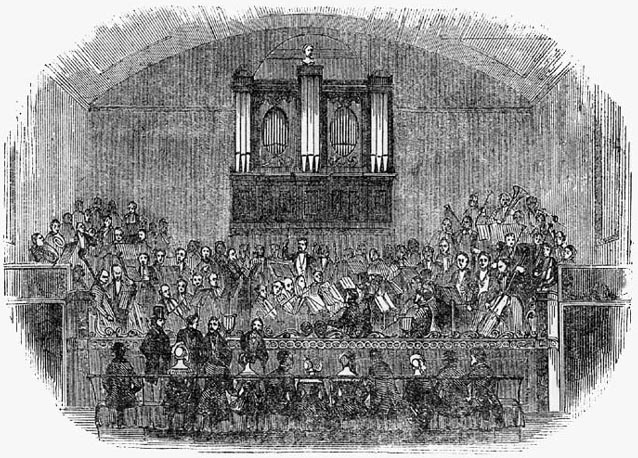
Hanover-Square-Rooms-concert

[i]

Hanover Square Rooms in 1843

HSRA 

[ii]

Hanover Square Rooms in 1843

            Mendelssohn had been an occasional guest conductor with London’s Philharmonic Society Orchestra since his first appearance there in 1829. In 1843, the Society had come into financial difficulties, and, by engaging Mendelssohn to conduct the following season, they hoped to help rebuild their audiences and recoup their losses. It may not have pleased them, therefore, when Mendelssohn suggested an unknown 12-year-old as a soloist. The Philharmonic had a long-standing ban on appearances by children. In arranging Joachim’s debut, Mendelssohn, who himself had a well-known aversion to the exploitation of prodigies, was required to give personal assurances to the committee that his young protégé was no mere Wunderkind, but already “an eminent artist and a fine person.”

Ella

John Ella

Portrait by Charles Baugniet in 1851
Courtesy of Raymond E. O. Ella, author-historian

Impresario John Ella claimed some of the credit for easing the committee’s skepticism, by including Joseph in what amounted to a series of high-profile auditions:

By special invitation, I accompanied a literary friend, in April 1844, to the residence of the late Madame Dulcken, Pianist to the Queen, to hear a youth play the violin. M. Dulcken was in doubt whether a boy of the age of Master Joachim, then fourteen [sic], would be allowed to play at the Philharmonic Concerts, and both Sir Henry Bishop and Sir George Smart were sceptical on the matter. On the Tuesday following, the youthful violinist came to my second weekly quartet union, and led Beethoven’s Quintet in C. At two other of my private musical gatherings Master Joachim played solos, or led quartets, and ultimately I mustered a notable assembly of musical lions to hear him play Beethoven’s Posthumous Quartet in Bb. Royalty and nobility crowded my room, but the most illustrious of the company comprised Mendelssohn, Moscheles, Dragonetti, Ernst, Lablache, Döhler, Offenbach, Benedict, Thalberg, Sainton, Sivori, Sir George Smart, Sir Henry Bishop, and Costa.[iii]

Ella

The Morning Post, May 15, 1844, p. 3

It seems that the original plan had been for Joseph to play Spohr’s Concerto No. 8, the Gesangsscene, but here again Ernst played a pivotal role in Joachim’s career; since Ernst had only weeks earlier played the same work, the choice fell by default to the Beethoven Violin Concerto, for which Joseph had provided cadenzas his own devising.[1]


JJCadenza

Joseph Joachim: Cadenza to the Rondo of Beethoven’s Violin Concerto
“London, 12 May 1844
To my dear friend Hill for remembrance”

“The MS. of the cadenza to the Rondo of the concerto is now in the possession of Messrs. W. E. Hill & Sons, the well-known violin makers of New Bond Street. The following ‘account’ is attached to it:— Joseph Joachim: born 1831. A cadenza written by the great violinist, in 1844, for the Beethoven Concerto, when he was but thirteen years of age, and presented by him to the late Henry Hill, who was present on the occasion of its being played for the first time at an evening musical party. Joachim played the cadenza from memory, and took the musicians by surprise when he told them that it was his own composition, and to convince them that this was so (some doubts being expressed) he wrote this and presented it to Henry Hill.'” [F. G. Edwards, Professor Joachim’s English Jubilee, The Musical Herald and Tonic Sol-fa Reporter 552 (1 March, 1894): 70.] Henry Hill was a prominent London violist, and a member of the famous English family of violin makers. This manuscript was passed to Hill’s son Arthur F. Hill, and eventually found its way into the collection of Serge Lifar. It was sold at Sotheby’s on December 6, 2002.


This, too, must have been a controversial decision. Beethoven’s concerto had had a checkered career since the evening, just before Christmas, 1806, when Franz Clement first conjured it to life in Vienna’s Theater and der Wien. Though it had been championed by such eminent violinists as Luigi Tomasini (Berlin, 1812), Pierre Baillot (Paris, 1828) and Henri Vieuxtemps (Vienna, 1834), [iv] it had never garnered more than a succès d’estime in public performance. Many great violinists, including Ludwig Spohr, had rejected the work outright (“…that was all very fine,” Spohr later said to Joachim by way of congratulations after a performance in Hanover, “but now I’d like to hear you play a real violin piece.”). [v] The concerto’s London premiere, given in April 1832 by a Frankfurt native named Edward Eliason, had not impressed the critics. “Beethoven has put forth no strength in his violin concerto,” wrote the reviewer for the Hamonicon. “It is a fiddling affair, and might have been written by any third or fourth rate composer. We cannot say that the performance of this concealed any of its weakness, or rendered it at all more palatable.” [vi]

This difficult, reputedly disagreeable work was a risky choice, then, as a debut vehicle for a boy one month shy of his 13th birthday. For Joseph, as for Mendelssohn, the stakes for this performance were unusually high. Joseph’s success in meeting this challenge would have historic consequences, both for the boy and for the concerto.

Screen shot 2013-07-03 at 7.00.56 PM

[vii]

A copy of the original program, signed in 1899 by Joseph Joachim, “the little fellow.”

            Joseph’s May 27 Philharmonic debut took place at the Hanover Square Rooms. [2] The long and diverse program began at eight. The highlight of the evening promised to be Mendelssohn’s incidental music to A Midsummer Night’s Dream, featuring the first English performance of the celebrated Wedding March. The concert opened with a performance of Beethoven’s fourth symphony, followed by a mawkish duet, excerpted from the young Liverpudlian John Liptrott Hatton’s opera Pascal Bruno:

Stung by horror, shame, and anguish,
Driven from her once loved home;
Mid yon mountains, wild, and lonely,
There she sought an early tomb.
Holy hand her grave ne’er hallowed;
Tears, none but his, her only child,
Who swore thereon an oath of vengeance —
Vengeance! as terrible as wild.

After that came Joseph and Beethoven’s “fiddling affair.” Mendelssohn’s account of the performance evokes the boisterous concert-going customs of the time, and vividly captures the atmosphere of exhilaration in the hall:

… The excitement into which [Joseph] had transported everyone, beginning with the rehearsal, was so great that a frenetic applause began as soon as he stepped in front of the orchestra, and lasted right up until the piece could begin. He then played the beginning so masterfully, so surely and well in tune, and, playing from memory notwithstanding, with such irreproachable security that the audience interrupted him three times before the first big Tutti, and then applauded throughout half of the Tutti. They likewise interrupted in the middle of his Cadenza, and after the first movement the noise only stopped because it needed to stop sometime, and because people’s hands and throats hurt from clapping and shouting. It was a great joy to be a fellow witness—and to see as well the boy’s quiet and secure modesty, immune from all temptation. After the first movement, he said softly to me: ‘I really am very frightened.’ The cheers of the audience accompanied every single part of the concerto throughout. When it was over and I took him down the stairs, I had to remind him that he should once more acknowledge the audience, and even then the thundering noise continued until long after he had again descended the steps, and was out of the hall. A better success the most celebrated and famous artist could neither hope for nor achieve. [viii]

“I well remember Mendelssohn’s bright look of pleasure and appreciative interest in his little friend,” witness Elizabeth Mounsey [3] recalled later. “As conductor, he turned towards the very young soloist, attired in short jacket and turned-down collar, so as to follow him dutifully, Mendelssohn’s own subordinate position appearing to give him a degree of amusement. But it was very beautiful to see the pleasure it gave him to regard the boy at his side, not only with admiration, but with honour. [4] Joachim, whose playing was so masterly, and whose whole manner was so thoughtful, was still boy enough to indulge in an unbecomingly full pocket at his side; one wondered what its contents might be!” [ix]

The ‘cellist Alfredo Piatti, making a London debut of his own that season, was also in the audience. Fifty years later, at a joint jubilee celebration, Piatti recalled the “little fat boy in tight trousers” who had made such a sensation that night. “He had blooming cheeks and a short jacket, and he stepped up on the platform at the Philharmonic Concert and played Beethoven’s violin concerto in such style that everybody was astonished. It was my good fortune to be very much associated with the little boy in after years; and his name was that of my friend, the great artist, Joseph Joachim.” [x]

Joseph emerged the lion of the hour, and even the most feared of reviewers were effusive in their praise. In the Athenaeum, the occasionally cantankerous Henry Chorley wrote: “Then came Beethoven’s Violin Concerto, played by Herr Joachim and, what is more, played with… Very few performers have come before us so satisfactory, and for the future so brightly promising as this boy; who seems, too, to possess a strong frame and a disposition so modest, as well as cheerful, that the perils of praise are less formidable than usual.” [xi]

The reviewer for The Musical World, probably J. W. Davison, was equally impressed:

Joachim’s rendering of Beethoven’s concerto was astonishing. Not only was it astonishing as coming from a comparative child, but astonishing as a violin performance, no matter from whom proceeding. The greatest violinists hold this concerto in awe. It is, we must own, not adapted to display advantageously the powers of the instrument — though a composition of great distinction, the first movement being in Beethoven’s highest manner. Young Joachim, however, attacked it with the vigour and determination of the most accomplished artist, and made every point tell. So well did he play, that we forgot how entirely unadapted for display was the violin part. No master could have read it better, no finished artist could have better rendered it. Tone, execution, and reading, were alike admirable — and the two cadences introduced by the young player were not only tremendous executive feats, but ingeniously composed — consisting wholly of excellent and musician-like workings of phrases and passages from the concerto. The reception of Joachim was enthusiastic, and his success the most complete and triumphant that his warmest friends could have desired. What Charles Filtsch [5] is upon the piano, Joseph Joachim is upon the violin, and he is, in common with that prodigious little genius, remarkable for the most attractive manners, the most amiable disposition, and the most intelligent and charming modesty. We wonder not that he should be such a favourite with Mendelssohn, who is ever the first to acknowledge and to nurture rising genius. [xii]

JJ London 1844
 [6]
Joseph Joachim at the time of his English debut
_____

The Illustrated London News concurred:

… now we come to the dictu mirabile monstrum, in the shape of a little boy of thirteen, who perhaps is the first violin player, not only of his age, but of his siècle. Of late years we have heard some prodigies, in the form of grown persons, as performers on that splendid instrument; but without severally enumerating them, or their merits, we can safely say that little Joachim is equal to any, or all of them, put together. His tone is of the purest cantabile character — his execution is most marvellous, and at the same time unembarrassed — his style is chaste, but deeply impassioned at moments; and his deportment is that of a conscious, but modest genius! He performed Beethoven’s solitary concerto, which we have heard all the great performers of the last twenty years attempt, and invariably fail in. On Monday last its performance was an eloquent vindication of the master-spirit who imagined it, and we might fearlessly add, that in the cadences, composed by the youth himself, there was as much genius exhibited as in the subject which gave birth to them. Joachim plays from memory, which is more agreeable to the eye of the auditor than to see anything read from a music-stand; it seems more like extemporaneous performance, and admits a greater degree of enthusiasm on the part of the instrumentalist. We never heard or witnessed such unequivocal delight as was expressed by both band and auditory. [xiii]

The reviewer concluded: “We did not think so much of the [Wedding] March as the rest of the audience, but “trahit sua quemque voluptas.” [7] Altogether it was a delightful concert; but we should like to see the programme of the next a little more varied.” [!]

Finally, the reviewer for the Morning Post enthused:

Joachim, the boy violinist, astounded every amateur. The concerto in D, op. 61… has been generally regarded by violin-players as not a proper and effective development of the powers of their instrument… But there arrives a boy of fourteen [sic] from Vienna, who, after astonishing everybody by his quartett-playing, is invited to perform at the Philharmonic, the standard law against the exhibition of precocities at these concerts being suspended on his account. […] As for his execution of this concerto, it is beyond all praise, and defies all description. This highly-gifted lad stands for half-an-hour without any music, and plays from memory without missing a note or making a single mistake in taking up the subject after the Tutti. He now and then bestows a furtive glance at the conductor, but the boy is steady, firm, and wonderfully true throughout.

In the slow movement in C — that elegant expanse of melody which glides so charmingly into the sportive rondo — the intensity of his expression and the breadth of his tone proved that it was not merely mechanical display, but that it was an emanation from the heart — that the mind and soul of the poet and musician were there, and it is just in these attributes that Joachim is distinguished from all former youthful prodigies… Joachim’s performance was altogether unprecedented, and elicited from amateurs and professors equal admiration.

Mendelssohn’s unequivocal expression of delight and Loder’s [8] look of amazement, combined with the hearty cheering of the band as well as auditory, all testified to the effect young Joachim had produced. [xiv]

Reports of Joseph’s success continued to appear. As late as August, Schumann’s Neue Zeitschrift für Musik reported: “The very youthful Jos. Joachim played in the 5th Philharmonic Concert, and aroused the liveliest sensation, and not simply through his virtuosity, but more through the maturity and capacity of comprehension, and the taste with which he performed the Beethoven Violin Concerto. He also retained these virtues elsewhere, through his outstanding quartet playing, and the partiality that he seems to hold for Bach’s works. Though, indeed, still a boy, Joachim is not one of those pitiable hothouse plants that our era is so rich in, and the tact with which he deflected all speculation that would stamp him as a Wunderkind is commendable.” [xv]

On the day after the concert, the thrill of the event still vivid in his mind, Mendelssohn sat down and penned the glowing letter to the Wittgensteins in Leipzig (from which the foregoing description of the concert was drawn):

Felix Mendelssohn to Herman Wittgenstein

 Dear sir,

I cannot neglect to tell you, at least with a few words, what an unheard-of, unprecedented success our dear Joseph has had with his performance of the Beethoven Concerto yesterday evening in the Philharmonic concert. The cheers of the entire audience, the unanimous love and esteem of all musicians, the warm affection of all who are genuinely interested in music and who base the fairest hopes upon such a talent — all that was expressed yesterday evening. You are to be thanked that you and your wife were responsible for bringing this exceptional boy into our midst; you have my thanks for all the joy he has given me in particular; and if heaven keep him in good and sound health, everything else that we wish for him will not then fail to be forthcoming — or rather, it cannot fail, for he no longer needs to become an eminent artist and a fine person: he is both already, as certainly as a boy of his age can be or ever has been. […]

With this [successful concert], the chief object of a first English visit has been, in my opinion, fully attained: every one here who is interested in music is his friend and will remember him. Now I wish, as you know, that he should soon return to a perfectly tranquil life, retiring entirely from public playing in order that he may use the next two or three years to develop his inner resources in every regard, practicing his art in all those areas in which there is still room for improvement without neglecting that which he has already achieved, composing industriously, and even more industriously going for walks and caring for his physical development, so that in three years’ time the youth may be as healthy in mind and body as the boy. I consider this impossible without perfect peace and quiet; may this be granted in addition to all the good things that Heaven has given him.

This letter is intended for your wife as well as for yourself; now just a short farewell from your most devoted,

Felix Mendelssohn-Bartholdy [xvi]
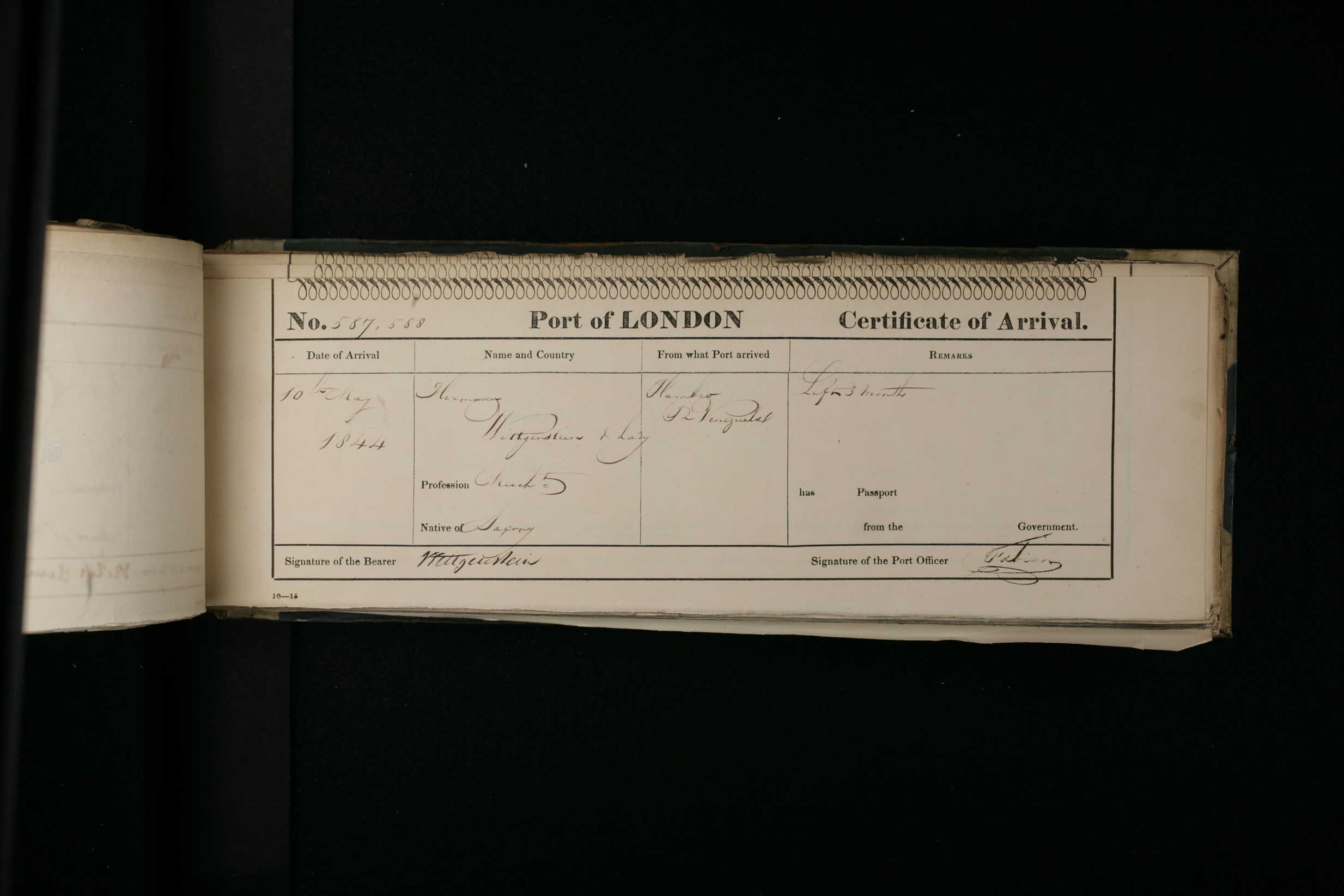
Wittgenstein arrival

Arrival of Hermann Wittgenstein at the Port of London

On the 5th of June, Fanny Wittgenstein sent a transcript of this letter to Joseph’s parents in Pest, along with the following lines:

Fanny Wittgenstein to Julius and Fanny Joachim [xvii]

Leipzig, 5 June [18]44

Dear Aunt and Dear Uncle,

It is a sweet task for me to add my joyous news to the many gratifying reports that you have received from London and Vienna about our Jos, for I have been a witness to a part of his success! Although it was a 14-day [journey], I could not resist the temptation of traveling to London with my dear Papa and my Hermann, and (perhaps foolishly) left my 4 children in the care of my servants and my brother-in-law. It was a great joy to see how Jos. is universally acknowledged and appreciated, how even ladies of the first rank approach him with interest, how he delights everyone with his talent and his modesty, and is therefore dearly loved by everyone. Fortunate parents, what joys still await you! How often have we regretted that you, especially, are not present to witness his triumphs! You know how Mendelsohn [sic], this marvelous, independent artist, dotes on Jos. — in order to demonstrate this properly, I send you a transcript of the letter that we received from him yesterday. As you shall see, he wishes for Jos. to devote several perfectly tranquil years to his studies, with particular attention paid to his health. Leipzig, which is home to so much genuine edification, because it does not possess the distracting temptations of larger cities, is a suitable place for him to live; we love him like our own child, and again accept him gladly, to watch over him with parental love (if I may say so), although it is a difficult challenge. Jos. is what he should be — a child — but a marvelous child; only precocious in the development of his art. This weekend, I will go to the countryside near Dresden with the children; there he should fully recuperate and then he will return diligently to work. The children are well, thank God. I congratulate you and dear Hany. Dear Uncle and dear Aunt, may you enjoy your grandchildren as much as you enjoy your children. Affectionate greetings to all of you dear ones from Fany Wst.

[xviii]

Joseph conquers the world, 1844.
Drawing attributed to John Callcott Horsley
Perhaps by Charles Edward Horsley
Private collection

Screen Shot 2014-10-16 at 6.23.21 PM

The Musical Post, May 17, 1844, p. 1

            The “perfectly tranquil life” would have to wait until Joseph’s return to Leipzig. Following his brilliant debut, invitations to perform flooded in from all quarters. Joseph’s reputation reached as far as Windsor, where, on June 4th, he was called to give a command performance at a state concert before Queen Victoria and the Prince Consort, together with their guests Emperor Nicholas of Russia, Frederick Augustus II, King of Saxony, the Duke of Wellington and Sir Robert Peel. [xix] He traveled to Windsor with his Uncle Bernhard, returning the next day. [xx] Joseph performed Ernst’s Othello Fantasy, and Bériot’s Andantino and Rondo Russe, [xxi] accompanied by the Queen’s private band, and received a golden watch and chain from the Queen for his efforts. [xxii] For the young “Hungarian Boy,” not yet thirteen years of age, the story of these days, which hovers so close to the world of myth, had already become the founding narrative of his incomparable English career.


Next Post in Series: A Prodigious Fellow


[1] “There will be nothing left for me to do than to choose to play the Beethoven concerto (since Ernst played the Gesangsscene in the 2nd concert).” [Joachim to David, Joachim/BRIEFE I, p. 5.] Joseph was paid 5 guineas for his performance (a guinea being equal to one pound, one shilling — there are 20 shillings in a pound). Five guineas was the same fee that Louise Dulcken got that season for the first English performance of Chopin’s Second Piano Concerto. Sivori was paid £11 for two consecutive concerto appearances, and Spohr £30 for a command concert and a concerto. [Ehrlich/PHILHARMONIC, p. 56.]

[2] “These same Hanover-square Rooms are the arcana of a mysterious temple, and many and beautiful and powerful have been the worshippers within its walls,” wrote The Illustrated London News in 1843. “Here are held many of the gay subscription assemblies of the London season — and here the stately and aristocratic ball of the Royal Academy holds its fancy court… But Music is the true genius of these halls — the concert is their lawful revelry, and to an annual round of musical celebration — soirée and matinée — are they devoted as sacredly as was ever patriot to the altar of country. In these rooms enthusiastic assemblies have heard evoked the genius of some of the finest spirits of the age. From that orchestra Paganini, with almost unearthly presence, enthralled hearts and souls with the magician power of an instrument, oracular with strength and beauty, and poetry, and his touch alone! There Liszt flooded the raptured sense with wonder and delight as he opened up the stores of Genius — and in marvellous and gushing harmonies seemed, with an almost hallowed inspiration, to improvise the very music of the spheres. […] Now, turn from the orchestra to the company, and see what a graceful assembly you have. Peer curiously among them, and ten to one but you discover people of renown — great critics, or men of literary fame — artists, professionals, and musical amateurs. There is always something bright, cheerful, and exhilarating about the atmosphere of the Hanover-square Rooms, and often are they honoured with the presence of royalty.” [The Illustrated London News, Vol. 2, No. 60 (June 24, 1843), p. 439.]

[3] A musical acquaintance of Mendelssohn’s, Elizabeth Mounsey was from the age of fourteen the organist of St. Peter’s Church, Cornhill. A musical souvenir (Bach Passacaglia in C Minor) that Mendelssohn gave her when he played the church organ in 1840 is still preserved in the organ gallery of the church. “Miss Bessie” Mounsey became an associate of the Philharmonic Society in 1842. Her sister’s husband, William Bartholomew, was the translator of the libretto to Mendelssohn’s Elijah. The work received its first English reading by the sisters in Miss Mounsey’s home. Elizabeth Mounsey died October 3, 1905, just days before her 86th birthday. [“Elizabeth Mounsey,” The Musical Times, Vol. 46, No. 753 (Nov. 1, 1905), pp. 718-721.]

[4] Singer Elise Polko similarly described Mendelssohn’s supportiveness as a conductor: “No words can describe Mendelssohn’s exceeding kindness to me when I sang at the Gewandhaus. He moved his conductor’s desk forward, which was quite unusual, so that it was close beside me, and I could see him just before me in order to inspire me with courage, and how good-naturedly he nodded and glanced at me while conducting! … Mendelssohn had always a cheering word for the timid singer. ‘Mademoiselle, you always do your work so admirably; but I can see by your face this evening that you intend fairly to bewitch the public;’ or, ‘Now just for the next half-hour imagine that your are the first singer in Europe; and so will I;’ or, ‘Let us try to turn Ferdinand Böhme’s head altogether to-day with delight.’ Oh! who could ever forget all those kind words, and the kind face, too!” [Polko/MENDELSSOHN, pp. 103-104].

[5] Charles Filtsch (1830-1845) was Chopin’s most gifted pupil, about whom Franz Liszt is reported to have said “When that boy begins to travel, I will close shop.” He died, tragically young, in Venice.

[6] “When, at the end of the season, Joachim was leaving London, I accompanied him to Claudet’s Daguerreotype Studio, at the old Adelaide Gallery in the Strand, for the purpose of sitting for some portraits, a process which was very different from that we experience in these days of photography, for instead of seconds, the patient — or shall I say victim? — had to remain in one position for several minutes. Joseph Joachim gave me one of these pictures, which, notwithstanding the years that have elapsed, is still in perfect preservation, and my readers will rejoice at the opportunity of seeing what this great artist was like when he first visited London.” Walter Cecil Macfarren, F.R.A.M., Memories, London & New York: Walter Scott Publishing Co., 1905, pp. 37-39. In March, 1840, Antoine Claudet (1797-1867), a student of Louis Daguerre, purchased the first Daguerreotype license for England for £200. He operated his studio in the Adelaide Gallery, behind St. Martin in the Fields, from 1841-1851.

[7] Virgil: “Each is led by his own taste.”

 Concertmaster John David Loder (1788-1846), a member of a prominent English musical family.


[i] The Illustrated London News (June 24, 1843).

[ii] The Illustrated London News, (June 24, 1843).

[iii] Ella/SKETCHES, p. 250.

[iv] Stowell/BEETHOVEN, p. 34.

[v] Moser/JOACHIM 1908, pp. 291.

[vi] Stowell/BEETHOVEN, p. 35.

[vii] The Musical Times, Vol. 40, No. 677 (July, 1899), p. 457.

[viii] MT/JOACHIM, p. 227.

[ix] The Musical Times, Vol. 39, No. 662 (April 1, 1898), p. 227.

[x] Klein/LONDON, pp. 396-397.

[xi] The Musical Times and Singing Class Circular, Vol. 35, No. 616 (June 1, 1894), p. 383-384. Original in Athenaeum June 1, 1844.

[xii] The Musical World, vol. XIX No. 22 (May 30, 1844), pp. 180-181.

[xiii] The Illustrated London News, vol. 4, No. 109 (June 1, 1844), p. 354.

[xiv] Morning Post, Tuesday, May 28, 1844

[xv] Neue Zeitschrift für Musik, Vol. 20, No. 16 (August 20, 1844), p. 63.

[xvi] Moser/JOACHIM 1907, pp. 63-65 [my translation; Fanny Wittgenstein’s transcription of this letter is in the British Library letters, p. 198]

[xvii] Unpublished MS, British Library: Joachim Correspondence, bequest of Agnes Keep, Add. MS 42718, p. 198.

[xviii]  Original 1844 pencil drawing on J. Whitman paper (watermarked 1842), depicting the young Joseph Joachim standing on England, atop the globe, with the four continents in the corners. Signed and dated in pencil at lower ground. Measures 8-3/4 x 6-3/4 inches. John Callcott Horsley (*1817 – †1903) was a well-known painter and illustrator, best known as the designer of the first Christmas card. His brother, Charles Edward Horsley (*1822 – 1876), was a composer and pupil of Mendelssohn. He lived in Leipzig from 1841 – 1843.

Ivan Mahaim, in his Beethoven: Naissance et renaissance des derniers quatuors (1964), ascribes the drawing to Charles Horsley and not his brother John Callcott Horsley, although the plate he reproduces from Briefe von und an Joseph Joachim (1911) attributes it to the latter, stating that the drawing is from Joseph Joachim‘s “stammbuch.” Neither of them provide any location for the work or said book. [Mahaim/BEETHOVEN, vol. 1, Fig. 41] Other publications, including Borchard’s Stimme und Geige: Amalie und Joseph Joachim: Biographie und Interpretationsgeschichte (2005, p. 60, p. 630 n.), variously suggest original placement in Joseph Joachim‘s “stammbuch” or in the John Callcott Horsley’s family album (“stammbuchzeichnung”). However, the British Library confirms that they have no record of the drawing ever appearing in their collections of Joachim and likewise the Bodleian Library, which houses the Horsley family archives, confirms the drawing has never been on deposit with them.  In any event, the work was at some point acquired by the noted collector of music education and appreciation, Diana R. Tillson (1918-2013), much of whose collection is now part of the Cotsen Children’s Library at Princeton University. The Callcott drawing, together with other items from the Tillson collection, was sold in a 2014 auction following her death.

[xix] Moser/JOACHIM 1908, p. 65.

[xx] Unpublished MS, British Library: Joachim Correspondence, bequest of Agnes Keep, Add. MS 42718, p. 199.

[xxi] The Times (London) (June 5, 1844), p. 4.

[xxii] Allgemeine Wiener Musik-Zeitung, Vol. 4, No. 86 (July 18, 1844), p. 344; Reich/BETH EL, p. 64; The Musical Times, Vol. 48, No. 775 (September 1, 1907), p. 578.

Share this:

  • Share on X (Opens in new window) X
  • Share on Facebook (Opens in new window) Facebook
  • Email a link to a friend (Opens in new window) Email

Like this:

Like Loading...

Alsager

03 Wednesday Jul 2013

Posted by Joachim in 1 Biographical Posts — RWE, Joachim in Great Britain

≈ 1 Comment

© Robert W. Eshbach, 2013

Previous Post in Series: London, 1844


JJ Initials

Alsager

NPG D13535; Thomas Massa Alsager ('The mirror of the Times') by and published by Richard Dighton, reissued by  Thomas McLean

Thomas Massa Alsager. By and published by Richard Dighton, reissued by Thomas McLean, hand-coloured etching, published August 1823

Thomas Massa Alsager (‘The mirror of the Times’)Thomas Massa Alsager (‘The mirror of the Times’)

National Portrait Gallery, London


Music-making in early 19th Century London owed much of its character to the enthusiasm and enterprise of musical amateurs. Among them, none had a greater influence, or left a greater legacy, than the co-owner, financial writer and sometime music critic of the Times, Thomas Massa Alsager. At a time when Beethoven’s works were still struggling for recognition, Alsager was a devoted advocate for the most difficult of them: the later string quartets and sonatas that even today elude many sophisticated audiences. Many of Beethoven’s works received their first English performances  — often by distinguished artists — at Alsager’s home at 26 Queen Square, Bloomsbury. Larger works were not excepted: the English premiere of Beethoven’s Missa solemnis took place there on December 24, 1832 conducted by Ignaz Moscheles. Alsager’s pioneering work on behalf of the Beethoven quartets culminated in a remarkable series of five concerts, held at two-week intervals between April 21st and June 16th 1845, in which the entire cycle of sixteen quartets (excluding the Grosse Fuge) was performed for the first time. Every concert featured at least one selection each from Beethoven’s early, middle and late quartets. Beautifully engraved programs and special pocket scores were printed for each occasion, to help the audience of 250 in their understanding of the works at hand. Listeners were requested to arrive at 8:00 o’clock for the 8:30 performances, to give them time to prepare their minds, and to assure that, once commenced, the music making would not be interrupted. [i]

Beethoven Qt pass 18

“Honor to Beethoven”

Admission token for a concert of the Beethoven Quartett Society

            Alsager committed suicide in 1846, on the anniversary of his wife’s funeral. Nevertheless, with the exception of 1849, the performance of the complete Beethoven cycle by the “Beethoven Quartett Society” continued as an annual spring feature of the London season until 1851. It would be forty-three years before it would be performed again in its entirety. [1] A contemporary reviewer commented upon the significance that these concerts had for the reception of Beethoven’s late works in England and beyond:

The Society’s concerts put an end to the controversy about the merit of Beethoven’s last quartets. Everything that used to be called eccentric, confused, linked to the excesses of a disorderly, unbalanced imagination resulting from the composer’s deafness, was actually only the product of the works’ originality which remained inaccessible to the uninitiated listener. In these brilliant recitals, the late Beethoven quartets were played with such exactness, such finesse of expression and nuances, with so much fire and impetus that they finally emerged in the purity of their architecture. They are listened to with most profound rapture. Unanimous opinion places them at the summit of this genre of composition. [ii]

Alsager copy

[iii]

One of the beautifully produced programs from the 1845 Beethoven Quartett Society Concerts. Poetry, musical incipits and program notes helped to do “Honor to Beethoven” and to spread the gospel of the Beethoven string quartets. The concerts were held at 76 Harley Street, the home of Louis Julienne (1812-1860), the colorful  director of the Drury Lane Theater. Hector Berlioz stayed there on his 1847 visit to London.

            Over the years, Mendelssohn had been a familiar participant at Alsager’s gatherings, performing both as a pianist and violist. On Thursday May 16th, 1844, having recently arrived from Berlin, he responded to Alsager’s invitation for the following Sunday: “Of course I shall be most happy to be allowed to assist to your musical Séance. . . I need not assure you that I will be at your house as early as I can, & you know very well how happy I shall be to shake you again by the hand & to perform on the Tenor [viola] or if that cannot be on the Piano as much of Beethoven’s music, and as little of mine as you possibly can give me.” [iv] Joseph was also invited to participate in the event, at which he delighted Mendelssohn with his performance of one of his “musical father’s” piano quartets. In the course of his stay in London, Joseph was a frequent guest at Thomas Alsager’s home, and a frequent partaker in the music-making there. [v] As a parting gift, Alsager presented Joseph with the Beethoven quartets in score.

On his second visit to London, in 1847, Joseph took part in the Beethoven Quartett Society’s ground-breaking performances, together with veteran performers Sainton, Hill, Thomas and Rousselot. [2] During that same 1847 visit, Joachim and the great Italian ‘cellist Alfredo Piatti [3] began a legendary chamber music partnership that lasted until Piatti’s retirement in 1898.


Next Post in Series: London Philharmonic Debut


[1] By Eduard Rappoldi and colleagues in Dresden. The Joachim Quartet did not perform the entire cycle until 1903. See: Mahaim/CYCLES, pp. 541-547.

[2] Violinist Prosper Sainton, violist Henry Hill and ‘cellist Scipion Rousselot were original members of the Beethoven Quartett Society.

[3] Alfredo Piatti (1822-1901) had been discovered, destitute and ill and playing on a borrowed instrument, by Franz Liszt, who, with characteristic generosity, bought him an Amati cello and introduced him in Paris. Shortly thereafter, Piatti made his London debut — on May 31, 1844, four days after Joachim. Longtime friends, Joachim and Piatti celebrated the 50th anniversary of their debuts together.


[i] Mahaim/CYCLES, p. 509.

[ii] Mahaim/CYCLES, pp. 508-509.

[iii] Reproduced in Mahaim, vol. I. Original in British Museum.

[iv] Levy/ALSAGER, p. 124.

[v] Margaret Alsager Ayrton’s unpublished diary in Levy/ALSAGER, p. 124 n.

Share this:

  • Share on X (Opens in new window) X
  • Share on Facebook (Opens in new window) Facebook
  • Email a link to a friend (Opens in new window) Email

Like this:

Like Loading...

London, 1844

03 Wednesday Jul 2013

Posted by Joachim in 1 Biographical Posts — RWE

≈ Leave a comment

© Robert W. Eshbach, 2013

Previous Post in Series: Growing Pains/Travel Plans


JJ Initials

CHAPTER IV: LONDON, 1844

Port of London Bartlett

The Port of London

W. H. Bartlett, ca. 1844

Joseph first saw the “smoky nest,” as Mendelssohn called London, [i] under the most auspicious of circumstances. To be introduced as Mendelssohn’s protégé was to fling wide every door to London’s musical establishment. That Mendelssohn was the most highly regarded living musician in English musical life, there can be no doubt. England was Mendelssohn’s second home, and a place in which he received, if anything, greater and more affectionate recognition than he did in his native Germany.

image.x

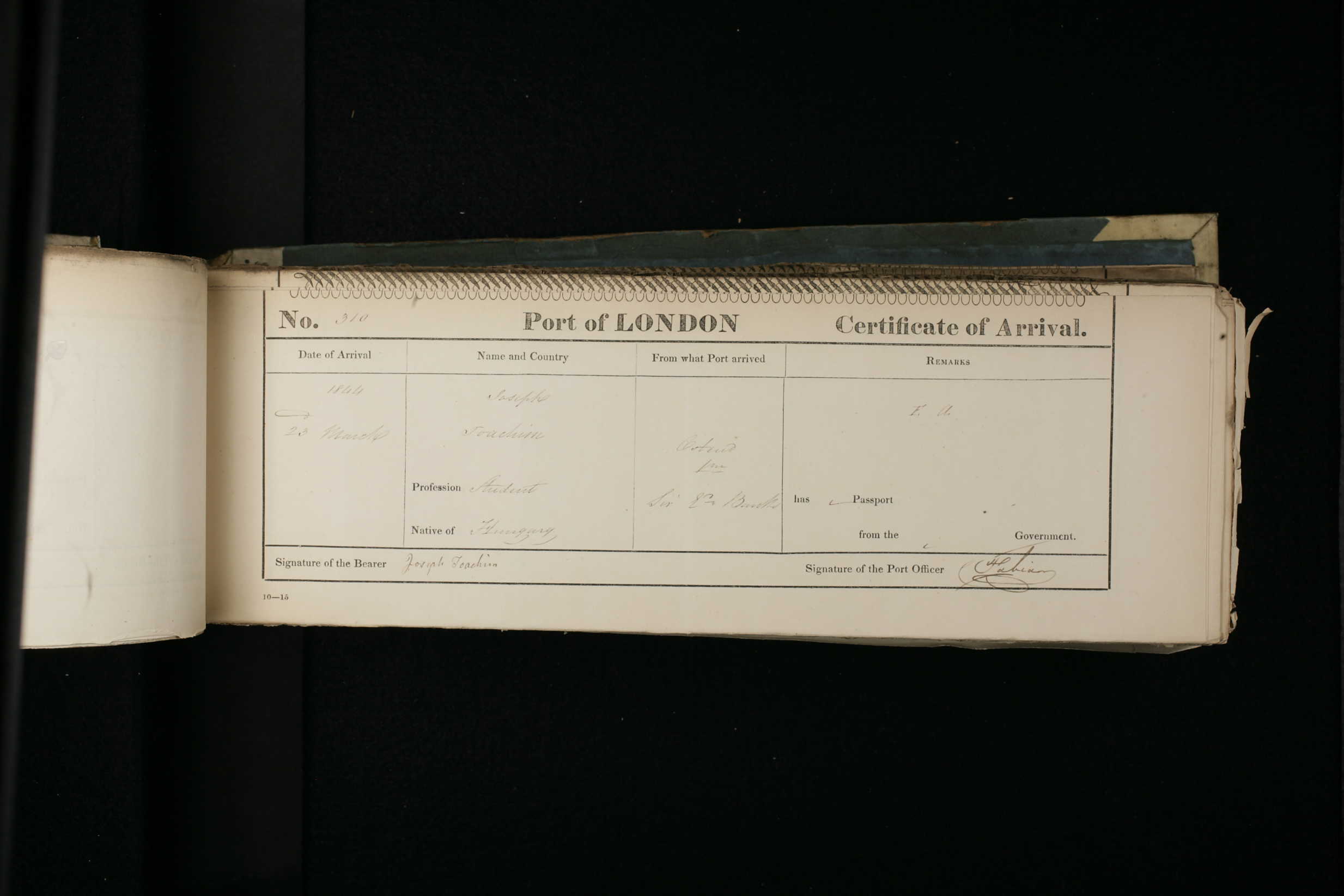
Record of Joseph Joachim’s Arrival in London, March 23, 1844 [ii]

Mendelssohn had fortified Joseph with extraordinary letters of introduction, with praise such as only the young could endure. To William Sterndale Bennett he wrote: “The bearer of these lines, although a boy of thirteen, is one of my best and dearest friends, and one of the most interesting people I have met for a long time.” [iii] Upon meeting Joseph, the eminent pianist Ignaz Moscheles wrote in his diary: “Joachim, a boy thirteen years of age, has come to London, bringing with him a letter of recommendation from Mendelssohn; his talent, however, is his best introduction. We organized a small party expressly for him. I listened with delight to him and Emily [1] playing in Mendelssohn’s lovely D minor trio; after that I was fairly taken by surprise by Joachim’s manly and brilliant rendering of David’s Variations and De Bériot’s Rondo. Mendelssohn is right, here we have a talent of the true stamp.” [iv]

Joachim Daguerreotype

[v]

Joseph Joachim at the time of his English Debut, From a Daguerreotype [4]

Joseph’s first London appearance came on March 28, when he performed between the first and second acts of Balfe’s operetta The Bohemian Girl at the Drury Lane Theatre. [2] This “Miscellaneous Concert,” produced by the impresario Alfred Bunn, [3] also included performances by three pianists: Ignaz Moscheles, Madame Louise Dulcken (Ferdinand David’s sister), and C. M. von Weber’s former pupil, Julius Benedict. The program declared “The celebrated Hungarian boy, MASTER IOACHIM [sic], will make his first appearance before an English public and perform Grand Variations for the violin on a theme from Rossini’s Othello, by Ernst.” [vi] Joseph was embarrassed by the merciless teasing that the “Hungarian Boy” received for being introduced at a performance of the “Bohemian Girl,” but Mendelssohn thought it was hilarious, and would later kid him as he arrived for his lessons: “Now, my ‘Hungarian Boy,’ what have you to show me?” [vii]

 St. Paul's

St. Paul’s Cathedral, London, 1844

While residing with his Uncle Bernhard Figdor [5] in Basinghall Street near St. Paul’s Cathedral, Joseph spent time attending concerts and taking in the musical landscape. After three weeks, he sent a newsy letter to Ferdinand David, thanking him for introductions to relatives: a certain Herr David, who lived along his travel route in Cologne, and to Mme. Dulcken in London. “There is a superabundance of foreign fiddlers here,” he wrote. “Ernst, Sivori, [6] Pott [7] (who will play in the 4th Philharmonic), Gulomy [8] (of whom one hears nothing at all), and Rossy, [9] 16 years old, who comes with good recommendations from Rossini and is supposed to play badly, as competent people say.” [viii]

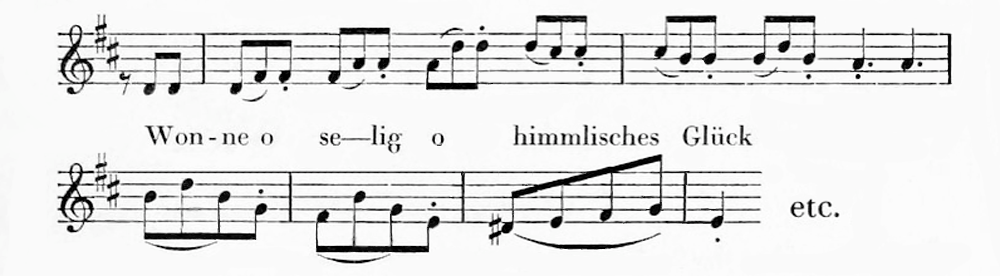
His sharp observations demonstrate a remarkable level of personal and musical maturity, and also paint a vivid picture of London’s musical scene. “I find that the Philharmonic Concerts do not deserve the reputation that they have,” he wrote, “for when one is used to hearing Beethoven’s symphonies in Leipzig, one cannot find edification in the performances here. Even the tempos were mistaken, in my possibly incorrect opinion.” The concert he attended was the second of the Philharmonic series, at which H. W. Ernst performed Spohr’s Gesangscene concerto. This was a piece that Joseph knew well: having performed it recently in the Gewandhaus, he had brought it with him to perform in London. “Ernst did not play the Gesangscene faithfully,” he told David; “he made the cadenza much more modern (although with the same harmony), introduced great difficulties, completely left out the beautiful modulations in the passage in the Allegro (in F), and made very modern endings to the terminations of every solo in the Allegro, played the staccato run in thirds, which required him to take the passage somewhat slower. I consider Ernst to be a very great violin player, and find him incomparably greater as a virtuoso, artist and human being than Sivori. [10] The latter creates truly surprising difficulties, but he often plays inaccurately, and is really a great Charlatan […]. Dr. Mendelssohn is very certainly expected here today:

 Wonne

[11]

I will go right away to H[err] Klingemann and see whether he is not yet here. Farewell, and do not completely forget your thankful Alderchen

J. Joachim.” [ix]


Screen Shot 2014-10-16 at 5.26.50 PM

The Morning Post, March 29, 1844, p. 1.

Joseph made a number of appearances before his official Philharmonic debut. On April 22 he gave his own performance of the Gesangscene Concerto in the Societa Armonica concert. [12]

Screen Shot 2014-10-16 at 5.42.33 PM

The Morning Post, April 25, 1844, p. 5

The following day, he played an important “audition” organized by John Ella, with many influential guests present:

Screen Shot 2015-04-08 at 10.22.39 PM

The Morning Post, April 24, 1844, p. 5

Two days later, he performed for the Melodists’ Club, and on May 1, he played at Miss Nunn’s Soirée:

Screen Shot 2014-10-16 at 5.53.54 PM

The Morning Post, April 27, 1844, page 5

Screen Shot 2014-10-16 at 5.58.59 PM

The Morning Post, May 2, 1844, p. 5


31160_A002129-00441

Record of Hermann Wittgenstein’s Arrival in London, May 10, 1844


Joseph took part in Madame Caradori-Allan’s extravaganza on May 17. [x] “At Caradori’s morning concert I accompanied some twenty-two vocal pieces in which the concert-giver and a host of vocalists took part” wrote Moscheles; “the legion of instrumentalists was headed by Joachim, who played Ernst’s ‘Otello’ Fantasia in the most masterly way.” [xi]

Joseph had a special affinity for this 15-minute showpiece — his war-horse — and an increasingly intimate personal relationship with its composer. Ever since he had first heard Ernst play in Vienna in 1839, Joseph had looked to him as a role model. Ernst’s kind and supportive intervention at that crucial moment had rescued Joseph’s violin-playing career, and his informed advice had steered young Pepi toward his all-important study with Joseph Böhm. [13]

Screen Shot 2014-10-16 at 5.33.31 PM

The Morning Post, April 19, 1844, p. 1

On this first English trip, Ernst and Joachim would solidify their friendship. The impresario John Ella records an occasion at which Joseph assisted as page-turner for Ernst during a performance of the second Razumovsky Quartet of Beethoven. He also assisted Mendelssohn during a performance of Mendelssohn’s Trio in D Minor:

Had the art of photography in 1844 been popular, as at the present time, we might have had a pictorial souvenir of this performance of Mendelssohn, and Joachim at his side, with Ernst and Hausmann at the violin and violincello [sic]. In the first Allegro, Ernst failing to turn his page in time for the rentrée of the violin, Mendelssohn improvised an elegant rhythm of four additional bars of music, which elicited bravos from all present. A bank director humorously accused Mendelssohn of “putting more notes into circulation than allowed by printed authority.” The composer, with joyous spirit, laughed heartily at the success of his improvisation, and Thalberg had his joke upon Ernst, voltando, non subito. [xii]

Ernst performed his famous Elegie at the same concert. On May 5, Ernst wrote to his brother: “Little Joachim is here […], creating a sensation. He is really extraordinary and to be placed far above the Milanollos with regard to execution and musicianship. I love him very much and see him often.” [xiii] Three weeks later, Joseph wrote to their teacher, giving news of his activities and conveying Ernst’s greetings:

Joseph Joachim to Joseph Böhm in Vienna [xiv]

[London, shortly before May 27, 1844]

Dear H[err] Professor,

I have owed you an answer for such a long time — can assure you, however, that it was neither ingratitude nor neglect that inhibited me from writing, but that I am truly very busy. Things are going very well for me here, thank God; on Monday the 27th I will play in the Philharmonic Concerts, the Beethoven Concerto, and if it is possible to work it out, also a solo. This evening, I will play quartets in public: No. 70 by Haydn in D Major, Quintet No. 2 in G minor by Mozart, Quartet with the fugue in C, No. 3 of the Razumovskys. [14] Ernst just left me; he wants me to send you and your wife many warm greetings. He is a magnificent person and artist. — If I get a little peace, I will write more to you, and better. With warm greetings, and a Handkuss to your wife, I am your eternally grateful, obedient pupil,

Peppi.

[…] Please convey many greetings and regards to Herr Preier, who I thought would come here, from his pupil.

Screen Shot 2014-10-16 at 6.10.16 PM

The Morning Post, May 15, 1844, p. 5


Next Post in Series: Alsager


[1] Moscheles’ daughter. Emily was 16 years old at the time.

[2] This concert was arranged for him by Moscheles. Balfe’s operetta, then very popular, is the source of the “hit” song “I dreamt that I dwelt in marble halls.” — “There is a dreadful vulgar ballad, composed by Mr. Balfe and sung with most unbounded applause by Miss Rainforth ‘I dreamt that I dwelt in marble halls’ which is sung and organed at every corner in London. I think you may imagine what kind of flowing 6/8 time of the last imbecility it is. The words are written by Mr. Bunn! ‘Arcades ambo.’” (Edward Fitzgerald to F. Tennyson, October 10, 1844) [Demuth/ANTHOLOGY, p. 206] The operetta is set in Pressburg, five miles from Joachim’s birthplace of Kittsee.

[3] “This was the gentleman of whom [soprano Maria] Malibran is said to have shown her indignation at an outburst of his managerial temper by saying: ‘I shall call you Good Friday, because you are a hot, cross Bunn!’” [The Musical Times, Vol. 39, No. 662 (April 1, 1898), p. 226.]

[4] This was one of the earliest portraits of this kind: the Daguerreotype process was patented in 1839.

[5] Bernhard Figdor (1806-1876) was the youngest of ten siblings, of whom Joseph’s mother was the oldest. He was born in Kittsee, and died in Baden, near Vienna. For many years, he represented Figdor family business concerns in London.

[6] Camillo Sivori (1815-1894) was Nicolò Paganini’s only pupil, and a renowned virtuoso. Among the numerous valuable instruments that he played, his favorite was a gift from Paganini — J. B. Vuillaume’s impeccable copy of Paganini’s Guarneri del Gesù, il cannone.

[7] August Friedrich Pott (1806-1883). Like Ferdinand David, Pott was a student of both Spohr and Hauptmann in Kassel. He made his debut with the London Philharmonic in 1838, playing Lipinski’s Concerto in B minor.

[8] Jérôme Louis Gulomy (1821-1887). A Livonian, Gulomy was one of the first violinists to perform the Beethoven Concerto (in Leipzig, 1841).

[9] Carlo Rossi. According to Moser, Rossi was a violin student of Menzel in Vienna. He was better known as a pianist, and lived, after 1851, in Venice.

[10] The reviewer for The Musical World concurred: “This dextrous violinist gave his first concert on Friday last at the Hanover-square rooms, and played several of the Paganini difficulties with wonderful address and neatness. Praise must pull up here; for feeling, expression, and everything like poetical enthusiasm, were swallowed in the flood of executive mechanisms. […] We give him great preferences as an astonisher. He is, however, very inferior to Ernst in the main essentials of his art. The latter has tone, pathos, and poetry, which Sivori never dreams of; and what is more, he selects, principally, such music for his displays as shall largely contain these desirable elements. [The Musical World, Vol. 19, No. 17, (April 25, 1844), p. 145.]

[11] Incorrectly quoted from memory from Schumann’s recently premiered Paradies und Peri.

[12] The Societa Armonica was one of four organizations that gave regular orchestral concerts in London at that time, the other three being the Antient Concerts, the Society of British Musicians, and the Philharmonic Society. The Society of British Musicians programmed exclusively works by British composers.

[13] Years earlier, Ernst’s encouragement had also helped to steer Robert Schumann toward a musical career.

[14] Hob. III: 70, K. 516 and op. 59, no. 3, respectively.


[i] F. G. E./JOACHIM, p. 577.

[ii] Ancestry.com, accessed 9/30/2011. England, Alien Arrivals, 1826-1869. Source Citation: Class: HO 2; Piece: 129; Certificate Number 310. The National Archives (England) Public Record Office.

[iii] G. Selden-Goth (ed.), Felix Mendelssohn Letters, London: Paul Elek, 1946.  p. 333

[iv] Coleridge/MOSCHELES II, pp. 116-117.
[v] Original from Brahms Nachlaß in Brahms-Institut, Lübeck. This is backwards—similar one in Ernst Burger, Robert Schumann.

[vi] Quoted in Fuller-Maitland/JOACHIM, p.6; also in The Musical Times, Vol. 45, No. 736 (June 1, 1904), p. 377.

[vii] The Musical Times, Vol. 39, No. 662 (April 1, 1898), p. 226; Moser/JOACHIM 1908 I, p. 62.

[viii] Joachim/BRIEFE I, p. 6.

[ix] Joachim/BRIEFE I, pp. 5-6. The date on this letter is incorrectly given as 1847. By internal evidence, it should be 1844. The letter, which was sold at Sotheby’s on June 9, 2010, is on four 8vo pages (20 x 12.5 cm), and bears the watermark “WHATMAN 1843.”

[x] The Musical Times, Vol. 45, No. 736 (June 1, 1904), p. 377.

[xi] Coleridge/MOSCHELES II, p. 117.

[xii] Ella/SKETCHES, p. 252.

[xiii] Rowe/ERNST, p. 128. [Quoted from Heller, Amely, H. W. Ernst in the Opinion of his Contemporaries, ed. Samuel Wolf, trans. Roberta Franke (Linthicum Heights: Swand Publications, 1886), p. 18. %]

[xiv] Biba/PEPPI, p. 203.

Share this:

  • Share on X (Opens in new window) X
  • Share on Facebook (Opens in new window) Facebook
  • Email a link to a friend (Opens in new window) Email

Like this:

Like Loading...

Leipzig and Mendelssohn

18 Tuesday Jun 2013

Posted by Joachim in 1 Biographical Posts — RWE

≈ Leave a comment


Previous Post in Series: Interlude — Leipzig 

__________

JJ Initials

CHAPTER III — LEIPZIG AND MENDELSSOHN

Res Severa Est Verum Gaudium

 JJ 12

Joseph Joachim at 12 years of age
Pencil drawing by Mrs. Moritz (Suzette) Hauptmann [1]

Leipzig remains the most important city for music, and I would advise any gifted young person to go there, where one hears so much music, and music of such good quality.

                                                            —Robert Schumann, 1844 [i]

            Joseph took up residence with Hermann and Fanny Wittgenstein and their three infant children, Anna, Marie and Paul, [2] in a large house, Am Markt 14, centre-ville opposite the old Rathaus and just around the corner from Leipzig’s historic Thomaskirche. [ii] The century-old building, with its high upper story and typical Leipziger bay, was considered one of the city’s most elegant residences. [3] There, Joseph awoke each morning like a pearl in an oyster, with all of Old Leipzig — its markets, churches, concert halls, restaurants, shops and schools — lying within a 600-yard radius of his front door.

HPIM7511 copy

[iii]

The Wittgenstein residence Am Markt 14
(Tüll & Spitzen building, right. The tower of St. Thomas just visible, left, top)

            The Wittgenstein residence faced east across the market square, within sight of Auerbach’s Keller, the famous tavern immortalized in Goethe’s Faust, and five hundred yards from the Gewandhaus and the newly-founded Conservatorium. Hermann’s office was situated an equal distance away in the opposite direction, No. 75 on the commercial street known as Brühl that parallels Leipzig’s old northern wall — a remnant of the ancient via regia that ran from Paris in the West to Kiev in the East. It was a short walk from there to the railway station that was the source of much of Leipzig’s new-found prosperity. A short walk, as well, to the Gerberstrasse: a north-south road that crossed the river where in earlier times Leipzig’s Gerber (tanners) had plied their trade. In the mid-19th-century, the area that encompassed the Gerberstrasse and Brühl was the center of the town’s lively fur and wool trade. Though not a “Jewish Quarter” in the commonly understood sense of the term, it was nevertheless home to the majority of Leipzig’s Jews. [4] At fair time, Brühl, “a street redolent of Limburg cheeses, and as full of gabardined Hebrews as the Ghetto of olden times,” [iv] was the preferred lodging place of visiting Jewish fur merchants, primarily from Russia and Poland. [v] A block from Wittgenstein’s building at No. 75 stood the house Zum Roten und Weissen Löwen (At the Red and White Lion) in which Richard Wagner had been born; [5] nearby was the house in which Karl Marx would one day write Das Kapital. Thus did Leipzig navigate between the poles of art and commerce.

Hermann’s older brother Richard, with whom he was doing business as M. M. Wittgenstein und Sohn, [6] lived with his wife and three children in the Thomaskirchhof, hard by the church and school. Richard’s children were older than Hermann and Fanny’s: the eldest, Johanna, was exactly Joseph’s age, and their youngest, Adolph, was five years his junior.

Thomasschule-crop

[vi]

Thomaskirche and Thomasschule, Leipzig

            Across from Richard’s residence, with the Pleisse River flowing at its feet, rose the old Thomasschule where Bach had lived and worked. Between the church and the river stood the new Bach monument, commissioned by Mendelssohn and designed by Eduard Bendemann, a testament to the esteem in which the musicians in Mendelssohn’s circle still held the old master. On the far side of the river, the large, pleasant garden districts that surrounded the old city stretched into the distance. Mendelssohn lived there, in Lurgenstein’s Garden; and just to the north, in Gerhard’s Garden, lived his friend and concertmaster, Ferdinand David.

Mendelssohn 1838 Sotheby's

Thomaskirche and Thomasschule as Seen From Mendelssohn’s Apartment
Painting by Felix Mendelssohn, 1838

For the next seven years, this would be the geography of Joseph’s life. Here, in the “quaint, cheerful and friendly” town that Chorley so vividly described — here, in the pretty, inviting residences “set in gardens, richly dressed and full of flowers” — here, among Chorley’s “kind hearts and distinguished musicians,” Joseph would find the ideal, stimulating, structured and nurturing, environment for the development of his remarkable gifts.

Leipzig Summer Garden Life

Leipzig Summer Garden Geselligkeit

© Robert W. Eshbach, 2013

__________

Next Post in Series: First Gewandhaus Concert. Pauline Viardot-Garcia


[1] Illustration from Moser/JOACHIM. Note the absence of a chinrest on Joachim’s violin. The chinrest was invented by Spohr around 1820, and did not come into general use until several decades thereafter. An 1833 article in the German journal Caecilia notes that “among many thousands of our currently existing violins, there is barely one with a chinrest to be found.” [Caecilia eine Zeitschrift für die musikalische Welt, Vol. 5, No. 60, pp. 284-285.] Spohr’s chinrest was affixed over the tailpiece in the center of the violin.

[2] Another handful would be born during Joseph’s stay in Leipzig: Josefine, Louis, Karl, Bertha and Clara. The last of the Wittgenstein’s nine children, Lydia, Milly and Clothilde, arrived after the family’s return to Vienna in 1851.

[3] The house, built in 1742, was demolished in 1895 to make room for the so-called “Bismarckhaus,” which in turn fell victim to the bombs of the Second World War. The site is currently occupied by the Breuninger department store.

[4] Despite its complicity with the French in Napoleonic times, the Saxon Kingdom was one of the most regressive areas of Germany when it came to Jewish emancipation. Jews had been banned from Leipzig in 1543, and it was only in the second half of the 18th Century that they had begun to return. In 1800, the Jewish population totaled between 40 and 50. Jews did not receive the right to form religious communities in Leipzig and Dresden until 1837. [Scholz/WAGNER, p. 51.]

[5] The fact that Wagner was born in the house at Brühl 3, in a largely Jewish section of town has been used as evidence for the erroneous belief that he was of partly Jewish ancestry. In fact, the family probably lived there because Wagner’s father, Carl Friedrich Wilhelm Wagner, was employed as a law clerk in the Royal Police office on Brühl. [Scholz/WAGNER, p. 51.]

[6] Hermann’s father, Moses Meier of Korbach in Hesse, the son of Meier Moses of Laasphe in Wittgenstein county, adopted the family name Wittgenstein, probably around 1808, when Jews were required by law to adopt surnames. His wife was born Brendel Simon. According to Brian McGuinness [Wittgenstein/WRITINGS, p. xvii], “The M. M. Wittgenstein Warenhaus was one of the largest businesses in Korbach and the family were rich enough to support a charitable foundation.”


[i] F. Gustav Jansen, Schumanns Briefe, Leipzig: Breitkopf und Härtel, 1904, p. 244.

[ii] Leipziger Adreßbuch auf das Jahr 1842 Mit königl. sächs. allergnädigstem Priviligium und unter der Universität Aufsicht Leipzig: Wilh. Staritz Universitätsdrucker, p. 160.

[iii] Stadtgeschichtliches Museum, Leipzig.

[iv] Stanford/FOLK, p. 233.

[v] Scholz/WAGNER, p. 50.

[vi] Author’s collection.

Share this:

  • Share on X (Opens in new window) X
  • Share on Facebook (Opens in new window) Facebook
  • Email a link to a friend (Opens in new window) Email

Like this:

Like Loading...

Interlude — Leipzig

18 Tuesday Jun 2013

Posted by Joachim in 1 Biographical Posts — RWE

≈ Leave a comment


Previous Post in Series: Milanollos, and a Farewell to Vienna

__________

Leipzig Illust

 JJ Initials

Interlude: Leipzig

 Brühl

[i]

Brühl, Leipzig 1840

The building on the left is the house Zum Roten und Weissen Löwen,
in which Richard Wagner was born.

            …the town in itself… has a quaint, cheerful, and friendly appearance. Within the walls, high richly-decorated houses and old churches seem almost toppling over each other, so thickly are they set. Without, where ramparts were, is an irregular pleasure-ground, spreading out in some places to such a respectable amplitude as to secure privacy for the walker. Beyond this belt is another ring, made up of houses, some of them set in gardens, richly dressed and full of flowers; the prettiest, most inviting residences which kind hearts and distinguished musicians could find. The town is rich in both. There I found that cheerful, simple, unselfish, and intelligent artistic life which many have been used to imagine as universally German. Leipsic has no court to stiffen its social circles into formality, or to hinder its presiding spirits from taking free way: on the other hand, it possesses a University to stir its intelligences, a press busy and enterprising, and a recurrence of those gatherings which bring a representative of every class of society in Europe together. These last can hardly pass over…without disturbing the settlement of that stagnant and pedantic egotism into which the strongest minds are apt to sink when the wheel of life moves too slowly, or the circle of cares is too narrow. [ii]

— Henry F. Chorley, 1844

The town that Goethe had called “a little Paris” that educates its people [iii] would provide young Joseph a rich soil in which to grow. In 1843, the Saxon city of Leipzig was a prosperous middle-class commercial center — a railway hub whose population had grown in the last decade from forty-three thousand to some fifty-six thousand inhabitants.

 Leipziger Messe Scan

Leipzig Marketplace, 1844
The Wittgenstein residence, where Joseph lived,
was just off the picture to the left.

Since the 12th century, Leipzig had been renowned for its trade fairs. Three times a year, at Easter, in September and at New Year’s, it was overrun with foreigners who provided a colorful and diverse theater of sights, sounds, and smells, taxing the town’s facilities, challenging its values, and lifting it out of the parochialism that might otherwise have been its lot. In 1843, the crowds of visitors numbered 40,000, nearly doubling the town’s population. “All this,” wrote an Austrian observer accustomed to the unhurried Gemütlichkeit of Imperial Vienna, “fills us with astonishment and admiration, not unmixed with a feeling of uncanniness at the sight of a busy merchant-world, which is so new to us.” [iv] Reading Henry Chorley’s [1] account of the 1839 Leipzig fair it is easy to imagine the excitement that young Joseph must have felt, himself a picture in his short Hungarian jacket, [v] as he absorbed and was absorbed by his new surroundings:

            I was arrested at every step by the high buildings, with wares of every conceivable quality streaming out of every window, from garret to cellar: — food for the mind in books, pleasure for the eye in prints, Nuremberg toys and that many-coloured Bohemian glass which makes the booths where it is exhibited glitter like Aladdin’s palace; — clothing for the body, in the shape of furs, woollen goods, knitted garments of form and use totally unintelligible to English eyes, and magnificent lengths of glaring calico which “the poet’s eye in a fine frenzy rolling” may accept, if he be willing, for pageant banners when Day begins to close in. Then the vendors! Here were peasantesses, presiding over their homely wares, in enormous winged caps, with long streamers, or tight forehead-bands of black lace, and every variety of tunic, joseph, petticoat, polonaise, and Hessian boot. There was a man… from head to heel of the colour of mud, with a huge hat, like an over-ripe mushroom in shape, not half covering his long unkempt hair, — who stopped and pressed every one to buy his mousetraps, in a deep melancholy voice that at once put to flight all the notions of brigandage and blackguardism which a first glance excited. Close behind, a couple of Jews, in their glossy camlet gaberdines and high-furred caps, made excellent painters’ figures […]. The next trader, perhaps, was a grave and stately Oriental, in his flowing robes and white turban, sitting patiently behind his stall of pipe waaren, or gliding up — the most courteous of merchants — with essenced amulets and necklaces of black clay, hanging in cataracts over the edge of his pedlar’s box. Among the people I most liked to meet in the Fair, were the Tyrolese… with their steeple hats pranked out with nosegays, and their round jackets, their leather girdles, and their velveteen breeches, displaying clean white stockings and calves… [vi]

In Leipzig, commerce and the intellectual life were intimately entangled. For more than a century, the city had been the unrivaled headquarters of the German book and music publishing trades, which flourished in a community long acclaimed as a center of learning. There had been book publishers in Leipzig since the fifteenth century. In the latter part of the seventeenth century, Leipzig achieved supremacy in the field when severe censorship eviscerated the competition in Frankfurt am Main. Leipzig’s Easter fair, devoted exclusively to books, became the bookmart for the entire continent.

The citizens of Leipzig had a mania for reading, and, with the recent popularity of the parlor sofa, they had a comfortable new item of furniture upon which to enjoy it. In 1789, an observer noted: “there are probably few places in Germany where there is as much love of reading, and where everyman has such a good opportunity to satisfy it, as in Leipzig.” “The hunch-backed woman reads behind her cheese-basket, as does the lady at her toilette; the market apprentice reads his master’s books as soon as his back is turned, maidens get their books from the book-lender; children read, people in their dotage read; mothers stand at their ironing boards while their daughters sit at the window and read. Everyone reads. … The barber doesn’t even find a warm soup when he comes home; his wife has been sitting over the fourth volume of Aesop. The shoe repairer lets his customers go barefoot, and reads and starves.” [vii] In 1834, Karl Julius Weber noted: “Nowhere does one read more than here, a fact that one notices especially among the women.” In 1839, Leipzig had 116 booksellers. [viii] In 1815, it had six lending libraries; in 1820, ten, in 1840 sixteen, and in 1845 twenty-four. [ix] At the time of Joseph’s arrival, the Leipziger Lesegesellschaft (Leipzig Reading-Society) subscribed to more than two hundred scientific and literary periodicals, as well as nearly a hundred political journals. [x]

Leipzig Abendseite 

Leipzig from the “Abendseite”

The production of books and periodicals eventually expanded to include the printing of music by such important, pioneering firms as Breitkopf & Härtel (from 1807 to 1872 also a manufacturer of pianos), C. F. Peters, Friedrich Hofmeister and C. F. Kahnt. Breitkopf & Härtel’s house journal, the Allgemeine musikalische Zeitung, under the editorship of Johann Friedrich Rochlitz, with contributions by E. T. A. Hoffmann, set the standard for German music criticism until 1834, when Robert Schumann founded his path-breaking Neue Zeitschrift für Musik, published twice weekly in Leipzig. When Joseph arrived in 1843, Schumann was nearing the end of his association with the journal, which he subsequently sold to historian and critic Franz Brendel. Under Brendel’s editorship from the first day of 1845, the Neue Zeitschrift für Musik would become the highly contentious mouthpiece for the “progressive” music of Berlioz, Liszt and Wagner.

Discourse, disputation and dissent were in Leipzig’s blood. Its renowned university, the alma mater of Goethe, Klopstock, Jean Paul Richter, Fichte, and Schelling, was founded in 1409 by a group of dissident students from Prague. Leipzig’s Pleissenburg citadel had been the scene, in 1519, of Luther’s debate with Johann Eck. Twenty years thereafter, Luther preached the Whit Sunday sermon under the massive, steep roof of St. Thomas’s church, as the city embraced Protestantism.

Thomasschule

Originally Augustinian, the Thomaskirche, together with its choir school, became an important center of Lutheran church music, employing a long line of distinguished cantors, among them Calvisius, Schein, Kuhnau, Hiller, and, from 1723 to 1750, the great Johann Sebastian Bach. The choir of the Thomaskirche was founded in 1212; its choir school, the Thomasschule, was established shortly thereafter. With the embrace of Protestantism in 1539, the school administration was annexed by the city, and the Thomaskantors became municipal employees. Thereafter, the municipal control of artistic institutions remained, for good or for ill, one of the distinguishing features of Leipzig’s cultural life. Protestant choral music emerged as a vital element in the constitution of the town’s social order. In the Biedermeier era, the city’s many secular choruses, [xi] including the Singakademie (founded in 1802), and the Liedertafel (founded in 1815), took on a social significance commensurate with their musical merit, as Leipzig’s belle vie extended outward from its salons to its choral societies.

Within Leipzig’s university, as in its salons, the singing of Lieder was a century-old local tradition. The initial flowering of the German Lied took place during the 18th century. Stirred by the simultaneous publication in Leipzig, in 1736, of Georg Christian Schemelli’s (1676-1762) Musical Song-book [2], and the immensely popular song collection Singing Muse on the Pleisse, [3] by “Sperontes” (Johannes Sigismund Scholze, 1705-1750), Germany experienced a rebirth of native song, long held in abeyance by the prestige of Italian opera. Most of Sperontes’ “odes,” as they were called, were originally instrumental dances of a type popular among Leipzig’s university students and musical amateurs. Scholze collected them and supplied them with his own texts. The simplicity of their forms, phrasing and harmonic vocabulary, as well as their relation to galant dance music, contrasted strongly with the ornate, formal style of the contemporary Italian aria. Despite the occasionally awkward instrumental intervals that confronted singers (which came to be known as “Sperontisms”), these songs quickly made their way throughout the German-speaking lands, inspiring many imitators. What began with a trickle ended with a flood. According to Arnold Feil, nearly 900 collections of Lieder appeared by century’s end: thirty-seven by 1750, some 200 by 1775, and more than 600 thereafter. [xii] By the 1840’s, Leipzig sang as Leipzig read — for edification, for pleasure, and for convivial Geselligkeit (sociability).

Public concerts were a long-standing Leipzig tradition, growing out of the performances of the municipal Stadtpfeifer [4], which date to 1479 (“to the glory of the city, and to be of use to all its citizens”). They grew, as well, from the university’s student collegia musica, which, beginning in the mid-seventeenth century, met in the coffee houses that had sprung up as a consequence of the Turkish military campaigns in the south. The distinction and reputation of the collegia musica grew in the eighteenth century when their directors included such eminences as Telemann, Fasch and Bach. The city’s professional orchestra grew directly out of another of these amateur collegia: the Grosse Concert-Gesellschaft, organized in 1743 by an association of merchants, and headquartered in the Hotel Zu den drei Schwanen (“At the Three Swans”). In 1781, the Grosses Concert took up residence in it’s own concert hall in the old Clothiers’ Exchange, or Gewandhaus. To this day its ensemble is known as the Gewandhaus Orchestra. Fifty-four years later, with the appointment of the 26-year-old Felix Mendelssohn Bartholdy as director, the orchestra came into its own as one of Europe’s great musical institutions.

Gewandhaussaal big

[xiii]

Hall of the Leipzig Gewandhaus, 1845

 Under Mendelssohn, the Thursday evening orchestra concerts became the focal point of Leipzig’s elite musical and social life. Since the Gewandhaus hall had a capacity of barely 500 (or 250 couples), only one Leipziger in a hundred could have been a regular subscriber. Most of the Gewandhaus patrons were personally acquainted, and many were friends. Subscriptions were hard to come by: it was a contemporary witticism that if a father signed up his newborn daughter, she might become eligible for a subscription by the time she was a grandmother. [xiv]

Gewandhaus concerts were typically of modest length, but Gewandhaus Geselligkeit did not end at the Gewandhaus door. Chorley observed:

Very pleasant were those concerts, and very pleasant — though any thing but English — the suppers which sometimes succeed them, — when parties of nine or a dozen ladies and gentlemen would repair to one of the hotels, to do justice to the good things of its speise-karte; and the animated scene of the dinner was more gaily repeated, from the ladies being in evening-dress. To be sure, I could not help lamenting over the fresh and pretty toilettes that must have gone home, in some cases, saturated with tobacco-smoke; and it was sometimes difficult to hear a word that passed in the midst of the noise of the service of the table — the explosion of champagne corks — and the diapason of a violent and busy band of music, playing Strauss and Bellini and Auber with an untiring industry hard to sympathise with when the ears are full with Beethoven and Mozart. Such a Babel of mirth and good-fellowship, such a mingling of many odours, I never encountered elsewhere. I cannot wish that such a Leipsic fashion should be brought home to us, [together] with the Leipsic style and conception of what orchestral music means. But there it was natural, and hearty, and pleasant. Jean Paul speaks of a “crumpled soul”: a better scene for the straightening of the same could not be devised than those merry and obstreperous finales, especially if the favour of the misanthropist is to be propitiated by a dish of larks. Those delicate birds are nowhere to be found in such perfection as upon a Leipsic supper-table: and Music, as all the world knows, is a most potent sharpener of the appetite! [xv]

The orchestra concerts were but a part of the seamless fabric of musical activities — church music, choral music, chamber and salon music, street and restaurant music, band music, opera and theater — that were patronized by a citizenry brought up with an implicit faith in the Bildungsideal of the time: the idea that human progress was possible through the education — or, more properly the edification — of well-socialized individuals; that through creative engagement with books and music and art, to say nothing of convivial conversation over a meal of larks and champagne, mankind could establish a better, more prosperous and just social order.

At its root, the verb “improve” means to make profitable. In the swelling optimism and bustle of entrepreneurial Leipzig, the capitalist’s confidence in growth met the philosopher’s belief in human perfectibility. In Leipzig, this long-cherished ideal flourished in a climate of affluence and freedom, at a halcyon moment poised between war and revolution in which everything seemed possible.

© Robert W. Eshbach, 2013


Next Post in Series: Leipzig and Mendelssohn  


[1] English journalist Henry Fothergill Chorley (1808-1872) had wanted to become a musician in a place and time, as he said, when “a musician was hardly a man.” After reading the stories of E. T. A. Hoffmann, he settled for the next best thing: to become a writer. “That is what I can do, and what I will do,” he wrote. In thirty-eight years of writing for the Athenaeum, Chorley reviewed nearly 2,500 books, and penned countless musical reviews. His books Music and Manners in France and Germany (1841), and Thirty Years’ Musical Recollections (1862), provide a priceless glimpse into the musical and social life of northern Europe at mid-century. q. v.: Robert Bledsoe, ‘Chorley, Henry Fothergill (1808–1872)’, Oxford Dictionary of National Biography, Oxford University Press, 2004 [http://www.oxforddnb.com/view/article/5350, accessed 7 Sept 2005]

[2] Musikalisches Gesangbuch, Leipzig: Breitkopf, 1736.

[3] Singende Muse an der Pleisse in 2 mal 50 Oden, Der neuesten und besten musikalischen Stücke mit den darzu gehörigen Melodien zu beliebter Clavier-Uebung und Gemüths-Ergötzung. The Pleisse is Leipzig’s river.

[4] In 1843, the town musicians still performed three times weekly from the balcony of the City Hall.


[i] Private collection.

[ii] Chorley/MUSIC pp. 85-86.

[iii] Faust–line 2172: “Es ist ein klein Paris, und bildet seine Leute.”

[iv] Krones/KAISERFELD, p. 27. “all dies. . .  erfüllte uns mit Staunen und Bewunderung welche jedoch nicht ohne Beimischung von Unheimlichkeit blieb bei dem uns so neuen Anblicke einer geschäftigen Kaufmannswelt.”  (Moritz von Kaiserfeld, 1844)

[v] Polko/MENDELSSOHN, p. 93.

[vi] Chorley/MUSIC  pp. 88-92.

[vii] Schmidt/LEIPZIG, p. 5. m.t.

[viii] E. Littell, Littell’s Living Age, Vol. 5 (1845), p. 407.

[ix] Schmidt/LEIPZIG, pp. 5-6. m.t.

[x] Ringer/ROMANTIC, p. 155.

[xi] By 1862, Leipzig possessed no fewer than 44 choral societies. [Hiltner/JADASSOHN, p. 13.]

[xii] Arnold Feil: Franz Schubert: Die Schöne Müllerin—Winterreise, Portland: Amadeus Press, 1975, p. 14.

[xiii] Leipzig Illustrierte Zeitung, Vol. 4, No. 94 (April 19, 1845): 253.

[xiv] “Man scherzte, daß, wenn ein Vater seine neugeborne Tochter einschreiben ließe, sie einst als Großmutter vielleicht Hoffnung hätte, an die Reihe zu kommen.” Quoted in Seidel/REINECKE, p. 49 from Gustav Wustmann, “Die Gewandhauskonzerte 1884,” in Aus Leipzigs Vergangenheit, Gesammelte Aufsätze, Neue Folge, Leipzig- 1898, p. 459.

[xv] Chorley/MUSIC, p. 107-108.

Share this:

  • Share on X (Opens in new window) X
  • Share on Facebook (Opens in new window) Facebook
  • Email a link to a friend (Opens in new window) Email

Like this:

Like Loading...

Milanollos, and a Farewell to Vienna

18 Tuesday Jun 2013

Posted by Joachim in 1 Biographical Posts — RWE

≈ Leave a comment


Previous Post in Series: Vienna Philharmonic Debut

__________

JJ Initials

Milanollos, and a Farewell to Vienna

index.php

[i]

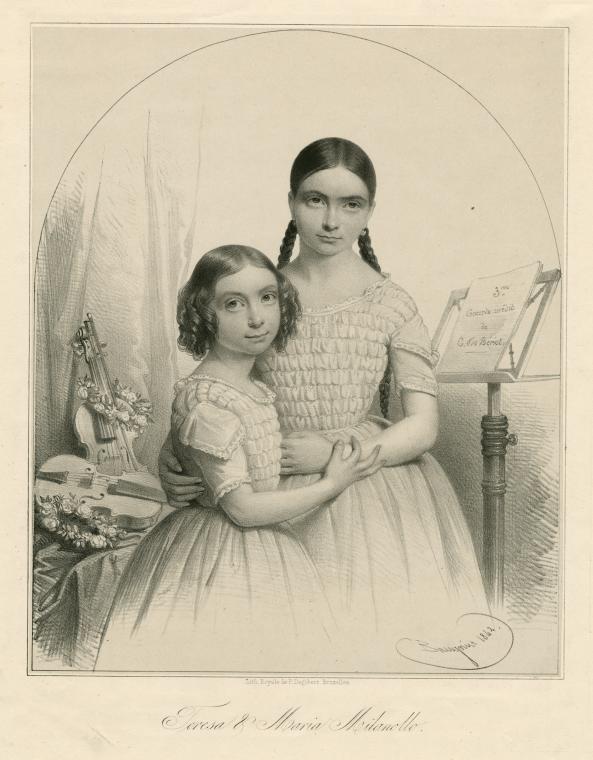
Teresa and Maria Milanollo, 1842

Exceptional as these notices were, Joseph’s Philharmonic debut was nearly overshadowed by the simultaneous appearance of two other child prodigies, Teresa and Maria Milanollo, whose arrival in Vienna had been a matter of breathless anticipation for weeks. The 15-year-old Teresa and her 10-year-old sister were adorable, gifted and irresistible, and they received copious, effusive notices in the press:

Truly, one can hear nothing more astonishing, nothing more surprising, nothing more enchanting than the violin playing of this thirteen-year-old child; [1] her talent is an insoluble puzzle, before which criticism stands powerless and perplexed — it is a marvel of nature, and not just for musicians but also for physiologists. In the hands of this magnificent girl, the violin is no longer an unsuitable instrument, for what is more graceful than this, so prettily formed arm, that controls the bow with the greatest noblesse and ease; this delicate child’s hand that masters the strings with giddy security! The talent of this child is equal to all genres; her execution is brilliant, gracious, sparkling, consummate, and above all full of deeply felt, touching expression — and at the same time full of purity and power, and inimitably tasteful, even in the most difficult passages, in double-stops and staccato. Her style is as grand as it is simple, and always her own. Her adagio is melting, her cantilena unsurpassable. Truly, one does not know what one should admire more, her immense talent, or her deep intelligence…. [ii]

Teresa had studied with various teachers in her native Savigliano, Italy, and in nearby Turin. When she and her sister were seven and three, they crossed the Alps on foot with their family, eventually arriving in Paris in 1837. There, Teresa took lessons from Lafont, Habaneck and de Beriot. Lessons were short-lived, however, as she was nearly constantly on the road, giving concerts in Holland and Belgium, England and Wales. At about this time, she began giving violin lessons to Maria, who was thereafter listed in programs as “Mlle. Maria Milanollo (Pupil of her Sister).” This much commented upon, maternal and nurturing, feature of their relationship added immensely to their popular and critical appeal. These “violin-playing angels” offered an appealing contrast in styles as well: Teresa’s playing was warm and emotional; Maria’s brilliant. To the public, they came to be known as Mademoiselle Adagio and Mademoiselle Staccato.[2]

Ex-Milanollo Francesco_Ruggeri

Francesco Ruggeri “Ex-Milanollo”

The concert instrument of Maria Milanollo [iii]

Like many young virtuosi, the Milanollo sisters lived hard lives, and encountered difficulties making the transition from prodigy to mature artist. They continued to travel widely on the virtuoso circuit, giving an immense number of concerts, but by 1845, they were beginning to encounter sharp, not to say sexist, criticism, especially in England:

As the efforts of young females, we are bound to own that the performances of the sisters Milanollo fully bear out their continental reputation. As a matter of art we would rather not number ourselves among the crowd of votaries who worship at their shrine. That the sisters are prodigies is undoubted — but prodigies are not invariably artists. Precocity is one thing, art another. The sisters Milanollo most betray the want of a steady and experienced master. They attempt things which are beyond their powers of execution, and thus, though they throw dust in the eyes of the multitude, they cannot deceive the connoisseur. The eldest, Teresa, who is eighteen, has certainly a great command of mechanism—but her mechanism is by no means faultless, and her style is not healthful. In the air of Bellini, on which Ernst has founded his Pirata fantasia, we remarked an excess of sentimentality which amounted to the maudlin. The continued miauling—to use an expressive word—absolutely put us beside ourselves. On the other hand, though a variation was omitted, and several of the difficulties (instance the pizzicato in the passage of tenths near the end) passed over, the variation in chords was admirably performed and proved that, with a careful instructor, Mdlle. Teresa Milanollo might become a first-rate executant. […] To sum up our opinion — the sisters Milanollo are clever, spiritual, and interesting girls — but unless they, for a while, abandon public playing — throw money-getting overboard — and take to serious and assiduous study — they are not likely ever to become great artists. [iv]

Teresa_and_Maria_Milanollo_by_Marie-Alexandre_Alophe

[v]

The Milanollo Sisters

The case of the Milanollo sisters demonstrates the dangers of the path that Joseph did not take: that of travelling Wunderkind. After a childhood of constant travel, Maria died of consumption at the age of 16, and was buried in Paris’s Père Lachaise cemetery. Grief-stricken Teresa withdrew from public life for some time, after which she devoted herself to giving concerts for the poor. Her Concerts des Pauvres were given in pairs: the first before a paying public, and the second before an indigent audience that, at the conclusion of the program, received gifts of money, food and clothing, bought with the proceeds of the paid event. Following her marriage in 1857, she retired from the concert stage. Joseph had been impressed with Teresa’s playing when she arrived in Vienna in 1843. It is not known how many of the sisters’ twenty-five concerts he attended. In later years, when she was the wife of French General Parmentier, he would never fail to visit her when he found himself in Paris. [vi]

 Teresa_and_Maria_Milanollo_by_Josef_Kriehuber

The Milanollo Sisters by Josef Kriehuber

During the summer of 1843, Joseph travelled to Leipzig, to audition for Mendelssohn. There, he also became acquainted with his prospective teachers: Gewandhaus concertmaster Ferdinand David, and the eminent theorist and cantor of St. Thomas’s Church, Moritz Hauptmann.

Returning to Vienna for a final visit, he gave a farewell recital. Saphir reported (20 July) in Der Humorist: “While visiting his family, the amiable violinist, Joseph Joachim, also highly esteemed in the [Imperial] Residence, has given a private academy in the salon of his uncle, the wholesaler Herr Vigdor. All that our city has to show for artists and patrons of art graced this private concert with their presence. The winsome little singer (that is Joachim on his instrument) was smothered in caresses. He who has not seen this Wunderkind with his own eyes as he performs the compositions of Classical masters would believe himself to be hearing a Nestor, or one of the modern, celebrated heroes of the violin. Joseph Joachim lacks only world renown — the aura of widespread reputation, in order to shine amongst the violin-stars of the present, both spiritually and technically. Whether his honorable family will see their wish fulfilled, to have the great public delight in their darling’s songs, is not yet determined.” [vii]

Screen Shot 2014-12-11 at 9.49.07 AM

On August 1, Joseph took a final leave of Vienna. With the Wittgensteins, he took the post-coach via Prague to Dresden, and the train from there to Leipzig. [viii] He did not get a chance to say farewell to the Böhms, who were staying in their summer residence at Schloss Plankenburg.

Joseph Joachim to Joseph Böhm [ix]

Vienna, [Monday] July 31, 1843

Revered Herr Professor,

You cannot imagine how sorry I am to miss the pleasure of seeing you before my departure, since I will not see you now for so long. The reason that I have not taken the liberty of visiting you in Plankenberg is that I only arrived here on Wednesday (delayed by illness), and I return tomorrow to Leipzig, which Mr. Wittgenstein only decided upon the day before yesterday; if I had known that we would leave my beloved Vienna so soon, I would have come to you in the first days of my presence here—so I am forced to take leave of you merely in writing. So with this I bid you my affectionate farewell, and further ask you to remember me; I will never forget the good things that you and your honored wife have done for me, and I will also strive to see that your efforts will not be in vain, to gratify you through my diligence. — Now farewell, dear Herr Professor, stay healthy, content and happy as you are now, and think sometimes, too, of your respectful and grateful pupil

Jos Joachim.

I kiss your dear, gracious wife’s hand. […]

Althen_Stationsrestaurant

Train on the Leipzig—Dresden Line, ca. 1837

[x]

© Robert W. Eshbach, 2013


Next Post in Series: Interlude: Leipzig 


[1] Following a well-worn custom, someone shaved several years off Teresa’s age.

[2] Teresa played a violin by Pietro Rogeri, later owned by David Oistrach. Maria played a 1703 Stradivarius. In 1846, the girls were bequeathed a pair of precious instruments by the great bass virtuoso Domenico Dragonetti. Maria received a violin built by Antonius and Hieronymus Amati ca. 1620, currently in the Smithsonian Institution; Teresa a 1728 Stradivarius that had once been the possession of Giovanni Battista Viotti, and had been played by Paganini. The Dragonetti-Milanollo Strad, an instrument of peerless beauty, has subsequently been owned by Christian Ferras and Pierre Amoyal. It is currently on loan to Corey Cerovsek.


[i] New York Public Library

[ii] Allgemeine Wiener Musik-Zeitung, No 35 & 36: 23, 25 March 1843, p. 147.

[iii] Tarisio Auctions

[iv] The Musical World, Vol, 20, No. 21 (May 22, 1845), p. 242.

[v] Musical Times, November 1, 1906, p. 737.

[vi] Moser/JOACHIM 1901, p. 24.

[vii] “Der liebenswürdige Violinspieler, Joseph Joachim, auch in der Residenz rühmlichst bekannt, hat, auf Besuch bei seiner Familie anwesend, im Salon seines Onkels, des Großhändlers Hr. Vigdor, eine Privatakademie veranstaltet. Was unsere Stadt an Notabeln Künstlern und Kunstmäcenaten besitzt, verherrlichte dieses Privatconcert. Der herzgewinnende kleine Sänger (das ist Joachim auf seinem Instrumente) wurde von Liebkosungen erdrükt. Wer dieses Wunderkind, während es die Kompositionen klassischer Meister vorträgt, nicht mit eigenen Augen sieht, glaubt in der That einen Nestor, oder einen der modernen, gefeierten Heroen der Violine zu hören. Joseph Joachim fehlt nur noch die ausgebreitete Weltbekanntschaft — der Nimbus des verbreiteten Rufes, um schon jetzt in geistiger wie in technischer Beziehung unter den Sternen der Violinisten der Gegenwart zu glänzen. Ob seine verehrliche Familie dem allgemeinen Wunsch: das große Publikum an den Gesängen ihres Lieblings delektiren zu lassen, nachkommen werde, ist bis jetzt unentschieden.” Der Humorist. Von M. G. Saphir, Vol. 7, No. 143 (Thursday, 20 July, 1843), p. 379.

[viii] Ehrlich/KÜNSTLERLEBEN, p. 154.

[ix] Biba/PEPPI, p. 201.

[x] Wikipedia http://en.wikipedia.org/wiki/File:Althen_Stationsrestaurant.jpg

Share this:

  • Share on X (Opens in new window) X
  • Share on Facebook (Opens in new window) Facebook
  • Email a link to a friend (Opens in new window) Email

Like this:

Like Loading...

Vienna Philharmonic Debut

18 Tuesday Jun 2013

Posted by Joachim in 1 Biographical Posts — RWE

≈ Leave a comment


Previous Post in Series: Summer Work in a Summer Playground 

__________

JJ Initials

Vienna Philharmonic Debut

A notice appeared in the August 13 edition of the Allgemeine Wiener Musik-Zeitung that on the following day, the 14th, Herr Saphir would give a musikalisch-declamatorische entertainment for the benefit of Baden’s Infant-preservation Institute. The performers were to include Dlle. Lutzer and Herr Staudigl, and, once again, “the ingenious little violinist Joachim.” [i] Whether this concert actually took place on the date indicated is unclear. In any case, a review later appeared in the same journal of Saphir’s benefit for the same charity in the Baden Theater at noon on August 28th. The roster of performers had grown, but Joseph, being “indisposed,” was not among them. [ii] As we learn from the following letter to Böhm, the first that we have from Joachim himself, Joseph was afflicted with a rash. The letter, undoubtedly written with his Aunt looking over his shoulder, nevertheless shows a degree of independence and sophistication rare in an 11-year-old.

Joseph Joachim to Joseph Böhm [iii]

Baden [bei Wien] September 12, 1842

Highly honored Herr Professor,

It gives me the greatest pleasure to let you know that on Friday I will be back in your dear company. If we have good weather, my dear Aunt will probably accompany me; otherwise, someone from the Comptoir will take me to Plankenberg. [1] — I am now once again completely well, and there is no longer any trace of the rash. I am very much looking forward to your loving instruction, which I have had to do without for so long, and, though I have been diligent here, I am unfortunately doubtful whether you will be satisfied with me. — You will certainly already have news from dear Louis, [2] which I would very much like to know. I hope to find you and your honored wife healthy and cheerful, and remain, with respect and love,

your pupil,

Jos. Joachim

Pepi

Joseph Joachim: An Early Daguerreotype

On February 20, 1843, Joseph played at the annual “private entertainment” of Franz Glöggl (1796-1872), publisher, music shop owner, professor of trombone and bass at the conservatory, and archivist of the Gesellschaft der Musikfreunde. The long and diverse program featured an elite cadre of performers, including Mad. Hasselt-Barth, who sang Schubert’s Gretchen am Spinnrade and several of her husband’s songs, receiving praise for her brilliant coloratura, and criticism for the overheated expression of her performance. There were other singers and other songs as well, and a wide variety of instrumental pieces. Among the performers, Joseph was singled out for special notice. “This is a hearty, genuine talent,” claimed Der Humorist, “not an inflated, labored virtuosity that has been pummeled into him. Here is fullness of tone, so much proficiency in all fingerings, passages, positions; such elegance of interpetation, as if the boy had labored for twenty years with the fiddle, though he has lived barely more than half that time. […] Once again, a pupil comes from master Böhm’s hand, in whose talent the teacher has found a rich soil, from which beautiful art-blossoms spring; but if we take pleasure in the flower, we must acknowledge the gardener who has tended it so well.” [iv] Critic A. J. Becher of the Sonntags-Blätter concurred: “J. Joachim played Ernst’s exceedingly difficult Othello Fantasy with a security of mechanism, a finished conception of expression and a roundness of tone that one seldom hears in a pupil (and then, only in a pupil of a master like Prof. Böhm). One is indeed familiar with the mastery of this promising boy, astonishing for his age; nevertheless, one is each time surprised anew.” [v] The reviewer for Der Wanderer wrote: “I have never so regretted that the term Wunderkind is so used up, and moreover has a bad reputation, as now, for, in my haste, I can find no other suitable term for this little hero of the violin. I heard Joachim today for the first time, and I must confess that I often could not believe my eyes. This powerful stroke, this lively combination of colors [Colorit], this astonishing bravoura, and from a small boy, twenty Paris Zoll in height, that works these wonders — — what should one demand from finished virtuosi?”  [vi]

April 43 Cons. Program

[vii]

On Wednesday, April 5, 1843, Joseph played a Rode concerto (the program does not reveal which) in a Conservatory pupil’s concert, under the direction of Ferdinand Füchs, who had temporarily taken over leadership of the orchestra from Preyer. Joseph appeared 5th and 8th on the program: between the first and second movements of the concerto the choir sang a hymn, and two voice students sang a duet from Spohr’s Jessonda.

That year, Joseph’s cousin Fanny, who had been so influential in helping the Joachims to send their son to Vienna, would once again play a decisive role in directing his career. In 1839, Fanny had married Hermann Christian Wittgenstein, [3] a wool merchant some eleven years her elder, and a business acquaintance of her brother Gustav. Operating out of offices in Vienna and Leipzig — where nearly all the wool-export companies were headquartered — Hermann acquired wool from Poland and Hungary and sold it in England and Holland. After their wedding, Hermann and Fanny left Vienna and settled in Leipzig, where, as it happened, Felix Mendelssohn was just then working to create a Conservatory of Music — a German alternative to the Paris Conservatoire — that would reflect his own artistic credo. “From her new home,” writes Otto Gumprecht, Fanny “could not report enough of the lively artistic life that surrounded her on all sides. These alluring descriptions made the deepest impression on her cousin’s mind. He resolved to complete his studies at the newly-founded Leipzig Conservatory, and despite the objections of his Viennese relatives, who, jealous of the family pride, did not want to allow him to move so far away, he persisted in his decision.” [viii]

Here, as elsewhere, Joseph is depicted as having had a strong and even stubborn sense of his own best interest and future direction. Andreas Moser nevertheless credits Fanny Wittgenstein, who “exerted her whole influence to have the boy sent to Leipzig for further development in his art.” [ix] In any case, Julius Joachim was persuaded, and resolved to follow both Fanny’s advice and Joseph’s desire. In the view of Joachim’s friend and colleague Heinrich Ehrlich, this decision was a blessing that led ultimately to the “harmonious development of the man.” “Other than the happy Felix Mendelssohn, there has been no musician in modern times who has been governed by such an auspicious star [as Joachim]; to whom it was granted to develop his capabilities in such an untroubled, straight-forward manner. Above all, he was granted the good fortune not to be sent as a Wunderkind on “artist-tours,” but rather to be brought to the Conservatory that Mendelssohn had just founded. Our time has no idea of the consequence of this decision. In the forties […] the currently-prevailing attitude toward art had achieved an enduring currency and success only in north Germany; in the south, where virtuosity, Italian opera and Meyerbeer reigned, it was little regarded. In Vienna, in particular, Mendelssohn was regarded by the majority of professionals and critics as an egghead musician; Schumann interested the public only as the storied huband of Clara Wieck, whose father had for so long refused to give in [to their desire to marry]. His compositions, which Vienna now adores, were known by very few. I remember very well how he came to Vienna in the forties with his wife, and how she performed his wonderful concerto for a half-empty house, with little success. At the time that I am speaking of, the Viennese regarded only Paris as the city in which a young artist could achieve the highest training and reputation; that one could learn much from a Leipzig violin player ‘David,’ or become a great musician under the supervision of Mendelssohn and the ‘old’ Moscheles, seemed so doubtful that even Joachim’s Viennese teacher Böhm, an admirable, classicly trained virtuoso, found this move by his pupil strange.” [x]

In convincing Julius Joachim to send his son to Leipzig, Fanny prevailed over the united objections of her own father and uncle Nathan, who often vied with one another as Joseph’s principal caregiver. More importantly, she prevailed over the opposition of Joseph Böhm, who, according to Moser, showed not a little displeasure at the idea. Böhm had wanted Joseph to follow the virtuoso route to Paris. In his opinion, there was no one in Leipzig who could fill the role of a destination teacher; and despite the prestige of its founder, the Leipzig Conservatory was, as yet, a school in name only.

Otto Nicolai

[xi]

Otto Nicolai, 1842

Lithograph by Kriehuber, Vienna

Before departing for Leipzig, Joseph made an important début, in the fourth-ever subscription concert of the nascent Vienna Philharmonic Orchestra. [4] Playing on Sunday, April 30 before a capacity audience at the Imperial and Royal Redoutensaal, he performed the Adagio religioso and Finale marziale movements of Vieuxtemps’s fourth concerto in D minor. The otherwise lack-lustre program included Preyer’s Symphony in D minor, [5] Abbé Vogler’s Ouverture to Samori and an aria from Mercadante’s Ipermnestra. “It is astonishing what this little virtuoso achieves,” observed the Allgemeine Wiener Musik-Zeitung; “with what security and ease he conquers even the most difficult passages, and with what boldness he performs overall.” [xii] “The young violin virtuoso Joachim provoked a true sensation with an Adagio and Rondo from Vieuxtemps’s newest concerto” wrote Saphir. “Rarely has the voice of the public been so fully in accord with that of the critics as concerning the talent of this still virtually child-like boy; rarely have the most daring prospects become manifest as they have with him. Little Joachim has many very worthy fellow mignon-virtuosi here, both smaller and larger, but none possesses a power of interpretation so steeped in mind and spirit, with such irreproachable clarity and subtlety and nuance, with such boldness and resoluteness of bowing [6] — in short, with so much technical correctness; none advances toward such a bright future, as he. His well-grounded and solid playing was interrupted by the liveliest applause, and at the end he was recalled three times with stormy acclaim.”[xiii]

Joseph had had an opportunity to hear the concerto from Vieuxtemps himself that Spring, when the young Belgian master had played in the same hall. As with Ernst’s Othello Fantasy, Joseph was not detered from attempting the work, though the memory of the composer’s own performance was still fresh in his audience’s ears. The critic for Frankl’s Sonntags-Blätter made the inevitable comparison in his review:

In these pages, I have frequently had the opportunity to speak of the magnificent equipment, and — for his age — unusually advanced attainments of this twelve-year-old boy, for whom, with his diligence and his freshness, one can predict a distinguished future; it was also extremely pleasant this time to observe the persistent progress that he has made in technique and interpretation since last year. Our Joachim succeeded in such a surprising degree with the exceedingly difficult compositon — which we just recently heard performed with consummate mastery and artistry from the composer’s own irreproachable hands — that it made a generally satisfactory impression, not merely from the relative standpoint of a youthful virtuoso, but viewed in and of itself. Parts of it were, indeed, quite excellent. [xiv]

© Robert W. Eshbach, 2013.


Next Post in Series: Milanollos, and a Farewell to Vienna


[1] The Böhms lived from summer until early autumn in Sieghartskirchen, 17 miles west of Vienna, at Schloss Plankenburg, the former estate of Count Moritz von Fries. At the time that the Böhms stayed there, the Fries estate was a boarding school for the nobility.  [Biba/PEPPI, p. 200.] The manor house was eventually sold to the Liechtenstein family, who rented it in the 1880’s to the well-known landscape painter Emil Jakob Schindler. Schindler’s daughter, Alma, the wife of Mahler, Gropius and Werfel, and lover of Oskar Kokoschka, grew up there, fearing the ghost that was said to walk the grounds.

A patron of Beethoven and Schubert, and the dedicatee of Beethoven’s Seventh Symphony, Imperial Treasurer Count Moritz von Fries (1776-1826) was co-proprietor of the Viennese banking house Fries & Co. Fries was a man of great culture, well traveled and well-read, and a great lover of music. His extensive art collection included works by van Dyck, Dürer, Rembrandt and Rafael. The family fortune had been assured when Fries’s father received a privilege for the minting of the “Maria Theresa Thaler,” in 1752. The Maria Theresa Thaler has been legal tender in many countries worldwide since 1741. Fries was allowed to keep 1/3 of the Seignorage—the difference between the face value of the coins and their cost of production.

[2] Böhm’s nephew, Ludwig Böhm, Joseph’s fellow pupil and housemate.

[3] Hermann Christian Wittgenstein (b. September 12, 1802 in Korbach — d. May 19, 1878 in Vienna).

[4] The first concert of the Vienna Philharmonic —Vienna’s first professional concert orchestra — was given under Otto Nicolai’s direction on March 28, 1842, the same year as the founding of the New York Philharmonic. In the beginning, the Vienna Philharmonic had no regular season. It gave only 14 concerts between 1842 and 1848.

[5] Schumann’s 1839 consideration of a Preyer symphony, perhaps this one, is interesting as much for what he says about Viennese tastes as for what he says about Preyer’s work: “A few pages suffice to disclose a progressive young composer, initially somewhat ill at ease in the large, unfamiliar form, but gaining in security and courage as he gets under way. His aspirations must be doubly acknowledged in view of the fact that he lives in a city where little encouragement is vouchsafed the solid, serious or even profound average, where judgments for and against are largely determined by first impressions, and where the verdict is usually couched in terms of ‘it appealed’ or ‘it did not appeal.’ Thus it was after the première of Christus am Ölberge and Fidelio. They did not appeal, and that was the end of it. This symphony, which has been played frequently in Vienna, ‘appealed.’ It even ‘impressed,’ thanks to the veneer of scholarly working out which it often displays.” [Henry Pleasants (ed.), Schumann on Music: a Selection from the Writings, New York: Dover Publications, 1988, p. 149.]

[6] Ignaz Lewinsky also noted Joseph’s boldness of approach in his brief review for the Allgemeine Wiener Musik-Zeitung, Vol. 3, No. 53 (May 4, 1843), p. 222.


[i] Allgemeine Wiener Musik-Zeitung Vol. 2, No. 97 (August 13, 1842), p. 396.

http://books.google.com/books?id=hOMqAAAAYAAJ&printsec=frontcover&dq=editions:LCCN10024356#PRA1-PA396,M1

[ii] Allgemeine Wiener Musik-Zeitung Vol. 2, No. 105 (September 1, 1842), p. 427.

http://books.google.com/books?id=hOMqAAAAYAAJ&printsec=frontcover&dq=editions:LCCN10024356#PRA1-PA427,M1

[iii] Joachim/BRIEFE I, p. 1.

[iv] Der Humorist von M. G. Saphir, Vol. 7, No. 37 (February 22, 1843), p. 154.

http://anno.onb.ac.at/cgi-content/anno?apm=0&aid=hum&datum=18430222&seite=2&zoom=2

[v] Sonntagsblätter, Vol. 2, No. 9 (February 26, 1843), p. 205. M. T. http://anno.onb.ac.at/cgi-content/anno?apm=0&aid=stb&datum=18430226&seite=13&zoom=2

[vi] Der Wanderer in Gebiete der Kunst und Wissenschaft, Industrie und Gewerbe, Theater und Geselligkeit, Vol. 30, No. 45 (Wednesday, 22 February, 1843), p. 179.

[vii] Private collection.

[viii] Gumprecht/CHARAKTERBILDER, p. 263-4. Gumprecht knew Joachim, and doubtless learned this at first hand.

[ix] Moser /JOACHIM 1901 p. 34

[x] Ehrlich/KÜNSTLERLEBEN, pp. 154-155.

[xi] Wikimedia commons.

[xii] Allgemeine Wiener Musik-Zeitung Vol. 3, No. 53, p. 222.

[xiii] Der Humorist von M. G. Saphir, Vol. 7, No. 87 (May 3, 1843), p. 354.

http://anno.onb.ac.at/cgi-content/anno?apm=0&aid=hum&datum=18430503&zoom=2

[xiv] Sonntags-Blätter, Vol. 2, No. 19 (May 7, 1843), p. 452.

Share this:

  • Share on X (Opens in new window) X
  • Share on Facebook (Opens in new window) Facebook
  • Email a link to a friend (Opens in new window) Email

Like this:

Like Loading...

Summer Work in a Summer Playground

17 Monday Jun 2013

Posted by Joachim in 1 Biographical Posts — RWE

≈ Leave a comment


Previous Post in Series: A Young Virtuoso 

__________

JJ Initials

Summer Work in a Summer Playground

0095

[i]

Baden bei Wien, painting by C. L. Hofmeister

Scheiner’s Kaffeehaus is the building with the portico on the left.

The school year over, Joseph spent the month of August and the first weeks of September with his Figdor relatives in Baden bei Wien, a spa resort frequented by affluent Viennese, including the highest nobility. [1] With its elegant public and private buildings, its warm mineral baths dating to Roman times, its wine gardens and coffee houses, its chestnut, linden and acacia allées, its flower gardens and parks, its evening illuminations, plays, concerts, balls and public readings — the town of Baden provided an idyllic escape from the heat and bustle of the city, and a pleasant opportunity for recreation and socializing. Upon the death of Emperor Franz in 1835, many of the aristocracy had ceased to summer in Baden; nevertheless, the resort was now enjoying a welcome revival since the opening of the railroad connection to Vienna in June 1841.

SB_Philadelphia

[ii]

The American locomotive “Philadelphia,” named after its city of manufacture, was the first locomotive on the Vienna-Baden line. The first Austrian railway line, between Vienna-Floridsdorf and Deutsch Wagram, had opened only four years earlier, in 1837.

Baden had been ravaged by fire three decades earlier, on July 26, 1812, and was subsequently rebuilt, in the Biedermeier style, through a combination of public and private largesse, including the proceeds of numerous benefit concerts and readings. [2] The residents of Baden may therefore have been particularly sympathetic when they learned that the Galician (Polish) town of Rzeszów had been consumed that June in a great conflagration. A gala benefit concert and reading was organized for Rzeszóws victims, to take place on August 7, 1842, in the ballroom of the Schloss Gutenbrunn. Tickets went on sale at Scheiner’s Kaffeehaus, a sojourner’s destination since 1803, whose pleasant portico was a popular gathering place for the well-to-do; tickets were also available at one of the stately and elegant houses on Baden’s Antonsgasse, adjacent to the palace of the recently deceased Archduke Anton. [3]

The charitable musikalisch-declamatorische Akademie was probably produced by its featured performer, Moritz Gottlieb Saphir, who, in the days before regular concert series, made a specialty of organizing such events. “Saphir’s academies are living samples of the notable artists that are harbored at a given time in our residence,” gushed the Wiener Allgemeine Musik-Zeitung half a decade later; “[…] they are the fragrant flower bouquets that are chosen and picked in the art-garden of our musical delights. Saphir’s academies unite the quiet art lover with the loud art-enthusiast, the lover of wit and humor with the lover of sentimental declamation; but also the benefactor and friend of the poor and the suffering. In short, Saphir’s academies are the unifying point of the most heterogeneous tastes; in them meets the most peculiar mix of a pleasure-seeking public. Saphir understands as no other how to cater to every palate; he is ready to provide everyone’s favorite dish.”[iii] This particular Olla Podrida of a program included an etude for piano by Thalberg, played by Dlle. Amalie Schönbrunner; a duet from Rossini’s Semiramis, performed by Dlle. Schwarz and Herrn Arcadius Klein; an unspecified poetic declamation; Ernst’s Othello Fantasy, performed by “the little violin player” Joseph Joachim; a cavatina from Donizetti’s Belisario, sung by Mad. Sophie Schoberlechner, née Dall’Occa; a duo concertante for piano and horn, performed by Herren Carl and Richard Lewy; and a humorous reading, composed and performed by Saphir himself. [4]

Moritz Saphir

[iv]

Moritz Gottlieb Saphir
Lithograph by Kriehuber, Vienna, 1835

Contemporary journals may well have raved about Saphir’s academies, but for critic Eduard Hanslick, writing in 1870, Saphir epitomized everything that was objectionable about Vienna’s pre-March concert life:

Through his consummately characterless yet dazzling wit, Saphir had raised himself to be the dominant force in Viennese journalism, and the idol of the Viennese public. They lived and breathed Saphir’s jokes. Saphir was flattered and feared as no other. The self-assurance of his wit, his jokes and word-plays, also dominated his criticism and corrupted that of the other Viennese. Saphir understood nothing at all about music; nonetheless, he wrote happily and often about it whenever he could raise one of his favorite virtuosi to the heavens, or could tread one that he disliked into the dirt. No matter how unjust he was in any particular case, the phalanx of laughers was on his side, and a witty remark could make or break a concert-giver’s fortune. The “Humorist” (a poorly edited, and, aside from Saphir’s own articles a completely trivial paper), exercised its corrupting influence on Viennese society for fully 21 years. Saphir placed himself in direct rapport with the public through the large “Academies” of which he gave two or three annually (from approximately 1834 to 1847). These academies, originally produced in the Josefstadt Theater, then a few times in the Wiedner Theater and finally in the Court Opera Theater, were a chrestomathy of all the artistry that Vienna had to offer. The most famous virtuosi and singers, the most celebrated artists of the Burgtheater and Court Opera participated in Saphir’s academies, for who among them would be so foolish as to court Saphir’s fury, or miss out on the prospect of a witty accolade, with a refusal? Saphir’s academies were the best attended and most beloved that there were in Vienna; people crowded for hours beforehand to get the best seats. And as the public wallowed in Saphir’s ironic-sentimental poems and insatiable wordplays, so journalists vied with one another in truly Byzantine idolatry over these academies. [v]

Saphir’s academies were variety shows, constructed according to a simple formula: a mixture of song, humor, dramatic reading, and virtuoso performance. In their own way, they were innovative and valuable: they helped establish a taste — and a market — for the German Lied as a genre, and Schubert’s Lieder in particular, and they provided a springboard for the talents of some of Austria’s most promising young musicians. In addition to Joseph Joachim, Saphir gave early opportunities to another Böhm prodigy, Alois Minkus, who played the Othello Fantasy at a Saphir academy in Pressburg, May 1, 1842 (earning praise, like all of Böhm’s students, for his excellent staccato); and also to the 8-year-old Moravian violinist Wilhelmine Neruda, who performed de Beriot’s sixième Air Varié in January 1847. Minkus subsequently achieved considerable renown as a composer of ballet music in Russia; Neruda, later Wilma Norman-Neruda (Lady Hallé), became one of the great violinists of the century.

annoshow

“What should I say about the little eleven-year-old violin virtuoso Josef Joachim?” asked the reviewer for the Sonntags-Blätter on this occasion. “That all the audacious expectations that his admirable playing arouses in expert listeners should be fulfilled, and that he should become one of the most illustrious stars in the firmament of virtuosi! He performed Ernst’s Othello Fantasy, and anyone who knows and appreciates the unusual and multi-faceted difficulties of this work understands what it means to say that everything in it was well-done, and much was consummately played. His excellent teacher, Herr Prof. Böhm, was accorded the well-deserved recognition of receiving a bow with his brilliant little pupil.” [vi]

The Allgemeine Wiener Musik-Zeitung spoke, not of virtuosity, but of artistry:

The eminent talent of this eleven-year-old artist—(one can call him this without exaggeration)—is so universally accepted, that I limit myself to saying that no one, hearing this supremely gifted boy for the first time with eyes shut, could suspect that it was not a man playing, and indeed one who already climbed to a high rung on the ladder of maturity; for his playing unites purity of intonation, security of technique, sweep of imagination, and intimacy of expression. Here, one may expect great things of the future, and the more so, since this rare innate talent is being nurtured with all the aid and solid direction of the proven master, Herr Prof. Böhm. [vii]

© Robert W. Eshbach, 2013.


Next Post in Series: Vienna Philharmonic Debut 


[1] Jews had first obtained permission to stay year-round in Baden in 1805, and in 1822, the first Jew, Heinrich Herz, had obtained a formal right of settlement. In 1839, Herz’s son Leopold occupied a house in the Wassergasse, where he opened a kosher restaurant and a Synagogue for 285 people. In 1849, Leopold Herz became the first Jew to be allowed to own property in Baden, a right that would not become general until 1860. Many of Baden’s Jewish residents came from the communities of Mattersdorf or Lackenbach in the Sheva Kehillot.

[2] Among the benefit concerts was one given in Karlsbad on August 6, by the Italian violinist Giovanni Battista Polledro, and the German pianist Ludwig van Beethoven, that raised 1,000 florins W. W. The charitable activities related to the Baden fire led directly to the founding of Vienna’s Gesellschaft der Musikfreunde and its conservatory.

[3] Rzeszów had a large Jewish population, and the preponderance of Jewish performers at this benefit, as well as the ticket sales at Scheiner’s Kaffeehaus (Scheiner was a common Galician Jewish name), suggests that the concert may have found its principal support among Jewish social circles.

[4] Many of Saphir’s academies featured the same participants. For example, Klein, the Lewys and Saphir had also participated in a benefit for the victims of the Pest flood four years earlier, April 1, 1838, in Vienna’s k. k. Redoutensaal. [Gibbs/LISZT, p. 182]


[i] Photo credit: Kinsky Art Auctions, Vienna.

[ii] Wikimedia Commons. http://de.wikipedia.org/wiki/WRB_–_Philadelphia

[iii] Wiener Allgemeine Musik-Zeitung, Vol 6, Nos. 14 & 15 (February 2 and 4, 1847), p. 60.

[iv] Wikimedia Commons.

[v] Hanslick/CONCERTWESEN I, p. 365.

[vi] Sonntags-Blätter für heimathliche Interessen, Vol. 1, No. 33 (August 14, 1842), p. 589

http://anno.onb.ac.at/cgi-content/anno?apm=0&aid=stb&datum=18420814&zoom=6

[vii] Allgemeine Wiener Musik-Zeitung, Vol. 2, No. 96 (August 11, 1842), p. 392. http://books.google.com/books?id=hOMqAAAAYAAJ&printsec=frontcover&dq=editions:LCCN10024356#PRA1-PA392,M1

Share this:

  • Share on X (Opens in new window) X
  • Share on Facebook (Opens in new window) Facebook
  • Email a link to a friend (Opens in new window) Email

Like this:

Like Loading...

A Young Virtuoso

17 Monday Jun 2013

Posted by Joachim in 1 Biographical Posts — RWE

≈ Leave a comment


Previous Post in Series: Conservatory Student 

__________

JJ Initials

A Young Virtuoso

The little Joachim is at present already a virtuoso on his instrument, and with this the entire judgment of him may be spoken, since we are not inclined to be all too free with that expression; however, one would like to impress deeply upon him the motto of the late Jurende: [1] “Do not stand still, stride steadily forward.” [i]

                                    — Allgemeine Wiener Musik-Zeitung, February 22, 1842

Kärntnertortheater

[ii]

Kärntnertortheater, Vienna
Copperplate, Tranquillo Mollo (1767-1837)

On a chilly Sunday, November 15, 1841, Joseph stepped before the Viennese public for the first time as Böhm’s protégé. The event, a gala benefit for the homeopathic hospital of the Merciful Sisters of St. Vincent de Paul was held in the in the k. k. Hoftheater nächst dem Kärntnerthore — the theater where, seventeen years earlier, Beethoven had conducted the premiere of his 9th Symphony. [2] The long musikalisch-declamatorische Akademie featured the city’s most illustrious performers: from the Court Opera, the renowned Dutch soprano, Wilhelmine Hasselt-Barth, soubrette Jenny Lutzer (wife of poet and Theaterintendant Franz von Dingelstedt), tenor Joseph Erl, and basses Johann Karl Schober (Schoberlechner) and Joseph Staudigl; appearing from the Burgtheater were actors Karl Fichtner, Heinrich Anschütz [3], Luise Neumann and Julie Rettich. The orchestra, conducted by the Opera’s Kapellmeister Heinrich Proch, was led by Joseph’s former violin teacher Georg Hellmesberger. Among the thirteen numbers performed, the anticipated highlight of the evening was the second Viennese performance of Mendelssohn’s Overture to A Midsummer Night’s Dream.

 Heinrich_Proch

[iii]

Heinrich Proch, Lithograph by Kriehuber, Vienna, 1840

 Hasselt

[iv]

Wilhelmine Hasselt-Barth, 1837

Joseph Staudigl 

Joseph Staudigl, Lithograph by Kriehuber, Vienna

 Heinrich_Anschuetz

[v]

Heinrich Anschütz

 Julie_Rettich

[vi]

Julie Rettich, Lithograph by Kriehuber, Vienna, 1835

Jenny Lutzer

[vii]

Jenny Lutzer, Lithograph by Kriehuber, Vienna, 1839

In Biedermeier Vienna, Wohltätigkeits-Akademien (“charitable academies”), together with virtuoso concerts, were the principal form of  concert life. The Hoftheater program, typical of such benefit entertainments, began with Lindpaintner’s Ouverture to Faust, an aria and chorus from Spohr’s Faust, and a poem, Lerchendank, by J. G. Seidl (a poet chiefly known today through song settings by Schubert, Loewe and Schumann). Fourth on the program came “the little Joachim” — according to M. G. Saphir’s Der Humorist: “a fresh-budding, lushly-verdant musical plant, acknowledged, even among the mass of luxuriant florets.” [viii]  “Joseph Joachim’s playing and performance of [Charles de] Beriot’s Adagio and Rondo truly surprised us,” wrote “Gross Athanasius” for the Allgemeine Wiener Musik-Zeitung.

[He] fully justified anew our conviction and our often-made claim about the soundness of Herr Prof. Böhm’s teaching method; for here, everything was accomplished — even the most audacious expectations that one can ask of an 8-to-9-year-old [Joseph was 10] — and the word virtuoso, if we wish to assign it to the little violinist, would not be an arrow shot too high above the target. Without question, one cannot, and will not, expect and demand from a child performing a composition of Beriot the power of tone, the subjectively nuanced interpretation, the firm, bold playing of a man; but his tone is pure, strong, his bowing noble and correct, his staccato astonishing, especially with a short bow, his harmonics pure and secure; and there was not — and this is truly all that one can say here — a false tone to be heard in any passage; neither in the runs nor in the double stops. Herr Professor Böhm has already trained a number of outstanding pupils, and if Joachim follows in the path that has been set out for him, we may confidently predict the highest for him; he should beware of arrogance; otherwise false paths are unavoidable, and — the return to, and progress along, the path of genuine art is very difficult. Experientia docti — ! [ix]

Two months later, Böhm’s newly-fledged pupil would again stand before the public, this time with a piece of an altogether higher level of difficulty: Heinrich Wilhelm Ernst’s Fantasie Brillante sur la Marche et la Romance d’Otello de Rossini, Op. 11, dedicated to Joseph Böhm and first published two years earlier in Mainz. Ernst’s Othello Fantasy has more musical substance than most virtuoso showpieces; at the same time, with its double stops, harmonics, quick runs and intricate passagework, it is a formidable technical challenge for even the most accomplished violinist. With the composer’s own astounding interpretation still fresh in the ears of the Viennese public, it was a daring choice for a student violinist to present to the public. Nevertheless, the Othello Fantasy would remain Joseph’s Cheval de Bataille from the age of ten until his mid-teens.

Screen shot 2013-07-03 at 5.01.00 PM

[x]

Program from the fourth Conservatory Concert,
27 January 1842

The performance took place on Thursday, January 27, 1842, in the fourth conservatory concert. Music critic J. N. Hofzinser reviewed the concert in the Wiener Theaterzeitung on January 31, 1842:

The palm of this evening went, and belonged by right to, the ten-year-old student of Herrn Professor Böhm, Joachim, who played variations by Ernst with astonishing virtuosity. The profession will soon have arrived at its peak of unattractiveness for adult concert artists if even boys prove so capable of comprehending and performing. Joachim is truly a musical phenomenon. It is difficult to discern whether his eminent interpretation surpasses his splendid technique or vice-versa.

If one hears the wonderful cantabile in the boy’s playing, with that intensity of feeling, the suffering in the tone, the lament of the violin, that resounding pain, which, as one imagines, only dreary life-experiences are capable of enticing out of the instrument, one becomes disoriented by the vision before one and believes oneself to be the plaything of an optical illusion. In this boy we behold the ripest fruit in early blossoming-season; we see in him the finished, deeply-feeling artist.

With regard to technique, Joachim handles the violin in an utterly exceptional manner. He possesses a beautiful skill in guiding the bow — which is not disturbed by the most heterogeneous bow-strokes on the E and G strings — combined with an exceedingly effortless control of the right hand. Through correct and expedient fingering, the left hand also displays this exemplary manner in the creation of a beautiful tone as well as in the clarity and distinctness of the passagework in all positions.  His playing reveals true study of the art of fingering.

In the execution of the aforementioned variations, Joachim displayed not only the greatest security in conquering immense difficulties, which in this piece seem to aim at outdoing one another, but also exhibited every beauty of the violin. Chords heap against chords in the most difficult forms and in all positions; thirds, octaves and tenths, chromatic and diatonic runs in the most rapid tempo, arpeggios with detaché and springing bow-strokes, staccatos at the tip and middle of the bow, pizzicato notes mixed with arco; in short, everything that may be called difficult this boy played with a security, purity and clarity that touches on the miraculous, in a performance that attests to the most admirable schooling and the most masterful method.

The reception was equal to the uncommon level of the achievement; it created an unparalleled clamor. After repeated recalls, intended for the boy, the audience did not rest from applauding until the appearance of the great master Böhm (who only seems to retire from playing in public in order that much more to be able to astonish with eminent pupils). Böhm’s pedagogical method has already become world-famous through Ernst. With every new pupil he also recalls the powerful impression that his faultless playing was capable of making on the minds of his auditors. [xi]

Hofzinser’s review was quoted nearly in full in Pesth’s Der Ungar, no doubt at the behest of Joseph’s family.

This concert also brought the welcome attention of the influential critic and impresario Moritz Gottlieb Saphir: [4]

Among the instrumental solos, we should first mention the little violin player Joseph Joachim. Here again is a genuine musical miracle-plant from which rich blossoms are to be expected; yet another disciple of art with a big talent. It is not his facility and his ability to dispense passagework fluff that captivates one — all of which can be learned and drilled into the fingers; it is not the pizzicatos, harmonics and octave runs in Ernst’s variations, which he played cleanly and effortlessly; it is the freedom, independence, resoluteness, the inwardness, the warmth, the mindedness that attracts us to him and provides us the assurance that this is a real talent.

Joachim is the pupil of Herrn Prof. Böhm, who understands like few others how to cultivate talent where he finds it, and to lead it toward artistry. Therefore it was only fair that the teacher was called for, with stormy applause, after the boy had taken multiple bows. [xii]

On July 30, the Conservatory ended its school year with its annual concert and awarding of prizes. The concert opened with the student orchestra performing Beethoven’s Egmont Overture under Preyer’s direction, followed by the choir, and a variety of student soloists, including violinist Ignaz Bauer, who, despite a shaky start and a small tone, “like almost all of Böhm students, distinguished himself through a good staccato.” [xiii] At the end of the concert, the prizes and medals were awarded by the Conservatory President, Landgraf Friedrich Egon von Fürstenberg. Of the five levels of prizes, given “for encouragement and reward,” Joseph received an award of the second highest degree, the “premium with entitlement to a medal” — an award generally given to encourage and reward diligence.

© Robert W. Eshbach, 2013.


Next Post in Series: Summer Work in a Summer Playground


[1] Austrian pedagogue and publicist Karl Josef Jurende (April 24, 1780-January 10, 1842).

[2] The Kärntnertortheater, as it is commonly known, was the Imperial and Royal Court Theater, the predecessor of the current Vienna State Opera. It occupied the site of the present Hotel Sacher. In addition to the premiere of Beethoven’s 9th Symphony, famous first performances there include Mozart’s Piano Concerto No. 25 in C Major, K. 503, Schubert’s Erlkönig, Carl Maria von Weber’s Euryanthe, and numerous operas by Salieri, Paer, Kreutzer, Donizetti and Nicolai. Frederic Chopin made his Viennese debut in the Kärntnertortheater in August of 1829. The building was closed in 1870, and razed in 1873-74.

[3] It was Anschütz who read Grillparzer’s eulogy at Beethoven’s funeral.

[4] The remarkably prolific Hungarian humorist, impresario, publisher, essayist, playwright, critic and poet Moritz Gottlieb Saphir was born on February 8, 1795 and died in Baden near Vienna on September 5, 1858.  His mordant wit made him a figure of controversy in Berlin, where he first attained success, and later in Munich. Expelled successively from Vienna, Berlin and Bavaria, he lived briefly in Paris, returning finally to Vienna in 1835. There, he became an associate editor of the Theaterzeitung, and, the following year, the editor of his own journal, Der Humorist. Born a Jew, Saphir converted to the Protestant faith in 1832.

__________

[i] Allgemeine Wiener Musik-Zeitung, Vol. 2, No. 23 (February 22, 1842), p. 92.

http://books.google.com/books?id=hOMqAAAAYAAJ&printsec=frontcover&dq=intitle:allgemeine+intitle:wiener+intitle:musik+intitle:zeitung&lr=&as_drrb_is=q&as_minm_is=0&as_miny_is=&as_maxm_is=0&as_maxy_is=&as_brr=1&source=gbs_book_other_versions_r&cad=4

[ii] Author’s collection.

[iii] Wikimedia commons.

[iv] Available from: http://digitalgallery.nypl.org/nypldigital/dgkeysearchdetail.cfm?trg=1&strucID=567879&imageID=1225886&total=1&num=0&word=Hasselt%2DBarth%2C%20Wilhelmine%20van%2C%201813%2D1881&s=3&notword=&d=&c=&f=2&k=0&lWord=&lField=&sScope=&sLevel=&sLabel=&imgs=20&pos=1&e=r

[v] http://upload.wikimedia.org/wikipedia/commons/0/02/Heinrich_Anschuetz.jpg

[vi] Wikimedia commons. http://upload.wikimedia.org/wikipedia/commons/7/70/Julie_Rettich.jpg

[vii] Wikimedia commons http://upload.wikimedia.org/wikipedia/commons/3/39/Jenny_Lutzer.jpg

[viii] Der Humorist von M. G. Saphir, Vol. 5, No. 229 (November 17, 1841), p. 939.

[ix] Allgemeine Wiener Musik-Zeitung, No. 139 (November 20, 1841), p. 582. m. t.

[x] Borchard/STIMME, p. 80. [Wien, Gesellschaft der Musikfreunde]

[xi] Moser/VIOLINSPIEL, pp. 260-261. Also quoted in Der Ungar, Vol. 1, No. 28 (February 4, 1842), p. 172:

annoshow

12

[xii] Der Humorist, Vol 6, No. 21 (Saturday, January 29, 1842), p. 86.

[xiii] Allgemeine Wiener Musik-Zeitung, Vol. 2, No. 95 (August 9, 1842), p. 385.

Share this:

  • Share on X (Opens in new window) X
  • Share on Facebook (Opens in new window) Facebook
  • Email a link to a friend (Opens in new window) Email

Like this:

Like Loading...

Conservatory Student

17 Monday Jun 2013

Posted by Joachim in 1 Biographical Posts — RWE

≈ Leave a comment


Previous Post in Series: Study with Joseph Böhm 

__________

JJ Initials

Conservatory Student

Joseph studied privately with Böhm for more than two years before enrolling at the Conservatory. His name appears as a registered student there for a short time only — during the school year 1842-1843 — and then, only as a member of Böhm’s advanced violin class. He seems to have been regarded in other ways as a special student. Published conservatory records show this as his first year, with an obligation for one more — an obligation never fulfilled. Otto Gumprecht tells us (presumably upon consultation with Joachim himself), that “during the three years that this relationship [with Böhm] lasted, he diligently attended the Vienna Conservatory, without, however, being an official pupil of the institution. He took part, with particular eagerness, as a section leader in all the orchestra rehearsals.” [i] At the end of the year, Joseph received top grades for diligence, progress and morals.

The Conservatory orchestra was conducted by Gottfried Preyer. For Karl Goldmark, whose conservatory study was cut short by the revolution of 1848, Preyer’s orchestra rehearsals were “the most important” part of his education, rivalled only by his attendance at Jansa’s string quartet concerts.

Both… revealed to me, if only slightly, a new world; the world of Haydn, Mozart and Beethoven. It is characteristic of the time, that there were no orchestra, vocal or song concerts [in Vienna].

            The Concerts spirituels that had been founded by the Gesellschaft der Musikfreunde, as well as the Nicolai Philharmonic concerts had been discontinued. And so, there were only virtuoso concerts, with their — mostly questionable — opera fantasias. One of the most painful misjudgments of artistic greatness was an opinion — that has remained fixed in my memory — by our excellent teacher of harmony and counterpoint, Gottfried Preyer… One time he had us read the first movement of Beethoven’s Ninth Symphony. At its conclusion, he said: “My dears, you must not be too astonished by this piece. Beethoven was by that time no longer completely in his right mind.” — This happened twenty years after Beethoven’s death. And, relating this, I am not saying anything bad about my good, capable teacher — that was pretty much the general opinion.

Gottfried_Preyer

[ii]

Gottfried Preyer, 1840
Lithograph by Kriehuber, Vienna

              “A man of recognized abilities, solid skills and musical knowledge, theoretically and practically a proficient musician,” [iii] Gottfried Preyer was born in 1807 in the out-of-the-way lower-Austrian town of Hausbrunn. He received his earliest musical training (in singing, violin and piano) from his father, a schoolteacher and choir director. He later studied music theory and composition with the renowned Imperial and Royal Court Organist Simon Sechter, the man with whom Schubert had hoped to study at the time of his final illness. Preyer became professor of Harmony and Counterpoint at the Vienna Conservatory in 1839, conductor of the Conservatory orchestra in 1840, and the Conservatory’s first director in 1844. (Prior to Preyer, the Conservatory had been directed by a committee.) In 1852, he was named Regens chori of St. Stephen’s Cathedral. In the decade of the ‘forties, Preyer taught all of Böhm’s remarkable young Hungarian-Jewish violin students, including Joachim, Singer, Pollitzer, Reményi, Grün, Straus and Goldmark. Preyer lived in Leopoldstadt, near Joseph’s relatives. He gave Joseph private lessons in theory and composition [iv] following Sechter’s thorough-bass approach. [1] A man of deep culture, a lover of music, books and art, he was still a young man in his thirties when Joseph studied with him. One of Joseph’s early letters mentions Preyer, and hints at a warm relationship between them. [v]

Screen shot 2013-06-16 at 11.57.38 PM

Johann Matthias Ranftl: Beggar Children on the Glacis, 1852.

Gottfried Preyer was much honored in his lifetime, receiving medals and awards from the Emperor and the Pope. He was elevated to the nobility in January 1894, and was subsequently known as Gottfried von Preyer. Following his death in 1901, he was buried in Vienna’s Zentralfriedhof near Beethoven, Schubert and Brahms. Nevertheless, he is remembered today for none of these pre-eminences so much as for a singular act of philanthropy. Walking one cold night through the scrub brush on the Laaer Berg (a hill in Vienna’s Favoriten district), Preyer encountered a distraught woman cherishing her dying child in her arms. This shattering experience moved the childless man to bequeath his large fortune of two million goldkronen for the establishment of a children’s hospital. [2] The Gottfried von Preyer’sches Kinderspital, which opened near the Laaer Berg in 1914, closed its doors in 2016.

© Robert W. Eshbach, 2013.


Next Post in Series: A Young Virtuoso 


[1] Simon Sechter’s approach, a revision of Rameau’s fundamental-bass theory, is laid out in his Die Grundsätze der musikalischen Komposition (3 vols., Leipzig: Breitkopf & Härtel, 1853-1854). An English adaptation of Sechter’s work was published by Carl Christian Müller in 1871.

[2] It is not clear what the source of Preyer’s fortune was. Among his other attributes, Preyer was an important art collector. His collection of approximately 50 paintings included works by Holbein, Rembrandt, Rubens, van Dyck, Ruysdael, Maes, Metsu, Chardin, Descamps, Troyon, Diaz, Fromentin and Ziem. [Wilhelm Freiherr von Weckbecker, Handbuch der Kunstpflege in Österreich, (3rd ed.), Vienna: K. K. Schulbücher-Verlag, 1902, p. 292.]


[i] Gumprecht/CHARAKTERBILDER, p. 263. m.t.

[ii] Wikimedia commons.

[iii] Euterpe. Ein musikalisches Monatsblatt für Deutschlands Volksschullehrer, Vol. 4, No. 12 (December 1844), p. 218.

http://books.google.com/books?id=lc0qAAAAYAAJ&pg=PA218&dq=gottfried+preyer&lr=&as_drrb_is=b&as_minm_is=0&as_miny_is=1780&as_maxm_is=0&as_maxy_is=1860&as_brr=0

[iv] Wurzbach/LEXIKON, Vol:  Jablonowski — Karoline,  Article: Joseph Joachim; The Monthly Musical Record, Vol. 37, No. 441, September 1, 1907. p. 193; Reich/BETH EL, p. 62.

[v] Biba/PEPPI, p. 203.


Share this:

  • Share on X (Opens in new window) X
  • Share on Facebook (Opens in new window) Facebook
  • Email a link to a friend (Opens in new window) Email

Like this:

Like Loading...
← Older posts
Newer posts →

Photo collage © Mathias Brösicke — Dematon, Weimar

Archives

Categories

  • 1 Biographical Posts — RWE
  • 2 Articles and Essays — RWE
  • 3 Talks — RWE
  • Articles by Contributing Authors
  • Bibliography
  • Biographical Sketches
  • Books About Joseph Joachim
  • Brief Biography
  • Chronology
  • Concert Reviews & Criticism
  • Concerts
  • Contracts
  • Documents
  • Ephemera
  • Estate/Nachlass
  • Family
  • Iconography
  • Instruments
  • Joachim in Great Britain
  • Joachim Quartet
  • Letters
  • Links
  • Literature
  • Literature Review
  • Miscellaneous Articles
  • Obituaries
  • Pages
  • Queries
  • Recordings
  • Reminiscences & Encomia
  • Scores
  • Speeches and Utterances (Joachim)
  • Students
  • Uncategorized
  • Works
  • Writings (Joachim)

Pages

  • INDEX

Recent Comments

Joachim on Jakab Marastoni (Jacopo Antoni…
Joachim on Max Bruch: Gedenkworte für Jos…
Elena Breschkow on Max Bruch: Gedenkworte für Jos…
Bicskei Éva on Jakab Marastoni (Jacopo Antoni…
Bibliography | Josep… on Joachim’s Youth—Joachim…

Meta

  • Log in
  • Entries feed
  • Comments feed
  • WordPress.org

Email: Reshbach(at)unh.edu

Powered by WordPress.com.


Loading Comments...
 

    %d