• Home
  • INDEX

Joseph Joachim

~ biography and research

Joseph Joachim

Category Archives: 1 Biographical Posts — RWE

Return to Leipzig

09 Tuesday Jul 2013

Posted by Joachim in 1 Biographical Posts — RWE

≈ Leave a comment

© Robert W. Eshbach, 2013

Previous Post in Series: After the London Debut: Tharandt


CHAPTER V: LEIPZIG AGAIN

JJ Initials

Return to Leipzig 

Leipzig Illust 

Leipzig [i]

optima quaeque dies miseris mortalibus aevi prima fugit.

                                                           — Virgil, Georgics Book III

Autumn found Joseph back in Leipzig. Nevertheless, the issue of a move to Paris was still alive as Joseph sent Rosh Hashanah greetings to his parents: [1]


Joseph Joachim to his parents: [i]

                                                                        Leipzig, 12 Sept. 44

Dearest Parents,

How happy I am to be able to offer you, too, my affectionate good wishes at the beginning of this year! May the Almighty sustain you yet many, many years, to your joy and your children’s, and allow your grandchildren and theirs still to experience great joys. It shall always be my keenest ambition, dear parents, to please you by my diligence and my behavior.

I received your dear letter on Monday, and with great joy learned from it of your good health, and that of my brothers and sisters. I have been here for 3 weeks, and have already begun my lessons with Mr. Hauptmann; unfortunately, my German teacher, Mr. Hering is still so busy that he will hardly be able to teach me until two weeks from now. This winter, I hope to benefit quite a lot, not only musically, but in all the other subjects as well. I get up every day at 6 o’clock (except Sunday), study Latin or something else until breakfast, and occupy myself all morning with music, that is, with violin playing, composition, figured-bass assignments, etc. At 1 o’clock we eat; at 2:30 I go to work again and write until 4; then I play the piano until 6 and then go walking with dear Hermann and dear Fanny. We usually return home around 7:30, and have tea, which — I say this as a sign of my good health, dear Mother — I partake of with a big appetite. I play the violin again for another hour, until 9, and read — sometimes I also learn something by Schiller, until around 10, when I have a cold wash and go to bed, and sleep without turning until 6.

Mendelssohn will not be spending the winter here, to my, and all Leipziger’s deepest regret — I am composing a concerto, and diligently write fugues. In the course of the winter I hope to play the Beethoven concerto publicly here as well. — Now, Adieu, dear parents. May the holidays pass off for you as pleasantly as the heart would wish.

Your adoring

Joséf

P.S. I still dare to hope that I will see you here this winter, and fear that it may not come to pass. Dear brothers and sisters, I kiss you, and still wish you much joy, and to your dear children, and everything that you wish for yourselves. Kiss dear: Carl, Edi, Hugo, Willi, Theodor, Ernst, Felix for

Your

Joséf

[Addendum in Fanny’s hand]

Dear Uncle and dear Aunt!

In all haste I wish you everything good imaginable for the New Year, and greet you most affectionately. If I have written you nothing about Jos. and your suggestion to take him to Paris, it is because I don’t know what to say about it. Mendels. has sufficiently explained his position as to Jos. education in the letter you are familiar with. You, as father, may be of a different opinion, and indeed undertake it. Jos. is big and strong has red cheeks a. is very enthusiastic; if one gives him time he will profit a great deal. The mail is leaving. Therefore, I bid you farewell!

Your Fanny.


In October, Joseph sent news of his activities to Böhm in Vienna:

Joseph Joachim to Joseph Böhm [ii]

                                                                        Leipzig, 15 October 1844

Beloved Herr Professor,

It was certainly not due to forgetfulness that I have not written to you for so long, for whenever I think about my London trip and its success, I remember you with deepest gratitude, my honored Master, whom I have mostly to thank. —

I am happy for you that in the coming winter you will finally see your dear Ernst. Now that I have the honor of knowing him myself, I can very well understand your love for him; he is really the sweetest man that one can imagine, and certainly the greatest virtuoso. I hope to see him soon, since he will come here in the next day or two. I have also heard Prume; [2] I didn’t like him particularly well. His tone seems to me pretty but not large, his bowing is not excellent and his interpretation not particularly inspired, his compositions not at all original. His right [sic] hand is very good though, and in this respect he is a really considerable violinist. He will go to Vienna next season as well. The Gewandhaus concerts have started up already; I wrote to you last year about the their excellence.

I am now practicing a Quatour brillant in B minor (Opus 61) by Spohr, which I like a lot. I also play Paganini quite alot, as well as old Bach, whose Adagio and Fugue for violin solo I played publicly in London.

My violin concerto will be finished soon. For Hauptmann I am composing songs, which should not fail to have an effect in houses where there are lots of mice and rats.

Remember me, beloved Professor, to your dear, honored wife, and don’t totally forget

Your pupil who loves you most dearly

Joseph Joachim
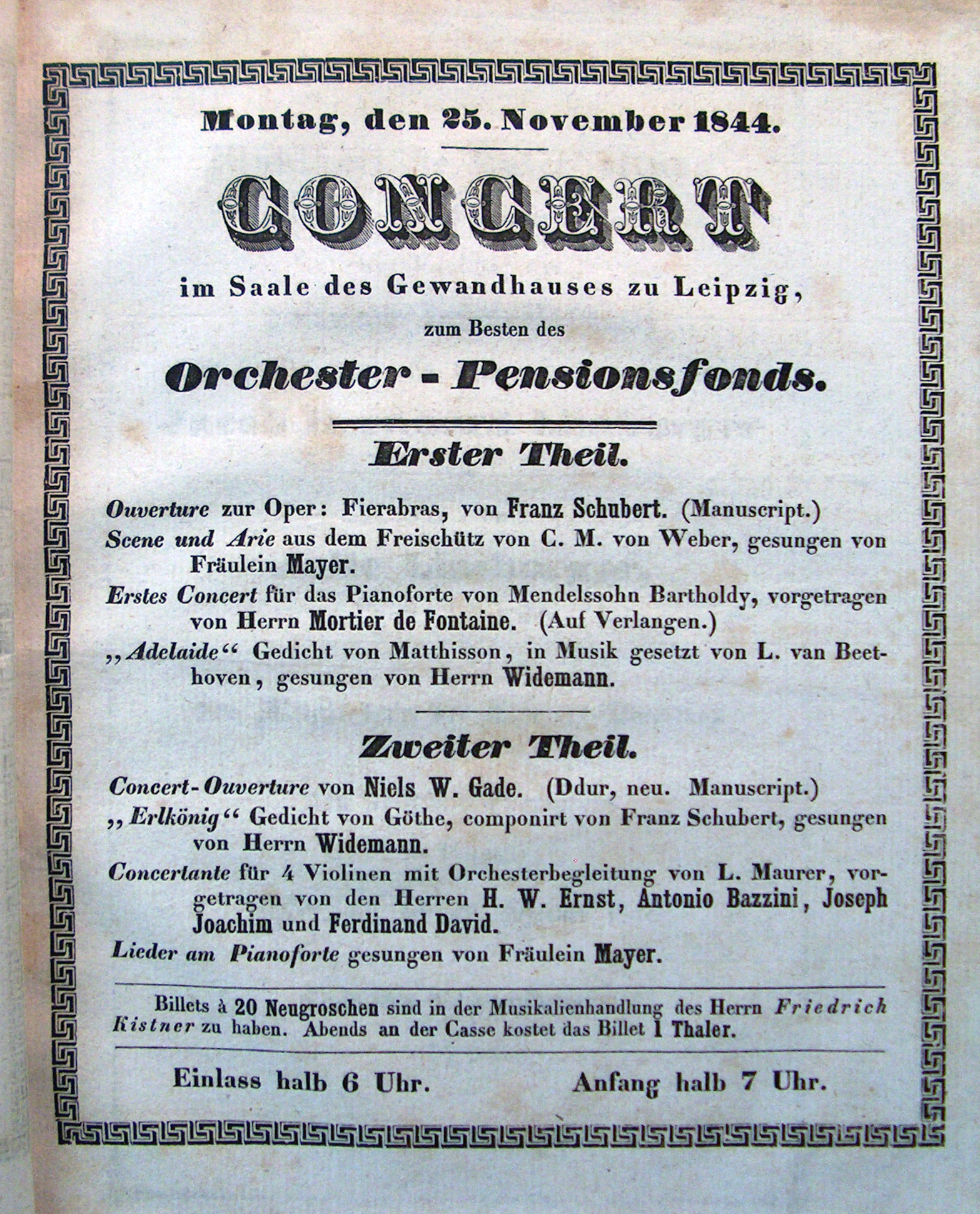

Maurer Program

[iii]

Though still a child, Joseph was now accepted as a colleague by the greatest violinistic talents of the age. Together with Ernst, Bazzini and David, he played Maurer’s virtuosic Concertante, Op. 55 for four violins in a November 25 Gewandhaus concert, for the benefit of the orchestra pension fund — the same work that he had refused to play in London out of loyalty to Ernst. “In the cadenzas,” writes Alfred Dörffel, “[Ernst and Bazzini] played out their highest trumps; but they were so charmingly and ingeniously out-conjured by Joachim, who had the third part, that Ernst involuntarily burst out with a loud “Bravo!” and David, the fourth player, left out his cadenza completely. That was no doubt a unique occurrence.” [iv] This incident was not mentioned by the reviewer for the Allgemeine Musikalische Zeitung, who nevertheless reported enthusiastically upon what was surely one of the most entertaining of violinist-summits:

The ending of the concert consisted of the well-known Concertante for four violins by L. Maurer. It would not be easy to find a performance by such excellent forces, executed with such perfection, as occurred this time. To see artists such as Ernst, Bazzini, David, and the talented young Joachim, united in one aim — to observe how one strove to surpass the other in tone and handling of the same instrument, and yet all subordinating their individuality to the total effect wherever there was an ensemble, provided a rare and great interest. The ensemble was indeed masterful; it was as if one instrument, one bowstroke set the full chords ringing, and with the alternate emergence of one or the other violinist, the innate individuality of tone and conception fascinated the listener no less than the consummate finish of the whole. Near the end, an elaborate cadenza, which afforded each violinist an opportunity to assert himself in his own way, incited the audience to stormy applause. [v]

On the following day, Fanny Wittgenstein reported:

Fanny Wittgenstein to an unknown recipient

                                                                        Leipzig November 26, 1844 [vi]

Dearest Aunt,

I feel doubly induced to write you: first to thank you for the dear, cordial letter that I received today; second in order not to withhold from you and the others the joyous account of Joseph’s appearance yesterday. I wish his parents and all of you could have seen him playing between Ernst, Bazzini and David, all in a row. Maurer’s Quartet is not exactly the most beautiful music; it takes 4 masters to play all the passages together within a hair of one another with all possible nuances, and, in a word, to deliver a beautifully unified performance.

The concert was given for a select and noble cause; only the Quartet caused a furore, and the fact that Josef stood there on an equal footing with three respected artists naturally made the main impression.  Jos. profits a great deal as an artist from Ernst, because he is stimulated to work hard.

It is a joy to see such a talented boy develop; but this also has its downside. One can imagine that everyone loves him and that he receives praise from all quarters; there is no social event to which he is not directly or indirectly invited; this creates a certain attitude, and encourages an error that most clever children have, that we call being a “Schnaberl” [3] — something that naturally leads to occasional unpleasant scenes between Jos. and me. His early development leads to some difficulties, because he is too accomplished to attend school like others of his age, and to attend a lot of classes, but he is not mature enough to work seriously and with perseverance in his room alone.

David doesn’t want to give him any more lessons — he allows him to come from time to time so he can hear him. Hauptmann also finds it unnecessary to give him lessons very often, because he is so quick at the theory of composition, and so he is left to himself to learn and progress, which his 13 years hinder him from doing, since the thing he wants most to do is to race and tussle with the children. Enough, he is still a child, and that is his best tribute, because he fiddles in such a completely natural and innate way, and not affectedly, and he is well on his way to developing normally, both physically and mentally. Just yesterday, Ernst said, after some comment by Joseph, “Yes, one can say that a person can play the violin well and still be a child.” His parents and relatives can do him the great favor of having patience and giving him time — to let him reach 17 or 18 before he brings something properly to fruition. Everything is eagerly begun— concerto, quartet — but the endurance to complete something is missing, because he has no faith in his compositions.

Even as a violin player, I am also very doubtful that he will do well financially. Ernst gave a concert here that was half-full, in spite of the many complimentary tickets that he gave out; but in the theater, and in a concert where he played gratis, it was empty.


Joseph Joachim
Portrait by Wilhelm Girtner
Berlin, 13 January 1845
Art Institute of Chicago

[xi]


Due to its great popular success, the performance of Maurer’s Concertante was reprised on December 12, in a subscription concert of the Gewandhaus Orchestra. [vii] The applause was such that the soloists repeated the conclusion of the piece, this time with differently improvised cadenzas.

On November 29, Joseph took part in a performance of Mendelssohn’s Octet at a private soirée in the home of music publisher Hermann Härtel, attended by Mendelssohn, Robert und Clara Schumann, Moscheles, Hauptmann and Livia Frege. [viii] The players again included David, Ernst, Bazzini and Joachim playing the violin parts, together with Niels Gade and Otto von Königslöw on viola, and Julius Rietz and Andreas Grabau, cello. Such private gatherings were an almost daily feature of Leipzig’s musical life, and formed a significant part of Joseph’s musical upbringing. Henry Chorley mentions the “apparent ease and conformity to daily habit” that this informal music-making exuded, and remarks on “the very kindness and domesticity of the pleasure.” [ix] Ignaz Moscheles, recently arrived from London, frequently joined the company. “Here I find a genuine artistic atmosphere, where good music seems native to the place,” he wrote to his wife Charlotte. “Yesterday I had a quiet evening with David, who played me the new violin Concerto which Felix has expressly written for him. It is most beautiful, the last movement thoroughly Mendelssohnian, tripping like a dainty elf.” [x]

Screen shot 2014-01-07 at 4.58.15 PM

Ignaz Moscheles

[xii]


Next Post in Series: Ferdinand David


[1] In 1844, the first day of Tishrei was September 14.

[2] François Hubert Prume (1816-1849), Belgian virtuoso, was professor of violin in Liège from the age of seventeen. His most prominent pupils were his nephew, Frantz Jehin-Prume, and Hubert Léonard. He died of cholera at the age of 33.

[3] Stuck-up, literally: a “little beak.”


[i] British Library BL, family corresp., Add. MS 42718

[ii] Joachim/BRIEFE I, pp. 2-3. [Author’s translation after Bickley]

[iii] Stadtgeschichtliches Museum Leipzig

[iv] “In den Cadenzen spielten die beiden zuerst genannten, Ernst voran, ihre höchsten Trümpfe aus; sie wurden aber mit der Kadenz von Joachim, der die dritte Stimme hatte, in einer so genial-liebenswürdigen Weise ‘escamotirt’, dass Ernst unwillkürlich in ein lautes ‘Bravo!’ ausbrach und David als vierter Spieler seine Kadenz dann ganz wegliess. Das war wohl ein Ereignis einzig in seiner Art.” Dörffel/GEWANDHAUS, p. 110.

[v] AMZ, Vol. 46, No. 48 (November, 1844), pp 807-808.

http://books.google.com/books?id=11oPAAAAYAAJ&printsec=frontcover&dq=editions:OCLC9249860&lr=#PRA1-PA811,M1

[vi] British Library BL, family corresp., Add. MS 42718, p. 201, probably Fanny F to Fanny J: this letter exists in a different hand, marked “Copie.”

[vii] See review in AMZ, Vol. 46, No. 51 (December, 1844): 867-868.

[viii] See: Reineke/ERLEBNISSE, p. 219, Litzmann/SCHUMANN II, p. 77.

[ix] Chorley/MUSIC, p. 97.

[x] Coleridge/MOSCHELES II, pp. 130-131.

[xi] Art Institute of Chicago: https://www.artic.edu/artworks/75191/joseph-joachim

[xii] NY Public Library:

http://digitalgallery.nypl.org/nypldigital/dgkeysearchdetail.cfm?trg=1&strucID=667725&imageID=1407502&total=10&num=0&word=moscheles&s=1&notword=&d=&c=&f=&k=1&lWord=&lField=&sScope=&sLevel=&sLabel=&sort=&imgs=20&pos=1&e=w

Share this:

  • Share on X (Opens in new window) X
  • Share on Facebook (Opens in new window) Facebook
  • Email a link to a friend (Opens in new window) Email

Like this:

Like Loading…

Growing Pains/Travel Plans

08 Monday Jul 2013

Posted by Joachim in 1 Biographical Posts — RWE

≈ Leave a comment

© Robert W. Eshbach, 2013

Previous Post in Series: Berliner Geselligkeit


JJ Initials

 Growing Pains/Travel Plans

By spring, Joseph and Fanny Wittgenstein were beginning to get on each other’s nerves. The good behavior of November was less and less in evidence — relentless wrangling and bickering over practicing had begun to take a toll on their relationship, and Fanny was thinking of sending Joseph back to Vienna. Away on a business trip, Hermann recommended that Fanny find Joseph another place to do his work, in effect throwing him out of the house. “…you touch such a sore spot in my heart,” he wrote, “that I must give you this answer:

I fully grant the fairness of your reasoning concerning Joseph, insofar as it affects you. You are not required to make continual sacrifices for him. You have done more for him than any of his other relatives, and it arises from your innermost nature that an irrvocable separation must take place. So there is nothing to be done about it, and even less to be said; but you are wrong about everything else, and should have listened to counter-arguments. Just because it is no longer feasible for Joseph to live with us, there is no reason for him to make a journey against his wishes, to interrupt a course of study that he has chosen — or we for him — and to toss time and money and everything into the ditch. We could not take responsibility for that, though we could, perhaps, justify it before others, since they would not know where the problem lay. On the other hand, you believe that we could not justify before others if he were to get a room in a house where he could have his own piano, full freedom and privacy, if that is something that causes him distress, or if there is something that we cannot give him. Now, I do not care what others say; but in this case you may rest assured, for the dear people will find out that in so doing we are fulfilling Joseph’s wish, and a need at the same time. Dear Fanny, wait until I return — then we will find a room for Joseph, wherever; in the meantime, don’t let him feel his dependence so strongly, and later he will be for you, as for me, a welcome guest at our table. We will raise him together without great effort. I am so fully persuaded of the truth of what I write that I await your consent with confidence and let the subject drop.” [i]

The matter came to a head in March, just as news of Joseph’s sister Julie’s engagement reached Leipzig. Fanny, simultaneously surrogate mother and disciplinarian, dutiful niece and obedient wife, was clearly looking over Joseph’s shoulder as he wrote:

Joseph Joachim to his parents [ii]

Leipzig, March 4, 1844

Dearest Parents,

I received your dear letter, and am extraordinarily happy that you and my dear brothers and sisters are faring so well. I am also very healthy, as always, and am today very exuberant, because I am happy that from tomorrow on I will have the opportunity to test myself and see if I have enough strength and insight to be diligent and active without constant supervision. That is to say, I am getting my own room, since dear Fanny’s quarters are somewhat small, because of which we irritate one another — since I have for example no piano that I can use whenever I wish, and it must be most unpleasant for dear Fanny to hear my scratching and plunking all day long. The room, by the way, is very big and nicely furnished, and what pleases me the most is that it is in the same building in which dear Herrmann has his office. I promise you, dear parents, to be very diligent and regular, and not to misuse this great trust.

A couple of days ago, dear Heinrich wrote to me [from London], and I shall answer him soon; he told me that Vieuxtemps, Ernst and Sivori want to go there next season. Therefore there won’t be a shortage of good fiddlers. — The 2nd grand mass of Beethoven is being rehearsed here; I have attended 2 rehearsals of this giant work, and am totally entranced with it. I hope still to hear it very often. — Your description of my future brother-in-law, dear Mother, makes me regret even much more that I do not know him personally. Please give him and all my dear brothers and sisters best wishes from

Your respectful
Son
Joseph.

[Addendum in Fanny’s hand]

Dear Aunt, dear Uncle,

[…] [if my congratulations on] the engagement of your dear Julie arrive somewhat late, nevertheless you know that they are no less deeply felt. It is a great blessing to see your children happy and well taken care of. I congratulate you that you are among the few who are able to make that happen. Naturally, not everyone deserves it as much as you. I hope Joseph will someday crown your family happiness by making good use of the opportunity to develop his artistic abilities. I would have liked to see him spend the summer in Vienna, but my dear husband and Joseph had other wishes — so we shall attempt to see if he can live up to his responsibilities without supervision. Naturally, he will eat and spend the bulk of the evening with us […].


Korycany_engraving_by_Heber

Koryčany, showing the Figdor Schloss (top, center)

Joseph would not have long to get used to his new surroundings: as his letter implies, plans were already underway for him to travel to London, where he would make an important debut as Mendelssohn’s protégé. These plans were being managed, not only by Mendelssohn in Berlin, but also by his uncle Wilhelm (Fanny’s father) in Vienna. Wilhelm Figdor commanded impressive wealth and connections, and he was prepared to use them on Joseph’s behalf (among other beneficences, Joseph’s violin, a priceless Guarneri del Gesú, was a loan from Wilhelm and his brother Nathan). Wilhelm was a partner in the wool-trading firm of Isaac Figdor & Söhne, a shareholder and director of the Austrian National Bank, and a man of considerable property. [1] (One measure of his wealth can be seen from the estate in Koryčany, currently in the Czech Republic, that he acquired from Salomon Mayer Rothschild in 1851. An areal view of the imposing Baroque Schloss and Hof can be seen on Google maps, keyword: Koryčany). According to Fanny Wittgenstein’s granddaughter Hermine, Wilhelm and his son Gustav (Fanny’s brother) “lived in Vienna as respected, resident wholesalers (a letter of recommendation for Wilhelm F., signed by Prince Metternich, testifies to his respectability). […] They were Jews, but they felt themselves to be Austrians — as one could in those days — and they were also regarded as such by others.” [iii]

A letter dated February 29, describing Wilhelm’s preparations for Joseph’s upcoming trip, makes clear the extent of his continuing influence, not only over the course of Joseph’s incipient career, but over the other members of the family, including Joseph’s parents.


Wilhelm Figdor to Julius and Fanny Joachim [iv]

Vienna, February 29, 1844

Dear Brother-in-law and Sister,

I am happy to tell you that I have succeeded in getting a letter of introduction from Prince Coburg to Prince Albert; also from Count Harrach to the Duke of Beaufort; also from Count Bathiany in London. I will also send the one from Prince Esterh[az]y directly to Bd. [Bernhard Figdor] so that he won’t have to concern himself with it. Yesterday, I had a letter from Leipzig that Jos. will depart around the middle of March. I have already written that they should inform me how and when. In any case, Hermann and Fanny will attend to everything as for their own child, and you do not need to be the least bit concerned about it. Mendelssohn visited them in Leipzig, and will do everything for Jos. He may go himself, in order to direct the Philharmonic concerts. In that case, everything is taken care of. If he should be detained, he will provide him with all possible letters of introduction. I only ask that you not make any noise about it, as that could only hurt Jos. Mendelssohn also does not want you to allow the Pester Zeitung to gossip about it. All you would achieve would be that people would have to treat you as little children; it has not been an easy task, and is something I have long resisted. Very few people can boast such letters of introduction. God grant that they will bear fruit. What friends Jos. will have from them!

I beg you once again not to make Coburg’s letter into coffee house gossip.


On March 10th, Joseph was back in Berlin to play at another of Fanny Hensel’s Sonntags-Morgenmusiken. Among the six dozen or so Sunday musicales that Fanny had mounted over the years, this one was clearly out of the ordinary, as Fanny rather breathlessly revealed to her sister Rebecka:

Fanny Hensel to Rebecka Dirichlet: [v]

                                                                        Berlin, March 18, 1844

            We have been living the grand life here lately. […] Last Sunday we had, I think, the most brilliant Sunday-music that ever was, both as regards the music and the audience. When I tell you that we had twenty-two carriages in the court, and Liszt and eight princesses in the room, you will dispense with my describing the splendors of my cottage; but I will give you my program: quintet by Hummel, mit der Finger leicht Getummel , [2] duet from Fidelio, variations by David, played by that magnificent little Joachim, who is no Wunderkind, but a most wonderous child [ein bewunderungswürdiges Kind], and also Sebastian’s [2] thick friend. Two songs, one of which, Eckert’s beautiful ‘Lass die Schmerzen dieser Erde,’ Felix and Mme. Decker performed by heart, with eminent success, as usual […]. Then came the Walpurgisnacht, which my public has been eagerly looking forward to for these four weeks, and which went off excellently. We had three rehearsals, which the singers enjoyed so much that they would have liked to have as many again. Felix was present at the last, and was very satisfied. I should have liked him to accompany, but that he decidedly refused; however, he played the overture with me, and helped me in the difficult parts, by putting in bits, now in the bass, now in the treble, so that it was a kind of improvised arrangement for four hands, which sounded very good.


After the guests had left Fanny’s matinée — and with the impressions of the day still fresh in his mind — Mendelssohn took it upon himself to compose a remarkable series of references for Joseph to carry with him to London together with those provided by his uncle Wilhelm. To his old friend Karl Klingemann, the Prussian atachée in London, he wrote:

Felix Mendelssohn to Karl Klingemann [vi]

                                                                        Berlin, March 10, 1844

 My Beloved Friend:

I wish to make you acquainted by these lines with a lad who, during the three-quarters of a year that I have known him, has become very dear to my heart, and who has gained my love and high esteem to a degree that I may say I have latterly experienced for very few. His name is Joseph Joachim, a boy of thirteen years of age, [4] from Pesth, in Hungary. He intends to pay a visit of some months to his uncle Figdor, a London merchant.

I cannot say enough to you of his truly wonderful talent for the violin. You must first, however, hear him yourself, and the manner in which he can play all possible solos, both of the past and the present, and decipher and interpret every kind of music, in order to place him as high as I do, and to anticipate the glorious results which must accrue to art through him.

He is, moreover, sound at heart, an admirable, well-educated, thoroughly genuine, shrewd lad, of great good sense, and the strictest integrity. Be kind, therefore, to him; take some charge of him in great London, and present him to those of our acquaintances who know how to appreciate such glorious talent as his, and from whom he can in turn derive pleasure and improvement. I here allude principally to the Horsleys. Take him to Chorley’s, also, if you can, and, above all, remember that any kindness you show to him, you show also to me. [5] May we soon, God willing, have a happy meeting! When spring arrives, I hope also to come to you.

Your Felix


“Any kindness you show to him, you show also to me” — Klingemann would surely hear in Mendelssohn’s words an echo of Matthew 25:40. Joseph departed for London the next week, crossing the Channel on the 22nd.

hp_scanDS_45201703451

Etude for one violin, or Canon for 2 violins
to Joseph Joachim for friendly remembrance
Berlin, 11 March 1844
Felix Mendelssohn Bartholdy


Joseph Joachim to Felix Mendelssohn [vii]

Revered Herr Doctor,

You asked me, when I was visiting in Berlin, to notify you of the day of my departure for London; completely against my expectations, and contrary to the original plan, it must be moved up by several days, since the steamboat from Ostende departs on Friday. I regret that that makes it impossible for me still to receive your instructions here in Leipzig; I would, however, count myself lucky if you were to give me the opportunity to serve you in some manner, and thereby to demonstrate my most thankful devotion, that I may remain with greatest esteem,

Yours truly,
Joseph Joachim

Please commend me to your dear family. Greetings from my cousin. [6]

Leipzig, 17 March [1844]

My address in London is: B. Figdor for Jos. Joachim.


Hermann Wittgenstein to Felix Mendelssohn [viii]

Et[ernally] Highborn,

Allow me most respectfully to report that your protégé Joseph arrived safely in London on the 23rd. He wrote me a quarter of an hour before the post departed, and said only that he had had a splendid trip there from Ostende. May yours be the same!

Et Highborn,
Your equally thankful as respectful
H. Wittgenstein

Leipzig 31/3 44.


Next Post in Series: London, 1844


[1] “Laut Kundmachung vom 11. December 1841 für das Jahr 1842.” [Hof- und Staats-schematismus des österreichischen Kaiserthumes, Wien: k. k. Hof- und Staats-Aerarial-Druckerey, 1842, p. 639.]

[2] “Which trips easily off the fingers.”

[3] Fanny’s son, Sebastian Hensel (1830-1898)

[4] Mendelssohn here overstates Joachim’s age, and may have been using a traditional way of reckoning age, in which a newborn starts at one. Joseph was still only 12.

[5] “Was Du ihm Gutes thust, das thust Du auch mir.”

[6] Fanny Wittgenstein.


[i] Wittgenstein/FAMILIENERINNERUNGEN, pp. 13-14.

[ii] British Library BL, family corresp., Add. MS 42718, p. 1

[iii] Wittgenstein/FAMILIENERINNERUNGEN, p. 3. Wilhelm received the right of citizenship in the city of Vienna, and was for many years the financial advisor of the Viennese community. Hermine quotes his obituary: “Wilhelm Figdor was elected in 1861 to the Vienna city council, and he served continuously until 1876. The large commercial transactions that he carried out as head of his company gave him such an abundance of great viewpoints, especially in financial matters, that for many years he was also able to make excellent use of them regarding the financial concerns of the municipality. Therefore, his vote in matters of finance was in most cases of decisive impact, and in this connection he was accorded high regard around the town.” [Wittgenstein/FAMILIENERINNERUNGEN, p. 4.]

[iv] British Library BL, family corresp., Add. MS 42718, p. 196.

[v] Hensel/MENDELSSOHN II, p. 260-261.

[vi] Polko/MENDELSSOHN, p. 131. The same letter, with slight variations is in Moser/JOACHIM 1901, p. 54, and MT/JOACHIM, p. 226.

[vii] Bodleian Library, Mendelssohn Greenbooks XIX d. 45, fol. 159, fol. 182a, fol. 182 b, fol. 182c, fol. 197.

[viii] Bodleian Library, Mendelssohn Greenbooks XIX d. 45, fol. 159, fol. 182a, fol. 182 b, fol. 182c, fol. 197.

Share this:

  • Share on X (Opens in new window) X
  • Share on Facebook (Opens in new window) Facebook
  • Email a link to a friend (Opens in new window) Email

Like this:

Like Loading…

Berliner Geselligkeit

08 Monday Jul 2013

Posted by Joachim in 1 Biographical Posts — RWE

≈ Leave a comment

© Robert W. Eshbach, 2013

Previous Post in Series: Gewandhaus Debut


JJ Initials

Berliner Geselligkeit

Mendelssohn_Berlin_Leipziger_Strasse

[i]

The Mendelssohn Home: Leipzigerstrasse No. 3

Having visited with the Mendelssohn family in Berlin on the occasion of the Midsummer Night’s Dream premiere, Joseph was now introduced to a wider circle of Berlin society, performing on February 11th (1844) in one of Fanny Mendelssohn Hensel’s celebrated Sunday musicales. Like all of Hensel’s late-morning Sonntagsmusiken, this matinée took place in the Mendelssohns’ family home, the former “Reck’sche Palais” at Leipzigerstrasse No. 3, later lovingly portrayed by Fanny’s son, and Joseph’s boyhood friend, Sebastian Hensel:

To the members of the family this house was not a piece of property of a certain value, or mere dead bricks and mortar, but a living individuality, one of themselves, sympathising with and sharing their happiness, and considered by them and their nearest friends somehow as the representative of the family. In this sense Felix often uses the expression ‘Leipziger Strasse 3,’ and in this sense they all loved it and mourned its loss when, after the deaths of Fanny and Felix, it was sold, and became the Upper Chamber of the Prussian Parliament. […] The rooms were stately, large, and lofty, built with that delightful spaciousness which architects have almost entirely given up since the price of ground has become so high, and for which kind of comfort either the taste or the means have almost entirely disappeared. One room especially, overlooking the court, and opening by means of three arches into an adjoining apartment, was beautiful, and most suitable for theatrical representations. For many, many years, at Christmas and on birthdays and other festive occasions, this was the scene of delightful performances, overflowing with wit and humour. Generally it was Leah’s [Mendelssohn’s mother] sitting-room. The windows opened upon a very spacious court, surrounded by low side-buildings, and closed by a one-storied garden-house, over which looked the tops of ancient trees. In this garden-house Fanny and Hensel lived after their marriage. It has since been pulled down, to make room for the session-chamber of the Prussian House of Lords. In the winter it had great drawbacks, […] but in summer the house was perfectly delightful. The windows were embowered in vines, and all opened on to the garden, with its blooming lilacs and avenues of stately old trees. And for all times of the year it had certain special advantages, especially complete peace and quiet. The large court and high front building kept off every sound; in the garden-house, no more than 100 yards away from the noisy street, you lived as in the deepest loneliness of a forest—vis-à-vis, the magnificent trees of the garden, with merrily twittering birds, no lodger above or below, after the noise of streets the quietest and almost rural seclusion, and at your windows green leaves. [1] The center part of the house, and its most invaluable and beautiful portion, consisted in a very spacious hall, too large to be called a drawing-room. There was space in it for several hundred people, and it had on the garden side a movable glass wall, interrupted by pillars, so that the hall could be changed into an open portico. The walls and ceiling (a flat cupola) were covered with fantastic fresco-paintings. This was the real scene of the Sunday matinées. The hall commanded a view of the garden — or rather the park — (about seven acres), which touched the gardens of Prince Albrecht; in Frederick the Great’s time it had been a part of the Tiergarten, and was therefore rich in most beautiful old trees. [ii]

With her brother Felix’s explicit encouragement, Fanny had begun her Sonntags-Morgenmusiken in 1831, taking up a family tradition that had lain dormant for several years. By the 1840’s, what had begun as private entertainments had taken on a more public face. As Fanny described it in 1846: “It has gradually — and naturally without our doing — become a remarkable cross between private and public in character, so that 150-200 people are present at every concert, and such that, if I have to cancel, and don’t give notice, no one comes, because the fact publicizes itself.” [iii]

“I have once again taken up my Sunday morning musicales,” Fanny wrote to Anna Dirichlet [2] of this first concert of 1844, “and — think of it — in the garden room; it heats up quite well, and it was just lovely, since we happened to have good weather just then.” [iv] Fanny’s neighbor, the writer, political free-thinker and women’s rights advocate Fanny Lewald, was among the guests, and remembered the event in her memoirs: [v]

There were still individual women in whose salons a mixed company comprising all classes gathered, and among these Fanny Mendelssohn, the oldest sister of Felix Mendelssohn who was married to the painter Wilhelm Hensel, took pride of place. She was small, and except for her large soulful eyes, actually homely, but she had a sharp intellect, was very well-informed, very self-confident, and as a musician she was her brother’s equal. Her younger sister Rebecka, the wife of the famous mathematician Lejeune Dirichlet, and her youngest brother, the banker Paul Mendelssohn were also exceedingly musical, and the matinées that Frau Hensel hosted in the peaceful, spacious rooms of her garden house were exceptionally interesting. She lived in the garden wing of her parents’ house, the same as the upper house of the legislature now occupies, and out of the floor-length windows of this back section of the house, which consisted only of a Rez de Chaussée, from her art-bedecked rooms one looked out on the old trees of a large garden while enjoying the most superb performances, in which artists and first-rate amateurs took part together. It was in such a matinée that I first saw and heard Felix Mendelssohn. Among the listeners were Henrik Steffens, Friedrich von Raumer, the artists Wach and Tieck, a princess from Dessau, Princess Radzivill with her families, the English ambassador Count Westmoreland [sic], two of Bettina’s [von Arnim] daughters, a daughter of Prince Karl of Prussia with her governess, Schönlein, and a multitude of others, whose names were important, or would later acquire importance, such as that of the musician Joseph Joachim, who was then still a boy, and, accompanied by Felix Mendelssohn, performed very brilliant variations by David.

In the middle of the performance, all eyes suddenly turned to the doors, and a cheerful smile passed over all faces as a still-youthful man appeared in the doorway of the room. He was a slim, mobile figure. He entered silently, head held high, with sparkling eyes, which had something uncommonly startling, indeed overwhelming about them. It was Franz Liszt. [3] […]

That morning they began the music with a quartet of Weber that Frau Hensel played, and which the Gans [Ganz] brothers and Felix Mendelssohn accompanied. Then Frau Hensel and her brother played the latter’s variations à quatre mains. Pauline von Schätzel, at that time the wife of court-printer Decker, sang an aria with chorus from The Creation, and latter with an excellent singer (I think he was named Bär [Behr]) a few large scenas from the Templer und der Jüdin. Felix Mendelssohn accompanied the singing on the piano, and finally Mendelssohn played the previously mentioned variations with the young Joachim.

What is a public? In Joachim’s youth, the contemporary phenomenon of an audience as a gathering of strangers, unknown to one another, hardly existed. A “public,” as Joachim’s contemporaries would have understood it, was a social organism: unlike a crowd, it had structure and texture. As Lewald’s account implies, this “mixed company comprising all classes” consisted of a nexus of consequential people: a fabric of family, friendship, business relations, and celebrity. The same could be said, even of such ostensibly fully “public” events as Leipzig’s Gewandhaus concerts, or the concerts of Berlin’s Singakademie.

The modern idea of public life had its origins in the Enlightenment “Republic of Letters” — that group of thinkers, who, unfettered by linguistic or national boundaries, began to challenge traditional notions of nation and state, daring to imagine new and better ways of organizing and regulating human relations. When Beethoven received a letter from his brother, signed “Johann van Beethoven, land-owner,” his sharp reply, signing himself “Ludwig van Beethoven, brain-owner,” was entirely in the spirit of that Enlightenment project. In the modern, enlightened world, traditional markers of status and power were challenged and overturned by a newly emerging public — a new aristocracy of “brain-owners.” “What! Because you are a great Man, you fancy yourself a great Genius,” Beaumarchais had his Figaro say. “How came you to be the rich and mighty Count Almaviva? Why truly, you gave yourself the trouble to be born! While the obscurity in which I have been cast demanded more abilities to gain a mere subsistence than are requisite to govern Empires.”

In Figaro we also find a common Enlightenment trope: that men are disputatious, mutually threatening, agonistic. By contrast, women were taught to be accommodating, and to make common cause across class boundaries. Masculine intellectual life, so cultural historian Dena Goodman tells us, had always been a form of combat. [vi] In the Republic of Letters, however, men’s innate combativeness was restrained, their discourse moderated and governed by a particularly strong and brilliant group of women — salonnières — who invited the sparring intellectuals into their homes, and taught them to converse. Thus, as Goodman writes, “the central discursive practices of the Enlightenment Republic of Letters were polite conversation and letter writing, and its defining social institution was the Parisian salon.” [vii]

Upper- and middle-class social life in Berlin was inevitably influenced by Prussia’s Francophile court. By the turn of the 19th century, Berlin’s intellectual and social life likewise centered on the salon — a regular gathering involving tea and conversation, and a kind of culturally edifying sociability (Geselligkeit). Through their occupation as salonnières, women such as Rahel Varnhagen, Henriette Herz, Sarah Levy, Caroline and Wilhelmine Bardua, Bettina von Arnim, and later Fanny Mendelssohn Hensel took on a powerful role as leaders in Berlin’s intellectual and cultural life.

In Berlin as in Paris, salons were held at a regular day and time, and guests had standing invitations to attend at their pleasure. The gatherings took place in the salonnières’ homes (while the majority of guests were men, salons were conducted by women), and it was they who organized the activities and guided the conversation of the gathering. Regular guests would frequently have the privilege of introducing their friends at the salon. Once included, these friends were permanently welcomed as members of the circle. There were various types of salons: political, literary, musical, etc., each according to the interests of the salonnière. Berlin’s salons, whose ideal was “a mixed company comprising all classes,” were mostly intellectual gatherings, serving the purposes of Bildung in an inclusive, non-threatening social context, and always with a feminine emphasis on bridging the worlds of intellect and feeling. [4] Political conversation was generally of a liberal bent, with a romantic-nationalistic flavor, advocating democratic and constitutional rights, and participation in societal reform. Salons served as both impetus and venue for much of the music, art and literature of the period (a prominent example being Wilhelm Müller’s poetic cycle Die Schöne Müllerin, originally improvised and performed by a circle of young poets, painters and musicians — including Fanny Mendelssohn’s future husband Wilhelm Hensel — in the Staegemann salon in Berlin). Conversation about the arts was strongly influenced by current aesthetic theory. The involvement of the salon in the growth of professional criticism remains largely unexplored. Many of the journals that appeared during this period were in effect an extension of the critical conversations of salon Geselligkeit.

The Mendelssohn family played a crucial role in the development of the Berlin salon. Moses Mendelssohn (1729-1786), the great philosopher of the Haskalah (Jewish Enlightenment) had been one of the first to keep an “open house,” in which the leading intellectuals of the day gathered. There, according to historian Petra Wilhelmy: “When guests gathered in the evening, the discussions did not center on strictly scholarly topics, but rather, matters of literature and art. Hospitality was modest. It is noteworthy that practically all of the subsequent Salonnières and salon women before 1800 gathered in his house, and in many cases were friends of his daughters, among them the gifted Dorothea (Veit-Schlegel). […] The celebrated Henriette Herz was well aware of the model that Moses Mendelssohn provided for the women of her generation. “Foreign intellectuals seldom visited Berlin, without allowing themselves to be introduced by him,” she wrote. “His friends, and his friends’ friends came uninvited, and therefore also the brilliant friends of the daughters of the house.” [viii] One consequence of Mendelssohn’s Geselligkeit can be seen in the large number of Berlin’s salonnières who were Jewish. In 1798 theologian Friedrich Schleiermacher wrote to his sister: “It is very natural that young scholars and men of fashion frequent the big Jewish houses in Berlin, for they are much the wealthiest middle-class families here, almost the only ones which keep open house [5] and in which, because of their extensive connections in all countries, one meets foreigners of every rank. So anyone who wants to see something of good society in a very unceremonious way obtains an introduction to such houses, where any man of talent, even if it is only social talent, is welcome and will certainly find plenty to amuse him, because Jewish women — their husbands are rushed too early into trade — are highly cultivated, can talk about everything and are usually very accomplished in one or other of the arts.” [ix]

Ultimately, the Berlin salon became a kind of Jewish woman’s university. [6] Berlin’s Jewish salonnières were influential in promoting the ideals of Bildung, as well as the twin ideals of women’s rights and religious tolerance. The harvest of the salonnières’ sowing is everywhere to be found in nineteenth-century art, music, literature, and political philosophy — though it was most often claimed by men — and it informed the nineteenth-century’s concept of the “public” as a fabric of diverse, yet interrelated individuals. The epigraph to John Stuart Mill’s On Liberty, for example, quoted from Wilhelm von Humboldt’s Sphere and Duties of Government, [7] is a Bildungsideal that Humboldt absorbed from Berlin’s Jewish salonnières: “The grand, leading principle, towards which every argument unfolded in these pages directly converges, is the absolute and essential importance of human development in its richest diversity.” [x] “The worth of a State, in the long run, is the worth of the individuals composing it,” wrote Mill at the end of his essay, “and a State which postpones the interests of their mental expansion and elevation […], a State which dwarfs its men, in order that they may be more docile instruments in its hands even for beneficial purposes, will find that with small men no great thing can really be accomplished […].” [xi] For early nineteenth-century Germany, the salon was simply the ideal state in a nutshell, and the salonnière’s goal was to make sure that the mental expansion and elevation of her guests was satisfied. Though by 1843 the golden age of the Berlin salon was largely over, Joseph would discover on his own journey of Bildung, that without the example and influence of great women imbued with this tradition — Fanny Hensel, Bettina von Arnim, Clara Schumann and others — boys like him would have grown into small men indeed.


Next Post in Series: Growing Pains/Travel Plans


[1] “Next Sunday I shall play with obbligato nightingale and lilac blossom accompaniment,” Fanny wrote in a May 6, 1846 letter to the painter Julius Elsasser. [Klein/MUSIKVERANSTALTUNGEN, p. 49.]

[2] The mother-in-law of her sister Rebecka.

[3] This is the first documented encounter between Joachim and Liszt, the two musical lions of the nineteenth-century. They would next meet some years later in Vienna.

[4] Viennese salons, on the other hand, tended to be sharply differentiated by class — the middle- and lower-class salons being little more than occasions for card playing, light conversation and dancing.

[5] “The term salon was applied to the social and intellectual gatherings at the homes of Jewish women in Berlin only in retrospect,” writes Steven M. Lowenstein. “At the time the institution was referred to by many different terms such as ein offenes Haus (an open house), Thee-gesellschaft (tea society), Theetisch (tea table), äesthetischer Tee (aesthetic tea), or Kränzchen (social circle). Often all sorts of circumlocutions were used. Thus one “opened one’s home “to social intercourse.” Often the salon guests were referred to by the term Hausfreund (friend of the family).”  [Lowenstein/COMMUNITY p. 105]

[6] This is meant quite literally. Much to their chagrin, Jewish women could not be admitted to Humboldt’s Berlin University, which was founded, to a large extent, on ideas of Bildung that Humboldt first encountered in their company. Humboldt was a guest of, among other salonnières, Fanny Hensel, Henriette Herz, Hedwig von Olfers, Henriette Paalzow, Luise Radziwill, Elisabeth von Staegemann, Rahel Varnhagen and Luise von Voß [Wilhelmy/SALON, p. 918]. As a teenager, he was a member, together along with Henriette Herz and Moses Mendelssohn’s daughters Dorothea and Henriette, of a Tugendbund — a league of virtue — whose goal, according to Herz was “mutual moral and mental development, as well as performing practical acts of love.” “He was then 17 years old,” wrote Herz, “and I a married woman […] It might sound arrogant now when I say that I exercised a certain superiority over him, without at all intending it. To a certain extent, I introduced him to the world, and soon he was a friend to all my women friends, most of whom excelled in spirit and heart.” [J. Fürst, Henriette Herz. Ihr Leben und ihre Erinnerungen, Berlin: 1850, p. 149.]

In an essay on Berlin’s salons during the Restoration, Barbara Hahn calls attention to a critical difference between the university and the salons: whereas the salons emphasized mutual discovery, discussion and sharing of ideas, university education was based upon talking heads delivering information ex cathedra while students took notes. Without the give-and-take of conversation, she claims, “knowledge is as though imprisoned.” [Klein/MUSIKVERANSTALTUNGEN, p. 14.]

[7] Currently known by the title: The Limits of State Action.


[i] Wikipedia, public domain, from Adolph Kohut, Berühmte Israelitische Männer und Frauen, vol. 1, Leipzig: 1900.

[ii] Hensel/MENDELSSOHN vol. 1, pp. 121-122

[iii] Klein/MUSIKVERANSTALTUNGEN, p. 49.

[iv] Letter dated February 22, 1844, quoted in Klein/SONNTAGSMUSIKEN, p. 59.

[v] Lewald/LEBENSGESCHICHTE, pp. 105-107 [my translation]

[vi] See Goodman/REPUBLIC pp. 91 ff.

[vii] Goodman/REPUBLIC, p. 4.

[viii] Wilhelmy/SALON, p. 45.

[ix] Quoted in Bruford/TRADITION, p. 4.

[x] Mill/LIBERTY, p. 4.

[xi] Mill/LIBERTY, p. 207.

Share this:

  • Share on X (Opens in new window) X
  • Share on Facebook (Opens in new window) Facebook
  • Email a link to a friend (Opens in new window) Email

Like this:

Like Loading…

Gewandhaus Debut

08 Monday Jul 2013

Posted by Joachim in 1 Biographical Posts — RWE

≈ Leave a comment

© Robert W. Eshbach, 2013

Previous Post in Series: In the Court of Friedrich Wilhelm IV: A Work of Timeless Quality


JJ Initials

Gewandhaus Debut

Gewandhaussaal big

Back in Leipzig, Joseph was again practicing Ernst’s Othello Fantasy, this time in preparation for his official Gewandhaus debut. It was a piece that he had played often and well, and one that Mendelssohn particularly liked. Rochus Freiherr von Liliencron recalled in his memoirs an evening party in the winter of 1842 when Mendelssohn accompanied Ernst on this very work. Mendelssohn was reportedly so delighted with a passage at the end, that he made Ernst repeat it three times. [i] Now, Mendelssohn was equally delighted by the boldness with which Joseph attacked the high C sharp on the E string in the same passage. After their dress rehearsal he told him: “Listen, you Teufelsbraten, if I really do write a concerto for you fiddlers someday, I’ll have to put in Ernst’s audacious leap that you so brilliantly reminded me of today.” [ii] Mendelssohn wrote his celebrated concerto in 1844, and Joseph learned it shortly thereafter. Joachim later recalled to Moser how, during a coaching, Mendelssohn stopped near the end of the last movement and asked: “Do you know where I got that? From Ernst’s Othello Fantasy.” [iii]

Gewandhaus Debut Program 1Gewandhaus Debut Program 2

[iv]

Joseph’s debut took place on November 16th in the Gewandhaus Orchestra’s seventh subscription concert, with Mendelssohn conducting. “Herr Joseph Joachim aus Wien” was joined on the program by another debutant that evening: the nineteen-year-old pianist and future Gewandhaus conductor, “Herr Carl Reinecke aus Altona.” As an old man, Reinecke recalled the emotions of that day:

On the evening of November 16, 1843, I walked the short way from my apartment to the old Gewandhaus in Leipzig. For me, it was a momentous course, for on this historic site, where from Mozart on practically every great artist had played, and where, for seven years, Mendelssohn had presided with holy zeal over his office as Kapellmeister, I now had to prove myself a competent artist. These sacred, but outwardly modest, rooms did not include a green room, and until I was called to the piano I had to listen to the preceding numbers through the door if I could not succeed in hiding in a small nook on the dais. A symphony by Haydn, and an aria from his Creation had elapsed, when a twelve-year-old boy in a short jacket and turned-down collar appeared, and with consummate virtuosity and boyish lack of self-consciousness played the then famous Othello Fantasy of Ernst. It was Joseph Joachim, who was stormily cheered by the otherwise somewhat reserved Gewandhaus audience. I still had quite a while to wait until I had to sit down at the piano and play Mendelssohn’s Serenade and Allegro gioioso. I was not hurt by the fact that the audience, though friendly in its reception, did not celebrate me in the same manner as the twelve-year-old Wunderkind, for I had the good sense to take it as a matter of course that the public would reward a boy who could produce all of the fireworks of this brilliant virtuoso work on his violin more than a nineteen-year-old youth in tails who had performed the agreeable, but by no means bravoura-laden, serenade by Mendelssohn. [v]

Leipzig’s Allgemeine Musikalische Zeitung reported:

Herr J. Joachim from Vienna, pupil of the violin virtuoso Herrn Böhm of the same city, and just 13 or 14 years old, is a supremely interesting phenomenon, not only in regard to the excellent talent that is abundantly and authoritatively enunciated in his achievements, but due to the outstanding training and culture to which his playing bears unmistakable witness. It must be a joy to teach such a gifted student; much honor is also due the teacher, for having guided a wonderful talent, and having brought him so far so early that it can hardly be doubted that he will reach a high level of mastery before long. We have heard that Herr Joachim will remain here for some time, in order to receive further musical training from Herren Hauptmann, David, et. al.; if his disposition remains as natural and modest as it is now, his effort as diligent and careful as it must have been up to this point, one can expect him to become even more than a great virtuoso: he will certainly become a distinguished artist. May our hope not remain unfulfilled. Having said this, it further goes without saying that the audience received Herr Joachim with the liveliest applause. [vi]

“Today’s letter concerns only our dear Joseph, who in yesterday’s appearance received the full applause given here only to such artists as Mendelssohn,” wrote Hermann Wittgenstein to Joseph’s parents. “As you already know, he played the Othello Fantasy, and received applause with every variation, and at the end was heartily recalled. However, it was not only the crowd that was moved by his talent, but, as we hear, he is said also to have delighted the masters. The papers will not neglect to echo the general opinion, and that can only have the best consequences for him, since Leipzig has a reputation in musical matters. My Fanny was not a little tense, i.e., in the highest agitation, but also very satisfied, as concerns her own, by the appreciation of the local audience, which is otherwise rather cold, and shows not a trace of the enthusiasm that in Vienna reveals a southern complexion. Joseph is very happy over the daring adventure of his public appearance […]; he is convinced that there is a more active musical life here, even than in Vienna. That is, one hears and performs specifically classical music. […] Above all, I wish that dear Grandfather were here, so that he could see that Mendelssohn, though he probably meant it in jest, came to crown him with a laurel wreath.” Fanny added a postscript: “David was just here, and requested that we let Joseph go with him to a party where the whole musical clique will be present. He assured us that [Joseph] has delighted everyone, and that one can now already count him among the greatest artists. But everyone is also astounded by his demeanor and his tact — and really, as long as he has been with us, he has not said or done anything that is in any way blameworthy. Please forward these lines to dear Papa.” [vii]

About this time, Joseph’s acquaintance with Mendelssohn began to ripen into a true friendship. “From the beginning Mendelssohn had been the best of friends and advisers to the boy,” writes Andreas Moser; “but he became more intimiate with him after one evening, when, as they were walking together, Joachim answered one quotation from Jean Paul with the apt application of a passage from his ‘Flegeljahre.’ Mendelssohn was greatly surprised, and from that evening his interest in the Teufelsbraten grew to greatest affection; for, like Schumann, he only placed in the first rank artists ‘who could not only play passably one or more instruments, but who were also human enough to understand the writings of Shakespeare and Jean Paul.’” [viii]

On November 25, Mendelssohn traveled to Berlin for a protracted stay. Joseph continued his studies, practiced the Beethoven Concerto, and worked at composition. On December 20th, David wrote to Mendelssohn “Joachim has written a very pretty cadenza to the first movement of the Beethoven Violin Concerto; he is also writing a Rondo in B minor, in which there are some pretty passages — it seems to come to him with much more difficulty than fiddling, however.” [ix]

Moriani, Napoleone

[x]

Napoleone Moriani

            On January 3, Joseph played a set of variations by Ferdinand David as a guest artist in k. k. Kammersänger Napoleone Moriani’s Gewandhaus recital. A celebrated tenor, Napoleone Moriani (1806/08-1878) died so impressively in Donizetti’s Lucia de Lammermoor and Pia de’ Tolomei that he became known as il tenore della bella morte — the tenor of the beautiful death. Though a favorite with Mendelssohn, he was, by 1844, reaching the end of his voice, and the end of his career. The Allgemeine Musikalische Zeitung said of his recital: “The only really interesting, indeed very outstanding thing in the entire concert was a child’s-play, namely the violin playing of the young Joseph Joachim from Vienna, who so successfully performed variations by F. David on “Das Lob der Thränen” by Fr. Schubert, likewise with pianoforte accompaniment, that he repeatedly received the most universal and lively applause. —” [xi] Schumann’s Neue Zeitschrift für Musik, while likewise calling attention to the audience’s warm acclaim (“as great as it was deserved”) concluded: “we do not believe ourselves deceived in pointing out this boy as a significant virtuoso talent, from whom the future can expect something extraordianary.” [xii] The news of this successful appearance reached Vienna several weeks later, and recieved a notice in the Allgemeine Wiener Musik-Zeitung. [xiii]

Charlotte_Birch-Pfeiffer

Charlotte Birch

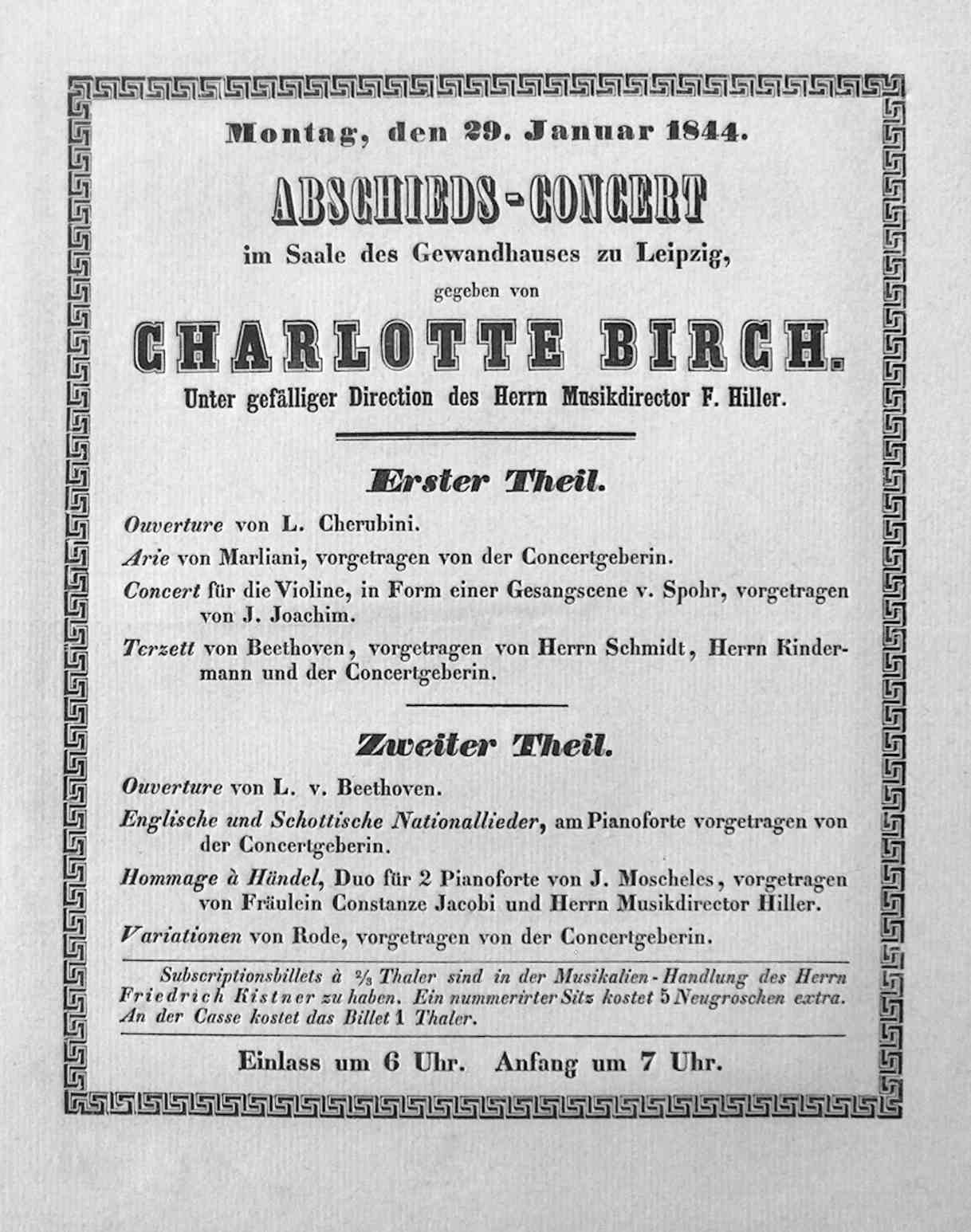
Three weeks later, on January 29, Joseph again appeared in the Gewandhaus, this time in the last of a series of concerts by the English soprano Charlotte Birch (then on her first visit to Germany). [1] Mendelssohn being in Berlin, the conductor for the occasion was Ferdinand Hiller.

Program, 1:29:44

[xiv]

This concert demonstrated the astonishing speed with which Joseph was able to learn new repertoire, and the self-confidence with which he could perform it. As Moritz Hauptmann told a friend: “Joachim […] is here from Vienna. He seems to have learned [the violin] so easily. He was brought early, with good talent, to Böhm’s good, regular schooling. Now he plays, perhaps an hour [daily]. Recently he played Spohr’s Gesangscene in the Gewandhaus — on the spur of the moment — after having started it just a few days earlier with David; and since the solo part was mislaid, played it by heart such that Spohr himself would have enjoyed it. In the aria his tone was of utterly touching beauty, his intonation pure as a bell and in the most difficult places he was infallibly secure.” [xv]

For the critic of the Allgemeine Musikalische Zeitung, undoubtedly unaware of the full extent of Joseph’s accomplishment, the concert was simply a welcome demonstration of musical depth from a young player hitherto known only for his brilliant virtuosity:

[…] We have already extolled the deserving accomplishments of the young Jos. Joachim from Vienna; what we had heard him play earlier were mere virtuoso affairs, pieces in which the intention is primarily the production of a sparkling technique, less the representation of an artistic idea, and not at all the realization a work of art in the higher sense. We could therefore only say with certainty that his technical training was quite extraordinary, and already so advanced that one could surely soon expect him to become a virtuoso of the first rank; in another, purely artistic respect, the inner character of his achievements — the propensity of his taste in their performance — gave us some reason to hope that he possessed a genuine talent and a real artistic instinct that could prevent the artist from being overwhelmed by the virtuoso. Now, after the performance of the Gesangscene by Spohr — to be sure a grateful composition, but also an imposing one, such that it remains a difficult assignment, even for experienced and thoroughly trained artists — we consider ourselves justified in expecting the greatest things from the young Joachim. He has performed the piece with such a clear, correct understanding, with such copious and good sense and taste, as only a truly significant talent can. May this talent continue to enjoy the calm, solid training which has been so beneficial to him, and through which alone it can be guided to a high and beautiful goal! [xvi]


Next Post in Series: Berliner Geselligkeit


[1] Soprano Charlotte Ann Birch (1815-1901), a protége of Sir George Smart, studied at the Royal Academy of Music in London from 1831-1834. She was the first to sing the soprano part of Mendelssohn’s revised Elijah: in Exeter Hall, London, on April 16, 1847, under Mendelssohn’s direction. According to W. H. Hadow, “Miss Birch possessed a beautiful soprano voice, rich, clear, and mellow, and was a good musician, but her extremely cold and inanimate manner and want of dramatic feeling greatly marred the effect of her singing.” [Grove’s Dictionary of Music and Musicians, Vol. 1, J. A. Fuller Maitland (ed.), London: Macmillan, 1911, p. 328.]


[i] Lilienkron/JUGENDTAGE, pp. 131-132.

[ii] Moser/VIOLINSPIEL II, p. 252.

[iii] Lilienkron/JUGENDTAGE, pp. 131-132.

[iv] Stadtgeschichtliches Museum Leipzig.

[v] Reineke/ERLEBNISSE, pp. 260-261.

[vi] Allgemeine Musikalische Zeitung, Vol 45, No. 49 (December 6, 1843), p. 890.

[vii] British Library BL, family corresp., Add. MS 42718, p. 195.

[viii] Moser/JOACHIM, 1901, pp. 50-51.

[ix] Eckardt/DAVID, pp. 200-201.

[x] http://digitalgallery.nypl.org/nypldigital/dgkeysearchdetail.cfm?trg=1&strucID=667709&imageID=1407472&total=1&num=0&parent_id=667037&word=&s=&notword=&d=&c=&f=&k=0&sScope=&sLevel=&sLabel=&lword=&lfield=&imgs=20&pos=1&snum=&e=r

[xi] Allgemeine Musikalische Zeitung, Vol. 46, No. 3, (January, 1844), p. 43.

Screen shot 2014-11-01 at 9.50.03 AM

[xii] Neue Zeitschrift für Musik, Vol. 20, No. 6, (January 18, 1844), p. 24.

[xiii] Allgemeine Wiener Musik-Zeitung, Vol. 4, No. 10, (January 23, 1844), p. 40.

[xiv] Stadtgeschichtliches Museum Leipzig.

[xv] Letter to Hauser, April 8. Hauptmann/HAUSER, vol. 2, p. 16. Author’s translation.

[xvi] Allgemeine Musikalische Zeitung, Vol. 46, No. 5 (January, 1844) pp. 73-75.

Share this:

  • Share on X (Opens in new window) X
  • Share on Facebook (Opens in new window) Facebook
  • Email a link to a friend (Opens in new window) Email

Like this:

Like Loading…

In the Court of Friedrich Wilhelm IV: A Work of Timeless Quality

08 Monday Jul 2013

Posted by Joachim in 1 Biographical Posts — RWE

≈ Leave a comment

Potsdam, Neues Palais© Robert W. Eshbach, 2013

Previous Post in Series: Bildung


JJ Initials

In the Court of Friedrich Wilhelm IV:

A Work of Timeless Quality

OLYMPUS DIGITAL CAMERA

[i]

Potsdam, Neues Palais

Felix’s Midsummer Night’s Dream was “dreamt for the first time” (as his sister Fanny put it) on Saturday, October 14, 1843, in the theater of the Neues Palais in Potsdam. The private command performance, in anticipation of the king’s 48th birthday, was followed by a series of sold-out public performances in Berlin’s Schauspielhaus on October 18, 19, 20 and 21. On the 18th, Fanny reported to her sister Rebecka:

…the entire cadre of Leipzig musicians came in order to attend the festival: Hiller, David, Gade, and a darling 12-year-old Hungarian, Joachim, who is such a clever violin player that David doesn’t know what more to teach him, and such a sensible boy, that he rode here on the train alone, lives alone in the “Rheinischen Hof,” and it seems perfectly natural that he should do so.

Thirteen years later, Joseph still recalled with pride how he had traveled on his own from Leipzig, and “how it pleased me to see myself entered in the hotel register as a ‘grammar-school student.’” [ii] Berlin’s Rheinischer Hof Hotel was conveniently located at the corner of Leipzigerstrasse and Friedrichsstrasse, a block away from the Mendelssohn home, and a short walk from the theater where the Midsummer Night’s Dream was to be performed.

The premiere was preceded by several days of Mendelssohn family festivities, including an evening at Felix’s younger brother Paul’s “where everybody that could fiddle fiddled, and everybody that could play played, but unfortunately not a soul amongst us had the smallest voice for the smallest song, everyone being an instrumentalist.” [iii] On that evening, Joseph’s sang-froid was tested when Mendelssohn cajoled the young Teufelsbraten to “jump in” for the absent violinist Hubert Ries. After they tuned, 23 year-old Royal Concertmaster Leopold Ganz, who had taken the viola part, said to Joseph: “All right, you poor little worm, now you’ll have to pull yourself together like hell — because this is a completely different matter than playing a couple of little solos.” Joseph acquitted himself well, and Mendelssohn afterward said with a smirk: “so, dear Ganz, the poor little worm played his part better than you thought he would!” [iv]

The little worm was present, along with a host of invited notables, at the dress rehearsal of the play. [1] He later recalled to Moser how, during a break in the rehearsal, he had taken the air with Niels Gade, Karl Eckert and the notorious know-it-all Ami de Beethoven, Anton Schindler. Schindler, famously obnoxious about his former relationship with Beethoven, prattled on to such an extent that an exasperated Gade finally turned to young Joseph, and in his ungrammatical German said: “let yourself be educated by this long, wise man; I have already learned enough” [2] — and hastened away with Eckert on his arm, leaving the long and the short to promenade together. [v]

Potsdam, Schloßstraße

[vi]

Hotel zum Einsiedler, Potsdam

The premiere performance occurred that evening. “At the Einsiedler [3] there is not another room to be had,” Fanny Mendelssohn wrote to her sister Rebecka, “so we seven ladies arranged our hair in Felix’s room, and then proceeded to the palace.” The audience assembled in the tiny royal amphitheater — the King and Queen, Princes and Princesses in the lower semicircle, and behind them, members of the royal household. The loges were reserved for the invited guests. Surrounding Joseph were the Mendelssohns, David, Hiller, Gade, Schindler, Alexander von Humboldt, the historians Friedrich von Raumer and Leopold von Ranke, classicist August Boekh (who had collaborated with Mendelssohn on his Antigone), poet August Kopisch, writer and salonnière Bettina von Arnim, Karl August Varnhagen von Ense, Feodor von Wehl, poet and critic Ludwig Rellstab, and novelist Willibald Alexis (author of The Werewolf) — in short, the artistic and intellectual elite of the realm. [vii]

Potsdam, Sanssouci, Theater im Neuen Palais

[viii]

Theater, Royal Palace, Potsdam

The little theater had been specially reconstructed with at three-tiered stage, following Tieck’s understanding of Elizabethan practice. At Tieck’s insistence, the costumes (which met with a mixed reception) were in 17th-century Spanish style. Tieck and Mendelssohn had arranged the play such that it could be performed without interruption; [4] in the middle acts, the changes of scene were marked only by Mendelssohn’s musical interludes. Fanny’s vivid description of the performance captures the excitement and wonder that Joseph must have shared, sitting with the Mendelssohn family and the King of Prussia in these fairy-tale surroundings:

…the clowns were for the most part excellent, and even Gern, who to the terror of the fairies played the part of Bottom, was better than I had expected. The fairies, about thirty children from the dancing school, were charming; and when they trooped into the theatre to the strain of that lovely march, the effect was quite magical. But the most beautiful part of the whole piece and the only thing which I never thought much of in reading the play, is the last scene, where the court goes off in procession to the splendid wedding-march, and you hear the music gradually dying away in the distance, till suddenly it breaks into the theme of the overture, and Puck and the fairies re-appear on the empty stage. I assure you it is enough to make one cry. The interludes are real masterpieces, and were performed to perfection. Never did I hear an orchestra play so pianissimo. The three middle acts are separated by music alone, the curtain not falling at all; after the second comes a wonderful piece, representing Hermia seeing Lysander, which suddenly changes to a mad burlesque at the moment that the clowns appear in the forest expressing their delight at the beauty of the scene by comical gestures. It is irresistibly ludicrous. How delighted all the children of Berlin will be with this piece, for the lion and the ass are splendid. The ass opens its mouth wide and puts out its tongue, and when pretty Peas-blossom in a little red cap and tiny Mustard-seed set to work to scratch its head, I can assure you, Walter, it is fine! But I must describe the Lion’s costume. His jacket and trousers are of yellow-gray felt, his wig, made of shavings, hangs down to the ground, and his tail is an enormously long wisp of straw fastened on in an almost indecorously natural manner. Thisbe’s attire is rather too extravagant for my taste: one of her stockings is hanging down, and she pulls it up when one of the courtiers remarks that Pyramus might hang himself with her garter; she has nothing womanly about her except a towel arranged as a drapery. The dead-march for her and Pyramus is really stupendous; I could hardly believe up to the last that Felix would have the impudence to bring it before the public, for it is exactly like the mock preludes he plays when you cannot get him to be serious. [ix]

Potsdam Palais Throne Room

[x]

Throne Room of the Royal Palace, Potsdam

In Dresden, Tieck had for years been told that a revival of this long-dead play was an impossibility — yet he had longed to attempt it. Then, in Berlin, his lively and characterful reading of the play in court had prompted the King to ask: “Is it really a fact that this piece cannot be performed on stage?” For Tieck, “thunderstruck,” the King’s question and subsequent request came as the fulfillment of a “dream” of his own. [xi] What place did a “historic” work have in the world of modern art? Could the spirit of a centuries-old comedy be resuscitated? Could an ancient play stir new generations? For their contemporaries, the success of the Tieck/Mendelssohn production of Shakespeare’s A Midsummer Night’s Dream became the theatrical equivalent of Mendelssohn’s famous revival of Bach’s St. Matthew Passion.  “We shall never forget that day,” recalled the dramatist and writer Feodor Wehl, who was present at the premiere “— it was a day in which, under the gaze of an art-loving king, a miracle of interpretation unfolded and gloriously proved that, for the initiates of art there are no impossibilities. In this Midsummer Night’s Dream the fairy world seemed truly to have come alive; it arose out of the earth, the breezes, the trees and flowers; it swayed on the boughs and branches; it wafted on the moonbeams. The light, the shade, the sounds, the echo, leaves and blossoms, whispers and singing, yodels and shouts; everything contributed to making the miracle a reality.” [xii]

“I am in a strange mood after this Summer Night’s Dream!” wrote Carl Gustav Carus after a subsequent performance in Dresden:

— How powerfully this whole, colorful world of poetry presses in on me! […] The desire, and the attempt, to take up again great works of the past; to revive and to clarify them in new, well-rounded productions, certainly has incalculable consequences. — It especially brings to a clear conviction what I have always tacitly but strongly believed about all art and knowledge, namely, that the consummate in both should everywhere be regarded and honored “as something timeless.”

For so it surely is! The unimportant, weak, merely elegant or otherwise momentarily alluring belongs to the times — is effective only in its time, and therefore merely transiently; the truly excellent, the great, that which belongs to humanity, also lives forth with humanity; often has more validity and exerts more of an effect after a millennium than in the time of its appearance, and must therefore be continually revived and viewed in a new light. — If, someday, the period of that which Goethe called “world-literature” is fully revealed, the great dramatic works of all times must necessarily also become the property of the stage, and when that has happened they will have a powerful influence on the Bildung and development of a higher humanity. [xiii]

7_Schlosstheater_Neues_Palais


Next Post in Series: Gewandhaus Debut


[1] Mendelssohn had eleven rehearsals in all.

[2] “Lassen du dich nun belehren von diese lange, weise Mann; ich sein schon genug klug davon!”

[3] Hotel zum Einsiedler, Schloss-Strasse 8, opposite the royal stables, was at the time the oldest of Potsdam’s hotels. It had been newly renovated in 1842. Gottfried Emanuel von Einsiedel was born in 1690, and in 1726 received the former Wartenberg house as a gift from King Friedrich I. On that site, he built the “Einsiedlsche Haus,” which continued in later years as the Hotel zum Einsiedler (literally, “the hermit”), an elite Potsdam establishment. [Theodor Fontane, Havelland. Die Landschaft um Spandau, Potsdam, Brandenburg, Berlin: Wilhelm Hertz, 1892, pp. 381-382.] The building was destroyed by English bombers in the night of April 14-15, 1945.

[4] “It had been arranged, according to [Mendelssohn’s] wish, that the whole thing, with the entr’actes, should be played without any pause whatsoever, as in his opinion this was indispensable for the proper effect,” wrote Ferdinand Hiller. “Nevertheless, not only was a long pause introduced, but it was made use of to offer all kinds of refreshments to the Court, so that a full half-hour was taken up with loud talking and moving about, whilst the rest of the audience, who were quite as much invited, though perhaps only tolerated, were sitting in discomfort, and had to beguile the time as best they could. This disregard of artistic considerations, as well as common civility, so enraged Mendelssohn that he hardly took any notice of all the fine things that we had to say to him.” [Hiller/MENDELSSOHN, pp. 213-214.]

Potsdam

Potsdam, Neues Palais


[i] Wikimedia Commons.

[ii] Letter to Gisela von Arnim in: Joachim/BRIEFE I, pp. 325-326.

[iii] Hensel/FAMILIE II, p. 244.

[iv] Moser/JOACHIM 1908, p. 57-58.

[v] Moser/JOACHIM 1898, p. 47.

[vi] http://www.stadtbild-deutschland.org/forum/index.php?page=Thread&threadID=2980

[vii] Wehl/DIDASKALIEN, p. 5.

[viii] Wikimedia Commons.

[ix] Hensel/MENDELSSOHN, pp. 216-217, with translation emendations.

[x] Author’s collection.

[xi] See Feodor Wehl’s description of the events from his Didaskalien, quoted in: William Shakespeare, A Midsommer Nights Dreame, Horace Howard Furness (ed.), Philadelphia: J. B. Lippincott Co. 1895, p. 329.

[xii] Carinthia, Zeitschrift für Vaterlandskunde, Belehrung und Unterhaltung, Ernst Rauscher (ed.), Vol 53, No. 41 (October 10, 1863), p. 328.

[xiii] Carl Gustav Carus: “Ludwig Tieck. Zur Geschichte seiner Vorlesungen in Dresden,” in: Raumer/TASCHENBUCH, pp. 232-235.

Share this:

  • Share on X (Opens in new window) X
  • Share on Facebook (Opens in new window) Facebook
  • Email a link to a friend (Opens in new window) Email

Like this:

Like Loading…

Bildung

07 Sunday Jul 2013

Posted by Joachim in 1 Biographical Posts — RWE

≈ 1 Comment

© Robert W. Eshbach, 2013

Previous Post in Series: Two Teachers: Hering and Hauptmann


JJ Initials

Bildung

            Midsummer and autumn found Mendelssohn commuting between Leipzig and Berlin, where, as Royal Generalmusikdirektor for Ecclesiastical and Sacred Music, he was reluctantly fulfilling the demands of Prussia’s King Friedrich Wilhelm IV. Among his many projects for the King was a collaboration with the Romantic poet and Dramaturg Ludwig Tieck on a production of Shakespeare’s A Midsummer Night’s Dream. For Mendelssohn, this project involved revisiting his famous overture, composed half his lifetime earlier at age 17, and elaborating it with incidental music for the play that he had known since his earliest youth.

Shakespeare’s play held a particular significance for the entire Mendelssohn family, whose daily affections were rooted in the intimate entanglement of art, literature and music. Upon hearing her brother’s new score, Fanny Mendelssohn recalled

how we had all at different ages gone through the whole of the parts from Peas-blossom to Hermia and Helena, “and now it had come to such a glorious ending.” But we really were brought up on the “Midsummer-night’s Dream,” and Felix especially had made it his own, almost recreating the characters which had sprung from Shakespeare’s inexhaustible genius. From the wedding-march, so full of pomp but so thoroughly festive in its character, to the plaintive music at Thisbe’s death, the fairy songs, the dances, the interludes, the characters, including such creatures as the clowns — all and everything has found its counterpart in music, and his work is on a par with Shakespeare’s.

For Tieck, too, this production was the culmination of a lifetime’s passionate preoccupation with Shakespeare’s work. Tieck had studied Shakespeare and Elizabethan drama at Göttingen’s Georgia Augusta University. A prominent member of the Jena circle of German Romantic writers, he had been closely associated with August Wilhelm Schlegel, 1 whose translation of seventeen of Shakespeare’s plays became an instant German classic upon their publication (it was Schlegel’s translation of A Midsummer Night’s Dream that inspired the Mendelssohn family’s preoccupation with the play). Tieck had edited Schlegel for publication, and his gifted daughter Dorothea, together with Count Baudissin, had completed the series of translations under Tieck’s supervision.

Tieck lived in the Saxon capital of Dresden from 1819 until 1841, when Friedrich Wilhelm IV called him to Berlin as the Royal Vorleser (“reader”). In Dresden, he had been famous for his dramatic readings of classic literature, including, primarily, works by Shakespeare, Sophocles, Euripides and Aristophanes. Memoirs of his contemporaries give vivid descriptions of these readings. Anna Jameson’s is typical:

His voice is rich and capable of great variety of modulation. I observed that the humorous declamatory passages were rather better than the pathetic and tender passages: he was quite at home among the elves and clowns in the ‘Midsummer Night’s Dream,’ of which he gave the fantastic and comic parts with indescribable humor and effect. As to the translation I could only judge of its marvellous fidelity, which enabled me to follow him word for word; but the Germans themselves are equally enchanted by its vigour and elegance and poetical colouring. 2

The Royal Saxon physician, Carl Gustav Carus also described Tieck’s readings, in a way that captures the values and aesthetics common to the educated classes of Saxony and Prussia in those times, and that closely mirrors the reception that Joachim would later receive for his violin playing.

There were three things in particular that distinguished this reading: first the individuality of the reader; the rich experience, the broad erudition, the fine Attic education [Bildung], the sonorous, deeply inward-sounding organ of speech, and his own high gift as a poet. These attributes explain why, when he performed a poet’s works, we found it so easy to enter into the thoughts of the poet himself, and in so doing often forgot the reader, and were able all the better to penetrate the powerful idea of the work he was performing. — Secondly, a certain Cultus that was adopted at these readings; a certain solemnity and devotion, that tolerated not the slightest interruption, and thereby made it possible to grasp a whole work truly as a whole, and not piecemeal. — Once the reading began, a tacit agreement prevailed among all, to abstain from even the slightest disturbance. Latecomers took their seats as quietly as possible; those who were called away — among whom (unfortunately!) this writer, on account of his profession, was often numbered — slipped away as unnoticeably as possible through the creaky doors; and no lengthy pauses (e.g. between the acts of the dramas) were tolerated. — […] Thirdly, the choice of works to be performed came into consideration. — Not that the choice always fell to the most exquisite, the greatest, the most brilliant; many light-hearted works were also numbered in the repertoire. But the empty philistine, the merely modern, the inherently inane was always absent. […]

In this sense, in particular, these readings by Tieck had an inspiring effect on many; if I were to express what they meant to me, I would have to say that they produced in me what every genuine reading should: namely, a deeper insight into my own breast — into the true art of living — and a freer outlook toward an infinite world. 3

Carus’s use of the term attische Bildung (“Attic education”) deserves elaboration in this context, since it was central to the mentality of pre-March Prussian and Saxon society — an article of faith within the Mendelssohn family — and a near religion among nineteenth-century emancipated Jews. It would, in time, come to define the mature Joachim’s concept of art.

The German language represents the English “education” variously as Erziehung, Ausbildung or Bildung. Each carries a different connotation: Erziehung means something like “upbringing;” Ausbildung “training.” Bildung is perhaps best rendered as “edification.” Bildung derives from Bild, an image or picture, a likeness or representation. To the early German mystics like Meister Eckhart (ca. 1260-ca.1327), it was literally the construction of the human spiritual edifice, the purposeful trans-formation of the personality in the image, or Bild, of God. From the beginning, then, Bildung — edification — was conceived as a teleological, or end-driven, process, carried out in reference to a normative ideal.

Bildung attained a significantly different meaning in the early Romantic philosophy of Johann Gottfried von Herder (1744-1803). For Herder, Bildung had no telos — no end point, no Bild or archetype towards which it strives. Freed from the telos, Man becomes, in Nietzche’s memorable phrase, “ein aus sich rollendes Rad” — a wheel rolling out of its own center — a person who is literally evolving. 4 Herder would have thought more organically: Bildung is the growth of the individual out of his own seed — the continuous process of becoming, of learning to fulfill the demands of each hour and age in a unique and personal way. It is not difficult to imagine what implications this conceptual innovation had for the development of Romantic art.

In later years, the concept of Bildung became secularized, and, in the wake of the Winckelmann-inspired Hellenic revival, took on a decidedly Attic cast. The nineteenth-century concept of Bildung has deep connections with the Athenian notion of Paideia: the process of educating man to his own ideal form, the Kalos Kagathos — the “beautiful and good.” As S. H. Butcher expressed it in 1904: “The Greek Paideia (παιδεία) in its full sense involves the union of intellectual and moral qualities. It is on the one hand mental illumination, an enlarged outlook on life; but it also implies a refinement and delicacy of feeling, a deepening of the sympathetic emotions, a scorn of what is self-seeking, ignoble, dishonourable — a scorn bred of loving familiarity with poets and philosophers, with all that is fortifying in thought or elevating in imagination.” 5

The spirit of noble Hellas permeates Schiller’s letters On the Aesthetic Education of Man (Über die ästhetische Erziehung des Menschen, 1794), written in response to the violent excesses of the French Revolution. The same spirit may be found in the works of Schiller’s friend, the great scholar-statesman Wilhelm von Humboldt (1767-1835), who, during the Napoleonic wars, undertook to remake the Prussian educational system as part of Heinrich Friedrich Karl, Freiherr vom und zum Stein’s liberal governmental reforms in the wake of the disastrous twin defeats at Jena and Auerstedt. Schiller and Humboldt believed that the freedoms and excellences achieved through education provide the ultimate justification of human existence, both individually and as a society. “The true end of Man,” wrote Humboldt, “[…] is the highest and most harmonious development of his powers to a complete and consistent whole. Freedom is the first and indispensable condition which the possibility of such a development presupposes […].” 6

Both Schiller and Humboldt occupied themselves with the social and political implications of personal freedom, affirming the prior claims of self-realization over those of the state, and preempting the conservative nationalistic arguments articulated by Fichte in his Addresses to the German Nation (Reden an die Deutsche Nation, 1808). “What does one demand of a nation, of an age, of an entire race of men, if one is to grant it one’s respect and admiration?” Humboldt asked in his Theory of the Education of Man (Theorie der Bildung des Menschen, 1793). “One demands that Bildung, Wisdom and Virtue should reign as widely and powerfully as possible among them…” In a time of war — in a time of defeat — that is what he set out to accomplish. In 1809, the year of Felix Mendelssohns’s birth, Stein appointed Humboldt to head the Department for Religion and Education of the Prussian Ministry of the Interior. Humboldt undertook a top-to-bottom restructuring of the educational system, according to the ideals of Bildung, and colored by the ideas of the great Swiss school and social reformer Johann Heinrich Pestalozzi (1746-1827). Humboldt’s vision was to create, through education, a kind of open-source nation, to which each free and self-realizing individual would inevitably make a unique and valuable contribution. His work established Germany’s still-extant system of humanistic gymnasia and trade schools, and culminated in the founding of Berlin University in 1810.

The Humboldtian notion of Bildung encompassed, roughly speaking, five aspects or ideals. First and foremost was the ideal of organic development: the growth of the individual personality out of its own potential or genius. Bildung is seen as a never-ending process whose aim is the creation of a unique, independent, self-realizing, capable and morally engaged individual. “The ultimate task of our existence is to give the fullest possible content to the concept of humanity in our own person,” Humboldt wrote. 7

This process was understood to take place on a spiritual plane, in a realm detached from the world of occasional concerns. In this way, Bildung was held distinct from Ausbildung — edification from training. “The goal of studies,” Humboldt wrote, “does not lie in a superior competency in one’s field alone, but also in the formation of a personality which combines reliability with the desire to achieve…” The formation of such a personality was to be accomplished largely through the soft power of aesthetics. Humboldt considered goodness itself to be an aesthetic quality: “Supreme is the morally beautiful character, who through reverence for the holy and a deeply felt love of the purely good and true, is educated to a noble revulsion against everything unclean, indelicate and coarse.” 8

It was believed that an individual developed best through a preoccupation with great works and great questions — in Butcher’s words, a “loving familiarity with poets and philosophers, with all that is fortifying in thought or elevating in imagination.” This aspect of Bildung aligns with the contemporary theory of the sublime: i. e. the (distant) encounter between Man and an awe-inspiring, uncontrollable Nature, which, through disproportionality of size and strength, was believed to provoke a moral response from the beholder — in essence forcing him to “measure up,” to find within himself a quality of character comparable to the colossal forces that threaten to overcome him. Great works and great questions similarly force us to “measure up,” provoking radical, comprehensive responses, or awakening dormant capacities. 9

A further aspect of Bildung, a novelty when compared with the older notion of the transformation of man in the image of God, is the idea of Selbstbildung: that Bildung should be a self-directed, self-fulfilling process. Bildung may be influenced by Erziehung, by upbringing, but its ultimate goal is the mature, self-realizing individual. Humboldt organized the Prussian educational system with this in mind, with general education preceding more specialized training, allowing ever-greater freedom of choice to each student as he matured. This notion of self-directedness is related to nineteenth-century Germany’s admiration for the quality of sincerity — an admiration that we also find in British thinkers like Thomas Carlyle, for whom sincerity was a prerequisite for growth, and for greatness. In this view, the sincere man is one who always strives for the true, the better. The sincere youth who struggles to achieve spiritual and moral maturity became the protagonist of the numerous Bildungsromane, the “novels of formation” of the late eighteenth and early nineteenth centuries, of which Goethe’s Wilhelm Meister is perhaps the most characteristic and best-known example.

A final, overriding aspect of Bildung is the belief that individual self-realization can take place only within a social context. In the end, the process of Bildung requires that each person be both willing and able to render critical judgment as a participant in the larger community. Since thinking and self-expression were seen to be one and inseparable, intellectual and moral growth were to be achieved largely through creative encounter with others, in an environment that required feelings and ideas to be clearly formulated, and, if necessary, challenged and revised. It was this last aspect of Bildung that informed the salon culture of nineteenth-century Leipzig, Weimar and Berlin; however, the social context was also understood to include the family, the Volk, the res publica, and, in an ever-widening circle, all of humanity. In this sense, Bildung was ultimately a social ideal as well as a strictly personal one: a gebildete (“edified”) society was thought to function like a healthy organism in which each constituent member is responsible for making a unique contribution to the whole, according to his or her fully-developed talents; society was thus imagined to be a sort of meta-individual, itself subject to a dialectical process of self-realization through history.


Next Post in Series: In the Court of Friedrich Wilhelm IV: A Work of Timeless Quality


  1. Schlegel’s sister-in-law, Dorothea (née Brendel Mendelssohn, 1764-1839), was Felix Mendelssohn’s aunt, and one of the leading literary women and salonnières of the German Enlightenment, as well as of the early Romantic movement. ↩︎
  2. Jameson/MEMOIRS, p. 68. ↩︎
  3. Raumer/TASCHENBUCH, pp. 205-208 passim. ↩︎
  4. From the Latin evolvere, to unroll; the noun evolutio referred originally to the unrolling of a scroll in the process of reading or writing. In this sense of Bildung, each person could be thought of as gradually revealing the story of his own life, rather than moving toward the imitation of an externally determined ideal. ↩︎
  5. Butcher/GREEK, p. 124. ↩︎
  6. Humboldt/LIMITS, p. 16. ↩︎
  7. Theorie der Bildung des Menschen, Werke vol. I, p. 237 ↩︎
  8. Wilhelm von Humboldt, Briefe an eine Freundin, Zweiter Theil, (5. Auflage), Leipzig: 1853, 61. Brief pp. 291f. ↩︎
  9. “I once saw a bell that had been brought new out of the workshop. In order to be sure that its tone was exactly as ordered, an organ pipe was brought that gave just this pitch. As soon as the pure tone sounded from the pipe, the bell began, all on its own, without being touched, to resonate and ring. — No other tone would make it sound! — Thus it is with me, and likely with others! — Only that which is deeply related can powerfully stir its kin! —” [Carl Gustav Carus, quoted in Raumer/TASCHENBUCH, pp. 231-232.] ↩︎

Share this:

  • Share on X (Opens in new window) X
  • Share on Facebook (Opens in new window) Facebook
  • Email a link to a friend (Opens in new window) Email

Like this:

Like Loading…

Two Teachers: Hering and Hauptmann

07 Sunday Jul 2013

Posted by Joachim in 1 Biographical Posts — RWE

≈ Leave a comment


Previous Post in Series: Mendelssohn

__________JJ Initials

Two Teachers: Hering and Hauptmann

Pleißenburg_um_1850 

The Pleissenburg, Leipzig

The academic tutor that Mendelssohn chose for Joseph was a young man named Hering, a lover of Bach and Beethoven, originally known to Mendelssohn for his fine tenor voice. A native Thuringian, Hering had come to Leipzig as a Thomaner — a choirboy at St. Thomas’s. Now a graduate student in Theology, he lived an ascetic life in a garret high in Leipzig’s Pleissenburg fortress, rented to him by the celebrated mathematician and astronomer August Ferdinand Möbius. The apartment was furnished with a desk, a couch and a few chairs, a wash table, a small stove and a lamp — and many piles of books and papers. In fair weather, birds flew in and out through the open windows, and were frequently rewarded with crumbs of bread.

Hering crop

Hering was a small man with gentle eyes, thoughtful and unpretentious, a man of few needs who would often keep to his rooms for weeks at a time, occasionally descending at night for solitary walks through the city. He never married. Among the few exceptions to his asceticism was his weakness for fine strong cigars and fresh apples (Andreas Moser tells us he would carefully air out his apartment before Joseph arrived, and save the reddest apples for his young student). Hering was fondly remembered by Joachim in his later years — “I climbed up to him many times a week, literally and figuratively,” he wrote. [i] Joseph’s studies with Hering included Latin, Geography, History, Literature and Religion. The latter, according to Moser, was of particular value to young Joseph, being taught from an ethical rather than from a dogmatic perspective, with no effort to proselytize. Mendelssohn also took a personal interest in Joseph’s academic work. “I had to go to him regularly to ‘report progress’ on my studies,” Joachim later recalled, “and his influence over me was of the highest good.” [ii]

Hering Pleissenburg

Martin Laemmel:
Magister Hering’s apartment in the Pleissenburg [iii]

Joseph’s theory and composition teacher was the cerebral Moritz Hauptmann (1792-1868). Hauptmann was then in his second year as Cantor at the church of St. Thomas, and just taking up his duties at the newly-founded Conservatory — it would be a decade before he would publish the magnum opus: Die Natur der Harmonik und Metrik, [1] a treatise that exercised a considerable influence over generations of theorists, and the work for which he is best known today. By Hauptmann’s own meticulous count, J. Joachim from Pest was his 104th student, and only his third in Leipzig.

Himself a violinist, and a disciple and friend of the eminent Ludwig Spohr, Hauptmann took a special interest in the young prodigy that Mendelssohn sent him. “We have here a young Viennese called Joachim, a born virtuoso on the violin,” he wrote to Spohr. “He is thirteen years old, and all but perfect. I wish you could hear him, but still more do I wish that he could hear you.” [iv]

Moritz-Hauptmann

Now in his early fifties, Hauptmann was at last enjoying the fruits of a long carreer as a musical journeyman. He had been born in Dresden, the son of he city’s chief provincial architect. As a boy, he learned mathematics, science, drawing and languages: subjects intended prepare him to follow in his father’s profession. At the same time he studied music with Carl Maria von Weber’s sometime rival, the director of Dresden’s Italian Opera, Francesco Morlacchi (he held a poor opinion of Morlacchi’s teaching). In 1811, nineteen years old and feeling a vocation to a musical career, he traveled to Gotha to study violin and composition with Spohr. Spohr gave him four lessons a week, and demanded that he devote six or seven hours daily to practice. In addition, he gave him one or two weekly lessons in composition. [v]  “I spared no pains, the one year that I studied under Spohr in Gotha,” he recalled later. “I had two motives for hard work — one, my own delight in a thing that required my undivided attention; and secondly, the thought ‘In a year’s time, you must be a made man!’ My very anxiety left me no time for idleness.” [vi]

After a series of temporary jobs in Dresden and Vienna, Hauptmann accepted a position in the household of Prince Nicolai Grigorievich Repnin-Wolkonski, the Russian Governor General of post-war Saxony. From 1815 to 1819 he lived successively in St. Petersburg, Moscow, Pultava and Odessa. For twenty years, beginning in 1822, he played violin in the Cassel Opera, where he again came into close contact with Spohr. Nevertheless, it was not a job that could satisfy his artistic impulses. “I like to remember those old Cassel days, when I first met you…” he wrote to his friend Franz Hauser. “How new and fresh it all was! Though I had passed my teens, life was still before me, the future was hidden, and the sun shone gaily. Why, that time, compared with this, was as spring to winter! … I could cry when I think of it. There is dry wood, where once there were green leaves. … It is intolerable to be tumbled into a place like Cassel, and to have to stay there for the rest of one’s life. However, to get any farther, one must be able to do something. When a fellow like me has been sitting for six or eight years in the orchestra, nobody thinks of asking whether the Herr Kammermusikus is really musical; but supposing he were to go to a new place?” [vii]

Hauptmann’s opportunity finally came in 1842, when, with Spohr’s and Mendelssohn’s help, he succeeded Christian Theodor Weinlig as Cantor of St. Thomas’s Church in Leipzig. In time, Hauptmann would become a respected composer, theorist and journalist, and a founding member and president of the Bach Gesellschaft. Together with Mendelssohn and Schumann, he was one of the original teachers of theory and composition at the Leipzig conservatory. After a lifetime of teaching, he would count Ferdinand David, Joachim, Otto Goldschmidt [2], Wilhelm von Wasielewski, Hans von Bülow, Bernhard Cossmann, William Mason, F. O. Dessoff, Salomon Jadassohn, Felix Draeseke, Norbert Burgmüller, August Wilhelmj and Sir Arthur Sullivan among his more than 300 students.

Hauptmann’s letters reveal him to be a sympathetic figure, formal but not pompous, conservative but without rigidity. In his earlier years, he was intensely self-critical. “Bad at the fiddle, bad at the piano, out and out bad as a musician” was his self-assessment at age 35. [viii] At 45, he wrote: “[…] I know that I make so unfavorable an impression at a first interview that I have little chance of getting a second; hence my aversion to fresh introductions. What a paralyzing feeling is self-consciousness, the seeing and hearing of nothing but one’s self! I am only at one with myself amongst people who know my clumsiness, and can still tolerate me […]. ” [ix] With time and position, he seems to have become more self-assured — as a musician and a person — though he continued to regret his lack of skill as an instrumentalist. In his Leipzig years, he is said to have led a comfortable, contemplative life, suited to a man of a philosophical nature.

As a teacher, Hauptmann was a firm believer in the mastery of fundamentals, which, unlike Mendelssohn, he attempted to teach in a systematic way. “[…] I had far rather start with a pupil de novo,” he declared to Hauser in 1840. “With those who are able to do something already, I have often had to go backwards, because I had pre-supposed knowledge which did not exist, and unpicking bad work is the worst of all things.” [x] Truth in expression was his maxim — never novelty for it’s own sake. He stuck to traditional models, among them Palestrina, Mozart and Gluck. About the latter, he maintained: “His music is ever new, because it was never modern, it was only true; truth is forever new to us […].” [xi] “Do try to be plain, and keep to the old rules as far as possible!” he wrote to his pupil Ferdinand Brennung in 1851. “What is good is not necessarily peculiar nor out of the way; the right way never has changed.” [xii]

For Hauptmann, musical truth lay not in intellectual fashion, but in the nature of the musical materials themselves, and in what he referred to as “the laws of musical architecture.” For this reason, he was suspicious of extra-musical meanings, and out of tune with what he referred to at a later date (1861) as “the egotism of the latest style of emotional music […].” [xiii] In his judgment of his contemporaries, Hauptmann was often on the wrong side of history. “The phenomena of this modern Romantic Music, or whatever they call it, suggest the vegetable kingdom,” he wrote. “Schumann’s construction is that of a tree — a branch more or less, and what does it matter? Mozart’s is that of the human body: you cannot add an arm or a leg.” [xiv] All the same, in his opinions he could occasionally be like the very people he criticized. Schumann himself disliked the term Romantic, and Schumann’s opinion of the piano virtuosi was confoundingly similar to Hauptmann’s. “Once is enough for Liszt and Thalberg,” wrote Hauptmann in 1840; “ — all very well in its way, but we know what it means.” [xv]

Teaching reinforced Hauptmann’s opinion of the corrupting influence exercised by the new “emotional” music. “So many of our young composers have had absolutely no poetic, innocent childhood in their art; they begin right away with the Paradise lost […]. That which is not extravagant appears dull and unimportant to them. The word ‘beauty’ is no longer in their lexicon.” [xvi] He had seen more than his share of young “tone poets,” long on conception and short on technique. “Speaking generally, a pupil must have an instinct of pure writing, an innate and comprehensive grasp of the meaning of harmony, rhythm, and melody,” he wrote to Hauser from Cassel. “Many a lad, however thoroughly well drilled at first in theory and practice, will never learn the secret of composing a good four-part chorale. Modern music is a bad nursery, and the most modern music of all is a bad schoolroom. Pianists who have Henselt, Chopin, and Liszt at their fingers’ ends, feel it especially. If they have had no other models, they may labor in vain for any clear idea of harmony or polyphonic writing. You may as well expect to learn the beautiful proportions of the human body when all that you have seen is the lady of a fashionable journal, with her puffed sleeves and her wasp’s waist; of course there is a body inside it all, and even tight lacing can’t change it much, but we see only the accessories; there may be a form underneath, even a form harmonious in itself, but it is a difficult task to recognize the articulation of the limbs. Set them to draw from the nude, and they will do it fairly well, though perfunctorily, for their one wish is to get it done. ‘What’s the good of it?’ they say. ‘People don’t go about stark naked.’ […]  Most of the learners of this generation do not care for what I can teach them. I am, quâ teacher, superannuated […]. It is idle to say, ‘this is good,’ and ‘that is bad.’ Some clever fellows, Aristotle and Plato amongst the number, think it far better to explain clearly how things are, and how they have come to be so; the rest can be done by the veriest simpleton, just as well as the wisest.” [xvii]

Hauptmann was unquestionably a demanding teacher. “‘Pretty good!’ is the worst that can be said of a work of art,” he wrote. “It had much better be abominable at once, for then no one would bring it out, no one would care to hear it. But ‘Pretty good!’ is good enough for so many people, and, as it is, we are deluged with things that are ‘Pretty good!’” [xviii] Nevertheless, he was no pedant, and he did not gladly suffer pedantry in others. A story made the rounds of the conservatory that a certain student had handed in his assignment with the remark that the ink was not yet dry. “Oh, just give it to me,” Hauptmann replied laconically. “Your assignments are usually dry enough.” [xix] Hauptmann took exception to Mendelssohn’s dictum that “Talent is industry,” saying: “[…] he never would allow that talent could exist under any other conditions. There is an element of truth in this, if it be rightly understood; but long continued, permanent industry is also a sign of utter want of talent. Who, that had the smallest insight in matters of Art, but would do anything rather than torment himself and others by making mechanical exercises, which lead to nothing, the principal business of his life?” [xx]

The Thomaskantor had a poet’s gift for description and feeling for form. “In most of Bach’s cantatas,” Hauptmann explains in a letter, “the central elevation occurs at the beginning, in the form of a broad introductory chorus, a sort of steam-engine, dragging after it a row of Recitative and Aria trucks, ending up with a choral mail-coach.”[xxi] For all his insistence on classical models, he recognized artistic authenticity, and valued originality. In 1860, he wrote to Otto Jahn: “It is amusing to see our youngsters in the Conservatoire composing whole pieces, which are Mendelssohn from beginning to end, without so much as a suspicion that they are plagiarizing. It is not a casual drop here and there; the whole bucket is drawn from Mendelssohn’s well. They are like the caterpillars on the mignonette, just as green as the plant they feed on.” [xxii] Once, when listening to an unfamiliar piece, he exclaimed: “That sounds quite Mendelssohnian, it must be by Sterndale Bennett.” [xxiii] To a student he wrote: “Imitate the great men in this alone; be yourself. There is no plagiarism in that; it is common property, like air and light.” [xxiv] “He spoke little,” wrote Felix Moscheles, “but when he did, it was to say much.” [xxv]

Above all, as a teacher Hauptmann seemed to possess an artist’s sensibilities, combined with that distinctive appreciation for the wonders and delights of childhood that characterized the age in which he lived: “What an epoch in a child’s life are the first cherries of the season!” he exclaims to Eduard Hille in May of 1855. “What a joy are the first three strawberries! Now, when cherries come in again, I feel as if I had eaten cherries yesterday. Very well! Buy the first cherries, and peas, and strawberries for the children, and think what they were to you when you were a child, not what they are now you are old!

‘How cherries and berries taste,
Children and sparrows know best,’

says Goethe. It is just the same with other and more important things. ‘In youth there’s no truth,’ says the proverb; but youth does not need it. The young enjoy themselves unconditionally, not indirectly — on condition — by comparison — after mature reflection — as we do. Of course our enjoyment is more intellectual, less material, and we are bound to arrive at that stage, if we are ever to become men; nevertheless, we should be careful to respect the spirit which makes the common people enjoy a ballad when they neither know nor care whether it is a good composition. For him who likes it, it is a good one.” [xxvi]

Hauptmann was five years old when Schubert was born, and thirty-five when Beethoven died. He came late to music, and he knew his limitations. His reluctance to embrace the new is what we might expect from a man of his generation who was intelligent and well-schooled, but not by disposition a trail blazer. His aversion to modern music often took the form of indifference rather than outright enmity. Nevertheless, he was not shy about expressing his judgments, which he delivered in his heavy Saxon accent, and with characteristic, sardonic humor. Once, passing through the green room where a young woman was warming up her fingers on a dumb piano, he remarked to Ferdinand David: “it’s a shame that more hasn’t been written for that instrument.” [xxvii] Later in his life, he liked to tell the story of his young son Ernst’s reaction to a performance of Wagner’s Lohengrin. Asked how he had liked the opera, the little boy said: “some of it quite well, some of it not.” “So, what didn’t you like?” asked the father. The son replied: “Well, for example, the music.” [xxviii]

Hauptmann-Moritz-03

Moritz Hauptmann

It is likely that Hauptmann was a better teacher for the intellectually intuitive Joachim, Bülow and Sullivan than for the average student. “As a theory teacher,” wrote his former student Alfred Richter [3], “Hauptmann was not as outstanding as one would assume from his excellent achievements in precisely this field. To be sure, he did possess a scholar’s nature, which was capable of captivating a circle of intelligent listeners for hours through brilliant elucidations; but he was incapable of teaching, in a clear, transparent and methodical way, an average person who needed to know the same material. He was supremely interesting when presented with the opportunity to expound on his favorite subjects; his judgments on music and musicians, though many may not have shared them, were also clever and well-founded. But, though students may have enriched themselves with these in a general way, they made no other progress. In the practical sphere, he lacked precisely the view of an experienced teacher who immediately notices where the weak points are, and steers the student to proper activity — which, for intellectually eminent men, may not exactly be very amusing. Everyone was proud to call himself his student, but, truth to tell, they would have to say that they learned what they learned from other teachers.” [xxix] Whether this is true in Joachim’s case we cannot say.

© Robert W. Eshbach, 2013


Magister Hering
Martin Laemmel fec. Jan. 1879
Watercolor and pencil
Stadtgeschichtliches Museum Leipzig
Source: Europeana collections

From Joachim’s letter to Herman Grimm, Hanover, 20 May, 1860: 

“Eine Anerkennung und ein Verständniß Deines Strebens hat mir unerwartet in Leipzig große Freude gemacht, von Seiten eines alten Lehrers von mir; nicht Klengel, von dem ich Dir wohl bisweilen gesprochen, sondern ein viel älterer Mann, der schon seit zwanzig Jahren fast wie ein Einsiedler auf der Sternwarte wohnt, den ganzen Tag Bücher corrigirt, um unabhängig zu leben, und deßhalb höchstens ein Mal in der Dämmerung zu den Menschen herabsteigt, weil er dann doch nicht arbeiten kann, um spazieren zu gehen. Er war früher Theologe, hat aber, da seine Ansichten nicht ganz mit den auf der Kanzel geforderten übereinstimmen, die Unabhängigkeit einer Anstellung vorgezogen, obwohl er nicht nur Sinn für die Gesellschaft hat, sondern auch als Tenorist mit schöner Stimme und gebildeter Musiker von allen Seiten verhätschelt ward. Auf Mendelssohn’s Empfehlung hatte er mich als Schüler im Latein und biblischer Geschichte angenommen, und ich kletterte denn mehrmals wöchentlich zu ihm hinauf, wirklich und bildlich. Dieser nun brach, als zufällig Dein Name erwähnt ward, und ohne zu wissen, wie nah wir uns ständen, in das wärmste Lob für Dich aus, dessen edle, feine, männliche Sprache (ich citire bloß,) und tiefe sittliche Anschauung, die er nur aus den Aufsätzen im Morgenblatt kennt, ihn auf eine durch und durch bedeutende Persönlichkeit schließen ließen. War’s da nicht schön, als ich ihm Deinen Aufsatz über Cornelius mittheilen konnte, den Du mir eben geschickt, und ihm sagen konnte, weßhalb ich seine Wärme ganz verstände? Gestehe, es passirt noch manchmal ganz Erlebenswerthes —

[BRIEFE II: 95-6]


Next Post in Series: Bildung


[1] Die Natur der Harmonik und Metrik (1853, 2nd ed. 1873, translated as The Nature of Harmony and Metre, London, 1888).

[2] Joachim’s contemporary student, Goldschmidt was later the husband of soprano Jenny Lind.

[3] Alfred Richter (1846-1919) was the son of Hauptmann’s colleague, the composer, theorist and later Thomaskantor Ernst Friedrich Richter (1808-1879). His rich, detailed memoir of Leipzig’s musical life, Aus Leipzig’s musikalischer Glanzzeit, has recently been made available for the first time, edited by Doris Mundus and published by Lehmstedt (2004).


[i] Letter to Herman Grimm, Joachim/BRIEFE II, p. 95.

[ii] The Musical Times, Vol. 39, No. 662 (April 1, 1898), p. 226.

[iii] Stadtgeschichtliches Museum, Leipzig. Also: Picture of Hering in Briefe II, p. 96. Engraving: “Magister Hering in his Hermitage” Die Gartenlaube No. 16 (1882), p. 269.

[iv] Hauptmann/CANTOR, II, p. 272.

[v] Spohr/FESTSCHRIFT, pp. 55-56.

[vi] Hauptmann/CANTOR, II, p. 10.

[vii] Hauptmann/CANTOR, I, pp. 33-34.

[viii] Hauptmann/CANTOR, I, p. 33.

[ix] Hauptmann/CANTOR, I, p. 102.

[x] Hauptmann/CANTOR, I, p. 217.

[xi] Hauptmann/CANTOR, II, p. 230.

[xii] Hauptmann/CANTOR, II, p. 222.

[xiii] Hauptmann/CANTOR, II, p. 244.

[xiv] Hauptmann/CANTOR, II, p. 271.

[xv] Hauptmann/CANTOR, I, p. 212.

[xvi] Naumann/ZUKUNFTSMUSIK, p. 22. Translation: RWE

[xvii] Hauptmann/CANTOR, I, pp. 217-218.

[xviii] Hauptmann/CANTOR, II, p. 271.

[xix] Richter/GLANZZEIT, p. 283. Translation: RWE

[xx] Hauptmann/CANTOR, II, p. 273.

[xxi] Hauptmann/CANTOR, II, p. 240.

[xxii] Hauptmann/CANTOR, II, p. 242.

[xxiii] Moscheles/FRAGMENTS, p. 53.

[xxiv] Hauptmann/CANTOR, II, p. 222.

[xxv] Moscheles/FRAGMENTS, p. 53.

[xxvi] Hauptmann/CANTOR, II, p. 225.

[xxvii] Edmund Singer, “Aus meiner Künstlerlaufbahn,” Neue Musik-Zeitung, Vol. 33, No. 1, p. 16.

[xxviii] Richter/GLANZZEIT, p. 284. Translation: RWE

[xxix] Richter/GLANZZEIT, p. 282. Translation: RWE

Share this:

  • Share on X (Opens in new window) X
  • Share on Facebook (Opens in new window) Facebook
  • Email a link to a friend (Opens in new window) Email

Like this:

Like Loading…

Mendelssohn

07 Sunday Jul 2013

Posted by Joachim in 1 Biographical Posts — RWE

≈ Leave a comment


Previous Post in Series: The Wittgensteins

_________

JJ Initials

Mendelssohn

 24586

            “The Cherub” (Mendelssohn’s word was ‘Posaunenengel’ — ‘trombone-angel’) “has no need of a conservatory for his instrument; no need at all of a violin teacher. He can easily work on by himself, and from time to time play something for [Ferdinand] David to get his opinion and advice.” Mendelssohn’s words at Joseph’s audition were undoubtedly not what the Wittgensteins had expected to hear from the founder of the new conservatory. Mendelssohn had listened as Joseph played a few solos. Together, they played Beethoven’s Kreutzer sonata, after which Mendelssohn gave Joseph a few harmony exercises to complete. When it came time to render judgment, Mendelssohn first asked what the Wittgensteins would like him to do for the boy. “Let him breathe your air!” Hermann is reputed to have replied. [1]

Mendelssohn responded with the most generous offer conceivable: the gift of his own precious time and attention. “I will regularly and frequently play with him myself, and be his artistic advisor in musical matters. The boy has also completed his Harmony tests so easily and correctly that I strongly advise him to continue these studies with [Thomaskantor Moritz] Hauptmann, so that he will learn everything that one could and should expect from a true artist. I place by far the greatest value on his receiving a careful and thorough instruction in the academic subjects, and will see to it myself that this is undertaken by a competent teacher.” [i]

To the extent possible, [2] Mendelssohn stood by his promise to play regularly and frequently with his young “Teufelsbraten.” [3] Mendelssohn was not a teacher in a systematic sense, however: for that he lacked the time and interest, and perhaps, as he himself said, the patience. His Sunday meetings with Joseph were likely similar to those mentioned by Charles Edward Horsley (1822-1876), who studied privately with Mendelssohn from 1841 to 1843:

When those who had the right to call themselves [private] pupils of Mendelssohn assert the fact, it must not be thought that he gave lessons in the ordinary acceptation of the word. In the first place I do not believe there is a single instance in which he received pecuniary recompense for his advice. Next, his instruction was not imparted in a formal manner. Speaking of myself as an example of the course he followed with others, I generally went to him three times a week. Previous to fixing an hour he would advise me to practice certain pieces, generally by Bach or Beethoven, and when I played them to him he would either criticize the performance, or more frequently play them to me. His favorite mode of giving advice was, however, by taking a walk during which he would invariably talk on musical subjects. One of his favorite haunts was a little Inn in a small forest near Leipzig, called the Rosenthal. I have frequently walked with him there, and during our wanderings he would invariably select for consideration a Symphony by Beethoven, an Opera of Mozart, or an Oratorio of Handel, or a Fugue of Bach. He would analyze these, point out the various beauties of their ideas, the ingenuity of their instrumentation, or the subtleness of their counterpoint in a most masterly manner. After the rehearsals of the Gewandhaus, which were free to all his pupils, we had generally to undergo a pretty keen examination as to the construction and peculiarities of each […]. [ii]

 HPIM6785

Rosenthal Meadows, Leipzig

While not systematic, Mendelssohn’s teaching was nevertheless extraordinarily rigorous. Thoroughness and accuracy were the first order of business. At the same time technique was always to be subordinated to a higher purpose. Mendelssohn taught that “art only rises above handicraft when it devotes the greatest possible technical perfection to a purely spiritual end: to the expression of a higher thought.” [iii] We hear an echo of this philosophy in Joachim’s maxim, entered in Brahms’s commonplace book in 1853: “There is a degree of technique that becomes spiritual, since it inclines to perfection.” [iv]

“Every word that the master spoke, grounded in rich experience, deep insight and vision, was worth its weight in gold,” recalled Wilhelm Joseph von Wasielewski, who attended Mendelssohn’s composition classes in the first years of the Conservatory’s existence. “Mendelssohn possessed the rarest gift of expressing himself, on every matter to be taught, in plain language — briefly, clearly, and specifically, and since he always combined the most refined taste with an unfailingly pointed judgement, his teaching was always truly helpful. After more than fifty years, I still well remember what demands he made for the comprehension and performance of a piece of classical music, and how he was able to guide a student without wasting time, with a brief remark or even only a suggestion.” [v] In this, Wasielewski echoed Schumann, who after Mendelssohn’s death wrote: “His judgments in musical matters — especially on composition — the most trenchant imaginable, go straight to the innermost core. — He instantly and everywhere recognized flaws and their cause.” [vi]

In an age of artistic license, Mendelssohn was an early advocate of Werktreue — faithfulness to the text as the composer had set it forth. Moser writes in his History of Violin Playing that Joseph “had been urged at first by Böhm, but more insistently by Mendelssohn, to respect the artwork and its author under all circumstances, and never to misuse it for the gratification of personal vanity or for the sake of external effect.” [vii] “It is inartistic, barbaric even, to alter so much as a note of their works,” Mendelssohn told him. [viii] These statements must be understood within the context of the extraordinary liberties with text and time taken by Mendelssohn’s contemporaries. Mendelssohn was strict, but not rigid in this approach; if an alteration was done with a legitimate artistic objective, it was likely to meet with his approval. At the time, for example, it was widely considered inappropriate to use a springing bow in classical works. [4] Here, Mendelssohn advised Joseph not to be dogmatic, but to follow his own taste — “if it is appropriate to the passage concerned and sounds good.” [ix]

Mendelssohn’s pedagogical approach reflected the outlook that he had assimilated from his own parents and teachers — that the musical canon represents a treasure of timeless spiritual truth, rooted in communal values and built up over time; that music, though personal, is not wilful; that in music there are certain rules to be followed and skills to be mastered, and that these rules and skills can be both taught and learned, through discipline and hard work. Mendelssohn pursued this outlook with a characteristic restless energy that he expected to be matched by his students. “Talent is industry,” he told Moritz Hauptmann. On occasion he could be (in the words of Eric Werner) “an autocratic, high-strung, irascible, extremely sensitive, proud, almost haughty personality.” Underlying these occasional foibles, however, breathed a man of “selfless generosity, captivating charm, warm feeling, impeccable integrity, and great noblesse,” without “the faintest trace of conceit, smugness, or… complacency.” [x]

William Smith Rockstro, who entered the Conservatory in 1845, left an account of Mendelssohn at work in the classroom:

“Carelessness infuriated him. Irreverence for the composer he could never forgive. “Es steht nicht da!”  (“It isn’t there”) he almost shrieked one day to a pupil who had added a note to a certain chord. To another, who had scrambled through a difficult passage, he cried, with withering contempt, “So spielen die Katzen!”  (“That’s the way cats play!”) But when he saw an earnest desire to do justice to the work at hand, he would give direction after direction, with a lucidity which we have never heard equalled. [xi]

Mendelssohn’s uncompromising musical ethic became a cornerstone of Joachim’s own artistic creed. “Quite naturally, Joachim was still completely under the spell of virtuosity when he appeared in Leipzig,” recalled Carl Reineke, “but through his interactions with Mendelssohn, who loved and fostered the boy like a father, he was soon initiated into the sanctity of art, and from then on he made use of his artistic abilities solely for the consummate rendition of genuine artworks of the violin literature.” [xii] Leopold Auer, who studied with Joachim in Hanover from 1863-1865, wrote that Joachim “was considered to be the greatest among the virtuoso musicians who practiced the aphorism, ‘Music first, and then the virtuoso.’ It held good not only for his playing, but also for his programs, which contained nothing but good music.” [xiii] Auer, too, traced this attitude to Mendelssohn’s influence.

All in all, Mendelssohn gave Joseph a thorough education in the Leipzigerian res severa: a way of thinking about music that was opposed in its nature to the “artistic” license of virtuosity.  This local ethic was well expressed by Chorley:

At Leipsic I found that the merits most cordially admired in instrumental composition and performance were a sober breadth of reading — grandeur without ponderosity — expression without caricature — light and shade without needless flourish. Whether I was listening to the orchestra, or to the pianoforte-playing of Mendelssohn, or to the organ-playing on the piano of Madame Schumann […] who commands her instrument with the enthusiasm of a Sybil, and the grasp of a man, — or to the leading or the quartett playing of my incomparable friend David, — the same characteristic preferences forced themselves on my notice, to the satisfaction of the heart and mind, if not always of the imagination. A Leipsic audience seemed to me difficult, and perhaps over-exquisite, in its likings and dislikings, but not captious without the power of giving reason. Among Beethoven’s symphonies, for instance, the “Pastorale” is the least in favour, and the worst-played: the taste of the town not tending towards musical punning, or (to speak more reverently) to such literal imitation as calls up rivulets, birds, and thunder-storms, even when wielded by a Beethoven. … In spite of the residence there of Herr Schumann, the German Berlioz, whose “Kreissleriana,” and other pianoforte compositions, are in the very wildest strain of extravagant mysticism, a regular concerto will probably be better relished at Leipsic than the most airy and delicate piece of fantasy of the newer schools. “C’est un peu perruque ici!” said —— to me one day; a little chagrined, I suspect, at my smiling at his enthusiastic arrogation to Paris of all the musical excellence now remaining in the world. “Perhaps,” replied I, “you would call bread, or wine, or any thing else that nourishes without unhealthy stimulus, perruque, also? — or think, with the lady in the comedy, that spasms and fits of epilepsy are but an extravagance of health?” “Bah!” was the answer, as he turned upon his heel on his road to L’Académie and the conservatoire of the French metropolis. [xiv]

© Robert W. Eshbach, 2013


Next Post in Series: Two Teachers: Hering and Hauptmann


[1] Wittgenstein/FAMILIENERINNERUNGEN, p. 10. According to an early, 1856, biographical sketch (that likely originated with information provided by Joachim’s parents), Mendelssohn first heard Joseph play at a gathering in his own house in late 1842. When the boy with long curls finished playing, Mendelssohn reportedly kissed him on the forehead, saying enthusiastically: “I, too, was probably once a boy like this!” This kiss, “that impressed the consecration of Art upon his forehead,” resembles the famous Weihekuss that Beethoven supposedly bestowed on the young Liszt — and may be an apocryphal element of myth-making in both cases. [Reich/BETH-EL, p. 63.]

[2] At that time, Mendelssohn was simultaneously engaged both in Leipzig and Berlin — a feat made possible only by the recent inauguration of the Leipzig-Berlin railroad line. It is not known whether, or how often, Joseph may have followed him to Berlin. We know, at least, that he travelled to Berlin on his own for the premiere of Mendelssohn and Tieck’s production of A Midsummer Night’s Dream. For much of 1845, Mendelssohn resided in Frankfurt, during which time Joseph would have had little or no contact with him. Mendelssohn returned to Leipzig in September 1845, and maintained a home there until his death in November, 1847.

[3] “Scoundrel” (literally: “Devil’s-roast” —  a meal for the devil) — Mendelssohn’s nickname for Joseph (“I suppose it was because I was a fat boy,” Joachim said later). [The Musical Times, Vol. 39, No. 662 (April 1, 1898), p. 226.]

[4] For an enlightening history of bow-stroke usage, see Clive Brown’s excellent article: Bowing Styles, Vibrato and Portamento in Nineteenth-Century Violin Playing, (Journal of the Royal Musical Association, Vol. 113, No. 1 (1998): 97-128.


[i] Moser/JOACHIM 1908, I. p. 45. [author’s translation]

[ii] Todd/WORLD, p. 240.

[iii] Mendelssohn/BRIEFE, p. 454.

[iv] Brahms/SCHATZ, p. 57.

[v] Wasielewski/SIEBZIG, p. 34

[vi] Jacob/MENDELSSOHN, pp. 105-106.

[vii] Moser/VIOLINSPIEL, p.265.

[viii] Moser/JOACHIM 1908, p. 54.

[ix] Moser/JOACHIM 1908, p. 55. “Immerhin, mein Junge, wenn es für die betreffende Stelle paßt und gut klingt.”

[x] Eric Werner, Mendelssohn Sources, Notes, 2nd Ser., Vol. 12, No. 2 (March, 1955), p. 204

[xi] Rockstro/MENDELSSOHN, p. 106.

[xii] Reineke/ERLEBNISSE, p. 261. m.t.

[xiii] Auer/LIFE, p. 57.

[xiv] Chorley/MUSIC, pp. 124-125.

Share this:

  • Share on X (Opens in new window) X
  • Share on Facebook (Opens in new window) Facebook
  • Email a link to a friend (Opens in new window) Email

Like this:

Like Loading…

First Gewandhaus Concert. Pauline Viardot-Garcia

06 Saturday Jul 2013

Posted by Joachim in 1 Biographical Posts — RWE

≈ Leave a comment


Previous Post in Series: Leipzig and Mendelssohn

__________

JJ Initials

Pauline Viardot-García

 Pauline_Viardot-Garcia_1

[i]

Pauline Viardot-García

On Saturday, August 19, [ii] a long week after settling in Leipzig, “12 year-old Jos. Joachim, pupil of Herrn Böhm in Vienna” [1] appeared for the first time in the city’s renowned Gewandhaus, as an assisting artist in the 22-year-old mezzo-soprano Pauline Viardot-García’s first public appearance in Germany. [iii] One of the leading ladies of her day, Viardot-García possessed voice that Camille Saint-Saëns later described as powerful, prodigious in its range, and capable of overcoming all the difficulties in the art of singing. “But this marvelous voice did not please everyone,” he wrote, “for it was by no means smooth and velvety. Indeed, it was a little harsh and was likened to the taste of a bitter orange. But it was just the voice for a tragedy or an epic, for it was superhuman rather than human.” [iv]

Viardot Program 1843

[v]

Even as a young woman, Viardot-García was one of the preeminent musicians of the age. A great personality and an even greater intellect, she had recently been immortalized as Consuelo in George Sand’s novel of the same name (“La musique et la poésie sont les plus hautes expressions de la foi, et la femme douée de génie et de beauté est prêtesse, sibylle et initiatrice,” Sand wrote there: “Music and poetry are the highest expressions of faith, and the woman endowed with genius and beauty is a priestess, a sibyl and an initiator”). Viardot-García had studied piano with Liszt and composition with Reicha, and was reputed to be as fine a pianist and composer as she was a singer. She was a close friend of Chopin, and like him, she understood and excelled in the art of rubato, an attainment for which the mature Joachim would also be famous. According to Saint-Saëns, “she spoke and wrote fluently Spanish, French, Italian, English and German. She was in touch with all the current literature of these countries and in correspondence with people all over Europe.” In her Gewandhaus appearance, Mme. Viardot-García sang French, Spanish and German Romanzen, as well as arias by Persiani, Händel, Rossini and Charles de Bériot, accompanying herself on the piano. [vi] Viardot-García’s older sister, the great Spanish diva Maria Malibran, had had a longstanding affair with de Bériot, and had married him shortly before her untimely death. [2] It must have seemed appropriate, therefore, for Joseph to contribute de Bériot’s Rondo — a work that he knew well, having first performed it in Vienna’s Kärntnertortheater two years earlier. Mendelssohn played the accompaniment.

Gewandhaus Hall

[vii]

The Hall of the Leipzig Gewandhaus

The original Gewandhaus concert hall, designed by J. F. C. Dauthe, was constructed within the erstwhile cloth merchants’ exhibition building, just a few blocks from Leipzig’s central marketplace, and inaugurated on November 25, 1781. The auditorium was of modest proportions, 100 feet long and 40 feet wide, rounded at the corners, and surrounded on three sides by empty rooms and corridors. Its acoustics were reputed to have been ideal. [3] Emblazoned high above the stage was the Epigram of Seneca that was the motto of the Gewandhaus concerts: Res severa est verum gaudium — true joy is a serious matter. This otherwise unpretentious room quickly became one of the most prestigious concert venues in Europe. By Joachim’s time, it was steeped in history. For decades, it had been the site of concerts by the greatest artists, reaching back to an early visitor, Wolfgang Mozart, who appeared in the hall in May of 1789, performing a program of his own music. From 1835-1847 the Gewandhaus took on added prestige as the scene of Felix Mendelssohn’s path-breaking work.

Mozart Gewandhaus Program

[viii]

The size and arrangement of the hall was conducive to Leipziger sociability (“Geselligkeit”). In reality, the Gewandhaus was a large salon, in which couples separated, and audience members associated by gender as they did at church, the women sitting together in the center of the auditorium, facing vis-á-vis, while the men stood crowded along the walls. The visual focus of a Gewandhaus performance was therefore not primarily on the stage, but on one’s fellow concertgoers. Audience members were primarily regular attendees. A few seats at the back of the hall, and a small room for standees were all that were available for non-subscribers.

The closely packed, cramped quarters of the old Gewandhaus were likened by a contemporary to the mid-deck of a slave ship. According to Sir Charles Villiers Stanford, the hall “was quite innocent of windows […] and was capable of a truly wonderful Turkish-bath temperature.” [ix] On this August evening, the heat and humidity of the crowded auditorium caused Joseph’s E-string to snap as he began the Rondo. [4] Returning with a new E-string in the second half of the program, he was again interrupted in mid-performance — this time by the alarm and commotion attending a nearby fire, which sent the audience into a momentary panic. Julius Becker, writing for the Neue Zeitschrift für Musik, observed: “nevertheless, he received rich applause, as his playing in any case deserved.” [x] Joseph’s success on this occasion was an auspicious introduction to musical Leipzig, and helped to confirm his parents in their decision to allow him to stay. [xi] His favorable notice in Leipzig’s music journals sent his name throughout Germany and beyond.

The evening’s program also included a Beethoven Sonata played by Clara Schumann, and Robert Schumann’s newly-composed Andante with Variations for two pianos in B-flat Major, op. 46, performed from manuscript by Clara Schumann and Mendelssohn. [5] At the rehearsal for the concert Joseph was introduced to Robert Schumann for the first time. Joachim later recalled to Friedrich Niecks, how the taciturn Schumann had “looked at him through his lorgnette, smiling kindly.’” [xii]

© Robert W. Eshbach, 2013


Next Post in Series: The Wittgensteins


[1] On August 16, Mendelssohn wrote to Kistner asking whether the “12 year-old” should be left out of the advertisements. [Joachim/BRIEFE I, opp. p. 16.]

[2] Maria (García) Malibran (1808-1836). The García sisters were daughters of the well-known tenor Manuel García (1775-1832), who had created the role of Count Almaviva in Rossini’s Barber of Seville. Maria met and married banker François Eugene Malibran, 43 years her senior, during a sojourn in New York. They separated a year later. Maria and de Bériot lived as common-law partners for six years. In 1833 they had a son, Charles-Wilfrid, the future piano teacher of Ravel and Granados. They married in 1836, after Maria and Malibran divorced. A few months later, Maria died tragically, at the age of 28, the delayed result of a riding accident. Malibran’s death was commemorated in verse by Alfred de Musset (Stances à la Malibran):

Meurs donc! ta mort est douce et ta tâche est remplie.
Ce que l’homme ici-bas appelle le génie,
C’est le besoin d’aimer; hors de là tout est vain.
Et, puisque tôt ou tard l’amour humain s’oublie,
Il est d’une grande âme et d’un heureux destin
D’expirer comme toi pour un amour divin!

—

Die, then! Thy death is sweet, thy goal is won;
What is called genius by men here below
Is the need to Love; all else is but show;
And since, soon or late, human love is undone,
It is for a great heart, and happy fate like thine
To die as thou didst — for a love divine!

In 1843, the year of Joseph’s Gewandhaus debut, de Bériot was just beginning his tenure as the principal violin instructor at the Brussels Conservatoire. An important pedagogue, de Bériot is considered the founder of the Franco-Belgian school of violin playing. His students included Henri Vieuxtemps, Hubert Léonard and Teresa Milanollo.

[3] The word Gewandhaus means garment house or clothiers’ exchange. The so-called “New Gewandhaus,” built in the 1880’s and destroyed in 1944 contained a chamber music hall built to the proportions of the old Gewandhaussaal.

[4] Steel E-strings had not yet been invented, and gut E’s were particularly susceptible to this problem.

[5] Clara Schumann wrote about this visit in the marriage diary that she and Robert kept: “At the end of July I finally saw my dear Pauline (Viardot) again, and found her as always the old, most kind, and most genial of all female artists. She spent only 2 days with us, and we also liked him [Louis Viardot] very much. He doesn’t seem like a typical Frenchman to me — much more serious and solid and affectionate toward Pauline, who is exactly the same toward him. Pauline has made significant progress as a virtuosa, as she demonstrated in the concert she gave on August 19, yet her choice of pieces did not appeal to us and Robert occasionally found something not noble in her voice (whose range is 3 full octaves, equally strong.) A pity that such a thoroughly musical creature as Pauline, who certainly has the sense for really good music, completely sacrifices her taste to the public, and thus follows in the footseps of all the ordinary Italians. — At our house she sang a Spanish and an Arabic romance for us, which interested me the most; she makes an extraordinary impression with the power of her voice, and I’ve never yet heard a woman’s voice like that. Her concert was very well attended and the audience enthusiastic, only disturbed in the middle of the concert by a fire alarm. I played the D Minor Sonata by Beethoven and with Mendelssohn Robert’s very charming Duo (Andante with variations — formerly accompanied by two celli and a horn, but now set only for two pianos because of the difficulty of performance), which also was well liked and would have been liked even better if the fire alarm hadn’t caused the audience to miss a little of the musical conception and calm, which is exactly what is needed for responding to such an intimate, tender-hearted piece. This piece was gratifying after all the interminable coloratura flourishes that just are not music.

On the 20th Pauline left after giving me a beautiful shawl and taking one of my old ones in exchange. Mendelssohn was indignant that Pauline did not even thank him for all his efforts, but surely that did not happen with any malice on her part — her head and heart were already in Paris.” [Schumann/MARRIAGE, p. 200]


[i] Wikimedia.

[ii] Litzmann incorrectly gives this date as 18 Aug. “…in einem Konzert der Viardot=Garcia am 18. August 1843. [Litzmann/SCHUMANN II, p. 55.]

[iii] Mackinlay/GARCIA, p. 132-133.

[iv] Camille Saint-Saëns, Musical Memories, Edwin Gile Rich (tr.), Boston: Small, Maynard & Co., 1919,  Chapter XIV: http://www.gutenberg.org/files/16459/16459-h/16459-h.htm, accessed 10/21/2007.

[v] Stadtgeschichtliches Museum Leipzig.

[vi] Mackinlay/GARCIA, p. 133.

[vii] Stadtgeschichtliches Museum Leipzig.

[viii] Illustration in Dörffel/GEWANDHAUS, p. 42.

[ix] [Stanford/DIARY, p. 143.]

[x] [% Source]

[xi] http://books.google.com/books?id=uDIpAAAAYAAJ&pg=PA466&dq=%22joseph+böhm%22+violine&hl=en&ei=LZmNTJ6PMMKblgfj4ahg&sa=X&oi=book_result&ct=result&resnum=9&ved=0CFMQ6AEwCA#v=onepage&q=%22joseph%20böhm%22%20violine&f=false

[xii] Niecks/SCHUMANN, p. 8.

Share this:

  • Share on X (Opens in new window) X
  • Share on Facebook (Opens in new window) Facebook
  • Email a link to a friend (Opens in new window) Email

Like this:

Like Loading…

A Prodigious Fellow

04 Thursday Jul 2013

Posted by Joachim in 1 Biographical Posts — RWE, Joachim in Great Britain

≈ Leave a comment

© Robert W. Eshbach, 2013

Previous Post in Series: London Philharmonic Debut


JJ Initials

A Prodigious Fellow

             Joseph found himself in constant demand for the remainder of his stay in London. On Monday June 3, “the marvelous little Joachim” played at Mr. Hausmann’s soirée at 55 Wimpole Street, where Louise Dulcken was among the other performers. Adult appearances required an adult wardrobe. Ignaz Moscheles’ son Felix, [1] who was two years younger than Joseph, recalled: “after singing at our house, Mendelssohn wanted to take [Joachim] to a musical party; a pair of gloves were deemed necessary to make him presentable, and we two boys were sent out to get them; we had a walk, and a talk besides, and I remember thinking what a nice sort of sensible boy he was; no nonsense about him and no affectation; not like the other clever ones I knew. The gloves we bought in a little shop in Albany Street, Regent’s Park, and as these were the first pair of English gloves that Joseph wore, I duly record the historical fact for the benefit of all those who have at one time or the other been under the spell of the fingers we fitted that evening.” [i]

“Evening concerts of Classical Instrumental Music at Radley’s Hotel, Bridge Street, Blackfriars, this evening,” ran an advert in the Times on June 5th. “Mr. Purdy has the pleasure to inform his friends and the public that Dr. Felix Mendelssohn Bartholdy has kindly consented to play his Trio in D minor for pianoforte, violin, and violoncello; and that Master Joachim will lead two quartetts, and play a solo on the above named night, supported by Messrs. Case, Hill, and Hancock.” This was a formidable program. The “quartetts” were Mozart’s Quartet in d minor, K. 421, and a reprise of Beethoven’s treacherous “Rasumovsky” Quartet in C Major, op. 59, no. 3. The solo was again Ernst’s Othello Fantasy. That evening’s trio performance left a deep impression on Joseph, not only of Mendelssohn’s memory and sang-froid, but also of his character. “It so happened,” he later recalled, “that only the violin and violoncello parts had been brought to the concert-room, and Mendelssohn was rather displeased at this; but he said, ‘Never mind, put any book on the piano and someone can turn from time to time, so that I need not look as though I played by heart.’ Nowadays, when people put such importance on playing or conducting without a book, I think this might be considered a good moral lesson of a great musician’s modesty. He evidently did not like to be in too great a prominence before his partners in the Trio. He was always truly generous!” [ii]

Amidst this whirlwind of performance, Joseph somehow found time for study. Mendelssohn, who was directing his education, placed a great emphasis on his compositional work, and insisted as well that he not neglect his general studies and physical culture. “So thoroughly grounded seems to be this young professor in musical science, as well as in executive skill —,” wrote Henry Chorley, “so liberally gifted in the essentials of head, heart, and health — that we see no limit to his future career; and if the creative faculty develop itself, shall look for a great artist in him, in the most comprehensive acceptation of the term.” [iii]

No doubt on Mendelssohn’s recommendation, Joseph took lessons in composition and orchestration from the thirty-one-year-old George Macfarren, at Macfarren’s flat on the corner of Oxford and Berners Streets. Lady Macfarren later recalled their first meeting at Joseph’s uncle Bernhard Figdor’s home at Tulse Hill: “It was a grey, warm afternoon, and I saw a tall, [2] genial youth, who I was told was a great violin player. I had a long game of ball with him, several times resumed, on the lawn, whilst Professor Macfarren and his uncle walked up and down on the paths at the sides of the garden.” [iv]

 Screen shot 2013-07-03 at 5.01.00 PM

Album leaf: “for Joseph Joachim in remembrance of his
friend G. A. Macfarren, London 20 May 1844” [v]

Though not an enthusiastic advocate of Macfarren’s theories, Mendelssohn was nevertheless generous in his support of Macfarren, whose overture Chevy Chase he had performed at the Leipzig Gewandhaus on October 26 of the previous year. [3] Macfarren was an engaging and original teacher, with a “quaint, chatty” tutorial style. While still in his mid-twenties, he had been appointed professor of harmony and composition at the Royal Academy of Music. He founded the Society of British Musicians in 1834 and the Handel Society in 1844. In 1845, he would assume conducting duties at the Royal Opera House, Covent Garden.

A proponent of Alfred Day’s novel and controversial harmonic theory, Macfarren was discovered one day in 1847 by an official of the RAM teaching from an unauthorized text. “Holloa!” cried the visitor. “What is this book? We cannot have any new-fangled notions here.” [vi] A conference was called with Macfarren’s former teacher Cipriani Potter (then director of the school), William Sterndale-Bennett and three others. After a spirited discussion, Macfarren resigned his position, “rather than continue to teach contrary to his convictions.” Potter eventually recalled Macfarren to his old position, telling him: “come back and teach anything you please.” In the words of a friend, “better counsels prevailed; not the acceptance of Day’s theory, but the wise persuasion that it was better to have a musician of unquestioned competence and power to teach that which he believed from his own out-thinking, than that any old traditions should be so stereotyped in an educational system or curriculum as to bar all free thought, and to alienate from the Institution one whose worth was so fully recognised.” [vii]

Macfarren gave Joseph his first instruction in composing for orchestra. [viii] Whether he taught Joseph using Day’s theories is not known, but it seems likely that he did. Day’s Treatise on Harmony was begun at Macfarren’s instigation in 1840 — though it was not published until 1845.

On Friday, June 7th, Joseph was among the performers at a concert in the Princess’ Concert Room, co-sponsored by Macfarren and the critic for the Musical World, James William “Jimmy” Davison. For Joseph, this program, too, amounted to a recital. As originally conceived, it was to have included a performance by W. H. Holmes of Macfarren’s Second Solo Sonata in A Major, Ma Cousine. When Holmes fell ill, Macfarren asked Mendelssohn to step in. Mendelssohn demurred:

Felix Mendelssohn to George Macfarren [ix]

4, Hobart Place, Eaton Square

June 6th, 1844.

My dear Sir,

I need not tell you with how great a pleasure I would have played your Sonata to-morrow, if I possibly could—for I hope you know this. And you also know that it is with true and sincere regret that I must say I am not able to undertake the task which you propose me. During the bustle of the last weeks I have not yet been able to become acquainted with your Sonata; the whole of this day and of to-morrow morning is taken up with different musical and unmusical engagements, and accordingly I would hardly have an hour till to-morrow night to play your Sonata over. This I cannot think sufficient, and I would not be able to do it justice in my own eyes. Do not misunderstand me and take this for false modesty; I know very well that I should be able to-morrow to play it through without stopping, and perhaps without wrong notes; but I attach too much importance to any public performance to believe that sufficient, and unless I am myself thoroughly acquainted with a composition of such importance and compass, I would never venture to play it in public. Once more I need not tell you how much I regret it, for you must know it very well.

Mr. Davison told me the Concert was now to begin with my Trio: I shall therefore be punctually with you to-morrow evening at half-past eight. I beg you will arrange about having a good piano of Erard’s at the room; they know there already which I like best.

Always very sincerely yours,

Felix Mendelssohn Bartholdy.


The room was filled — “the presence of the most eminent musicians and dilettanti giving a character and importance to the audience not often observable apart from the Philharmonic.” The concert opened with a performance of Mendelssohn’s D minor Trio, [4] performed by Mendelssohn, Joachim and Hausmann “with a spirit, freshness, and brilliancy perfectly inapproachable by any other set of artists. The andante and the scherzo were encored.” [x]  Later, Joachim, substituting for the ailing Holmes, played J. S. Bach’s Prelude and Fugue in G minor for violin solo (BWV 1001), after which he led a performance of Mendelssohn’s quartet in D, op. 44.

“The adagio and fugue in G minor, which Joachim volunteered, were delivered to perfection, and met with a unanimous encore,” reported the Morning Herald. “The more frequently this gifted lad plays the more extraordinary does he appear. Boy as he is, it does not seem that he has more to learn. He has all the energy, feeling, and judgement of the matured musician, and certainly he does not lack those acquirements of hand, which have hitherto been supposed attainable only by years of persevering practice. The vigorous fugue of old Bach he gave with the most complete readiness and precision; never faltering for an instant, or clouding the development of the subject in its interlacements by confused or insufficient workmanship. As a mere manual performance it was remarkable; but there was a fine intelligence pervading every bar in the highest degree gratifying, the more so as it was quite unlooked for.” [xi] The reviewer for The Polytechnic Review and Magazine, who took a decidedly negative view of the entire concert, demonstrated the risk of programming Bach’s solo works in the age of opera fantasias: “Young Joachim, in obedience to the Genius of Dulness, who seemed to have made these concerts the objects of her most particular care, played a dull tiresome fugue from one of Bach’s Violin Studies. The playing was marvellously good, and the music miraculously flat.” [xii]

Scan1Scan2

[xiii]

             Better than any review was a letter from a Miss Robinson, daughter of the Venerable Archdeacon Robinson, addressed to a Mr. Wood, and later forwarded to Macfarren:

                                                                                    14, Euston Square

                                                                                    June 8 [1844]

My dear Mr. Wood,

How much have we to thank you for! The Concert last night was a rare treat, and the boy Joachim is beyond my poor powers of description. He is ‘a marvel and a mystery’ if ever one existed. How I wish you could have heard him! It is impossible otherwise to form a notion of his power. Papa and I were convinced that, however wonderful, it seemed impossible that such a child could equal or even approach a master of the art like Ernst; but we came away satisfied that the impossibility was accomplished. I should say Joachim is fully equal to Ernst both in power of expression and execution. The firmness and delicacy of his touch (is that a right epithet for the violin?) and the taste with which he applies both, is something quite mysterious when you remember what a mere child he is. There is no accounting for it by any method of ordinary reasoning. He has been endowed with the gift, ‘the faculty divine,’ and that has lifted him above all education.

In case you have not seen him I will just give you an idea of his appearance. He is rather short for his age, and has shaggy hair which completely covers his brow and shades his eyes, which are deep set with an earnest sort of gaze in them, the eyebrows being slightly contracted, which throws an expression of thought and intellectual grasp over his countenance. He has a most genius-like awkwardness about his figure and great simplicity and childishness of carriage. His bow of acknowledgment to the thunders of the room seemed rather to say ‘do be quiet and let me be at it again,’ than the usual ‘I am much obliged to you’ air of a bow. He just gave it as a necessary quietus, and no more. His enthusiasm in playing was intense; in the pieces, at which he played seated, he would every now and then get up and every nerve appeared to thrill as the music burst into form at his spell, while at some of the soft wailing tone which his little instrument sent forth, he bent his head close to it and shut his eyes till you might well fancy it was a spirit breathing out his plaint into his master’s ear. His face is very pale and perfectly free from vanity or consciousness of being anything extraordinary; altogether, he is a very interesting looking child. So much for his personal appearance, which I hope has not been a tedious detail. I always, myself, like to have a picture to look at, and so I tried to give you one.

What am I to say of that ‘Boy-God’s’ solo and the quartett? They were both perfectly wonderful. The Fugue, played without notes, was delicious, and the extreme grace with which he managed the reiterations surprising. I thought the house would have been down with the shouting ‘again, again, encore,’ and the clapping and thumping. In the quartett he seemed to be the master-spirit of the thing and, without the slightest effort, accomplished the most difficult passages. His shake is beautiful, clear and distinct; I thought Ernst was matchless there, but this boy is his equal. The Concert was crowded to excess, so much so that even the orchestra up to the top was thronged. [xiv]


Macfarren responded:

                                                                        73, Berners Street [xv]

                                                                        Friday.

 My Dear Sir,

I return you Miss Robinson’s sprightly and clever letter with thanks for its perusal.

Joachim is surely a prodigious fellow — I do not mean a ‘prodigy.” This is a term that has been so abused that we conventionally understand it as a mountebanking charlatan. I assure you that on his instrument, in his general capacity for music, and in his mental powers in matters unconnected with the art, he is at once one of the most minded and most interesting persons I have ever known. It has been my great pleasure to be very intimate with him during his stay in London, and I have had perhaps better opportunities than most people of estimating his transcendent talents, for he has played my music and I have given him lessons during his sojourn. I speak therefore most advisedly, and I am most delighted to find that I am not alone in my opinion, but that he is generally understood and appreciated.

Sincerely yours,

G. A. Macfarren
G. H. Wood, Esq.


Special dispensation was no longer necessary for Joseph to appear with the Philharmonic. At the beginning of his final week in England, he was invited, at Prince Albert’s request, to appear in the Sixth Philharmonic Concert, playing Ludwig Maurer’s Sinfonia Concertante, op. 55, for four violins, together with three veteran performers: his hero, Heinrich Wilhelm Ernst, Henry Blagrove, and Paganini’s protégé, Camilo Sivori. The concert, which also included Beethoven’s 5th Symphony, arias by Mozart and Bellini, William Sterndale Bennett’s Overture The Naiades, and a reprise of Mendelssohn’s incidental music to A Midsummer Night’s Dream, was to be attended by Queen Victoria, Prince Albert and their guest, the King of Saxony. [xvi]

Ernst, who had been in precarious health, was disinclined to play, and at first refused. At Mendelssohn’s request, he reconsidered, but only on the condition that he should play the first violin part. Sivori then objected, proposing that they draw lots to determine parts. Hearing this, Ernst again refused to participate. The French virtuoso Prosper Sainton was persuaded to fill in for Ernst, and it seemed as if the “show-lion quatour” was again en train. “At the rehearsal, however,” reported the Musical World, “when the four violinists were called upon, little Joseph Joachim, a good artist and true, seeing that Ernst was not present, was not to be persuaded by any argument to ascend the orchestra. He declared, and properly so, that he had only acceded to make one of the quartet on the understanding that Ernst was to lead it — and that though he would play any where, or any thing under the auspices of that great violinist, he would by no means place himself under the same control with any one else. Nothing could be more straight-forward than this, and the little violinist was as firm as a rock — not to be shaken. At last the directors were compelled to ask Mr. Willy to play; and Mr. Willy, with his usual good nature, consented. So that on Monday we had the advantage of hearing two first-rate English violinists (Blagrove and Willy), one first-rate Italian and one first-rate Frenchman (Sivori and Sainton), perform, before an English audience, one of the most supreme pieces of rubbish that ever was penned to flatter popular prejudice or tickle uncultivated ears.” [xvii]

On that Monday afternoon, Joseph played instead at Madame Dulcken’s soirée in the Great Concert Room of the Italian Opera House. According to the Musical World, “Mad. Dulcken’s soirée, in honor of Dr. Mendelssohn, was brilliantly attended, by amateurs and artists of the highest distinction. The Doctor delighted the company by several performances on the piano, and little Joachim, Goffrie, Hill, Hausman, Brizzi, Miss Rainforth, (who sang the Reislied, [sic] ‘Journey song,’ to the accompaniment of the great composer) and Madame Dulcken herself, helped to make up a musical treat of the most intellectual kind.” [xviii] That same week “the extraordinary little Joachim” also appeared in Mr. John Parry’s Concert and was present at the final dinner of the Melodists club, at which Ernst and Jacques Offenbach (on ‘cello) played solos.

Screen shot 2014-10-17 at 9.00.12 AM

London Standard, June 17, 1844, p. 3

On June 14, [5] “Master Joachim” made his final London appearance in a morning gala of gargantuan proportions, promoted by Julius Benedict, in the Great Concert Room of Her Majesty’s Theatre. Here again, the boy was in the most illustrious company. An advance notice boasted: “The giant concert of this most amiable man and distinguished musician takes place to-morrow morning… Not a name of any ability is absent from the programme — and we cannot doubt that the attendance will be as brilliant as the high merit of the beneficiaire and the unrivalled pretensions of his programme so richly deserve.” [xix] The distinguished roster of performers included, among others, Mendelssohn, Thalberg, Dulcken, Sivori, Lablache, [6] Staudigl, Costa, Parish-Alvars and Jacques Offenbach. Thirty-nine pieces were presented. Joseph played the Othello Fantasy “(by desire) […] (His last appearance in England.)” [xx]

That evening, two weeks prior to his 13th birthday, Joseph left for Leipzig with the English public at his feet. In his baggage was a gift from Thomas Alsager: a score of the Beethoven quartets. [xxi] The Musical World reported his departure:

JOSEPH JOACHIM left London on Friday night, by the Hamburgh steamer, for Leipsic where he goes to study under Hauptman, the contrapuntist. Query:— does he better himself by leaving Macfarren? But there are other educational reasons. Little Joseph’s departure will cause many a heart-pang. He is as much loved for his amiability, as for his most wonderful talent. He has no reason, we hope, to feel discontented with his reception in England. [xxii]

hp_scanDS_77251730335 copy

Joseph Joachim acknowledges the audience, London, 1844

This album-leaf is the joint effort of Julius Benedict and Felix Mendelssohn.

The drawing is probably Mendelssohn’s, and shows the young violinist from the conductor’s perspective. Note the proper accentuation of Joachim’s name, which is pronounced in the Hungarian manner: JOachim. [xxiii]


Joachim, little Joachim
Fare well, Fare well
and come back to us very soon
come soon, come soon back to us.
Mendelssohn says he can’t write any more
nothing, nothing. What a Malheur.
Joachim, little Joachim,
don’t take it badly of me.
Since he won’t help,
it’s all over with my song.
I search and search in vain. Ei. ei. ei.

Joseph was to return as he had come — alone. Mendelssohn’s old friend Karl Klingemann escorted the youth safely to the ship. There, Joseph was entrusted to the supervision of the Hanoverian courier. The journey quickly became a nighmare. The weather was violent. The storm-tossed ship lost its mainmast, and was badly damaged. With the courier nowhere to be seen, the ship’s captain intervened to care for the seasick child. At Cuxhaven, Joseph eventually took it upon himself to find his protector. When he opened the cabin door, he found the courier lying dead on the floor with his throat slit.


Joachim’s English Repertoire March 28 — June 14, 1844 included at least the following works:

Bach Adagio and Fugue in G Minor, BWV 1001
Beethoven Violin Concerto, Op. 61
Beethoven Quartet Op. 59, No. 3
Beethoven Quartet in Bb Op. 130
Beethoven Quintet in C
de Bériot Andantino and Rondo Russe (from the Concerto No. 2 in B Minor, op. 32)
Ernst Othello Fantasy
Haydn Quartet Hob. III: 70
Maurer Sinfonia Concertante, Op. 55 for four violins (prepared but ultimately not performed)
Mendelssohn Quartet in D Major, Op. 44 No. 1
Mendelssohn Trio in D Minor
Mozart Quartet K 421
Mozart Quartet K. 516
Spohr Concerto No. 8 in A Minor, Op. 47, Gesangsscene


Next Post in Series: After the London Debut: Tharandt


[1] Felix Moscheles was Mendelssohn’s godson.

[2] Perhaps Lady Macfarren was very short. Joachim, in any case, was not tall.

[3] “Macfarren’s theoretical system […] may have led him to write unusual chords and progressions,” wrote Macfarren’s friend Henry Banister; “certainly it led him to use unusual notation. Mendelssohn did not argue these matters with him, it may well be believed; but, when playing from Macfarren’s manuscript, would, on coming to such cases, cry out, in that quick way which is not to be forgotten by those who once heard it: ‘Mac, Mac, do you mean this?’ On an affirmative answer being given, he would simply say, ‘Very well, all right, go on,’ to the rest of the performers.” [Banister/MACFARREN, p. 81]

[4] The first English performance of the trio had occurred the previous year, also in one of the Davison-Macfarren concerts. The performers were Sterndale Bennett, Henry G. Blagrove and Charles Lucas. [Banister/MACFARREN, p. 98]

[5] Not May 19th, as stated in Moser/JOACHIM 1901, p. 55.

[6] Luigi Lablache (1794-1858) was the great bass singer of the age, and a great fan of Joseph’s violin playing. Moser relates how, whenever Joseph played something particularly well, “Lablache’s resonant voice” was sure to be heard from a corner of the room, with a loud and encouraging “serr gutt.” [Moser/JOACHIM 1898, p. 51] During Joseph’s English sojourn, Lablache on one occasion backed out of a previous performance commitment, so that he could appear on the same program with Joseph. “Joachim plays, then I sing,” he said. [Unpublished MS, British Library: Joachim Correspondence, bequest of Agnes Keep, Add. MS 42718, p. 199.]

[i] Moscheles/FRAGMENTS, p. 25.

[ii] The Musical Times, Vol. 45, No. 736 (June 1, 1904), p. 377. See also: Moser/JOACHIM 1901, p. 101.

[iii] The Musical Times and Singing Class Circular, Vol. 35, No. 616 (June 1, 1894), p. 383.

[iv] Lady Macfarren, Recollections of Dr. Joachim, The Musical Times, Vol. 48, No. 776 (Oct. 1, 1907), p. 662.

[v] Lübeck: Brahms Institut, Sig. ABH: 6.3.96

[vi] Banister/MACFARREN LIFE, p. 70.

[vii] Banister/MACFARREN LIFE, p. 70.

[viii] Banister/MACFARREN, p. 103.

[ix] Banister/MACFARREN, pp. 102-103.

[x] Review of Messrs. MacFarren and Davison’s Concerts of Chamber Music (From the Morning Herald.)  Friday, 7 June, 1844, Quoted in The Musical World, vol. XIX No. 24 (June 13, 1844), p. 196.

[xi] Review of Messrs. MacFarren and Davison’s Concerts of Chamber Music (From the Morning Herald.)  Friday, 7 June, 1844, Quoted in The Musical World, vol. XIX No. 24 (June 13, 1844), p. 196.

[xii] The Polytechnic Review and Magazine, George G. Sigmond, M. D., (ed.), London: John Mortimer, (July-December 1844), p. 77.

[xiii] Program scans courtesy the collection of John and John Anthony Maltese.

[xiv] F. G. E./JOACHIM, pp. 579-580.

[xv] F. G. E./JOACHIM, p. 580.

[xvi] See letter in British Library: Joachim Correspondence, bequest of Agnes Keep, Add. MS 42718, p. 199.
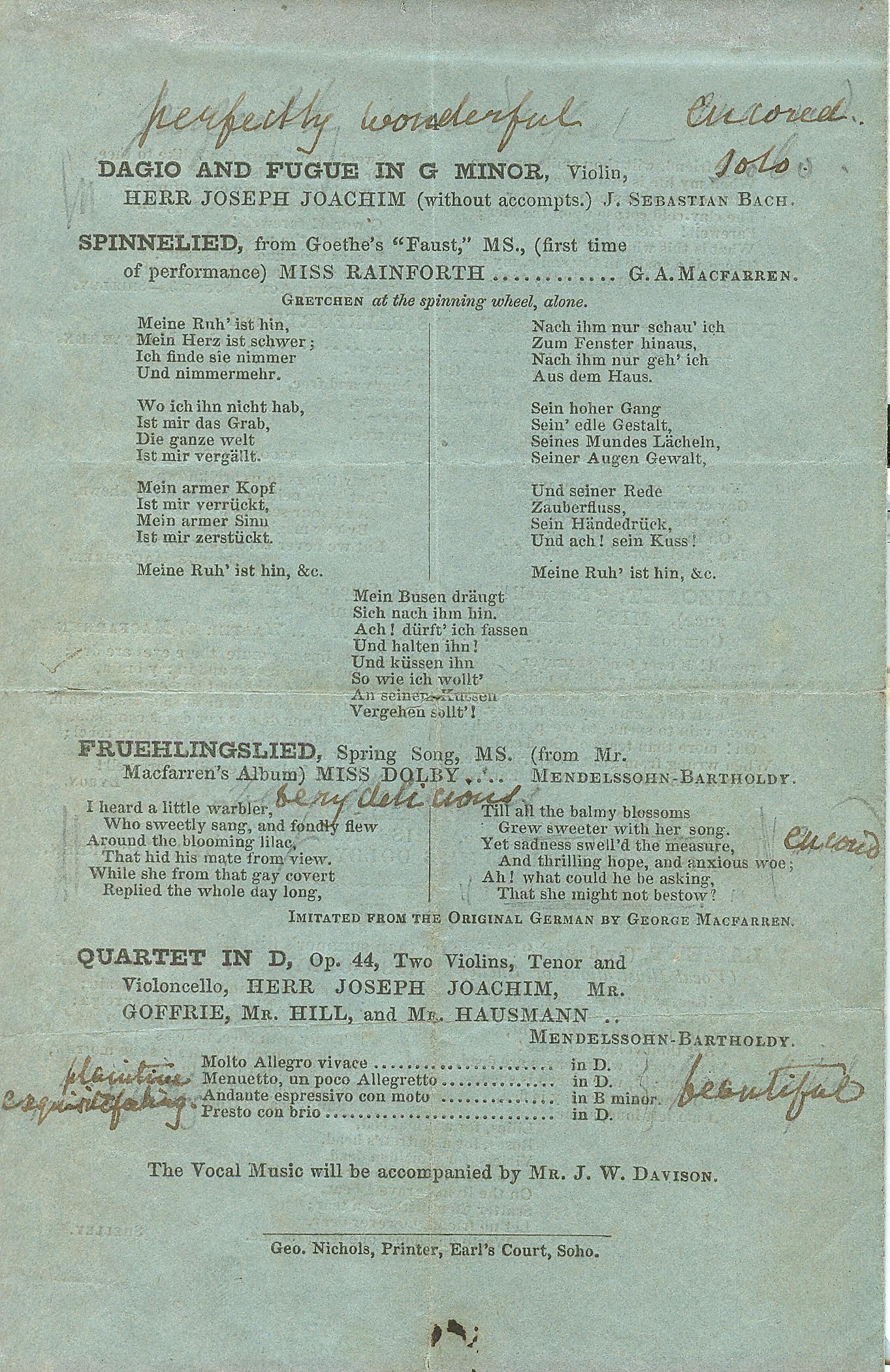
[xvii] The Musical World, vol. XIX No. 24 (June 13, 1844), p. 197 Review of concert Monday, 10 June, 1844 Sixth Philharmonic Concert.

[xviii] The Musical World, vol. XIX No. 24 (June 13, 1844), p. 199.

[xix] The Musical World, vol. XIX No. 24 (June 13, 1844), p. 200.

[xx] A full notice of the concert appeared in the Allgemeine Wiener Musik-Zeitung, Vol. 4, No. 82 (July 9, 1844), p. 328.

[xxi] Levy/ALSAGER, p. 124.

[xxii] The Musical World, vol. XIX No. 25 (June 20, 1844), p. 207.

[xxiii] Lübeck Brahms Institute, Sig. ABH: 6.3.97

Share this:

  • Share on X (Opens in new window) X
  • Share on Facebook (Opens in new window) Facebook
  • Email a link to a friend (Opens in new window) Email

Like this:

Like Loading…
← Older posts
Newer posts →

Photo collage © Mathias Brösicke — Dematon, Weimar

Archives

Categories

  • 1 Biographical Posts — RWE
  • 2 Articles and Essays — RWE
  • 3 Talks — RWE
  • Articles by Contributing Authors
  • Bibliography
  • Biographical Sketches
  • Books About Joseph Joachim
  • Brief Biography
  • Chronology
  • Concert Reviews & Criticism
  • Concerts
  • Contracts
  • Documents
  • Ephemera
  • Estate/Nachlass
  • Family
  • Iconography
  • Instruments
  • Joachim in Great Britain
  • Joachim Quartet
  • Letters
  • Links
  • Literature
  • Literature Review
  • Miscellaneous Articles
  • Obituaries
  • Pages
  • Queries
  • Recordings
  • Reminiscences & Encomia
  • Scores
  • Speeches and Utterances (Joachim)
  • Students
  • Uncategorized
  • Works
  • Writings (Joachim)

Pages

  • INDEX

Recent Comments

Joachim on The Kittsee Kehilla
Johann Heinrich Bona… on Concerts: Vienna, January, 188…
Johann Heinrich Bona… on Joachim at the Società del Qua…
Johann Heinrich Bona… on Joachim in Italy (1880)
Concert: Düsseldorf,… on The 31st Lower Rhine Music Fes…

Meta

  • Log in
  • Entries feed
  • Comments feed
  • WordPress.org

Email: Reshbach(at)unh.edu

Powered by WordPress.com.

Loading Comments...

    %d