• Home
  • INDEX

Joseph Joachim

~ biography and research

Joseph Joachim

Category Archives: 1 Biographical Posts — RWE

Digression: The Road to Jewish Emancipation

05 Monday Aug 2013

Posted by Joachim in 1 Biographical Posts — RWE

≈ Leave a comment


Previous Post in Series: The Kittsee Kehilla

__________jj-initials

Digression: The Road to Jewish Emancipation

For Jews, the journey of assimilation into modern urban society promised great rewards. Nevertheless, for those who had grown to maturity in the Kehilla, this new life could be difficult, confusing, and fraught with a host of momentous personal choices. The traditional Jewish way of life had been a profoundly integrated one. The long shutting-off of the Jewish people from the central institutions of European society had led to the world that Leopold Kompert so eloquently, so nostalgically described: a sensuous world, rich in feeling and faith, close-knit, traditional, autonomous, and largely untouched by progressive ideas and ideals. In Kittsee, it may not have occurred to the Joachims to consider their ethnic, religious, political and cultural identities as discrete and separable. It may never have occurred to many traditional Jews to question how their sense of themselves might change, should those various identities somehow become disaggregated. What would it mean to abandon time-honored ways of living, to loosen the bonds of family and friendship, and attempt to navigate their way in the dangerous, unpredictable waters of an alien culture? To what extent was it possible to do so? What new skills, what new ways of thinking would be required? What new social habits? What obligations did those who departed bear to those whom they left behind? Did accepting the new imply an outright rejection of heritage — or a rejection of those individuals and communities that continued to honor traditional ways?

The issues that confronted the Joachims were common among their generation. Could one remain an observant Jew while living within a dominant Christian culture? [1]  Could one retain a Jewish identity without necessarily being religious? What did it mean to an increasing number of Jews to follow the route of conversion, whether out of expediency or conviction? What became of the authority of Jewish leaders as their kehillot dispersed, and as the state began to engage Jews directly as individuals — not as a “nation” through their official representatives? How should those leaders respond? What, at the end of the day, were the consequences for Jews of attempting to embrace a culture that often eyed them with suspicion and contempt, as pariahs and parvenus? [2] The commonly accepted term “assimilation” hardly begins to anticipate the wide variety of issues that faced the Joachims and other nineteenth-century Jews, or the diversity of responses that they gave, as they took up the challenges of contemporary European life. More importantly, it does not hint at the cultural riches and spiritual gifts that they brought with them on their journey, or acknowledge the magnitude of their contribution to the society that they sought to enter.

*

*               *

The bewildering identity crisis that beset nineteenth-century Jewry can in many ways be seen as an unintended, delayed consequence of an attempt at philosophical clarity and sectarian harmony amongst the Christian majority. The modern notion of religious tolerance originated early in the course of the Enlightenment, in the intellectual milieu of seventeenth-century English and French deism, amid concerns for promoting peaceable co-existence among conflicting Christian denominations. In A Letter Concerning Toleration (1689), John Locke argued that religious doctrine should lie beyond the reach of state power. “Speculative opinions […] and articles of faith (as they are called) which are required only to be believed, cannot be imposed on any Church by the law of the land,” he wrote. “For it is absurd that things should be enjoined by laws which are not in men’s power to perform. And to believe this or that to be true does not depend upon our will.” [i]

The democratic ideals that characterized the Atlantic Revolutionary Era were likewise at odds with the traditional legal segregation and exclusion of religious minorities. Revolutionary France led Europe in the drive for the civic emancipation of its Jewish population, consistent with its faith in the principles of liberty, equality and fraternity, and its espousal of the quintessential Enlightenment notion that what is good and true for one people, time and place must necessarily be good and true for all.

Aside from philosophical issues of fairness, the belief that motivated enlightened leaders was largely this: that the problems besetting an empire — besetting mankind, generally — were not inherent and intractable, but the result of poor education and bad administration; that the development of human potential in all sectors of society could not but lead to an age of happiness and prosperity; that with proper laws and proper incentives, proper rewards and proper punishments, with proper schooling promoting a common language and culture, human ignorance, superstition, and prejudice could be conquered, and a better way of life could be secured for all of the citizens or subjects of the realm.

Carl_von_Sales_Bildnis_Joseph_II_posthum_1823

Joseph II

Hungarian Jews, who had suffered under the repressive regime of Empress Maria Theresa (1717-1780), enjoyed considerable political advancement under the enlightened rule of her son, Emperor Joseph II (1741-1790). Immediately upon accession to the throne, Joseph pressed a series of reforms aimed at rationalizing and centralizing the administration of his dominions. Some of Joseph’s reforms have become familiar to musicians through the biography of Mozart: his insistence on the use of the German language throughout the Empire, for example, led to the establishment of a German-language opera company in Vienna, for which Mozart wrote his Singspiel, Die Entführung aus dem Serail. Even in death, Austrians were affected by Joseph’s Enlightened thinking. Mozart was buried in an unmarked grave pursuant to the conditions of the Emperor’s funeral ordinance, which required, as a matter of hygiene and efficient land use, that cemeteries be located outside of the city, and that decomposed corpses be exhumed and gravesites reused.

In 1782, Joseph issued a Toleranzpatent, for Bohemian Jewry, with the intent of making Jews “useful and serviceable to the State, principally through better education and the enlightenment of their youth, and by directing them to the sciences, the arts, and the crafts.” [ii] In 1783 he issued a similar Edict of Toleration (Systematica gentis Iudaicae regulatio) for Hungary, for the first time permitting Hungarian Jews to attend any school or university, and to work at almost any occupation. With proper authorization, and in fixed numbers, Jews were henceforth to be allowed to reside in most places within the empire — with the exception of mining towns. During Joseph’s reign, Jews were required to use the German language for all but religious purposes and were required to take German-sounding surnames. Joachim’s maternal grandfather, previously known as Victor Schul because he lived near the Kittsee synagogue, took the variant name (Isaac) Figdor. [iii]

The increasing importance of capital in modern life undoubtedly played a role in the Emperor’s thinking as well. With the growth of international trade and banking, in which Jews played a predominant role, economic self-interest coincided with philosophical conviction to dictate a more pragmatic, tolerant policy toward this traditionally despised minority. (An early hint of this change of policy occurred as early as 1744, when the famously intolerant Maria Theresa was dissuaded from enforcing her banishment of Prague’s Jewish community by the argument that their expulsion might injure the Habsburg economy). [iv]

6fc5f31c-8bf0-469a-bc3e-7b5247c8ea98_570

Count Stanislas-Marie-Adélaide de Clermont-Tonnerre (1757-1792)

Portrait by Adolf-Ulrik Wertmuller, 1781

For Hungary’s Jews, the strongest winds of change blew from the northwest. On December 23, 1789, in a debate before France’s National Constituent Assembly, Count Stanislas-Marie-Adélaide de Clermont-Tonnerre (1757-1792) rose to address the question of political and social rights for executioners, actors and Jews, none of whom were then permitted to vote or hold office. A classic expression of the temper of the times, his Speech on Religious Minorities and Questionable Professions conveys some idea of the reasoning that was current among Enlightened leaders, and that helped to promote Jewish emancipation throughout Europe. Concerning the rights of executioners, Clermont-Tonnerre said: “It is against reason to tell [them], do this, and if you do it, you will be considered infamous.” As for actors: “I will certainly have less trouble disarming a prejudice that has been weakened for a long time by the influence of the Enlightenment, the love of the arts, and reason…. We should either forbid plays altogether or remove the dishonor associated with acting. Nothing infamous should endure in the eyes of the law, and nothing that the law permits is infamous.” Turning to the Jews, he argued:

Every creed has only one test to pass in regard to the social body: it has only one examination to which it must submit, that of its morals. It is here that the adversaries of the Jewish people attack me. This people, they say, is not sociable. They are commanded to loan at usurious rates; they cannot be joined with us either in marriage or by the bonds of social interchange; our food is forbidden to them; our tables prohibited; our armies will never have Jews serving in the defense of the fatherland. The worst of these reproaches is unjust; the others are only specious. […] Is there a law that obliges me to marry your daughter? Is there a law that obliges me to eat hare, and to eat it with you? No doubt these religious oddities will disappear; and if they do survive the impact of philosophy and the pleasure of finally being true citizens and sociable men, they are not infractions to which the law can or should pertain.

But, they say to me, the Jews have their own judges and laws. I respond that is your fault and you should not allow it. We must refuse everything to the Jews as a nation and accord everything to Jews as individuals. We must withdraw recognition from their judges; they should have only our judges. We must refuse legal protection to the maintenance of the so-called laws of their Judaic organization; they should not be allowed to form in the state either a political body or an order. They must be citizens individually. But, some will say to me, they do not want to be citizens. Well then! If they do not want to be citizens, they should say so, and then, we should banish them. It is repugnant to have in the state an association of non-citizens, and a nation within the nation. […] In short, Sirs, the presumed status of every man resident in a country is to be a citizen. [v]

There was the quid pro quo, and therein lay the dilemma for Jews if they wished to find a place in modern European life: emancipation under such conditions meant expansion of freedom and opportunity at the cost of their autonomy and the unraveling of that ancient ethnic-religious-political-cultural entity known to themselves and their contemporaries as the “Israelite nation.” By and large, the Enlightenment’s leaders were no friends of the Jewish religion, which they commonly viewed as retrograde, legalistic and superstitious. Like Clermont-Tonnerre, many who argued for Jewish emancipation tacitly assumed that emancipated Jews would quickly give up their “religious oddities” and traditional ways once they were allowed to become “true citizens and sociable men”— that they would become assimilated and quietly disappear from view. Many Jewish leaders feared the same. They sensed, correctly, that even as it promised religious tolerance, the universalist premise of the Enlightenment threatened the Israelite nation with dissolution, disappearance, or, to use Wagner’s much-misunderstood, untranslatable word, Untergang.

France granted Jews full rights of citizenship at a stroke on September 27, 1791 — an action that resonated throughout Europe. Prussia granted citizenship rights to Jews in 1812, during the French occupation. Progress in Germany and Hungary was precarious, however: in the period of Restoration that followed the Wars of Liberation and the Congress of Vienna, Jewish rights took a temporary step backward in German lands, as many emancipatory acts were rescinded.

Even among the enlightened, few gentiles believed that Jewish culture had anything of value to contribute to the progress of Western civilization. “It dares to spread irreconcilable hatred against all the nations; it revolts against its masters. Always superstitious, always greedy for others’ property, always barbarous, servile in misfortune, and insolent in prosperity” — this was Voltaire’s assessment of the Israelite nation. [vi] “The belief in something divine, in something great, cannot live in the dung. The lion has no room in a nutshell, the infinite spirit none in the prison of a Jewish soul, the whole of life none in a withering leaf,” wrote G. W. F. Hegel at Enlightenment’s end. [vii] What implications did such beliefs hold for the future of an artist of Joachim’s stature? How was a Jew to square that circle within the context of his own life?

Christian_Fürchtegott_Gellert

Christian Fürchtegott Gellert (1715-1769)

Since the question of Jewish emancipation seemed to hang on the possibility of Jewish assimilation, it became important to ask whether assimilation was truly possible, and if so, to ask what a successfully assimilated Jew would look and act like. Accordingly, the didactic figure of the “noble Jew” began to appear in mid-eighteenth-century German drama, playing against stereotype as generous, selfless and unacquisitive. Christian Gellert’s Das Leben der Schwedischen Gräfin von G*** (1747) provided the first such positive portrayal of a Jew in German literature. [viii] A substantial body of mostly trivial or sentimental plays portraying Jews in often exaggeratedly sympathetic roles grew up over the next sixty years, after which, in Charlene A. Lea’s phrase, the “noble Jew” suddenly and completely “disappeared, exhausted, from the stage.” [ix]

Gotthold_Ephraim_Lessing

Gotthold Ephraim Lessing (1729-1781)

The most important philo-Semitic works of the Aufklärung (German Enlightenment) were the plays of Gotthold Ephraim Lessing (1729-1781): Die Juden (The Jews, 1749), influenced by Gellert, and especially his “dramatic poem” Nathan der Weise (Nathan the Wise, 1779), which German Jewry came to look upon as their “spiritual Magna Carta.”  [x] The son of a Lutheran minister, Lessing had a family heritage of religious tolerance: his grandfather, Theophilus, had written an early essay On the Universal Tolerance of all Religions.  Lessing himself believed that the exclusion of Jews from the larger Christian society was unreasonable and therefore intolerable.

Lessing’s contribution to the emancipation debate went beyond the literary. When the “noble Jew” — the Jew with an enlightened moral viewpoint — came to be criticized as a mere philosophical conceit and literary fiction, a liberal fantasy, improbable and unrealistic, Lessing brought forth a suitable flesh-and-blood representative by way of demonstration. The figure of Lessing’s Nathan, revered by Jews and reviled by anti-Semites, [4] was based upon the character and thought of his real-life friend and contemporary, Moses Mendelssohn (1729-1786). Lessing helped to bring Mendelssohn to prominence, introducing him to influential thinkers, and supporting him in his efforts to find a new role for Jews in modern European society.

Moses_Mendelson_P7160073

Moses Mendelssohn (1729-1786)

Portrait by Anton Graff, 1773

In Judaism, the history of enlightened reform begins with Mendelssohn, who as a fourteen-year-old boy, malformed in body but brave in spirit, followed his rabbi, David Fränkel, from his native Dessau to Berlin. There, he lived in poverty “so great that on the loaf he bought every week as his only food he marked his daily allowances with lines, knowing that if he had eaten more he would have had nothing left at the end of the week.” [xi] Mendelssohn worked as a clerk at Isaak Bernhard’s silk factory, eventually rising to manager. All the while, he pursued his education largely on his own and in secret, since significant contact with Christian society was forbidden him, including access to the books on language and philosophy that he desired, and somehow found ways of obtaining. “Individual Jews achieved prominence in the culture of the world long before Mendelssohn’s time,” Alfred Jospe tells us. “But Mendelssohn was the first to make a deliberate effort not merely to acquire European culture for himself but to use his influence to bring modern culture to his fellow Jews and, speaking publicly as a Jew to the non-Jewish world, to demand respect for his people’s faith and human rights.” [xii]

Mendelssohn is known today as the most prominent progenitor and leader of the Haskalah (Jewish Enlightenment), and a central figure in the religious and social history of Reform Judaism. More than any other individual, it was he who enabled European Jews to enter the mainstream of European life and culture. [5] According to Jospe: “Mendelssohn attempted to bridge the two worlds by encouraging Jews to move from the ghetto into modernity in three ways: through civic emancipation, cultural integration, and the philosophic validation of Judaism’s religious tenets before the bar of reason. One or the other of these concerns kept Mendelssohn occupied through most of his adult life, often simultaneously.” [xiii]

LavaterJC

Johann Kaspar Lavater (1741-1801)

In 1769, the Swiss poet and pastor, Johann Kaspar Lavater (1741-1801) famously challenged Mendelssohn to dispute the claims of naturalist and philosopher Charles Bonnet’s Palingénésie philosophique, [6] and in so doing either to refute Bonnet’s assertions or convert to Christianity. Though Mendelssohn evaded the direct challenge, his subsequent, reluctantly engaged defense of Judaism provided what Michael Meyer has called “the first articulate expression in the language of a larger intellectual milieu” of “an experienced consciousness of the self as Jew.” [xiv] Like Locke and Clermont-Tonnere, Mendelssohn took refuge in the argument that faith was inherently a personal response to revealed truth, a matter of individual belief; morality, on the other hand, was a question of behavior, and therefore a legitimate subject of social concern. It was on the basis of morality, therefore, not doctrine, that Mendelssohn sought common ground among religions, and hoped to promote a more tolerant attitude among their faithful. “What a happy world we would live in if all men accepted and practiced the truths that the best Christians and the best Jews have in common,” he wrote. [xv]

“I look on [Moses Mendelssohn] as the future glory of his nation if his own brethren, who always have been instigated by an unhappy spirit of persecution against men of his kind, will but let him reach maturity,” wrote Lessing [xvi] Certainly, not all Jews wished to go where Mendelssohn led. In his 1836 will, the Chatam Sofer wrote: “May your mind not turn to evil and never engage in corruptible partnership with those fond of innovations, who, as a penalty for our many sins, have strayed from the Almighty and His law! Do not touch the books of Rabbi Moses [Mendelssohn] from Dessau, and your foot will never slip! […] Be warned not to change your Jewish names, speech, and clothing — God forbid. […] Never say: ‘Times have changed!’ We have an old Father — praised be His name — who has never changed and never will change.” [xvii] In and around Pressburg, the Hungarian Jewish establishment, supported by reactionary political elements (reform-minded Jews tended to support liberal, nationalist politics), remained staunchly opposed to reform.

If there were cross-currents within Judaism, the nineteenth century saw strong cross-currents within mainstream European culture as well, arising out of the great criticism of the Enlightenment that we call Romanticism. In France, Romanticism was colored by nostalgia for the heady glory days of revolution and empire; in England — the crucible of the Industrial Revolution — it was characterized by a longing for Nature, pure and undefiled. In the more than thirty independent German states, from Prussia to Liechtenstein, Romantics yearned for unification: for the creation of a greater Germany, not so much political as cultural — familial, even — a drawing together of the German Volk around themes of language, custom, religion, music, landscape, and a shared contempt for the cold, alienating refinements of French civilization.

Enlightened thinkers like Locke, Clermont-Tonnerre and Mendelssohn had drawn clear distinctions between the rights and obligations of individuals as citizens, and their self-defined religious and cultural identities. For them, the state’s only concern was how a person behaved in public, not what he or she believed in private. Such a distinction between the universal, objective world of laws and the closed, subjective world of identity and belief had been alien to the traditional, integrated outlook of the Kehilla. In the progress of the nineteenth century, it would become increasingly alien to the culturally defined national ambitions of the German people as well.

Ironically, the Kehilla represented nearly everything that the German nation would wistfully try to reify in the Romantic notion of the Volk — that humble, insular world of myth and magic familiar to anyone who has ever read a tale beginning: “There once was a poor woodcutter who lived with his wife in a little hut on the edge of a vast, dark forest.” As the Romantic criticism of Enlightenment began to transform German politics and the German nation began to coalesce around the notion of the Volk, the distinction between public conduct and private identity became harder to maintain. At the same time, the notion of Jewish emancipation came to be associated with some of the hot-button issues of post-Napoleonic politics: the rise of Capitalism, and the hégémonie of the hated and reviled French. Thus, Jews and Germans met on different trajectories, and Jews unwittingly found themselves on the wrong end of a great cultural bait and switch: progressive German Jews embraced the universalism of Enlightenment just as the German nation was retreating from it. Judaism was redefined as a Vernunftsreligion — a rational religion — just as ardent Young Germans were turning in large numbers to Catholic mysticism. Jews celebrated modern, capitalistic society as Germans were rediscovering the Gothic, Heiliges Römisches Reich. The Israelite nation was abandoning the Kehilla and moving to the city just as the German nation was learning to extol the virtues of folk culture, nature and the village.

The woodcutter and his wife, the miller and the huntsman and the maid—the whole cast of strong, honest, Germanic-depressive rustics that the Romantiker sent forth to do battle with the Enlightenment’s venal, over-sexed and over-civilized gods and goddesses, its insipid, indulged, eternally happy nymphs and swains—grew from German soil like the oaks of the Teutoberger forest: not citizens of a centralized state, but  members of an organically integrated German Volk. Thus, greater Germany would not be conceived politically and legalistically, as a civilization like France or ancient Rome, but as a Kulturnation based upon a constructed identity—an idealized looking-glass self. The success of the German cultural project inspired other nations like Hungary to follow suit—to discover or invent their own cultural identity as a weapon in their struggle for social unity and political autonomy.

Part of that identity grew out of a feeling for the land itself. To fully accept the myth of the Volk was to possess, and be possessed by, the spirit of the landscape. To be one of the Volk was to have roots. But to be a Jew was repeatedly to be rejected from the landscape. To be a Jew was to strike a tent. Johann Gottfried Herder, an early architect of the concept of the Volk, wrote of the Jews: “The People of God (Das Volk Gottes), to whom Heaven itself once gave its fatherland, has been for millennia, indeed almost from its beginnings, a parasitic plant on the trunks of other nations, a race of cunning dealers throughout nearly the whole world, which despite oppression never yearns for its own honor and dwelling, never for its own fatherland.” [xviii] Conversely, Franz Werfel once claimed that the Jews of Burgenland took pride in two things: their learned men, and their attachment to the land.[xix] Pride and affection notwithstanding, that attachment had to prove elusive. Joseph Joachim’s ancestors arrived in Kittsee as refugees. They lived for a time at the pleasure of the mighty Esterházy princes, huddled in a tiny German-speaking Kehilla in a place that they may have loved but could not own. Today, their bones lie untended and forgotten in Kittsee’s sacred ground, awaiting, as they would believe, the fulfillment of Ezekiel’s prophesy: “Thus saith the Lord God: Behold, O my people, I will open your graves, and have you rise from them, and bring you into the land of Israel.”

For Joseph Joachim, Kittsee was only a brief sojourn: the beginning of a journey in search of a congenial home—a place of companionship and belonging—a landscape in which his intellect and spirit could flourish. His youth became a Bildungsreise: a journey of education, of personal growth and maturing, in search of identity and self-realization. That journey would take him to Pest, to Vienna, to Leipzig, London, Weimar and Hanover, and ultimately to Berlin. Joachim could wax nostalgic enough about his native land. He could call it his Heimat, and evoke its memory in his Hungarian Concerto. But for him it was a good place to be from, not a place or a world to which he could ever comfortably return. Robert Frost once wrote a long poem extolling the virtues of New Hampshire that concludes:

“It’s […] restful just to think about New Hampshire.
At present I am living in Vermont.”

Joseph Joachim is buried in Berlin.

© Robert W. Eshbach, 2013.


Next Post in Series: Of Rivers and Highways: The Perilous Journey into the Future


[1] Observant Jews had, of course, special requirements that could not easily be met outside of the community. For example: “Being an observant Jew I took every precaution not to cross the ereb [eruv] on the Sabbath if I was carrying something in my pocket,” wrote one 19th-century Jew. “I mean the rope which marked the inside of the city, for had I crossed this line, it would have been considered an act of business, it would have desecrated the holy day of rest. Therefore on the Sabbath I only dared to walk with a kerchief in my belt, my eyes fixed on the rope hanging from the pole.” [Ármin Vámbéry, Küzdelmeim (My Struggles), 1905, quoted in Frojimovics/BUDAPEST, p. 70.]

[2] Gustav Mahler famously declared: “I am three-times homeless: as a Bohemian among Austrians, as an Austrian among Germans, as a Jew throughout the entire world. Everywhere one is an intruder, nowhere ‘desired.’” (“Ich bin dreifach heimatlos: als Böhme unter den Österreichern, als Österreicher unter den Deutschen und als Jude in der ganzen Welt. Überall ist man Eindringling, nirgends ‘erwünscht.’”)

[3] In one of his more bizarre fulminations, for example, Richard Wagner once joked that “all the Jews ought to be burnt at a performance of Nathan the Wise. [Cosima Wagner diaries, December 18, 1881.]

[4] Joseph Joachim would imbibe this tradition as a young man. Joachim was thirteen when he first met Mendelssohn’s grandson, Felix. He was immediately accepted into the heart of the Mendelssohn family and treated virtually as an adopted child. For the next four years, until Felix Mendelssohn’s shocking death in 1847, Joseph’s parents entrusted Felix Mendelssohn with the direction of the their son’s education. In countless ways, the Mendelssohn family would exercise a warm and beneficial influence on Joachim’s life from the time of his coming of age until his death. There is no question that they played a large part in forming his identity as a Jew, and later as a Lutheran convert.

[5] Bonnet expounded a preformationist “scientific ideology” of evolution that posited the rising of all creatures toward God through a continuous sequence of rebirths. [See: Arthur McCalla, “Palingenesie Philosophique to Palingenesie Sociale: From a Scientific Ideology to a Historical Ideology,” Journal of the History of Ideas Vol. 55, No. 3 (Jul., 1994), pp. 421-439.] The second part of Bonnet’s book consists of a historical demonstration of the truth of Christianity. Lavater translated the book into German, addressing Mendelssohn personally in the dedication with the words: “I make bold to ask, in the presence of the God of truth, your Creator and Father and my own, not that you read this work with philosophical impartiality, for this you will certainly do without my requesting it, but that you refute it publicly insofar as you find yourself unable to accept the essential argumentation by which the facts of Christianity are proved; or if you find this argumentation valid, that you do what wisdom, love of truth, and honesty dictate, that you do what Socrates would have done if he had read this work and found it irrefutable.” [Quoted in: Edward S. Flajole, “Lessing’s Attitude in the Lavater-Mendelssohn Controversy,” PMLA, Vol. 73, No. 3. (Jun., 1958), p. 202.]


[i] http://www.constitution.org/jl/tolerati.htm, accessed 11/29/2006.

[ii] Sachar/JEWS, p. 25.

[iii] Hollington/FAMILY, p. 35.

[iv] Sachar/JEWS, p. 18.

[v] From The French Revolution and Human Rights: A Brief Documentary History, translated, edited, and with an introduction by Lynn Hunt, Boston/New York: Bedford/St. Martin’s, 1996, pp. 86–88.

[vi] Quoted in Robertson/JEWISH, p. 23.

[vii] Quoted, ibid., p. 26. “Der Löwe hat nicht Raum in einer Nuss, der unendliche Geist nicht Raum in dem Kerker einer Judenseele.” Der Geist des Christentums und sein Schicksal (ed. Nohl) p. 312.

[viii] Lea/TOLERANCE, p. 168.

[ix] Lea/TOLERANCE, p. 176.

[x] Mendes-Flohr/JEWS, p. 36.

[xi] Hensel/MENDELSSOHN, p. 4.

[xii] Mendelssohn/WRITINGS, p. 5.

[xiii] Mendelssohn/WRITINGS, p. 11.

[xiv] Meyer/ORIGINS, p. 9.

[xv] Quoted in Meyer/ORIGINS, p. 33.

[xvi] Hensel/MENDELSSOHN I, p. 5.

[xvii] Quoted in Plaut/REFORM, pp. 256-257. This reading has been a matter of controversy, some believing that “do not touch the books of R. Mosche of Dessau” was a mistaken reading, and that the text should properly be read: “do not touch romantic novels.”

[xviii] Johann Gottfried Herder, Ideen zur Philosophie der Geschichte der Menschheit, Book XII, Chap. III Hebräer.

[xix] Quoted in Zalmon/WEG.
Share this:

  • Share on X (Opens in new window) X
  • Share on Facebook (Opens in new window) Facebook
  • Email a link to a friend (Opens in new window) Email

Like this:

Like Loading...

Friends

22 Monday Jul 2013

Posted by Joachim in 1 Biographical Posts — RWE

≈ Leave a comment

 © Robert W. Eshbach, 2013

__________

jj-initials

Friends

When he was not roughhousing at home with the Wittgenstein children, Joseph seems to have spent the majority of his social time in the company of adults. Occasionally, we learn of his having formed friendships with boys of his own age, such as Fanny Hensel’s son, Sebastian, or Ignaz Moscheles’ son Felix; how close these friendships were, however, is difficult to tell. Sebastian Hensel lived in Berlin, and though Joseph and Felix Moscheles had been acquainted in London, Felix would not reside in Leipzig until 1846, when his father, Ignaz, took up his piano teaching duties at the Leipzig Conservatory. [1]

Joseph found a close friend in Otto Goldschmidt, the son of a Hamburg merchant who was Louis Plaidy’s piano student at the Conservatory. [2] Goldschmidt was several years older than Joseph, but of a similar Jewish background, and a good musician. Like Joseph, he studied counterpoint with Hauptmann. In later years Goldschmidt had a significant musical career in England, but he is perhaps best known today as the husband of Jenny Lind, whom he married in Boston while accompanying the “Swedish Nightingale” on an American tour.

At the end of May, 1845, Joseph and Otto found a new friend in the 22-year old William Smith Rockstro, [3] an English protégé of Sterndale Bennett, who had come to study at the Conservatory. Like Goldschmidt, Rockstro joined Plaidy’s piano class, and studied counterpoint with Hauptman.  Though Joseph was not yet fourteen, he and Rockstro formed a friendship that would be strengthened later that autumn, when Mendelssohn returned from Frankfurt and accepted both Rockstro and Goldschmidt into his select class of seven students in piano interpretation and composition.

Since the days of his friendship with “Mundi” Singer in Buda-Pest, we have no indication that Joseph had enjoyed an intimate friendship such as he now had with his two older companions. Sir Charles Villiers Stanford recalled:

[Rockstro] told me that there were three of them always together — Joachim, Otto Goldschmidt, and himself — and that this trio used occasionally to become a quartet by the advent of a fourth brilliant boy who was studying law, which he used to lay down so dogmatically that Joseph and he sometimes nearly came to blows […]. The occasional visitor was Hans von Bülow, and much as they admired each other’s genius, they always went on in the same way; Hans taking an impish delight in treading upon a tender toe, and Joseph just letting him go as far as he dared, but no farther. Their immense sense of humour, however, generally saved the situation. [i]

Rockstro […] described to me how [Joachim and Goldschmidt] used to have internecine encounters, which they sank when v. B. appeared on the scene to stay with his relative, Frau Frege. They joined forces to defend themselves from v. B.’s satirical tongue, and gentle Rockstro had to pour such oil as he could upon the troubled waters. They were all then in short jackets, but they managed to make it appear that their coats had tails to tread on. Joachim and v. B. were the protagonists. The boys were fathers to the men. They kept up their altercations of squabbles and reconciliations to the end of their lives. The most serious breach was after the Weimar manifesto, when v. B. (as he afterwards confided to Joachim in an affectionate moment) considered the advisability of purchasing a pistol to shoot him at sight. But they had a deep underlying respect and admiration for each other, though their natures were so diverse as to make frictions unavoidable. He never stinted in his praise. Joachim rarely expressed his. Therein lay the kernel of the whole matter. The one pined for outspoken appreciation, which the other never volunteered. [ii]

index.php

Otto Goldschmidt and Jenny Lind 

 [iii]


[1] “When […] we met in Leipsic [in 1846],” Moscheles writes in his Fragments of an Autobiography, “it so happened that I was suddenly fired with the desire to play the violin too. My friend Joseph was quite ready to teach me, and we started operations, but two or three lessons were sufficient to convince him and me, that mine was an unholy desire, which, if gratified, would give me the power of inflicting much suffering on my fellow-creatures, and which therefore was calculated to lead me into trouble. So we gave it up, and Joachim has had to rely on other pupils for his reputation as a teacher.” [Moscheles/FRAGMENTS, p. 25.]

[2] Otto Moritz David Goldschmidt (1829-1907) attended the Leipzig Conservatory from 1843-1846. In addition to his studies with Plaidy and Hauptmann, he was a member of Mendelssohn’s elite piano class. He married Jenny Lind in 1852, and thereafter was often associated with her in musical projects and public performances. Goldschmidt converted to the Protestant faith, and was active as a church musician in England. He became professor of piano at London’s Royal Academy of Music in 1863, and was vice-principal of the same institution from 1866-1868. He composed a variety of works, including the 1867 oratorio Ruth, written for his wife.

[3] Born William Smyth Rackstraw (1823-1895), Rockstro attended the Conservatory for only one year: from May 1845 to June 1846. Like Otto Goldschmidt, Rockstro would go on to an unusually prolific and varied career in England as a composer, pianist and organist, editor and author. He was known in his time as a leading authority on early counterpoint, and an expert on the music of Palestrina, whose music he ws said to be able to imitate with confounding fidelity. He wrote A General History of Music, biographies of Handel and Mendelssohn, and with Scott Holland, a biography of Jenny Lind.


[i] Stanford/MEMORIES, pp. 133-134.

[ii] Stanford/DIARY, pp. 269-270.

[iii] http://digitalgallery.nypl.org/nypldigital/dgkeysearchdetail.cfm?trg=1&strucID=521367&imageID=th-16549&total=1&num=0&parent_id=521366&s=&notword=&d=&c=&f=&k=1&sScope=&sLevel=&sLabel=&lword=&lfield=&sort=&imgs=20&pos=1&snum=&e=w Accessed 7/21/2013

Share this:

  • Share on X (Opens in new window) X
  • Share on Facebook (Opens in new window) Facebook
  • Email a link to a friend (Opens in new window) Email

Like this:

Like Loading...

The Call to Hanover

15 Monday Jul 2013

Posted by Joachim in 1 Biographical Posts — RWE

≈ Leave a comment

© Robert W. Eshbach, 2013

image

The Call to Hanover

JJ CDV 2

On November 12, 1852, Joachim’s Viennese friend and fellow student Georg Hellmesberger died of consumption, two months short of his twenty-third birthday. Hellmesberger had been called to Hanover several years earlier, and had served as Konzertmeister to the King until illness made his work impossible. While in Hanover, he had enjoyed an excellent reputation as a violinist, and he had been the aspiring composer of two operas.

When it appeared that Hellmesberger could no longer work, Jean Joseph Bott was approached to fill his post. Bott, the second Kapellmeister to Spohr in Cassel, was nevertheless unable to break his contract, and so consideration turned to the young Grand-ducal concertmaster in Weimar. When court pianist Heinrich Ehrlich sought Liszt’s assistance in obtaining Joachim for Hanover, Liszt, recognizing an opportunity for Joachim to gain a “large sphere of influence,” generously assisted in obtaining his release.[1]

During his September contract negotiations with Hanover Court Intendant Count Julius von Platen, Joachim expressed his desire to play for the King before final commitments were made. Arrangements were made for his Hanover debut at a benefit concert for the orchestra musicians, their widows and orphans. As it happened, the concert took place on the day following Hellmesberger’s death. For this crucial first appearance, Joachim chose a contemporary work: Mendelssohn’s Violin Concerto, performed for the first time in manuscript seven years earlier by Ferdinand David. The Zeitung für Norddeutschland reported: “[Joachim] truly deserves the excellent reputation that preceded him, for this masterpiece can probably not be played more masterfully. Joachim utterly rejects the typical tricks and exaggerations of other violinists; the most thoughtful, spiritual delivery is paired with a calm, security, and bell-like purity of playing that must delight anyone. If only Hanover’s orchestra could count this man among its members.”[2] Joachim played several additional command performances for the King before being engaged as Konzertmeister for the coming year.[3] His new appointment began on January first.

Georg Hellmesberger jun

Georg Hellmesberger junior

[4]

Joachim was offered a considerably more favorable contract in Hanover than he had been accorded in Weimar. In his new position, he was to be responsible for the direction of all the instrumental music in the court theater (Heinrich Marschner was responsible for the direction of the vocal music), and was to act as concertmaster for all the opera rehearsals and concerts. He was to be prepared to conduct the opera should the Kapellmeister become indisposed. Additionally, he was to play at court at the pleasure of the King, usually once or twice a week. In recompense, he would receive the generous salary of one thousand Thalers, two months’ Winter leave, not to coincide with the concert season or the King’s birthday, and a five-month leave in the Summer. This free time was of particular importance to him, as it would allow him the opportunity of touring, and of furthering his education at Göttingen’s Georgia Augusta University. At the signing of his contract, Joachim expressed his pleasure that his new position held such exceptional artistic promise.[5]

Joachim sought his release from Weimar in a letter to Intendant Ferdinand von Ziegesar on November 30:

Joseph Joachim an Ferdinand von Ziegesar [6]

Weimar, 30. November 1852

Eurer Hochwohlgeboren erlaube ich mir vorzustellen, daß mir vom Chef der Königlichen Kapelle in Hannover eine Anstellung geboten wird, welche für mein musikalisches Fortbilden und Wirken so günstige Bedingungen enthält, daß ich im Hinblick auf meine künstlerische Zukunft den Wunsch sage, dieselbe anzunehmen. Dieser Wunsch kann indeß nur dadurch zur That werden, daß Seine Königliche Hoheit, der Großherzog, geruhen, mich meiner jetzigen Stellung gnädig zu entheben.

Ich wage es daher, Euer Hochwohlgeboren zu ersuchen, bei Seiner Königlichen Hoheit meine Entlaßung aus dem Großherzoglichen Dienste eines Concertmeisters gütigst bewirken zu wollen, so groß auch mein Bedauern sein muß, aus einer Stellung zu scheiden, in der Erfüllung deren Pflichten ich bisher so große Genugthuung und Freude empfand.

Euer Hochwohlgeboren aber bitte ich die Versicherung zu genehmigen, daß die Erinnerung an die Zeit, während welcher ich die Ehre hatte meine Kräfte einer so schönen künstlerischen Sache zu widmen, wie sie an dem Institute vertreten wird, dem Hochstselben vorstehen, mich als eine der schönsten meines Lebens überall hin begleiten wird, und daß ich, in aufrichtigster Dankbarkeit eingedenk des Wohlwollens Euer Hochwohlgeboren, stets verharren werde

Hochstselben ergebenster

Joseph Joachim


[1] “The Court Intendant, Count Platen, asked me who could best fill the vacant position, and I immediately replied: ‘Joachim.’ I could not for an instant doubt that his artistic accomplishments infinitely outshone my own, or that my position at court would lose a great deal of its apparent lustre in comparison with his — at that time already highly esteemed — personality. But I was consumed with the single thought that, with the appointment of a great artist, I would share the activity of a very worthy circle, and that, under him, I could serve Art. My personal relations with him were never intimate — we have not visited one another for years — but I always hear his incomparable performances in the quartet, and of classical works, with the same delight, and I could never bring myself to set the accomplishments of other violinists in these areas on a par with his.” / “Der Hofintendant Graf von Platend fragte mich, wer wohl die erledigte Stelle am besten ausfüllen könnte, und ich nannte sofort “Joachim.” Der Künstler, mir damals persönlich gänzlich unbekannt, war noch lebenslänglich in Weimar gebunden, ich erbot mich, den Einfluß Liszts (zu jener Zeit Hofkapellmeister und Kammerherr in Weimar) zu gewinnen, um Joachim von der Verpflichtung zu befreien.) [Note: “Ich besitze noch alle Briefe Liszts und Joachims über diese Angelegenheit. Jener schrieb mir, er wollte J.’s Enthebung von der Verpflichtung erwirken, wenn ihm ein “großer Wirkungskreis” eröffnet wird. Joachim, der zuerst nach Hannover gekommen war, um die Verhältnisse zu prüfen, teilt mir einige Tage später mit, er sei entschlossen dem Antrag anzunehmen. Der Brief endet mit den Worten “haben Sie Dank für alles Liebe und Gute was Sie gethan haben Ihrem J.”] Daß seine Kunstleistungen die meinen überragten, daß gegenüber seiner schon in jener Zeit hochgeehrten Persönlichkeit meine Stellung am Hofe an äußerem Scheine verlieren mußte, konnte mir nicht einen Augenblick zweifelhaft sein. Aber mich erfüllte der eine Gedanke, mitthätig zu sein bei der Berufung eines großen Künstlers in einen seiner würdigen Wirkungskreis, und unter ihm der Kunst zu dienen. Meine persönlichen Beziehungen zu ihm sind niemals vertrauliche gewesen, seit Jahren haben wir uns nicht besucht, aber mit immer gleichem Entzücken vernehme ich seine unvergleichliche Vorträge im Quartett und klassischen Werken, und niemals konnte ich es über mich gewinnen die Leistungen anderer Geigenkünstler in dieser Richtung den seinigen gleichzustellen.” Ehrlich/KÜNSTLERLEBEN, pp. 8-9.

[2] “Er verdient wahrlich den ausgezeichneten Ruf, der ihm vorherging, den meisterhafter kann dies Meisterwerk wohl nicht aufgeführt werden. Joachim verschmäht gänzlich die gewöhnlichen Kunstgriffe und Aufschneidereien anderer Violinspieler; der überdachteste, seelenvollste Vortrag ist mit einer Ruhe, Sicherheit und Glockenreinheit des Spiels gepaart, die Jeden hinreissen müssen. Wenn doch Hannover’s Orchester deiesn Mann unter seine Mitglieder zählen könnte.” Fischer/HANNOVER, pp. 226-227.

[3] Joachim’s contract in his Hanover Personalakten is dated November 1852, and lasts until April 1, 1855.

[4] http://digitalgallery.nypl.org/nypldigital/dgkeysearchdetail.cfm?trg=1&strucID=577603&imageID=1231905&total=5&num=0&word=hellmesberger&s=1&notword=&d=&c=&f=&k=0&lWord=&lField=&sScope=&sLevel=&sLabel=&imgs=20&pos=1&e=r

[5] Fischer/HANNOVER, p. 227.

[6] Staatsarchiv Weimar, Generalintendanz des Deutschen Nationaltheaters Weimar No. 183 “Die Anstellung des Konzertmeisters Joachim.”

Share this:

  • Share on X (Opens in new window) X
  • Share on Facebook (Opens in new window) Facebook
  • Email a link to a friend (Opens in new window) Email

Like this:

Like Loading...

King George V of Hanover

15 Monday Jul 2013

Posted by Joachim in 1 Biographical Posts — RWE

≈ Leave a comment

© Robert W. Eshbach, 2013


JJ Initials

 King George V of Hanover

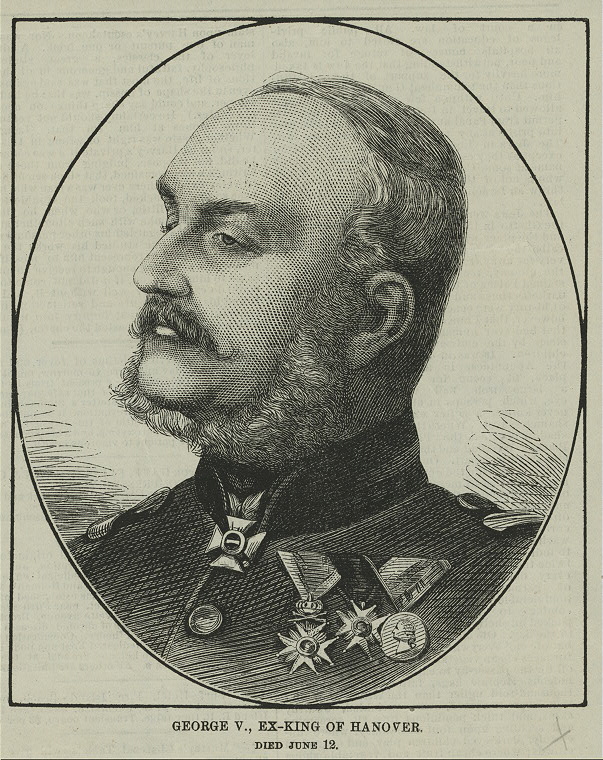
George V

George V, King of Hanover [i]

Georg Friedrich Alexander Karl Ernst August (1819-1878) was the grandson of Great Britain’s King George III, and first cousin to Britain’s Queen Victoria. Until the birth of Victoria’s first child in 1841, he was second in the line of succession to the British throne. Hanoverian kings ruled Britain until Victoria became Queen of England in 1837. At that time, the Lex Salica, which forbade a female succession in Hanover, forced an end to the 123-year old conjoined British-Hanoverian monarchy. Georg, the Crown Prince of Hanover and Prince of Cumberland succeeded his father Karl August as King of Hanover on November 18, 1851, styling himself King George V. When Joachim arrived in Hannover, George had been monarch for little more than a year.

The King was blind. He had lost the sight of one eye due to a childhood illness — the other in a freak circumstance: at the age of fourteen, swinging a purse full of coins, he accidentally hit himself in his good eye.

George was broadly educated, and possessed an impressive memory. He was passionate about music, an appreciation that could only have been enhanced by his blindness. “From early youth on, I have striven with ardent love to make music my own,” he wrote. “For me, she has become an exquisite companion and comforter throughout the course of my life.  She became more and more priceless to me, the more I learned to appreciate and understand her immeasurable wealth of ideas and inexhaustible abundance; the more intimately her poetry mingled with my entire being.” [ii]

King George was musically trained. He had studied piano with Ferdinand David’s sister Louise Dulcken, and was the composer of some two hundred works, including songs, choruses, cantatas, piano pieces and a symphony. [iii] As monarch, he involved himself directly in the musical life of his court. “The king was his own general manager,” wrote Georg Fischer, a contemporary chronicler of the Hanoverian musical scene. “He decided on opera repertoire, concert programs and engagements, and distributed new operas among the music directors in a highly personal way. Not seldom, specific operas, symphonies and other concert pieces were undertaken on special orders. The character and the casting of roles was treated with the seriousness of affairs of state.” [iv] One might equally well say that the king treated the court music with the importance that he assigned to religion. “His attitude toward art was idealistic;” Fischer tells us, “he lived in the conviction that artists were subject to a different tribunal before the throne of God.” [v]

Georg V Hannover Edit copy

This sense of the significance of music had come to him early. At the age of twenty, Crown Prince George lamented: “One so often hears remarks by musical enthusiasts that reveal that they not only fail to recognize the exalted and sublime character of music, they actually have a false idea of it; they regard it as merely a means of ordinary entertainment, like card-playing and dancing, or rather through their remarks show that they deem it to be no more than a pastime.” [vi] Wishing to give fuller expression to his own deeper appreciation of the musical art, he published his Ideas and Observations on the Characteristics of Music (Ideen und Betrachtungen über die Eigenschaften der Musik) in 1839. “If only a few can become deeply permeated with the conviction that this gift of heaven, this speaking witness to revelation, originates from God alone,” he wrote, “if only one can be moved to adopt it in the condign praise of the supreme, then the purpose of these lines is fulfilled.” [vii]

1099751692_erg257_titel

Reactionary in his politics, George V was also traditional in his musical understanding. “Music is a language in tones,” he wrote. But the language he understood was not the language of tones that was the revolutionary intellectual invention of the early romantic thinkers. His understanding was informed by the Enlightenment principle of mimesis—a concept that originated in the visual arts and poetry, and traces its history back to Plato and Aristotle. According to this doctrine, art is deemed good insofar as it successfully imitates nature (in Aristotle, art imitates nature, not as it is, but as it ideally ought to be). Thus, in the eighteenth century, music was said to “paint:” to portray rather than to evoke. The echo of Aristotle’s ideas can be heard in the words of the king: “Ideas, feelings, world events, natural occurrences, paintings, scenes from life of every kind can be clearly and intelligibly expressed through music, as through any language in words.” [viii] It is striking that the examples he cites in his chapter on “Instrumental Music” are distinctly visual in their aspect: the Pastoral Symphony of Beethoven, with its scene by the brook, its merry dancing, its sublime thunderstorm, and especially its scene of thanksgiving; the Creation of Haydn, (“How expressive, how true is the music of the “fleeing of the host of infernal spirits, down into eternal night… above all, however, how the composer portrays in the most gripping manner, with all the powers of music, the moment that is evoked with the Creator’s words: ‘let there be light:” “and there was light!”); Weber’s Invitation to the Dance, (“the faithfulness and truth with which all details and small incidents of a ball are portrayed: the invitation of the dancer, the subsequent acceptance of the lady dancer, the dance itself, the conversation in a period of rest, the iteration of the dance, and the leading of the lady dancer back to her seat…”); the overture to Weber’s Freischutz, (“through which the listener receives a kind of overview of the events of the entire compositon.”); and the introduction to Bellini’s Norma, (“…a most skillful portrayal of a locale. Beginning with low tones, it unfolds itself in gloomy harmonies, and gives the very impression that the woodsy darkness of a vast grove brings forth in human feelings… The reader will certainly be even more struck by the felicitousness of this tone-painting, when I cite the comment of a blind person who, listening to this introduction for the first time, immediately guessed the portrayal of a forest-outing at the scene!”). [ix]

Family_George_V_of_Hanover

The Family of King George V of Hanover [x]

“The King preferred to listen to music in the circle of his family,” wrote pianist and conductor Bernhard Scholz. [xi] “Evenings, Joachim and I were very often called to Herrenhausen [the royal residence]. The King was friendly; the Queen kindliness itself. The royal children were well-behaved and modest. Two nephews of the King and the Princes Colms were among the regular guests; likewise, the lady-in-waiting to the Queen, Fräulein von Gabelentz — a dignified lady — and, in later years, the Swedish voice teacher Lindhult were always present; by turns one of the adjutants on duty, now and then the father of the young Princes Colms, a step-brother of the King. Every year, the old Duke von Altenburg, the father of the Queen, came for a visit, accompanied by his sister, Princess Therese. Two of the King’s brothers-in-law appeared regularly, Grand-Duke Konstantin, brother of Emperor Alexander II, with his beautiful wife — who surpassed even Empress Eugenie with her proud bearing and grace of movement — and the Grand-Duke and Grand-Duchess of Oldenburg. The Grand-Duke [Konstantin], who played ‘cello, was fond of music; the Grand-Duke [of Oldenburg], on the other hand had no interest in it — but did not feign any, and withdrew to an adjacent room to look at copperplate engravings or to read.”

“The King could tolerate unbelievable quantities of music, but he did not possess a reliable judgement,” wrote Scholz; “he liked everything, particularly the pleasantly agreeable, and under this precondition also the good; in this way he was able to gain respect for Joachim’s art. He repeatedly requested certain agreeable pieces, eg. a Barcarolle and a Gavotte of Spohr. I would really like to know how often we played them for him! Then, he would consent to hear one of the Mozart and the easier Beethoven sonatas, or the variations from the Kreutzer sonata. There was no pre-set program; the king chose from the things we brought with us — Joachim well knew what he preferred. After the music, their majesties sat with us for tea and casual conversation, which the king was very good at leading. In the end, one of the ladies-in-waiting, or, when she was present, Princess Therese herself would prepare an excellent Warmbier.” [1] Citing this passage, Beatrix Borchard comments: “Joachim, who had repeatedly stressed that an artist does not exist for the entertainment of others, nevertheless served at the King’s beck and call as a ‘living phonograph record.’” [xii]

George V Hannover

[xiii]

Georg V Hannover: Ideen und Betrachtungen über die Eigenschaften der Musik

See also: Georg V Hannover: Musik und Gesang


[1] A recipe for Warmbier: 1 bottle dark beer, cinnamon, 1/3 cup milk, 1/3 cup sugar, 2 egg yolks. Ginger may also be added to taste. Bring to a boil: beer, cinnamon, milk and sugar (ginger). Stir in the egg yolks and bring back to a boil. Pour through a sieve into heated glasses.


[i] http://www.welfen.de/GeorgVExil.htm

[ii] “Mit feuriger Liebe habe ich die Musik von früher Jugend an mir zu eigen zu machen bestrebt. Sie ist mir eine köstliche Begleiterin und Trösterin durchs Leben geworden; immer unschätzbarer wurde sie mir, je mehr ich ihren unermesslichen Ideenreichthum, ihre unerschöpfliche Fülle würdigen und verstehen lernte; je inniger sich ihre Poesie mit meinem ganzen Sein verwebte.” Georg/IDEEN, p. 6.

[iii] Fischer/HANNOVER, p. 144.

[iv] “Der König war sein eigener General-Intendant. Er entschied über Opern-repertoir und Concertprogramme, über Engagements für erste und zweite Fächer und vertheilte die neuen Opern unter die Capellmeister; nicht selten wurden gewisse Opern, Symphonien und sonstige Concertstücke auf besonderen Befehl angesetzt. Bei Meinungsverschiedenheiten über Charakter und Besetzung von Rollen wurden Correspondenzen nach allen Richtungen hin geführt, ja gelegentlich mit der Wichtigkeit von Staatsgeschäften behandelt, indem dazu die Gesandtschaften im Auslande in Anspruch genommen wurden. Fischer/HANNOVER, p. 146.

[v] “Seine Stellung zur Kunst war eine ideale; er lebte in der Ueberzeugung, dass die Künstler vor Gottes Thron einem besonderen Gerichte unterständen (Ehrlich).” Fischer/HANNOVER, p. 145. [this quoting Ehrlich: see Fischer/OPERN, p. 177]

[vi] “Man hört so oft Äußerungen von Musikliebhabern, welche verrathen, daß selbige den hohen und erhabenen Character der Musik nicht nur nicht erkennen, sondern sogar verkennen; sie betrachten diese nur als ein Mittel zur gewöhnlichen Unterhaltung, wie das Kartenspiel und den Tanz, oder bezeugen ihr vielmehr durch ihre Äußerungen eine nicht viel höhere Achtung als jenem Zeitvertreibe.” Georg/IDEEN, p. 5.

[vii] “… werden nur Wenige recht tief durchdrungen von der Überzeugung, daß nur von Gott allein sie abstamme, diese Himmelsgabe, dieser redende Zeuge der Offenbarung; wird nur Einer bewogen, sie anzuwenden zum würdigen Preise des Allerhöchsten: so ist die Absicht dieser Zeilen erreicht….” Georg/IDEEN, p. 7.

[viii] “Es werden uns durch die Musik Gedanken, Gefühle, Weltbegebenheiten, Naturerscheinungen, Gemälde, Scenen aus dem Leben aller Art, wie durch irgend eine Sprache in Worten, deutlich und verständlich ausgedrückt….”  Georg/IDEEN, p. 8.

[ix] Georg/IDEEN, passim.

[x] Wikimedia commons.

[xi] Scholz/WEISEN, p. 146.

[xii] Borchard/STIMME, p. 99.

[xiii] New York Public Library:

http://digitalgallery.nypl.org/nypldigital/dgkeysearchdetail.cfm?trg=1&strucID=595341&imageID=1242816&total=2&num=0&word=george%20v%20hanover&s=1&notword=&d=&c=&f=&k=1&lWord=&lField=&sScope=&sLevel=&sLabel=&sort=&imgs=20&pos=1&e=w

Share this:

  • Share on X (Opens in new window) X
  • Share on Facebook (Opens in new window) Facebook
  • Email a link to a friend (Opens in new window) Email

Like this:

Like Loading...

Mendelssohn’s Death

10 Wednesday Jul 2013

Posted by Joachim in 1 Biographical Posts — RWE

≈ Leave a comment

© Robert W. Eshbach, 2013


JJ Initials

Each Moment has its sickle, emulous
Of Time’s enormous scythe, whose ample sweep
Strikes empires from the root: each Moment plays
His little weapon in the narrower sphere
Of sweet domestic comfort, and cuts down
The fairest bloom of sublunary bliss.

                                    — Edward Young, Night Thoughts, Night I. (1742)

HPIM4575

The hallway in the Mendelssohn home. The small bedroom in which Mendelssohn died is at the end of the hall on the right.

            On November 3rd, word reached friends that Mendelssohn was in dire condition. Recalling the event, Ferdinand David wrote to Sterndale Bennett: “Never shall I forget Gade’s coming to me at the Conservatorium and telling me that Mendelssohn had another attack and that it was a question of life and death. I ran out at once and was met with the tidings that there was no hope. It was quite a quarter of an hour before I was calm enough to go in to him. I found him unconscious (this was Wednesday evening) and his shrieks, which lasted until 10 o’clock, were terrible. Then he began to hum and to drum as if music were passing through his head and, when he became exhausted by it, he started giving fearful screams and continued to do so throughout the night. In the course of the following day the pains seem to have abated, but his face was that of a dying man.” [i]

On the morning of November 4, as Mendelssohn lay dying, Ignaz Moscheles sat in his friend’s house, and committed his meditations to paper:

Mother Nature, art thou demanding thy rights? Angels who dwell in the heavenly spheres, do you wish to reclaim your brother whom you consider as your own, and whom you deem to be too noble to keep company with us ordinary mortals? We still possess him, we still cling to him, and we hope that by God’s gracious mercy he will be able to dwell longer among us; he who has always enlightened our lives as an example to us of all that is noble and all that is beautiful. Only Thou, O Creator, knowest why it is. Thou hast poured into this soul treasures of the spirit and the mind which the tender shell of his body can bear for only a limited time, and these same treasures are now threatening to shorten his very existence. May we plead to thee as a fellow brother? Thou hast achieved such a marvelous creation in him. Thou hast shown us how man can be raised towards thee and how he can even approach thee. No man has come closer to thee than this man for whom we now stand in fear and trembling. We beseech thee to allow him to enjoy his earthly rewards, to enjoy the love of his chosen companion, the development of his children, the bonds of friendship and the adoration of the world. [ii]

The deathwatch continued into the evening. Hedwig Salomon wrote: “After dinner, Madame David invited me to go to her, where we all wanted to gather to hear news. I went. Oh, how strange it was. Davids, Constanze [Schleinitz], Gade and Joachim sat around in the parlor; Schleinitz slept nearby. No one dared to speak a word: we were all as though paralyzed. Occasionally the children would shout, and then look around frightened, as though they had done something bad. The concert was called off: David, Gade wouldn’t have it. Schleinitz and David wanted to take turns waking, and to rest at Gade’s. [1] We sent them pillows. — […] I didn’t want to go with the men, and pretended to go my way. But Gade turned around, saw that I was following him, and asked what sort of maneuver that was. “I didn’t want to go with you” — I answered. “Ih — why not?” he said, so idiosyncratically, — went to me and complained that the others were walking so quickly. I asked him to take care of Schleinitz — I felt so sorry for him. — ‘I have two sofas: it will work.’ — Joachim looked repeatedly around after us. ‘We are going too fast for you, aren’t we?’ he said. ‘Don’t worry,’ I answered. ‘I’m going off here,’ and with that I turned into the Barfußpförtchen, because it was a bit too bold for me to walk alone with Gade through the city at dusk.” [iii]

As they awaited the arrival of his sister Rebekkah and several other close friends, Mendelssohn’s breathing became slow and labored. “The doctors counted [his breaths] as if they were hoping to be able to enrich scientific research with new discoveries,” wrote Moscheles. “His features were transfigured; Cécile knelt by his bed and burst into tears. Paul Mendelssohn, David, Schleinitz and I stood round the bed in deathly silence, immersed in prayer. With every breath that was wrested from him, I could feel the struggle of his great spirit, wanting to free itself from its earthly shell. I had often heard his breathing while admiring his performing, as if he were riding heavenwards on Pegasus, and now these same sounds had to ring out, announcing this terrible end… At 24 minutes past nine, with one last deep sigh, he exhaled his great soul from his body.” [iv]

Mendelssohn was thirty-eight years old.

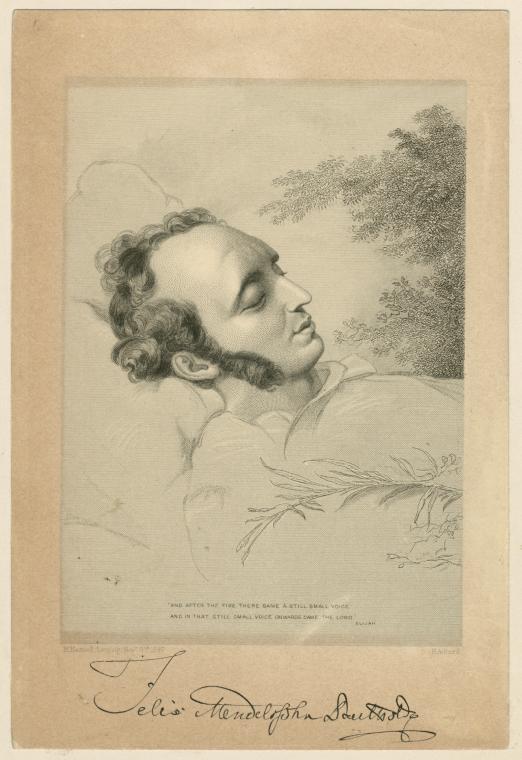
Mendelssohn Deathbed

Image: Eduard Bendemann

(NY Public Library)

JJ Initials

Joseph Joachim to his parents [v]

                                                                        [Leipzig, November 5, 1847]

Dear, dear, good parents!

Prepare yourselves to hear from me something unspeakably terrible and sad. God Almighty yesterday afflicted me for the first time with a great misfortune; all my joys, all my hopes, everything, everything has been ruined since yesterday at 9 o’clock — Mendelssohn is dead! A world of sorrow lies in these three words; unfortunately, they are only too true. — Dead! dead! dead! — it is impossible for me to think of anything else, or to listen to even one note of music. Mendelssohn had been unwell for some time; 8 days ago he had a relapse, and he suffered a small stroke; nevertheless, the entire time we had the best hopes, until the day before yesterday, Wednesday, at two o’clock, when he had another, very violent attack, and things became more and more alarming. Yesterday evening the rattling in his throat began, and his strength gradually failed him, so that at a few minutes after nine o’clock he passed over into a more beautiful world, calmly as only an angel could do.

The thoughts of you and other dear ones in Pest is the only thing that keeps me up. But I am very unhappy, and will never be cheerful again. You can easily imagine, my dear parents, how much good a few lines from you would do me, and I fervently hope that I shall soon see your dear handwriting. —

Your disconsolate

Joseph.

JJ Initials

I hold you as a thing enskied and sainted.

— Shakespeare, Measure for Measure 1. 4. 34

            Oliver Wendell Holmes wrote unforgettably about the permanence of misfortune’s impress: “Did you ever happen to see that most soft-spoken and velvet-handed steam-engine at the Mint? The smooth piston slides backward and forward as a lady might slip her delicate finger in and out of a ring. The engine lays one of its fingers calmly, but firmly, upon a bit of metal; it is a coin now, and will remember that touch, and tell a new race about it, when the date upon it is crusted over with twenty centuries. So it is that a great silent-moving misery puts a new stamp upon us in an hour or a moment, — as sharp an impression as if it had taken half a lifetime to engrave it.” [vi] So it was that the finger of anguish reached out and touched an entire community, leaving behind a myriad coinage, ineffaceably minted with the date in November, 1847 when they first learned of Mendelssohn’s death.

Hedwig Salomon in her diary:

                                                                        November 8, 1847

As I wrote that, he was dead. I shall never forget the 5th of November. Schleinitz came to me to write a letter concerning Mendelssohn. He told me everything — but how! His voice quavered so that he often had to stop speaking. He constantly fought back tears, and it is so unsettling to see a man cry! “Oh, it is a misery! he said, I am not miserable for Mendelssohn, he is with God, but his wife, and we! Oh, this woman, this woman! She kneeled by his bed like a saint, kissed him on the forehead calmly and without complaint, and received his last breath. And when no one else came, she listened a while, and lay down on his bed and with childlike piety looked him in the face. Then she folded her hands. It was so quiet in the room, where so many people stood! This death was like a worship service, an edification. [Erbauung] She allowed us to take her quietly from the room, she wept only when she was outside and asked: “Is it truly all over?” — She said to me: “You won’t leave me, will you? Oh, I am very unhappy!” — I closed my friend’s eyes, he has had a beautiful death, God sent him an angel, who helped him die. Oh, this submission to God! This calm! She shames us all. “This morning I awoke early,” she said. “Oh, now I am alone!” You will meet him again, I said. “He is already with me,” she answered, “otherwise I could not bear it.” She went to her five children with the words: “Now, dear children, you must obey me alone. Your father is dead.” She wept seldom, but she is crestfallen for life.”

So, more or less, Schleinitz related it to me. It sounds cold as I have written it, but the way he told it to me it completely broke my heart. I could not console him, just weep with him; and that, honestly, is what I did. Those days, when I met friends, we pressed each others’ hands and everyone had to cry.

On Thursday evening, as many people as room would allow stood and wept in Mendelsson’s house, on the stair, and in the courtyard. No one could think of anything else. I was often at Schleinitz’s, I could not stay home; I had a great desire to see Mendelssohn in death, but there was no one who would go with me to see him.

HPIM4581

The Courtyard of Mendelssohn’s Apartment Building

The Mendelssohns occupied the visible second floor.

 HPIM4576

The Staircase to the Mendelssohn Apartment

HPIM4791

Inside the Mendelssohn Apartment

HPIM4556

Mendelssohn’s Study

HPIM4812

Cecile Mendelssohn’s Sitting Room

Robert Schumann in his diary:

Sunday, the 7th, mild day, like in Spring — Memories, overflowing, of Mendelssohn — …Great mass of people — the adorned casket — all his friends — Moscheles, Gade and I on the right, Hauptmann, David and Rietz on the left of the casket — in addition Joachim and many more behind — immense train — beautiful mourning-solemnity of the march in e minor from the 5th book of the Songs without Words, played along the way — two choirs in alternation— in the church the choir. [vii]

Mendelssohn's Funeral 

Mendelssohn’s Funeral Cortège [viii]

Moritz Hauptmann to Ludwig Spohr [ix]

Leipzig, November 16, 1847

Dear Herr Kapellmeister,

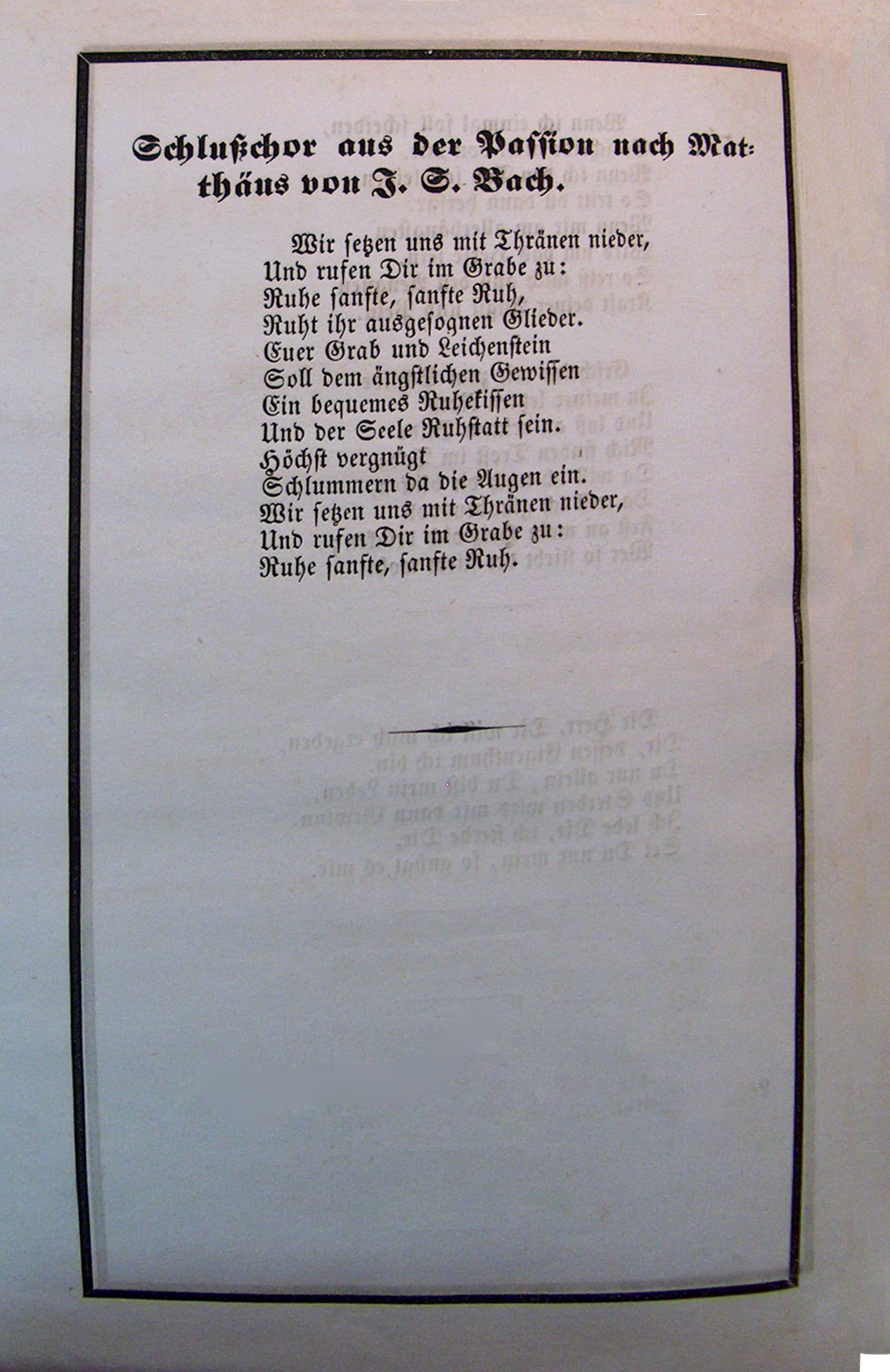
Eight days ago on Sunday, a very beautiful and dignified funeral was held for Mendelssohn, which was all the more fitting, since he was buried in Berlin and not here.  After the funeral procession had left the house on its way to the Paulinerkirche, with suitable music and a cortège that was longer than one can imagine, the adorned casket was positioned in the middle of the church, surrounded by candelabras, and a choir of 500, accompanied by organ and trombones, sang verses from the chorale O Haupt voll Blut und Wunden; the eulogy followed, then the beautiful chorus from Paulus Sie wir preisen seelig, the Benediction, and finally the last chorus from the Bach passion. The orchestra was of a strength commensurate with the choir; the whole thing had the most beautiful, uplifting effect, and it was truly remarkable that it had all been brought together in barely two days. Remarkable, too, the order and calm of the procession, since such an enormous mass of people crowded in, following and looking on. The ceremony was over around 6 in the evening. The casket remained in the church, and at 10:00 o’clock in the evening was taken by a special train to Berlin; it was received in Cöthen by music director Lang — in Dessau by Dr Schneider — with Männerchor singing. Mendelssohn’s family will remain through this winter in Leipzig, then probably move to Frankfurt, where the mother of his wife lives.

Announcement Mendelssohn Death

Announcement of Mendelssohn’s death

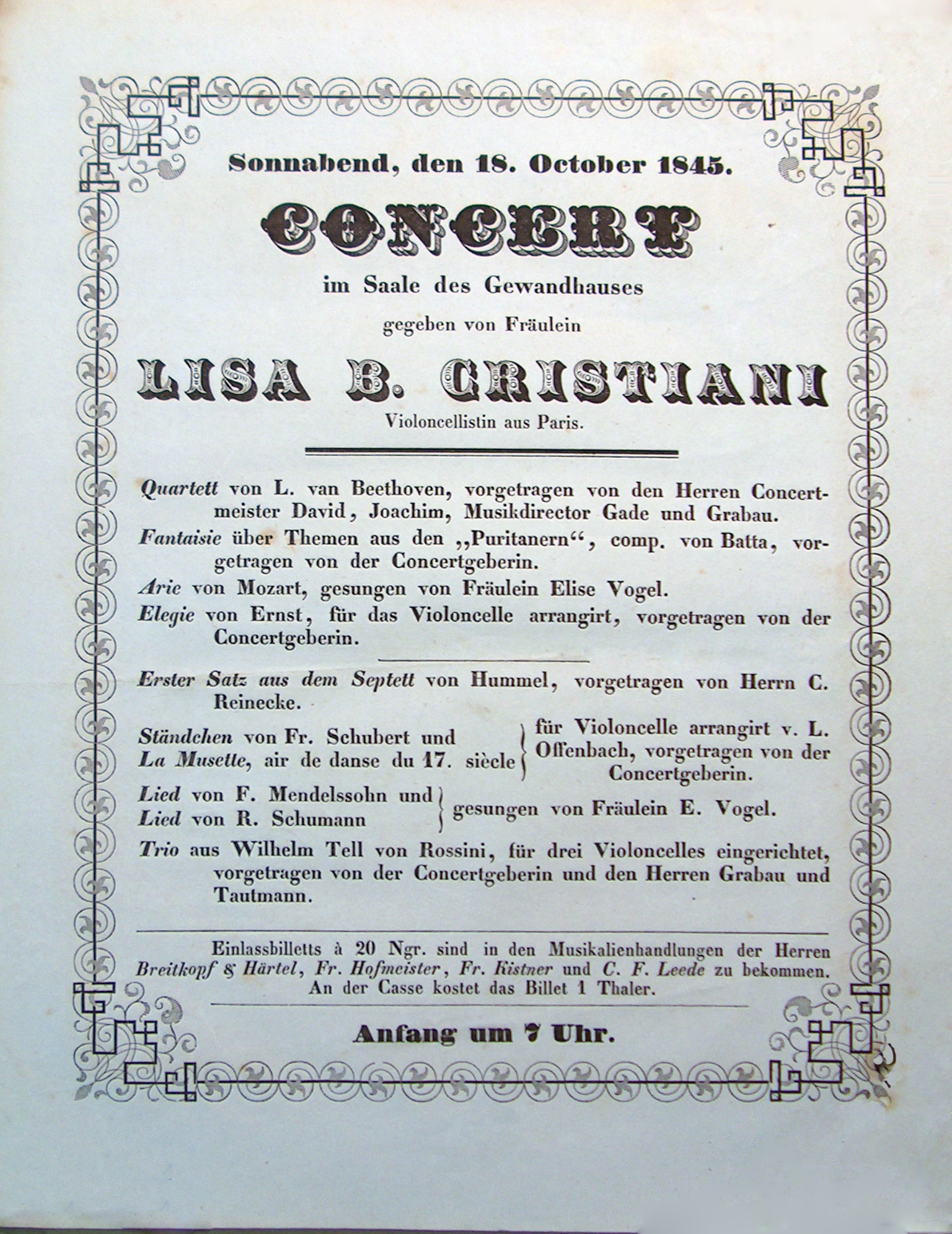
Leipzig after Mendelssohn’s death was Pompeii after the eruption of Vesuvius. The musicians carried on as best they could, but they were dead at heart. Mendelssohn was indispensable — irreplaceable. Ferdinand Hiller wrote: “In the evening there was a concert at the Gewandhaus to his memory. ‘The saddest thing,’ says George Sand somewhere, ‘after the death of a beloved being, is the empty place at table.’ I had exactly the same feeling during the concert. There were the orchestra, the chorus, the audience, which for so many years had been inspired by Mendelssohn; they made their music and played and sang — and only a few days before they had followed his corpse to the church.” [x]

Mendelssohn Concert Program 1

Mendelssohn Program 2

Fifth Subscription Concert of the Leipzig Gewandhaus

Felix Mendelssohn in memoriam [xi]

11 November, 1847

Hedwig Salomon in her diary: [xii]

November 11, 1847

Today was the first concert after Mendelssohn’s death. It was very solemn — everyone dressed in mourning. This black-clothed throng looked indescribably serious. [Livia] Frege sang the song [Mendelssohn’s Nachtlied: Vergangen ist der lichte Tag] [2] very, very sombrely, which gave one the chills. After so many years of silence, Schleinitz sang the solo in the motet; in this hour, and in this music, his wonderful voice was more moving than anything else.

I could not avoid the thought that Mendelssohn was listening today. Shouldn’t the spirits surround us here? — should their life be a slumber — no continuation of the earthly life? — I imagine that they see and hear everything as before, but they penetrate the causes of that which appears incomprehensible and painful to us here. Of all people, I cannot imagine Mendelssohn dead — not even temporarily asleep — for his spirit was so utterly compelling that he appeared to be made entirely of soul, entirely of spirit.

Whenever he entered a rehearsal or a performance, a new life flowed into everyone; his eyes sparkled, every motion was elastic, stimulating, and always and everywhere this noble command, this outward as well as inward nobility. And whoever had never seen him before would have recognized him at first sight as a great spirit among thousands. And how every feeling found direct and lively expression on his face! No greater joy than to see him listening to music, for instance in a quartet that he did not participate in playing. Every thought of the unfamiliar music could be read in his face. How heartily could he laugh! One could not hear three words from him without there being a significant, a stimulating one among them.

_____

Schumann likewise gathered his thoughts in his diary:

            His judgments in musical matters — especially on composition — the most trenchant imaginable, go straight to the innermost core. — He instantly and everywhere recognized flaws and their cause. —

He never kept diaries or anything of that sort, he told me. —

I always considered his praise the highest — he was the highest authority, the court of last appeal.

If he had unjustly offended anyone — spoken of someone adversely to a third party — he could not rest until he had made amends. His behavior toward other living composers… When he had nothing to praise, he said nothing; but where he unmistakably found talent, he was the first to say so (thus in the cases of Bennett, Gade and Rietz).

In 1836 when we were talking about aging composers, he said “how sad is the thought of creativity drying up” and added that he could not be reconciled to this thought. —

He was free of all the weaknesses of vanity. —

The exaltation of associating with him. Highest moral and artistic principles; for that reason intransigent, sometimes seemingly rude and unkind. —

He never remained in debt. If you said something good or significant to him, you could be certain of receiving it back twice and thrice over. —

On his relationship to Meyerbeer he said they had never suited each other; if one of them said “Good day” the other would surely have scented some ulterior motive. —

Self-crriticism, the strictest and most conscientious I have ever encountered in an artist. He changed some passages five and six times. (Especially the Elijah; his fine remark on that: “I think there are a few things I might do better.”) —

If all his intimate friends had been writers, each would have had something extraordinary and something different to record; each would have whole volumes to write about him. —

It was as if every day he had been born anew. —

Did he feel that he had fulfilled his mission?

I think so. The trace of melancholia that is so frequently found in all his compositions after the Lobgesang. —

His face in death. He looked like a hierophant, like a warrior of God who had conquered. — 6th November 1847. [xiii]

_____

In England, the “musical world talked as if the sun had fallen from the sky.” [xiv] Mendelssohn’s friend Sophy Horsley traveled to Leipzig to be with Cécile. Years later she wrote to Joachim: “In November 1847, when I was at Leipsic dearest Cécile M. B. spoke of the great love her Husband had borne you, of the high hopes he entertained for yr future career, adding ‘Poor boy, he has lost his best friend.’” [xv]

Screen Shot 2015-04-21 at 11.06.27 AM

For Joseph, the loss was crushing. “It seemed as if the world had ceased,” he later quietly recalled. [xviii] On the centenary of Joachim’s birth, Donald Francis Tovey commented: “Mendelssohn died when Joachim was only sixteen; and to the end of his life Joachim felt that this early loss had checked his development. Old age is enviable when it can thus retain the passionate loyalties of youth: but Joachim’s memories of Mendelssohn were not vague sentiments. He could tell us many definite things of Mendelssohn’s playing and conducting, of the spontaneity and truth of his rubato, of his touch in Beethoven’s C minor variations, and of his wonderful extempore cadenzas in classical concertos. These were the details of the artist; of the man one learnt from Joachim only what can never be put into words.” [xvi]

Cécile continued to treat Joseph with maternal kindness. Mendelssohn had been the first to conduct the Gewandhaus Orchestra with a baton. [3]  Of her husband’s five batons, she gave four to her children as a remembrance of their father. The fifth, she gave to Joseph.[xx] Later, on April 30, 1848, she presented Joseph with the manuscript of Mendelssohn’s Violin Sonata in F minor, Op. 4. [xix]

JJ Initials

Reacting to the news of Mendelssohn’s death, Joseph’s father urged him to return home to Pest. Joseph, however, wrote to his physician brother-in-law, Dr. Rechnitz:


Joseph Joachim to Dr. Johann Rechnitz [xx]

Leipzig, 18 November 1847

Dear, good Rechnitz,

If one can be comforted by anything for such an enormous, bitter loss as has recently befallen me, it is only by such a loving and sincere compassion as you, my dear brother, have shown for my misfortune. Your letter has done me so infinitely much good, and is such a welcome new sign of your solicitous care for me, that I cannot express the thanks that I owe to you with my lifeless pen. Simply be assured that my heart rings with the most heartfelt, most childlike love for you, my brotherly brother, and I shall never forget, thou splendid doctor, how you have dropped the most curative balsam on my ailing soul. It has been the first great sorrow in my life — nevertheless! The only thing that one can do is to learn to accept it, in obedience to God. Man is so shortsighted and tiny, that he must not dare to grumble against mighty fate, since he cannot understand why the Allgracious may have sent it. —

Leipzig, which, as long as Mendelssohn was there seemed to me a paradise, has now lost its magic charm for me. — nevertheless! (It might perhaps astonish you) My dear father’s suggestion is something with which I am — not in agreement. When I received his treasured letter yesterday, I was greatly taken with the thought of once again belonging to you, my dear ones, and immediately made all kinds of plans about it; about my journey, etc. I have already gone so long without the great delight of seeing you all that in the beginning I could hardly give in to any other thought than the joy of it. But as little by little I calmed down, and began quietly and seriously to mull it over, I had unfortunately to admit that it would not agree well with my artistic development, and duty must take precedence over that ever-so-great satisfaction. — It is absolutely necessary for my reputation, my independence and also for my purse that I go next spring to England, as my best friends there expect. To this end, I plan to spend the few months that remain early next year to write a few pieces—this is absolutely necessary. Since there only remains until the end of February or the beginning of March, I would like to spend as much time as possible on it, and if I go to Pesth, I will lose much time with the trip back and forth, and I would barely be able to spend 2 1/2 months with all of you, irrespective of the fact that I would have not a single musical advisor there whose inspiration would assist me in my compositional work. — Also, as concerns my other studies, literature and Latin for example, I would hardly have such a dear friend and teacher as [I do] here, who is of such value to me, and with whom I am, so to speak, settled in, and who takes such pains for my education as a human being; and to be uprooted from here would certainly not be good for me. What’s more, I don’t believe that I, who have been spoiled by the good fortune of having the musical companionship of people like Hauptmann, Gade, Mendelssohn, could get used to keeping company with people like Hunyady, Kohn, etc., [4] and if I could, I would certainly hold it to be an intellectual/spiritual step backwards, as you undoubtedly would also, dear Rechnitz. May I therefore trouble you with the request to tell me as soon as possible whether my motives appear right, for the advice of such a well-meaning, dear friend would be of the greatest value and service to me. — Also, I ask you to present and explain to my dear father and good mother my reasons which cause me not to spend this Winter in Pesth, since, coming from your eloquent mouth they will surely have genuine power and weight for them. Perhaps it will work out next year, when I hope to be more musically and intellectually developed, that I will fully come to Pesth; for I am sensible of how wholesome and beneficial it would be for me once again to live fully for those that I call my own. — Unfortunately, the post-hour strikes, and I must cease my conversation with you, my fatherly, much admired friend. Greet and kiss your loved ones. I thank your dear Hanni for her affectionate good wishes, which I return with all my heart. I will write to my dear parents soon, since today I can only still send filial and sincere wishes for their well-being, which is so precious to us.

From my entire soul,

your

Joseph Joachim

_____

This letter is stunning to look at. Carefully copied and darkly lettered, the writing is a nearly perfect imitation of Felix Mendelssohn’s hand — the word “Mendelssohn” an exact replica of Mendelsson’s signature.Joseph’s early childhood letters are written in a tiny, clear, copybook script. Between 1844 and 1847, the writing evolves, gradually becoming less cautious and tidy. Joachim’s handwriting would continue to change over the course of his life — but from the time of his beloved mentor’s death, it would always retain a clear vestige of, and sometimes a striking resemblance to, that of Felix Mendelssohn Bartholdy. [xxi]

_____

Joseph Joachim to his brother Heinrich in Vienna [xxii]

Leipzig, 19 November 1847

For such a kind, consoling letter I owe you a debt of thanks that I repay with my whole heart. It is indeed a good fortune that God in his benevolence has granted me such dear, good souls, whose sympathy comforts me so well, and whose love for me I learn more and more to recognize and to value.  Here, everything that concerns music is now so desolate and empty, since the exalted spirit who was her guardian is departed from us. His works, which I study eagerly, are my most beautiful consolation, and I linger with heartfelt delight over them, to which I already owe so many transported hours. Whenever I go to the piano and play for myself a particularly beautiful passage in which his noble soul is so fully reproduced, it brings a rapture of melancholy such as I am incapable of describing in words.

In any case, I plan to stay here throughout the winter, and to write a few compositions for myself for next Spring (in London)… Just now the mailman has brought me a letter from dear Mother, in which she invites me to Pesth; this after dear Father wrote me the same thing the day before yesterday. As great as my desire is, and as firmly as I had already decided to travel there, in the end I had to tell myself, after I had thought it over more calmly, that it cannot be well reconciled with my artistic development, and so reluctantly decide not to leave here for now, since I don’t know a single person there with whom musical relations could be anything but a disadvantage for me. It is only good that I had the courage to write to dear Rechnitz yesterday that I wasn’t going, for I believe that after the loving letter of our good Mother today, the ardent longing to see my own, whose loving gaze I have missed for so long, would have won. Aren’t you going soon to Pesth? If only I could be so close to my own!…

Your,

Joseph Joachim.

[On the end of this letter, not published in BRIEFE, but present in the holograph,  Brahms Institut Lübeck, 1991.2.47.4:

Es befremdet mich, dass ich von den lieben Wienern nichts direct hörte, da sie doch wissen, ein wie grosses Unglück mich betroffen hat. Ich weiss, dass ich es nicht für Theilnahmslosigkeit halten soll; es will mir beinahe so scheinen, als sollte es Rache sein, für mein Stillschweigen, welche ich aber in diesem Falle nicht für edel halte.  — Warst du bei der Aufführung des Elias zugegen? Es würde mir ausserordentlich lieb sein, wenn ich darüber etwas Näheres hören koennte. Dürfte ich dich denn, lieber Bruder, darum bitten? Ich würde dir sehr dankbar dafür sein, u. du kannst dir ja denken wie sehr es mich interessiert. — Grüsse mir alle unsere lieben Verwandten recht herzlich, und verzeihe mir mein oftes Ausstreichen. Ich habe einen Hass, gegen das Abschreiben der Briefe. Diess hätte ich mit enem grossen Mann gemein (Jean Paul) — freilich: quod licet Jovi, non licet bovi; aber ich weiss ja, wie gerne du vergiebst, Guter, und darum hoffe ich es auch für mich, der ich mit innigster Liebe bin

Dein Joseph Joachim]

Screenshot 2018-08-09 12.05.56
Brahms Institut Lübeck, 1991.2.47.4

_____

“Mendelssohns musical influence was probably the most far-reaching of any that affected him,” Georg Fischer wrote of Joachim in 1903; “under [Mendelssohn’s] example he had the good fortune to develop deliberately, and it was also to him that he owed his harmonious development as a person.” [xxiii]

Joseph would stay on for several years in the city that had “now lost all its magic charm” for him. Continuing forward would require that he face significant challenges and make difficult adjustments.


[1] Gade lived near Mendelssohn at Königstrasse 16.

[2] The song by Mendelssohn, with words by Eichendorff:

Vergangen ist der lichte Tag;
Von ferne kommt der Glocken Schlag;
So reist die Zeit die ganze Nacht,
Nimmt Manchen mit der’s nicht gedacht.
Wo ist nun hin die bunte Lust,
Des Freundes Trost und treue Brust,
Der Liebsten süsser Augenschein? —
Will Keiner mit mir munter sein? —
Frisch auf denn, liebe Nachtigall,
Du Wasserfall mit hellem Schall
Gott loben wollen wir vereint,
Bis dass der lichte Morgen scheint.
_____

Gone is the bright day,
From afar the church bells sound;
So, time journeys all night long,
Taking with it many an unsuspecting man.
Where has my colorful pleasure gone,
My friend’s consolation and true heart,
The sweet, bright eyes of my darling girl? —
Will no one be joyful with me? —
Take heart, then, dear nightingale,
You waterfall with your bright sound,
We will praise God together
Until the bright morning shines.

[This song — “Gone is the Bright Day” — is the song Mendelssohn was playing with Livia Frege when he suffered his first attack]

[3] Mendelssohn was among the second generation of conductors in the modern sense, and should be counted among the inventors of the conductor’s art. Among the first generation of conductors, the baton was a novelty. Carl Maria von Weber (1786-1826) conducted using a rolled-up sheet of paper. Richard Wagner described how Gaspare Spontini (1774-1851) used a heavy baton made of ebony with white ivory knobs at the ends: “He did not hold it, like other conductors, at the end, but rather clasped it in the middle with his full fist and moved it in such a way that one could clearly see he considered the device as a marshal’s baton, using it not to beat time, but to command.”  [Richard Wagner: My Life, (Andrew Gray, tr., Mary Whittall, ed.) New York: Da Capo Press, 1992. p. 280.] Louis Spohr (1784-1859) claimed to have introduced the art of conducting with a baton to England during a guest appearance with the London Philharmonic in 1820. “It was at that time still the custom there that when symphonies and overtures were performed, the pianist had the score before him, not exactly to conduct from it, but only to read after and to play in with the orchestra at pleasure, which when it was heard, had a very bad effect. The real conductor was the first violin, who gave the tempi, and now and then when the orchestra began to falter gave the beat with the bow of his violin. So numerous an orchestra, standing so far apart from each other as that of the Philharmonic, could not possibly go exactly together, and in spite of the excellence of the individual members, the ensemble was much worse than we are accustomed to in Germany. I had therefore resolved when my turn came to direct, to make an attempt to remedy this defective system…. I … took my stand with the score at a separate music desk in front of the orchestra, drew my directing baton from my coat pocket and gave the signal to begin. Quite alarmed at such a novel procedure, some of the directors would have protested against it; but when I besought them to grant me at least one trial, they became pacified….[With the baton, I] could not only give the tempi in a very decisive manner, but indicated also to the wind instruments and horns all their entries, which ensured to them a confidence such as hitherto they had not known there. I also took the liberty, when the execution did not satisfy me, to stop, and in a very polite but earnest manner to remark upon the manner of execution… Incited thereby to more than usual attention, and I conducted with certainty by the visible manner of giving the time, they played with a spirit and a correctness such as till then they had never been heard to play with. Surprised and inspired by this result the orchestra immediately after the first part of the symphony, expressed aloud its collective assent to the new mode of conducting, and thereby overruled all further opposition on the part of the directors. It is true, the audience were at first startled by the novelty, and were seen whispering together; but when the music began and the orchestra executed the well-known symphony with unusual power and precision, the general approbation was shown immediately on the conclusion of the first part by a long-sustained clapping of hands. The triumph of the baton as time-giver was decisive, and no one was seen any more seated at the piano during the performance of symphonies and overtures.” [Louis Spohr: Louis Spohr’s Autobiography, London: Reeves & Turner, 1878, pp. 81-82.]

[4] See Edmund Singer’s memoir. (Ridley Kohne; also Hunyady)


[i] Music & Letters, Vol. 36, No. 4 (October, 1955) p. 375.

[ii] Smidak/MOSCHELES, pp. 162-163.

[iii] Holstein/GLÜCKLICHE, pp. 66-67.

[iv] Smidak/MOSCHELES, p. 163.

[v] Author’s translation based on German text in Reich/BETH EL, p. 67, amended from the English quoted from the Jewish Chronicle and Hebrew Observer in The South Australian Advertiser, Monday, October 31 1859, p. 3.

[vi] Oliver Wendell Holmes, The Autocrat of the Breakfast-Table: Every Man his own Boswell, Boston: Houghton, Mifflin and Company, 1894, p. 38.

[vii] Litzmann/SCHUMANN II, p. 171.

[viii] Author’s collection.

[ix] Hauptmann/SPOHR, pp. 30-31. m.t.

[x] Hiller/MENDELSSOHN, p. 217.

[xi] This is in Creuzburg/GEWANDHAUS, opp. p. 82.

[xii] Holstein/GLÜCKLICHE, pp. 70-71.

[xiii] Jacob/MENDELSSOHN, pp. 105-106.

[xiv] Ernest Walker, quoted in Demuth/ANTHOLOGY, p. 212.

[xv] Sophie Horsley to Joseph Joachim, Kensington, March 17, 1889. Holograph in Staatliches Institut für Musikforschung Preußischer Kulturbesitz, Berlin.

[xvi] The Musical Times, Vol. 39, No. 662 (April 1, 1898), p. 226.

[xvii] Joachim/CENTENARY, p. 11.

[xviii] Moser/JOACHIM 1898 I, p. 65

[xix] See: Friedhelm Krummacher, Mendelssohn — der Komponist: Studien zur Kammermusik für Streicher, Munich: Wilhelm Fink Verlag, 1978, p. 83.

[xx] British Library BL, family corresp., Add. MS 42718

[xxi] This relationship was noticed by Otto Gumprecht: “Bis in das Kleinste und Aeußerlichste spiegelte sich die Innigkeit dieses Verhältnisses wieder, z. B. auch in dem Umstande, daß die Handschrift Joachim’s eine überraschende Aehnlichkeit mit der des geliebten Meisters gewann.” Gumprecht/CHARAKTERBILDER, p. 267

[xxii] Joachim/BRIEFE I, pp. 8-9

[xxiii] Fischer/HANNOVER, p. 227.

Share this:

  • Share on X (Opens in new window) X
  • Share on Facebook (Opens in new window) Facebook
  • Email a link to a friend (Opens in new window) Email

Like this:

Like Loading...

Spohr

10 Wednesday Jul 2013

Posted by Joachim in 1 Biographical Posts — RWE

≈ Leave a comment

© Robert W. Eshbach, 2013

Previous Post in Series: 

http://josephjoachim.com/2013/07/10/vienna-again/


JJ Initials

Spohr

Louis+Spohr

Louis Spohr, self-portrait

In June, Louis Spohr arrived unexpectedly in Leipzig for a rendezvous with Wagner.  Spohr, remembered today principally as a violinist, was at that time regarded as a composer already enshrined in the musical pantheon — in J. W. Davison’s words (1843): “a witness to his own admission into the realms of classical immortality. His writings take their station among the master-pieces of Bach, Handel, Gluck, Haydn, Mozart, Beethoven, Weber and Cherubini. They have long enjoyed that distinction and nothing can now remove them from the rock upon which they are fixed … their influence will survive until art is on its death-bed.” [i] Alas for Spohr, tempus vincit omnia.

“Spohr was of Herculean stature,” wrote Edward Speyer. “This and his erect figure, his dignified and manly bearing, made his appearance extraordinarily impressive.” He was certainly an imposing figure to Joseph, who was introduced to him at an evening of chamber music at Hauptmann’s (Johann Sebastian Bach’s former apartment in the Thomasschule). [1] In the course of the evening Mendelssohn, Spohr and Julius Rietz read Mendelssohn’s C minor Trio, dedicated to Spohr, after which they played a trio that Spohr had dedicated to Mendelssohn. Before beginning Mendelssohn’s Scherzo, Spohr asked the composer what tempo he had in mind. “Mendelssohn replied, in an amiably obliging way, ‘Let’s just begin. Whatever tempo you take will be the right one.’ When it came time to play Spohr’s trio, Mendelssohn wished to know how fast Spohr wanted to take the first movement. ‘Na so!’ cried Spohr, ‘eins, zwei, drei, vier,’ beating the quarters for the composer of the Midsummer Night’s Dream with his bow, as if he were instructing a student at the Conservatorium.” [ii]

The next day, Wagner hosted a supper at Brockhaus’s home, after which, Spohr recounts in the third person, the evening was spent “most delightfully at Mendelssohn’s, who did his utmost to entertain and please Spohr.” “This family has for me something very idealistic about them, they present a combination of inward and external features, and withal so much beautiful domestic happiness, that one seldom sees the like of in actual life. In their establishment and whole manner of living there is so much unassuming modesty amid all the obvious luxury and wealth around them, that one cannot but feel at one’s ease. […] [Mendelssohn] himself played a most extremely difficult and highly characteristic composition of his own, called ‘Siebenzehn ernste Variationen’ [Variations sérieuses, Op. 54], with immense effect; then followed two of Spohr’s quartets — among them the newest (the 30th.) — on which occasion Mendelssohn and Wagner read from the score with countenances expressive of their delight. Besides these, the wife of doctor Frege [2] sang some of Spohr’s songs, which Mendelssohn accompanied beautifully; and in this manner the hours passed rapidly and delightfully with alternate music and lively conversation, till midnight drew on unobserved, and at length gave impressive warning to break up.” [iii]

Mendelssohn hastily improvised a Gewandhaus concert in Spohr’s honor, to be given before a specially invited audience. The program, which took place on the evening of the 25th, consisted entirely of Spohr’s own works: the Overture to Faust, an aria from Jessonda (Frl. Mayer), the Violin Concerto No. 7 in e minor (Joachim), songs with piano and clarinet accompaniment (Mme. Frege), and the Symphony No. 4 in F Major “Weihe der Töne.” Mendelssohn conducted and played the piano. Joseph at first protested that he was unready to play, but Mendelssohn insisted, saying “Joachim, you must be part of it — you are our Pentecostal ox that is to be sacrificed today!” [iv] No doubt unaware of Joseph’s self-professed lack of preparation, the Allgemeine Musikalische Zeitung reported: “the 16-year-old [sic] Joachim played the concerto with the technical polish of a man. Only in the expression did one sense that that deeper life experience, with its bitter pains and exalted joys, as art likes to portray them, and as the master has actually included them in this work, has not yet passed through his naïve, youthful breast, and left its mark. One could almost wish for this talented boy that destiny would soon work a little — not too much — mischief with him. This cannot be spared him, if, in the future, he wishes to awaken, not just admiration, but also the compassion of his listeners.” [v] Spohr, in his Autobiography, however, notes, again in the third person, that the “Grand violin concerto” was “played to Spohr’s complete satisfaction by the wonderful boy Joachim.” [vi]

Spohr was surprised and delighted by the concert. “In this manner up to the last moment was Mendelssohn’s thoughtful and kind attention evinced to Spohr,” he writes, and tells us that the following morning, taking leave at the railway station, Mendelssohn was “the last of all, who, as the train at first proceeded slowly, ran for a considerable distance by the side of the carriage, until he could no longer keep up with it, and his kindly beaming eyes were the last that left their expression on the minds of the travellers from Leipzig, little anticipating indeed that it was to be their last meeting on this side of the grave!” [vii]

Screen shot 2014-01-07 at 4.51.09 PM

Louis Spohr

[viii]


[1] “It was an antique room with panelled wainscotting,” wrote Hauptmann’s student John Francis Barnett, “and it did not seem as if it had undergone any material change since the time that Bach occupied it. In a corner near the window was a German stove, which, to me, looked very unlike a stove, compared with our English fireplaces. In fact it had the appearance of a large model tower in white porcelain, reaching almost to the ceiling. By the wall, opposite the window, was an upright piano, and at the side of the room, near the door, stood a secretaire. […] A pretty canary was flying about the room, and perched sometimes upon [Hauptmann’s] shoulder.” [Barnett/REMINISCENCES, p. 33.]

[2] Livia Frege.


[i] Musical World, Vol. 18 (1843), p.259, quoted in Clive Brown: “Louis Spohr,” Grove Music Online ed. L. Macy (Accessed October 5, 2006), http://www.grovemusic.com

[ii] Moser/JOACHIM 1908 I, p. 69.

[iii] Spohr/AUTOBIOGRAPHY, Vol. 2, pp. 277-278.

[iv] Moser/JOACHIM 1908, p. 69ff.

[v] Allgemeine Musikalische Zeitung, Vol. 48, No. 27 (July 8, 1846), pp. 457-459.

[vi] Spohr/AUTOBIOGRAPHY, Vol. 2, p. 278.

[vii] Spohr/AUTOBIOGRAPHY, Vol. 2, p. 279.

[viii] NY Public Library:

http://digitalgallery.nypl.org/nypldigital/dgkeysearchdetail.cfm?trg=1&strucID=1917809&imageID=1942594&total=37&num=0&word=spohr&s=1&notword=&d=&c=&f=&k=1&lWord=&lField=&sScope=&sLevel=&sLabel=&sort=&imgs=20&pos=2&e=w

Share this:

  • Share on X (Opens in new window) X
  • Share on Facebook (Opens in new window) Facebook
  • Email a link to a friend (Opens in new window) Email

Like this:

Like Loading...

Vienna Again — and Pest

10 Wednesday Jul 2013

Posted by Joachim in 1 Biographical Posts — RWE

≈ Leave a comment

© Robert W. Eshbach, 2013

Previous Post in Series: Schumann, Christiani, and Lind


JJ Initials

Vienna Again — and Pest

Stephansdom

            The New Year (1846) brought a trip to Vienna and Pest — Joseph’s first since his departure three years earlier. The visit was undertaken with earnest artistic and professional intentions, and reflects both the high esteem in which the young man was still held in Viennese musical circles, and the influence of Figdor wealth and connections. Joseph took with him three pieces that would become the cornerstones of his adult solo repertoire: the Beethoven and Mendelssohn concerti, and Bach’s Chaconne. “Approximately three or four years ago,” wrote Saphir’s Humorist, “the chubby-cheeked boy Joachim, a pupil of our excellent Böhm, drew unusual attention to himself with a few public appearances. In the meantime, he has undertaken serious and systematic studies, such as one can make under the auspices of a Mendelssohn-Bartholdy. That boy, now returned, is not yet grown to a youth, but has shot up into an artist.” [i]

Joseph’s first appearance was on December 28th, 1845, in the Theater an der Wien, in one of Saphir’s “Musical Academies and Humorous Readings,” for the benefit of the Institute for the Care of the Blind (Blinden-Versorgungs-Anstalt). Among the numerous performers were Ernst, and the pianist Alexander Dreyschock. Joseph played “a caprice by Ernst, whose great difficulties he conquered with unusual security, purity, and delicacy. He who has achieved such virtuosity at the age of 14 is prepared for the highest consecration of art.” [ii]

Jetty-treffz

Jetty Treffz  [iii]

On Sunday, January 11th, Joseph gave a well-attended noonday concert in the 700-seat hall of the Musikverein, Unter den Tuchlauben, performing the Beethoven and Bach, and David’s Variations on a Russian Theme. The Imperial and Royal Court Opera Orchestra was engaged to accompany, under Georg Hellmesberger’s direction. The concert began with Mendelssohn’s overture to A Midsummer-night’s Dream. Joseph’s violin solos were interspersed with a French romance, and songs by F. W. Kücken and Josef Netzer, performed by the popular mezzo-soprano Henriette “Jetty” Treffz, then the mistress of the wealthy, cultured, Jewish banker Moritz Todesco (for confessional reasons they could not marry), and later the wife of Johann Strauss II. [iv]

Musikvereinsgebäude unter d. Tuchlauben.Musikverein unter den Tuchlauben (Right), Vienna

The serious nature of the program, typical for Leipzig, but unusual for a Viennese virtuoso matinée, drew immediate notice from Frankl’s Sonntagsblätter: “This Joachim must be a genuine artistic talent — otherwise he would not begin his concertizing here with Beethoven and Bach; other concert-givers do not customarily angle for audiences with such compositions.” Quoting Horace’s dictum: “Pore over your Greek models day and night,” the reviewer praised the program as an antidote to the insipid nature of the customary virtuoso fare: “With the great levelling of contemporary concert music, it is most advisable to take a step backward in order to move forward. Returning to Bach and those of like mind might somewhat cleanse the tainted blood of our concert-music composers, and improve what has come to be our inane taste.” [v] Der Humorist, reacted similarly: “It is so satisfying, in this difficult, needy age of bravoura, to see a talent emerge, that has been led on the path of the worthy, dignified and poetic in art; that feels at home there, and promises to remain. […] We can already see from the program of the concert he gave in the hall of the Verein on the 11th that Joachim is a violin player who does not pursue the same path as the others. His main offerings consisted of the concerto of Beethoven, the most precious gem that the violin repertoire possesses, and a ‘Ciaconna’ by Joh. Seb. Bach. — A violin piece by Bach? Has the concert-going public ever heard one here — have they heard one played by a concert giver? Most people must have thought to themselves: “that looks curious!” Oh, rococo! Classical, but not brilliant; we won’t find guitar plucking on the violin, and flute blowing with the bow, in that — no pizzicatos and no harmonics. — Certainly nothing of that, but nevertheless Classical, and truly Classical, this ‘Ciaconna’ is nevertheless as brilliant as any solo piece that has been written for the violin; and not only are there few such magnificent, wonderfully-constructed violin pieces as this fugue [sic], but there are also few players who can perform them with such roundedness, such spirit, such power and stamina, in short, in such an excellent manner as our young artist, who, alone through the magnificent performance of this piece stands in the first rank of contemporary violinists.”

The reviewer went on to praise Joseph’s “beautiful, pithy, masculine tone,” which demonstrated “not only the singing, but also the strongly intellectual-spiritual element. His left hand easily encompasses the most difficult configurations with power and dexterity, and the fullness and beauty of his trills is remarkable. To this is added […] a noble, adroit and firm bow arm, which demonstrates proficiency and security in all bowing styles.” [vi]

Der Wanderer reported that “Herr Ernst was an attentive listener until he had to go to the Redoutensaal, in order to let his talent sparkle there.” [vii]

Joseph’s second Viennese concert, on Saturday, February 28, was less well attended than the first: Liszt was in town, and commanded the 12:30 Sunday time in the Musikvereinssaal, so Joseph had to present his concert at nine thirty the previous evening — an unusual time, as most Viennese concerts occurred at mid-day. For this appearance, Mendelssohn had entrusted Joseph with the important Viennese premiere of his Violin Concerto in E Minor, which David had brought to life in the Gewandhaus a year earlier. The rest of his program consisted of a perhaps different set of variations by David (“on an original theme”), and a reprise of the Bach Chaconne. He was assisted in this concert by the popular alto Betti Bury who sang songs by Nicolai and Dessauer, and “Herr Wieselmann,” who “shrieked” an aria from Rossini’s Othello. The Imperial and Royal Court Opera Orchestra, under Hellmesberger’s direction, performed Mozart’s Titus Overture, and accompanied the concerto and aria.

Haidenröslein

Home in Pesth, Joseph saw the appearance of his first published work: a setting in G Major for soprano and piano of Goethe’s Haidenröslein. The song, with the text in Hungarian translation below the original German, was published by the otherwise obscure “Verlag des Ungar” — the “Hungarian Press” — and may have been a private printing.

It is an effort worthy of Cherubino. The simple, folk-like, “Deck the Halls” tune, which appears at first in classic horn thirds, fifth and sixth, feints immediately to e and a minor, and is soon buried under an overwrought, dissonance-laden 16th-note accompaniment more descriptive of the trials of Clytemnestra than the fate of a poor little heath-rose. The three verses are set in ABA’ form, the B section in mournful e minor, concluding with proto-Mahlerian Gypsy-minor sighs in the piano part, and transitioning to the reprise through a minor version of the horn call theme. The song ends as it began — with horns. A good boy, the composer’s sympathies were all with the rose, and not with the lad.


Concert Reviews:

Concert: Vienna, January 11, 1846, Musikvereinssaal

M. G. Saphir (ed.), Der Humorist, Vol. 10, No. 11 (Tuesday, January 13, 1846), pp. 42-43.

Concert: Vienna, January 11, 1846, Musikvereinssaal

Ferdinand Ritter von Seyfried (ed.), Der Wanderer im Gebiete der Kunst und Wissenschaft, Industrie und Gewerbe, Theater und Geselligkeit, Vol. 33, No. 11 (January 13, 1846), p. 44.

Concert: Vienna, January 11, 1846, Musikvereinssaal

Wiener Zeitschrift für Kunst, Literatur, Theater und Mode, Vol. 31, No. 12 (January 16, 1846), p. 48

Concert: Vienna, January 11, 1846, Musikvereinssaal

Ludwig August Frankl (ed.), Sonntagsblätter, Vol. 5, No. 3 (18 January, 1846) p. 59-60.

Concert: Vienna, February 28, 1846, Musikvereinssaal

Ferdinand Ritter von Seyfried (ed.), Der Wanderer im Gebiete der Kunst und Wissenschaft, Industrie und Gewerbe, Theater und Geselligkeit, Vol. 33, No. 53 (March 3, 1846), pp. 211-212.

Concert: Vienna, February 28, 1846, Musikvereinssaal

M. G. Saphir (ed.), Der Humorist, Vol. 10, No. 53 (March 3, 1846), p. 215.

Concert: Vienna, February 28, 1846, Musikvereinssaal

G. Ritter von Franck (ed.), Wiener Zeitschrift für Kunst, Literatur, Theater und Mode, Vol. 31, No. 45 (March 3, 1846)

Concert: Vienna, February 28, 1846, Musikvereinssaal

Ludwig August Frankl (ed.), Sonntagsblätter, Vol. 5, No. 10 (March 8, 1846), p. 236.

Concert: Vienna, February 28, 1846, Musikvereinssaal

August Schmidt (ed.) Wiener allgemeine Musik-Zeitung, Vol. 6, No. 28, (5 March 1846), p. 110.


Next Post in Series: Spohr


[i] M. G. Saphir (ed.) Der Humorist, Vol. 10, No. 11 (January 13, 1846), p. 43.

[ii] Die Gegenwart. Politisch-literarisches Tagblatt, Vol. 1, No. 73 (December 30, 1845), p. 350.

[iii] Wikimedia Commons

[iv] The presence of Jetty Treffz on Joseph’s program, together with the venue and the accompanying court orchestra, strongly implies the continuing influence, financial support, and social connections of Joseph’s uncle Wilhelm Figdor. Moritz Todesco’s father, Hermann, had been born in 1791 in Pressburg. His large fortune was based in textiles: flax, cotton and silk. When Hermann died in 1844, his estate was valued at circa twelve million guilders. Hermann’s sons, Eduard and Moritz, were partners in the family banking and wholesale company doing business as “Hermann Todesco’s Sons.” Moritz, a music lover, later built an impressive, five-story in-town palais (designed by Theofil Hansen, who also designed the building of the Gesellschaft der Musikfreunde) on Vienna’s Kärntnerstrasse, opposite the opera house. The Todescos were eventually allied in business with the Miller zu Aichholz family. See: Jill Lloyd, The Undiscovered Expressionist. A Life of Marie-Louise Von Motesiczky, New Haven: Yale University Press, 2007, Chapter I, Family Portrait.

800px-Palais_Todesco_Aug_2006_070

Palais Todesco, Vienna

[v] Ludwig August Frankl (ed.), Sonntagsblätter, Vol. 5, No. 3, (January 18, 1846), pp. 59-60.

http://josephjoachim.com/2013/06/13/concert-vienna-january-11-1846-musikvereinssaal/

[vi] M. G. Saphir (ed.) Der Humorist, Vol. 10, No. 11 (January 13, 1846), p. 43.

http://josephjoachim.com/2013/07/16/concert-vienna-january-11-1846-musikvereinssaal-2/

[vii] Ferdinand Ritter von Seyfried (ed.), Der Wanderer im Gebiete der Kunst und Wissenschaft, Industrie und Gewerbe, Theater und Geselligkeit, Vol. 33, No. 11 (January 13, 1846), p. 44.

http://josephjoachim.com/2013/07/16/concert-vienna-january-11-1846-musikvereinssaal-4/

Share this:

  • Share on X (Opens in new window) X
  • Share on Facebook (Opens in new window) Facebook
  • Email a link to a friend (Opens in new window) Email

Like this:

Like Loading...

Schumann, Cristiani, and Lind

09 Tuesday Jul 2013

Posted by Joachim in 1 Biographical Posts — RWE

≈ Leave a comment

© Robert W. Eshbach, 2013

Previous Post in Series: 1845


JJ Initials

Schumann, Cristiani, and Lind

 Schumann-Kriehuber1839 clean:small

[i]

Robert Schumann
Portrait by Kriehuber, 1839

 At an evening gathering at Mendelssohn’s, Mendelssohn and Joachim had played Beethoven’s Kreutzer Sonata. After the music, the guests were served a casual supper at small tables. Joachim found a place at a little table where Schumann sat. It was summertime, and, through the wide-open windows, the night sky appeared, sown with numberless stars. Eventually, Schumann, who had sat for a long time without saying anything, gently touched the knee of his little companion, and, gesturing with his hand to the starry sky, asked in his inimitably kind-hearted way: “whether out there, there might exist beings who know how beautifully, here on earth, a little boy had played the Kreutzer Sonata with Mendelssohn?” [ii]

The tale varies somewhat from telling to telling — Edith Sichel recalled the event as following a performance of the Beethoven Concerto. Be that as it may, for Joachim this encounter was of seminal significance: “Fifty years afterwards he loved to tell the story, in his vivid way, acting the gesture, recalling the tones which the years had not dulled for him,” Sichel writes. [iii]

The kindly smile, the warmth of Schumann’s voice — these were among Joachim’s earliest, indelible, impressions of his future mentor. The hand on his knee, the gesture toward heaven and the poetic reference to otherworldly beings would have come as an unfamiliar — though not unwelcome — gesture of intimacy to a boy who, for the last five years, had been raised under the rigid regime of a succession of strict taskmasters. Joseph’s father, uncles and brothers were merchants, and they viewed his occupation primarily from their own accustomed perspective, as the business of giving concerts — his education, a preparation for that business. The profession of buying and selling commodities had not always been kind to Julius Joachim, and his letters make clear that he viewed his son’s extraordinary gift for music as a preferred alternative to a life spent in the wool-room and the counting-house. But with this unfamiliar path came new uncertainties, and for many years the concern of the extended family, often anxiously expressed, seemed to center on how their prodigy might achieve security and renown as a performer and composer.

Amidst these worldly concerns and family pressures, the taciturn Schumann’s gesture to the heavens, [iv] his quiet reference to the success of a little boy, not in terms of careerist ambitions, parental approval, the pride of a teacher or the applause of an audience, but rather in terms of beauty achieved, sufficient to please celestial beings — was something rare, and perhaps unique, in Joseph’s experience. In Schumann, as in Mendelssohn, Joseph encountered what must have been, to him, a novel and unfamiliar conception of childhood — one that was grounded in the writings of Rousseau, Jean Paul Richter, Pestalozzi and Fröbel, and in the practical educational experiments of the Kindergarten movement. In this Biedermeier sensibility, childhood was no longer viewed as a stage to be passed through as quickly as possible on the way to a responsible adulthood, but as a sacred time — a time of innocence and wonder, learning and creativity, with its own particular insights into the meaning and value of human existence. Here, for the first time, children were looked upon not merely as unformed adults, but as creatures deserving of their own culture, to be brought up in nurseries replete with age-appropriate toys, pets, clothing, books — and music [1]. Childhood was a time to be prolonged and savored, and ultimately a time to be looked back upon with nostalgia as the purest and best years of one’s life. “The child was held to be the better human being,” writes Bernhard R. Appel in his study of Schumann’s Jugendalbum. “Through its unspoiled nature, it is distant from civilizing deformations. The child is eo ipso good in the moral sense. According to this romanticized ideology of childhood, it still lives in Arcadian bliss, unencumbered by troubles and far from the prosaic workaday world of the adult.” [v] Schumann shared this attitude toward childhood. “In every child there lies a marvelous depth,” [vi] he once wrote, and indeed, Schumann possessed a childlike depth of his own.

Schumann always made a distinction between the poetry of art and the prose of practical or pecuniary arrangements. This evidence of his idealistic (or impractical) nature, and of his solicitousness toward the young, was Joachim’s first real personal contact with a man who, upon their first introduction, had managed merely to smile and to stare. In the end, the ability of this gentle, taciturn man to draw a connection between a child’s performance of a mature work and an imagined reception in the celestial realm — ideal, timeless, disinterested and otherworldly — marked him permanently in Joachim’s mind as a man who had himself somehow managed to retain those moral and spiritual characteristics that the Biedermeier ascribed to childhood.

JJ Initials

On Sunday, November 9, 1845, Schumann sent an urgent message to Mendelssohn in Leipzig, requesting help with an orchestra concert that was to take place the following Tuesday night in Dresden: “My poor wife is ill, not critically, but such that she cannot play in the first subscription concert the day after tomorrow. The management is now in a great quandary. I thought, therefore, of Joachim — whether he couldn’t come — and of your always readily supportive kindness — whether you couldn’t help encourage Joachim to do it. Naturally, time is of the essence. My stepfather has thus immediately gotten underway. If you would be so kind as to help him in his efforts this very evening by writing a few lines to Joachim, or by personally accompanying him to visit Joachim, we would be greatly obliged and thankful to you. My stepfather will deal with everything else.” [vii]

This letter was never received: at the time, Mendelssohn was not in Leipzig, but in Berlin. Wieck went next to David, and then tried his luck with Wittgenstein. At 9:00 o’clock that evening he wrote back to Schumann: “It is impossible to converse with Joachim’s uncle [sic] — Herr Wittgenstein.” Joseph was “nothing but his uncle’s slave,” he continued, “and, since I was forewarned by David, I saw that there was nothing to be accomplished by pressing; I operated differently, and apparently well, since he didn’t say ‘no,’ but wanted to think it over and give me his answer before noon tomorrow. When I made him aware — with angelic meekness — that I might perhaps get a message to you on the freight wagon by 10 o’clock, so that a notice might be put in the gazette, he said he would give me an answer around 10 o’clock […]” [viii]

Wieck’s diplomatic efforts were successful in the end. The following evening, Joseph joined Schumann in Dresden, bringing with him Mendelssohn’s violin concerto and David’s Variations on Schubert’s Lob der Thränen for Violin and Orchestra, op. 15. [2] In addition to Joseph’s solos, the program consisted of Mendelssohn’s Calm Sea and Prosperous Voyage Overture, Beethoven’s 5th Symphony, and several arias, sung by Leopoldine Tuczek from Berlin. [3] The subscription series, attended mostly by the nobility, took place in the ballroom of the Hôtel de Saxe, with the orchestra — in Schumann’s opinion “very competent, the winds excellent” [4] — under the direction of Ferdinand Hiller.

This Dresden premiere would be Joseph’s first performance of the Mendelssohn Concerto, and the third public performance of the work outright. [5] The work would remain a cherished part of Joachim’s repertoire throughout his career.

The rehearsal took place on the morning of the concert, after which Joseph and Hiller joined the Schumanns at home. Clara was unable to attend the concert, but wrote that evening in her diary: “Little Joachim had a good success. Joachim played a new violin concerto by Mendelssohn, that is supposed to be wonderful.” [ix] A week later, the Allgemeine Musikalische Zeitung reported:

            Frau Dr. Clara Schumann had wished to gratify the public with the performance of Henselt’s new pianoforte concerto, which she played in the first Gewandhaus concert. She was unfortunately frustrated in this intention by an illness, and the young violinist J. Joachim from Vienna (we should now properly say: from Leipzig) stood in for her, presenting the beautiful violin concerto in E by Mendelssohn Bartholdy and David’s Grand Variations on Schubert’s “Lob der Thränen.” The young virtuoso — and he is more than that — has already been recognized for his merits in these pages, and we, too, must declare ourselves in agreement, that he is on the path of attaining the highest artistic perfection. More than his proficiency and security, which is equal to every technical difficulty — more than his pure-as-gold intonation and his outstandingly beautiful tone — his characteristically true, deeply felt presentation — the intellect — the poetic spirit — and that at his youthful age, surprised us doubly. In any case, one can predict for him an important career, especially since he appears to have entirely retained his modesty in spite of all the recognition that has come his way. . . .   Wise. [x]

The Neue Zeitschrift für Musik reported, simply: “Young Joachim astounded the audience with his performance of Mendelssohn’s beautiful violin concerto and David’s Variations.” [xi]

 Cristiani Program

[xii]

            A month earlier, Joseph had joined David, Niels Gade and Andreas Grabau in a performance of a Beethoven quartet — his first public quartet performance in Leipzig. The quartet led a mixed program in the Gewandhaus given by the 17-year old Parisian ‘cellist Lisa B. Cristiani. [6] In those days, playing the ‘cello was considered particularly unfeminine, and professional female ‘cellists were unknown. Cristiani, making her first German tour, was therefore a great curiosity, as much for her appearance (how would she hold the ‘cello?) as for her musicianship. On this occasion, Mendelssohn accompanied her on the piano. Mendelssohn was apparently pleased with her playing: he later dedicated to her his Song without Words op. 109 no. 38. Cristiani enjoyed a brilliant but short career, during which she traveled extensively. She died of cholera in Siberia in 1853, while touring Russia in the footsetps of her renowned countryman, François Servais.

 Jenny_Lind_retouched

[xiii]

Jenny Lind, 1850

            On December 4, Joseph appeared for the first time in the Gewandhaus as a composer, playing his own Adagio and Rondo for violin and orchestra [7], together with Ernst’s Introduction, Caprices and Final on a Theme from Opera “Il Pirata” by V. Bellini. [xiv] The critic for Signale für die Musikalische Welt wrote that “the promising young violinist’s” performances — “of great interest” — were greeted with vigorous applause. “He played… with such security, endurance and taste, that, without looking, one would have imagined him to be an artist of a more mature age. If we find the young Joachim once more to have advanced since we heard him last, and discover a talent for composition in him, then we do not speak falsely when we maintain that he will someday become an important violin-artist, for whom, if he continues his studies, one can predict a happy future.” [xv] After the concert, Ferdinand David paid a collegial compliment to Joseph Böhm in Vienna: “While here, your pupil Joachim has given us much pleasure and you the greatest honor through his outstanding talent, his good, modest behavior and his passion for art; and if your name in the art world were not already well founded, the accomplishments of your two students Ernst and Joachim would suffice to assign it one of the first places.” [xvi]

Though Joseph performed with distinction, the audience had gathered to hear the other soloist of the evening: the 25-year-old singing sensation Jenny Lind, with whom Joseph would later establish a long-lasting friendship and artistic partnership. [8] Elise Polko, present at the occasion, wrote unforgettably about the young soprano:

…the concert public were in a state of feverish excitement; and when at length she came forward on the raised platform, a slender girlish form with luxuriant fair hair, dressed in pink silk, and white and pink camelias on her breast and in her hair, in all the chaste grace of her deportment, and so utterly devoid of all pretension, the spell was dissolved, and the most joyous acclamations ensued.

Jenny Lind only looked beautiful when she sang… Music alone, and nothing else, transfigured her countenance so wonderfully; it then became actually transparent, the soul within shining brightly through the earthly vail in the most enchanting manner.

And it was thus she sang, on that evening in the Gewandhaus, Bellini’s “Casta Diva,” the Duett from the “Montecchi e Capuletti,” “Se fuggire,” with Miss Dolby, the letter Aria from Mozart’s “Don Juan,” [sic] and two of Mendelssohn’s songs, “Auf Flügeln des Gesanges,” and “Leise zieht durch mein Gemüth.”

I cannot remember how I got home after that concert; I only know that I trembled and wept, and never closed my eyes all night. It was not, however, the “Casta Diva,” with all its pearly adornment and florid graces, not the lovely Giulietta, nor the stately Donna Anna who haunted my thoughts, and whom I seemed ever to hear; it was exclusively the ineffably sweet, ethereal, almost unearthly, “By the first rose thou hap’st to meet.” And what must Mendelssohn have felt, who was seated at the piano, accompanying the singer, and from whose soul this lovely flower of a song had sprung.  [xvii]

The next evening, Lind appeared again in the alarmingly overcrowded Gewandhaus, this time performing a benefit concert for the Orchestral Widows’ Fund. After the concert, she was serenaded by torchlight — by 300 singers and instrumentalists — in the courtyard of the Brockhaus family mansion, where she was residing. [9] The tongue-tied Lind enlisted Mendelssohn to descend with her into the courtyard, to speak for her. “Gentlemen!” he said, “You must not think that I am Mendelssohn, for at this moment I am Jenny Lind, and as such I thank you from my heart for your delightful surprise. Having now, however, fulfilled my honorable commission, I am again transformed into the Leipzig Music-Director, and in that capacity, I say, ‘Long live Jenny Lind!’” [xviii]

“The singers dispersed to the strains of Mendelssohn’s ‘Waldlied,’” wrote Elise Polko. “Jenny Lind, so different in her personality from all other artists, soon became, in her girlish modesty, and spotless purity and disinteredness, a kind of mythical form to the public at large. Fable after fable was related about her, and at length it would scarcely have seemed marvelous had she dissolved into the mist before all eyes, or floated away like her own piano-pianissimo. …Her piano was a breath, such as angelic lips might breathe. Those who listened to her felt as if there was something holy in the art of singing, and that this ‘Mädchen aus der Fremde’ had only come among us to proclaim the truth to the children of this world.” [xix]

JJ Initials

“Dear Mendelssohn,” wrote Schumann on December 12, “Are you back to normal life — completely at home after your unsettled time in Berlin and the Lind-fever, so that one can knock and be cordially received? I thought of you most affectionately as Joachim played the violin concerto; I cannot criticize such a piece after the first hearing — but completely indulge myself […]. [xx]


Next Post in Series: Vienna Again — and Pest


[1] See: Bernhard R. Appel: Robert Schumanns »Album für die Jugend,« Zürich & Mainz 1998, in particular the chapter »In jedem Kinde liegt eine wunderbare Tiefe. Schumann und die Pädagogik seiner Zeit.«

[2] David must have provided the orchestral parts for both works; the Mendelssohn Concerto was, as yet, unpublished.

[3] At this concert, Joseph earned the admiration of the renowned virtuoso Karol Lipiński. From 1839 the concertmaster of the Dresden Kapelle, Lipiński (1790-1861) was renowned as one of the greatest players of the age. The Countess de Merlin once asked Paganini whom he considered the first violinist in the world. “I do not know the first,” Paganini replied tactfully, “but the second is certainly Karol Lipiński.” Indeed, Lipiński had already been known as “the Polish Paganini” when the two virtuosi first met in 1818. Lipiński had traveled to Milan to hear Paganini play, and afterward, he played for Paganini while the Italian master drank champagne and accompanied him on the guitar. The two concertized together briefly in Piacenza, and did not meet again until 1829, when Paganini visited Poland. Their rivalry eventually ended their friendship. [Czeslaw Raymond Halski, Paganini and Lipiński, Music and Letters, Vol. 40, No. 3 (July, 1959), pp. 274-278, passim.] Paganini dedicated to Lipiński his Op. 10 Burlesque Variations on “La Carnaval de Venise” for unaccompanied violin. Lipiński is also the dedicatee of Robert Schumann’s Carnaval. Lipiński had hoped to succeed Matthäi as concertmaster of Leipzig’s Gewandhaus Orchestra, and felt slighted that Mendelssohn gave his friend David the job. Thereafter, when he played in Leipzig he played only in the Euterpe concerts. The management of the Gewandhaus reportedly once dispatched David to ask Lipiński why he didn’t play in “first-tier concerts.” “Where I play, it is always a first-tier concert,” Lipiński is said to have replied. [Moser/JOACHIM 1908, pp. 74-76.]

[4] The strings were mainly local city players, while the winds were drawn from the military band.

[5] David performed it again in the Gewandhaus on October 25. Joseph Hellmesberger Sr. gave the Viennese premiere in a concert of the Musikverein on December 21. [Pohl/CONSERVATORIUM, p. 190.]

[6] Cristiani played a 1700 Stradivari, later owned by Hugo Becker. The “ex-Cristiani” Strad is currently preserved in the Museo Stradivariano in Cremona, Italy.

[7] Using this MS as an example, William Smyth Rockstro later noted the similarity of Joachim’s hand to Mendelssohn’s. “We have at this moment in our possession the first sketch of an unpublished Concerto for the Violin, composed by [Joachim] in 1845, and played on the 4th of December, in that year, at the Gewandhaus, which exemplifies the likeness so strongly that many of its passages might very easily be supposed to have been written by Mendelssohn himself. [W. S. Rockstro, The Life of George Frederick Handel, London: Macmillan and Co., 1896, p. 226.]

[8] That Joseph was recruited to perform with Lind is a true demonstation of Mendelssohn’s faith in him. Mendelssohn himself was quite head-over-heels for Lind, as numerous accounts attest. As for Lind, it was characteristic of her to share her programs with children — perhaps enhancing her own image as a “chaste diva.” She would do it again in Vienna in January 1847, when she sang “for love” in the debut series given by the young Wilhelmine Norman, later Wilma Norman-Neruda, Lady Hallé.

[9] Heinrich Brockhaus (*1804 — † 1874) inherited his father’s publishing house at the age of twenty, and, over the course of years, made it into one of the most respected in Germany. For Brockhaus’s account of Lind’s visit, see Brockhaus/TAGEBÜCHERN II, p. 88 ff. Carl Reinecke also provides an interesting narrative of the events in Reinecke/SCHATTEN, pp. 62 ff.


[i] Wikimedia Commons.

[ii] Moser/JOACHIM 1908, p 72.

[iii] Edith Sichel: Joseph Joachim — A Remembrance, in The Living Age, vol. 254 (1907), p. 694.

[iv] For Schumann’s interest in the stars at around this time in his life, see: Gerd Nauhaus: Schumann und die Sterne, in Schumann Studien 3/4, Köln 1994, pp. 174-178.

[v] Bernhard R. Appel: Robert Schumanns »Album für die Jugend,« Zürich & Mainz 1998, p. 19.

[vi] Gesammelte Schriften über Musik und Musiker von Robert Schumann, ed. by Martin Kreisig, Leipzig 1914, p. 20. Quoted in Appel, Album, p. 17.

[vii] Schumann/BRIEFE, p. 253. m. t.

[viii] Schumann/BRIEFEDITION I, p. 244   Schumann, Briefedition, vol. 1, p. 244

[ix] Litzmann/SCHUMANN II, p. 111.

[x] Allgemeine Musikalische Zeitung, Vol. 47, No. 47 (November 19, 1845), pp. 838-839.

[xi] Neue Zeitschrift fur Musik, Vol., 24, No. 9 (January 29, 1846), p. 36.

[xii] Stadtgeschichtliches Museum Leipzig

[xiii] Jenny Lind, 1850, Wikimedia Commons.

[xiv] Dörffel/GEWANDHAUS, p. 126; Polko/MENDELSSOHN, p. 110; Program, Stadtgeschichtliches Museum, Leipzig. Moser/JOACHIM1908, I, p. 67) incorrectly gives the date of this concert a year earlier, i.e. in 1844.

[xv] Signale für die Musikalische Welt, Vol. 3, No 50, (December 1845), p. 394.

[xvi] Letter of December 6, 1845, quoted in Moser/JOACHIM 1908 I, pp.52-53 n.

[xvii] Polko/MENDELSSOHN, pp. 110-111.

[xviii] Polko/MENDELSSOHN, p. 113.

[xix] Polko/MENDELSSOHN, pp. 113-114.

[xx] Robert Schumann to Felix Mendelssohn, Dresden, December 12, 1845. Schumann/BRIEFEDITION, vol. I, p. 251.

Share this:

  • Share on X (Opens in new window) X
  • Share on Facebook (Opens in new window) Facebook
  • Email a link to a friend (Opens in new window) Email

Like this:

Like Loading...

1845

09 Tuesday Jul 2013

Posted by Joachim in 1 Biographical Posts — RWE

≈ Leave a comment

© Robert W. Eshbach, 2013

Previous Post in Series: Ferdinand David


JJ Initials

1845

Wilhelm Figdor to Julius and Fanny Joachim [i]

Vienna, 2 Dec. 1844

Dear brother-in-law and sister,

It gives me great pleasure to be the bearer of pleasant news from your dear Jos. But at the same time you realize how necessary and useful it is for him, from time to time to receive admonitions and inducements from afar, and especially from his homeland and from his parents. It is up to you to impress upon him that he must aspire to achieve independence and to make a name for himself. He can only do this through composition — and this is not possible without effort and perseverance. Fanny certainly does not ask more of him than he can achieve, and she knows full well how much of his negligence is due to his tender years. Also, she has not complained, except that he needs to be pushed. We all know this, and the more he is courted by foreigners, the more tireless his relatives must be in saying to him that his successes so far have owed more to his youth and the fortunate external circumstances here, and that without composition, which demonstrates his diligence, he will have achieved nothing, and when he is older, and stands there merely as a violin player, he will be nothing.  You must demand, with the authority that only parents possess, that he complete the work that he has begun. I also write to him often, and do what I can to push him on to greater effort. We are all well, and hope to hear the same of you and your children, to whom I send many greetings.

Farewell,
Your
Wilhelm

_____

 Wilhelm Girtner Portrait2

[ii]

Joseph Joachim
Berlin, January 13, 1845
Crayon Drawing by Wilhelm Girtner

What is to accrue from the manhood of such a boy as Joseph Joachim, who, at the age of fourteen, performed during our last London musical season such pieces as Beethoven’s Concerto, Mendelssohn’s Ottetto, Beethoven’s Sonata, dedicated to Kreutzer, &c. &c., all of them requiring finished style and great powers of physical endurance, it may be for some future amateur to discover. The whole relation would seem fabulous, were it not told of a boy wonderfully endowed, both intellectually and corporeally. That this early development of the musical nature is, however, a work that incurs risk, and should be prosecuted with caution, we have lately had a melancholy instance in the death of one of the Eichorns, [1] at the age of twenty-two — formerly in the tenderest infancy of a Wunderkind, and then, with his little brother, astonishing Spohr and other good judges of the difficulties of the violin with feats that were deemed prodigious. Such is too often the fate of talent — it ripens into the great artist, or becomes an early sacrifice to death. [iii]

—    Foreign Quarterly Review, January, 1845

On Thursday the 16th of January, Joseph reprised the Beethoven concerto, this time with the Gewandhaus orchestra. The reviewer for Signale für die Musikalische Welt echoed sentiments that seemed to be on everyone’s mind: “Given the great proficiency, the immaculate, secure and powerful tone, the artistic intelligence with which this magnificent work was performed, at the same time considering the cadenzas which he composed himself and introduced [into the concerto], we ask with amazement: what remains for the man to accomplish, who is capable of such things as a boy?” [iv]

Joseph’s rapid musical growth was apparent to all. The following Wednesday, the Allgemeine Musikalische Zeitung reported:

Of great interest was the playing of the young, 15 year-old Joseph Joachim. The local public knows already from earlier appearances the beautiful, full tone, which he knows how to elicit from the violin, as well as his great dexterity and security, and has always applauded and encouraged these virtues, the more remarkable in one so young. What Mr. Joachim offered us this time, however, was doubly surprising, for he not only gave evidence of the significant advance he has made in technical skill, but he also showed that he is already mature enough to grasp the intellectual and spiritual meaning of a work of the highest artistic importance. The manner in which he performed the difficult and brilliant concerto of Beethoven leaves no doubt as to his true vocation for the musical profession, and now sets him above the mere virtuosi in the ranks of artists. In this connection, we take notice of the two free cadenzas, which he introduced into the first and last movements of the concerto, ingeniously and interestingly made up of the principal themes of the work. Mr. Joachim’s playing is so true and secure, his tone so large and resonant, and always so pure in intonation, even in the highest and most difficult passages, the execution so natural and yet so independent, that only by looking at his juvenile form can one convince oneself of his youthful age. May the young man who last year celebrated triumphs in England long preserve his childlike, modest nature, and neither through the great praise which his accomplishments have always found, this time not excepted, nor through the opinion that he may have already arrived at the peak of perfection, lead him astray and keep him from untiringly striving forward. He has a great and honored future before him, and will certainly be numbered amongst the great artists. [v]

Reading Joseph’s letter to his family, however, one would hardly guess that he had done anything remarkable:

Joseph Joachim to his parents [vi]

Leipzig, 17 January 1845

Dearest parents,

It will surprise you to know that I played the Beethoven concerto publicly in a Gewandhaus concert yesterday, and I am endlessly happy to be able to say to you that, thank God, it turned out well. You will receive a personal report of it from Mr. Singer from Pesth, who was at the concert. He arrived from Paris, where he left his son behind, and departed this morning from here on his way home. He regretted very much that he had consigned his son to Paris, because music is said to be very much in decline there, and the artists dreadfully rigid. Additionally, the living is very expensive. And the poor Mundi [2] is left completely on his own there. How much must I thank dear God that he has supported me so well! Dear Herrman has lain in bed for two weeks with a bad foot, suffering from severe pain, and it will likely be another two weeks before he recovers. I, too, was somewhat unwell, but am again as healthy as a fish in water, and didn’t feel anything other from the disease than that I couldn’t eat anything. — I will study the violin concerto of Mendelssohn that will appear soon; I have already heard it and find it wonderful; the Rondo especially is very effective. My studies go well. You have probably seen my letter to Rechnitz. I kiss all my dear siblings and nephews most affectionately.

Your

adoring son

Joseph.

Dear Herrman [sic] sends his regards, as does dear Fanny.

_____

Joseph would be the second person, after David, to play Mendelssohn’s violin concerto in public; as this letter indicates, he began work on it virtually simultaneously with David, and before David had given the premiere performance. [3] Since Mendelssohn was away in Frankfurt for the better part of 1845, it is likely that Joseph first learned it under David’s guidance.

On Sunday, January 25, Joachim joined David and six others in a performance of Mendelssohn’s Octet at the Gewandhaus. In the same concert, David played the Bach Chaconne, and the David Quartet (David, Klengel, Hunger and Wittman) performed Beethoven’s Quartet in C Minor, Op. 18, No. 4. Signale für die Musikalische Welt reported on David’s performance of the Chaconne: [vii]

In the performance of Seb. Bach’s Ciaconne for violin solo, which we had a prior opportunity to hear at a soirée at Robert and Clara Schumann’s, Herr Concertmaster David unfolded, with enormous technical skill, the power of his large tone, [4] which surpasses that of all virtuosi known to us, and the deep artistic insight with which he penetrates the spirit of every composition, and whose every poetic climax he makes lively to the mind’s eye. Precisely this composition offers a multitude of opportunities to admire his talent. He is the first to have provided us with the key to understanding it; indeed, perhaps the only one who knows how to use it so. No wonder, that the enthusiastic gathering thanked him with stormy applause.

On March 13, Joseph heard David give the first performance of Mendelssohn’s as yet unpublished violin concerto. (“You see, dear David,” Schumann said afterward with a friendly smile, “that is the violin concerto that you always wanted to compose!”) [viii] The reviews in the papers immediately recognized the concerto as an important contribution to the violin literature. The Allgemeine Musikalische Zeitung called it a “dignified” and “attractive” work, and praised especially the outer movements:

[…] the one distinguished itself through its worthy unity, richness of melody and brilliant bravoura, while the other, with its lightly hopping and teasing principal idea, gives a picture of frolicking cheerfulness. […] Despite all its beauties, the middle movement left us somewhat colder; the reason for this might perhaps lie partly in the fact that its melodies are given almost exclusively to the higher and highest tones of the violin, which, due to their greater sharpness and lack of fullness, seemed less conducive to songful performance, and therefore speak less directly to the mood of the hearer. Herr Concertmeister David — through his musical Bildung, more competent than most to enter into the profundities of Mendelssohn’s composition — performed this most difficult, but thankful, piece of music with his usual capable understanding and perfection, and — joyfully greeted by the audience on his appearance — he received in full measure, at the conclusion of each movement, the well-received recognition for his excellent achievement. [ix]

In May, Joseph went on holiday with the Wittgensteins. Along the way, he had his first experience of Hanover and its music director Heinrich Marschner. Both would re-enter his life in 1853, when, as a young man, he would be called to Hanover as the concertmaster of the Royal Theatre. On May 15, he wrote to his parents: “We plan to be away from Leipzig for 10 days in all, and to return via the Harz (where it is very beautiful), which pleases me very much. I have been alone here for several days, because Hermann and Fanny are visiting the former’s sister, who lives in Rinteln, a ¾ day’s journey from here, and that didn’t interest me much. I stayed here, rather, and await their return tomorrow. Though not large, Hanover is a pretty town, with very beautiful walks, but not many things to see, and I would perhaps have been bored had I not made a quite interesting acquaintance, namely that of Kapellmeister Marschner, the composer of the Vampire, etc., to whom I had a letter of introduction from Hauptmann, and who received me very warmly, and who has a most agreeable family; I have not yet played anything for him. — Yesterday I went to the opera, which is mediocre right down to the orchestra. Auber’s Des Teufels Antheil seemed to me to be very shallow; also, I would not have gone if Marschner had not taken me along for free. —” [x]

HPIM4584

HPIM4577

Mendelssohn’s Apartment Building in the Königstrasse,
currently Goldschmidtstrasse 12, Leipzig.
The Mendelssohn family occupied the second floor.

Mendelssohn returned to Leipzig in August, prepared to resume his duties at the Gewandhaus and the conservatory after an extended sojourn in Frankfurt. On September 4, he and his young family moved in to what would be his final residence: a newly-built apartment just outside the city center in the Königsstrasse. Mendelssohn’s return was of inestimable value to Joseph — a reinvigoration of his musical life. Around this time, Fanny Wittgenstein wrote: [5] “There is no quartet gathering at David’s where Joseph does not also play. Once, Mendels. accompanied him home on foot, and, taking leave, gave him a kiss. A few days ago, Mendels. decided to have him come to him, to play tête-à-tête; he played his own concerto and the new one by Mendel. a. indeed so to [Mendelssohn’s] satisfaction that he exclaimed over and over again ‘very beautiful’ (‘sehr schön’). Mends. praise was best to be seen in the joy and bliss on Joseph’s face. Such a demonstration of approval from such a distinguished man encourages Jos. a great deal, and spurs him on to greater effort.” [xi]


Next Post in Series: Schumann, Cristiani, and Lind


[1] The brothers Ernst and Eduard Eichhorn, born April 30th 1822, and Oct. 17th 1823, respectively, were celebrated violin prodiges. Ernst died on June 16th, 1844.

[2] Edmund Singer attended the Paris Conservatoire until 1846, when, at age 15, he won a position as concertmaster of the Budapest Stadttheater. In 1854, Singer succeed Joachim as concertmaster in Weimar, a position he held until 1861 when he became concertmaster and professor of violin in Stuttgart. Singer played a fine “silver-toned” Maggini violin that he purchased from his former violin teacher, Ridley Kohné. While in Weimar, he studied composition with Raff. Many of Singer’s violin editions, arrangements and cadenzas are still in print.

[3] The manuscript, which passed from Ferdinand David through Ernst von Mendelssohn Bartholdy, is now in the Jagiellonian Library in Krakow, Poland, where it was sent for safe keeping during the Second World War. It is dated 16 September, 1844. The concerto had not yet been performed publicly; David gave the premiere at a Gewandhaus concert on March 13, 1845, Niels Gade conducting.

[4] In his career, David owned two important violins: the Lark Stradivari of 1694, and a 1742 Guarneri del Gesù, played for many years by Jascha Heifetz.

[5] Though this letter is undated, and its recipient is unknown, it probably dates from around this time, and was probably written to Wilhelm Figdor. The document, in the British Library, is a contemporary transcription.


[i] British Library: Joachim Correspondence, bequest of Agnes Keep, Add. MS 42718, p. 200.

[ii] From The Musical Times, Vol. 48, No. 775 (Sept. 1, 1907): 579.

[iii] Quoted in Dwight’s Journal, http://books.google.com/books?id=T2APAAAAYAAJ&pg=PA119&dq=Herr+Joachim&lr=&as_drrb_is=b&as_minm_is=0&as_miny_is=1850&as_maxm_is=0&as_maxy_is=1853&as_brr=1&as_pt=ALLTYPES#PRA1-PA132,M1

[iv] Signale für die Musikalische Welt, Vol. 3, No. 4 (January, 1845): 26.

[v] Allgemeine Musikalische Zeitung, Vol. 47, No. 4, (January 22, 1845), p. 62. Also quoted in Fuller-Maitland/JOACHIM, pp. 9-11. Original German: http://josephjoachim.com/2013/06/13/amz-january-1845/

[vi] British Library: Joachim Correspondence, bequest of Agnes Keep, Add. MS 42718, pp. 5-6.

[vii] Signale für die Musikalische Welt, Vol. 3, No. 5., (January, 1845) p. 33.

[viii] Reinecke/SCHATTEN, pp. 151-152.

[ix] Allgemeine Musikalische Zeitung, Vol. 47, No. 12 (March 19, 1845), p. 204

[x] Joachim/BRIEFE I, p. 4.

[xi] British Library: Joachim Correspondence, bequest of Agnes Keep, Add. MS 42718, p. 221.


Share this:

  • Share on X (Opens in new window) X
  • Share on Facebook (Opens in new window) Facebook
  • Email a link to a friend (Opens in new window) Email

Like this:

Like Loading...

Ferdinand David

09 Tuesday Jul 2013

Posted by Joachim in 1 Biographical Posts — RWE

≈ Leave a comment

© Robert W. Eshbach, 2013

Previous Post in Series: Return to Leipzig


JJ Initials

 David CDV crop

Ferdinand David

[i]

After Mendelssohn, Ferdinand Victor David was the unquestioned leader of Leipzig’s musical community. A genial, energetic man beloved by the Leipzig public, the acclaimed concertmaster of the Gewandhaus Orchestra was Mendelssohn’s close friend and confederate. They had been born under the same roof, eleven months apart: Felix on February 3, 1809 and Ferdinand on June 16, 1810 [1]. At the time, Mendelssohn’s father was a leading Hamburg banker and David’s a prominent merchant. The house at Große Michaelisstraße 14 was a prodigious nursery. Fanny and Rebecka Mendelssohn were born there as well, as was David’s gifted sister Louise, who, as Mme. Louise Dulcken, would later have a notable pianistic career in England [2].

When David was twelve years old, his musical studies took him to Cassel, where for two years he studied violin with Louis Spohr and learned theory from Moritz Hauptmann. In 1825, he and his sister (“Cabale und Liebe” their father called them, after Schiller’s drama) [ii] set out on an extended concert tour, appearing in Copenhagen, Berlin, Dresden and Leipzig. In Berlin, they renewed their association with the Mendelssohn family, and Ferdinand and Felix became friends. The following year, on Felix’s advice, [iii] David settled in Berlin, where for two seasons he occupied a position in the Königstadt Theater Orchestra. During his Berlin years, David became a regular guest and chamber music partner at Leipzigerstrasse 3.

From 1829 to 1835, David led a string quartet in the employ of Field Marshal Karl Gotthard von Liphart (1778-1853) in the largely German-speaking city of Dorpat, Livonia (currently Tartu, Estonia). Liphart was a man of deep culture, an art historian and musical amateur. His collection of paintings, drawings, graphic art and sculpture, as well as his library of 30,000 volumes was pre-eminent in the Baltic lands. David’s duties were light enough during his years of service in Dorpat to enable him to undertake solo concert tours to a number of Russian cities, among them St. Petersburg, Moscow and Riga. When Mendelssohn was appointed conductor of the Gewandhaus in 1835, he invited David to lead his orchestra. Having achieved this prominent and secure position, the newly-appointed Gewandhaus concertmaster married Sophie von Liphart (13 November 1807 — 8 March 1891), the daughter of his former patron. His marriage brought with it a considerable fortune.

36455Gerhards

[iv]

Gerhard’s Garden, 1851
The Thomaskirche is in the background

The newly-wed couple took up residence at Gerhard’s Garden number twelve, in a house that Chorley called the “the beau idéal of a German musician’s residence.” At that time, Leipzig’s inner city, which is a mere fourteen-hundred paces across at its largest diameter, was encircled by green space, with allées, meadows and large, elegant gardens, to which Leipzigers could escape in summer months for leisurely strolls, meals, outdoor concerts and theater performances.

Summer Theater Leipzig

Summer Theater, Gerhard’s Garden

A mere two decades earlier, from the 16th to the 19th of October, 1813, these pleasant gardens had been the site of the bloody “Battle of the Nations” — until then the largest battle in European history — in which Napoleon’s army of 191,000 was defeated by an allied force of 330,000, the combined casualties totaling nearly 100,000. Napoleon’s Polish-born Marshal, Jósef Antoni Poniatowski met his doom in the terrain west-northwest of the city, when his retreating armies were trapped in a curve of the Elster River, the only escape bridge having been mistakenly detonated by friendly troops.

img.php

Statue of Flora in Gerhard’s Garden

[Stadtgeschichtliches Museum, Leipzig]

On the site of this slaughter, legation councilor Wilhelm Gerhard later erected a large summer theater, and eventually a small seasonal museum of battle artifacts, surrounded by walks and garden-homes. [3] “Some parts [were] delightfully kept,” wrote Joseph’s friend Felix Moscheles, “others still more delightfully neglected. Wild tangles blocked disused paths; weeds and creepers climbed up the legs of classical statues, and wound round their arms when they had any.” [v] In these bucolic surroundings, David and his family led a “pleasant life […] spent in a constant interchange of good offices, musical and social, with his towns-men and strangers.” [vi] “In private life David took great delight in intellectual pursuits,” recalled one observer. “A well-read man, his brain was richly stored with knowledge beyond that required in his ‘daily round and common task.’”  [vii] He was well acquainted with art, for which, as a youth, he had shown an aptitude equal to his musical talent. He spoke fluent French and very good English. “Witty and humorous to a degree, he was a pleasant companion and excellent conversationalist.” [viii]

Turkish Baths Gerhardt's Garten

[ix]

Turkish Baths, Gerhardt’s Garden

David was a presence in Leipzig. Wherever we look, we encounter him: as soloist, conductor, concertmaster, quartet player, composer, editor and teacher. Alfred Richter, who knew him well, left this vivid portrait:

David was […] not a virtuoso of the highest rank. His left-hand technique was not sufficient for conquering the greatest difficulties; instead, he possessed an exquisite agility of the right hand, to an extent that one encountered in no other violinist, Wieniawski excepted, [4] which, however, also tempted him into all sorts of tricks, as his violinistic opponents, allegedly also Joachim, deemed them.

[…] The “tingly” liveliness of his character, as Wagner would say, carried over into his playing; as repose did not accord with his nature, he did not like long-held notes. They did not suit him, and I can easily imagine that in the beautiful introduction to his friend Mendelssohn’s overture Calm Sea and Prosperous Voyage, where […] the violins have to hold very long, high notes, it must have cost him a prodigious amount of self-possession not to embellish it with a trill.

A propos, a funny story. I had composed a violin sonata — he had heard about it, and since he had always taken a great interest in me, invited me through my father to play it for him. In this sonata there was an eight-measure-long so-called “lying voice.” In the rehearsal, the talented violinist Stigalski said to me that David would on no account suffer this long note, but would immediately propose a trill. And, sure enough, it happened. Stigalski winked merrily, and I could hardly stifle a laugh. [x]

As concertmaster, David was “a man complete in his subject,” “the right man at the right time in the right place.” “I have met with no one at the executive head of an orchestra to compare with Herr David,” wrote Chorley. “Spirit, delicacy, and consummate intelligence, and that power of communicating his own zeal to all going along with him, are combined in him in no ordinary measure […].” [xi] Alfred Richter confirms Chorley’s impression:

One had to have seen David in the rehearsals: how he stood there, [5] following every note with an acute ear, turning around slightly at each difficult spot and playing into the first violins. And then, whenever a particularly difficult section appeared […] woe to the unhappy young fiddlers who ruined the passage! He used to single them out then, and it might also transpire that he would rehearse the place with a single stand, usually the last, on which the advanced conservatory students stood who were promoted to participation in the concerts — indeed with a single pupil — occasionally to the amusement of the large audience who also attended the rehearsals, but by no means to his own; for in things that pertained to art, and upon which the success or failure of the performance depended, he had no sense of humor, as witty as he could be otherwise. […] And how he took the initiative when the tempo was not taken up as quickly as he wanted it, and with what life and fire he filled the entire orchestra — he positively electrified it — one had to have seen that, or rather heard it! [xii]

David Scan

Joachim’s relationship with David was cordial, but it was not without a certain critical distance. Though it has often been averred that he studied with David, [6] Joachim never claimed David as his formal teacher: he considered himself to have completed his violin studies with Böhm. During Joachim’s Leipzig years, Böhm’s status as Joseph’s “final” violin teacher was freely acknowledged in the contemporary press, as well as in private correspondence between David and Böhm. In Andreas Moser’s authorized biography, we read that “the boy continued to study on his own, going to David from time to time for advice on pieces that he either had never heard, or had not taken up in Vienna: [7] primarily Spohr’s concertos, Bach’s pieces for solo violin and the concerti of Beethoven and Mendelssohn that he wanted to incorporate into his repertoire.” [xiii] Formal lessons may have ceased; nevertheless, given the importance of those pieces to Joachim’s long musical career, one can assume that David’s influence on Joachim must have been substantial. David clearly guided Joseph’s choice of repertoire, and he, himself, pioneered much of the repertoire for which his protégé would later become famous. He premiered Mendelssohn’s violin concerto, for example, and he was the first to play Bach’s Chaconne in public (in a Gewandhaus concert on January 21, 1841). [8] He also set an example for Joseph as a chamber musician. “[…] David was the greatest pioneer of Beethoven’s quartets in Germany,” claimed Ivan Mahaim, the French authority on the performance history of those canonical works. “He had been playing all the Beethoven quartets in Leipzig for many years, albeit separately, and from 1857 on he was the first musician in Germany who dared play the Great Fugue Op. 133 and indeed played it repeatedly in public. [9] The secret of the adolescent Joachim’s miraculous maturity in the performance of Beethoven’s music lies in the fact that he worked with both Joseph Boehm and Ferdinand David.” [xiv]

Though David’s influence on Joseph was strong, it is nevertheless unconvincing to try to ascribe to him the “secret” of Joachim’s “miraculous maturity.” David provided repertoire guidance, musical advice, opportunities for performance, and a healthy example of what it meant to be a dedicated, working musician. On the other hand, Joseph’s early letters to Böhm suggest that, already as a 13-year-old, he was self-confident enough to know his own mind musically, and it seems unlikely that David’s violin playing ever appealed to him in any deep way. “Just as in matters of taste the two men were totally different, so they were in the manner of handling their instrument, both technically and as regards performance,” wrote Alfred Richter. “One had to a high degree precisely that which the other had to a small degree, and vice versa. And so it is very probable that Joachim thought differently from David in many things that pertained to violin playing. But I believe it is totally out of the question that […] he therefore had a disparaging opinion of his quasi-teacher. […] I have never personally spoken with Joachim about David, but in earlier times, when the latter was still alive, I often observed, that [Joachim] was very devoted to him. Whenever he came to Leipzig and played in the Gewandhaus — and that occurred nearly every year with the exception of the Weimar period — he made a habit of […] standing near the first desk where David and the second concertmaster Dreyschock, later Röntgen, played […] after the intermission, and playing with the symphony, which always electrified the orchestra and the audience, and spurred [David] on […] to surpass himself, as much as this was still possible. Later, after David’s death, he no longer did this. [xv]


Next Post in Series: 1845


[1] His birthday is sometimes given as January 19.

[2] Among her achievements, she introduced London audiences to Chopin’s Piano Concerto No. 2 in F Minor (on April 3, 1843, with the London Philharmonic), and was Queen Victoria’s piano teacher and court pianist.

[3] “Herr Legationsrath Gerhard,” wrote Felix Moscheles, was “a personal friend of the great Goethe, and himself a gifted poet, and so good a scholar, that he was able to make an admirable translation of Burns’s poems. The good people of Leipsic appreciated his talents, but were very angry with him because he was unmistakably a poet with an eye to business, and he charged five neugroschen (sixpence) for admission to the historical site and to the Poniatowski Kiosk.” [Moscheles/FRAGMENTS, p. 94.]

[4] Mendelssohn called upon this facility with the bow in the last movement of the concerto that he composed for David.

[5] The violinists in the Gewandhaus orchestra stood to play.

[6] Including in the New Grove entry for Ferdinand David: Albert Mell: “David, Ferdinand,” Grove Music Online ed. L. Macy (Accessed July 18, 2006) http://www.grovemusic.com. Q. v. Moser/JOACHIM 1908, p. 52n.

[7] This is borne out by Fanny Wittgenstein’s November 26 letter.

[8] David was responsible for the first practical edition of J. S. Bach’s sonatas and partitas for violin alone. It was he who established the practice of combining an edited part, arranged with his bowings and fingerings, with what he believed to be Bach’s Urtext. Joachim followed this practice in his own — still popular — edition, published posthumously in 1908.

[9] This is something that even Joachim did not dare to do until the very end of his career.


[i] Author’s Collection.

[ii] Eckardt/DAVID, p. 2.

[iii] See the long, detailed and interesting letter of August 1826, Eckardt/DAVID, p. 9-13.

[iv] http://fotothek.slub-dresden.de/index.html?/html/recherche.html

[v] Moscheles/FRAGMENTS, p. 93.

[vi] Chorley/MUSIC, p. 96.

[vii] The Musical Times, Vol. 47, No. 761 (July 1, 1906), p. 460.

[viii] Ibid.

[ix] Author’s collection.

[x] Richter/GLANZZEIT, pp. 216. m.t.

[xi] Chorley/MUSIC, p. 95-96.

[xii] Richter/GLANZZEIT, pp. 226. m.t.

[xiii] Moser/JOACHIM 1898, p. 42.

[xiv] Mahaim/CYCLES, p. 514.

[xv] Richter/GLANZZEIT, pp. 219-220. m.t.


Share this:

  • Share on X (Opens in new window) X
  • Share on Facebook (Opens in new window) Facebook
  • Email a link to a friend (Opens in new window) Email

Like this:

Like Loading...
← Older posts
Newer posts →

Photo collage © Mathias Brösicke — Dematon, Weimar

Archives

Categories

  • 1 Biographical Posts — RWE
  • 2 Articles and Essays — RWE
  • 3 Talks — RWE
  • Articles by Contributing Authors
  • Bibliography
  • Biographical Sketches
  • Books About Joseph Joachim
  • Brief Biography
  • Chronology
  • Concert Reviews & Criticism
  • Concerts
  • Contracts
  • Documents
  • Ephemera
  • Estate/Nachlass
  • Family
  • Iconography
  • Instruments
  • Joachim in Great Britain
  • Joachim Quartet
  • Letters
  • Links
  • Literature
  • Literature Review
  • Miscellaneous Articles
  • Obituaries
  • Pages
  • Queries
  • Recordings
  • Reminiscences & Encomia
  • Scores
  • Speeches and Utterances (Joachim)
  • Students
  • Uncategorized
  • Works
  • Writings (Joachim)

Pages

  • INDEX

Recent Comments

Joachim on Jakab Marastoni (Jacopo Antoni…
Joachim on Max Bruch: Gedenkworte für Jos…
Elena Breschkow on Max Bruch: Gedenkworte für Jos…
Bicskei Éva on Jakab Marastoni (Jacopo Antoni…
Bibliography | Josep… on Joachim’s Youth—Joachim…

Meta

  • Log in
  • Entries feed
  • Comments feed
  • WordPress.org

Email: Reshbach(at)unh.edu

Powered by WordPress.com.


Loading Comments...
 

    %d