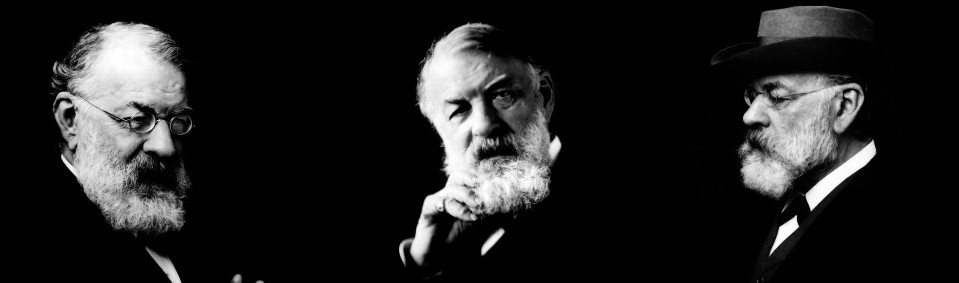
Joseph Joachim: Romanze aus dem Concert in Ungarischer Weise, Berlin, 9 January 1893
Cardiff, March, 1894
AMusQS. (“Joseph Joachim”). 1½ pp. Oblong 8vo. On a single sheet of folded paper. Five measures from the second movement of Giuseppe Tartini’s Devil’s Trill Sonata marked “Tempo giusto” and inscribed in German “In memory of the concert in Cardiff and of Joseph Joachim.” Sold by Lion Heart Autographs.
Joseph Joachim: Album Leaf for Elisabeth Joachim, Spring 1897
“Zur Erinnerung an den letzten Kammermusikabend 1896-97. Möge, liebes Kind, Brahms Musik dir ein treuer Schatz für’s Leben bleiben, wie mir!
Joseph Joachim
Frühling 1897.”
“In remembrance of the last chamber music evening 1896-97. May Brahms’s music remain for you a true treasure, dear child, as for me!
Joseph Joachim
Spring 1897.
Berlin, June 5, 1897 Incipit. Bach, Fugue in C Major from Violin Sonata No. 3 in C Major, BWV 1005.
[In English] “In remembrance of Joseph Joachim / Berlin / June 5th 1897”
Bern, March 14, 1900 Incipit. Joachim, Romanze in B flat Major, from Drei Stücke, op. 2.
[In English] “With many thanks for your nice little letter, and for telling me that your mamma liked the piece. / Joseph Joachim / Berne / March 14th 1900”
The Weekly Herald (New York), August 31, 1844, p. 275.
This article is interesting primarily as one of the earliest mentions of Joachim in an American periodical. It concerns his first London sojourn, as Mendelssohn’s protégé, and mentions him in conjunction with several other violinists whose abilities young Joachim commented on in his letters (particularly Ernst, whom Joachim considered the greatest violinist he ever heard). Note that it gives Joachim’s age as fifteen. According to Joachim’s widely accepted birth date he was thirteen, but there is some additional evidence that he may have been older.
CORRESPONDENCE
London.
LONDON, August 1, 1844.
Musical Doings in Europe.
The season of 1844 which has been the most brilliant on record is drawing to a close, and will be classed in a few days among “things that were.” Lions out of number from every part of continental Europe paid us visits. Mendelssohn, the great composer; Ernst, the greatest living violinist, who has mounted the throne of Paganini, and sits unmolested. His success has no parallel in the musical annals. He has more fervor and passion — more grandeur and variety of expression in his playing than any of the great fiddlers. He possesses a poetical style which is to be preferred to all the mechanism in the universe, although as a mere mechanist his dexterity is unrivaled. Joseph Joachim is another violinist, of fifteen, who has now accomplished, what many of the most celebrated players have not yet achieved. He has the most complete command over the instrument and executes music of all schools from a fugue of Bach to a caprice of Ernst and Bériot with equally marvelous facility. He is Mendelssohn’s pet, and quite outshone Camillo Sivori, “the great humbug of the day,” who, although a violinist of great power, does not possess one atom of originality, and belongs to that respectable class who are justly nick-named “monkey-Paganinis.” Another violinist, who gained more laurels than sovereigns is Mr. Pott, a very clever artist, but who does not possess any transcendent quality so requisite to produce a sensation amongst such a galaxy of talent. […]
Joseph Joachim, Fantasies on Hungarian and “Irish” [recite: Scottish] motives [i.e. “Fantasia on Scottish Airs”]; Early Cadenza to Beethoven Violin Concerto, op. 61. ca. 1850
Joseph Joachim, [1.] Fantasie über ungarische Motive, for violin and orchestra; [2.] Fantasie über irische Motive, for violin and orchestra; [3.] Cadenza (early version) for Beethoven’s Violin Concerto, op. 61; 69 fols., 32.5 x 26.5 cm [autograph ms., before 1853 (ca. 1850)] — H 15849, marked “Joseph-Joachim Nachlaß.” University of Łódź Library. From the Philipp Spitta Collection.
See: Christoph Wolff, From Berlin to Łódź: The Spitta Collection Resurfaces, Notes, Second Series, 46/2 (December, 1989): 311-327.
The manuscript, which was part of the Joseph Joachim Nachlaß at the Berlin Hochschule für Musik, was sent, along with other materials, to Poland during the Second World War. Christoph Wolff details his discovery of the collection in his 1989 article.
“The only manuscript from the Joseph Joachim estate of the Hochschule für Musik, today divided between a smaller part at the Hochschule der Künste Berlin (West) and a larger part at the Deutsche Staatsbibliothek Berlin (East).
Program for the first performance of the Phantasie über ungarische Motive, woO, Weimar, October 19, 1850. Ref: Landesarchiv Thüringen.
Joachim gave the premiere of the Phantasie über ungarische Motive in Weimar on October 19, 1850. He gave further performances of the piece during his English sojourn in 1852 (Oxford, Sheldonian Theatre, June 23, and London, Hanover Square Rooms, June 25). On June 26, the London Daily News reviewed the latter concert:
HERR JOACHIM’S CONCERT.—This distinguished violinist gave a concert at the Hanover-square Rooms yesterday evening. His principal performance was Beethoven’s Concerto for the violin, in which he was accompanied by a full and excellent orchestra. He played it magnificently in every respect—in tone, style, execution, and expression. At the close of the first movement he introduced a new Cadenza of his own—very long, elaborate, and full of enormous difficulties, which he surmounted triumphantly; but it was more wonderful than pleasing, as it did not seem to flow out of the subject, and was deficient in melody. A Fantasia on Hungarian airs was a most marvelous display of executive power; but Mr. Joachim shines more as a performer than as a composer. His themes had less national character than many Hungarian airs that we have heard, nor was there anything characteristic in his treatment. It was, however, a perfect piece of violin playing, and, as well as his other pieces, was enthusiastically applauded. There was a numerous audience and a great many musical notabilités were present. M. Ferdinand Hiller officiated as conductor, and among other eminent personages in the room, we observed Dr. Spohr and the Chevalier Neukomm.
The first performance of the Fantasie über irische Motive[recte: Fantasia on Scottish Airs] was given with the Philharmonic Society of London on 31 May, 1852. The program also included Mendelssohn’s violin concerto. The performance occasioned one of the few truly bad reviews that Joachim ever got, in Bell’s Weekly Messenger, June 5, 1852: “Herr Joachim’s playing of Mendelssohn’s concerto, no less than of his own composition, much disappointed us. From the promise which this gentleman gave, when quite a boy, and when last in England, we fully expected to have found much greater improvement in tone and finish than he indicated. His reading of the first and last [movements] of the Mendelssohn concerto was bold and vigorous; but there was a roughness of bowing, a thinness of tone, and an occasional failing in the intonation, which destroyed the effects intended by the composer. The andante was better played; but even here the manner to our minds was not comparable with that of Mr. Cooper, who performed the same composition two years ago at one of these concerts. Herr Joachim is still young enough to improve, and we trust his visit to England will be the means of inducing him to observe the manner of such violinists as Sainton, Sivori, Blagrove, Cooper, and other artistes, whose talent and finish are equal to their execution. From constant playing upon the Continent, where boldness of manner is more applauded than delicacy of execution, he has fallen into a style which requires to be entirely remodeled ere he can be pronounced as one of the most eminent violinists of the day. In his second performance the composition was so mediocre as almost to defy criticism, and his playing, partaking of all the defects manifested in the first concerto, made it even more disagreeable.”
The London Evening Standard [June 1] was more charitable: “In the violin concerto of Mendelssohn, Herr Joachim came in almost immediate rivalry with Sivori, who played the same work last Friday night at the New Philharmonic Concerts. Each artist, however, had a specialty of his own. The fine bowing of Herr Joachim, and his pure musician-like style, were brought into noble requisition, and the concerto had thus every advantage belonging to a highly-refined taste and the most susceptible intelligence. The performance, in a word, was masterly; and the applause, consequently, was loud and vehement. The exquisite slow movement was rendered by this young and diligent artist with a fervour strongly suggestive of the passionate intensity of Ernst. We could not desire a more intellectual or poetical reading. His fantasia in the second act, founded on well-known Scottish airs, was of a more popular complexion; but equally favourable for the display of those fine qualities of style, mechanism, and expression, which every violinist acknowledges him to possess.”
The Morning Post [June 1] wrote: “In the fantasia on Scotch airs, the eminent violinist not only displayed his wonderful digital dexterity to the fullest extent, but proved at the same time, by the general excellence of his composition, that he possesses qualities entitling him to a much higher artistic rank than that of a mere executant. The fantasia, in addition to being so constructed as to exhibit most effectively the special powers of the leading instrument, is consistent in design, and offers, in its harmony and instrumentation, much to interest and charm the classical musician. The mechanical difficulties of this composition are enormous, but Herr Joachim mastered them all with a skill bordering upon the miraculous; and we could not but join heartily in the rapturous demonstrations of approval with which he was honoured.”
Of the Fantasia, the Examiner [June 5] wrote: “In his fantasia he introduced two Scottish airs, and played them with true feeling. But this second performance was altogether de trop. One violin piece is enough for one evening. A second, and from the same hand, argued a poverty of resource, or a want of the means of procuring aid; and as the Society is affluent, we are compelled to impute the error to a failure in the activity or in the judgment of the directors.”
The Morning Chronicle [June 1] compared the Mendelssohn interpretations of the “Teuton” from Prague (!) and the Italian, Sivori, but failed to mention the Fantasia at all.
The London Times, June 1, 1852
Subsequent Performances
The Morning Chronicle, Tuesday, June 1, 1852
Joachim performed the Fantasia again a few days later [Wednesday, June 2, at 1:30 p.m.] at “Mrs. Anderson’s Concert Annual Grand Morning Concert” “Under the Immediate Patronage of her Most Gracious Majesty the Queen” at the Royal Italian Opera, Covent Garden. Bell’s Weekly Messenger [June 6] reviewed the concert, mentioning: “The other solo and concerted instrumental pieces were Joachim’s fantasia on Scottish airs (the same that he played on Monday at the Philharmonic Society); Maurer’s concertante for four violins, performed by Messrs. Sainton, Cooper, Blagrove, and Day; and a duet for violoncello and contrabasso, by Piatti and Bottesini.” The Morning Advertiser [June 3] led with a mention of Joachim’s performance: “Costa conducted the instrumentalists, and of these we may, without invidious preference, mention as soloists Herr Joachim, whose violin fantasia in the first part exhibited a command of the resources and delicacies, as well as the more popular trickeries, practiced on that most marvellous of instruments.” The Windsor and Eton Express [June 5] declared that “Herr Joachim’s fantasia, for the violin, on Scotch airs” was “splendidly performed.”
The Morning Chronicle, Monday, June 7, 1852
A third performance came on Friday evening, June 11 in a benefit for the Royal Society of Female Musicians.
A modern edition of the fantasies is available from Bärenreiter, edited by Katharina Uhde:
Katharina Uhde, violin
Michael Uhde, piano
The first modern performance of the Irish (Scottish) Fantasy.
Katharina Uhde, violin
R. Larry Todd, piano
The first modern performance of the Hungarian Fantasy
See also: Katharina Uhde, “Rediscovering Joseph Joachim’s ‘Hungarian’ and ‘Irish’ [‘Scottish’] fantasias,” The Musical Times, Winter, 2017.
Also: Chapter 1, Virtuosity Uncoiled: Two Fantasies Rediscovered; Fantasy on Hungarian Themes (1848–50); Fantasy on Irish [Scottish] Themes (1852) in Katharina Uhde, The Music of Joseph Joachim, Woodbridge: The Boydell Press, 2018, 15-60.
Publication: Leipzig, Breitkopf und Härtel, 1855; French Edition: Paris, S. Richault
See: Kompositionsverzeichnis Joseph Joachim, in Beatrix Borchard, Stimme und Geige: Amalie und Joseph Joachim, Biographie und Interpretationsgeschichte, Wien, Köln, Weimar: Böhlau Verlag, 2005.
Ernst Rabich, Haus und Kirchenmusik, vol. 1, no. 1 (January 1, 1897), p. 15.
Aus Robert Schumann’s letzten Tagen
Aus Robert Schumanns letzten Tagen veröffentlicht Ed. Hanslick in der “N. Fr. Pr.” bisher noch ungedruckte Briefe des geistig erkrankten Komponisten. Sie sind an Brahms und Joachim gerichtet und Hanslick leitet diese Veröffentlichung folgendermassen ein: “Brahms hatte auf die Nachricht von Schumanns Erkrankung sofort seinen Wohnsitz in Düsseldorf genommen, um in dieser schweren Prüfungszeit Frau Clara und ihren Kindern trost- und hilfreich zur Seite zu stehen. Schumann hatte zuerst an dem jungen Brahms das grosse Talent erkannt und anerkannt — jetzt bekam die Familie Gelegenheit, sein Herz kennen zu lernen. Brahms war der häufigste und willkommenste Besucher in Endenich; er kam wöchentlich ein-, auch zweimal zu dem Kranken, der mit zärtlicher Liebe an ihm hing. Sein Erscheinen wirkte offenbar freundlich beruhigend auf Schumann, mit dem er von dessen Angehörigen und über Musik sprach, auch vierhändig spielte. Sonst gestattete der Arzt nur sehr selten nahen Freunden den Zutritt zu Schumann, dem jede Aufregung sorgsam fernzuhalten war. Clara selbst durfte ihn erst ganz kurz vor seinem Tode sehen, als er nicht mehr sprechen konnte. Joachim schreibt mir bei Übersendung des letzten Schumannbriefes: “Ich habe Schumann dreimal in Endenich besucht; das erste Mal hatte ich trostreiche Eindrücke, es war ganz sein freundlicher Blick, das liebreiche, tieftreue Auge, wie es uns auch aus so vielen seiner Notenreihen, von schönen Welten träumend, entgegenleuchtet. Er sprach viel und hastig, freilich, frug nach Freunden und musikalischen Vorgängen und zeigte mir alphabetische Register von Städtenamen, die er emsig zusammengestellt. Als ich fort wollte, nahm er mich noch geheimnisvoll in eine Ecke (obwohl wir unbeachtet waren) und sagte, dass er sich von da wegsehne; er müsse von Endenich weg, denn die Leute verständen ihn gar nicht, was er bedeute und wolle. Es schnitt mir ins Herz! Zum Abschiede begleitete er mich noch ein Stück auf die Chausee und umarmte mich dann. (Ein Wärter war in der Ferne gefolgt.) Die beiden weiteren Male schwand leider jeder Hoffnungsschimmer; zusehends hatte er auch körperlich wie geistig abgenommen.”
Ethel Smyth, Impressions that Remained, New York: Alfred A. Knopf, 1946, p. 251; p. 354.
From Ethel Smyth: Impressions that Remained
Ethel Smyth
f the Joachims I saw a good deal. She was the finest contralto I ever heard, and until she got too fat, the Orpheus of one’s dreams. Joachim according to all English people was of course perfection, but I saw him in another setting and never wholly liked him — perhaps among other reasons because trouble was even then brewing in his house and all my sympathies were with the wife, who, though socially far less than satisfactory than her husband, was a warm, living human being. I wished she would not crawl under the supper table in a fit of New Year jollity, armed with a hat-pin, but why did Joachim allow it, I ask myself. Why did he sit there serenely at the head of the table looking like a planed-down Jupiter and utter no remonstrance? In a certain letter Rubinstein’s answer to this riddle may be found, though obviously grotesque, it proves that I was not the only Joachim-heretic in the world. That evening Joachim told me he had just heard Melba, and raved about her; “How can one speak of coldness,” he asked, “in connection with such phrasing?” Perhaps he knew that the same accusation was often levelled against himself, and in both cases it is obvious what people meant — the “coldness,” compared to Renaissance work, of the Delphic Character, which is not to everyone’s taste.
Elisabeth (Lisl) von Herzogenberg to Ethel Smyth
Leipzig, November 5, 1882
… And this man [Anton Rubinstein] maintains in his blind madness the German “inwardness” (Innerlichkeit) means nothing, or rather is another word for impotence, whereby of course he is thinking of Brahms! He said some nice things about the ugly Joachim affair, and thinks he started the whole business in order to marry an English Lady Somebody! “If that is so,” he added grimly, “then I have no use for his Beethoven Concerto and his inwardness and all the rest of it!” Though this is nonsense from the point of view of art, humanly speaking it was warm and sympathetic, and I was glad to hear the frivolous R. talking in that style.
I have not told you, I think, that Frau Joachim has been here and that I visited her in her hotel. I considered it my duty, though it wasn’t easy, for I dreaded what the impression might be. But it was good beyond all expectation; she threw her arms round my neck, sobbing, and was so simple — merely the mother, the lioness robbed of her cubs — that I was deeply touched. Still I cannot get rid of the feeling that she has let herself drift in the direction of cheap, trivial, sentimental yearnings, and gazed forth right and left with moderate lust of conquest; not with any evil intention, but after the fashion of people whose souls are poorly furnished. Things are different now; I think sorrow has ripened and ennobled her, and that took hold of me. Her despair when she speaks about the children (they have taken the daughters to England) is so touching. Imagine! not a soul, except Frau O. and myself went to see her, and in Berlin everyone cuts her — so cowardly and evil is the world! And the worst of all are the virtuous women, who make me perfectly furious. [1]
[1] Later, when Herzogenberg accepted a post offered him by Joachim at the Hochschule, Lisl did not call on Frau Joachim, who was still living in Berlin. [Original footnote.]
Hans Küntzel, Brahms in Göttingen, Göttingen: Edition Herodot, 1985, pp. 96-98.
Agathe von Siebold: Göttingen, Summer of 1857
(from Allerlei aus meinem Leben)
Agathe von Siebold
(*1835 — †1909)
in wunderschönes Jahr war dann für mich das Jahr 1857, wo im Sommersemester Joseph Joachim sich Studierens halber in Göttingen aufhielt. Gekannt hatte ich den großen Künstler schon früher, aber näher bekannt und befreundet wurden wir erst durch meinen Freund und Lehrer Julius Otto Grimm, den mit Joachim eine enge Freundschaft verband. Es war ein ganz herrlicher Sommer, den ich da verlebte. Täglich die herrlichste Musik oder schöne Ausflüge in die Wälder. Joachim hatte auch verschiedene Schüler für die Zeit seines Göttinger Aufenthaltes nach sich gezogen, die des Meisters Unterricht hier genießen wollten: Adolf Bargheer, nachmals Musikdirektor in Basel, Friedemann Bach, ein Nachkomme des großen Sebastian, Herner, der erst Orchestermitglied in Hannover, dann Musikdirektor und Kapellmeister dort wurde. Dieser Herner war ein äußerst begabter Mensch, ein musikalisches Genie. Fast auf allen Instrumenten vermochte er zu spielen, wenn auch die Geige sein Hauptinstrument war. Auf dem Cello war er sehr tüchtig, und dieses Instrument spielte er auch in den häufig stattfindenden Kammermusik-Zusammenkünften, wo Joachim selbstverständlich an der ersten Geige saß, Bach an der zweiten, während Adolf Bargheer Bratsche spielte. Es gesellte sich dann später noch Carl Bargheer, der ältere Bruder von Adolf hinzu, Geiger und Kapellmeister in Detmold. Gott, war das schön! Ich lebte wie in einem Meer von Glück und Entzücken. Immer, alle Tage, die wunderbare Musik und das fröhliche Zusammensein im Grimmschen, in unserem, im Dirichletschen Hause. Auch ich fand Beachtung mit meinem Gesang und Joachims damalige Lieblingsstücke, den Liederkreis an die ferne Geliebte von Beethoven, und die wunderbar schönen schottischen Lieder mit Cello und Geige und Klavierbegleitung von Beethoven sangen wir wochenlang alle und alle Tage. Als mein Lehrer J. O. Grimm einmal ein paar Wochen verreisen mußte, da bat er Joachim, mit mir indessen Musik zu treiben, und da kam der große Künstler fast alle Tage und ließ mich seine und meine Lieblingslieder singen. Auch tat er mir einmal die Ehre an und spielte die G-dur Geigensonate von Mozart mit mir und war dabei so schön geduldig, wenn ich in meiner Weise stümperte oder Taktfehler in der letzten Variation machte. Dann hielt er nachher wohl seine Hand geöffnet hin und sagte: “Ich bitte mir von Ihnen so und so viel Achtel (oder Viertel oder Sechzehntel) aus, um die Sie mich betrogen haben.” Meine Stimme hatte er gern und verglich den klaren, hohen Sopran wohl mit einer Amati-Geige. Ich erinnere mich noch ganz genau des Abends, wo ich ihm zuerst, und was ich ihm vorsang. Das war bei Dirichlets, der Schwester von Felix Mendelssohn Bartholdy. Frau Rebekka hatte mir aus Berlin von Frau Fanny Mendelssohn eine Arie von dem alten italienischen Meister Porpora mitgebracht, die Joachim nicht kannte. Dieselbe hatte ich bei Grimm einstudiert und trug sie nun vor, und außerdem eine Arie von Händel aus dem Josua: “O, hätt’ ich Jubals Harf etc.” Ich glaube, ich zog mich damals ganz anständig aus der Affäre, denn Joachim war sehr freundlich, und von der Zeit an durfte ich immer mit musizieren. Dann erinnere ich mich auch noch meines Geburtstages, des 5. Juli, wo ich 22 Jahr alt wurde. Grimm gab an dem Tage, ein Sonntag war’s, eine seiner Matinéen im Ritmüllerschen Saal. Joachim spielte, und ich sang die Haydn’sche Schöpfungsarie “Nun beut die Flur.” Dies Mal machte ich es wirklich gut, denn sowohl Joachim wie auch Julius Hey, der nachherige Gesangsprofessor, sagten mir viel Erfreuliches.
Wunderherrlich, voll Schönheit und Poesie, waren auch die gemeinsame Ausflüge. Oft lagen wir im Wald oder am Waldrand im Schatten und lasen uns schöne Sachen vor: z.B. Brentanosche Novellen “Die mehreren Wehmüller,” Indische Sagen, übersetzt von Holzmann u.s.w., und die Romantik dieser Werke paßte so ganz und gar, so harmonisch zu der ganze Poesie unseres Daseins. Es war eine so herrliche und reiche Zeit, wie ich sie vorher nie gekostet hatte, und tief ist sie in mein Gedächtnis eingegeraben. Auch sie mußte ein Ende nehmen. Ich mußte mit der Mutter auf Reisen gehen. So schön die Aussicht gewesen wäre, ins Fichtelgebirge, dann nach München und nach Berchtesgaden zu gehen, jetzt freute ich mich kein bißchen darauf, reiste sogar sehr ungern ab, denn Joachim und die anderen lieben Musikanten blieben noch in Göttingen, und ich mußte scheiden.
Henry J. Wood, My Life of Music, London: Victor Gollancz Ltd. 1938, pp. 183-185.
JOACHIM (1904)
Henry Wood ca. 1906
The outstanding event of the 1904 season was the diamond jubilee of Joseph Joachim. A wonderful reception was given for him in Queen’s Hall on Monday, May 16. The president was Arthur James Balfour whom, for the first time, I had the honour of meeting. On the programme appeared a delightful poem by Robert Bridges and, on the second page, a reproduction of a pencil drawing by Frau Moritz Hauptmann; also a recently-taken photograph.
I opened the concert with Mendelssohn’s Hebrides Overture. I may say that, in those early days of my conducting, Mendelssohn was not a great favourite of mine; I was more devoted to Bach, Beethoven, Brahms, and Wagner. Joachim, on the other hand, had known Mendelssohn personally — indeed, he had played with him. He was naturally devoted to Mendelssohn’s works. I was therefore not a little proud of the result of my conducting of the Hebrides overture, for it brought nothing but words of praise from Joachim.
Later, that amazing personality Sir Hubert Parry read, and Balfour presented an illuminated address to Joachim together with his portrait by Sargent. The second item on the programme was announced as ‘solo violin’, and someone went into the artists’ room and brought Joachim’s fiddle-case which he opened amid tremendous applause and enthusiasm. I began the introduction to Beethoven’s violin concerto and Joachim gave a memorable performance of it with his own cadenza. This was followed by his arrangement of Schumann’s Abendlied for violin and orchestra. The musical part of the programme closed with Joachim conducting his own overture to Shakespeare’s King Henry IV (written in 1885) and also the Brahms Academic Festival Overture.
In his address Balfour referred to Joachim’s association with Mendelssohn and told us how the composer conducted the concerto we had just heard when Joachim played it at the Philharmonic concert of May 27, 1844. He then addressed Joachim thus:
“Learning from Mendelssohn and working with Brahms and in the comradeship of life-long friends, you have devoted your whole energies as executant and composer to continuing the tradition and maintaining the ideal of classical music. We now hold it that the sixtieth anniversary of your first appearance in London should not pass without greeting. Your first thoughts as a performer have ever been for the composer, not for yourself.”
The list of the committee and subscribers numbered six hundred and three and contained all the greatest names in music, literature, painting, and even politics.
Of Joachim I always felt that one was in the presence of a Hungarian gentleman of great intellect, and although his playing lacked the emotional depth of that of dear Ysaÿe, his was a quiet classical serenity free from any trace of exaggeration and always musical and scholarly. Joachim was always conscious of his dignity; one could never have the fun out of him that was possible with Ysaÿe. He was a great friend and always a welcome guest at the house of Edward Speyer in Elstree — generally known as the ‘Elstree Speyer’, and cousin to Sir Edgar. Those two did not quite hit it musically: Edgar was all out for the modern in music, Edward for the strictly classical.