
Joseph Joachim
Portrait by John Singer Sargent (1904)
From The Sphere, London, 24 August, 1907

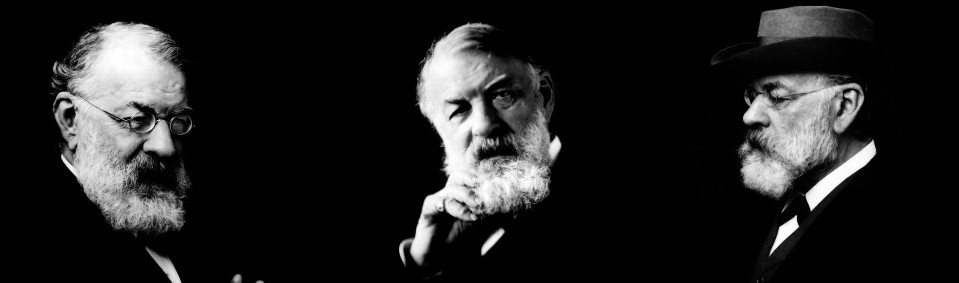
20 Monday Oct 2014
Posted in Iconography
Joseph Joachim
Portrait by John Singer Sargent (1904)
From The Sphere, London, 24 August, 1907
Posted in Uncategorized

Highly honored sir, you call Joachim only the leading German violinist? I find him to be the leading performing musician altogether — an ideal of perfection. With his incomparable mastery he has terrified me and laid me low — but the feeling of artistic elevation that I owe to him won out in the end.
Hans von Bülow to Franz Wüllner, 1 December, 1866
(Berlin SBPK: Mus. ep. Hans von Bülow 1537)
This website is dedicated to the life and art of Joseph Joachim. The information on the site derives from my ongoing research and writing, which I am publishing here in the  spirit of modern, open-source scholarship. For copyright reasons related to the source material, some information remains password-protected and unavailable to the public. The material on this site is organized by category. The detailed Biographical Posts begin here (“Kittsee, 1831”), and continue as a series of linked articles. There are some gaps in the links — this is, as I say, an ongoing project. A Brief Biography begins below (“Joseph Joachim”).
In general, if you wish to use any of the content on this site, especially copyright material or photographs, please acknowledge the source. I request that those with whom I have shared protected information keep their password secret and refrain from making public any information that is not already in the public domain.
The WordPress blog format does not allow me to organize posts as I wish: it organizes posts by date, which is to say, randomly. I am, however, linking the Biographical Posts in sequence, and organizing all of the material in the INDEX. Content is also searchable using the “search” function.
I wish to acknowledge the invaluable and generous support of the University of New Hampshire, without which this work would not have been possible.
 Robert W. Eshbach
Associate Professor of Music Emeritus
University of New Hampshire
reshbach (at) unh.edu
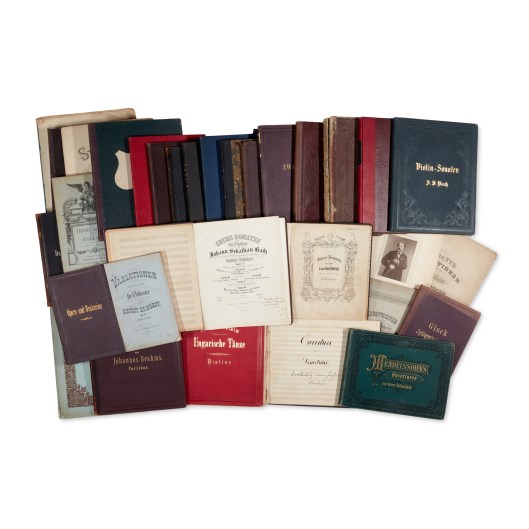
Sold at Sotheby’s on December 13, 2022:
Joachim. Collection of printed and manuscript music belonging to Joachim and his family.
Collection of printed and manuscript music belonging to Joachim and his family, WITH A MANUSCRIPT FULL SCORE OF JOACHIM’S OVERTURE DEMETRIUS, REVISED BY JOACHIM
the printed scores including by Bach (including a Breitkopf edition of six violin sonatas with piano accompaniments by Schumann, INSCRIBED BY SCHUMANN TO JOACHIM), Beethoven (Peters editions of the quartets op.18, arranged for piano four hands, inscribed “Joh. Joachim Pforta, d. 12 Sept. 1883”, and the violin concerto op.61), Gluck (a Peters edition of Iphigénie en Aulide, belonging to Marie Joachim), Mozart (a Peters vocal score of La clemenza di Tito inscribed by Marie Joachim), Tartini, Leclair, Spohr, Schubert, Mendelssohn (including a Peters edition of overtures arranged for piano four hands belonging to Johannes Joachim), Joachim (op.2 no.1, Romance), Schumann (first editions of Bunte Blätter, op.99, and Albumblätter, op.124), Ernst Rudorff (Variations op.24, inscribed by the composer), Brahms (including Ungarische Tänze, arranged for violin and piano, vols.1-3, vol. 3 without the violin part), and Heinrich von Herzogenberg (full score of Symphony no.2, inscribed by the composer “Seinem lieben Freunden Joseph Joachim Weihnacht 1890 HH”)
the manuscript comprising a scribal full score of Joachim’s orchestral overture Demetrius, op.6, notated in brown ink on one 16-stave system per page, dated by the scribe at the end (“Berlin, den 28sten August 1854″), WITH EXTENSIVE PENCIL ADDITIONS AND CORRECTIONS IN JOACHIM’S HAND, the title-page annotated by Joachim (“Umarbeitung einer frühern Ouverture”), 79 pages, oblong 4to (25.5 x 33.5cm), contemporary cloth, no place, [1854 and later]
33 volumes in all, various sizes, bound in with the volume containing Beethoven’s op.61 some manuscript items, including a sonata by Tartini, possibly marked up by Joachim, mostly cloth, nineteenth century, the inscription by Schumann on one edition cropped
A remarkable collection of volumes from the library of arguably the greatest violinist of the nineteenth century. Of particular interest is the score of Joachim’s Demetrius overture, composed 1853-1854 and later revised – a fine example of what the composer himself termed ‘psychological music’.
I would be delighted to hear from the buyer of this collection. The manuscript copy of the Demetrius Overture is of great historical importance, and should not be lost to scholarship. Please contact me at: reshbach(at)unh.edu. Thank you!
Now available from Boydell & Brewer: The Creative Worlds of Joseph Joachim, Valerie Woodring Goertzen and Robert Whitehouse Eshbach, editors

Contents
Introduction: The Creative Worlds of Joseph Joachim
Robert Whitehouse Eshbach
PART ONE: Identity
1. “Of the Highest Good”: Joachim’s Relationship to Mendelssohn
R. Larry Todd
2. Joseph Joachim and His Jewish Dilemma
Styra Avins
3. Joachim and Romani Musicians: Their Relationship and Common Features in Performance Practice
Mineo Ota
PART TWO: Joachim as Performer
4. Joachim’s Violins: Spotlights on Some of Them
Ruprecht Kamlah
5. (Re-)Enchanting Performance: Joachim and the Spirit of Beethoven
Karen Leistra-Jones
6. “Thou That Hast Been in England Many a Year”: The British Joachim
Ian Maxwell
7. Joachim at the Crystal Palace
Michael Musgrave
8. “Music Was Poured by Perfect Ministrants”: Joseph Joachim at the Monday Popular Concerts, London
Therese Ellsworth
9. “Das Quartett-Spiel ist doch wohl mein eigentliches Fach”: Joseph Joachim and the String
Quartet
Robert Riggs
10. Professor Joachim and His Pupils
Sanna Pederson
11. Performers as Authors of Music History: Joseph and Amalie Joachim
Beatrix Borchard
12. At the Intersection of Performance and Composition: Joseph Joachim and Brahms’s Piano
Quartet in A Major, Op. 26, Movement III
William P. Horne
PART THREE: Joachim as Composer
13. Re-considering the Young Composer-Performer Joseph Joachim, 1841-53
Katharina Uhde
14. “Franz Liszt gewidmet”: Joseph Joachim’s G-minor Violin Concerto, Op. 3
Vasiliki Papadopoulou
15. Drama and Music in Joachim’s Overture to Shakespeare’s Henry IV
Valerie Woodring Goertzen
16. “So Gleams the Past, the Light of Other Days”: Joachim’s Hebräische Melodien for Viola and Piano, Op. 9 (1853)
Marie Sumner Lott
17. Tovey’s View of Joachim’s “Hungarian” Violin Concerto
Robert Riggs
Bibliography
Index
DESIDERATA:
 1) I am trying to locate the correspondence between Joseph Joachim and Bettina von Arnim that was sold by Henrici auction house in 1929. [Karl Ernst Henrici, Versteigerungskatalog 155, Berlin: am 5. Juli 1929.] I would be very grateful for any information leading to its whereabouts.
2) I am interested in finding birth records from the Kittsee Kehilla from the late 1820s to the early 1830s. As far as I know, birth records exist only from the mid 1830s onward — too late to include Joachim.
3) I would like to find Margaret Alsager Ayrton’s unpublished diary.
4) I am always interested in seeing letters, photographs, memorabilia, etc. connected with Joachim. Please email me at the above address.
5) I am interested in the whereabouts of the painting by Felix Possart of the Joachim Quartet in the Singakademie zu Berlin (1903).
6)

Joseph Joachim at the time of his Adelskasino debut
This priceless historical artifact was erroneously sold by Stair Galleries on September 13, 2008 as “Joseph Joachim Guernier — The Young Violinist,” “Oil on panel, 8 3/4 x 6 3/4 in. Provenance: Property from the New York Public Library, Astor, Lenox and Tilden Foundations.” It’s whereabouts are currently unknown.
Thank you! RWE
Desiderata:
Nur das Bedeutungslose fährt dahin,
Was einmal tief lebendig ist und war,
Das hat Kraft zu sein für immerdar.
Only the meaningless passes away.
That which is and was once deeply alive
Has the power to be for eternity
Joseph Joachim in Agathe von Siebold Schütte’s Stammbuch, Fall, 1894
20 Monday Oct 2014
Posted in Brief Biography

JOSEPH JOACHIM
* 28 June 1831 Kittsee (Kopčany/Köpcsény) Hungary (now Austria)
† 15 August 1907 Berlin
Violinist, Composer, Conductor, and Pedagogue. Founding director of the Königlich Akademischen Hochschule für ausübende Tonkunst (now Universität der Künste) Berlin. Joachim studied violin with Stanisław Serwaczyński and Joseph Böhm; composition with Gottfried Preyer and Moritz Hauptmann. He was a protégé of Felix Mendelssohn and Robert Schumann, and, in the early 1850s, Franz Liszt. In adulthood, he became a close friend and collaborator of Johannes Brahms and a celebrated opponent of the New German School of Wagner and Liszt. He is widely regarded as one of the most significant and influential musical personalities of the long 19th century.
LIFE
 oseph Joachim was born in Kittsee (Kopčany/Köpcsény) Hungary, in what is now the Burgenland region of Austria. He was the seventh child of Fanny (Franziska) Figdor Joachim (* ca. 1791 — † 1867), the daughter of a prominent Kittsee wool wholesaler then residing in Vienna, and Julius Friedrich Joachim (* ca. 1791 — † 1865), also a wool merchant, born 20 miles to the south in the town of Frauenkirchen (Boldogasszony). [1] Joachim’s birth date, now commonly accepted as June 28, 1831, has never been authenticated. [2]
Joachim was an Austro-Hungarian Jew, whose ancestors had been banished from  Vienna by Emperor Leopold I in the early 1670s and settled in the Kittsee Kehilla, one of the culturally prominent Sheva Kehillot (“Seven Jewish Communities”) that arose in the late 17th century, and stood under the protectorate of the powerful Esterházy family. [3] The Sheva Kehillot were among the wealthiest of the Hungarian Jewish communities, and their members were among the best-educated of Hungary’s Jews. Many were traders, who enjoyed considerably more privileges than the ghetto Jews of nearby Pressburg (Bratislava). As merchants, they travelled freely throughout the region, maintaining close contact with Vienna’s Jewish population, as well as with the large numbers of their co-religionists in Pressburg and Pest. In the early 1820’s Joachim’s maternal grandparents, Isaac (* 1768 — † 1850) and Anna (* 1770 — † 1833) Figdor, left Kittsee and settled in the Viennese Vorstadt of Leopoldstadt, the district along the Danube canal that was home to most of Vienna’s Jewish population. That the Figdors, as Jews, were permitted to live in Vienna at that time, before the loosening of residential restrictions in 1848, is an indication of special status, and suggests affluence. [4] Amongst the Figdors’ other grandchildren was Fanny Figdor Wittgenstein, the mother of the industrialist Karl Wittgenstein and the grandmother of the pianist Paul Wittgenstein and the philosopher Ludwig Wittgenstein. Fanny Wittgenstein served as a surrogate mother to Joachim throughout much of his youth.
In 1833, the Joachim family settled in Pest, then the capital of Hungary’s thriving wool industry. [5] Joseph’s interest in music was stimulated by hearing his older sister, who studied voice and accompanied herself on the guitar. He became fixated on the violin when his father brought him a toy violin from a fair.
© Robert W. Eshbach 2014
[1] The siblings were: 1. Friedrich (*ca. 1812 Kittsee — †1882 Vienna), m. Regine Just (*1825 Brno — †1883 Vienna); 2. M. Josephine (Pessel) (*1816 — †1883) m. Otto Naftali Rosenthal Thali Ronay (*1810 — †after 1866); 3. Julie (*1821 Kittsee — †1901 Vienna) m. Joseph Singer (*ca. 1818 — †1870); 4. Heinrich (*1825 Kittsee — †1897 London) m. Ellen Margaret Smart (*ca. 1844 — †1925), 5. Regina (*ca. 1827 Kittsee — †1862 Pest) m. William Östereicher (*ca. 1817), and later Wilhelm Joachim, (*ca. 1812 — †1858); 6. Johanna (*1829 Kittsee — †1883) m. Lajos György Arányi (*1812 — †1877), and later Dr. Johann W. Rechnitz (*ca. 1812); and 7. Joseph (*1831 Kittsee — †1907 Berlin) m. Amalie Marie Schneeweiss (*1839 — †1899). An 1898 interview with Joachim [Musical Times, April 1, 1898, p. 225] claims that Joachim was “the youngest of seven children.” In his authorized biography, however, Moser claims that Joseph was “the seventh of Julius and Fanny Joachim’s eight children.” The name and fate of the eighth and last sibling is unknown.
[2] Joachim himself was unsure of his birth date. For the first 23 years of his life, he believed he had been born in July — either the 15th or the 24th (Carl Ferdinand Becker, for example, in his Die Tonkünstler des Neunzehnten Jahrhunderts, (Leipzig, 1849, p. 82), gives Joachim’s birthdate as July 15, 1831. Joachim was living in Leipzig at the time, and was, undoubtedly, the source of this information). Joachim apparently discovered the date of June 28 after receiving a Hochzeit-Geburts-Schein from Kittsee (see letter to Clara Schumann dated 21 August, 1863 [Schumann/BRIEFEDITION II, 2.1, p. 735]. Joachim’s boyhood friend Edmund (Ödön) Singer (* 14 October 1831, Totis, Hungary — † 1912) also calls into question the year of Joachim’s birth. “All reference books gave 1831 as Joachim’s birth year, as well as the birth-year of my humble self. […] Joachim himself asked me one day: ‘How does it happen that we are always mentioned as having been born in the same year? I am at least a year older than you!’ — I, myself, finally established my glorious birth-year after many years, while Joachim tacitly allowed the wrong date to persist.” [Edmund Singer, “Aus meiner Künstlerlaufbahn,” Neue Musik-Zeitung (Stuttgart), Vol. 32, No. 1, (1911), p. 8.]
[3] Deutschkreutz, Eisenstadt, Frauenkirchen, Kittsee, Kobersdorf, Lackenbach and Mattersburg (Hungarian: Német-Keresztur, Kismarton, Boldogasszony, Köpcsény, Kábold, Lakompak and Nagy Marton, respectively). Before 1924, Mattersburg was called Mattersdorf. Principal among these closely cooperating communities was Eisenstadt (Kismarton).
[4] Joseph’s maternal grandparents were Isaac [Israel, Isak] Figdor [Avigdor, Vigdor, Victor] (*1768 — †1850), k.k. priv. Großhändler [Imperial and Royal Wholesaler], and Anna Jafé-Schlesinger Figdor (*1770 — †April 12, 1833). Isaac and Anna had ten children: Regine, Karoline, Ferdinand, Fanny, Michael, Nathan, Bernhard, Wilhelm, Eduard, and Samuel. [E. Randol Schoenberg, GENI website: http://www.geni.com/people/Isak-Figdor/6000000008300436213?through=6000000007800493942 accessed 2/14/2011.]
[5] Wool was one of Hungary’s principal articles of commerce and a major source of capital for the Hungarian economy, primarily because it was one of the few export commodities that the Austrian government did not tax. Due to improved farming methods and the introduction of Spanish merino sheep to the region, Hungarian wool was of exceptional quality and highly prized by English woolen manufacturers. Each year, nearly 9 million pounds of wool were offered for sale at the spring trade fair in Pest, most of it bought by German merchants for resale in England. This trade in wool was largely carried on by strategically networked Jewish families, many of whom, like the Figdors, had relatives placed in each of the wool-trading capitals of Europe. The Figdor family connections extended from Pest and Vienna to Leipzig, London, and Leeds. This network of family and business connections was critical to the establishment, guidance, and promotion of Joachim’s musical career, which in its early years, not coincidentally, was centered in those same cities.
20 Monday Oct 2014
Posted in Uncategorized

This page is under construction. Please come back later!
Extended biographical posts for the early years of Joachim’s life begin here.
17 Friday Oct 2014
Posted in Concert Reviews & Criticism
The Examiner, no. 1896 (June 1, 1844), p. 5.


17 Friday Oct 2014
Posted in Concert Reviews & Criticism
The Morning Post, No 22,893 (May 28, 1844), p. 3.
Philharmonic Society.
…Joachim, the boy violinist, astounded every amateur. The Concerto in D, Op. 61, is the only one that Beethoven composed for the violin. It was written shortly after the Symphony No. 4, and came within the second period of Beethoven’s existence, according to the divisions in his biography made by Schindler. This fact is worthy of notice, because the concerto in question has been generally regarded by violin players as not a proper and effective development of the powers of that instrument. […] Despite of these criticisms, kindred genius will now and then spring up, and eloquently illustrate what a mastermind has created — chaos to mediocrities, of course, but clear and intelligible to the highly-gifted executant. The celebrated Baillot — now also no more — did not find the concerto a sealed book. In his hands it was a grand and inspiring work; it has been essayed at the Philharmonic, but with chequered success. But there arrives a boy of fourteen [sic] from Vienna, who, after astonishing everybody by his quartet-playing, is invited to perform at the Philharmonic, the standard law against the exhibition of precocities at these concerts being suspended on his account. He is asked what concerto he will play. “That of Beehoven,” is the youth’s reply, and he submits to the conductor, for his revisal and approbation, the cadences that he had ventured to compose for the concerto. Mendelssohn on seeing them sheds tears of joy at the refined taste and marvelous invention of Joachim, for the violinist has penned cadences which are a masterly resumé of the movements of the composer; he has entered into the spirit and character of the concerto, and his executive dexterity is employed to carry out the themes of his master, not for the mere display of individual power, but to give consistency and coherency to the whole. Modern fantasia manufacturers might derive a valuable lesson from Joachim’s manner of treating the imaginings of a master spirit. As for his execution of this concerto, it is beyond all praise, and defies all description. This highly-gifted lad stands for half-an-hour without any music, and plays from memory without missing a note or making a single mistake in taking up the subject after the Tutti. He now and then bestows a furtive glance at the conductor, but the boy is steady, firm, and wonderfully true throughout.
“In the slow movement in C — that elegant expanse of melody which glides so charmingly into the sportive rondo — the intensity of his expression and the breadth of his tone proved that it was not merely mechanical display, but that it was an emanation from the heart — and the mind and soul of the poet and musician were there, and it was just in these attributes that Joachim is distinguished from all former youthful prodigies. One suggestion, caused by the reminiscence of Baillot’s execution of this concerto, Joachim will, no doubt, be thankful for, as he is modest as well as clever. In the opening subject of the rondo, he should lead off on the fourth string with more energy and animation, so as to form a marked contrast when he takes up [the subject] in alto. This spirited reading of Baillot rendered the violin a dangerous rival to the horns in the same theme. Joachim executes it playfully and gracefully, but the [illegible] of more vigor in the opening passage would tell immensely. Joachim’s performance was altogether unprecedented, and elicited from amateurs and professors equal admiration.
Mendelssohn’s unequivocal expression of delight and [concertmaster] Loder’s look of amazement, combined with the hearty cheering of the band as well as the auditory, all testified the effect young Joachim had produced.”
15 Wednesday Oct 2014
Posted in Obituaries
Czernowitzer Allgemeine Zeitung, No. 1097 (August 18, 1907), p. 3.
N. B.: Obituaries are posted for historical interest only, and should not be taken as sources of accurate biographical information.


15 Wednesday Oct 2014
Posted in Obituaries
Neuigkeits Welt-Blatt, Vol. 34, No. 187 (August 17, 1907), pp. 11-12.
N. B.: Obituaries are posted for historical interest only, and should not be taken as sources of accurate biographical information.


The final paragraph of this obituary is particularly interesting, given that the cause of Joachim’s death is often cited as actinomycosis — a diagnosis that has been convincingly called into question by Dr Harald H. Reinhart, Assistant Clinical Professor of Medicine (Infectious Diseases), of the Yale School of Medicine. It also mentions, contrary to other reports, that the doctors refrained from operating on Joachim, due to his advanced age. The article, which appeared in Vienna, describes his prolonged stay in the Viennese Hotel Tegetthoff, beginning in March, where he “lay for many weeks with a bad case of influenza.”

Hotel Tegetthoff, Vienna
12 Sunday Oct 2014
A collection of programs from 1881-1907 including many from the Joachim Quartet concerts at the Berlin Singakademie, the program from Joachim’s 60th anniversary concert, and programs from Amalie Joachim’s historic song recitals.


A Collection of Programs, 1881-1907 PDF
11 Saturday Oct 2014
Posted in Reminiscences & Encomia
Pester Lloyd, Vol. 63, No. 229 (August 18, 1916), p. 6
(Graf Géza Zichy’s Liszterinnerungen)
Graf Géza Zichy schildert in seinem zweibändigen, überaus unterhaltenden und anekdotenreichen Memoirenwerk “Aus meinem Leben” (Deutsche Verlagsanstalt, Stuttgart) eine Versöhnung zwischen Joachim und Liszt: Es war Anfang der achtziger Jahre, als Josef Joachim frühmorgens in mein Zimmer trat. “Helfen Sie mir, lieber Graf, ich bin in einer sehr schlimmen Lage,” sprach der Meister und schien sehr erregt. “Sie wissen es ja, ich stand Liszt sehr nahe, doch später, mein Gott, wir dienten andern Göttern. Und dann die vielen Ohrenbläser, ich verließ ihn.” — “Ich weiß es,” sagte ich trocken. — Joachim fuhr mit seiner Hand über sein gekräuseltes braunes Haar und fragte mich zögernd: “Wird er mich empfangen? Da bin ich nun in Budapest, laufe um sein Haus herum und traue mich nicht hinauf. Ich möchte ihn sehen, den großen, bedeutenden und so guten Mann! Joachim sprach weich, in aufrichtiger, warmer Weise. “Er wird Sie gewiß empfangen und morgen speisen Sie sogleich mit mir. Um Sie aber ganz zu beruhigen, kommen Sie sogleich mit mir. Ich werde bei Liszt vorsprechen und fragen, ob er Sie empfangen will. Nein, nicht “will”, aber wann er Sie empfangen “wird.” Liszt versteht, vergibt und verschenkt alles!” — Wir gingen in Liszt’s Wohnung. Joachim blieb im Vorzimmer. Als ich eintrat, saß mein lieber Meister an seinem Schreibtisch und schrieb. Ich trat langsam zu ihm hin und legte meine Hand auf seine Schulter. Er wandte sich um, schob seine Augengläser auf die Stirn und frug mich: “Was ist denn los, Géza, daß Sie schon so früh kommen?” — “Ich bringe einen Büßer, den nur Sie freisprechen können!” “Ist’s schon geschehen!” sprach der engelsgute Mann, “wer ist es denn?” — “Er traut sich nicht herein, weil er sich dereinst an Ihnen vergangen hat!” — Liszt lächelte. “Wenn wir nur mit jenen Freunden und Bekannten verkehren wollten, die sich nicht an uns vergangen, so müßten wir Einsiedler werden… also wer ist’s?” “Josef Joachim!” “Joachim!” rief Liszt freudig erregt, “Joachim!” Ja wo ist er denn?” “Hier.” sprach ich und öffnete die Tür. Beide flogen sich in die Arme und hielten sich lange umschlungen. “Vergib mir, Franz!” sprach Joachim. — “Kein Wort darüber!” entgegnete Liszt und führte den großen Geiger zu seinem Kanapee. Den nächsten Tag speisten beide bei mir, und ich kaufte so starke Champagnergläser, daß man dieselben kaum mit der Faust hätte zerschlagen können.

