Joseph Joachim to his Parents, November 5, 1847

Translation © Robert W. Eshbach, 2013


jj-initials1

Joseph Joachim to his parents [i]

                                                                        [Leipzig, November 5, 1847]

Dear, dear, good parents!

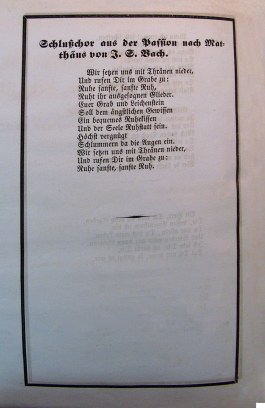
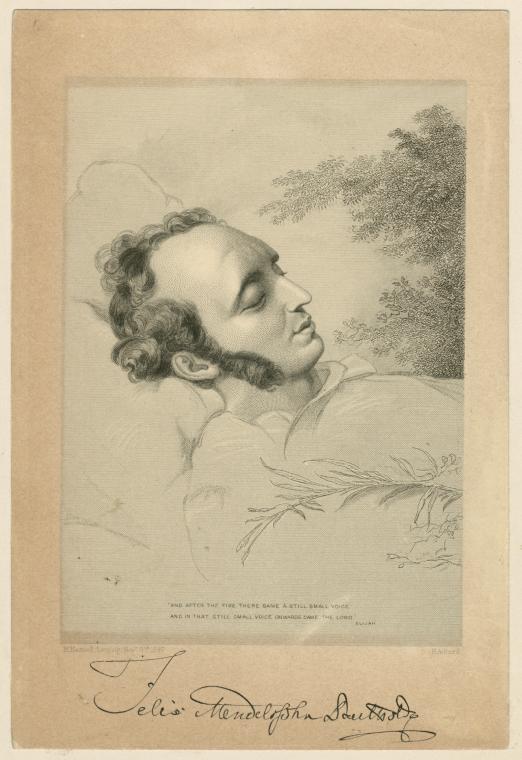
Prepare yourselves to hear from me something unspeakably terrible and sad. God Almighty yesterday afflicted me for the first time with a great misfortune; all my joys, all my hopes, everything, everything has been ruined since yesterday at 9 o’clock — Mendelssohn is dead! A world of sorrow lies in these three words; unfortunately, they are only too true. — Dead! dead! dead! — it is impossible for me to think of anything else, or to listen to even one note of music. Mendelssohn had been unwell for some time; 8 days ago he had a relapse, and he suffered a small stroke; nevertheless, the entire time we had the best hopes, until the day before yesterday, Wednesday, at two o’clock, when he had another, very violent attack, and things became more and more alarming. Yesterday evening a rattling in his throat began, and his strength gradually failed him, so that at a few minutes after nine o’clock he passed over into a more beautiful world, calmly as only an angel could do.

The thoughts of you and other dear ones in Pest is the only thing that keeps me up. But I am very unhappy, and may never be cheerful again. You can easily imagine, my dear parents, how much good a few lines from you would do me, and I fervently hope that I shall soon see your dear handwriting. —

Your disconsolate

Joseph.


Original German  [ii]

Liebe, liebe, gute Eltern! Bereiten Sie sich vor, etwas ganz unerhört Schreckliches und Trauriges von mir zu vernehmen. Der liebe Gott hat mich gestern zum ersten Male mit einem großen Unglück heimgesucht; all meine Freuden, all mein Hoffen, Alles, Alles ist seit gestern Abends 9 Uhr zerstört, Mendelssohn ist todt! Es liegt eine Welt von Schmerz in den drei Worten; leider sind sie nur allzuwahr. — Todt! todt! todt! — Es ist mir unmöglich an irgend etwas Anderes zu denken oder nur einen Ton Musik zu hören. Mendelssohn war schon lange unwohl, er wurde gestern vor 8 Taten rezidiv und ein leichter Schlaganfall kam dazu; dennoch hatten wir die ganze Zeit die beste Hoffnung, bis sich der Anfall mit großer Heftigkeit vorgestern Mitwoch um 2 Uhr wiederholte und es immer bedenklicher wurde. Gestern Abend stellte sich ein Röcheln ein, und nach und nach schwanden die Kräfte, so daß er wenige Minuten nach 9 Uhr, ruhig wie es nur ein Engel thun kann, in eine schönere Welt hinüberschlummerte.

Der Gedanke an Sie und andere liebe Wesen in Pest, ist das einzige, was mich noch aufrichtet. Ich bin aber sehr, sehr unglücklich und werde wol nie wieder froh werden. Wie wohl mir ein Paar Zeilen von Ihnen thun würden, liebe Eltern, können Sie sich denken, und ich hoffe sehnlichst, daß Sie mir bald Ihre lieben Schriftzüge zeigen werden.

Ihr trostloser

Joseph.


[i] Translation based on German text in Reich/BETH EL, p. 67, amended from the English quoted from the Jewish Chronicle and Hebrew Observer in The South Australian Advertiser, Monday, October 31 1859, p. 3.

[ii] Reich/BETH EL, p. 67.

Spohr

© Robert W. Eshbach, 2013

Previous Post in Series: 

http://josephjoachim.com/2013/07/10/vienna-again/


JJ Initials

Spohr

Louis+Spohr

Louis Spohr, self-portrait

In June, Louis Spohr arrived unexpectedly in Leipzig for a rendezvous with Wagner.  Spohr, remembered today principally as a violinist, was at that time regarded as a composer already enshrined in the musical pantheon — in J. W. Davison’s words (1843): “a witness to his own admission into the realms of classical immortality. His writings take their station among the master-pieces of Bach, Handel, Gluck, Haydn, Mozart, Beethoven, Weber and Cherubini. They have long enjoyed that distinction and nothing can now remove them from the rock upon which they are fixed … their influence will survive until art is on its death-bed.” [i] Alas for Spohr, tempus vincit omnia.

“Spohr was of Herculean stature,” wrote Edward Speyer. “This and his erect figure, his dignified and manly bearing, made his appearance extraordinarily impressive.” He was certainly an imposing figure to Joseph, who was introduced to him at an evening of chamber music at Hauptmann’s (Johann Sebastian Bach’s former apartment in the Thomasschule). [1] In the course of the evening Mendelssohn, Spohr and Julius Rietz read Mendelssohn’s C minor Trio, dedicated to Spohr, after which they played a trio that Spohr had dedicated to Mendelssohn. Before beginning Mendelssohn’s Scherzo, Spohr asked the composer what tempo he had in mind. “Mendelssohn replied, in an amiably obliging way, ‘Let’s just begin. Whatever tempo you take will be the right one.’ When it came time to play Spohr’s trio, Mendelssohn wished to know how fast Spohr wanted to take the first movement. ‘Na so!’ cried Spohr, ‘eins, zwei, drei, vier,’ beating the quarters for the composer of the Midsummer Night’s Dream with his bow, as if he were instructing a student at the Conservatorium.” [ii]

The next day, Wagner hosted a supper at Brockhaus’s home, after which, Spohr recounts in the third person, the evening was spent “most delightfully at Mendelssohn’s, who did his utmost to entertain and please Spohr.” “This family has for me something very idealistic about them, they present a combination of inward and external features, and withal so much beautiful domestic happiness, that one seldom sees the like of in actual life. In their establishment and whole manner of living there is so much unassuming modesty amid all the obvious luxury and wealth around them, that one cannot but feel at one’s ease. […] [Mendelssohn] himself played a most extremely difficult and highly characteristic composition of his own, called ‘Siebenzehn ernste Variationen’ [Variations sérieuses, Op. 54], with immense effect; then followed two of Spohr’s quartets — among them the newest (the 30th.) — on which occasion Mendelssohn and Wagner read from the score with countenances expressive of their delight. Besides these, the wife of doctor Frege [2] sang some of Spohr’s songs, which Mendelssohn accompanied beautifully; and in this manner the hours passed rapidly and delightfully with alternate music and lively conversation, till midnight drew on unobserved, and at length gave impressive warning to break up.” [iii]

Mendelssohn hastily improvised a Gewandhaus concert in Spohr’s honor, to be given before a specially invited audience. The program, which took place on the evening of the 25th, consisted entirely of Spohr’s own works: the Overture to Faust, an aria from Jessonda (Frl. Mayer), the Violin Concerto No. 7 in e minor (Joachim), songs with piano and clarinet accompaniment (Mme. Frege), and the Symphony No. 4 in F Major “Weihe der Töne.” Mendelssohn conducted and played the piano. Joseph at first protested that he was unready to play, but Mendelssohn insisted, saying “Joachim, you must be part of it — you are our Pentecostal ox that is to be sacrificed today!” [iv] No doubt unaware of Joseph’s self-professed lack of preparation, the Allgemeine Musikalische Zeitung reported: “the 16-year-old [sic] Joachim played the concerto with the technical polish of a man. Only in the expression did one sense that that deeper life experience, with its bitter pains and exalted joys, as art likes to portray them, and as the master has actually included them in this work, has not yet passed through his naïve, youthful breast, and left its mark. One could almost wish for this talented boy that destiny would soon work a little — not too much — mischief with him. This cannot be spared him, if, in the future, he wishes to awaken, not just admiration, but also the compassion of his listeners.” [v] Spohr, in his Autobiography, however, notes, again in the third person, that the “Grand violin concerto” was “played to Spohr’s complete satisfaction by the wonderful boy Joachim.” [vi]

Spohr was surprised and delighted by the concert. “In this manner up to the last moment was Mendelssohn’s thoughtful and kind attention evinced to Spohr,” he writes, and tells us that the following morning, taking leave at the railway station, Mendelssohn was “the last of all, who, as the train at first proceeded slowly, ran for a considerable distance by the side of the carriage, until he could no longer keep up with it, and his kindly beaming eyes were the last that left their expression on the minds of the travellers from Leipzig, little anticipating indeed that it was to be their last meeting on this side of the grave!” [vii]

Screen shot 2014-01-07 at 4.51.09 PM

Louis Spohr

[viii]


[1] “It was an antique room with panelled wainscotting,” wrote Hauptmann’s student John Francis Barnett, “and it did not seem as if it had undergone any material change since the time that Bach occupied it. In a corner near the window was a German stove, which, to me, looked very unlike a stove, compared with our English fireplaces. In fact it had the appearance of a large model tower in white porcelain, reaching almost to the ceiling. By the wall, opposite the window, was an upright piano, and at the side of the room, near the door, stood a secretaire. […] A pretty canary was flying about the room, and perched sometimes upon [Hauptmann’s] shoulder.” [Barnett/REMINISCENCES, p. 33.]

[2] Livia Frege.


[i] Musical World, Vol. 18 (1843), p.259, quoted in Clive Brown: “Louis Spohr,” Grove Music Online ed. L. Macy (Accessed October 5, 2006), http://www.grovemusic.com

[ii] Moser/JOACHIM 1908 I, p. 69.

[iii] Spohr/AUTOBIOGRAPHY, Vol. 2, pp. 277-278.

[iv] Moser/JOACHIM 1908, p. 69ff.

[v] Allgemeine Musikalische Zeitung, Vol. 48, No. 27 (July 8, 1846), pp. 457-459.

[vi] Spohr/AUTOBIOGRAPHY, Vol. 2, p. 278.

Vienna Again — and Pest

© Robert W. Eshbach, 2013

Previous Post in Series: Schumann, Christiani, and Lind


JJ Initials

Vienna Again — and Pest

Stephansdom

            The New Year (1846) brought a trip to Vienna and Pest — Joseph’s first since his departure three years earlier. The visit was undertaken with earnest artistic and professional intentions, and reflects both the high esteem in which the young man was still held in Viennese musical circles, and the influence of Figdor wealth and connections. Joseph took with him three pieces that would become the cornerstones of his adult solo repertoire: the Beethoven and Mendelssohn concerti, and Bach’s Chaconne. “Approximately three or four years ago,” wrote Saphir’s Humorist, “the chubby-cheeked boy Joachim, a pupil of our excellent Böhm, drew unusual attention to himself with a few public appearances. In the meantime, he has undertaken serious and systematic studies, such as one can make under the auspices of a Mendelssohn-Bartholdy. That boy, now returned, is not yet grown to a youth, but has shot up into an artist.” [i]

Joseph’s first appearance was on December 28th, 1845, in the Theater an der Wien, in one of Saphir’s “Musical Academies and Humorous Readings,” for the benefit of the Institute for the Care of the Blind (Blinden-Versorgungs-Anstalt). Among the numerous performers were Ernst, and the pianist Alexander Dreyschock. Joseph played “a caprice by Ernst, whose great difficulties he conquered with unusual security, purity, and delicacy. He who has achieved such virtuosity at the age of 14 is prepared for the highest consecration of art.” [ii]

Jetty-treffz

Jetty Treffz  [iii]

On Sunday, January 11th, Joseph gave a well-attended noonday concert in the 700-seat hall of the Musikverein, Unter den Tuchlauben, performing the Beethoven and Bach, and David’s Variations on a Russian Theme. The Imperial and Royal Court Opera Orchestra was engaged to accompany, under Georg Hellmesberger’s direction. The concert began with Mendelssohn’s overture to A Midsummer-night’s Dream. Joseph’s violin solos were interspersed with a French romance, and songs by F. W. Kücken and Josef Netzer, performed by the popular mezzo-soprano Henriette “Jetty” Treffz, then the mistress of the wealthy, cultured, Jewish banker Moritz Todesco (for confessional reasons they could not marry), and later the wife of Johann Strauss II. [iv]

Musikvereinsgebäude unter d. Tuchlauben.Musikverein unter den Tuchlauben (Right), Vienna

The serious nature of the program, typical for Leipzig, but unusual for a Viennese virtuoso matinée, drew immediate notice from Frankl’s Sonntagsblätter: “This Joachim must be a genuine artistic talent — otherwise he would not begin his concertizing here with Beethoven and Bach; other concert-givers do not customarily angle for audiences with such compositions.” Quoting Horace’s dictum: “Pore over your Greek models day and night,” the reviewer praised the program as an antidote to the insipid nature of the customary virtuoso fare: “With the great levelling of contemporary concert music, it is most advisable to take a step backward in order to move forward. Returning to Bach and those of like mind might somewhat cleanse the tainted blood of our concert-music composers, and improve what has come to be our inane taste.” [v] Der Humorist, reacted similarly: “It is so satisfying, in this difficult, needy age of bravoura, to see a talent emerge, that has been led on the path of the worthy, dignified and poetic in art; that feels at home there, and promises to remain. […] We can already see from the program of the concert he gave in the hall of the Verein on the 11th that Joachim is a violin player who does not pursue the same path as the others. His main offerings consisted of the concerto of Beethoven, the most precious gem that the violin repertoire possesses, and a ‘Ciaconna’ by Joh. Seb. Bach. — A violin piece by Bach? Has the concert-going public ever heard one here — have they heard one played by a concert giver? Most people must have thought to themselves: “that looks curious!” Oh, rococo! Classical, but not brilliant; we won’t find guitar plucking on the violin, and flute blowing with the bow, in that — no pizzicatos and no harmonics. — Certainly nothing of that, but nevertheless Classical, and truly Classical, this ‘Ciaconna’ is nevertheless as brilliant as any solo piece that has been written for the violin; and not only are there few such magnificent, wonderfully-constructed violin pieces as this fugue [sic], but there are also few players who can perform them with such roundedness, such spirit, such power and stamina, in short, in such an excellent manner as our young artist, who, alone through the magnificent performance of this piece stands in the first rank of contemporary violinists.”

The reviewer went on to praise Joseph’s “beautiful, pithy, masculine tone,” which demonstrated “not only the singing, but also the strongly intellectual-spiritual element. His left hand easily encompasses the most difficult configurations with power and dexterity, and the fullness and beauty of his trills is remarkable. To this is added […] a noble, adroit and firm bow arm, which demonstrates proficiency and security in all bowing styles.” [vi]

Der Wanderer reported that “Herr Ernst was an attentive listener until he had to go to the Redoutensaal, in order to let his talent sparkle there.” [vii]

Joseph’s second Viennese concert, on Saturday, February 28, was less well attended than the first: Liszt was in town, and commanded the 12:30 Sunday time in the Musikvereinssaal, so Joseph had to present his concert at nine thirty the previous evening — an unusual time, as most Viennese concerts occurred at mid-day. For this appearance, Mendelssohn had entrusted Joseph with the important Viennese premiere of his Violin Concerto in E Minor, which David had brought to life in the Gewandhaus a year earlier. The rest of his program consisted of a perhaps different set of variations by David (“on an original theme”), and a reprise of the Bach Chaconne. He was assisted in this concert by the popular alto Betti Bury who sang songs by Nicolai and Dessauer, and “Herr Wieselmann,” who “shrieked” an aria from Rossini’s Othello. The Imperial and Royal Court Opera Orchestra, under Hellmesberger’s direction, performed Mozart’s Titus Overture, and accompanied the concerto and aria.

Haidenröslein

Home in Pesth, Joseph saw the appearance of his first published work: a setting in G Major for soprano and piano of Goethe’s Haidenröslein. The song, with the text in Hungarian translation below the original German, was published by the otherwise obscure “Verlag des Ungar” — the “Hungarian Press” — and may have been a private printing.

It is an effort worthy of Cherubino. The simple, folk-like, “Deck the Halls” tune, which appears at first in classic horn thirds, fifth and sixth, feints immediately to e and a minor, and is soon buried under an overwrought, dissonance-laden 16th-note accompaniment more descriptive of the trials of Clytemnestra than the fate of a poor little heath-rose. The three verses are set in ABA’ form, the B section in mournful e minor, concluding with proto-Mahlerian Gypsy-minor sighs in the piano part, and transitioning to the reprise through a minor version of the horn call theme. The song ends as it began — with horns. A good boy, the composer’s sympathies were all with the rose, and not with the lad.


Concert Reviews:

Concert: Vienna, January 11, 1846, Musikvereinssaal

M. G. Saphir (ed.), Der Humorist, Vol. 10, No. 11 (Tuesday, January 13, 1846), pp. 42-43.

Concert: Vienna, January 11, 1846, Musikvereinssaal

Ferdinand Ritter von Seyfried (ed.), Der Wanderer im Gebiete der Kunst und Wissenschaft, Industrie und Gewerbe, Theater und Geselligkeit, Vol. 33, No. 11 (January 13, 1846), p. 44.

Concert: Vienna, January 11, 1846, Musikvereinssaal

Wiener Zeitschrift für Kunst, Literatur, Theater und Mode, Vol. 31, No. 12 (January 16, 1846), p. 48

Concert: Vienna, January 11, 1846, Musikvereinssaal

Ludwig August Frankl (ed.), Sonntagsblätter, Vol. 5, No. 3 (18 January, 1846) p. 59-60.

Concert: Vienna, February 28, 1846, Musikvereinssaal

Ferdinand Ritter von Seyfried (ed.), Der Wanderer im Gebiete der Kunst und Wissenschaft, Industrie und Gewerbe, Theater und Geselligkeit, Vol. 33, No. 53 (March 3, 1846), pp. 211-212.

Concert: Vienna, February 28, 1846, Musikvereinssaal

M. G. Saphir (ed.), Der Humorist, Vol. 10, No. 53 (March 3, 1846), p. 215.

Concert: Vienna, February 28, 1846, Musikvereinssaal

G. Ritter von Franck (ed.), Wiener Zeitschrift für Kunst, Literatur, Theater und Mode, Vol. 31, No. 45 (March 3, 1846)

Concert: Vienna, February 28, 1846, Musikvereinssaal

Ludwig August Frankl (ed.), Sonntagsblätter, Vol. 5, No. 10 (March 8, 1846), p. 236.

Concert: Vienna, February 28, 1846, Musikvereinssaal

August Schmidt (ed.) Wiener allgemeine Musik-Zeitung, Vol. 6, No. 28, (5 March 1846), p. 110.


Next Post in Series: Spohr


[i] M. G. Saphir (ed.) Der Humorist, Vol. 10, No. 11 (January 13, 1846), p. 43.

[ii] Die Gegenwart. Politisch-literarisches Tagblatt, Vol. 1, No. 73 (December 30, 1845), p. 350.

[iii] Wikimedia Commons

[iv] The presence of Jetty Treffz on Joseph’s program, together with the venue and the accompanying court orchestra, strongly implies the continuing influence, financial support, and social connections of Joseph’s uncle Wilhelm Figdor. Moritz Todesco’s father, Hermann, had been born in 1791 in Pressburg. His large fortune was based in textiles: flax, cotton and silk. When Hermann died in 1844, his estate was valued at circa twelve million guilders. Hermann’s sons, Eduard and Moritz, were partners in the family banking and wholesale company doing business as “Hermann Todesco’s Sons.” Moritz, a music lover, later built an impressive, five-story in-town palais (designed by Theofil Hansen, who also designed the building of the Gesellschaft der Musikfreunde) on Vienna’s Kärntnerstrasse, opposite the opera house. The Todescos were eventually allied in business with the Miller zu Aichholz family. See: Jill Lloyd, The Undiscovered Expressionist. A Life of Marie-Louise Von Motesiczky, New Haven: Yale University Press, 2007, Chapter I, Family Portrait.

800px-Palais_Todesco_Aug_2006_070

Palais Todesco, Vienna

[v] Ludwig August Frankl (ed.), Sonntagsblätter, Vol. 5, No. 3, (January 18, 1846), pp. 59-60.

http://josephjoachim.com/2013/06/13/concert-vienna-january-11-1846-musikvereinssaal/

[vi] M. G. Saphir (ed.) Der Humorist, Vol. 10, No. 11 (January 13, 1846), p. 43.

http://josephjoachim.com/2013/07/16/concert-vienna-january-11-1846-musikvereinssaal-2/

[vii] Ferdinand Ritter von Seyfried (ed.), Der Wanderer im Gebiete der Kunst und Wissenschaft, Industrie und Gewerbe, Theater und Geselligkeit, Vol. 33, No. 11 (January 13, 1846), p. 44.

http://josephjoachim.com/2013/07/16/concert-vienna-january-11-1846-musikvereinssaal-4/

Schumann, Cristiani, and Lind

© Robert W. Eshbach, 2013

Previous Post in Series: 1845


JJ Initials

Schumann, Cristiani, and Lind

 Schumann-Kriehuber1839 clean:small

[i]

Robert Schumann
Portrait by Kriehuber, 1839

 At an evening gathering at Mendelssohn’s, Mendelssohn and Joachim had played Beethoven’s Kreutzer Sonata. After the music, the guests were served a casual supper at small tables. Joachim found a place at a little table where Schumann sat. It was summertime, and, through the wide-open windows, the night sky appeared, sown with numberless stars. Eventually, Schumann, who had sat for a long time without saying anything, gently touched the knee of his little companion, and, gesturing with his hand to the starry sky, asked in his inimitably kind-hearted way: “whether out there, there might exist beings who know how beautifully, here on earth, a little boy had played the Kreutzer Sonata with Mendelssohn?” [ii]

The tale varies somewhat from telling to telling — Edith Sichel recalled the event as following a performance of the Beethoven Concerto. Be that as it may, for Joachim this encounter was of seminal significance: “Fifty years afterwards he loved to tell the story, in his vivid way, acting the gesture, recalling the tones which the years had not dulled for him,” Sichel writes. [iii]

The kindly smile, the warmth of Schumann’s voice — these were among Joachim’s earliest, indelible, impressions of his future mentor. The hand on his knee, the gesture toward heaven and the poetic reference to otherworldly beings would have come as an unfamiliar — though not unwelcome — gesture of intimacy to a boy who, for the last five years, had been raised under the rigid regime of a succession of strict taskmasters. Joseph’s father, uncles and brothers were merchants, and they viewed his occupation primarily from their own accustomed perspective, as the business of giving concerts — his education, a preparation for that business. The profession of buying and selling commodities had not always been kind to Julius Joachim, and his letters make clear that he viewed his son’s extraordinary gift for music as a preferred alternative to a life spent in the wool-room and the counting-house. But with this unfamiliar path came new uncertainties, and for many years the concern of the extended family, often anxiously expressed, seemed to center on how their prodigy might achieve security and renown as a performer and composer.

Amidst these worldly concerns and family pressures, the taciturn Schumann’s gesture to the heavens, [iv] his quiet reference to the success of a little boy, not in terms of careerist ambitions, parental approval, the pride of a teacher or the applause of an audience, but rather in terms of beauty achieved, sufficient to please celestial beings — was something rare, and perhaps unique, in Joseph’s experience. In Schumann, as in Mendelssohn, Joseph encountered what must have been, to him, a novel and unfamiliar conception of childhood — one that was grounded in the writings of Rousseau, Jean Paul Richter, Pestalozzi and Fröbel, and in the practical educational experiments of the Kindergarten movement. In this Biedermeier sensibility, childhood was no longer viewed as a stage to be passed through as quickly as possible on the way to a responsible adulthood, but as a sacred time — a time of innocence and wonder, learning and creativity, with its own particular insights into the meaning and value of human existence. Here, for the first time, children were looked upon not merely as unformed adults, but as creatures deserving of their own culture, to be brought up in nurseries replete with age-appropriate toys, pets, clothing, books — and music [1]. Childhood was a time to be prolonged and savored, and ultimately a time to be looked back upon with nostalgia as the purest and best years of one’s life. “The child was held to be the better human being,” writes Bernhard R. Appel in his study of Schumann’s Jugendalbum. “Through its unspoiled nature, it is distant from civilizing deformations. The child is eo ipso good in the moral sense. According to this romanticized ideology of childhood, it still lives in Arcadian bliss, unencumbered by troubles and far from the prosaic workaday world of the adult.” [v] Schumann shared this attitude toward childhood. “In every child there lies a marvelous depth,” [vi] he once wrote, and indeed, Schumann possessed a childlike depth of his own.

Schumann always made a distinction between the poetry of art and the prose of practical or pecuniary arrangements. This evidence of his idealistic (or impractical) nature, and of his solicitousness toward the young, was Joachim’s first real personal contact with a man who, upon their first introduction, had managed merely to smile and to stare. In the end, the ability of this gentle, taciturn man to draw a connection between a child’s performance of a mature work and an imagined reception in the celestial realm — ideal, timeless, disinterested and otherworldly — marked him permanently in Joachim’s mind as a man who had himself somehow managed to retain those moral and spiritual characteristics that the Biedermeier ascribed to childhood.

JJ Initials

On Sunday, November 9, 1845, Schumann sent an urgent message to Mendelssohn in Leipzig, requesting help with an orchestra concert that was to take place the following Tuesday night in Dresden: “My poor wife is ill, not critically, but such that she cannot play in the first subscription concert the day after tomorrow. The management is now in a great quandary. I thought, therefore, of Joachim — whether he couldn’t come — and of your always readily supportive kindness — whether you couldn’t help encourage Joachim to do it. Naturally, time is of the essence. My stepfather has thus immediately gotten underway. If you would be so kind as to help him in his efforts this very evening by writing a few lines to Joachim, or by personally accompanying him to visit Joachim, we would be greatly obliged and thankful to you. My stepfather will deal with everything else.” [vii]

This letter was never received: at the time, Mendelssohn was not in Leipzig, but in Berlin. Wieck went next to David, and then tried his luck with Wittgenstein. At 9:00 o’clock that evening he wrote back to Schumann: “It is impossible to converse with Joachim’s uncle [sic] — Herr Wittgenstein.” Joseph was “nothing but his uncle’s slave,” he continued, “and, since I was forewarned by David, I saw that there was nothing to be accomplished by pressing; I operated differently, and apparently well, since he didn’t say ‘no,’ but wanted to think it over and give me his answer before noon tomorrow. When I made him aware — with angelic meekness — that I might perhaps get a message to you on the freight wagon by 10 o’clock, so that a notice might be put in the gazette, he said he would give me an answer around 10 o’clock […]” [viii]

Wieck’s diplomatic efforts were successful in the end. The following evening, Joseph joined Schumann in Dresden, bringing with him Mendelssohn’s violin concerto and David’s Variations on Schubert’s Lob der Thränen for Violin and Orchestra, op. 15[2] In addition to Joseph’s solos, the program consisted of Mendelssohn’s Calm Sea and Prosperous Voyage Overture, Beethoven’s 5th Symphony, and several arias, sung by Leopoldine Tuczek from Berlin. [3] The subscription series, attended mostly by the nobility, took place in the ballroom of the Hôtel de Saxe, with the orchestra — in Schumann’s opinion “very competent, the winds excellent” [4] — under the direction of Ferdinand Hiller.

This Dresden premiere would be Joseph’s first performance of the Mendelssohn Concerto, and the third public performance of the work outright. [5] The work would remain a cherished part of Joachim’s repertoire throughout his career.

The rehearsal took place on the morning of the concert, after which Joseph and Hiller joined the Schumanns at home. Clara was unable to attend the concert, but wrote that evening in her diary: “Little Joachim had a good success. Joachim played a new violin concerto by Mendelssohn, that is supposed to be wonderful.” [ix] A week later, the Allgemeine Musikalische Zeitung reported:

            Frau Dr. Clara Schumann had wished to gratify the public with the performance of Henselt’s new pianoforte concerto, which she played in the first Gewandhaus concert. She was unfortunately frustrated in this intention by an illness, and the young violinist J. Joachim from Vienna (we should now properly say: from Leipzig) stood in for her, presenting the beautiful violin concerto in E by Mendelssohn Bartholdy and David’s Grand Variations on Schubert’s “Lob der Thränen.” The young virtuoso — and he is more than that — has already been recognized for his merits in these pages, and we, too, must declare ourselves in agreement, that he is on the path of attaining the highest artistic perfection. More than his proficiency and security, which is equal to every technical difficulty — more than his pure-as-gold intonation and his outstandingly beautiful tone — his characteristically true, deeply felt presentation — the intellect — the poetic spirit — and that at his youthful age, surprised us doubly. In any case, one can predict for him an important career, especially since he appears to have entirely retained his modesty in spite of all the recognition that has come his way. . . .   Wise[x]

The Neue Zeitschrift für Musik reported, simply: “Young Joachim astounded the audience with his performance of Mendelssohn’s beautiful violin concerto and David’s Variations.” [xi]

 Cristiani Program

[xii]

            A month earlier, Joseph had joined David, Niels Gade and Andreas Grabau in a performance of a Beethoven quartet — his first public quartet performance in Leipzig. The quartet led a mixed program in the Gewandhaus given by the 17-year old Parisian ‘cellist Lisa B. Cristiani. [6] In those days, playing the ‘cello was considered particularly unfeminine, and professional female ‘cellists were unknown. Cristiani, making her first German tour, was therefore a great curiosity, as much for her appearance (how would she hold the ‘cello?) as for her musicianship. On this occasion, Mendelssohn accompanied her on the piano. Mendelssohn was apparently pleased with her playing: he later dedicated to her his Song without Words op. 109 no. 38. Cristiani enjoyed a brilliant but short career, during which she traveled extensively. She died of cholera in Siberia in 1853, while touring Russia in the footsetps of her renowned countryman, François Servais.

 Jenny_Lind_retouched

[xiii]

Jenny Lind, 1850

            On December 4, Joseph appeared for the first time in the Gewandhaus as a composer, playing his own Adagio and Rondo for violin and orchestra [7], together with Ernst’s Introduction, Caprices and Final on a Theme from Opera “Il Pirata” by V. Bellini[xiv] The critic for Signale für die Musikalische Welt wrote that “the promising young violinist’s” performances — “of great interest” — were greeted with vigorous applause. “He played… with such security, endurance and taste, that, without looking, one would have imagined him to be an artist of a more mature age. If we find the young Joachim once more to have advanced since we heard him last, and discover a talent for composition in him, then we do not speak falsely when we maintain that he will someday become an important violin-artist, for whom, if he continues his studies, one can predict a happy future.” [xv] After the concert, Ferdinand David paid a collegial compliment to Joseph Böhm in Vienna: “While here, your pupil Joachim has given us much pleasure and you the greatest honor through his outstanding talent, his good, modest behavior and his passion for art; and if your name in the art world were not already well founded, the accomplishments of your two students Ernst and Joachim would suffice to assign it one of the first places.” [xvi]

Though Joseph performed with distinction, the audience had gathered to hear the other soloist of the evening: the 25-year-old singing sensation Jenny Lind, with whom Joseph would later establish a long-lasting friendship and artistic partnership. [8] Elise Polko, present at the occasion, wrote unforgettably about the young soprano:

…the concert public were in a state of feverish excitement; and when at length she came forward on the raised platform, a slender girlish form with luxuriant fair hair, dressed in pink silk, and white and pink camelias on her breast and in her hair, in all the chaste grace of her deportment, and so utterly devoid of all pretension, the spell was dissolved, and the most joyous acclamations ensued.

Jenny Lind only looked beautiful when she sang… Music alone, and nothing else, transfigured her countenance so wonderfully; it then became actually transparent, the soul within shining brightly through the earthly vail in the most enchanting manner.

And it was thus she sang, on that evening in the Gewandhaus, Bellini’s “Casta Diva,” the Duett from the “Montecchi e Capuletti,” “Se fuggire,” with Miss Dolby, the letter Aria from Mozart’s “Don Juan,” [sic] and two of Mendelssohn’s songs, “Auf Flügeln des Gesanges,” and “Leise zieht durch mein Gemüth.”

I cannot remember how I got home after that concert; I only know that I trembled and wept, and never closed my eyes all night. It was not, however, the “Casta Diva,” with all its pearly adornment and florid graces, not the lovely Giulietta, nor the stately Donna Anna who haunted my thoughts, and whom I seemed ever to hear; it was exclusively the ineffably sweet, ethereal, almost unearthly, “By the first rose thou hap’st to meet.” And what must Mendelssohn have felt, who was seated at the piano, accompanying the singer, and from whose soul this lovely flower of a song had sprung.  [xvii]

The next evening, Lind appeared again in the alarmingly overcrowded Gewandhaus, this time performing a benefit concert for the Orchestral Widows’ Fund. After the concert, she was serenaded by torchlight — by 300 singers and instrumentalists — in the courtyard of the Brockhaus family mansion, where she was residing. [9] The tongue-tied Lind enlisted Mendelssohn to descend with her into the courtyard, to speak for her. “Gentlemen!” he said, “You must not think that I am Mendelssohn, for at this moment I am Jenny Lind, and as such I thank you from my heart for your delightful surprise. Having now, however, fulfilled my honorable commission, I am again transformed into the Leipzig Music-Director, and in that capacity, I say, ‘Long live Jenny Lind!’” [xviii]

“The singers dispersed to the strains of Mendelssohn’s ‘Waldlied,’” wrote Elise Polko. “Jenny Lind, so different in her personality from all other artists, soon became, in her girlish modesty, and spotless purity and disinteredness, a kind of mythical form to the public at large. Fable after fable was related about her, and at length it would scarcely have seemed marvelous had she dissolved into the mist before all eyes, or floated away like her own piano-pianissimo. …Her piano was a breath, such as angelic lips might breathe. Those who listened to her felt as if there was something holy in the art of singing, and that this ‘Mädchen aus der Fremde’ had only come among us to proclaim the truth to the children of this world.” [xix]

JJ Initials

“Dear Mendelssohn,” wrote Schumann on December 12, “Are you back to normal life — completely at home after your unsettled time in Berlin and the Lind-fever, so that one can knock and be cordially received? I thought of you most affectionately as Joachim played the violin concerto; I cannot criticize such a piece after the first hearing — but completely indulge myself […]. [xx]


Next Post in Series: Vienna Again — and Pest


[1] See: Bernhard R. Appel: Robert Schumanns »Album für die Jugend,« Zürich & Mainz 1998, in particular the chapter »In jedem Kinde liegt eine wunderbare Tiefe. Schumann und die Pädagogik seiner Zeit.«

[2] David must have provided the orchestral parts for both works; the Mendelssohn Concerto was, as yet, unpublished.

[3] At this concert, Joseph earned the admiration of the renowned virtuoso Karol Lipiński. From 1839 the concertmaster of the Dresden Kapelle, Lipiński (1790-1861) was renowned as one of the greatest players of the age. The Countess de Merlin once asked Paganini whom he considered the first violinist in the world. “I do not know the first,” Paganini replied tactfully, “but the second is certainly Karol Lipiński.” Indeed, Lipiński had already been known as “the Polish Paganini” when the two virtuosi first met in 1818. Lipiński had traveled to Milan to hear Paganini play, and afterward, he played for Paganini while the Italian master drank champagne and accompanied him on the guitar. The two concertized together briefly in Piacenza, and did not meet again until 1829, when Paganini visited Poland. Their rivalry eventually ended their friendship. [Czeslaw Raymond Halski, Paganini and Lipiński, Music and Letters, Vol. 40, No. 3 (July, 1959), pp. 274-278, passim.] Paganini dedicated to Lipiński his Op. 10 Burlesque Variations on “La Carnaval de Venise” for unaccompanied violin. Lipiński is also the dedicatee of Robert Schumann’s Carnaval. Lipiński had hoped to succeed Matthäi as concertmaster of Leipzig’s Gewandhaus Orchestra, and felt slighted that Mendelssohn gave his friend David the job. Thereafter, when he played in Leipzig he played only in the Euterpe concerts. The management of the Gewandhaus reportedly once dispatched David to ask Lipiński why he didn’t play in “first-tier concerts.” “Where I play, it is always a first-tier concert,” Lipiński is said to have replied. [Moser/JOACHIM 1908, pp. 74-76.]

[4] The strings were mainly local city players, while the winds were drawn from the military band.

[5] David performed it again in the Gewandhaus on October 25. Joseph Hellmesberger Sr. gave the Viennese premiere in a concert of the Musikverein on December 21. [Pohl/CONSERVATORIUM, p. 190.]

[6] Cristiani played a 1700 Stradivari, later owned by Hugo Becker. The “ex-Cristiani” Strad is currently preserved in the Museo Stradivariano in Cremona, Italy.

[7] Using this MS as an example, William Smyth Rockstro later noted the similarity of Joachim’s hand to Mendelssohn’s. “We have at this moment in our possession the first sketch of an unpublished Concerto for the Violin, composed by [Joachim] in 1845, and played on the 4th of December, in that year, at the Gewandhaus, which exemplifies the likeness so strongly that many of its passages might very easily be supposed to have been written by Mendelssohn himself. [W. S. Rockstro, The Life of George Frederick Handel, London: Macmillan and Co., 1896, p. 226.]

[8] That Joseph was recruited to perform with Lind is a true demonstation of Mendelssohn’s faith in him. Mendelssohn himself was quite head-over-heels for Lind, as numerous accounts attest. As for Lind, it was characteristic of her to share her programs with children — perhaps enhancing her own image as a “chaste diva.” She would do it again in Vienna in January 1847, when she sang “for love” in the debut series given by the young Wilhelmine Norman, later Wilma Norman-Neruda, Lady Hallé.

[9] Heinrich Brockhaus (*1804 — † 1874) inherited his father’s publishing house at the age of twenty, and, over the course of years, made it into one of the most respected in Germany. For Brockhaus’s account of Lind’s visit, see Brockhaus/TAGEBÜCHERN II, p. 88 ff. Carl Reinecke also provides an interesting narrative of the events in Reinecke/SCHATTEN, pp. 62 ff.


[i] Wikimedia Commons.

[ii] Moser/JOACHIM 1908, p 72.

[iii] Edith Sichel: Joseph Joachim — A Remembrance, in The Living Age, vol. 254 (1907), p. 694.

[iv] For Schumann’s interest in the stars at around this time in his life, see: Gerd Nauhaus: Schumann und die Sterne, in Schumann Studien 3/4, Köln 1994, pp. 174-178.

[v] Bernhard R. Appel: Robert Schumanns »Album für die Jugend,« Zürich & Mainz 1998, p. 19.

[vi] Gesammelte Schriften über Musik und Musiker von Robert Schumann, ed. by Martin Kreisig, Leipzig 1914, p. 20. Quoted in Appel, Album, p. 17.

[vii] Schumann/BRIEFE, p. 253. m. t.

[viii] Schumann/BRIEFEDITION I, p. 244   Schumann, Briefedition, vol. 1, p. 244

[ix] Litzmann/SCHUMANN II, p. 111.

[x] Allgemeine Musikalische Zeitung, Vol. 47, No. 47 (November 19, 1845), pp. 838-839.

[xi] Neue Zeitschrift fur Musik, Vol., 24, No. 9 (January 29, 1846), p. 36.

[xii] Stadtgeschichtliches Museum Leipzig

[xiii] Jenny Lind, 1850, Wikimedia Commons.

[xiv] Dörffel/GEWANDHAUS, p. 126; Polko/MENDELSSOHN, p. 110; Program, Stadtgeschichtliches Museum, Leipzig. Moser/JOACHIM1908, I, p. 67) incorrectly gives the date of this concert a year earlier, i.e. in 1844.

[xv] Signale für die Musikalische Welt, Vol. 3, No 50, (December 1845), p. 394.

[xvi] Letter of December 6, 1845, quoted in Moser/JOACHIM 1908 I, pp.52-53 n.

[xvii] Polko/MENDELSSOHN, pp. 110-111.

[xviii] Polko/MENDELSSOHN, p. 113.

[xix] Polko/MENDELSSOHN, pp. 113-114.

[xx] Robert Schumann to Felix Mendelssohn, Dresden, December 12, 1845. Schumann/BRIEFEDITION, vol. I, p. 251.

Wilhelm Figdor to Julius and Fanny Joachim, December 2, 1844

Translation © Robert W. Eshbach, 2013


Wihelm Figdor

JJ Initials

Wilhelm Figdor to Julius and Fanny Joachim [i]


Vienna, 2 Dec. 1844

Dear brother-in-law and sister,
It gives me great pleasure to be the bearer of pleasant news from your dear Jos. But at the same time you realize how necessary and useful it is for him, from time to time to receive admonitions and inducements from afar, and especially from his homeland and from his parents. It is up to you to impress upon him that he must aspire to achieve independence and to make a name for himself. He can only do this through composition — and this is not possible without effort and perseverance. Fanny certainly does not ask more of him than he can achieve, and she knows full well how much of his negligence is due to his tender years. Also, she has not complained, except that he needs to be pushed. We all know this, and the more he is courted by foreigners, the more tireless his relatives must be in saying to him that his successes so far have owed more to his youth and the fortunate external circumstances here, and that without composition, which demonstrates his diligence, he will have achieved nothing, and when he is older, and stands there merely as a violin player, he will be nothing.  You must demand, with the authority that only parents possess, that he complete the work that he has begun. I also write to him often, and do what I can to push him on to greater effort. We are all well, and hope to hear the same of you and your children, to whom I send many greetings.

Farewell,
Your
Wilhelm

[i] British Library: Joachim Correspondence, bequest of Agnes Keep, Add. MS 42718, p. 200.

1845

© Robert W. Eshbach, 2013

Previous Post in Series: Ferdinand David


JJ Initials

1845

Wilhelm Figdor to Julius and Fanny Joachim [i]

Vienna, 2 Dec. 1844

Dear brother-in-law and sister,

It gives me great pleasure to be the bearer of pleasant news from your dear Jos. But at the same time you realize how necessary and useful it is for him, from time to time to receive admonitions and inducements from afar, and especially from his homeland and from his parents. It is up to you to impress upon him that he must aspire to achieve independence and to make a name for himself. He can only do this through composition — and this is not possible without effort and perseverance. Fanny certainly does not ask more of him than he can achieve, and she knows full well how much of his negligence is due to his tender years. Also, she has not complained, except that he needs to be pushed. We all know this, and the more he is courted by foreigners, the more tireless his relatives must be in saying to him that his successes so far have owed more to his youth and the fortunate external circumstances here, and that without composition, which demonstrates his diligence, he will have achieved nothing, and when he is older, and stands there merely as a violin player, he will be nothing.  You must demand, with the authority that only parents possess, that he complete the work that he has begun. I also write to him often, and do what I can to push him on to greater effort. We are all well, and hope to hear the same of you and your children, to whom I send many greetings.

Farewell,
Your
Wilhelm

_____

 Wilhelm Girtner Portrait2

[ii]

Joseph Joachim
Berlin, January 13, 1845
Crayon Drawing by Wilhelm Girtner

What is to accrue from the manhood of such a boy as Joseph Joachim, who, at the age of fourteen, performed during our last London musical season such pieces as Beethoven’s Concerto, Mendelssohn’s Ottetto, Beethoven’s Sonata, dedicated to Kreutzer, &c. &c., all of them requiring finished style and great powers of physical endurance, it may be for some future amateur to discover. The whole relation would seem fabulous, were it not told of a boy wonderfully endowed, both intellectually and corporeally. That this early development of the musical nature is, however, a work that incurs risk, and should be prosecuted with caution, we have lately had a melancholy instance in the death of one of the Eichorns, [1] at the age of twenty-two — formerly in the tenderest infancy of a Wunderkind, and then, with his little brother, astonishing Spohr and other good judges of the difficulties of the violin with feats that were deemed prodigious. Such is too often the fate of talent — it ripens into the great artist, or becomes an early sacrifice to death. [iii]

—    Foreign Quarterly Review, January, 1845

On Thursday the 16th of January, Joseph reprised the Beethoven concerto, this time with the Gewandhaus orchestra. The reviewer for Signale für die Musikalische Welt echoed sentiments that seemed to be on everyone’s mind: “Given the great proficiency, the immaculate, secure and powerful tone, the artistic intelligence with which this magnificent work was performed, at the same time considering the cadenzas which he composed himself and introduced [into the concerto], we ask with amazement: what remains for the man to accomplish, who is capable of such things as a boy?” [iv]

Joseph’s rapid musical growth was apparent to all. The following Wednesday, the Allgemeine Musikalische Zeitung reported:

Of great interest was the playing of the young, 15 year-old Joseph Joachim. The local public knows already from earlier appearances the beautiful, full tone, which he knows how to elicit from the violin, as well as his great dexterity and security, and has always applauded and encouraged these virtues, the more remarkable in one so young. What Mr. Joachim offered us this time, however, was doubly surprising, for he not only gave evidence of the significant advance he has made in technical skill, but he also showed that he is already mature enough to grasp the intellectual and spiritual meaning of a work of the highest artistic importance. The manner in which he performed the difficult and brilliant concerto of Beethoven leaves no doubt as to his true vocation for the musical profession, and now sets him above the mere virtuosi in the ranks of artists. In this connection, we take notice of the two free cadenzas, which he introduced into the first and last movements of the concerto, ingeniously and interestingly made up of the principal themes of the work. Mr. Joachim’s playing is so true and secure, his tone so large and resonant, and always so pure in intonation, even in the highest and most difficult passages, the execution so natural and yet so independent, that only by looking at his juvenile form can one convince oneself of his youthful age. May the young man who last year celebrated triumphs in England long preserve his childlike, modest nature, and neither through the great praise which his accomplishments have always found, this time not excepted, nor through the opinion that he may have already arrived at the peak of perfection, lead him astray and keep him from untiringly striving forward. He has a great and honored future before him, and will certainly be numbered amongst the great artists. [v]

Reading Joseph’s letter to his family, however, one would hardly guess that he had done anything remarkable:

Joseph Joachim to his parents [vi]

Leipzig, 17 January 1845

Dearest parents,

It will surprise you to know that I played the Beethoven concerto publicly in a Gewandhaus concert yesterday, and I am endlessly happy to be able to say to you that, thank God, it turned out well. You will receive a personal report of it from Mr. Singer from Pesth, who was at the concert. He arrived from Paris, where he left his son behind, and departed this morning from here on his way home. He regretted very much that he had consigned his son to Paris, because music is said to be very much in decline there, and the artists dreadfully rigid. Additionally, the living is very expensive. And the poor Mundi [2] is left completely on his own there. How much must I thank dear God that he has supported me so well! Dear Herrman has lain in bed for two weeks with a bad foot, suffering from severe pain, and it will likely be another two weeks before he recovers. I, too, was somewhat unwell, but am again as healthy as a fish in water, and didn’t feel anything other from the disease than that I couldn’t eat anything. — I will study the violin concerto of Mendelssohn that will appear soon; I have already heard it and find it wonderful; the Rondo especially is very effective. My studies go well. You have probably seen my letter to Rechnitz. I kiss all my dear siblings and nephews most affectionately.

Your

adoring son

Joseph.

Dear Herrman [sic] sends his regards, as does dear Fanny.

_____

Joseph would be the second person, after David, to play Mendelssohn’s violin concerto in public; as this letter indicates, he began work on it virtually simultaneously with David, and before David had given the premiere performance. [3] Since Mendelssohn was away in Frankfurt for the better part of 1845, it is likely that Joseph first learned it under David’s guidance.

On Sunday, January 25, Joachim joined David and six others in a performance of Mendelssohn’s Octet at the Gewandhaus. In the same concert, David played the Bach Chaconne, and the David Quartet (David, Klengel, Hunger and Wittman) performed Beethoven’s Quartet in C Minor, Op. 18, No. 4. Signale für die Musikalische Welt reported on David’s performance of the Chaconne[vii]

In the performance of Seb. Bach’s Ciaconne for violin solo, which we had a prior opportunity to hear at a soirée at Robert and Clara Schumann’s, Herr Concertmaster David unfolded, with enormous technical skill, the power of his large tone, [4] which surpasses that of all virtuosi known to us, and the deep artistic insight with which he penetrates the spirit of every composition, and whose every poetic climax he makes lively to the mind’s eye. Precisely this composition offers a multitude of opportunities to admire his talent. He is the first to have provided us with the key to understanding it; indeed, perhaps the only one who knows how to use it so. No wonder, that the enthusiastic gathering thanked him with stormy applause.

On March 13, Joseph heard David give the first performance of Mendelssohn’s as yet unpublished violin concerto. (“You see, dear David,” Schumann said afterward with a friendly smile, “that is the violin concerto that you always wanted to compose!”) [viii] The reviews in the papers immediately recognized the concerto as an important contribution to the violin literature. The Allgemeine Musikalische Zeitung called it a “dignified” and “attractive” work, and praised especially the outer movements:

[…] the one distinguished itself through its worthy unity, richness of melody and brilliant bravoura, while the other, with its lightly hopping and teasing principal idea, gives a picture of frolicking cheerfulness. […] Despite all its beauties, the middle movement left us somewhat colder; the reason for this might perhaps lie partly in the fact that its melodies are given almost exclusively to the higher and highest tones of the violin, which, due to their greater sharpness and lack of fullness, seemed less conducive to songful performance, and therefore speak less directly to the mood of the hearer. Herr Concertmeister David — through his musical Bildung, more competent than most to enter into the profundities of Mendelssohn’s composition — performed this most difficult, but thankful, piece of music with his usual capable understanding and perfection, and — joyfully greeted by the audience on his appearance — he received in full measure, at the conclusion of each movement, the well-received recognition for his excellent achievement. [ix]

In May, Joseph went on holiday with the Wittgensteins. Along the way, he had his first experience of Hanover and its music director Heinrich Marschner. Both would re-enter his life in 1853, when, as a young man, he would be called to Hanover as the concertmaster of the Royal Theatre. On May 15, he wrote to his parents: “We plan to be away from Leipzig for 10 days in all, and to return via the Harz (where it is very beautiful), which pleases me very much. I have been alone here for several days, because Hermann and Fanny are visiting the former’s sister, who lives in Rinteln, a ¾ day’s journey from here, and that didn’t interest me much. I stayed here, rather, and await their return tomorrow. Though not large, Hanover is a pretty town, with very beautiful walks, but not many things to see, and I would perhaps have been bored had I not made a quite interesting acquaintance, namely that of Kapellmeister Marschner, the composer of the Vampire, etc., to whom I had a letter of introduction from Hauptmann, and who received me very warmly, and who has a most agreeable family; I have not yet played anything for him. — Yesterday I went to the opera, which is mediocre right down to the orchestra. Auber’s Des Teufels Antheil seemed to me to be very shallow; also, I would not have gone if Marschner had not taken me along for free. —” [x]

HPIM4584

HPIM4577

Mendelssohn’s Apartment Building in the Königstrasse,
currently Goldschmidtstrasse 12, Leipzig.
The Mendelssohn family occupied the second floor.

Mendelssohn returned to Leipzig in August, prepared to resume his duties at the Gewandhaus and the conservatory after an extended sojourn in Frankfurt. On September 4, he and his young family moved in to what would be his final residence: a newly-built apartment just outside the city center in the Königsstrasse. Mendelssohn’s return was of inestimable value to Joseph — a reinvigoration of his musical life. Around this time, Fanny Wittgenstein wrote: [5] “There is no quartet gathering at David’s where Joseph does not also play. Once, Mendels. accompanied him home on foot, and, taking leave, gave him a kiss. A few days ago, Mendels. decided to have him come to him, to play tête-à-tête; he played his own concerto and the new one by Mendel. a. indeed so to [Mendelssohn’s] satisfaction that he exclaimed over and over again ‘very beautiful’ (‘sehr schön’). Mends. praise was best to be seen in the joy and bliss on Joseph’s face. Such a demonstration of approval from such a distinguished man encourages Jos. a great deal, and spurs him on to greater effort.” [xi]


Next Post in Series: Schumann, Cristiani, and Lind


[1] The brothers Ernst and Eduard Eichhorn, born April 30th 1822, and Oct. 17th 1823, respectively, were celebrated violin prodiges. Ernst died on June 16th, 1844.

[2] Edmund Singer attended the Paris Conservatoire until 1846, when, at age 15, he won a position as concertmaster of the Budapest Stadttheater. In 1854, Singer succeed Joachim as concertmaster in Weimar, a position he held until 1861 when he became concertmaster and professor of violin in Stuttgart. Singer played a fine “silver-toned” Maggini violin that he purchased from his former violin teacher, Ridley Kohné. While in Weimar, he studied composition with Raff. Many of Singer’s violin editions, arrangements and cadenzas are still in print.

[3] The manuscript, which passed from Ferdinand David through Ernst von Mendelssohn Bartholdy, is now in the Jagiellonian Library in Krakow, Poland, where it was sent for safe keeping during the Second World War. It is dated 16 September, 1844. The concerto had not yet been performed publicly; David gave the premiere at a Gewandhaus concert on March 13, 1845, Niels Gade conducting.

[4] In his career, David owned two important violins: the Lark Stradivari of 1694, and a 1742 Guarneri del Gesù, played for many years by Jascha Heifetz.

[5] Though this letter is undated, and its recipient is unknown, it probably dates from around this time, and was probably written to Wilhelm Figdor. The document, in the British Library, is a contemporary transcription.


[i] British Library: Joachim Correspondence, bequest of Agnes Keep, Add. MS 42718, p. 200.

[ii] From The Musical Times, Vol. 48, No. 775 (Sept. 1, 1907): 579.

[iv] Signale für die Musikalische Welt, Vol. 3, No. 4 (January, 1845): 26.

[v] Allgemeine Musikalische Zeitung, Vol. 47, No. 4, (January 22, 1845), p. 62. Also quoted in Fuller-Maitland/JOACHIM, pp. 9-11. Original German: http://josephjoachim.com/2013/06/13/amz-january-1845/

[vi] British Library: Joachim Correspondence, bequest of Agnes Keep, Add. MS 42718, pp. 5-6.

[vii] Signale für die Musikalische Welt, Vol. 3, No. 5., (January, 1845) p. 33.

[viii] Reinecke/SCHATTEN, pp. 151-152.

[ix] Allgemeine Musikalische Zeitung, Vol. 47, No. 12 (March 19, 1845), p. 204

[x] Joachim/BRIEFE I, p. 4.

[xi] British Library: Joachim Correspondence, bequest of Agnes Keep, Add. MS 42718, p. 221.


Ferdinand David

© Robert W. Eshbach, 2013

Previous Post in Series: Return to Leipzig


JJ Initials

 David CDV crop

Ferdinand David

[i]

After Mendelssohn, Ferdinand Victor David was the unquestioned leader of Leipzig’s musical community. A genial, energetic man beloved by the Leipzig public, the acclaimed concertmaster of the Gewandhaus Orchestra was Mendelssohn’s close friend and confederate. They had been born under the same roof, eleven months apart: Felix on February 3, 1809 and Ferdinand on June 16, 1810 [1]. At the time, Mendelssohn’s father was a leading Hamburg banker and David’s a prominent merchant. The house at Große Michaelisstraße 14 was a prodigious nursery. Fanny and Rebecka Mendelssohn were born there as well, as was David’s gifted sister Louise, who, as Mme. Louise Dulcken, would later have a notable pianistic career in England [2].

When David was twelve years old, his musical studies took him to Cassel, where for two years he studied violin with Louis Spohr and learned theory from Moritz Hauptmann. In 1825, he and his sister (“Cabale und Liebe” their father called them, after Schiller’s drama) [ii] set out on an extended concert tour, appearing in Copenhagen, Berlin, Dresden and Leipzig. In Berlin, they renewed their association with the Mendelssohn family, and Ferdinand and Felix became friends. The following year, on Felix’s advice, [iii] David settled in Berlin, where for two seasons he occupied a position in the Königstadt Theater Orchestra. During his Berlin years, David became a regular guest and chamber music partner at Leipzigerstrasse 3.

From 1829 to 1835, David led a string quartet in the employ of Field Marshal Karl Gotthard von Liphart (1778-1853) in the largely German-speaking city of Dorpat, Livonia (currently Tartu, Estonia). Liphart was a man of deep culture, an art historian and musical amateur. His collection of paintings, drawings, graphic art and sculpture, as well as his library of 30,000 volumes was pre-eminent in the Baltic lands. David’s duties were light enough during his years of service in Dorpat to enable him to undertake solo concert tours to a number of Russian cities, among them St. Petersburg, Moscow and Riga. When Mendelssohn was appointed conductor of the Gewandhaus in 1835, he invited David to lead his orchestra. Having achieved this prominent and secure position, the newly-appointed Gewandhaus concertmaster married Sophie von Liphart (13 November 1807 — 8 March 1891), the daughter of his former patron. His marriage brought with it a considerable fortune.

36455Gerhards

[iv]

Gerhard’s Garden, 1851
The Thomaskirche is in the background

The newly-wed couple took up residence at Gerhard’s Garden number twelve, in a house that Chorley called the “the beau idéal of a German musician’s residence.” At that time, Leipzig’s inner city, which is a mere fourteen-hundred paces across at its largest diameter, was encircled by green space, with allées, meadows and large, elegant gardens, to which Leipzigers could escape in summer months for leisurely strolls, meals, outdoor concerts and theater performances.

Summer Theater Leipzig

Summer Theater, Gerhard’s Garden

A mere two decades earlier, from the 16th to the 19th of October, 1813, these pleasant gardens had been the site of the bloody “Battle of the Nations” — until then the largest battle in European history — in which Napoleon’s army of 191,000 was defeated by an allied force of 330,000, the combined casualties totaling nearly 100,000. Napoleon’s Polish-born Marshal, Jósef Antoni Poniatowski met his doom in the terrain west-northwest of the city, when his retreating armies were trapped in a curve of the Elster River, the only escape bridge having been mistakenly detonated by friendly troops.

img.php

Statue of Flora in Gerhard’s Garden

[Stadtgeschichtliches Museum, Leipzig]

On the site of this slaughter, legation councilor Wilhelm Gerhard later erected a large summer theater, and eventually a small seasonal museum of battle artifacts, surrounded by walks and garden-homes. [3] “Some parts [were] delightfully kept,” wrote Joseph’s friend Felix Moscheles, “others still more delightfully neglected. Wild tangles blocked disused paths; weeds and creepers climbed up the legs of classical statues, and wound round their arms when they had any.” [v] In these bucolic surroundings, David and his family led a “pleasant life […] spent in a constant interchange of good offices, musical and social, with his towns-men and strangers.” [vi] “In private life David took great delight in intellectual pursuits,” recalled one observer. “A well-read man, his brain was richly stored with knowledge beyond that required in his ‘daily round and common task.’”  [vii] He was well acquainted with art, for which, as a youth, he had shown an aptitude equal to his musical talent. He spoke fluent French and very good English. “Witty and humorous to a degree, he was a pleasant companion and excellent conversationalist.” [viii]

Turkish Baths Gerhardt's Garten

[ix]

Turkish Baths, Gerhardt’s Garden

David was a presence in Leipzig. Wherever we look, we encounter him: as soloist, conductor, concertmaster, quartet player, composer, editor and teacher. Alfred Richter, who knew him well, left this vivid portrait:

David was […] not a virtuoso of the highest rank. His left-hand technique was not sufficient for conquering the greatest difficulties; instead, he possessed an exquisite agility of the right hand, to an extent that one encountered in no other violinist, Wieniawski excepted, [4] which, however, also tempted him into all sorts of tricks, as his violinistic opponents, allegedly also Joachim, deemed them.

[…] The “tingly” liveliness of his character, as Wagner would say, carried over into his playing; as repose did not accord with his nature, he did not like long-held notes. They did not suit him, and I can easily imagine that in the beautiful introduction to his friend Mendelssohn’s overture Calm Sea and Prosperous Voyage, where […] the violins have to hold very long, high notes, it must have cost him a prodigious amount of self-possession not to embellish it with a trill.

A propos, a funny story. I had composed a violin sonata — he had heard about it, and since he had always taken a great interest in me, invited me through my father to play it for him. In this sonata there was an eight-measure-long so-called “lying voice.” In the rehearsal, the talented violinist Stigalski said to me that David would on no account suffer this long note, but would immediately propose a trill. And, sure enough, it happened. Stigalski winked merrily, and I could hardly stifle a laugh. [x]

As concertmaster, David was “a man complete in his subject,” “the right man at the right time in the right place.” “I have met with no one at the executive head of an orchestra to compare with Herr David,” wrote Chorley. “Spirit, delicacy, and consummate intelligence, and that power of communicating his own zeal to all going along with him, are combined in him in no ordinary measure […].” [xi] Alfred Richter confirms Chorley’s impression:

One had to have seen David in the rehearsals: how he stood there, [5] following every note with an acute ear, turning around slightly at each difficult spot and playing into the first violins. And then, whenever a particularly difficult section appeared […] woe to the unhappy young fiddlers who ruined the passage! He used to single them out then, and it might also transpire that he would rehearse the place with a single stand, usually the last, on which the advanced conservatory students stood who were promoted to participation in the concerts — indeed with a single pupil — occasionally to the amusement of the large audience who also attended the rehearsals, but by no means to his own; for in things that pertained to art, and upon which the success or failure of the performance depended, he had no sense of humor, as witty as he could be otherwise. […] And how he took the initiative when the tempo was not taken up as quickly as he wanted it, and with what life and fire he filled the entire orchestra — he positively electrified it — one had to have seen that, or rather heard it! [xii]

David Scan

Joachim’s relationship with David was cordial, but it was not without a certain critical distance. Though it has often been averred that he studied with David, [6] Joachim never claimed David as his formal teacher: he considered himself to have completed his violin studies with Böhm. During Joachim’s Leipzig years, Böhm’s status as Joseph’s “final” violin teacher was freely acknowledged in the contemporary press, as well as in private correspondence between David and Böhm. In Andreas Moser’s authorized biography, we read that “the boy continued to study on his own, going to David from time to time for advice on pieces that he either had never heard, or had not taken up in Vienna: [7] primarily Spohr’s concertos, Bach’s pieces for solo violin and the concerti of Beethoven and Mendelssohn that he wanted to incorporate into his repertoire.” [xiii] Formal lessons may have ceased; nevertheless, given the importance of those pieces to Joachim’s long musical career, one can assume that David’s influence on Joachim must have been substantial. David clearly guided Joseph’s choice of repertoire, and he, himself, pioneered much of the repertoire for which his protégé would later become famous. He premiered Mendelssohn’s violin concerto, for example, and he was the first to play Bach’s Chaconne in public (in a Gewandhaus concert on January 21, 1841). [8] He also set an example for Joseph as a chamber musician. “[…] David was the greatest pioneer of Beethoven’s quartets in Germany,” claimed Ivan Mahaim, the French authority on the performance history of those canonical works. “He had been playing all the Beethoven quartets in Leipzig for many years, albeit separately, and from 1857 on he was the first musician in Germany who dared play the Great Fugue Op. 133 and indeed played it repeatedly in public. [9] The secret of the adolescent Joachim’s miraculous maturity in the performance of Beethoven’s music lies in the fact that he worked with both Joseph Boehm and Ferdinand David.” [xiv]

Though David’s influence on Joseph was strong, it is nevertheless unconvincing to try to ascribe to him the “secret” of Joachim’s “miraculous maturity.” David provided repertoire guidance, musical advice, opportunities for performance, and a healthy example of what it meant to be a dedicated, working musician. On the other hand, Joseph’s early letters to Böhm suggest that, already as a 13-year-old, he was self-confident enough to know his own mind musically, and it seems unlikely that David’s violin playing ever appealed to him in any deep way. “Just as in matters of taste the two men were totally different, so they were in the manner of handling their instrument, both technically and as regards performance,” wrote Alfred Richter. “One had to a high degree precisely that which the other had to a small degree, and vice versa. And so it is very probable that Joachim thought differently from David in many things that pertained to violin playing. But I believe it is totally out of the question that […] he therefore had a disparaging opinion of his quasi-teacher. […] I have never personally spoken with Joachim about David, but in earlier times, when the latter was still alive, I often observed, that [Joachim] was very devoted to him. Whenever he came to Leipzig and played in the Gewandhaus — and that occurred nearly every year with the exception of the Weimar period — he made a habit of […] standing near the first desk where David and the second concertmaster Dreyschock, later Röntgen, played […] after the intermission, and playing with the symphony, which always electrified the orchestra and the audience, and spurred [David] on […] to surpass himself, as much as this was still possible. Later, after David’s death, he no longer did this. [xv]


Next Post in Series: 1845


[1] His birthday is sometimes given as January 19.

[2] Among her achievements, she introduced London audiences to Chopin’s Piano Concerto No. 2 in F Minor (on April 3, 1843, with the London Philharmonic), and was Queen Victoria’s piano teacher and court pianist.

[3] “Herr Legationsrath Gerhard,” wrote Felix Moscheles, was “a personal friend of the great Goethe, and himself a gifted poet, and so good a scholar, that he was able to make an admirable translation of Burns’s poems. The good people of Leipsic appreciated his talents, but were very angry with him because he was unmistakably a poet with an eye to business, and he charged five neugroschen (sixpence) for admission to the historical site and to the Poniatowski Kiosk.” [Moscheles/FRAGMENTS, p. 94.]

[4] Mendelssohn called upon this facility with the bow in the last movement of the concerto that he composed for David.

[5] The violinists in the Gewandhaus orchestra stood to play.

[6] Including in the New Grove entry for Ferdinand David: Albert Mell: “David, Ferdinand,” Grove Music Online ed. L. Macy (Accessed July 18, 2006) http://www.grovemusic.com. Q. v. Moser/JOACHIM 1908, p. 52n.

[7] This is borne out by Fanny Wittgenstein’s November 26 letter.

[8] David was responsible for the first practical edition of J. S. Bach’s sonatas and partitas for violin alone. It was he who established the practice of combining an edited part, arranged with his bowings and fingerings, with what he believed to be Bach’s Urtext. Joachim followed this practice in his own — still popular — edition, published posthumously in 1908.

[9] This is something that even Joachim did not dare to do until the very end of his career.


[i] Author’s Collection.

[ii] Eckardt/DAVID, p. 2.

[iii] See the long, detailed and interesting letter of August 1826, Eckardt/DAVID, p. 9-13.

[v] Moscheles/FRAGMENTS, p. 93.

[vi] Chorley/MUSIC, p. 96.

[vii] The Musical Times, Vol. 47, No. 761 (July 1, 1906), p. 460.

[viii] Ibid.

[ix] Author’s collection.

[x] Richter/GLANZZEIT, pp. 216. m.t.

[xi] Chorley/MUSIC, p. 95-96.

[xii] Richter/GLANZZEIT, pp. 226. m.t.

[xiii] Moser/JOACHIM 1898, p. 42.

[xiv] Mahaim/CYCLES, p. 514.

[xv] Richter/GLANZZEIT, pp. 219-220. m.t.


Return to Leipzig

© Robert W. Eshbach, 2013

Previous Post in Series: After the London Debut: Tharandt


CHAPTER V: LEIPZIG AGAIN

JJ Initials

Return to Leipzig 

Leipzig Illust 

Leipzig [i]

optima quaeque dies miseris mortalibus aevi prima fugit.

                                                           — Virgil, Georgics Book III

Autumn found Joseph back in Leipzig. Nevertheless, the issue of a move to Paris was still alive as Joseph sent Rosh Hashanah greetings to his parents: [1]


Joseph Joachim to his parents: [i]

                                                                        Leipzig, 12 Sept. 44

Dearest Parents,

How happy I am to be able to offer you, too, my affectionate good wishes at the beginning of this year! May the Almighty sustain you yet many, many years, to your joy and your children’s, and allow your grandchildren and theirs still to experience great joys. It shall always be my keenest ambition, dear parents, to please you by my diligence and my behavior.

I received your dear letter on Monday, and with great joy learned from it of your good health, and that of my brothers and sisters. I have been here for 3 weeks, and have already begun my lessons with Mr. Hauptmann; unfortunately, my German teacher, Mr. Hering is still so busy that he will hardly be able to teach me until two weeks from now. This winter, I hope to benefit quite a lot, not only musically, but in all the other subjects as well. I get up every day at 6 o’clock (except Sunday), study Latin or something else until breakfast, and occupy myself all morning with music, that is, with violin playing, composition, figured-bass assignments, etc. At 1 o’clock we eat; at 2:30 I go to work again and write until 4; then I play the piano until 6 and then go walking with dear Hermann and dear Fanny. We usually return home around 7:30, and have tea, which — I say this as a sign of my good health, dear Mother — I partake of with a big appetite. I play the violin again for another hour, until 9, and read — sometimes I also learn something by Schiller, until around 10, when I have a cold wash and go to bed, and sleep without turning until 6.

Mendelssohn will not be spending the winter here, to my, and all Leipziger’s deepest regret — I am composing a concerto, and diligently write fugues. In the course of the winter I hope to play the Beethoven concerto publicly here as well. — Now, Adieu, dear parents. May the holidays pass off for you as pleasantly as the heart would wish.

Your adoring

Joséf

P.S. I still dare to hope that I will see you here this winter, and fear that it may not come to pass. Dear brothers and sisters, I kiss you, and still wish you much joy, and to your dear children, and everything that you wish for yourselves. Kiss dear: Carl, Edi, Hugo, Willi, Theodor, Ernst, Felix for

Your

Joséf

[Addendum in Fanny’s hand]

Dear Uncle and dear Aunt!

In all haste I wish you everything good imaginable for the New Year, and greet you most affectionately. If I have written you nothing about Jos. and your suggestion to take him to Paris, it is because I don’t know what to say about it. Mendels. has sufficiently explained his position as to Jos. education in the letter you are familiar with. You, as father, may be of a different opinion, and indeed undertake it. Jos. is big and strong has red cheeks a. is very enthusiastic; if one gives him time he will profit a great deal. The mail is leaving. Therefore, I bid you farewell!

Your Fanny.


In October, Joseph sent news of his activities to Böhm in Vienna:

Joseph Joachim to Joseph Böhm [ii]

                                                                        Leipzig, 15 October 1844

Beloved Herr Professor,

It was certainly not due to forgetfulness that I have not written to you for so long, for whenever I think about my London trip and its success, I remember you with deepest gratitude, my honored Master, whom I have mostly to thank. —

I am happy for you that in the coming winter you will finally see your dear Ernst. Now that I have the honor of knowing him myself, I can very well understand your love for him; he is really the sweetest man that one can imagine, and certainly the greatest virtuoso. I hope to see him soon, since he will come here in the next day or two. I have also heard Prume; [2] I didn’t like him particularly well. His tone seems to me pretty but not large, his bowing is not excellent and his interpretation not particularly inspired, his compositions not at all original. His right [sic] hand is very good though, and in this respect he is a really considerable violinist. He will go to Vienna next season as well. The Gewandhaus concerts have started up already; I wrote to you last year about the their excellence.

I am now practicing a Quatour brillant in B minor (Opus 61) by Spohr, which I like a lot. I also play Paganini quite alot, as well as old Bach, whose Adagio and Fugue for violin solo I played publicly in London.

My violin concerto will be finished soon. For Hauptmann I am composing songs, which should not fail to have an effect in houses where there are lots of mice and rats.

Remember me, beloved Professor, to your dear, honored wife, and don’t totally forget

Your pupil who loves you most dearly

Joseph Joachim


Maurer Program

[iii]

Though still a child, Joseph was now accepted as a colleague by the greatest violinistic talents of the age. Together with Ernst, Bazzini and David, he played Maurer’s virtuosic Concertante, Op. 55 for four violins in a November 25 Gewandhaus concert, for the benefit of the orchestra pension fund — the same work that he had refused to play in London out of loyalty to Ernst. “In the cadenzas,” writes Alfred Dörffel, “[Ernst and Bazzini] played out their highest trumps; but they were so charmingly and ingeniously out-conjured by Joachim, who had the third part, that Ernst involuntarily burst out with a loud “Bravo!” and David, the fourth player, left out his cadenza completely. That was no doubt a unique occurrence.” [iv] This incident was not mentioned by the reviewer for the Allgemeine Musikalische Zeitung, who nevertheless reported enthusiastically upon what was surely one of the most entertaining of violinist-summits:

The ending of the concert consisted of the well-known Concertante for four violins by L. Maurer. It would not be easy to find a performance by such excellent forces, executed with such perfection, as occurred this time. To see artists such as Ernst, Bazzini, David, and the talented young Joachim, united in one aim — to observe how one strove to surpass the other in tone and handling of the same instrument, and yet all subordinating their individuality to the total effect wherever there was an ensemble, provided a rare and great interest. The ensemble was indeed masterful; it was as if one instrument, one bowstroke set the full chords ringing, and with the alternate emergence of one or the other violinist, the innate individuality of tone and conception fascinated the listener no less than the consummate finish of the whole. Near the end, an elaborate cadenza, which afforded each violinist an opportunity to assert himself in his own way, incited the audience to stormy applause. [v]

On the following day, Fanny Wittgenstein reported:

Fanny Wittgenstein to an unknown recipient

                                                                        Leipzig November 26, 1844 [vi]

Dearest Aunt,

I feel doubly induced to write you: first to thank you for the dear, cordial letter that I received today; second in order not to withhold from you and the others the joyous account of Joseph’s appearance yesterday. I wish his parents and all of you could have seen him playing between Ernst, Bazzini and David, all in a row. Maurer’s Quartet is not exactly the most beautiful music; it takes 4 masters to play all the passages together within a hair of one another with all possible nuances, and, in a word, to deliver a beautifully unified performance.

The concert was given for a select and noble cause; only the Quartet caused a furore, and the fact that Josef stood there on an equal footing with three respected artists naturally made the main impression.  Jos. profits a great deal as an artist from Ernst, because he is stimulated to work hard.

It is a joy to see such a talented boy develop; but this also has its downside. One can imagine that everyone loves him and that he receives praise from all quarters; there is no social event to which he is not directly or indirectly invited; this creates a certain attitude, and encourages an error that most clever children have, that we call being a “Schnaberl” [3] — something that naturally leads to occasional unpleasant scenes between Jos. and me. His early development leads to some difficulties, because he is too accomplished to attend school like others of his age, and to attend a lot of classes, but he is not mature enough to work seriously and with perseverance in his room alone.

David doesn’t want to give him any more lessons — he allows him to come from time to time so he can hear him. Hauptmann also finds it unnecessary to give him lessons very often, because he is so quick at the theory of composition, and so he is left to himself to learn and progress, which his 13 years hinder him from doing, since the thing he wants most to do is to race and tussle with the children. Enough, he is still a child, and that is his best tribute, because he fiddles in such a completely natural and innate way, and not affectedly, and he is well on his way to developing normally, both physically and mentally. Just yesterday, Ernst said, after some comment by Joseph, “Yes, one can say that a person can play the violin well and still be a child.” His parents and relatives can do him the great favor of having patience and giving him time — to let him reach 17 or 18 before he brings something properly to fruition. Everything is eagerly begun— concerto, quartet — but the endurance to complete something is missing, because he has no faith in his compositions.

Even as a violin player, I am also very doubtful that he will do well financially. Ernst gave a concert here that was half-full, in spite of the many complimentary tickets that he gave out; but in the theater, and in a concert where he played gratis, it was empty.


Joseph Joachim
Portrait by Wilhelm Girtner
Berlin, 13 January 1845
Art Institute of Chicago

[xi]


Due to its great popular success, the performance of Maurer’s Concertante was reprised on December 12, in a subscription concert of the Gewandhaus Orchestra. [vii] The applause was such that the soloists repeated the conclusion of the piece, this time with differently improvised cadenzas.

On November 29, Joseph took part in a performance of Mendelssohn’s Octet at a private soirée in the home of music publisher Hermann Härtel, attended by Mendelssohn, Robert und Clara Schumann, Moscheles, Hauptmann and Livia Frege. [viii] The players again included David, Ernst, Bazzini and Joachim playing the violin parts, together with Niels Gade and Otto von Königslöw on viola, and Julius Rietz and Andreas Grabau, cello. Such private gatherings were an almost daily feature of Leipzig’s musical life, and formed a significant part of Joseph’s musical upbringing. Henry Chorley mentions the “apparent ease and conformity to daily habit” that this informal music-making exuded, and remarks on “the very kindness and domesticity of the pleasure.” [ix] Ignaz Moscheles, recently arrived from London, frequently joined the company. “Here I find a genuine artistic atmosphere, where good music seems native to the place,” he wrote to his wife Charlotte. “Yesterday I had a quiet evening with David, who played me the new violin Concerto which Felix has expressly written for him. It is most beautiful, the last movement thoroughly Mendelssohnian, tripping like a dainty elf.” [x]

Screen shot 2014-01-07 at 4.58.15 PM

Ignaz Moscheles

[xii]


Next Post in Series: Ferdinand David


[1] In 1844, the first day of Tishrei was September 14.

[2] François Hubert Prume (1816-1849), Belgian virtuoso, was professor of violin in Liège from the age of seventeen. His most prominent pupils were his nephew, Frantz Jehin-Prume, and Hubert Léonard. He died of cholera at the age of 33.

[3] Stuck-up, literally: a “little beak.”


[i] British Library BL, family corresp., Add. MS 42718

[ii] Joachim/BRIEFE I, pp. 2-3. [Author’s translation after Bickley]

[iii] Stadtgeschichtliches Museum Leipzig

[iv] “In den Cadenzen spielten die beiden zuerst genannten, Ernst voran, ihre höchsten Trümpfe aus; sie wurden aber mit der Kadenz von Joachim, der die dritte Stimme hatte, in einer so genial-liebenswürdigen Weise ‘escamotirt’, dass Ernst unwillkürlich in ein lautes ‘Bravo!’ ausbrach und David als vierter Spieler seine Kadenz dann ganz wegliess. Das war wohl ein Ereignis einzig in seiner Art.” Dörffel/GEWANDHAUS, p. 110.

[vi] British Library BL, family corresp., Add. MS 42718, p. 201, probably Fanny F to Fanny J: this letter exists in a different hand, marked “Copie.”

[vii] See review in AMZ, Vol. 46, No. 51 (December, 1844): 867-868.

[viii] See: Reineke/ERLEBNISSE, p. 219, Litzmann/SCHUMANN II, p. 77.

[ix] Chorley/MUSIC, p. 97.