Concert: Vienna, January 11, 1846, Musikvereinssaal

G. Ritter von Franck (ed.), Wiener Zeitschrift für Kunst, Literatur, Theater und Mode, Vol. 31, No. 12 (January 16, 1846), p. 48.

__________jj-initials

Musik-Foyer.

Wien. Der jugendliche Violinvirtuose Joseph Joachim erregte in seinem ersten Konzerte, welches am 11. Jänner im Musikvereinssaale Statt fand, wahrhaft Sensation. Der kaum fünfzehnjährige Künstler ist durch Intelligenz und wunderbares musikalisches Auffassungsvermögen den Jahren vorausgeeilt, und wir werden bei seinem zweiten Konzerte Veranlassung nehmen, seine Vorzüge ausführlicher zu würdigen. Für jetzt begnügen wir uns damit, darauf hinzudeuten, daß ein schöner kräftiger Ton, präcise Bogenführung, bedeutende Bravour, bewunderungswürdige Geläufigkeit, und vor Allem hervorleuchtende Klarheit der Darstellung ihm einen Platz unter den besten Violinspielern sichern. Ein besonderes Verdienst hat sich Joachim noch durch die Wahl eines sehr interessanten Programmes erworben. Er spielte ein Violinkonzert von Beethoven, Variationen von Ferdinand David und die “Ciaconna” von Seb. Bach. Das Konzert wurde mit Mendelssohns Ouvertüre zum Sommernachtstraume eröffnet, und als Zwischennummern trug Dlle. Treffz mehre Lieder, worunter eines von Netzer, mit der ihr eigenthümlichen Gewandtheit vor. Die Kadenzen, welche der junge Akademiegeber zum Beethoven’schen Konzerte selbst komponirt hatte, waren geistreich und im Sinne der Komposition. Ausführlicheres über den jungen interessanten Virtuosen, wie schon gesagt, nach seinem zweiten Konzerte.

Screen shot 2013-07-16 at 1.04.44 AM

Concert: Vienna, January 11, 1846, Musikvereinssaal

M. G. Saphir (ed.), Der Humorist, Vol. 10, No. 11 (Tuesday, January 13, 1846), pp. 42-43.


JJ Initials

Concert.

Joseph Joachim.

Früh entfaltet sich der Künstlerschaft glühende und duftige Blüte, spät nur reifen des Wissens goldene Früchte; man kann schon Künstler sein, ohne die Knabenschuhe abgelegt zu haben. Nicht nur die zahlreichsten, auch die jüngsten Jünger sind die Jünger der Tonkunst; aber wenn auch der Berufenen, so gibt’s doch hier

43

wie überall der Auserwählten wenige; das wahre, große Talent erscheint auch in der Tonkunst nicht gar so häufig, trotz dem Drängen, Wimmeln und Krabbeln von Musikmachern aller Art; trotzdem so viele Eltern glauben, ihrem Kinde sei die klingende Leier des Tongottes in die Wiege gelegt worden.

In Joseph Joachim tritt uns wieder ein jugendlicher Künstler entgegen, der mit vollster Begabung, Geschick und Bildung, Geist und Gefühl im Einklange auf der sang- und sinnbietenden Violine zur Würde der Kunst wie zur Freude ihrer Begehrer und Empfänger jetzt schon wirkt und noch mehr zu wirken berufen ist. Es thut so wohl, in dieser Schwerenothzeit der Bravour ein Talent erscheinen zu sehen, das auf die Bahn des Würdigen, Gediegenen und Poesievollen in der Kunst geleitet, auf ihr sich heimisch fühlt und zu bleiben verspricht. Mag man immerhin auf dem Klaviere fortbeharren in der Difficultätenmacherei, mag man toben rasen, treten, reiten, eisenbahnfahren auf den Tasten; das Piano ist ein Hammerwerk, das durch Kraft in Bewegung gesetzt wird, und wo Kraft waltet, ist es nicht leicht, Geist und Gefühl festzuhalten. Mag man immer auf diesem Instrumente die Grenzen der Technik immer weiter ausdehnen und die des wahren Kunstgeistes immer mehr einziehen; konnte man’s bis jetzt nicht anders machen, wird man in der Folge es zu Besserem bewegen nicht im Stande sein; die Geige aber, die liegt uns am Herzen, wie ihr Klang im Herzen; in ihr wohnt ein empfindungsvolles, tiefsinniges Tonvölklein, welches wir nicht gerne durch Schärren, Zwacken und Klopfen zurückgedrängt sehen möchten; dem Violinspiele soll sein Gefühl, sein Geist, seine Herrlichkeit und Majestät erhalten werden.

Vor drei oder vier Jahren ungefähr zog schon der kleine, vollwangige Knabe Joachim, ein Zögling unseres ausgezeichneten Böhm, ungewöhnliche Aufmerksamkeit mit einigen öffentlichen Produktionen auf sich; das frische und üppige Talent hatte sich schon damals laut angekündigt. Er hat seitdem in Leipzig weitere, gründliche und gewichtige Studien gemacht, so wie man sie unter eines Mendelssohn-Bartholdys Auspizien machen kann. Jener Knabe, der jetzt wiederkehrt, ist wohl auch jetzt noch nicht zum Jüngling aufgewachsen, aber zum Künstler emporgeschossen, wir sagen emporgeschossen, denn schon vor einem Jahre erntete er in London Bewunderung.

Es war schon aus dem Programme seines am 11. im Vereinssaale gegebenen Concertes zu sehen, daß Joachim ein Violinspieler ist, welcher nicht den Weg der Anderen einschlägt. Das Concert von Beethoven, das kostbarste Kleinod, welches die Violinmusik besitzt, und eine “Ciaconna” von Joh. Seb. Bach bildeten seine Hauptvorträge. — Eine Violiolinpiece [sic] von Bach? Haben die Concertfreunde schon hier eine gehört, von einem Concertspieler sie gehört? Das muß kurios aussehen! werden sich wohl die Meisten gedacht haben. Oh, rococo! klassisch, aber nicht brillant; darin finden wir gewiß nicht auf der Violine Guitarre gezupft, und nicht mit dem Bogen Flöte geblasen, keine Pizzikatos und keine Flageolets. — Gewiß nichts davon, aber obgleich klassisch und recht klassisch, ist diese “Ciaconna” doch so brillant, als nur irgend ein Solostück, das es für die Violine gibt, und es gibt nicht nur wenige so brillante, so prachtvolle, so wundervoll gebaute Stücke für die Violine wie diese Fuge, es gibt auch sehr wenige Spieler, welche sie mit solcher Rundung, solchem Geiste, solcher Kraft und Ausdauer, kurz, in so ausgezeichneter Weise vortragen dürften, wie unser junger Künstler, welchen die herrliche Ausführung dieses Stückes allein den ersten Violinspielern der Gegenwart anreiht.

Um von den einzelnen Eigenschaften Joachims zu sprechen: so ist vor Allem sein schöner, markiger, männlicher Ton hervorzuheben, in welchem sich nicht bloß das singende, sondern auch das geistigkräftige Element ausklingen kann. Seine linke Hand umfaßt leicht, mit Kraft und Gewandtheit die schwierigsten Griff-Formen, und ist vorzüglich die Fülle und Schönheit seines Trillers zu bemerken. Dem schließt sich noch in technischer Beziehung eine edle, gewandte und feste Bogenführung an, die in allen einzelnen Stricharten Fertigkeit und Sicherheit aufweist. Mit dieser abgeschlossenen Vollkommenheit in dem technischen Theile seines Spieles hält das Verständniß und die Innerlichkeit seiner Darstellungsweise gleichen Schritt.

Wir haben schon oben erwähnt, wie meisterlich er die “Ciacconna” von Bach spielte; ein Gleiches muß man auch von der Durchführung des Beethoven’schen Concertes sagen. Man weiß, was das sagen will, dieses Concert nur verstehen, nun erst es gut ausführen. Es war ein durchaus edler, geist- und gemüthvoller Vortrag, welcher in den von dem jungen Künstler komponirten, dem Allegro und dem Rondo eingeschalteten Cadenzen noch ein eigenes Interesse bot. Wer in solchem Alter eine dem Geiste eines Beethoven’schen Werkes sich so sinnig-anschließende und doch dabei brillante Cadenz, wie die im ersten Satze angebrachte, zu komponiren versteht, von dem läßt sich Anderes, Geistigbesseres, als der übliche Singsang und Klingklang der meisten jetzigen Concertsolos für die Violine ist, erwarten. Die zweite Cadenz ist gleichfalls sinnig und glänzend, doch steht sie der ersteren nach. Außer den beiden herrlichen Werken von Beethoven und Bach, spielte Hr. Joachim noch Variationen über ein russisches Thema, von David, welche von unerheblicher Gestaltung, doch dem Vortragenden, besonders gegen den Schluß zu, Gelegenheit gab, seine vortreffliche Bogenführung geltend zu machen. Die Aufnahme, welche der junge Künstler fand, war eine enthusiastische, er wurde während seinen Vorträgen stets vom lebhaftesten Beifalle unterbrochen und nach jedem derselben einige Mal hervorgerufen. Mit Vergnügen sehen wir einem zweiten Concerte dieses reichbegabten Violinisten entgegen.

Zwischennummern waren: “Maurisches Ständchen,” von Kücken, französische Romanze und ein von Hrn. Netzer komponirtes Lied, mit österreichischem Texte von Klesheim, dessen Melodie aber gar nicht österreichisch klang. Alle diese Piecen wurden von Dlle. Treffz vorgetragen, das “Ständchen” am ausdrucksvollsten. Mendelssohns herrliche Ouverture zum “Sommernachtstraum” wurde von dem Orchester des k. k. Hofoperntheaters, unter Leitung des Hrn. Prof. Helmesberger, mit vortrefflicher Präzision ausgeführt. Der Besuch des Concertes war ein sehr zahlreicher.

H—r.

Joseph Joachim, Overture to Hamlet, Op. 4 (score)

JJ Initials

Joseph Joachim Overture to Hamlet, Op. 4

Composed: Hanover, January, 1853

Dedication: Den Mitgliedern der Weimarischen Kapelle

First Performance: May, 1853

Publication: Leipzig, Breitkopf und Härtel 1854 (Parts), 1908 (Score)

See: Kompositionsverzeichnis Joseph Joachim, in Beatrix Borchard, Stimme und Geige: Amalie und Joseph Joachim, Biographie und Interpretationsgeschichte, Wien, Köln, Weimar: Böhlau Verlag, 2005.

Hofmeister: Musikalisch-literarischer Monatsbericht, 1854, p. 660:
Hofmeister Musikalisch-literarischer Monatsbericht 1854
__________

Albert Dietrich to Joseph Joachim, Düsseldorf, February 28, 1854

Translation © Robert W. Eshbach, 2013


JJ Initials

 Albert Dietrich to Joseph Joachim [i] 

                                                                        Düsseldorf, 28 February [1854]

Beloved friend,

I have infinitely sad news to communicate to you and our Johannes. Pardon me for withholding the specific details at the moment—I am still too upset to write them down. In a recent letter to Brahms I hinted at Schumann’s dire nervous condition. This has deteriorated, day by day. He heard music incessantly, often of the most beautiful kind, often also excruciatingly hideous. Later, spirit-voices joined in, which, as he believed, told him the most dreadful and the most beautiful things. A week ago Saturday, came the first violent attack of despair. Since then, Schumann was clearly mentally disturbed; the spirits allowed him not a moment of peace. I was with him 3 times daily; usually he appeared to be in a calm state; only occasionally did he indicate that something horrible might happen, which the spirits urged him to carry out—and he has attempted it;—on Monday—yesterday—at about noon he found a way to sneak out of the house—Hasenclever, I and a number of others searched until nearly 1:30 without success. Around this time he returned, brought by 4 boatmen;—they had rescued him from the Rhein; he had plunged in from the middle of the pontoon bridge. Now he is apparently sane as before, and yet so mentally disturbed that he is not expected to recover in the near future—although the doctors have not yet given up hope.—His wife is, as you might well imagine, hysterical with pain and despair; still, we were able to conceal the worst of it from her. Nevertheless, she seems to have an inkling—she shall not find out—since then, she is not allowed to go to him, but lives with Frl. Leser and consumes herself with longing. Only I, and no one except the doctors and caretakers are allowed to go to him—he will likely be taken to a well-run sanatorium.

What I have suffered, you may well imagine. I was very sick and am still ailing, so that I am often seized, as with fever shivers. I hope that I will soon be able to send you better news—I will send news again soon.

Schumann was not able to look at your Overture. I studied it thoroughly until Monday. I admire the sublime work most profoundly—will gladly write you quite a lot about it—but today it is impossible.

Your

Faithfully devoted

Albert Dietrich.


[i] Joachim/BRIEFE I, pp. 165-166.

Moritz and Susette Hauptmann to Joseph Joachim, 1854

Moritz and Susette Hauptmann to Joseph Joachim, 1854

D0053300

Album page. Two-part composition by Moritz Hauptmann with dedication: “Zu freundlichem Andencken M. Hauptmann Leipzig d. 8 Juli 1854.” —  Pencil sketch of the entrance to the Leipzig Conservatorium by Susette Hauptmann with dedication: “Zur Erinnerung an die so oft betretenen Schwellen des Conservatoriums und des Gewandhausconcertes von Ihrer Sie herzlich liebenden Susette Hauptmann Leipzig im Novbr 1854.”


Paper
21,0 x 27,1 cm

Leipzig, Stadtgeschichtliches Museum
Invnr.: A/1977/2010

http://museum.zib.de/sgml_autographe/sgml_autographe.php?seite=5&fld_0=D0053300

The Call to Hanover

© Robert W. Eshbach, 2013

image

The Call to Hanover

JJ CDV 2

On November 12, 1852, Joachim’s Viennese friend and fellow student Georg Hellmesberger died of consumption, two months short of his twenty-third birthday. Hellmesberger had been called to Hanover several years earlier, and had served as Konzertmeister to the King until illness made his work impossible. While in Hanover, he had enjoyed an excellent reputation as a violinist, and he had been the aspiring composer of two operas.

When it appeared that Hellmesberger could no longer work, Jean Joseph Bott was approached to fill his post. Bott, the second Kapellmeister to Spohr in Cassel, was nevertheless unable to break his contract, and so consideration turned to the young Grand-ducal concertmaster in Weimar. When court pianist Heinrich Ehrlich sought Liszt’s assistance in obtaining Joachim for Hanover, Liszt, recognizing an opportunity for Joachim to gain a “large sphere of influence,” generously assisted in obtaining his release.[1]

During his September contract negotiations with Hanover Court Intendant Count Julius von Platen, Joachim expressed his desire to play for the King before final commitments were made. Arrangements were made for his Hanover debut at a benefit concert for the orchestra musicians, their widows and orphans. As it happened, the concert took place on the day following Hellmesberger’s death. For this crucial first appearance, Joachim chose a contemporary work: Mendelssohn’s Violin Concerto, performed for the first time in manuscript seven years earlier by Ferdinand David. The Zeitung für Norddeutschland reported: “[Joachim] truly deserves the excellent reputation that preceded him, for this masterpiece can probably not be played more masterfully. Joachim utterly rejects the typical tricks and exaggerations of other violinists; the most thoughtful, spiritual delivery is paired with a calm, security, and bell-like purity of playing that must delight anyone. If only Hanover’s orchestra could count this man among its members.”[2] Joachim played several additional command performances for the King before being engaged as Konzertmeister for the coming year.[3] His new appointment began on January first.

Georg Hellmesberger jun

Georg Hellmesberger junior

[4]

Joachim was offered a considerably more favorable contract in Hanover than he had been accorded in Weimar. In his new position, he was to be responsible for the direction of all the instrumental music in the court theater (Heinrich Marschner was responsible for the direction of the vocal music), and was to act as concertmaster for all the opera rehearsals and concerts. He was to be prepared to conduct the opera should the Kapellmeister become indisposed. Additionally, he was to play at court at the pleasure of the King, usually once or twice a week. In recompense, he would receive the generous salary of one thousand Thalers, two months’ Winter leave, not to coincide with the concert season or the King’s birthday, and a five-month leave in the Summer. This free time was of particular importance to him, as it would allow him the opportunity of touring, and of furthering his education at Göttingen’s Georgia Augusta University. At the signing of his contract, Joachim expressed his pleasure that his new position held such exceptional artistic promise.[5]

Joachim sought his release from Weimar in a letter to Intendant Ferdinand von Ziegesar on November 30:

Joseph Joachim an Ferdinand von Ziegesar [6]

Weimar, 30. November 1852

Eurer Hochwohlgeboren erlaube ich mir vorzustellen, daß mir vom Chef der Königlichen Kapelle in Hannover eine Anstellung geboten wird, welche für mein musikalisches Fortbilden und Wirken so günstige Bedingungen enthält, daß ich im Hinblick auf meine künstlerische Zukunft den Wunsch sage, dieselbe anzunehmen. Dieser Wunsch kann indeß nur dadurch zur That werden, daß Seine Königliche Hoheit, der Großherzog, geruhen, mich meiner jetzigen Stellung gnädig zu entheben.

Ich wage es daher, Euer Hochwohlgeboren zu ersuchen, bei Seiner Königlichen Hoheit meine Entlaßung aus dem Großherzoglichen Dienste eines Concertmeisters gütigst bewirken zu wollen, so groß auch mein Bedauern sein muß, aus einer Stellung zu scheiden, in der Erfüllung deren Pflichten ich bisher so große Genugthuung und Freude empfand.

Euer Hochwohlgeboren aber bitte ich die Versicherung zu genehmigen, daß die Erinnerung an die Zeit, während welcher ich die Ehre hatte meine Kräfte einer so schönen künstlerischen Sache zu widmen, wie sie an dem Institute vertreten wird, dem Hochstselben vorstehen, mich als eine der schönsten meines Lebens überall hin begleiten wird, und daß ich, in aufrichtigster Dankbarkeit eingedenk des Wohlwollens Euer Hochwohlgeboren, stets verharren werde

Hochstselben ergebenster

Joseph Joachim


[1] “The Court Intendant, Count Platen, asked me who could best fill the vacant position, and I immediately replied: ‘Joachim.’ I could not for an instant doubt that his artistic accomplishments infinitely outshone my own, or that my position at court would lose a great deal of its apparent lustre in comparison with his — at that time already highly esteemed — personality. But I was consumed with the single thought that, with the appointment of a great artist, I would share the activity of a very worthy circle, and that, under him, I could serve Art. My personal relations with him were never intimate — we have not visited one another for years — but I always hear his incomparable performances in the quartet, and of classical works, with the same delight, and I could never bring myself to set the accomplishments of other violinists in these areas on a par with his.” / “Der Hofintendant Graf von Platend fragte mich, wer wohl die erledigte Stelle am besten ausfüllen könnte, und ich nannte sofort “Joachim.” Der Künstler, mir damals persönlich gänzlich unbekannt, war noch lebenslänglich in Weimar gebunden, ich erbot mich, den Einfluß Liszts (zu jener Zeit Hofkapellmeister und Kammerherr in Weimar) zu gewinnen, um Joachim von der Verpflichtung zu befreien.) [Note: “Ich besitze noch alle Briefe Liszts und Joachims über diese Angelegenheit. Jener schrieb mir, er wollte J.’s Enthebung von der Verpflichtung erwirken, wenn ihm ein “großer Wirkungskreis” eröffnet wird. Joachim, der zuerst nach Hannover gekommen war, um die Verhältnisse zu prüfen, teilt mir einige Tage später mit, er sei entschlossen dem Antrag anzunehmen. Der Brief endet mit den Worten “haben Sie Dank für alles Liebe und Gute was Sie gethan haben Ihrem J.”] Daß seine Kunstleistungen die meinen überragten, daß gegenüber seiner schon in jener Zeit hochgeehrten Persönlichkeit meine Stellung am Hofe an äußerem Scheine verlieren mußte, konnte mir nicht einen Augenblick zweifelhaft sein. Aber mich erfüllte der eine Gedanke, mitthätig zu sein bei der Berufung eines großen Künstlers in einen seiner würdigen Wirkungskreis, und unter ihm der Kunst zu dienen. Meine persönlichen Beziehungen zu ihm sind niemals vertrauliche gewesen, seit Jahren haben wir uns nicht besucht, aber mit immer gleichem Entzücken vernehme ich seine unvergleichliche Vorträge im Quartett und klassischen Werken, und niemals konnte ich es über mich gewinnen die Leistungen anderer Geigenkünstler in dieser Richtung den seinigen gleichzustellen.” Ehrlich/KÜNSTLERLEBEN, pp. 8-9.

[2] “Er verdient wahrlich den ausgezeichneten Ruf, der ihm vorherging, den meisterhafter kann dies Meisterwerk wohl nicht aufgeführt werden. Joachim verschmäht gänzlich die gewöhnlichen Kunstgriffe und Aufschneidereien anderer Violinspieler; der überdachteste, seelenvollste Vortrag ist mit einer Ruhe, Sicherheit und Glockenreinheit des Spiels gepaart, die Jeden hinreissen müssen. Wenn doch Hannover’s Orchester deiesn Mann unter seine Mitglieder zählen könnte.” Fischer/HANNOVER, pp. 226-227.

[3] Joachim’s contract in his Hanover Personalakten is dated November 1852, and lasts until April 1, 1855.

[4] http://digitalgallery.nypl.org/nypldigital/dgkeysearchdetail.cfm?trg=1&strucID=577603&imageID=1231905&total=5&num=0&word=hellmesberger&s=1&notword=&d=&c=&f=&k=0&lWord=&lField=&sScope=&sLevel=&sLabel=&imgs=20&pos=1&e=r

[5] Fischer/HANNOVER, p. 227.

[6] Staatsarchiv Weimar, Generalintendanz des Deutschen Nationaltheaters Weimar No. 183 “Die Anstellung des Konzertmeisters Joachim.”

Joseph Joachim to Franz Liszt, March 21, 1853


Translation © Robert W. Eshbach, 2013


JJ Initials

Joseph Joachim to Franz Liszt [i]

                                                                        Hanover, March 21, 1853

Honored, dear Master,

Instead of bothering you with a long explanation of why you have heard nothing from me for such a long, long time, I prefer to send you my Ouverture to Hamlet, right in the first joy of finally having a completed copy before me. In so doing, I hope that the work will tell you that which I hope you have not doubted: that you, my Master, have been constantly present in my mind. The parting words that you called out to me on one of the last evenings in Weimar remain in my ears. They echo inside me as music that can never die away. I was at leisure here to listen to this “voix interne”: I was very much alone. The contrast between the atmosphere that, through your activity, is ceaselessly filled with new sounds, and an air that has been made utterly tone-rigid by the rule of a phlegmatic northerner from the time of the Restoration [Hanover under Heinrich Marschner] is too barbaric! Wherever I looked, no one who shared my aspirations; no one except the Phalanx of like-minded friends in Weimar. The yawning gulf between the most intense desire and the impossibility of its fulfilment filled me with despair. I turned to Hamlet. The motives of an Ouverture that I had already “wanted” to write in Weimar came back to me, but nothing satisfied me when I wrote them down. I revised constantly, and finally after your letter (because my joy over it strengthened me) I revised the whole thing again. But who knows how childish my Hamlet will seem to you, great Master! So be it! Nevertheless, I dare address you once again with its tones, because I know that you will not fail to recognize the earnest intention that went into the work. Yes, I am certain that you will look through the score, my always considerate Master, and supposing that I sat next you, dumb as usual but eagerly listening to your musical wisdom, advise me. But if you don’t have very much of your precious time to write to me, just let me know, through a few lines, that I have not become estranged from you! In any case, I will come myself before the month of May.

From my whole heart, your

Joseph Joachim


Hannover den 21. März 1853

Verehrter, theurer Meister!

Statt Sie mit einer langen Auseinandersetzung zu quälen, weshalb Sie in so langer, langer Zeit von mir nichts gehört haben, will ich Ihnen lieber gleich in der ersten Freude über die endlich in einer Kopie fertig vor mir liegende Ouverture zu Hamlet, dieselbe überschicken; ich habe dabei den Wunsch, das Werk möge Ihnen auch sagen, woran Sie hoffentlich nicht gezweifelt haben, daß Sie, mein Meister, mir beständig gegenwärtig waren. Die Abschiedsworte, welche Sie mir unter Freunden an einem der letzten Abende in Weimar zugerufen hatten, sind mir noch in den Ohren; sie hallen in meinem Innern als Musik wieder, die nie verklingen kann. Dieser “vox interne” zuzuhorchen, hatte ich hier alle Muße; ich war sehr allein. Der Kontrast, aus der Atmosphäre hinaus, die durch Ihr Wirken rastlos mit neuen Klängen erfüllt wird, in eine Luft, die ganz tonstarr geworden ist von dem Walten eines nordischen Phlegmatikers aus der Restaurations-Zeit, ist zu barbarisch! Wohin ich auch blickte, keiner, der dasselbe anstrebte wie ich; keiner statt der Phalanx gleichgesinnter Freunde in Weimar. Die Kluft zwischen dem heftigsten Wollen und dem unmöglichen Vollbringen gähnte mich verzweifelt an. Ich griff da zum Hamlet; die Motive zu einer Ouverture, die ich schon in Weimar hatte schreiben “wollen,” fielen mir wieder bei; aber  beim Aufschreiben genügte mir nichts; ich überarbeitete immer, und zuletzt nach Ihrem Brief (weil mich die Freude darüber kräftigte) nochmals das Ganze. Aber wer weiß, wie kindisch auch jetzt mein Hamlet Ihnen, großer Meister, vorkommen wird! Sei es! Ich darf Sie dennoch zuerst wieder mit seinen Tönen anreden, weil ich weiß, den ernsten Willen bei der Arbeit werden Sie nicht verkennen wollen. Ja, ich bin gewiß, Sie werden, mein immer nachsichtiger Meister, die Partitur durchsehen, und meinend, ich säße neben Ihnen, stumm wie immer, aber mit Begierde Ihrer musikalischen Weisheit zulauschend, mir rathen. Haben Sie aber nicht so viel Ihrer kostbaren Zeit übrig, mir zu schreiben, so lassen Sie mich nur in ein paar Zeilen wissen, daß ich Ihnen nicht fremd geworden bin! Ich komme sonst noch vor dem Monat Mai selbst.

Aus ganzem Herzen Ihr

Joseph Joachim


[i] Joachim/BRIEFE I, pp. 44-45. Holograph: Weimar GSA 59/19, 15.

King George V of Hanover

© Robert W. Eshbach, 2013


JJ Initials

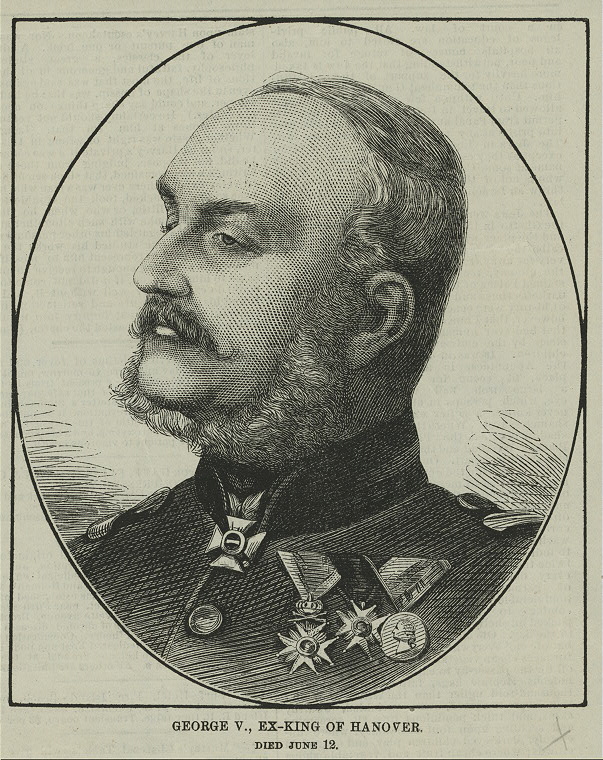
 King George V of Hanover

George V

George V, King of Hanover [i]

Georg Friedrich Alexander Karl Ernst August (1819-1878) was the grandson of Great Britain’s King George III, and first cousin to Britain’s Queen Victoria. Until the birth of Victoria’s first child in 1841, he was second in the line of succession to the British throne. Hanoverian kings ruled Britain until Victoria became Queen of England in 1837. At that time, the Lex Salica, which forbade a female succession in Hanover, forced an end to the 123-year old conjoined British-Hanoverian monarchy. Georg, the Crown Prince of Hanover and Prince of Cumberland succeeded his father Karl August as King of Hanover on November 18, 1851, styling himself King George V. When Joachim arrived in Hannover, George had been monarch for little more than a year.

The King was blind. He had lost the sight of one eye due to a childhood illness — the other in a freak circumstance: at the age of fourteen, swinging a purse full of coins, he accidentally hit himself in his good eye.

George was broadly educated, and possessed an impressive memory. He was passionate about music, an appreciation that could only have been enhanced by his blindness. “From early youth on, I have striven with ardent love to make music my own,” he wrote. “For me, she has become an exquisite companion and comforter throughout the course of my life.  She became more and more priceless to me, the more I learned to appreciate and understand her immeasurable wealth of ideas and inexhaustible abundance; the more intimately her poetry mingled with my entire being.” [ii]

King George was musically trained. He had studied piano with Ferdinand David’s sister Louise Dulcken, and was the composer of some two hundred works, including songs, choruses, cantatas, piano pieces and a symphony. [iii] As monarch, he involved himself directly in the musical life of his court. “The king was his own general manager,” wrote Georg Fischer, a contemporary chronicler of the Hanoverian musical scene. “He decided on opera repertoire, concert programs and engagements, and distributed new operas among the music directors in a highly personal way. Not seldom, specific operas, symphonies and other concert pieces were undertaken on special orders. The character and the casting of roles was treated with the seriousness of affairs of state.” [iv] One might equally well say that the king treated the court music with the importance that he assigned to religion. “His attitude toward art was idealistic;” Fischer tells us, “he lived in the conviction that artists were subject to a different tribunal before the throne of God.” [v]

Georg V Hannover Edit copy

This sense of the significance of music had come to him early. At the age of twenty, Crown Prince George lamented: “One so often hears remarks by musical enthusiasts that reveal that they not only fail to recognize the exalted and sublime character of music, they actually have a false idea of it; they regard it as merely a means of ordinary entertainment, like card-playing and dancing, or rather through their remarks show that they deem it to be no more than a pastime.” [vi] Wishing to give fuller expression to his own deeper appreciation of the musical art, he published his Ideas and Observations on the Characteristics of Music (Ideen und Betrachtungen über die Eigenschaften der Musik) in 1839. “If only a few can become deeply permeated with the conviction that this gift of heaven, this speaking witness to revelation, originates from God alone,” he wrote, “if only one can be moved to adopt it in the condign praise of the supreme, then the purpose of these lines is fulfilled.” [vii]

1099751692_erg257_titel

Reactionary in his politics, George V was also traditional in his musical understanding. “Music is a language in tones,” he wrote. But the language he understood was not the language of tones that was the revolutionary intellectual invention of the early romantic thinkers. His understanding was informed by the Enlightenment principle of mimesis—a concept that originated in the visual arts and poetry, and traces its history back to Plato and Aristotle. According to this doctrine, art is deemed good insofar as it successfully imitates nature (in Aristotle, art imitates nature, not as it is, but as it ideally ought to be). Thus, in the eighteenth century, music was said to “paint:” to portray rather than to evoke. The echo of Aristotle’s ideas can be heard in the words of the king: “Ideas, feelings, world events, natural occurrences, paintings, scenes from life of every kind can be clearly and intelligibly expressed through music, as through any language in words.” [viii] It is striking that the examples he cites in his chapter on “Instrumental Music” are distinctly visual in their aspect: the Pastoral Symphony of Beethoven, with its scene by the brook, its merry dancing, its sublime thunderstorm, and especially its scene of thanksgiving; the Creation of Haydn, (“How expressive, how true is the music of the “fleeing of the host of infernal spirits, down into eternal night… above all, however, how the composer portrays in the most gripping manner, with all the powers of music, the moment that is evoked with the Creator’s words: ‘let there be light:” “and there was light!”); Weber’s Invitation to the Dance, (“the faithfulness and truth with which all details and small incidents of a ball are portrayed: the invitation of the dancer, the subsequent acceptance of the lady dancer, the dance itself, the conversation in a period of rest, the iteration of the dance, and the leading of the lady dancer back to her seat…”); the overture to Weber’s Freischutz, (“through which the listener receives a kind of overview of the events of the entire compositon.”); and the introduction to Bellini’s Norma, (“…a most skillful portrayal of a locale. Beginning with low tones, it unfolds itself in gloomy harmonies, and gives the very impression that the woodsy darkness of a vast grove brings forth in human feelings… The reader will certainly be even more struck by the felicitousness of this tone-painting, when I cite the comment of a blind person who, listening to this introduction for the first time, immediately guessed the portrayal of a forest-outing at the scene!”). [ix]

Family_George_V_of_Hanover

The Family of King George V of Hanover [x]

“The King preferred to listen to music in the circle of his family,” wrote pianist and conductor Bernhard Scholz. [xi] “Evenings, Joachim and I were very often called to Herrenhausen [the royal residence]. The King was friendly; the Queen kindliness itself. The royal children were well-behaved and modest. Two nephews of the King and the Princes Colms were among the regular guests; likewise, the lady-in-waiting to the Queen, Fräulein von Gabelentz — a dignified lady — and, in later years, the Swedish voice teacher Lindhult were always present; by turns one of the adjutants on duty, now and then the father of the young Princes Colms, a step-brother of the King. Every year, the old Duke von Altenburg, the father of the Queen, came for a visit, accompanied by his sister, Princess Therese. Two of the King’s brothers-in-law appeared regularly, Grand-Duke Konstantin, brother of Emperor Alexander II, with his beautiful wife — who surpassed even Empress Eugenie with her proud bearing and grace of movement — and the Grand-Duke and Grand-Duchess of Oldenburg. The Grand-Duke [Konstantin], who played ‘cello, was fond of music; the Grand-Duke [of Oldenburg], on the other hand had no interest in it — but did not feign any, and withdrew to an adjacent room to look at copperplate engravings or to read.”

“The King could tolerate unbelievable quantities of music, but he did not possess a reliable judgement,” wrote Scholz; “he liked everything, particularly the pleasantly agreeable, and under this precondition also the good; in this way he was able to gain respect for Joachim’s art. He repeatedly requested certain agreeable pieces, eg. a Barcarolle and a Gavotte of Spohr. I would really like to know how often we played them for him! Then, he would consent to hear one of the Mozart and the easier Beethoven sonatas, or the variations from the Kreutzer sonata. There was no pre-set program; the king chose from the things we brought with us — Joachim well knew what he preferred. After the music, their majesties sat with us for tea and casual conversation, which the king was very good at leading. In the end, one of the ladies-in-waiting, or, when she was present, Princess Therese herself would prepare an excellent Warmbier.” [1] Citing this passage, Beatrix Borchard comments: “Joachim, who had repeatedly stressed that an artist does not exist for the entertainment of others, nevertheless served at the King’s beck and call as a ‘living phonograph record.’” [xii]

George V Hannover

[xiii]

Georg V Hannover: Ideen und Betrachtungen über die Eigenschaften der Musik

See also: Georg V Hannover: Musik und Gesang


[1] A recipe for Warmbier: 1 bottle dark beer, cinnamon, 1/3 cup milk, 1/3 cup sugar, 2 egg yolks. Ginger may also be added to taste. Bring to a boil: beer, cinnamon, milk and sugar (ginger). Stir in the egg yolks and bring back to a boil. Pour through a sieve into heated glasses.


[ii] “Mit feuriger Liebe habe ich die Musik von früher Jugend an mir zu eigen zu machen bestrebt. Sie ist mir eine köstliche Begleiterin und Trösterin durchs Leben geworden; immer unschätzbarer wurde sie mir, je mehr ich ihren unermesslichen Ideenreichthum, ihre unerschöpfliche Fülle würdigen und verstehen lernte; je inniger sich ihre Poesie mit meinem ganzen Sein verwebte.” Georg/IDEEN, p. 6.

[iii] Fischer/HANNOVER, p. 144.

[iv] “Der König war sein eigener General-Intendant. Er entschied über Opern-repertoir und Concertprogramme, über Engagements für erste und zweite Fächer und vertheilte die neuen Opern unter die Capellmeister; nicht selten wurden gewisse Opern, Symphonien und sonstige Concertstücke auf besonderen Befehl angesetzt. Bei Meinungsverschiedenheiten über Charakter und Besetzung von Rollen wurden Correspondenzen nach allen Richtungen hin geführt, ja gelegentlich mit der Wichtigkeit von Staatsgeschäften behandelt, indem dazu die Gesandtschaften im Auslande in Anspruch genommen wurden. Fischer/HANNOVER, p. 146.

[v] “Seine Stellung zur Kunst war eine ideale; er lebte in der Ueberzeugung, dass die Künstler vor Gottes Thron einem besonderen Gerichte unterständen (Ehrlich).” Fischer/HANNOVER, p. 145. [this quoting Ehrlich: see Fischer/OPERN, p. 177]

[vi] “Man hört so oft Äußerungen von Musikliebhabern, welche verrathen, daß selbige den hohen und erhabenen Character der Musik nicht nur nicht erkennen, sondern sogar verkennen; sie betrachten diese nur als ein Mittel zur gewöhnlichen Unterhaltung, wie das Kartenspiel und den Tanz, oder bezeugen ihr vielmehr durch ihre Äußerungen eine nicht viel höhere Achtung als jenem Zeitvertreibe.” Georg/IDEEN, p. 5.

[vii] “… werden nur Wenige recht tief durchdrungen von der Überzeugung, daß nur von Gott allein sie abstamme, diese Himmelsgabe, dieser redende Zeuge der Offenbarung; wird nur Einer bewogen, sie anzuwenden zum würdigen Preise des Allerhöchsten: so ist die Absicht dieser Zeilen erreicht….” Georg/IDEEN, p. 7.

[viii] “Es werden uns durch die Musik Gedanken, Gefühle, Weltbegebenheiten, Naturerscheinungen, Gemälde, Scenen aus dem Leben aller Art, wie durch irgend eine Sprache in Worten, deutlich und verständlich ausgedrückt….”  Georg/IDEEN, p. 8.

[ix] Georg/IDEEN, passim.

[x] Wikimedia commons.

[xi] Scholz/WEISEN, p. 146.

Mendelssohn’s Death

© Robert W. Eshbach, 2013


JJ Initials

Each Moment has its sickle, emulous
Of Time’s enormous scythe, whose ample sweep
Strikes empires from the root: each Moment plays
His little weapon in the narrower sphere
Of sweet domestic comfort, and cuts down
The fairest bloom of sublunary bliss.

                                    — Edward Young, Night Thoughts, Night I. (1742)

HPIM4575

The hallway in the Mendelssohn home. The small bedroom in which Mendelssohn died is at the end of the hall on the right.

            On November 3rd, word reached friends that Mendelssohn was in dire condition. Recalling the event, Ferdinand David wrote to Sterndale Bennett: “Never shall I forget Gade’s coming to me at the Conservatorium and telling me that Mendelssohn had another attack and that it was a question of life and death. I ran out at once and was met with the tidings that there was no hope. It was quite a quarter of an hour before I was calm enough to go in to him. I found him unconscious (this was Wednesday evening) and his shrieks, which lasted until 10 o’clock, were terrible. Then he began to hum and to drum as if music were passing through his head and, when he became exhausted by it, he started giving fearful screams and continued to do so throughout the night. In the course of the following day the pains seem to have abated, but his face was that of a dying man.” [i]

On the morning of November 4, as Mendelssohn lay dying, Ignaz Moscheles sat in his friend’s house, and committed his meditations to paper:

Mother Nature, art thou demanding thy rights? Angels who dwell in the heavenly spheres, do you wish to reclaim your brother whom you consider as your own, and whom you deem to be too noble to keep company with us ordinary mortals? We still possess him, we still cling to him, and we hope that by God’s gracious mercy he will be able to dwell longer among us; he who has always enlightened our lives as an example to us of all that is noble and all that is beautiful. Only Thou, O Creator, knowest why it is. Thou hast poured into this soul treasures of the spirit and the mind which the tender shell of his body can bear for only a limited time, and these same treasures are now threatening to shorten his very existence. May we plead to thee as a fellow brother? Thou hast achieved such a marvelous creation in him. Thou hast shown us how man can be raised towards thee and how he can even approach thee. No man has come closer to thee than this man for whom we now stand in fear and trembling. We beseech thee to allow him to enjoy his earthly rewards, to enjoy the love of his chosen companion, the development of his children, the bonds of friendship and the adoration of the world. [ii]

The deathwatch continued into the evening. Hedwig Salomon wrote: “After dinner, Madame David invited me to go to her, where we all wanted to gather to hear news. I went. Oh, how strange it was. Davids, Constanze [Schleinitz], Gade and Joachim sat around in the parlor; Schleinitz slept nearby. No one dared to speak a word: we were all as though paralyzed. Occasionally the children would shout, and then look around frightened, as though they had done something bad. The concert was called off: David, Gade wouldn’t have it. Schleinitz and David wanted to take turns waking, and to rest at Gade’s. [1] We sent them pillows. — […] I didn’t want to go with the men, and pretended to go my way. But Gade turned around, saw that I was following him, and asked what sort of maneuver that was. “I didn’t want to go with you” — I answered. “Ih — why not?” he said, so idiosyncratically, — went to me and complained that the others were walking so quickly. I asked him to take care of Schleinitz — I felt so sorry for him. — ‘I have two sofas: it will work.’ — Joachim looked repeatedly around after us. ‘We are going too fast for you, aren’t we?’ he said. ‘Don’t worry,’ I answered. ‘I’m going off here,’ and with that I turned into the Barfußpförtchen, because it was a bit too bold for me to walk alone with Gade through the city at dusk.” [iii]

As they awaited the arrival of his sister Rebekkah and several other close friends, Mendelssohn’s breathing became slow and labored. “The doctors counted [his breaths] as if they were hoping to be able to enrich scientific research with new discoveries,” wrote Moscheles. “His features were transfigured; Cécile knelt by his bed and burst into tears. Paul Mendelssohn, David, Schleinitz and I stood round the bed in deathly silence, immersed in prayer. With every breath that was wrested from him, I could feel the struggle of his great spirit, wanting to free itself from its earthly shell. I had often heard his breathing while admiring his performing, as if he were riding heavenwards on Pegasus, and now these same sounds had to ring out, announcing this terrible end… At 24 minutes past nine, with one last deep sigh, he exhaled his great soul from his body.” [iv]

Mendelssohn was thirty-eight years old.

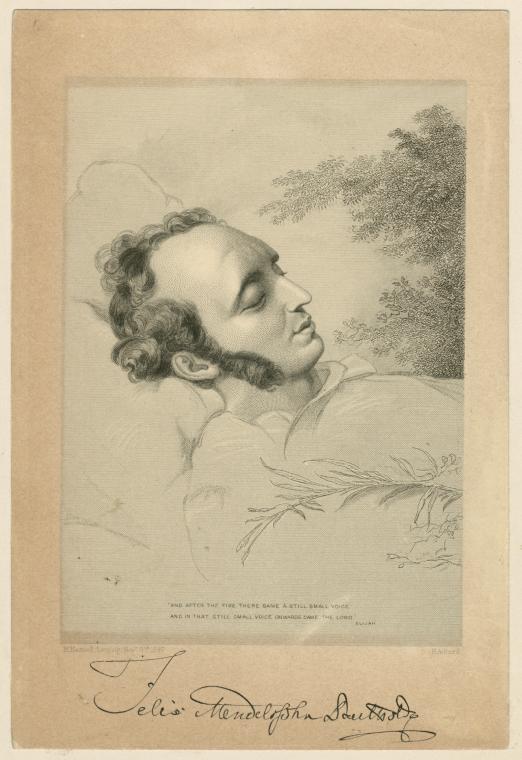
Mendelssohn Deathbed

Image: Eduard Bendemann

(NY Public Library)

JJ Initials

Joseph Joachim to his parents [v]

                                                                        [Leipzig, November 5, 1847]

Dear, dear, good parents!

Prepare yourselves to hear from me something unspeakably terrible and sad. God Almighty yesterday afflicted me for the first time with a great misfortune; all my joys, all my hopes, everything, everything has been ruined since yesterday at 9 o’clock — Mendelssohn is dead! A world of sorrow lies in these three words; unfortunately, they are only too true. — Dead! dead! dead! — it is impossible for me to think of anything else, or to listen to even one note of music. Mendelssohn had been unwell for some time; 8 days ago he had a relapse, and he suffered a small stroke; nevertheless, the entire time we had the best hopes, until the day before yesterday, Wednesday, at two o’clock, when he had another, very violent attack, and things became more and more alarming. Yesterday evening the rattling in his throat began, and his strength gradually failed him, so that at a few minutes after nine o’clock he passed over into a more beautiful world, calmly as only an angel could do.

The thoughts of you and other dear ones in Pest is the only thing that keeps me up. But I am very unhappy, and will never be cheerful again. You can easily imagine, my dear parents, how much good a few lines from you would do me, and I fervently hope that I shall soon see your dear handwriting. —

Your disconsolate

Joseph.

JJ Initials

I hold you as a thing enskied and sainted.

— Shakespeare, Measure for Measure 1. 4. 34

            Oliver Wendell Holmes wrote unforgettably about the permanence of misfortune’s impress: “Did you ever happen to see that most soft-spoken and velvet-handed steam-engine at the Mint? The smooth piston slides backward and forward as a lady might slip her delicate finger in and out of a ring. The engine lays one of its fingers calmly, but firmly, upon a bit of metal; it is a coin now, and will remember that touch, and tell a new race about it, when the date upon it is crusted over with twenty centuries. So it is that a great silent-moving misery puts a new stamp upon us in an hour or a moment, — as sharp an impression as if it had taken half a lifetime to engrave it.” [vi] So it was that the finger of anguish reached out and touched an entire community, leaving behind a myriad coinage, ineffaceably minted with the date in November, 1847 when they first learned of Mendelssohn’s death.

Hedwig Salomon in her diary:

                                                                        November 8, 1847

As I wrote that, he was dead. I shall never forget the 5th of November. Schleinitz came to me to write a letter concerning Mendelssohn. He told me everything — but how! His voice quavered so that he often had to stop speaking. He constantly fought back tears, and it is so unsettling to see a man cry! “Oh, it is a misery! he said, I am not miserable for Mendelssohn, he is with God, but his wife, and we! Oh, this woman, this woman! She kneeled by his bed like a saint, kissed him on the forehead calmly and without complaint, and received his last breath. And when no one else came, she listened a while, and lay down on his bed and with childlike piety looked him in the face. Then she folded her hands. It was so quiet in the room, where so many people stood! This death was like a worship service, an edification. [Erbauung] She allowed us to take her quietly from the room, she wept only when she was outside and asked: “Is it truly all over?” — She said to me: “You won’t leave me, will you? Oh, I am very unhappy!” — I closed my friend’s eyes, he has had a beautiful death, God sent him an angel, who helped him die. Oh, this submission to God! This calm! She shames us all. “This morning I awoke early,” she said. “Oh, now I am alone!” You will meet him again, I said. “He is already with me,” she answered, “otherwise I could not bear it.” She went to her five children with the words: “Now, dear children, you must obey me alone. Your father is dead.” She wept seldom, but she is crestfallen for life.”

So, more or less, Schleinitz related it to me. It sounds cold as I have written it, but the way he told it to me it completely broke my heart. I could not console him, just weep with him; and that, honestly, is what I did. Those days, when I met friends, we pressed each others’ hands and everyone had to cry.

On Thursday evening, as many people as room would allow stood and wept in Mendelsson’s house, on the stair, and in the courtyard. No one could think of anything else. I was often at Schleinitz’s, I could not stay home; I had a great desire to see Mendelssohn in death, but there was no one who would go with me to see him.

HPIM4581

The Courtyard of Mendelssohn’s Apartment Building

The Mendelssohns occupied the visible second floor.

 HPIM4576

The Staircase to the Mendelssohn Apartment

HPIM4791

Inside the Mendelssohn Apartment

HPIM4556

Mendelssohn’s Study

HPIM4812

Cecile Mendelssohn’s Sitting Room

Robert Schumann in his diary:

Sunday, the 7th, mild day, like in Spring — Memories, overflowing, of Mendelssohn — …Great mass of people — the adorned casket — all his friends — Moscheles, Gade and I on the right, Hauptmann, David and Rietz on the left of the casket — in addition Joachim and many more behind — immense train — beautiful mourning-solemnity of the march in e minor from the 5th book of the Songs without Words, played along the way — two choirs in alternation— in the church the choir. [vii]

Mendelssohn's Funeral 

Mendelssohn’s Funeral Cortège [viii]

Moritz Hauptmann to Ludwig Spohr [ix]

Leipzig, November 16, 1847

Dear Herr Kapellmeister,

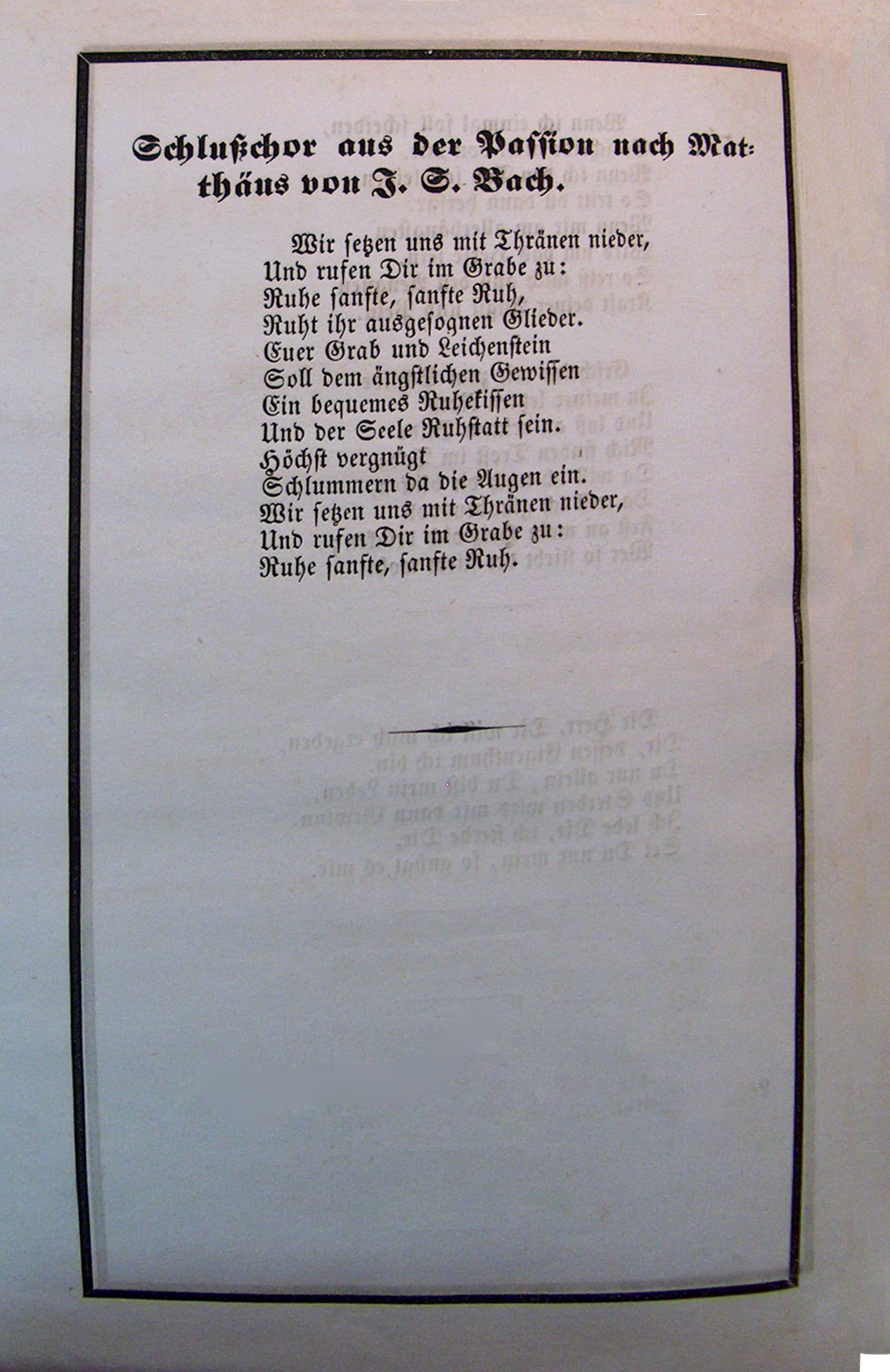
Eight days ago on Sunday, a very beautiful and dignified funeral was held for Mendelssohn, which was all the more fitting, since he was buried in Berlin and not here.  After the funeral procession had left the house on its way to the Paulinerkirche, with suitable music and a cortège that was longer than one can imagine, the adorned casket was positioned in the middle of the church, surrounded by candelabras, and a choir of 500, accompanied by organ and trombones, sang verses from the chorale O Haupt voll Blut und Wunden; the eulogy followed, then the beautiful chorus from Paulus Sie wir preisen seelig, the Benediction, and finally the last chorus from the Bach passion. The orchestra was of a strength commensurate with the choir; the whole thing had the most beautiful, uplifting effect, and it was truly remarkable that it had all been brought together in barely two days. Remarkable, too, the order and calm of the procession, since such an enormous mass of people crowded in, following and looking on. The ceremony was over around 6 in the evening. The casket remained in the church, and at 10:00 o’clock in the evening was taken by a special train to Berlin; it was received in Cöthen by music director Lang — in Dessau by Dr Schneider — with Männerchor singing. Mendelssohn’s family will remain through this winter in Leipzig, then probably move to Frankfurt, where the mother of his wife lives.

Announcement Mendelssohn Death

Announcement of Mendelssohn’s death

Leipzig after Mendelssohn’s death was Pompeii after the eruption of Vesuvius. The musicians carried on as best they could, but they were dead at heart. Mendelssohn was indispensable — irreplaceable. Ferdinand Hiller wrote: “In the evening there was a concert at the Gewandhaus to his memory. ‘The saddest thing,’ says George Sand somewhere, ‘after the death of a beloved being, is the empty place at table.’ I had exactly the same feeling during the concert. There were the orchestra, the chorus, the audience, which for so many years had been inspired by Mendelssohn; they made their music and played and sang — and only a few days before they had followed his corpse to the church.” [x]

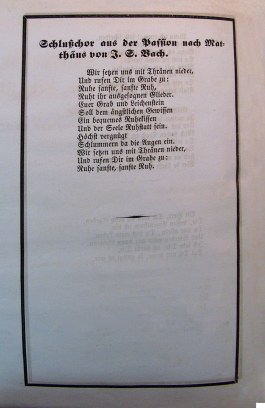
Mendelssohn Concert Program 1

Mendelssohn Program 2

Fifth Subscription Concert of the Leipzig Gewandhaus

Felix Mendelssohn in memoriam [xi]

11 November, 1847

Hedwig Salomon in her diary: [xii]

November 11, 1847

Today was the first concert after Mendelssohn’s death. It was very solemn — everyone dressed in mourning. This black-clothed throng looked indescribably serious. [Livia] Frege sang the song [Mendelssohn’s Nachtlied: Vergangen ist der lichte Tag[2] very, very sombrely, which gave one the chills. After so many years of silence, Schleinitz sang the solo in the motet; in this hour, and in this music, his wonderful voice was more moving than anything else.

I could not avoid the thought that Mendelssohn was listening today. Shouldn’t the spirits surround us here? — should their life be a slumber — no continuation of the earthly life? — I imagine that they see and hear everything as before, but they penetrate the causes of that which appears incomprehensible and painful to us here. Of all people, I cannot imagine Mendelssohn dead — not even temporarily asleep — for his spirit was so utterly compelling that he appeared to be made entirely of soul, entirely of spirit.

Whenever he entered a rehearsal or a performance, a new life flowed into everyone; his eyes sparkled, every motion was elastic, stimulating, and always and everywhere this noble command, this outward as well as inward nobility. And whoever had never seen him before would have recognized him at first sight as a great spirit among thousands. And how every feeling found direct and lively expression on his face! No greater joy than to see him listening to music, for instance in a quartet that he did not participate in playing. Every thought of the unfamiliar music could be read in his face. How heartily could he laugh! One could not hear three words from him without there being a significant, a stimulating one among them.

_____

Schumann likewise gathered his thoughts in his diary:

            His judgments in musical matters — especially on composition — the most trenchant imaginable, go straight to the innermost core. — He instantly and everywhere recognized flaws and their cause. —

He never kept diaries or anything of that sort, he told me. —

I always considered his praise the highest — he was the highest authority, the court of last appeal.

If he had unjustly offended anyone — spoken of someone adversely to a third party — he could not rest until he had made amends. His behavior toward other living composers… When he had nothing to praise, he said nothing; but where he unmistakably found talent, he was the first to say so (thus in the cases of Bennett, Gade and Rietz).

In 1836 when we were talking about aging composers, he said “how sad is the thought of creativity drying up” and added that he could not be reconciled to this thought. —

He was free of all the weaknesses of vanity. —

The exaltation of associating with him. Highest moral and artistic principles; for that reason intransigent, sometimes seemingly rude and unkind. —

He never remained in debt. If you said something good or significant to him, you could be certain of receiving it back twice and thrice over. —

On his relationship to Meyerbeer he said they had never suited each other; if one of them said “Good day” the other would surely have scented some ulterior motive. —

Self-crriticism, the strictest and most conscientious I have ever encountered in an artist. He changed some passages five and six times. (Especially the Elijah; his fine remark on that: “I think there are a few things I might do better.”) —

If all his intimate friends had been writers, each would have had something extraordinary and something different to record; each would have whole volumes to write about him. —

It was as if every day he had been born anew. —

Did he feel that he had fulfilled his mission?

I think so. The trace of melancholia that is so frequently found in all his compositions after the Lobgesang. —

His face in death. He looked like a hierophant, like a warrior of God who had conquered. — 6th November 1847. [xiii]

_____

In England, the “musical world talked as if the sun had fallen from the sky.” [xiv] Mendelssohn’s friend Sophy Horsley traveled to Leipzig to be with Cécile. Years later she wrote to Joachim: “In November 1847, when I was at Leipsic dearest Cécile M. B. spoke of the great love her Husband had borne you, of the high hopes he entertained for yr future career, adding ‘Poor boy, he has lost his best friend.’” [xv]

Screen Shot 2015-04-21 at 11.06.27 AM

For Joseph, the loss was crushing. “It seemed as if the world had ceased,” he later quietly recalled. [xviii] On the centenary of Joachim’s birth, Donald Francis Tovey commented: “Mendelssohn died when Joachim was only sixteen; and to the end of his life Joachim felt that this early loss had checked his development. Old age is enviable when it can thus retain the passionate loyalties of youth: but Joachim’s memories of Mendelssohn were not vague sentiments. He could tell us many definite things of Mendelssohn’s playing and conducting, of the spontaneity and truth of his rubato, of his touch in Beethoven’s C minor variations, and of his wonderful extempore cadenzas in classical concertos. These were the details of the artist; of the man one learnt from Joachim only what can never be put into words.” [xvi]

Cécile continued to treat Joseph with maternal kindness. Mendelssohn had been the first to conduct the Gewandhaus Orchestra with a baton. [3]  Of her husband’s five batons, she gave four to her children as a remembrance of their father. The fifth, she gave to Joseph.[xx] Later, on April 30, 1848, she presented Joseph with the manuscript of Mendelssohn’s Violin Sonata in F minor, Op. 4. [xix]

JJ Initials

Reacting to the news of Mendelssohn’s death, Joseph’s father urged him to return home to Pest. Joseph, however, wrote to his physician brother-in-law, Dr. Rechnitz:


Joseph Joachim to Dr. Johann Rechnitz [xx]

Leipzig, 18 November 1847

Dear, good Rechnitz,

If one can be comforted by anything for such an enormous, bitter loss as has recently befallen me, it is only by such a loving and sincere compassion as you, my dear brother, have shown for my misfortune. Your letter has done me so infinitely much good, and is such a welcome new sign of your solicitous care for me, that I cannot express the thanks that I owe to you with my lifeless pen. Simply be assured that my heart rings with the most heartfelt, most childlike love for you, my brotherly brother, and I shall never forget, thou splendid doctor, how you have dropped the most curative balsam on my ailing soul. It has been the first great sorrow in my life — nevertheless! The only thing that one can do is to learn to accept it, in obedience to God. Man is so shortsighted and tiny, that he must not dare to grumble against mighty fate, since he cannot understand why the Allgracious may have sent it. —

Leipzig, which, as long as Mendelssohn was there seemed to me a paradise, has now lost its magic charm for me. — nevertheless! (It might perhaps astonish you) My dear father’s suggestion is something with which I am — not in agreement. When I received his treasured letter yesterday, I was greatly taken with the thought of once again belonging to you, my dear ones, and immediately made all kinds of plans about it; about my journey, etc. I have already gone so long without the great delight of seeing you all that in the beginning I could hardly give in to any other thought than the joy of it. But as little by little I calmed down, and began quietly and seriously to mull it over, I had unfortunately to admit that it would not agree well with my artistic development, and duty must take precedence over that ever-so-great satisfaction. — It is absolutely necessary for my reputation, my independence and also for my purse that I go next spring to England, as my best friends there expect. To this end, I plan to spend the few months that remain early next year to write a few pieces—this is absolutely necessary. Since there only remains until the end of February or the beginning of March, I would like to spend as much time as possible on it, and if I go to Pesth, I will lose much time with the trip back and forth, and I would barely be able to spend 2 1/2 months with all of you, irrespective of the fact that I would have not a single musical advisor there whose inspiration would assist me in my compositional work. — Also, as concerns my other studies, literature and Latin for example, I would hardly have such a dear friend and teacher as [I do] here, who is of such value to me, and with whom I am, so to speak, settled in, and who takes such pains for my education as a human being; and to be uprooted from here would certainly not be good for me. What’s more, I don’t believe that I, who have been spoiled by the good fortune of having the musical companionship of people like Hauptmann, Gade, Mendelssohn, could get used to keeping company with people like Hunyady, Kohn, etc., [4] and if I could, I would certainly hold it to be an intellectual/spiritual step backwards, as you undoubtedly would also, dear Rechnitz. May I therefore trouble you with the request to tell me as soon as possible whether my motives appear right, for the advice of such a well-meaning, dear friend would be of the greatest value and service to me. — Also, I ask you to present and explain to my dear father and good mother my reasons which cause me not to spend this Winter in Pesth, since, coming from your eloquent mouth they will surely have genuine power and weight for them. Perhaps it will work out next year, when I hope to be more musically and intellectually developed, that I will fully come to Pesth; for I am sensible of how wholesome and beneficial it would be for me once again to live fully for those that I call my own. — Unfortunately, the post-hour strikes, and I must cease my conversation with you, my fatherly, much admired friend. Greet and kiss your loved ones. I thank your dear Hanni for her affectionate good wishes, which I return with all my heart. I will write to my dear parents soon, since today I can only still send filial and sincere wishes for their well-being, which is so precious to us.

From my entire soul,

your

Joseph Joachim

_____

This letter is stunning to look at. Carefully copied and darkly lettered, the writing is a nearly perfect imitation of Felix Mendelssohn’s hand — the word “Mendelssohn” an exact replica of Mendelsson’s signature.Joseph’s early childhood letters are written in a tiny, clear, copybook script. Between 1844 and 1847, the writing evolves, gradually becoming less cautious and tidy. Joachim’s handwriting would continue to change over the course of his life — but from the time of his beloved mentor’s death, it would always retain a clear vestige of, and sometimes a striking resemblance to, that of Felix Mendelssohn Bartholdy. [xxi]

_____

Joseph Joachim to his brother Heinrich in Vienna [xxii]

Leipzig, 19 November 1847

For such a kind, consoling letter I owe you a debt of thanks that I repay with my whole heart. It is indeed a good fortune that God in his benevolence has granted me such dear, good souls, whose sympathy comforts me so well, and whose love for me I learn more and more to recognize and to value.  Here, everything that concerns music is now so desolate and empty, since the exalted spirit who was her guardian is departed from us. His works, which I study eagerly, are my most beautiful consolation, and I linger with heartfelt delight over them, to which I already owe so many transported hours. Whenever I go to the piano and play for myself a particularly beautiful passage in which his noble soul is so fully reproduced, it brings a rapture of melancholy such as I am incapable of describing in words.

In any case, I plan to stay here throughout the winter, and to write a few compositions for myself for next Spring (in London)… Just now the mailman has brought me a letter from dear Mother, in which she invites me to Pesth; this after dear Father wrote me the same thing the day before yesterday. As great as my desire is, and as firmly as I had already decided to travel there, in the end I had to tell myself, after I had thought it over more calmly, that it cannot be well reconciled with my artistic development, and so reluctantly decide not to leave here for now, since I don’t know a single person there with whom musical relations could be anything but a disadvantage for me. It is only good that I had the courage to write to dear Rechnitz yesterday that I wasn’t going, for I believe that after the loving letter of our good Mother today, the ardent longing to see my own, whose loving gaze I have missed for so long, would have won. Aren’t you going soon to Pesth? If only I could be so close to my own!…

Your,

Joseph Joachim.

[On the end of this letter, not published in BRIEFE, but present in the holograph,  Brahms Institut Lübeck, 1991.2.47.4:

Es befremdet mich, dass ich von den lieben Wienern nichts direct hörte, da sie doch wissen, ein wie grosses Unglück mich betroffen hat. Ich weiss, dass ich es nicht für Theilnahmslosigkeit halten soll; es will mir beinahe so scheinen, als sollte es Rache sein, für mein Stillschweigen, welche ich aber in diesem Falle nicht für edel halte.  — Warst du bei der Aufführung des Elias zugegen? Es würde mir ausserordentlich lieb sein, wenn ich darüber etwas Näheres hören koennte. Dürfte ich dich denn, lieber Bruder, darum bitten? Ich würde dir sehr dankbar dafür sein, u. du kannst dir ja denken wie sehr es mich interessiert. — Grüsse mir alle unsere lieben Verwandten recht herzlich, und verzeihe mir mein oftes Ausstreichen. Ich habe einen Hass, gegen das Abschreiben der Briefe. Diess hätte ich mit enem grossen Mann gemein (Jean Paul) — freilich: quod licet Jovi, non licet bovi; aber ich weiss ja, wie gerne du vergiebst, Guter, und darum hoffe ich es auch für mich, der ich mit innigster Liebe bin

Dein Joseph Joachim]

Screenshot 2018-08-09 12.05.56
Brahms Institut Lübeck, 1991.2.47.4

_____

“Mendelssohns musical influence was probably the most far-reaching of any that affected him,” Georg Fischer wrote of Joachim in 1903; “under [Mendelssohn’s] example he had the good fortune to develop deliberately, and it was also to him that he owed his harmonious development as a person.” [xxiii]

Joseph would stay on for several years in the city that had “now lost all its magic charm” for him. Continuing forward would require that he face significant challenges and make difficult adjustments.


[1] Gade lived near Mendelssohn at Königstrasse 16.

[2] The song by Mendelssohn, with words by Eichendorff:

Vergangen ist der lichte Tag;
Von ferne kommt der Glocken Schlag;
So reist die Zeit die ganze Nacht,
Nimmt Manchen mit der’s nicht gedacht.
Wo ist nun hin die bunte Lust,
Des Freundes Trost und treue Brust,
Der Liebsten süsser Augenschein? —
Will Keiner mit mir munter sein? —
Frisch auf denn, liebe Nachtigall,
Du Wasserfall mit hellem Schall
Gott loben wollen wir vereint,
Bis dass der lichte Morgen scheint.
_____

Gone is the bright day,
From afar the church bells sound;
So, time journeys all night long,
Taking with it many an unsuspecting man.
Where has my colorful pleasure gone,
My friend’s consolation and true heart,
The sweet, bright eyes of my darling girl? —
Will no one be joyful with me? —
Take heart, then, dear nightingale,
You waterfall with your bright sound,
We will praise God together
Until the bright morning shines.

[This song — “Gone is the Bright Day” — is the song Mendelssohn was playing with Livia Frege when he suffered his first attack]

[3] Mendelssohn was among the second generation of conductors in the modern sense, and should be counted among the inventors of the conductor’s art. Among the first generation of conductors, the baton was a novelty. Carl Maria von Weber (1786-1826) conducted using a rolled-up sheet of paper. Richard Wagner described how Gaspare Spontini (1774-1851) used a heavy baton made of ebony with white ivory knobs at the ends: “He did not hold it, like other conductors, at the end, but rather clasped it in the middle with his full fist and moved it in such a way that one could clearly see he considered the device as a marshal’s baton, using it not to beat time, but to command.”  [Richard Wagner: My Life, (Andrew Gray, tr., Mary Whittall, ed.) New York: Da Capo Press, 1992. p. 280.] Louis Spohr (1784-1859) claimed to have introduced the art of conducting with a baton to England during a guest appearance with the London Philharmonic in 1820. “It was at that time still the custom there that when symphonies and overtures were performed, the pianist had the score before him, not exactly to conduct from it, but only to read after and to play in with the orchestra at pleasure, which when it was heard, had a very bad effect. The real conductor was the first violin, who gave the tempi, and now and then when the orchestra began to falter gave the beat with the bow of his violin. So numerous an orchestra, standing so far apart from each other as that of the Philharmonic, could not possibly go exactly together, and in spite of the excellence of the individual members, the ensemble was much worse than we are accustomed to in Germany. I had therefore resolved when my turn came to direct, to make an attempt to remedy this defective system…. I … took my stand with the score at a separate music desk in front of the orchestra, drew my directing baton from my coat pocket and gave the signal to begin. Quite alarmed at such a novel procedure, some of the directors would have protested against it; but when I besought them to grant me at least one trial, they became pacified….[With the baton, I] could not only give the tempi in a very decisive manner, but indicated also to the wind instruments and horns all their entries, which ensured to them a confidence such as hitherto they had not known there. I also took the liberty, when the execution did not satisfy me, to stop, and in a very polite but earnest manner to remark upon the manner of execution… Incited thereby to more than usual attention, and I conducted with certainty by the visible manner of giving the time, they played with a spirit and a correctness such as till then they had never been heard to play with. Surprised and inspired by this result the orchestra immediately after the first part of the symphony, expressed aloud its collective assent to the new mode of conducting, and thereby overruled all further opposition on the part of the directors. It is true, the audience were at first startled by the novelty, and were seen whispering together; but when the music began and the orchestra executed the well-known symphony with unusual power and precision, the general approbation was shown immediately on the conclusion of the first part by a long-sustained clapping of hands. The triumph of the baton as time-giver was decisive, and no one was seen any more seated at the piano during the performance of symphonies and overtures.” [Louis Spohr: Louis Spohr’s Autobiography, London: Reeves & Turner, 1878, pp. 81-82.]

[4] See Edmund Singer’s memoir. (Ridley Kohne; also Hunyady)


[i] Music & Letters, Vol. 36, No. 4 (October, 1955) p. 375.

[ii] Smidak/MOSCHELES, pp. 162-163.

[iii] Holstein/GLÜCKLICHE, pp. 66-67.

[iv] Smidak/MOSCHELES, p. 163.

[v] Author’s translation based on German text in Reich/BETH EL, p. 67, amended from the English quoted from the Jewish Chronicle and Hebrew Observer in The South Australian Advertiser, Monday, October 31 1859, p. 3.

[vi] Oliver Wendell Holmes, The Autocrat of the Breakfast-Table: Every Man his own Boswell, Boston: Houghton, Mifflin and Company, 1894, p. 38.

[vii] Litzmann/SCHUMANN II, p. 171.

[viii] Author’s collection.

[ix] Hauptmann/SPOHR, pp. 30-31. m.t.

[x] Hiller/MENDELSSOHN, p. 217.

[xi] This is in Creuzburg/GEWANDHAUS, opp. p. 82.

[xii] Holstein/GLÜCKLICHE, pp. 70-71.

[xiii] Jacob/MENDELSSOHN, pp. 105-106.

[xiv] Ernest Walker, quoted in Demuth/ANTHOLOGY, p. 212.

[xv] Sophie Horsley to Joseph Joachim, Kensington, March 17, 1889. Holograph in Staatliches Institut für Musikforschung Preußischer Kulturbesitz, Berlin.

[xvi] The Musical Times, Vol. 39, No. 662 (April 1, 1898), p. 226.

[xvii] Joachim/CENTENARY, p. 11.

[xviii] Moser/JOACHIM 1898 I, p. 65

[xix] See: Friedhelm Krummacher, Mendelssohn — der Komponist: Studien zur Kammermusik für Streicher, Munich: Wilhelm Fink Verlag, 1978, p. 83.

[xx] British Library BL, family corresp., Add. MS 42718

[xxi] This relationship was noticed by Otto Gumprecht: “Bis in das Kleinste und Aeußerlichste spiegelte sich die Innigkeit dieses Verhältnisses wieder, z. B. auch in dem Umstande, daß die Handschrift Joachim’s eine überraschende Aehnlichkeit mit der des geliebten Meisters gewann.” Gumprecht/CHARAKTERBILDER, p. 267

[xxii] Joachim/BRIEFE I, pp. 8-9

[xxiii] Fischer/HANNOVER, p. 227.